




Abstract
Feminist new material theories and affirmative critique is the returning point in this article. In early childhood education and research, critique and critical perspectives are given an important emphasis and might be taken for granted. Critic, criticism, critical perspectives, negation, opposite tactics, interpretation, explanation, reflection, and judgments have in education, according to Bunz, Kaiser, and Thiele, continued as analytical “tools” since Kant. Searching for complicity and rhizomatic entanglements with/in pedagogical and philosophical thinking practice might open for critical distinctions beyond subject/object, mind/body, knower/known, theory/practice, and nature/culture beyond Kant. The complicity and coemergence of any knowledge or critical assessment with what is known and with whoever knows is always already of perspectival, situated, and entangling nature. The interest of this article is complex and multifaceted. I want to elaborate on the politics of critique as well as experiment with matters of methodology. To critically address critique, I use seven previously copublished articles1 as data material. Being affectively attracted to intra-actions of what all matter offers—ways of looking and cutting together-apart—I wonder what an articleassemblage might generate inventively and relationally, also as critique. Resisting an idea of (re)presenting a summary of the articles, my wish is in line with feminist materialist diffractionists (Barad, Haraway)—experimenting with what the concept symbiogenesis might offer together with critical affirmative thinking. Sympoiesis is making-with, and according to Haraway—nothing is making itself, which invites to think of evolution as coevolution opening for intra-entangling and becoming-with potentiality and change.
Introducing Relationalities in the Making
This article builds on a feminist new materialist ontological turn, trying to make matters more rhizomatic, puzzling, and complex. A new materialist ontology no longer only assumes priority to the humans as the knowing subject and the organizer of research inquiries. A feminist new materialist ontology discusses critically ideas about representational thinking and causation, and theory as inventive (Coleman, 2014). According to Coleman (among many other feminist researchers; Alaimo & Hekman, 2008; Barad, 2007; Braidotti, 2013; Haraway, 2008), “feminist theories have been especially important in both establishing the ‘material turn’ and in staking out some of its key features, including thinking about gender and sexuality, the body, nature and culture” (Coleman, 2014, p. 28). A critique of scientific knowledge, like other forms of knowledge, is often gendered. Social sciences do seldom produce culture-free, gender-neutral knowledge 2 and is sometimes difficult to separate between. Bodies and movements are already involved in apparatuses, through complex, contradictory, structuring, and structured bodies. Hence, Barad (2007) proposes that human subjects are neither outside observers of apparatuses nor independent subjects that intervene in the workings of apparatuses. They are neither the products of the social technologies that produce them; subjects and objects are constituted through specific intra-actions. For Barad (2007), “human bodies, like all other bodies, are not entities with inherent boundaries and properties but phenomena that acquire specific boundaries and properties through the ongoing open-ended dynamics of intra-activity” (p. 172).
During the past 10 years or so, material feminist researchers 3 have questioned dominant humanist ideas and theories. It has long been commonplace within continental philosophy to focus just on discourse, text, culture, power, consciousness, or ideas as what constitutes reality. This raises questions of how the discursive turn and the new-material turn intra-relate in educational sites, and specifically in early childhood research, which is my location. Theories built on postmodernism, poststructuralism, and deconstruction have been ideals of the nonrealist trend for many years. As a response to a dominate humanist paradigm, a feminist material ontological turn is rethinking matter as dynamic, animated, and ongoing shifting processes (Alaimo & Hekman, 2008; Bennett, 2010; Haraway, 2008). A “wave of feminist theory that is taking matter seriously” (Alaimo & Hekman, 2008, p. 6) might create possibilities across natural sciences and humanities. Hence, feminist researchers are entangling and seeking materiality of matter in research, which for a while is wildly spreading. 4 To critically address the complex network of matter/bodies/movements, I propose that performative creative/critical practices offer generative thoughts for exploring materialities in “new” ways. Such matter(s)—as organic, affective, artistic, and sensory modes—operate outside traditional representation and discursive thinking, which now is circulating within the geo-political, political child/hood realities (Cannella, 2015).
Avoiding to create a judging researcher, (re)presenting the seven published articles—as an articleassemblage—Haraway’s (2016) concept symbiogenesis (p. 58) echoes a thought-provoking theoretical possibilities to “becoming-with” materialities. Haraway wants to rethink the causal scientific logic chain. She encourages us to think, following the idea of symbiogenesis, not through mutation but through infection. Infection is multispecies processes, ones it becomes alive it is no way to tell the simple story of species. Symbiogenesis might open for a rhizomatic, messy, and fluid co-becoming of researcher and practices—allowing the researcher to entangle-with-the data material, which here is to experiment with an articleassemblage (Figure 1). Assemblages are, for Bennett (2010), “ad hoc groupings of diverse elements, of vibrant materials of all sorts” (pp. 23-24). Power is not distributed equally across their surface, nor does a central head govern them. Hence, a risk of oversimplifying mystery of the data articleassemblage might give ideas of reconfiguring, transforming, and shifting processes, producing data into something else. Infection is, according to Haraway (2016), a multispecies process, so instead of visualizing a singular entity moving forward in time and space (a published article), a visualization of something more vague and enmeshed might happen resisting making a summary of the articles. Instead, I ask, “What might the articleassemblage offer as affirmative critique in ongoing inventions?”
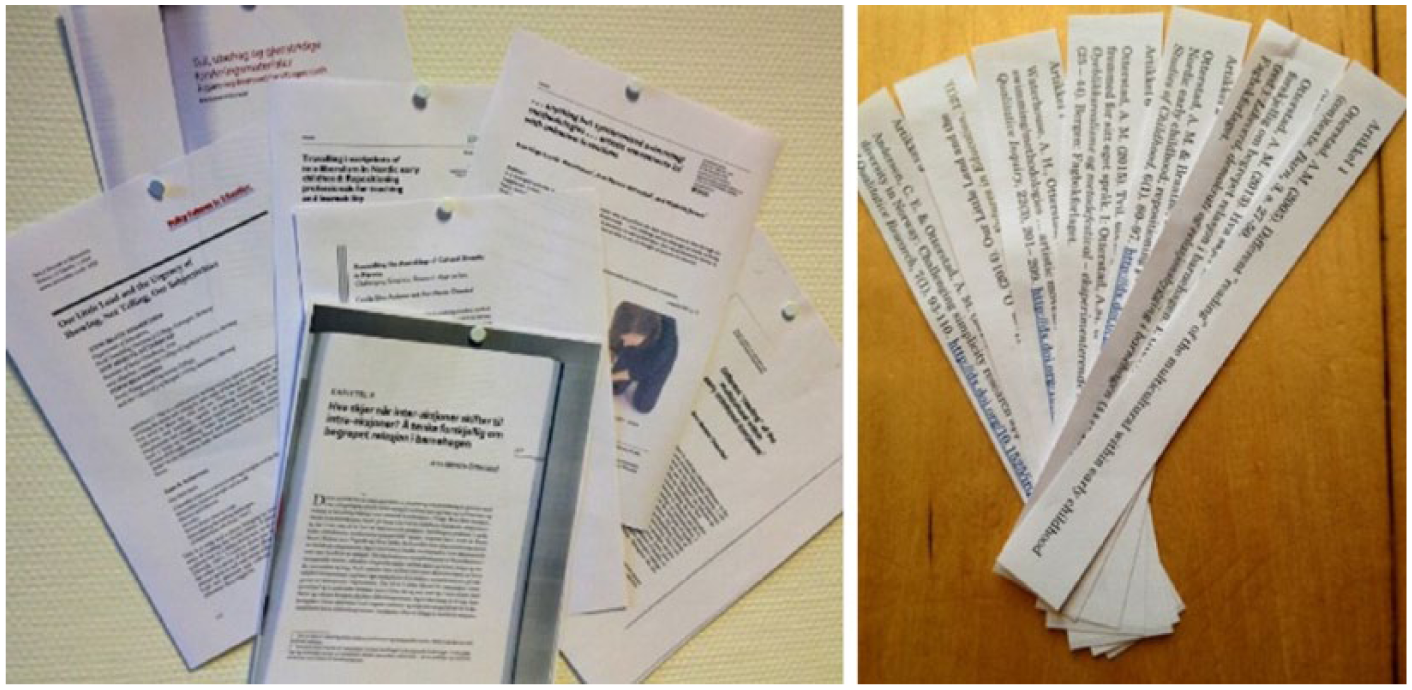
Articleassemblage
I examine how matter in new-materialist theories might (re)(con)figure with critical work and what its role is in feminist accounts of knowledge and ontology. To think and work more expansively in relation to human/nonhuman encounters and relations (Barad, 2007), questions of ethical response-ability are raised. An ontological turn, however, aims in this sense at something “beyond” the critical and linguistic turns. Such a standpoint shifts research toward what participates as affirmative critique and knowledge production in the making of theory inventions (Coleman, 2014).
Early Childhood and New Materialism
In Norwegian early childhood studies, it seems that humanity regularly remains at the center of child/hood theories, and reality appears in philosophy merely as the link of human thought. The Nordic countries are theoretically often described as a social-pedagogical tradition (Otterstad & Braathe, 2010), embedded in a Hegelian relational dialectical thinking (Otterstad, 2012). A humanist Hegelian relational dialectical thinking of recognition is encouraging pedagogues to work phenomenologically with subject–subject relations, which calls for a proposal of a critique of humanity’s place in the world and a critique of the Cartesian subject (Barad, 2007; Latour, 2004). I argue that early childhood studies rely too much on a social-cultural and psychological study-driven paradigm, centered on participatory culture and human interaction (Otterstad, 2012). Inspired by recent progress in new materialist theories, such vital reorientations might shed light on the ontological status of matter, the notion of intra-action in research, and, ultimately, what matters about critical point of views in knowledge creation (Reinertsen, 2017).
Thinking with feminist new materialism as an exploration and rethinking of what is “new” in feminist new materialism (Dolphijn & van der Tuin, 2012), I grapple with the notion of critique, hoping a productive infection can cocreate changes. A way of doing/performing critique that avoid to upheld dualism producing normative either/or distinction is challenging. Haraway’s (1991) emphasis on situated knowledges is suggesting a way of mapping a multiplicity of women’s ways of knowing. Not beginning with subjectivity or femininity or by any a priori category, but with searching for an affirmative way of writing—unconditionally and responsibly (Dolphijn, 2016). So, how can feminist new materialist methodologies aim to make potentials for generative matter that forces researchers to “engage affirmatively with the present, accounting for some of its features in a manner that is empirically grounded without being reductive and remains critical while avoiding negativity” (Braidotti, 2013, p. 5).
The “New” Material Ontology 5
The “new” material turn in the humanities renders uncertain the boundaries, limits, and definitions on which scholars within the humanities traditionally have relied on (Barad, 2007; Bennett, 2010; Haraway, 2008). These fairy new understandings compel researchers to rethink how to be(come) children, professionals, and students within expanded multiplicities of knowledge. Against a reduction of philosophy to an analysis of texts or of the structure of consciousness, this “new” turn has opened for an interest in ontological questions (Braidotti, 2013). Deleuze and Guattari did in their writings from 1970s and 1980s, set forth an ontological vision of an asubjective realm of becoming. Rather than rotating around the negative limitations of conceptual systems, Deleuze and Guattari (1987) created an affirmative ontological vision from the ruins of traditional ontologies (Bryant, Srnicek, & Harman, 2011). While there are still questions about whether Deleuze managed to escape correlations fully, there can be little doubt that his project was aimed at moving beyond the traditional Kantian limitations of continental thought (Reinertsen, 2007; St. Pierre, 2014).
In his Critique of Pure Reason, Kant claims that this reflective cognitive “I think” is a transcendental subject and a condition of possibility for knowledge: The belief that “I” can only represent the world as being a certain way if it is possible for me to be conscious of so representing it (Stanford Encyclopedia of Philosophy). 6 In her work, Reinertsen (2007, p. 115) 7 encourages for a critique of Kant not to reject his transcendental subject theory, but “bringing to light the effects of authority that are within his work by studying its hierarchizing, canonizing, marginalizing, and disqualifying procedures; the internal structuring of the text that is” (p. 124). Reinertsen is inspired by Derrida’s de-authorizing of Kant’s knowledge universe, which also can be to encourage for an affirmative possible critique of Kant’s “free subject” (pp. 124-125).
To question the accounts of a nonanthropocentric social-material world (Latour, 2004, 2005) is also present in early year’s research (Reinertsen 2007; Holmes & Jones, 2013; Lenz Taguchi & Palmer, 2013; Osgood & Scarlet/Giugni, 2015; Otterstad & Reinertsen, 2015; Otterstad & Waterhouse, 2016; Reinertsen, 2017. Haraway (2016) proposes that “it matters what ideas one uses to think other ideas with,” which might encourage renewed interest on agential realism theories, for example through theories in educational research connected to entanglements (Bodén, 2016), relationalities (Ceder, 2016), and intra-action (Hohti, 2016). I will further elaborate with these concepts.
Educational Relationalities as Entanglements
Educational relationality as research is not about creating entanglement; it is about noticing the entanglement that is already there. Nor is it about creating movement; it is about registering the movement that is already there. Haraway (2016) says in her book, Staying With the Trouble, that studying relations with relations is also about risking putting relations together from unexpected worlds. She says “It matters what thoughts think thoughts. It matters what knowledge know knowledge. It matters what relations relate relations. It matters what stories tell stories” (p. 35).
In the thinking with the articleassemblage materials I experiment with relationalities as it might infects, mix, flow, surface, and also mutate in the making, affectively sensed rather than recognized. This is a move beyond the Hegelian dialectical subject of recognition. Inspired by the work of the feminist Barad (2007, 2012, 2014), among many others, an ethical matter of concern is also about analyses that reduce every aspect of human life to an effect of social structure. Drawing on the work of Bohr, Barad (2007) argues against an understanding of observational and measuring tools as neutral and objective. She argues that scientific apparatuses do not reflect reality, nor mediate between matter and scientists, but are in fact an integral part of the reality they seek to explore. The nature of reality depends on the technologies through which that reality is observed and measured. As Barad writes, “[a]pparatuses, in Bohr’s sense, are not passive observing instruments. On the contrary, they are productive of (and part of) phenomena” (Barad, 2007, p. 199). So what might the articleassemblage generate of affirmative critique in the making?
Past–Present–Future to Come
By cutting together-apart (Barad, 2014) the articleassemblage is also about what belongs to the present connecting to the past and beyond. Being troubled (Haraway, 2016) by writing an overview of the content of seven articles to be externally assessed, I resist as well as connect to “new” material theories by undoing the ongoing expectations already at work. Being situated in the field of early childhood more than 40 years opens for wa(o)nderings about critique as past–present differently. As long as I can remember, I have been politically engaged by how materials work, for instance, how theoretical forces and relations are producing child/ren/hood in early years. Both as a practitioner and a researcher in the field, I am/was concerned with how a discursive Marxist social order, embedded in a modernist logic of separation, focused on ideology framing a specific child and a specific professional. A Marxist-driven critique works to protest against the shortage of power in various sociomaterial orientations. By contrast, Latour (2005), for example, treats political systems and capitalism as a series of powerful actor–networks, which requires nuanced historical analysis to determine how they combine, inscribe, and translate heterogeneous bodies, devices, technologies, and most importantly, what infection-effects they produce—on humans, nature, production, and so forth. In addition, an ecocritical approach opens for multidirectional trajectories of the planet and its human and more than human life Oppermann (2006) is mapping the environmental space for more response-able engagement in the world.
I have and still (reluctantly) trace, identify, negotiate, and make connections between discursive child/hood construction and power relations influencing subjects in early childhood settings. These tracings are influenced by Marxists and discursive theories, shaping reducible social categories, such as a vulnerable child, an oppressed child, a disadvantage, a lacking child, children at risk, often related to what Coole and Frost (2010) term dominant discourses flourishing under the cultural turn. Latour (2004) methodologically criticizes the exclusion of nonhuman entities from political representation and he calls for a social production and not a social constructionist worldview in educational research. And the question is still, “Where does critique appear in such territories?” According to Latour, critique becomes merely a matter of the conflict of represented facts, which might uphold reproduction of already existing theoretical ideas. Such practice might focus on seeing and hearing embedded in experience. When researchers within a discursive paradigm are directing critical debates over truth, evidence and matter of fact, common statements and references as; “she says,” ‘he claims “they mean” upholding the ordinary dominant discourse. Such experiences positions anthropocentrism as a depict representation, upholding means for human subjects—reducing critique and not directing ideas, for example, toward relations with more-than-human species (Haraway, 2016).
Beyond Representation
Barad (2007) has pointed to how representational thinking underpins accounts of matter that privilege discourse. Defining representational thinking as “the belief that representations serve a mediating function between knower and known” and in “the power of words to mirror preexisting phenomena,” Barad (2007) argues that such a notion of representation “displays a deep mistrust of matter, holding it off at a distance, figuring it as passive, immutable and mute” (p. 133). So not making the articleassemblage-data representative for “new knowledge creation,” my interest is to create an organic vitality, messy, and fluid knowledge inquiry—connecting a cutting together-apart articleassemblage (Figure 2) as symbiogenesis to critically visualize and invent breaks, cuts, infections, and sewing stitches as methodological practices. Such a “new” shift toward inventive datamaterialassemblage hopefully encourages researchers to think about research as affirmative critique “in terms of change, flows, mobilities, multiplicities, assemblages, materialities and processes” (Taylor & Ivinson, 2013, p. 665).

Articleassemblage
This also implies a nonrepresentational ethnography (Manning, 2013; Thrift, 2008; Vannini, 2014), which, and this I also hope, inaugurates a deeply different “critical” research approach with early childhood research. Moreover, reading data diffractively with the idea of sympoiesis might break through the academic habit of criticism and work along affirmative lines (van der Tuin, 2011. p. 22). Such a move not only challenges what constitutes data but it also challenges research methods, critical data analysis, as well as the politics of ethnographic representation (Holmes & Jones, 2013; MacLure, 2013; St. Pierre, 2013). Coole and Frost (2010) describe this trend within “new” materialism as an antipathy toward oppositional ways of thinking . . . where exponents: prefer a creative affirmation of a new ontology, a project that is in turn consistent with the productive, inventive capacities they ascribe to materiality itself. The prevailing ethos of new materialist ontology is consequently more positive and constructive than critical or negative: it sees its task as creating new concepts and images of nature that affirm matter’s immanent vitality. (p. 8)
Intra-activ-ities
Drawing on Barad and Deleuze together with Guattari,
8
Coole and Frost propose a view in which the intra-actions of education are used to emphasize the agential materiality of education. No agent is acting on its own, but all agencies are generated through entangled becoming. The view that we cannot have access to an observer-independent reality opens for accepting that our thinking and knowing lack the kind of solid foundation searched for by philosophers like Plato and Descartes (Ceder, 2016). Barad’s alternative is that scientific knowledge is no random construction that is independent of what is “out there,” because this is not separate from us, and given a specific set of constructed cuts. Some descriptive scientific concepts are well defined and can be used to reach reproducible results. Barad’s solution to the problem of objectivity lies in her view of referentiality that follows from the intra-active perspective, namely that the referent is not an observation-independent object, but a phenomenon; this Barad sees as “a condition for objective knowledge” (Barad, 2007, p. 198). The argument, according to Barad (2007), is that “phenomena are constitutive of reality,” that is, reality in itself is material-discursive; it is not built by “things-in-themselves or things-behind-phenomena, but of things-in-phenomena.” As such, science does not give us any information about an independent reality; it is the very fact “that scientific knowledge is socially constructed that leads to reliable knowledge and reproducible phenomena.” (p. 40)
Barad’s intra-active agential realism might be an idea of critical constructivism that is not relativist, but relationalist (Barad, 2007). It settles with relativism in its repudiation of absolutist conceptions of reality, truth, and knowledge but rejects relativism’s typical one-sided overemphasis of the constitutive role of the human subject. Haraway also offers new forms of subjectivism by saying, there is no border where evolution ends and history begins, where genes stop and environment takes up, where culture rules and nature submits, or vice versa. Instead, there are turtles upon turtles of naturecultures all the way down. Every being that matters is in a congeries of its formative histories—all of them—even as any genome worth the salt to precipitate it is a convention of all the infectious events cobbled together into the provisional, permanently emerging things Westerners call individuals, but Melanesians, perhaps more presciently, call dividuals. (The Haraway Reader, “Introduction,” p. 2, cited in Dolphijn, 2016)
Doing Critical Diffr-activities
When rethinking critique as situated practice, such an invitation opens for thinkingdoing critical diffractive pedagogy in the making. A speculative notion of critique and critical processes might open for a nonmodern practice of critique, which according to Whitehead is formulated as follows: “there is a becoming of continuity, but no continuity of becoming” (1985, p. 35, in Sehgal, 2014). In a speculative dispositions sense, a continuity is not given, but changing. This might be(come) in line with Haraway’s concept sympoiesis—making within with multispecies infection. Associating with Lather and St. Pierre (2013) they propose, If we cease to privilege knowing over being; if we refuse positivist and phenomenological assumptions about the nature of lived experience and the world; if we give up representational and binary logics; if we see language, the human, and the material not as separate entities mixed together but as completely imbricated “on the surface”—if we do all that and the “more” it will open up—will qualitative inquiry as we know it be possible? Perhaps not. (pp. 629-630)
Taking inspiration from feminist researchers as Mazzei (2013), Juelskjær (2013), Lenz Taguchi (2013), Springgay and Truman (2017), Staunæs (2016), St. Pierre and Jackson (2014), van der Tuin (2011) and Åsberg (2010), among many others, data-materials can occupy spaces as living entanglements where vital, complex, and creative possibilities can be figured and reconfigured in research. In their writings, van der Tuin and Dolphijn (2010) identify immanent thinking and nonlinearity as features of feminist new materialism. Immanent thinking “points at a generative matter, which is a concept that does not capture matter-as-opposed-to-signification, but captures mattering as simultaneously material and representational” (van der Tuin & Dolphijn, 2010, p. 155).
To perform matters of methodology differently, by experimenting diffractively with the articleassemblage, might open for noticing the entanglement already there. For Barad (2007), experimenting and theorizing are dynamic practices that play a constitutive role in the production of objects and subjects and matter and meaning . . . [they] are not about intervening (from outside) but about intra-acting from within, and as part of the phenomena produced. (p. 56)
Diffraction is, according to Haraway (2007, p. 71), “a physical phenomenon that lies at the centre of some key discussions in physics and the philosophy of physics.” Furthermore, “an apt metaphor for describing the methodological approach [. . .] of reading insights through one another in attending to and responding to the details and specificities of relations of difference and how they matter” (Barad, 2003, p. 811). According to Sehgal (2014), diffraction denotes the phenomenon of interference generated by the encounter of waves, be it light, sound or water and, within quantum physics, of matter itself. Such a superposition of waves produces a diffraction or interference pattern that records, i.e., incorporates the trajectory of the waves” (p. 188, with ref. to Barad, p. 80).
Diffraction, for Barad (2007), is not an analogy but a tool of analysis, a means of making evident “the entangled structure of the changing and contingent ontology of the world” (p. 73). Lenz Taguchi and Palmer (2013) see diffractions as how “thinking, seeing and knowing are never done in isolation but are always affected by different forces coming together” (p. 676).
By taking up a diffraction apparatus, here working with the articleassemblage, the data material can zoom into and out of focus as well as creating bending and stretching, hoping to “affirm how interference patterns can make a difference in how meanings are made and lived” (Haraway, 1997, p. 4). Putting the published articles together, assembling and rhizomatic entangling them through another is not an exercise in comparing, representing, or contrasting, but in discovering how meaning and matter are coconstituted.
I am excited—arranging and rearranging the published articles asking, what might the fibers of the materials create and produce (Ingold, 2009)? What do the materials do with what it does (Osgood & Scarlet/Giugni, 2015)? It is hard to answer these questions, instead allowing them “to engage aspects of each in dynamic relationality to the other” (Barad, 2007, p. 93). A diffractive methodology challenges a world organized in binaries, an efficient mechanism of capturing—knower and known. Think about gender in early years, a mode of governance, a mode of government-mentality. To think otherwise is to think transversally, 9 to create research differently.
By cutting together-apart (Barad, 2007, 2012), Haraway’s (2016) “plucking out fibres in clotted and dense events and practices” (p. 3) might have the potentiality to infect and disrupt. Following the clotted treads may let it go to track them and find the tangles and patterns crucial for “staying with the trouble” in real and practical place and times. These treads might be shadowed; it might be blurry, bacterial, messy, and also joyful, never finished and always unfolded. Barad gives openings for me, to cutting together-apart the academic articles as living materials—reading them—rereading them together—touching, wrapping, smelling, eating, affirming, entangling them—re/arranging and rethinking them, and and and . . . And maybe transforming them into a wild embroidery with buttons—asking for how the treads can figure and reconfigure past/present/future as wayfarers (Ingold, 2011) in this spacetimematterings (Juelskjær, 2013) that might be created today. I ask again, how can diffraction—thinking–seeing–knowing affirmativly and relationally, also become modes of critical worldly processes as matters of care (Puig de la Bellacasa, 2011)?
Making With Ethical Response-abilities
We can never become outside what we gauge, and Barad (2007) says that “any measurement has an effect on what is measured. The insistence on indeterminacy or the indeterminable discontinuity which quantum theory shows undermines the classical belief in an inherent subject–object distinction” (p. 127). How might it become possible to take an outstanding “critical” distancing stance from which to access and judge—ignoring the processual entanglements of what is known with the one who does the knowing (Bunz, Kaiser, & Thiele, 2017). According to van der Tuin (2011, p. 23), an affirmative reading does not allow for leaving a text untouched, and requires a text’s readers to engage with the transformation . . . [. . .] . . . In other words, assenting to philosophical texts does not mean that the texts are solely celebrated.
A radical speculative relationality calls for a new politics of critical affirmation and ethics, one that contributes to “the differential mattering of the world” where “we are responsible for the cuts that we help enact not because we do the choosing, but because we are an agential part of the material becoming of the universe” (Barad, 2007, p. 178). “Reality is composed not of things-in-them-selves, or of thing-behind-the-phenomena, but of things-in-phenomena. Because phenomena constitute a nondualist whole, it makes no sense to talk about independently existing things as somehow behind or as the cause of phenomena” (Barad, 2007, p. 205). And I am still troubled by making an interpretation and resume of the articleassemblage to be(come) measured and assessed by somebody from outside (Figure 3).
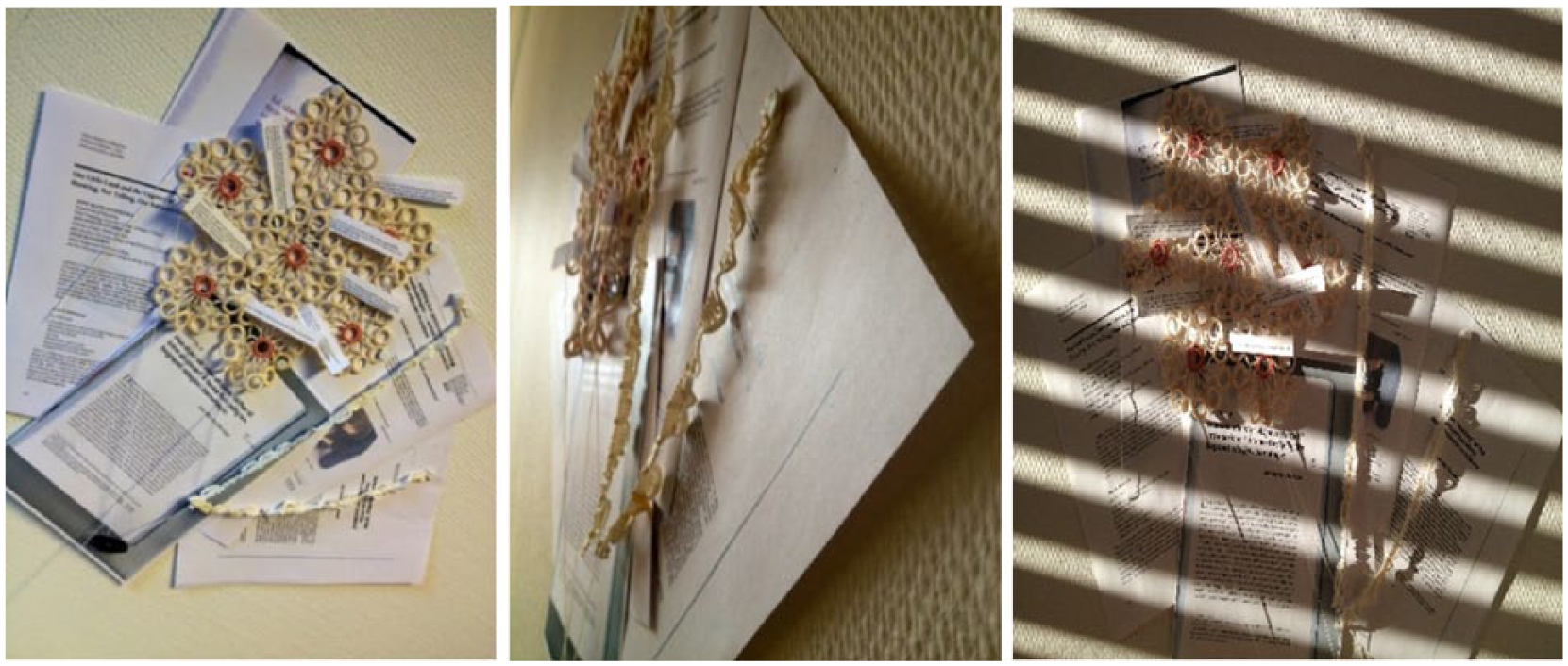
Articleassemblage
Turning Critique to a Relational Materialism of Knowing
A return to “relational materialism” goes beyond a sociocultural or discursive and Marxist stance, which seems to have so little critical effect. Affirmative and experimental critiques are not simply an unveiling of power relations and what is wrong. Critique needs to be working through practices and not simply about them. From a sociomaterialists standpoint (Edwards & Fenwick, 2015; Latour, 2013; Mol, 2002) there are many worlds or “modes of existence.” According to Latour (2004), realities are experimentally fabricated through things, which are attached, gathered, and negotiated as “matters of concern,” through open controversies. Here the real is not contrasted with the socially constructed but is taken seriously as fabricated, what Latour (2010) refers to as factishes—a connection of fact and fetish.
Hence, Barad’s (2007) concept of phenomena, as already touched upon, refers to something quite specific. Phenomena are “the ontological inseparability of intra-acting components” (p. 33), for example, phenomena do not just refer to how knowledge of an object is only possible through an agency of observation, nor to “the results of measurements” (Barad, 2007, p. 33). Phenomena “are not mere laboratory creations but basic units of reality” (Barad, 2007, p. 33). In short, “phenomena are ontological entanglements” (Barad, 2007, p. 33). Barad’s (2007) argument is concerned with the ontological (as well as the epistemological) nature of reality, and, for her, the “basic units of reality” are necessarily “entanglements” of “intra-acting components” (p. 33).
In other words, it is not so much that representations give us access to the preexisting material world, but that representations and matter intra-act to produce phenomena. Again, it is important to note here that Barad’s term is “intra-action” rather than “interaction.” As she suggests, whereas “interaction assumes that there are separate individual agencies that precede their interaction, the notion of intra-action recognizes that distinct agencies do not precede, but rather emerge through, their intra-action” (Barad, 2007, p. 33). That phenomena are “intra-actions” then refers to their necessarily relational nature, where relations connect. So Barad’s term agential cut is used as a contrast to what she calls the “Cartesian cut,” the latter signifying the idea that there is an inherent preexisting cut separating subject and object. The agential cut enacts a resolution within the phenomenon of the inherent ontological (and semantic) indeterminacy. In other words, relata do not preexist relations; rather, relata-within-phenomena emerge through specific intra-actions. Crucially, then, intra-actions enact agential separability—the condition of exteriority-within-phenomena (Barad, 2007, p. 140; Barad’s emphasis).
Barad takes an extra step in arguing that agencies themselves are the product of observer–phenomena relations. She suggests, On my agential realist elaboration, phenomena do not merely mark the epistemological inseparability of “observer” and “observed”; rather, phenomena are the ontological inseparability of agentially intra-acting “components . . .” It is through specific agential intra-actions that the boundaries and properties of the “components” of phenomena become determinate and that particular embodied concepts become meaningful. A specific intra-action (involving a specific material configuration of the “apparatus of observation”) enacts an agential cut (in contrast to the Cartesian cut—an inherent distinction—between subject and object) effecting a separation between “subject” and “object.” That is, the agential cut enacts a local resolution within the phenomenon of the inherent ontological indeterminacy. (Barad, 2003, p. 815)
Barad’s agential realism opens for creating movements from presenting a representative resume of seven articles from a critical realism philosophy to an agential realism thinking. Arranging and rearranging the agential cuts cultivating a researcher’s response-ability—toward a postanthropocentrism—includes more-than-human entanglements. A postanthropocentric approach starts from the idea that all aspects—human and nonhuman—are agential; therefore, no single aspect has priority. When feminist new material theories and the field of early childhood educational relations meet, obviously the aspect of relations comes into focus. This is not reduced to a Hegelian dialectical realist humanist approach locating a -theses—antitheses and syntheses—but critical affirmative entanglements to what might become (Figure 4).
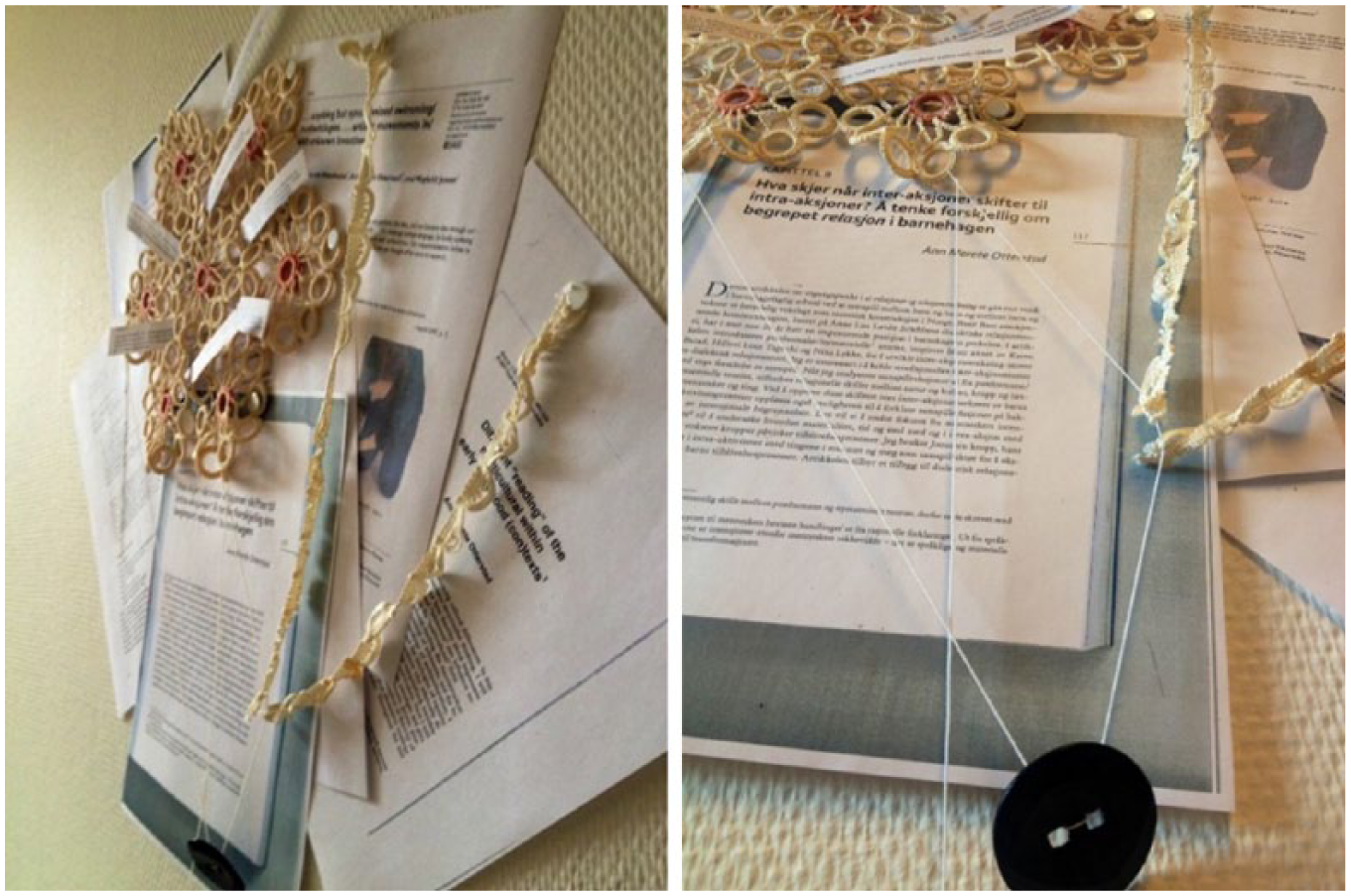
Articleassemblage
An Ethics of Worlding to Come
What would this imply in terms of the ongoing creative articleassemblage renewing itself together with symbiogenesis? What sort of boundaries and properties might be produced through the action performed. How do the articleassemblage infect me in the making? How do I think and do this? I feel ethical responsible, however, because there are so many possibilities for intra-action, I entangle and “entail an ethical obligation to intra-act responsibly in the world’s becoming, to contest and rework what matters and what is excluded from mattering” (Barad, 2007, p. 235). Lenz Taguchi (2012) argues that a diffractive analysis “is not about uncovering the essence or truth of the data. This is an uncovering of a reality that already exists among the multiple realities being enacted in an event, but which has not been previously ‘disclosed’” (p. 275). A wide range of human and nonhuman intra-acting entities contribute to the “uncovering” of realities through an agential cut. Knowledge and feminist affirmative critique in this view (in addition to being and ethics) cannot be created from an outside position looking at the world, but from being ethically entangling with the world. The cuts already made are embedded in response-ability in terms of what to focus on and what to point at, and to reconsider the material, affective, and discursive effects of the work in the making.
So what might the articleassemblage reading/doings through each other generate of affirmative critique? Bennett (2010) suggest that relational materiality can become “force of things,” “the agency of assemblages,” and “the vitality of materiality,” drawing from Deleuze and Guattari’s (1987) conception of vital materialism of energies flowing through matter. Such orientations of vitalism, along with the “new” understandings of ontological emergence and immanent materialization processes signaled by Barad and Haraway, offer affirmative feminist politics. Rather than seeing critical theory in terms of progress—as the unfolding of linear trajectories that lead to a better future—an understanding of affirmative inventive feminist theory would place emphasis on the performativity of researcher’s ways of observing, describing, and intervening in the worlds we are part. The not-wanting to create an article resume has traversed as an affective infection to resist. The articleassemblage has hopefully envisioned rhizomatic and intra-agentic connections, with different heterogenic and multiple treads signifying for ruptures sympoiesis – no linearities. Following Barad, she says, our intra-actions contribute to the differential mattering of the world. [. . .] Researchers are responsible for the cuts that we enact not because we do the choosing (neither do we escape responsibility because “we” are “chosen” by them), but because we are an agential part of the material becoming of the universe. (Barad, 2007, p. 178)
My idea for this article has to undo common-sense assumptions of “causality, agency, relationality and change without taken distinction to be foundational” (Barad, 2012, p. 32). The politics of affirmative inventive feminist theory here is thus understood as “an ethics of worlding” (Barad, 2007, p. 392) and my suggestion is that such an inventive practice might be a way of continuing to ensure the animation of feminisms as transformative affirmative critiques.
Footnotes
Author’s Note
Ann Merete Otterstad is now affiliated to OsloMet University, Norway. She wants to thank all the article authors influencing and giving the opportunity to think with their writing.
Declaration of Conflicting Interests
The author(s) declared no potential conflicts of interest with respect to the research, authorship, and/or publication of this article.
Funding
The author(s) received no financial support for the research, authorship, and/or publication of this article.