




Abstract
Book reviews written by readers and published on digital sites such as Goodreads are a new force in contemporary book culture. This article uses feminist standpoint theory to investigate the language used in Goodreads reviews to better understand how these reviewers articulate intimate reading experiences. A total of 692 reviews of seven bestselling fiction and nonfiction books are analyzed by two methods. The first, thematic content analysis, involves close reading of the reviews. The second, sentiment analysis, is an automated “distant reading” process. These methods prompt us, as researchers, to reflect on the way they foster or inhibit a sense of proximity to readers, even as they reveal predominant features of Goodreads reviews. Together, the methods reveal that 86.1% of Goodreads reviews describe a reading experience, and 68% specifically mention an emotional reaction to the book, with the emotion most intense in reviews of fiction. Reviews also create social connections by mentioning other readers, authors, characters, and people from the reviewer’s life. Through their emotional language and sociality, Goodreads reviews present distinctive, intimate reading practices, constituting a new cultural phenomenon, and a unique opportunity for investigation.
Reading has always involved different forms of intimate practice, from the personal act of choosing a book to the more visibly social formations of book clubs and book-based events. New media intriguingly blurs and complicates the levels of privacy and sociality in these practices. Online platforms for book reviews such as the site Goodreads, which has more than 55 million members and 50 million reviews, are particularly striking in this respect. There is a need for research that investigates these reviews on their own terms as complex cultural practices. Reader reviews are more than digitally enabled user feedback, and more than big data that can be mined for commercial purposes. They are also more than new versions of professional book reviews, which have long served commercial and cultural functions for the publishing industry.
Goodreads provides a platform for readers to actively participate in the reception of books, and the written reviews they write provide opportunities for researchers to observe emerging forms of discourse. In particular, reviews often present intimate accounts of reading. Consider this excerpt from a review of Graeme Simsion’s (2013) novel, The Rosie Project: “I laughed, I cringed, I sobbed and, through it all, I pictured some wonderful people in my own life and feel, as Don does at one point, that I have gained empathy for others.” As researchers, we are struck by this review’s description of emotion and the connections it makes with a character and people in the reader’s life.
In this article, we report on primary research into a set of 692 Goodreads reviews of bestselling books. We use two different empirical methods to analyze this set, namely, content analysis and sentiment analysis, and reflect on the way they position us close to or far away from readers and each other as they render visible different articulations of intimacy in Goodreads reviews. The argument of this article is that the performative and individual act of writing about a book on Goodreads creates a public account of a reading experience, and one that connects readers to others. We interpret the expressions of intimacy through emotional language as a particular way of talking about books that is meaningful for this group.
Paying Attention to Readers
Our research starts from the position that readers’ own statements about their reading are worth paying attention to. This commitment is informed by feminist standpoint epistemology, which provides both a theoretical frame and methodological approach for our research. Sociologist Dorothy Smith (1987) argues that “analyzing women’s conditions from the standpoint of women validates their experiential reality” (p. 38, emphasis in original). Standpoint theory is not limited to explorations of women’s experience but can be used to investigate the experience of other nonruling groups (Fuller, 2004, p. 16). Members of such groups interact with “ruling relations of power,” a term that describes the practices of governmental, legal, economic, and educational institutions (Smith, 1987, p. 3), as well as developing their own “locally organized practices” (p. 10).
About 75% of Goodreads users are women (Thelwall & Kousha, 2016), but, more broadly, as nonprofessional readers, they constitute a nonruling group with limited access to having a voice on mainstream media, and low visibility and authority within the formal institutions of literary culture. Goodreads affords these readers a new set of strategies to negotiate roles as active commercial and cultural mediators within book culture. Feminist standpoint theory enables researchers to recognize the agency of these readers, and analyze their relation to the social and cultural institutions that legitimize certain types of reading.
Our research builds on a significant body of work on contemporary readers and reading practices that has analyzed nonprofessional interpretive processes (see, for example, Fuller, 2008, 2011; Murray & Weber, 2017; Proctor & Benwell, 2015; Sweeney, 2010). Recent work has highlighted the operation of newer, online reading practices (Barnett, 2014; Driscoll, 2013, 2015; Goldsmith, 2016; Gruzd & Rehberg Sedo, 2012; Murray, 2015; Rehberg Sedo, 2003, 2011; Rowberry, 2016; Vlieghe, Muls, & Rutten, 2016), including online reader reviews (Allington, 2016; Finn, 2013; Gutjahr, 2002; Steiner, 2008). The involvement of digital reading sites with commercial processes has been a point of focus in some research (Nakamura, 2013). Scholarly work that takes a critical position on the underlying commercial infrastructure of online reviewing is valuable, but we approach Goodreads from a different theoretical perspective and with a different methodology. Feminist standpoint epistemology urges us to consider reviewing from the standpoint of the reviewers themselves, exploring in detail what Lisa Nakamura calls the “fascinating thread of vernacular criticism” found on Goodreads (p. 243). Our primary research is a theoretically informed, empirically based contribution to understanding this vernacular practice that takes seriously the agency and critical capacities of reviewers. As researchers, we are critics, but we are not the only critics.
In this article, we have a particular interest in the way readers engage in practices of intimacy. The concept of intimacy has been the focus of sustained scholarly attention in the social sciences and humanities (see, for example, Berlant, 1998; Giddens, 1992; Luhmann, 1998), including media studies (e.g., Horton & Wohl, 1956; Kavka, 2008; McGlotten, 2014; Rojek, 2016). At the same time, intimate is a word in general use, where it can mean both deeply personal, and in close relationship (Oxford English Dictionary, s. v. intimate). This vernacular understanding is not divorced from scholarly work: Giddens (1992) proposes similarly twinned concepts when he emphasizes that “intimacy is above all a matter of emotional communication” (p. 130). In this article, we follow the tenets of feminist standpoint theory by working with the term intimacy in its broadest sense, rather than starting with a detailed pre-definition that could exclude practices relevant to readers. We look to the statements of readers with an interest in how these express multiple concepts associated with intimacy, including but not limited to familiarity, close relationships, an interior life, and strong emotions.
Early in our research, it became evident that emotion is a particularly important concept for readers. As with intimacy, emotion has been researched in depth (see, for example, Garde-Hansen & Gorton, 2013; Harding & Pribram, 2009; Scheer, 2012; Solomon, 2003) but is also a word used in everyday speech to mean feelings, as opposed to reasoned thought (Oxford English Dictionary, s. v. emotion). Again, rather than taking a critical stance on the role of emotion in media environments (as done, for example, by Illouz, 2007), we approach the use of emotional language in Goodreads reviews with an openness to seeing how reviewers articulate feelings and thoughts.
We see our methodology, which grants authority and agency to readers, as part of a recent scholarly turn away from critique (e.g., Felski, 2015; Latour, 2004). Our work also extends some of the possibilities pointed to in other research on shared cultural experiences. Our awareness of both the potential value and limitations of mediated intimacy is influenced by Lauren Berlant’s (2008) concept of the “intimate public sphere,” which acknowledges that the “ideologically and materially constraining” circumstances of cultural consumption can also offer a “promise of belonging” and “a sense of being connected to others” (p. ix, cited in Fuller & Rehberg Sedo, 2013, p. 34). This promise, in Berlant’s account, is a fantasy implicated in a problematic “displacement of politics to the realm of feeling” (Berlant, 2008, p. xii), but it also has value for participants. In their work on mass reading events, Danielle Fuller and DeNel Rehberg Sedo (2013) found that “many readers were satisfied by ephemeral experiences of community,” even though they do not “necessarily transform anyone or anything” (p. 211). Viewed from the standpoint of participants in book culture, emotional language and other practices of intimacy can coexist with commerce, and may even be a tactic for dealing with a corporatized new media environment.
Researching Goodreads
Intimacy is embedded in the mission statement for Goodreads. On the website, founder Otis Chandler invokes the close personal ties of friendship and marriage as well as the domestic space of the living room when he writes that Goodreads was created to be “a place where I could see my friends’ bookshelves and learn about what they thought of all their books. Elizabeth, my co-founder (and now my wife) wrote the site copy and I wrote the code. We started in my living room” (About Goodreads, n.d.) This language of intimacy sits alongside the commercial context of the site, which in 2015 was acquired by Amazon.
Goodreads has evolved to become a complex site. Users can add books to virtual shelves, allocate them star ratings, write and reply to reviews, follow one another, and participate in discussion forums. There are links out to personal and commercial websites. Readers who use a Kindle (another Amazon technology) are prompted to add purchased books to their Goodreads account, and rate them when they finish reading. Within this constellation of digital book-based practices, reviews form a distinct reading response. Not every kind of reader writes online reviews, and the millions who do occupy a specific position in book culture. The reviews they write are significant for researchers because they provide access to a kind of reading experience that has previously been elusive. This opportunity is offset by difficulty; the size of Goodreads makes it harder to appreciate and contextualize the richness and complexity of individual reviews. In particular, it can be difficult for researchers to see intimacy when it is enmeshed in big data and new technological infrastructure.
The challenge of Goodreads brings into relief our own research practices, and how they foster or resist intimacy. Introducing a special issue of History of the Human Sciences on intimacy and research, Mariam Fraser and Nirmal Puwar (2008) reflect on the Bourdieusian challenge of moving between “the most intimate details gained in close proximity” and broader systematic analyses (p. 5). Just as readers move between quiet, private moments (alone with a book on the couch) and more public spaces (libraries, classrooms, online fora), as researchers on this project we trace an oscillation between proximity and distance, combining close reading of online reader-reviews with larger-scale automated computational analysis.
How We Read Goodreads Reviews
The dataset for the research presented in this article is drawn from a larger project on the transnational reception of bestsellers between Canada and Australia. The transnational element of our project design springs from our interest in how the physical situation of readers and the national markets of the publishing industry might be discussed on digital sites. We chose Canada and Australia due to our pre-existing knowledge of their market conditions and reading cultures, but this could usefully be expanded by future projects investigating readers from other places including non-Anglophone countries. We focus on bestsellers as part of our theoretical and methodological commitment to the choices and behavior of readers: These are the books that readers have chosen to buy. Bestsellers tend to secure very large numbers of reviews on Goodreads, but bestseller data are more accessible than finding the most reviewed titles on Goodreads. Using Amazon and Nielsen BookScan data for the period 2005-2015, we identified four titles first published in Australia that became Canadian bestsellers, and three Canadian titles that became Australian bestsellers. This produced a varied set of case studies (see Table 1).
Titles Reviewed and Studied.
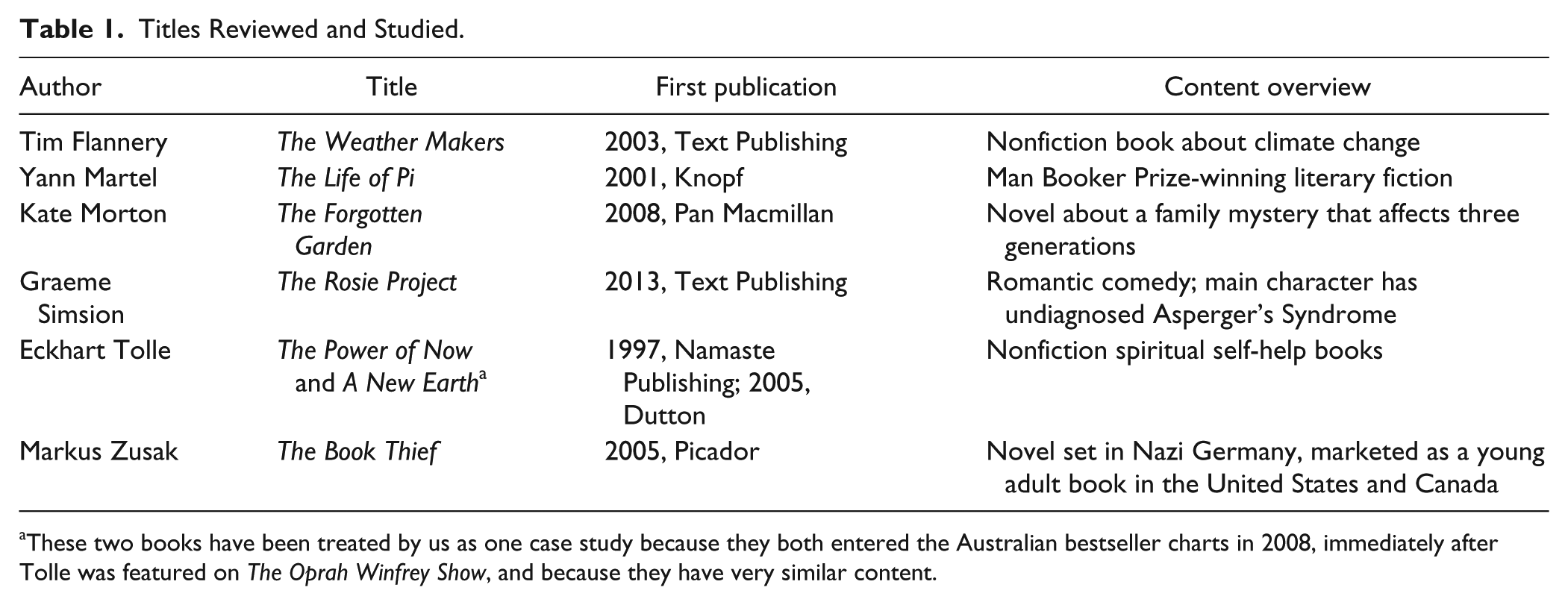
These two books have been treated by us as one case study because they both entered the Australian bestseller charts in 2008, immediately after Tolle was featured on The Oprah Winfrey Show, and because they have very similar content.
For each book, we examined Goodreads reviews up to December 31, 2015. Recognizing that reviewers most likely did not expect their reviews to be aggregated and studied, we reflected on the ethics of this method. We consider these publicly visible reviews to be acts of communication available for analysis; at the same time, we attempt to protect the reviewers’ privacy by not citing their usernames when we quote reviews.
The datasets of reviews for each case study book are of very different sizes, which reflects the uneven circulation and reception of books with different genres and publication dates as well as the difficulty of working with corporately owned and unstable data. Goodreads only displays a maximum of 3000 reviews at a time, showing either the oldest or newest 3000. 1 This meant that the maximum number of reviews we could view and scrape was 6000, even though Life of Pi, for example, currently has 42,123 reviews and The Book Thief has 90,702. For The Book Thief, reviewing occurred at such a fast rate that by the time we scraped in early 2016, all 3000 of the newest reviews fell after our cutoff date of December 2015.
Because our project is interested in transnational reception, we then filtered the reviews to include only users whose profile stated they were Australian (for the Canadian titles) or Canadian (for the Australian titles). The number of Goodreads reviews for the seven titles was 692, constituted as follows: The Rosie Project (292), The Forgotten Garden (193), The Power of Now and A New Earth (114), Life of Pi (54), The Book Thief (30), and The Weather Makers (7).
We analyzed the reviews using two methods: content analysis and sentiment analysis. For content analysis, we developed a codebook by jointly coding 109 reviews, looking together for recurring features and refining thematic codes. We then separately coded the remainder, meeting to discuss any that were difficult to code. Our codebook had 22 coding categories, each of which had a range of possible set or free text codes. To report our findings, we provide a descriptive analysis illustrated with exemplary reviews.
Sentiment analysis is an automated process that identifies emotion-bearing words in a corpus of texts. We used the program SentiStrength, which is lexicon-based, and assesses the strength of emotional words to give a rating of both the positive sentiment expressed in a text (on a scale of 1 = neutral to 5 = strong) and its negative sentiment (on a scale of −1 = neutral to −5 = strong). This gave us a rating of the positive and negative emotional language for each review, and enabled comparison across reviews for each title. Both methods yield insights about how Goodreads reviewers discuss books in terms of emotion. The close reading also enabled us to consider the way Goodreads reviewers discuss evaluation, experience, and social connections.
Evaluation and Experience
Most Goodreads responses are evaluative, underscoring their economic function and the enduring legacy of reviewing as a critical practice. Evaluation is a dominant feature of reviews in commercial contexts, especially on new media where prompts to give ratings are usually built into the structure or design of a site. Goodreads encourages users to rate books between one and five stars (whole stars only), and average star ratings are displayed for each title. While stars communicate a decision about a book’s place on a forced hierarchy, our focus was on the free text, where readers have more scope to respond to the book in a variety of ways.
We coded for evaluative language in a review, such as the words “good,” “terrible,” or “amazing.” Coding these highlighted different understandings of evaluation for Driscoll (trained in literary studies) and Rehberg Sedo (trained in media studies); it was through annotations to our shared spreadsheets and Skype conversations that we came to conclusions together about what constituted evaluative language in a book review. A little more than 70% (70.1%) of reviews evaluated the book. This high percentage is not a surprising result, given that evaluation is implicitly encouraged by the site, and book reviews are traditionally critical acts. Some reviewers showed a keen understanding of their evaluative role, as in this review of Life of Pi: “Tossed and turned about whether to give it 4 or 5 stars . . . .”
The highest percentage of evaluative reviews was for Life of Pi (83.3%). This is the most critically acclaimed literary title in our set, and our result suggests that readers may be conditioned to respond to literary fiction with aesthetic judgment. Examples of evaluative language for Life of Pi include “What an amazingly thrilling book to read . . . The book is wonderfully written,” 2 “Very fast read yet language was not so ‘fluffy,’” and “weaves an enchanting tale.” The lowest percentage of evaluative reviews was for Eckhart Tolle’s work (64.9%); similarly, this may relate to its genre as a self-help book, a type of writing that does not necessarily invite a determination of aesthetic quality.
Evaluation is clearly a part of activity on Goodreads, and it could be that the core of the typical Goodreads review is whether the reader likes the book or not. But reviews often do more than this. For example, one reviewer of A New Earth writes, Thought this book was bloody brilliant, changed my life in some ways. I was certainly down on my luck when I read it, and it couldn’t have been more perfect for such a book to appear at such a grim period in my life. I would credit it as part of my solution.
The evaluative judgment here, “bloody brilliant,” is closely linked to the life experiences of the reader. This is not just a critical act but also a personal one. In a slightly different register, a review of The Rosie Project reads, I give this book 4.8 stars out of 5. I really enjoyed this book. I read it in a day because I was so in love with the characters. I adored the two main characters, Rosie and Don. What a unique and beautiful love story. Must read!!!
Again, evaluation (“must read” and the very precise star rating) are combined with an account by the reviewer of what it felt like to read the book, including descriptions of the book’s emotional impact. In these textual responses, evaluation edges into something more intimate. This complexity became even more evident when we examined the experiential language in reviews.
Most of the reviews (86.1%) we coded describe a reading experience, and the percentage was even higher for reviews of The Rosie Project (90.8%) and The Forgotten Garden (90.2%). This is higher than the percentage of reviews evaluating the book (70.1%); experiential, rather than evaluative, language is the main way in which readers respond to books on Goodreads. From the standpoint of readers, describing a reading experience links the book not to objective or external criteria but to the lived experience of the reader. These articulations are similar to the “personal reading” practices identified in book club studies (Collins, 2010, p. 44; Long, 2003, pp. 185-186). Building on this key finding and earlier studies, we coded for the different types of experience mentioned, under the broad categories of temporal, intellectual, emotional, and physical. The most commonly described, by far, was emotion.
Emotion and Goodreads Reviews
Descriptions of emotion in Goodreads reviews are at the heart of this article and its focus on intimacy and research methods for new media. Emotions, which can be plural, in conflict, and described in diverse ways, have historically been difficult to define and, therefore, study (Scheer, 2012). We have used two methods that approach the analysis of emotion in different ways. Sentiment analysis relies on the research-based finding that even when different people use a multiplicity of terms to describe emotional reactions to an event (e.g., angry, sad, or upset), they are consistent in expressing either a positive or negative response: At least at the binary level, there is a shared understanding of what emotions are (Feldman Barrett, 2006; Thelwall, Buckley, Paltoglou, Cai, & Kappas, 2010). At the other extreme, we have used content analysis based on open, iterative, manual coding to balance this potentially reductive approach to emotion. We want to recognize the nuance, instability, and subtlety of emotional language in Goodreads reviews. Together, our two methods enable us to consider the utility of different research methods in exploring the way online reviewers express emotion.
Our content analysis found that 68% of reviews specifically mentioned an emotional reaction to the book—well over half of the Goodreads reviews. This percentage varied considerably across the different books. For The Rosie Project, 85.6% of reviews described an emotion, whereas for The Weather Makers and The Life of Pi, the percentage was less than 22%. Descriptions of emotions were much more common in reviews of the general fiction than in the literary fiction and nonfiction in our study.
We analyzed further by coding for different kinds of emotional experience, while recognizing that the particular books in our dataset may have affected the kinds of emotional language we observed. Enjoyment was frequently mentioned; of all our reviews, 41.9% described enjoying the book. The percentage was highest for The Forgotten Garden (67.4%) and The Rosie Project (58.2%), and lowest for The Weather Makers (0%) and Life of Pi (14.8%). Sometimes, this was straightforwardly expressed as, for example, “I really enjoyed this book” (a phrase that appeared nine times). At other times, enjoyment suffused the review: I loved this book, it has become one of my all-time favs and will be one I can read again and again. I loved the back and forth writing style, the way the author took you into different portals and back again, how romantic and heartbreaking at times the novel was. I would recommend this one to anyone and everyone. I finished this 550 plus page book in about 2 days because I just could not put it down. It made me laugh, it made me cry, I got angry at times and then filled with joy, any novel that can do that is worth a read in my mind. (Review of The Forgotten Garden)
As this review illustrates, enjoyment may be a common frame of reference, but it is not the only emotional register. Sixteen percent of reviews articulate amusement, for example, and this is most common in reviews of the romantic comedy in our set, The Rosie Project. Smaller numbers of reviews expressed absence of enjoyment (8%), disappointment (4%), sadness (3%), and annoyance (3%).
One of our codes for emotion was “multiple non-specific” (6.4% of reviews). Under this category, we coded words such as “emotional,” “touching,” and “moving”; one review we coded this way begins “Looking for a great book that will make you feel warm and fuzzy all over? Then let me introduce you to The Rosie Project!” The vagueness built into this code raised issues for us as researchers. Rehberg Sedo felt that the category sometimes highlighted our inability to fully capture what was being described; Driscoll’s more positive view was that expression of nonspecific emotion is a choice, one she recognized from the online discourse of romance and young adult readers who delight in feeling “all the feels.”
More concretely, as we coded, we observed the frequent use of the emotive word “love.” We ran a search for the word stem lov* (loving, lovable, loved, and so on) and found that 25.6% of the reviews use a word based on love, making this a striking feature of the Goodreads vernacular. As with emotional language in general, the use of the word love was most common in reviews of the general fiction titles: the result was more than 30% for reviews of Morton, Simsion, and Zusak. This observation about the role of a keyword shades into our use of a second method: sentiment analysis. Sentiment analysis is a “distant reading” method that does not rely on human interpretation of the context and meaning of a given text. Instead, it compares the words in each text against a predetermined lexicon of emotion-bearing words, with each of these allocated a weighting for strength of emotion (e.g., lov* is weighted as 2). For each text, sentiment analysis scores the strength of both the positive emotion and negative emotion; unlike our thematic coding, sentiment analysis measures not only the presence of emotional language but also its intensity.
We ran sentiment analysis on the sets of reviews for each of our texts, and the average scores varied considerably (see Table 2). Sentiment analysis confirmed our finding from the content analysis that emotional descriptions are more likely to be present in reviews of fiction, rather than nonfiction, titles, with reviews of the nonfiction titles scoring quite weakly for positive and negative emotion. Sentiment analysis also enriched our understanding of emotional language in fiction reviews. Reviews for The Book Thief had both the strongest average positive emotional language and the strongest average negative emotional language. Our thematic coding of The Book Thief had simply recorded that 73% of its reviews described an emotional experience (a lower percentage than for The Rosie Project and The Forgotten Garden); sentiment analysis shows that these emotional experiences were described at an intense register. This finding may be a result of the book’s harrowing themes, or of the demographics of the reviewers it attracts as a designated Young Adult book.
Average Strength of Positive and Negative Emotional Language for Each Book’s Reviews.

We also considered the most frequent scores for each set of reviews. In each case, apart from The Weather Makers, the most frequent positive emotional strength was 3 and the most frequent negative emotional strength was neutral. This indicates an overall positive emotional tenor across Goodreads reviews.
Reflecting on sentiment analysis as a method, we recognize its advantages. Consistent with a feminist standpoint epistemology, it “reads” the actual words used by readers. It is also much faster than manual coding, which makes future research into the presence of emotional language on Goodreads and other reader review platforms feasible on a large scale. It was also useful as a way of triangulating our findings, mitigating against the danger of drawing inaccurate conclusions. Sentiment analysis also has limitations. In particular, it does not capture emotional nuance and complexity. While it is true that sentiment analysis programs are becoming more sophisticated, the program that we used is blunt in its characterization of emotion as either positive and negative. In contrast, our content analysis—while still forcing emotional language into categories, sometimes uncomfortably—acknowledges multiple emotions, including amusement, delight, disappointment, and annoyance. The sentiment analysis program could not pick up “multiple non-specific” emotions in the way that we could when closely reading. Our knowledge of readers and book culture also meant that we read some reviews differently to the way they were coded by SentiStrength. For example, it gives a very high emotional score for the phrase “really enjoyed it,” but we read this as somewhat flat in tone compared with more detailed and evocative reviews. With sentiment analysis, the reviews are not read by us, carefully and individually; the trade-off for its speed is the distance imposed between us and the texts. For us, this distance and the consequent potential reductiveness of sentiment analysis mean that it works best as one of multiple research methods.
Comparing the two methods of sentiment analysis and close reading lays bare some of the processes involved in understanding and interpreting emotion for researchers. Through both methods, we confronted our own discomfort with classifying language into emotional categories. Are both methods, in fact, too narrow in their conception of emotion? Goodreads reviews of Tolle’s books often described contemplation; we coded this as a description of intellectual experience, but is it a subtle form of emotion? While the combination of two methods cannot grasp all dimensions of the way emotional experience is described, this approach powerfully demonstrates the predominance of emotional language in Goodreads reviews.
One way that we tried to extend our understanding of emotional language was to look at two related categories: descriptions of physical reading experience and the material book. Emotion is often understood or theorized as connected to the body (see Ahmed, 2004, p. 5), so we were interested in whether reviewers described physical and material phenomena as part of their practices of intimacy. We found that references to materiality and the physical body were not common. The materiality of the book was only mentioned in 6.6% of reviews. This suggests that the materiality of reading is not prioritized by Goodreads reviewers, and, more broadly, that the material container of the text has less importance for these readers communicating on a digital forum. Furthermore, there were only 34 mentions (4.9%) of a physical reading experience. One of the most common references was to “laughing out loud,” mentioned 13 times, and all for The Rosie Project, constituting 5.8% of that book’s reviews. We think this is a noteworthy finding because it is an example of readers sharing surprising, involuntary physical reactions with other readers, a highly intimate gesture and a formalized description of a bodily experience.
At a more allusive level, 8.8% of our reviews used metaphors of bodily experience to describe reading. This percentage was higher for the fiction books (11.6% for Simsion, compared with 5.2% for Tolle and 0% for Flannery). Body metaphors tend to be quite complex in the way they signal a sense of closeness with the books, as these excerpts from reviews of The Rosie Project illustrate: Some books are like an attack on your heart, or your soul; a monsoon of emotion and feeling. Other books are the equivalent to sitting your heart and soul by the hearth of a fireplace and feeling warm and soft all over. As soon as I finished reading The Rosie Project my first reaction was to give it a huge bear hug! I wanted to hug the author and Don and Rosie.
These are descriptions of how it feels to read a book. In other reviews, the body metaphors are more to do with impact. Reviews of The Forgotten Garden described the novel as one “whose characters touched me,” and “Breathtaking,” with another writing “I actually got chills when I was reading.” The body metaphors in reviews of The Book Thief often relate to its setting in Nazi Germany. One reviewer wrote, “I felt like I walked the streets right along with these characters,” weaving together geographical place, the body, and sociality.
Body metaphors are striking to us, even when they are not frequent, because they describe intense personal reactions. One reviewer of Tolle writes, “I could feel my whole body coming to life as I read it,” and another reflects “I found myself clinging to particular ideas.” A review of The Life of Pi spoke to a particularly complex emotion and a strong connection with the book: “This book got me deep into my soul.” Reviews that use body metaphors extend one of the dominant practices of the Goodreads vernacular: framing reading as a personal experience that involves strong emotional reactions. While the book as a material object does not appear much in the reviews, the reader’s body is still present, sometimes described literally, as a material living thing, and at other times articulated through symbolic language. These descriptions of the body of the reader and the emotions felt by the reader are shared with others on Goodreads, and illustrating part of the second element of intimacy: social connection.
The Social Dimensions of Goodreads Reviews
Reviews on Goodreads reach out to readers, authors, characters, and people in reviewers’ lives, assembling complex social networks of reading. As a social media platform, Goodreads builds connections between readers into its site design. In addition, reviews on this public site are implicitly addressed to other readers. Reviews, as a genre, assume a readership, because one of their functions is to guide the reading choices of others. This function has a commercial dimension but is also an act of service to other readers. We coded for reviews that took this aspect of reviews even further by explicitly referring to other readers in the text of the review. We recorded the use of “you,” statements about recommending or not recommending the book, warnings to readers (such as the phrase “spoiler alert”), and suggestions of how to read, such as “would make a perfect beach book.”
More than one quarter (27.5%) of our reviews addressed a future reader. This suggests that imagining and speaking to other readers is an important component of the Goodreads review genre. In some reviews, this takes the form of a direct address, such as “I recommend this to everyone I can as I do to you who is reading this review. Just go for it” (review of A New Earth), or shout-outs to specific readers, such as “Amazing book! I laughed and cried . . . Diana, Sarah, Megan and Rachel—you would all LOVE this book” (review of The Book Thief). This sense of imagining the next reader is also present in descriptions of ideal ways to read the particular book, such as “The Forgotten Garden is a lovely book best read cuddled into a warm chair, preferably with a cat on your lap.” In other cases, reviewers offer encouragement or guidance to future readers. For example, Somewhat difficult to get started, but once you do, it’s a rewarding and thoroughly engaging read. A story that you’ll never forget long after you have finished it. (Review of Life of Pi) Don’t be scared of the gloomy subject of this book . . . . (Review of The Book Thief) If you are looking for something light and somewhat romantic this might be for you. (Review of The Rosie Project)
Goodreads, like Twitter and Facebook, has also contributed to a shift in the relation between author and reader: When authors are present on social media platforms, there is a heightened possibility of readers directly connecting with them (Goldsmith, 2016; Gruzd & Rehberg Sedo, 2012). Goodreads fosters this closeness, for example, by hosting live chats with authors, while also trying to maintain some separation between authors and readers, for example, by advising authors not to respond to reviews (see Driscoll, 2016 for how this can go awry). The textual response of the Goodreads review is another space where readers negotiate their sense of proximity to authors. Reviews can invoke intimacy by mentioning the author, a process that some media theorists would see as para-sociality or, in Rojek’s (2016) term, presumed intimacy, since there is no physical relationship between the author and reader. But when viewed from the standpoint of readers, a review that mentions an author forms a connection, a link in a network. The review is of an authored book, not just a book; the author is part of an intimate reading experience.
A little more than 20% (20.1%) of the reviews explicitly mention the author, either by name or indirectly. This was most common for reviews of books by Tolle (31.6%) and Morton (29%). For Tolle, this suggests that the success of his self-help books may be linked to his own guru status; his visibility as a celebrity was significantly increased by his appearances on The Oprah Winfrey Show, which propelled the books to bestseller status in Australia (even though Winfrey herself was rarely mentioned in these Goodreads reviews). For Morton, different factors may be at work. We are particularly interested in the fact that Morton is the only female author among our set. As a general fiction title, her book occupies a similar position in the publishing industry to those by Zusak and Simsion, but readers are more likely to mention her (the author is mentioned in only 6.7% of Zusak’s reviews and 13.4% of Simsion’s). In particular, reviewers of Morton’s book are far more likely to use her first name: 57.1% of Morton’s reviews do this, compared with 36.1% of Tolle’s reviews that mention his first name and none or almost none of Simsion’s, Flannery’s, Zusak’s, and Martel’s. From the readers’ point of view, there may be a feeling of greater familiarity with female authors. The way that the use of an author’s name expresses intimacy is illustrated by these examples: Breathtaking beautiful. I adore Kate Morton. She is by far my favourite writer. A wonderful, magical book! She expertly weaves together a story and mystery, all converging quicker and quicker towards the end, when things finally reveal themselves. Kate is a wonderful writer and story teller. :) Fantastic read. Couldn’t put it down. You can tell Kate Morton has a wild imagination.
These are written in a style that assumes a familiar relationship with and knowledge of the author, which may be part of the pleasure of this reading experience. For reviews of The Forgotten Garden, readers were much more likely to mention the author than to mention future readers, suggesting that from their perspective, the social connection between author and reader may be more important for this book (and perhaps its genre) than the connection among readers.
Just as interesting to us is the fact that around 80% of Goodreads reviews did not mention the author at all. Previous studies of book clubs and responses to live book-related events have found that the author is often forefronted: for example, Driscoll’s (2015) sentiment analysis and close reading of tweets from the Melbourne Writers Festival found that “in most cases, strongly emotional language coalesces around the perceived sense of intimacy between attendees and writers” (p. 13), while Fuller and Rehberg Sedo (2013) found that the author’s involvement was important for audiences in One Book, One City events (pp. 214-234). By turning away from the author as a visible intermediary between book and reader, Goodreads reviews illustrate a different way of relating to books. From the standpoint of these readers, the connections worth highlighting are those with other readers and their community.
This difference is also evident in a third kind of relationship forged through reviews: that between the reviewers and the characters. Previous research on book club discourse indicated that readers often identify or otherwise link themselves with characters (see, for example, Allington & Benwell, 2012; Howie, 2011; Taylor, 2007; Whiteley, 2011). We coded for this practice and found that it was quite rare for Goodreads reviewers to identify directly with a character (18 mentions, or 2%). Most were for The Rosie Project, and relate to the characterization of the romantic lead, who has undiagnosed Asperger’s syndrome: I suppose I will have to read this now since the protagonist sounds eerily like me, although I’m a high school teacher and not a genetics professor. But, I too have huge problems when it comes to social interactions, to the point where I just avoid them.Excellent book. Don’t miss it.
In other reviews, readers compare characters to people from their lives. Sometimes this is quite general: for example, “people of all ages will identify with the struggles of ordinary people living under the Nazi regime” (review of The Book Thief) and “. . . I laughed out loud in spots, drawing parallels to some student scenarios. I was reminded throughout about how all of us are trying to make connections regardless of how we’re wired. Great read)” (review of The Rosie Project). Some reviewers make a more personal link between a character and someone in their life, a rhetorical move that often performs identity work for the reviewer. Again, this was most common for The Rosie Project. One reviewer writes, “This was a very good read, being mother to an Aspie, I could relate to Don.” Another reacts negatively to the character of Don, distinguishing him from people whom she knows: I felt as though this character was created by taking all of the possible stereotypes of someone with Asperger’s and cramming them (quite awkwardly) into one character. As a mother of a child with High Functioning Autism/Asperger’s, I was very disappointed with the portrayal of this character.
The character of Don is central to many Goodreads accounts of The Rosie Project. Not only did several reviews compare Don to people in their lives, but an even higher number of reviews—50 reviews, which is 17% of our set for The Rosie Project—compared Don with a specific fictional character: Sheldon Cooper from the television show, The Big Bang Theory. For example one review gathers together Don, Sheldon, and a person from the reviewer’s life: “. . . Don was hilarious (partly because my husband had a roommate when we were dating that could have been Don, or Sheldon Cooper (seriously) . . . .” Another reviewer writes, “If you’re a fan of The Big Bang Theory, you might even feel as though you’re reading Sheldon Cooper’s journal.” For some reviewers, this link has a material dimension because it affects the imagined sound of the character’s voice: “Felt like I was reading a book narrated by Sheldon from Big Bang Theory! Loved it!” and “I kept hearing Sheldon Cooper’s voice in my head.” These references show readers making connections between characters across media forms as well as with people they know, creating a multilayered social network.
The fact that it was not common for our reviewers to compare Don Tillman with themselves or people they know points to a possible difference between Goodreads reviews and book club discourse. Proctor and Benwell’s (2015) study illustrates how identification can work in a reading group setting. They analyze an exemplary instance of a book club member who used emotional language to align herself with a character, reporting the imagined speech of a mother giving her child up for adoption. This strategy of emotional identification produces an “account of the subjective experience of reading that is compatible with the social and moral ‘order’ of the group as it is performatively and continuously worked out” (p. 31). That is, using emotion to identify with a character is part of an established subcultural discourse in book clubs. In contrast, overall, only 6% of our reviewers compare a character in the novel to either themselves or someone they knew, suggesting this is not a common mode on Goodreads.
Goodreads reviewers are more likely to use emotional language to describe characters as people with whom the reviewer imagines a relationship. Nearly half (46%) of the reviews of fiction titles that we coded discussed the characters in the book, but rather than identifying with these characters, reviewers often expressed affection toward them. This is a kind of intimate discourse that is performative and subcultural, a way that readers talk to other readers. It is a form of nonrealist enjoyment, a self-conscious immersive fantasy, because it imagines a relationship that can never be two way. Reviewers describe loving the characters, rooting for them, feeling jealous of them, or feeling that they were friends; six reviews specifically describe the intensely intimate experience of falling in love with characters. One of the first reviews we jointly coded expresses a strong connection to the main character in Life of Pi: * spoiler alert ** Holey wow! This book was nothing short of amazing!! Such a unique and beautiful, moving story! Immediately we fall in love with the character of Pi as a young boy and I was personally intrigued by his faith and how sure he was of his relationship with God, and how he wouldn’t let a religion define it!! (He wanted to be all three!) Never have I ever been so connected with a character and rooting for his survival throughout the entirety of the book!
A review for The Rosie Project shows a similar way of expressing attachment to characters: I fell in love with Don, Rosie, and even Don’s two closest friends, Gene and Claudia. I rooted for them, laughed with them, shed tears for them. I whole-heartedly loved them. Don Tillman, the books main character, is quite the lovable eccentric. I have always been attracted to those who are unique.
In this review, identity work is being performed as the reader links the expression of feeling for a character to their own character traits.
In one review for The Forgotten Garden, the reader’s connection to characters is linked to the achievement of the author: “. . . she spends just enough time on character development, leaving you with the sense of utterly and completely being in love with each and every one of her characters. (Though admittedly not the ‘evil’ ones.) . . . .” Other reviews discuss characters as if they were real people, indicating an implicit bond with the characters that demonstrates an immersive reading experience. One review of The Forgotten Garden illustrates this well: A little predictable, but only to a certain extent. I was a little disappointed in Eliza for agreeing to Rose’s request. I would have thought she’d have learned enough from her life as a child in London to not be so naive. And I don’t think Rose was the kind of person who would inspire good people to do anything for her. She certainly didn’t fool me.
Reviews, then, can be immersed in the world created by the book, focused on the internal sociality of imagined relationships with characters. Less frequently, Goodreads reviews focus on the external context of the book, that is, the way it circulates through society as both a commodity and an object passed from one person to another.
One of the categories we coded for was whether the reviewer mentioned how they had received or chosen the book. The route to reader is explicitly mentioned in 8.7% of reviews, and this often involves social connections, such as librarians, staff at bookshops, friends, family members, and book clubs. Such reviews often feel quite personal, as we see in these for The Rosie Project: “a staff of my local Chapters had a long chat with me and recommended several books to me . . . I blame her for all this disappointment” and “Enjoyable read with heart. I was predisposed to like it because two of my best friends introduced it to me and I thought of them the whole time I was reading it.” These readers are tracing the paths taken by the book, as well as the paths they take in making their reading choices: The two paths meet in the reading experience. What our methodology, informed by feminist standpoint theory, has revealed is that many readers are not explicitly attentive to commerce. Although publishing is an industry, in which reviews serve a commercial function, this is not evident in most Goodreads reviews. Instead, the paths articulated by these readers prioritize the more intimate practices of describing emotion and making social connections.
Intimacy, Collaboration, and Research Methods for New Media and Reading Studies
Most readers have traditionally been voiceless among the formal institutions of literary culture. These readers have read privately, discussed books in small gatherings, or found themselves in the audiences of mass reading events and festivals. As digital technology becomes intertwined with these private and public practices, new possibilities have emerged, including the provision of high-profile forums where readers can write about books. Goodreads offers a platform to readers who have the confidence and literacy to write a public, permanent written book review, and a corresponding opportunity for researchers to observe some of the dimensions of book culture as experienced by readers.
Our study has opened up several avenues for researchers to follow. This is a time of industry change and new media forms when multiple questions are bubbling to the surface, challenging established understandings of cultural participation. Our project’s contribution to this moment is a set of empirically based findings about the work being performed by Goodreads reviews, framed by the productive theoretical model and methodological approach of feminist standpoint epistemology.
Across different Goodreads reviews, there are variations that appear to be influenced by the kind of book being reviewed and the gender of the author. What they have in common is that most do more than report on whether the reader liked or did not like a book. Goodreads reviews are not simple acts of customer feedback, even though this nonruling group may have considerable economic power. Instead, these reviews create circuits of intimacy.
Through the act of writing a review, readers describe the emotions they feel when reflecting on a book. This is a performative act, one that assumes the review will be read and constitutes a social network identity display. Nonetheless, these expressions of intimacy suggest a particular way of talking about books that is meaningful for this group. Our study suggests that the description of a reading experience, especially an emotional experience, is the most common feature of Goodreads reviews. Reviews are more likely to express positive rather than negative emotions, and love is mentioned frequently. Described emotions often center on pleasure and enjoyment, but nonspecific emotional language is also often present. Emotion tends to be discussed abstractly, without reference to the body, physicality, or materiality.
Describing emotion is a practice of intimacy, because it occurs in tandem with the social connections that are created by a Goodreads reviews. All Goodreads reviews are socially networked, and relationships among authors, readers, and characters are made explicit in a substantial number of reviews. The author is a less prominent figure in Goodreads reviews than in other social book culture formations (such as book festivals, mass reading events, book clubs). This suggests that Goodreads may offer something new, as a platform oriented more toward readers than toward authors. To use the language of feminist standpoint theory, this orientation may be part of the locally organized practices of the nonruling group of nonprofessional readers.
Intimacy on Goodreads is not, then, elusive or impossible for researchers to see, but all methods have limitations. Sentiment analysis is useful, fast, and broadly accurate, but very blunt and needs to be combined with some kind of human interpretation. Even when coding manually, we felt some discomfort and uncertainty over putting reviewers’ words into categories. Without being definitive, what we have done is given Goodreads reviewers an opportunity to have their voices heard, validating them for other scholars and illustrating methods that allow scholars to talk about Goodreads reviews as sets, rather than individually. We have also modelled intimacy of process, following a research design for new media that allowed space to recognize the emotions of readers and ourselves, and the social connections between us. Qualitative research always involves both emotion and social relations; in this project, new media facilitated our intimacy as researchers, through two years of almost biweekly, transcontinental research meetings, co-coding, analysis, and writing. Our research design also fostered a sense of intimacy with reader-reviewers, as our methods mandated immersion in the texts written by readers and reflection on the times when we felt close to readers, or far away from them. Our dataset for this project is medium-sized, and we have also arrived at a “medium distance” approach, by combining close and distant reading methods. New technologies not only enable the voices of readers to be heard but also offer researchers new tools and methods to listen, tuning in to the layers of connection and reflection—the different forms of intimacy—that characterize contemporary reading practices.
Footnotes
Declaration of Conflicting Interests
The author(s) declared no potential conflicts of interest with respect to the research, authorship, and/or publication of this article.
Funding
The author(s) disclosed receipt of the following financial support for the research, authorship, and/or publication of this article: Australian Research Council Discovery Project Grant DP170103192.