




Abstract
This article is about survival and resistance in the context of armed conflicts, such as the one in Colombia. The story of Anna, a “Total Llanera woman” was constructed during the inquiry “Narratives of Surviving and Restoration” conducted in Manizales, Colombia. Working within a socioconstructionist framework and with narrative therapy assumptions, the inquiry was designed to comprehend the survival process of people affected by the armed conflict, through a narrative and action research process. The story of Anna was analyzed using the Listening Guide Method, which intended to offer a way of tuning into the polyphonic voice of another person. The voices identified were enduring, caring, fighting, and what’s not right. The article presents the analysis of each voice and also the movement, the tensions, the harmonies and the dissonances between the different voices.
Introduction
“Here I Am” is the declaration of Anna, a woman who experienced multiple forced displacements, the assassinations of loved ones, and who powerfully expresses her radical presence. Despite all she has experienced, she continues to live actively. Hers is a life rescued from violent situations, a story of survival and strength. She introduces herself as a “total Llanera woman.” Culturally, Llaneros are the people from a flat region in Colombia where she was born, who present themselves as brave and strong. They are mainly men, because of their labors with cattle and horses.
The research, conducted in Manizales, Colombia, during 2017 was designed to discover what strategies survivors implemented to survive and resist the armed conflict. The study was conceived from a psychosocial and recuperative perspective. Survival refers to the repertoire of actions that people, families, and communities develop individually or collectively, and which allow them, primarily, to come out alive from extremely risky situations, and secondarily, to confront the material, symbolic, imaginary, relational, and cultural effects that the armed conflict inflicted on their lives. This research was especially concerned with the way in which people, families, and communities endured, perceived, and resisted the effects of forced displacement in their lives.
In this inquiry, suffering is taken as social suffering, from the perspective of Kleinman, Das, and Lock (1997), the assembly of human problems that has its origins and consequences in the devastating wounds inflicted on human experience by social forces. Social suffering, therefore, refers to various dimensions of human experience, including health, morality, religion, legality, and well-being. Social suffering disrupts the symbolic and imaginary networks that support life in society. If the suffering of survivors is subjective, its cause is not placed within that subjectivity, but rather has unfolded in a relational context. In this way, although the manifestations are diverse and do affect subjectivity, they come from collective situations (Villa, 2013).
Likewise, the category of survival is based on the recognition and appreciation of the survivors as valiant: lives that deserved to be lived and mourned (Butler, 2006), with the capacity for agency (Nussbaum, 1999) and responses to the adverse situations they have experienced (White, 2006). This inquiry was especially interested in the capacities and the resources that allow the survivors to continue on when confronted with devastating situations and in identifying their capacity for intentional action (Cobb, 1997).
In the revised literature, the focus is on the necessary transformation from the category of victim to that of survivor or agent. From the point of view of psychological restoration, López and Londoño (2007) consider that the notion of victim is not necessarily useful for recovering from the effects of violence as it disempowers the survivors. This also relates to that expressed by Denborough (2008), who considers that in no case of trauma or privation are people only recipients of suffering; they are people who respond through their abilities and knowledge. Molina (2010) for his part proposes transforming the condition of victim to that of social actor who makes decisions every time he or she can and participates in a wide and complex system of relationships.
Other authors concur in the necessity to transform the category of victim to something more generative that recognizes the multiple actions taken to confront the situations, disconnecting the survivors from the values associated with deficit, trauma, and mental illness (Arévalo, 2010; Arias, Arévalo, & Ruíz, 2002; Estrada, Ripoll, & Rodríguez, 2010; Martín-Beristain, 2004; Moreno, 2013; Moreno & Moncayo, 2015; Wilches, 2010). Martín-Baró (1984) set forth that the suffering of survivors is the most normal response to abnormal events that people are forced to live through. Placing emphasis on the individual pathological effects of the violent acts has the effect of individualizing and psychologizing the reactions of people in the armed conflict. This has been the object of criticism among various authors (Clancy & Hamber, 2008; Gergen, 1994; Hamber, 2004; MartínBeristain-, 2008; Shay, 1994), as it has a de-politicizing and negative effect on the political rights to the truth, justice, and reparations. It hides the social causes of violence, makes achieving social justice more difficult, and generates a new stigma for the survivors: that of mental illness.
Method
The inquiry “Narratives of Surviving and Restoration” 1 was designed to comprehend the survival process of people affected by the armed conflict, through a narrative and action research process (Clandinin, 2007; Riessman, 2007). Gergen (2014) drew attention to how the narrative inquiry brings into visibility the lives of the marginalized and oppressed, and the otherwise invisible conditions in which they live, and action research is motivated to achieve social change. One purpose of the inquiry was to comprehend the survival and resistance from “the inside” world of displaced people in Colombia, and therefore, to contribute in some way, to the psychosocial recovery of the participants during the process. The testimonies of the survivors are born of terribly shattered lives, are branded by the events, but also testify to the will to live of those who offer them. These testimonies, according to Das (2003), serve at least three purposes: to name the survivor’s suffering, to serve as and accompany mourning, and to establish relationships with others, which allows survivors to reinhabit devastated spaces.
Working within a socioconstructionist framework (Gergen, 1994) and with narrative therapy assumptions (White, 1995), the researchers planned seven narrative, dialogical and artistic encounters to engage with survivors, which lasted for 3 months. The researchers adapted the workshop called the “Tree of Life” created by Ncube (2006) and Denborough (2008) and also combined with the Identification Ceremony proposed by White (1995). During these encounters, researchers and participants created together visual and oral narratives based on a safe and trustiness relation among them. The participants were five women and one man; most of them displaced from rural areas, peasants before the displacement, and now urban residents. All the stories were recorded and verbatim transcribed.
The narrative of Anna was selected to apply the Listening Guide Method. The narrative itself was told over the course of several encounters. The text was pulled together keeping the names she chose for the chapters of her “book of life,” which are chronologically organized. Each chapter represents a different moment of her life.
The story was translated into English, and then the analysis started using the Listening Guide Method. According to Gilligan (2015), the Listening Guide is “a pathway into relationship rather than a fixed framework for interpretation” (Brown & Gilligan, 1992, p. 22). Even though the Listening Guide emerged from a set of psychoanalytic and feminist assumptions, it is coherent with the Social Construction perspective that Gergen (1994) had proposed. Both frameworks share the premise that human development occurs in relationship with others and, as such, our sense of self is inextricable from our relationships with others and with the cultures within which we live (Spencer, 2000).
The Method includes a series of sequential steps, which are called a “listening” rather than a “reading,” because the process of listening requires the active participation of both the teller and the listener. The first listening is called the Listening for the Plot. The researcher begins to know the landscape of the story but also his or her social location in relation to the participant through the exploration of the different connections, resonances, and interpretations that the listener brings to the analytical process.
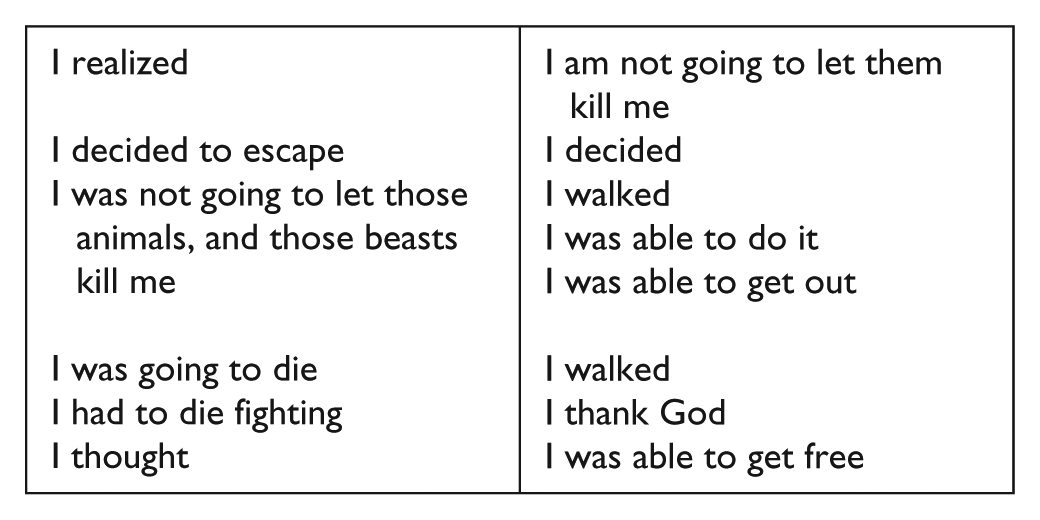
The second listening tunes the ear of the researcher to the voice of the I, the first-person voice as it speaks of acting and being in the world. The researcher follows the use of this first-person pronoun and constructs what Elizabeth Debold (1990) has called “I poems,” with each “I” starting a separate line of the poem and stanza breaks marking where the “I” shifts direction (Brown & Gilligan, 1992).
The next, listening for contrapuntal voices, brings the analysis back into relationship with the research question. The logic behind this step is drawn from the musical form counterpoint, which consists of the combination of two or more melodic line (Denisch, 2017). During this step, four voices were identified, as in a fugue: caring, fighting, enduring, and what’s not right. Each voice was colored in the text. The written text is composed now of multiple segments of different colors. After this, the number of lines each segment had was counted, to establish the length of each one, drawn with a square conserving the order of appearance in the text. In this way, a complete melodic curve line of colored segments appeared. This melodic curve line was divided in episodes and some episodes in parts according to what was heard and seen in the text. A fugue in four voices was created.
In the final phase of the Listening Guide Method, the researcher pulls together what has been learned from the listening and how what has been learned or discovered speaks to the research question. In essence, the interpretation pulls together and synthesizes what has been learned through the process of listening. On this basis, an analysis is composed.
Findings
The first listening was listening for the plot which is understood as the landscape of the story. The plot is composed by the social and political context of Colombia. The displaced people are victims of the armed conflict in which the armed forces, guerrilla groups and various paramilitary factions, have fought one another. The origins of this conflict are linked to enormous inequality and social injustice, political exclusion, and fierce ambition for control of the nation’s diverse resources, especially the land. In 2013, the government of President Juan Manuel Santos began negotiations with the FARC-EP guerrilla group in Havana, Cuba, and the peace agreement for the end of the armed confrontation was signed in 2016. The final peace agreement led to a greater polarization between those in favor and those against such an agreement. The current challenge is to build social reconciliation among all the parties, to know the lives and the stories of displaced people could contribute to this purpose.
The Voice of Enduring
This voice speaks of Anna’s ability to sustain a prolonged effort or activity, resisting difficult situations where she is faced with a sense of losing dignity, connection, meaning, control, efficacy, and power. This voice is tuned to a more deep vulnerability or being at risk of losing her life and the consequent depression as a response.
The sense of losing dignity has to do with everything Anna needed to have a decent life: food, house, clothes, good job, and money. She referred to this situation as having “lived like indigenous people.” When Anna was a child, she and her family lived in the jungle, far away from any human settlement, which meant for her physical isolation, loosing connection with other people beside her immediate family. However, the most important loss of connection was to lose the people she loved: her first husband and her father, both of whom were murdered.
Many times during her life her answer was fighting. This can been heard in the voice of keep fighting. But sometimes she felt too much pain to fight, and her response was to be depressed, to “freeze or (be) paralyzed.” This happened three times during her narration: when her first husband was murdered, when her father was killed, and when her daughters were taken away from her. This is the I poem, tracking Anna’s first-person voice in the passage where she narrated her husband’s murder:

I don’t know and I couldn’t feel is frequently heard. This is a situation in which Anna had a sense of having lost control of herself, even of her body. This is the reason Anna called the third chapter of her book, “a woman full of sadness.” This is about feeling desperate and going to the end of the line, surrendering: “but at that time, in the midst of the sorrow I didn’t care. I said: “Ok, kill me, I don’t care” (Anna, The Book of Life “Llanera woman,” June 2, 2017, p. 18). This phrase is the opposite of her statement which we have taken as the title of the article, “Here I Am a Total Llanera Woman”. The contradiction is a key for understanding the complex effects of these violent experiences on survivors. Anna’s mourning is interpreted as an act of courage rather than humiliation or shame. The ability to feel the full range of emotions, including grief, must be understood as an act of resistance rather than submission to the perpetrator’s intent. Only through mourning everything she has lost (“I was inconsolable”) can Anna discover her indestructible strength to live (Herman, 2015).
Although these situations were terrible and as she says full of sorrow, Anna seemed to recover from them. There is, however, a situation about her father’s murder that caused the most painful injury and about which she said, “You do not get over.” The murder of her father was accompanied by a loss of meaning because she wasn’t able to bury him. This caused a deep injury that still remains: She feels she has betrayed her father. This situation created a lot of guilt and in Shay’s (1994) terms, a moral injury.
Worst of all he had been killed and we couldn’t go to see him; he was killed in the worst way possible. He had to be buried in a wooden box that the community made. He was buried in a pasture because there really is no cemetery there. What hurts the most is not being able to go and see him, find out how he was killed, which was the worst. It was a difficult time for me. (Anna, The Book of Life “Llanera woman,” June 9, 2017, p. 28)
Shay (1994) says that a moral injury is a shattering of trust that follows the betrayal of “what’s right,” in a high-stakes situation, where someone in a position of legitimate authority sanctioned the betrayal. Shay developed this concept in working with combat veterans, but in the case of Anna, it could be useful to understand a different kind of wound. An injury that has to do with subjective guilt and the shame that guilt often covers up (Sherman, 2014). As Gilligan (2003) stated, the shocking betrayals are betrayals of love.
Anna was a witness of grotesque actions made by armed perpetrators. She was even at risk of losing her life at the hands of her father, the military, and the paramilitaries. She lived with threats to life or bodily integrity, close personal encounters with violence and death. She was in the most vulnerable position of any human, facing the extremities of helplessness and terror. It could be said that Anna lived with all the symptoms of a psychological trauma during these episodes, characterized by intense fear, helplessness, loss of control, and threat of annihilation (Herman, 2015). However, the life of Anna goes beyond any diagnosis, any classification.
The Voice of What’s Not Right
This is a voice about morality, injustice, unfairness, moral orders and values, betrayal, and distrust, but also about responding to injustice: denouncing, telling the truth, questioning authority, and establishing political statements. This voice allowed Anna to proclaim aloud the horrible events she witnessed and thus to overcome denial or concealment. In this voice, the unspeakable becomes spoken publicly, with Anna saying what she knows from her position as witness, victim, and survivor. The content of the voice is what she knows, what she understands, what she witnessed, what she can tell about the perpetrators. This voice is speaking about “righteous indignation” and provides a way to regain a sense of power without becoming the one who desires revenge. On the contrary, it begins the process of joining with others to hold the perpetrators accountable for their crimes (Herman, 2015).
The voice of what’s not right speaks about how Anna used some strategies to survive and resist like denouncing, telling the truth, and questioning authority. The denouncing is about the terrible actions taken by the guerrillas, the paramilitaries, the military, and the government. The Guerrillas kidnapped her brother and killed her father. Her brother was saved thanks to the community and her father’s death created a moral injury that has lasted until now. The paramilitaries killed her husband, kidnapped her, and committed brutal acts against the population. Anna denounces it using adjectives and adverbs such as brutally, horrible, and bloodthirsty.
The army was sent, along with them the police and the paramilitaries, and it was horrible; because they arrived to kill everybody in town, it didn’t matter how old. You would see them fall, they didn’t care about killing people in front of us, it didn’t matter to them to torture people; you didn’t know when it was your turn. (Anna, The Book of Life “Llanera woman,” June 2, 2017, p. 14)
The denunciation goes also to the military and the government. For the first one, the military, what Anna denounces is their indifference and refusal to intervene during her husband’s murder and the consequent threat to her because she knew that truth. For the second, the government, she denounces the unfair action of taking her girls away from her. It can be said that Anna is a victim of all of them; however, her voice of what’s not right is loud and clear. She is denouncing and questioning the authority in the middle of these situations. She is telling the truth about her husband and the negligence of the military.
Anna positioned herself as a witness and this gives her the strength to express also political statements about, for example, the reelection of the former president Uribe.
I am not a politician or a guerrillera women but all my life I have been impartial, just like my father; but no, it’s horrible that the people want Uribe to be president again because I live it, I witnessed it. . . (Anna, The Book of Life “Llanera woman,” June 9, 2017, p. 20)
This last quote shows us not just her sense of worth but her political position against what publicly was accepted. The strategies expressed in the voice of what’s not right have the purpose of publicly telling what happened and who the responsible ones are, but Anna is not looking for revenge or compensation. This is about moral integrity and the need to find a way to express what cannot be done ever again. She is pursuing justice and she knows that truth is what perpetrators most fear.
The Voice of Keep Fighting
This is the resistance voice, the one that tell us about not giving up and what does it mean in the middle of a violent situation when life is at risk. This voice recognizes the heritage of the father and the cultural mark in Anna’s life. The name of the article comes from her statement: “Well, the title of my book is ‘Llanera woman’ because I am a total ‘Llanera’ woman and it’s in my blood” (Anna, The Book of Life “Llanera woman,” May 26, 2017, p. 1). When I asked about what it means, Anna started talking about the strength of the people from the plains in Colombia and how they fight and love the land. They also know how to work in a farm, milk cows, and manage the cattle, and her father told her everything about being a Llanera woman.
The strength produces in Anna a sense of efficacy and power that allows her to restore some sense of helpfulness and gives her a sense of autonomy, initiative, competence, and identity. Without this strength, it would have been impossible for her to preserve her life and her physical integrity. The strategies that could be identified are appearing/being strong; moving, leaving, and escape; using legal methods; and preserving the will to live.
When Anna spoke about being strong, she referred to fearing nothing. It is as if she has accepted the fear in herself and others, while at the same time striving to overcome the fear by preparing herself for danger as well as she could. Sometimes it is not just to feel the strength; it is to appear being strong. This sounds like a performance, as Goffman (1959) said. But more deeply, it is a sense that she has to do something, not being a spectator but an active human being who takes control of what remains, the possibility of survival, to take the risk of defending what she deserves, as she said: My father always taught me to be strong and that if I was going to die, I had to die fighting. That night I thought to myself: “I am not going to let them kill me.” My mother, in Bogota waiting for me, worried and everything, so not me. (Anna, The Book of Life “Llanera woman,” June 9, 2017, p. 22)
The motivation is founded in the relational world of Anna. Keeping fighting and struggling is because of the others. She is not thinking just of saving her life but also of moving forward to take care of others who need her: “Here is a motivation to not fall down and give up for anything, to keep fighting and struggling more for them, to move forward, to raise them the best way” (Anna, The Book of Life “Llanera woman,” June 9, 2017, p. 31).
Another strategy is moving, leaving, and scape. Anna is a multiple forced displacement survivor. During her life, she suffered a first forced displacement when she was a child, from the jungle to the grandfather’s farm in the nearest town because her father had a coca laboratory and the guerrillas started asking him for money and the army was about to find it. So, they moved to a town to preserve the life of the family.
Then, Anna left the parents’ home as a strategy to preserved her integrity and life because of her father’s abuse and mistreatment. She moved to live with her first husband, running away from her parents’ house when she was 13 years old. This was a successful survival strategy, because she started a new life with a beloved person, who took care of her.
After a period of time, her husband was murdered by the paramilitaries because they suspected that he was helping the guerrillas. The military were present at the crime scene but they did nothing to save the life of the man. Because Anna knew this when she arrived at the scene, the military threatened her, and she was forced to leave her house, her town, the plains, everything. She left to save her life. After a while, she needed to return to her town and she was kidnapped by the paramilitaries because of the link to her murdered husband. In the middle of this situation, Anna decided to escape to save her life again. The “I poem” of this part of the story illustrates the present, active, and attentive I, the HERE I AM, that shows a sense of autonomy, initiative, and ability:
The last move in Anna’s life was from Bogotá, the capital, to Manizales, a small city in the Andes, because her second husband lived there. She was looking for love, as when she ran away from her parent’s house. When she realized that the love in this relationship was over, she decided to separate from her husband and try to have a better life for herself and her two daughters.
The voice of keep fighting talks also about another strategy of surviving: fighting using the law or legal means. As a citizen, Anna found a way to fight for her rights, the ones that she felt were unfairly denied. This is a very uncommon practice in Colombia, because most of the survivors don’t know their rights, and even less have the legal means to fight for them.
There were two episodes when Anna felt betrayed and responded using legal means. When the family of her murdered husband denied her right to economic compensation as a widow, and when her second husband destroyed her image as a mother and the government took her daughters away from her. Anna had to demonstrate she was telling the truth about being the wife of the murdered husband, but also that she was a “good” mother to recover the girls. Anna told in her story how she provided statements, documents, witnesses’ declarations, and medical records as evidence of her rights. These legal recourses succeeded in helping Anna acquire a new house, collect economic compensation for the murder of her first husband, and recover her daughters. These were important achievements for her and remain as such to date.
The Voice of Caring
This is the first voice to appear in Anna’s story and it lasted until the end. This is how the story began: My family consists of my two daughters who are the reason for me to live after so much instability in my life. They are the reason for which I see myself as totally stable and so, I have a reason for moving forward. (Anna, The Book of Life “Llanera woman,” May 26, 2017, p. 1)
This is the relational voice, the one that speaks out about connection with others. This voice is also telling us that she is not isolated; she can build intimacy, close and stable relationships. Her survival depended on her connection to others that she preserved, even in extremity of danger. This connection is fragile and could easily have been destroyed (Herman, 2015).
The voice of caring is about taking care of others, about being cared for by the others as well. Thus, the caring is in both directions; it is mutual, which means that when Anna acts or takes care, her activity cannot be accounted as her own because she is always shaped by being cared for by the others around her; all of them create a space of activity, a shared reality in between, as Shotter (1993) said (see also Gilligan, 1982, 2011). This joint action is represented in the story by the word “together”: living together, fighting together, building a house together, and working together.
For Anna, taking care means stability, happiness, enthusiasm, energy, motivation, a reason to live, and a gift. In other words, it seems like Anna takes her energy to fight from here, she imbibes from this source. Care makes possible for human beings to envisage a world, in which we belong, a world hospitable to us. It is the foundation of belief in the continuity of life. In taking care of others, Anna feels recognized, loved, and cared for herself. In this research, taking care is understood as an activity, a practice that includes everything Anna does to help the people she loves to meet their vital needs and maintain their basic capabilities and resources (Engster, 2007), but most of all to avoid or alleviate the pain and suffering they have lived with because of this violent context. Thereby, taking care is indispensable for surviving.
It is also evident in the story of Anna that the voice of caring has a purpose related to having a better life, for example, to have a home, accomplish a dream, improve her situation, have an excellent future, prevent bad situations for her daughters, not be alone, move forward, go on, and not give up. Envisioning a better future could be a strategy to survive and resist violence. McNamee (2007) refers to focus on the future as a potential activity that allows people to change their sedimentary and immutable past and begin to shape another story of the suffering, one of surviving and resistance.
Related to the research question, the voice of caring is speaking about two different types of caring: falling in love, and behaving like a mother/becoming a mother. The first one, falling in love, was especially important and referred to her first husband. When Anna was just 13 years old, she fell in love with a very young man, which allowed her to get away from an abusive relation with her father and helped her to study; he built a house for her, pampered her. Therefore, this was an early relational experience that taught her it was possible to have this kind of connection with another person.
L: And what did the house mean to you? A: First, the house represents a gift fought for by my husband. From the moment he bought the plot of land he said: “this is going to be for you.” The struggle, the enthusiasm and the energy that he put into building that house and, well, for us to live well together; it meant stability for both, a home, having good things. (Anna, The Book of Life “Llanera woman,” June 2, 2017, p. 20)
The second one is about behaving like a mother when she was a child and becoming a mother as an adult woman. Both of them are closely connected to the relationship with her mother: “She (the mother) struggled to survive with my three sisters and I was a burden, but she supported me unconditionally” (Anna, The Book of Life “Llanera woman,” June 9, 2017, p. 22). In many instances, Anna told in her story that she survived because of not leaving her mother alone or because she didn’t cause her too much grief. So, the relation with her mother was constantly present in the most difficult situations Anna went through.
When Anna was a child, she took care of her siblings and she uses these words “tremendous happiness,” only in this part of her story, when talking about the births of her brothers and sisters. Behaving as a mother is totally opposite to her father’s willingness to raise her as a boy. Her father is absent in the caring voice, even though she recognizes she loved him very much, and he is present in the voice of fighting. He is a powerful image that gave her strength.
Becoming a mother is the continuation of behaving like a mother when Anna was a child. Ruddick (1989) associated “maternal practice” with resistance to violence, because it yields specific kinds of thinking and support linked to preservative love, fostering growth and social acceptability. Anna shows a high degree of responsibility for the protection of her daughters as well as herself. She struggled to avoid them to go through what she went through.
On the other side of this caring voice is being cared for by others. As it was said before about her first husband and her mother, Anna lived two powerful situations when the community saved her brother’s life and helped her to recover her daughters after the government unfairly took them away from her.
V: Why wasn’t he killed? A: Because the town priest realized that he was too young to be killed and he went to talk to the commander along with other people from the town, asking them to let him live, that he was a little boy . . . , so they convinced the commander and they set him free under the condition that he wouldn’t leave the town. (Anna, The Book of Life “Llanera woman,” June 9, 2017, p. 30)
This community care helped to restore some of Anna’s sense of justice and rebuilt some form of trust and safety, heard in other voices. Being cared by for others empowers the energy and motivation that the relational world has for Anna, which helped her to not give up, to move forward, and to survive and resist.
The Contrapuntal Movement: The Fugue in Four Voices
After presenting the development and movement of each voice, it was important to listen for how they interacted with each other. Through listening for contrapuntal voices, it is possible to hear the movement, the tensions, the harmonies, and the dissonances between the different voices, with the nuances, modulations, and silences becoming clearer.
The first episode of Anna’s story is about her childhood, up until she was 8 years old. As in a fugue, the voices appear one after another. The first voice to appear is the caring voice. Then, the fighting voice, establishing the name of the story that is going to remain until the end: “Llanera woman.” The voice of enduring is the dominant one during this episode, talking about isolation and disconnection. The voice of what is not right is muted. Anna’s life between 8 and 13 years old showed a counterpoint between the voice of what is not right and the voice of enduring. The other two voices, caring and fighting, are muted. It seems that the father’s domination and the violent political context silence the caring and the fighting during this episode of her late childhood.
A woman full of sadness emerged when Anna was 13. This period ended when she was 17 years old. This is an extensive episode of the story. In the first part of the episode, the caring voice appears, then disappears for the second part (maybe because her husband was murdered), and then reappears for the third part. It is the first time in the story that the four voices are sounding together. The enduring voice becomes stronger again and also the what’s not right voice denounces what happened. This dialogue sounds contradictory and full of disharmony as Anna speaks of saving her life and at the same time not caring about her life. The analysis shows the complexity in human existence, making it possible to get out of binaries, and underlines the multiplicity of experience. In spite of the difficult situations, the voice of fighting is still present until the end and the voice of enduring is dialoguing with the voice of what’s not right, showing that it is not just enduring, but also fighting using different and successful strategies.
The following episode is “A City: From 17 to 21 Years Old.” The enduring voice is dominant during this part of the episode. The caring voice refers to taking care of her siblings. Then, the counterpoint is between the what’s not right and the enduring voices, speaking about the father’s murder. The fighting voice is not talking in this episode, too much pain, no fighting.
The last episode is when Anna is 21 years old until present date. The name is “My Two Daughters.” The lead motive in this episode is the renaissance of the caring voice because of the birth of her two daughters. The fighting voice becomes stronger due to the need to recover the girls and defend her rights. The Llanera woman appears in this scene until the end, loud and clear. There is an active dialogue between the caring and the fighting voices. The what’s not right voice is muted, as is the enduring voice at the end. This is the time that the voice of fighting is speaking about healing and the lessons learned.
The contrapuntal analysis illuminated and clarified the healing process as it was lived during the encounters. Recovering the daughters implied that Anna had started studying and recovering from what she went through. Starting to study signifies recovering the initiative and competence and also realizing that she hasn’t lost trust in herself completely. She recognized a will to live, a sense of efficacy and power to undo the helplessness; she found the strength to persevere and the pride to construct some reasonable purpose for the actions in which she was engaged. She realized that she could be the author and arbiter of her life.
This voice sounds like Anna is healing, that she acknowledges the positive consequences of what she has lived through. She recognized the resources she has, the learning, her dreams, and future goals, that she has some control of her destiny. Restoring power for Anna means reducing isolation, diminishing helplessness by increasing her range of choice supported by others.
The predominance of the counterpoint or dialogue between the voices of caring and fighting at the end of the story is evidence of what Jonathan Shay (1994) came to see as crucial to healing from trauma. It depends on communalization of the trauma, being able to safely tell the story to someone who is listening and who can be trusted to retell it truthfully to others in the community. For Anna, the opportunity to share her story with others who truly listen may have made it possible for her to express her sense of empowerment and agency through the fighting and caring voices.
Discussion
The objective of this research was to understand the strategies of survival and resistance created by the survivors themselves, making it possible for them to emerge from the difficult situations they lived through that were caused by the violence in Colombia.
A narrative approach and research action were particularly important to illuminate this question as it allowed the survivors to tell their stories in front of other people, professionals, and other survivors who were sincerely interested in hearing what was being related. This type of research also is coherent with what Gergen (1999) maintains about types of research that help us to critically and appreciatively reflect on the conditions, traditions, institutions, and relationships that are integral to people’s lives. Likewise, Das (cited by Ortega, 2008) suggests that it is necessary to ask through forms of action, intervention, and investigation, what really contributes to the recuperation of dignity and empowerment of the survivors.
This inquiry with survivors demanded of the researcher recognition of the people who had suffered damage as valid and respected interlocutors with the capacity to make use of the word and be part of the audience that also listened. When the researcher is in front of valid interlocutors, credit is given to their narration, and their positions are respected; the dialogue is a genuinely curious manner to gain a better understanding and to learn from the experiences of the survivors; that is, the researcher really listens (Lugo, 2017).
Through the use of the Listening Guide Method, the characteristics of each of the voices present in Anna’s story could be made evident: caring, fighting, enduring, and what’s not right. These embodied voices, as a form of communicating the experience allowed the establishment of a contextual framework for understanding survival and resistance, and especially the multiple counterpoints, harmonies, and disharmonies among them.
Some of the counterpoints identified in Anna’s story were how to be a “Llanera” woman with all the implications of force and power that adjective carries with it, and at the same time feel that it lost its force, up to the point of renouncing the life it had defended, depressed, and defeated. Also, there is contradiction between the disconnection to which she was submitted to during her childhood, living isolated and without control over her own life, at least that was how her father wanted it, and maintaining interest and the necessity for social relationships, the care and responsibility for others, which is expressed in the voice of caring. Not living in isolation but, on the contrary, being connected with others who loved her and also receiving help from those who were not that close.
In spite of having the sensation of having lost control, of not having autonomy and of feeling impotent and depressed, Anna can recover her initiative, competence, and energy to keep moving forward, which is a sign of recuperation, that at the same time coexists with wounds that don’t seem to have completely healed, as with the fact of not being able to bury or mourn for her father. It’s a moral wound that’s difficult to heal. However, during the workshops, it could be seen in the movement of the voices that the voice of caring and fighting remained until the end, and the voice of enduring and what’s not right were silenced, which is evidence of a recovery process in motion, of the power of the narrative of the survivors. These counterpoints are more easily heard by applying the Listening Guide Method, especially with the analysis of the counterpoint among the four voices. This was one of the most important findings of the analysis, the evidence of the recovery process that had started during the research.
How some authors state it, the survivor’s story constitutes a process of speaking and recovering the territory of words and history, a mediation needed to reoccupy “the very signs of injury . . .” to form a continuity in that space of devastation. The relief that comes through recovery of the voice, the word, is understood as the symbolic, moral, and aesthetic cohesion produced by the narrative. It is through the narrative form that the survivors moralize reality, and this explains why it is often attributed therapeutic powers (Ortega, 2008).
Anna resists being defined as a passive victim of her violent circumstances. On the contrary, her story is constructed under the guise of a relational agency that allows taking control of the significance of her story and of her multiple identities. The painful experiences serve as indicators to highlight her force and ability for survival and her capacity for creating something better with others. However, the analysis also shows that there exist profound counterpoints along the road of survival and resistance. The principal implication of this finding is the way the survivors of the armed conflict in Colombia are named or spoken about and also in implementing recovery or restoration programs for them.
This has also been valid for other researchers. Moreno and Díaz (2016) stated that the way in which the facilitators of restorative processes perceive and deal with people who have suffered violent acts has repercussions in the way they relate to them, the type of activities that they propose, and the way in which they reveal themselves. This is also supported by authors such as Sánchez and Musitu (1996), Martín-Beristain (2008), and Meertens (2006).
The way in which the research activities were developed was coherent with what Herman (2015) states as the fundamental stages of the recuperation process for survivors: safety, reconstruction of the traumatic story, and restoration of the connection between the survivors and their communities. It could be said that this research included these stages and could be thought of as healing in that it found evidence of recuperation, at least in the case of Anna. However, much more has to be done to contribute to the survivors’ recuperation. The research in this field is just beginning in Colombia (Lugo, Sánchez & Rojas, 2018).
Future research also will have to deepen the discussion around the concept of psychological trauma, as it is one of the most complex and presents the greatest controversy today. This research did not use this concept because of the risk of too easily associating it with pathology and mental illness. However, the contributions made by the studies on trauma, and especially, on recuperation are recognized. Equally important would be to deepen the relationship among survival, resistance, and resilience, this last concept broadly utilized in psychology and public health.
Footnotes
Declaration of Conflicting Interests
The author(s) declared no potential conflicts of interest with respect to the research, authorship, and/or publication of this article.
Funding
The author(s) disclosed receipt of the following financial support for the research, authorship, and/or publication of this article: The inquiry “Narratives of surviving and restoration” was financed by Universidad de Caldas and Universidad Católica Luis Amigó. This article was written by both authors during Dr. Lugo’s stay in New York University as a Fulbright Visiting Scholar. Victoria Lugo received this grant by Fulbright Colombia in 2018.
