



Abstract
Doing social science involves collaboration. Yet, there has been little attention to the character of collaboration between social scientists, or to if and in what ways research networks exist. This article reports aspects of a mixed method, participatory case study of a small international social work research network. It sets out how someone becomes a member of—or leaves—the network, how roles appeared to form and be assigned or taken, how the network operates, and the perceived transitional status of the network. The nature of collaboration is central to this analysis. The article illumines forms of collaboration typically deemphasized in arguments for its desirability. It was not characterized by consensus, but required role friction and creative reflexivity, where uncertainty and ambiguity were endemic, sometimes productively so.
Keywords
Doing science involves collaboration. The desirability of collaborative endeavor may seem to be a given, yet “tensions and paradoxes are essential features of collaboration, even within established, co-located research groups, so the mere occurrence of face-to-face interaction does not insure that understanding and solidarity will result” (Hackett, 2005, p. 668). Hackett expresses these tensions as “openness and secrecy, cooperation and competition, priority and patience, dirigisme and autonomy, craft and articulation work, role conflicts, and risks of various sorts” (p. 670). Yet, unlike laboratory-based sciences, there has been little attention to the character of collaboration between social work scientists, or to if and in what ways research networks exist. “Currently we have no theory of the ‘ideal’ level of collaboration in science” (Cummings & Kiesler, 2005, p. 718).
What are we talking about when we speak of collaboration or of a social work research network? Who belongs? Is membership based on some understanding of identity, action, or place? How do we know if particular social work program faculty, social work practitioners, contract researchers, or service users are part of such a community? National boundaries, even where first languages are shared, are also likely to shape the extent and forms of collaboration. Hackett suggests that the questions, what collaboration is, and why scientists should collaborate, are “deceptively simple questions” that “have elicited complicated and qualified answers” (Hackett, 2005, p. 668).
Tentative conclusions from a review of the state of social work writing and thinking on research networks lead one to conclude that the focus mainly has been on intentionally formed networks—sometimes with a capital “N.” There is no extended discussion of the nature of social work research networks, and still more clearly, almost no empirical work on the form, organization, or significance of such networks. 1
A Network Case Study
This article reports aspects of a mixed method, participatory case study of a small international social work research network. It meets from one country to another annually. Let us call it EVALNET. 2 It has no formal constitution, no home base or website, no funding, and no conventional external accountabilities. It was originally constituted 20 years ago, with a fairly small membership of representatives of social work evaluation centers primarily, but not wholly, in Europe, linked to government programs. The network evolved gradually to a more individual membership. It is ruled by no project in the sense of a shared program that aspires to tangible outputs or outcomes, and hence no obvious recognizable indicator of success. EVALNET has no staffing, and no formal division of labor or enduring allocation of roles.
The study consisted on an initial self-completed survey by 21 past and present members, documentation from the history and development of the network, and extensive interviews with eight current members, chosen to comprise a spread of early and later joiners, all of whom were still active, and covered most countries that participate. Each person in the survey prepared a network map.
The broad thematic categories were developed in two stages. First, the lead researcher’s position as an inside member of the network had an inescapable predisposing influence in the structure of both the survey and interview schedule. Second, the final broad, interlinked thematic frames emerged through a joint exchange between the team members, and from a fairly lengthy process of understanding member categories in the survey and interviews transcripts, influenced by McCracken’s procedure for relatively long interviews (McCracken, 1988).
How the network works entails a range of issues. However, this article is restricted to considering how someone becomes a member of—and may leave—EVALNET, how roles appeared to form and be assigned or taken, how the network operates, the nature of collaboration, and the perceived transitional status of the network. Member pseudonyms reflect their national identities.
Becoming a Member
Within the survey, some restated what they believed to be the key parts of the creation mandate of the network. Original members were drawn from participants in a meeting on evaluation research held in Sweden in 1997. Emphasizing the association with research centers, some recalled the invitation of identified centers, an informal policy to remain small, and an active membership management.
These accounts may have benefited from hindsight. One person, widely accepted as core to the network, remarked, To be honest, I’m not sure I am a founder member—if you mean a participant at meetings to set up the 1998 York seminar. If you mean a participating in the York seminar, then yes I am a founder member.
A former central member advised “I think how you define a founder member has its own difficulties since there has been something of a blurring around the question of whether it is research institutes or individuals who are members.”
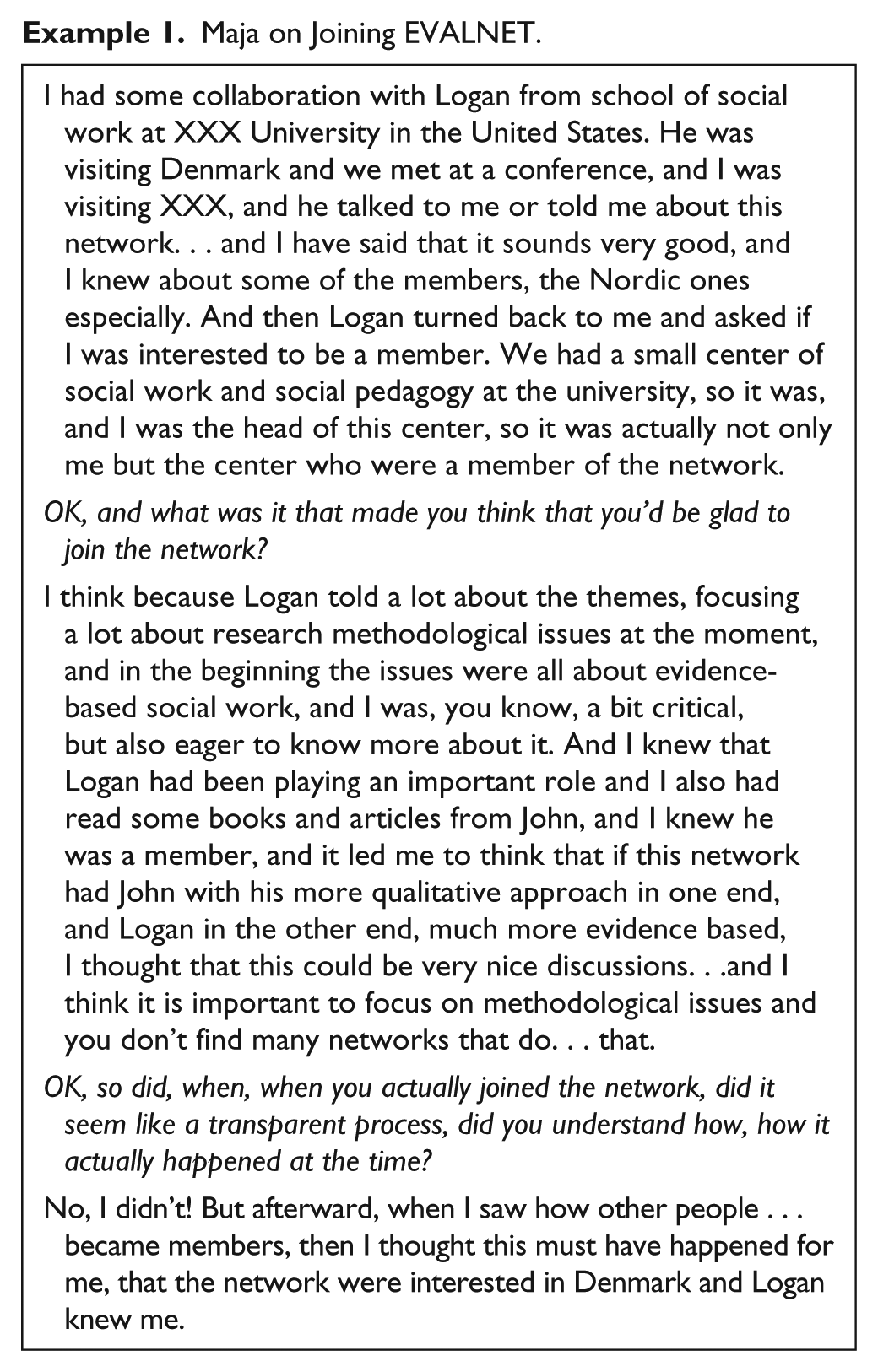
In describing the present arrangements, the main variant was the extent to which the initiative lay with those who wished to join or with the existing network. Maja and Luca gave accounts that demonstrated the dynamics of these processes. Maja (Example 1) joined fairly early but subsequent to the foundation, and Luca shortly afterward.
Maja on Joining EVALNET.
Luca’s account gave more emphasis to his personal agency in actively seeking out a network that would speak to his concerns and interests.
Because all this research and evaluation and evidence-based practice wasn’t really developed in Switzerland, it came quasi-naturally to me to say, “Well, I have to look for an international relationship network, and meet some more experienced colleagues,” and, well I did a little research on the Internet, and saw some information about this network, and it was quite obvious to me that this might be exactly what I was looking for. So I, I made this contact, I asked the. . . who was it, it was a lady from XXX . . . Anyway, I wrote an e-mail and asked if I could join the group, and she was very kind to me and invited me to the next meeting.
He completed his narrative.
I presented a research. . . I don’t remember what it was. . . Well the network decided that this is interesting person, an interesting approach to, to what the network didn’t discuss before, and, and so they took me in.
Asked if the process had been transparent, “I wasn’t concerned about this process. I had the feeling that there are some very kind people, and it is worth to make a visit and look how things were developed.”
What might be observed from these accounts? It is apparent that the sense of membership being network-led receives emphasis in Maja’s account, although with limited at-the-time reflection. Second, the importance of personal dynamics (Luca twice refers to members’ “kindness”) lies close to the surface. Third, in general, the processes were opaque to those on the outside moving in. This should not be regarded as necessarily negative. As Luca remarked, “I wasn’t concerned about this process.”
There was little or no sense that new members were troubled by network-joining processes. Yet, this went hand in hand with uncertainty and ambiguity, even opaqueness, regarding network rules. These accounts of “rules,” explicit or implicit, formal or informal, do not reveal the process of becoming part of a network. Given the nature of the network, joining is unlikely to be fully captured by procedural descriptions. Indeed, it may be that individuals approaching the network as strangers recall it as the exercise of agency and choice, whereas for the network it may be seen more as someone inviting on behalf of the network. Quoting from the early sociologist Georg Simmel, Merton concluded that the objectivity of the stranger “does not simply involve passivity and detachment; it is a particular structure composed of distance and nearness, indifference and involvement” (Merton, 1971, p. 33).
Changes in Membership Status
The endemic fluidity and ambiguity of membership status came to the fore when members changed their status in relation to their home research center or university. When Anders was asked how people or centers left the network, he replied a really difficult question, I don’t believe that any institution as such left the network, at least I’m not aware of that, and, you know, I don’t think that any institution did.
Alexis explained, When the network expanded, it was agreed that we should have a policy about accepting new members and also a policy of “resigning” from the network, especially when a person moves to another institution. This has happened several times, (but) to my knowledge, we have all continued as a member. (John, me, Anders)
The general sense of seeing membership changes in broadly ecological terms was reflected in Logan’s remark “It’s rare in my experience that people have resigned from the network, it’s just more by default.” Unit members may close or change in character, and network representatives may move on, but none of this appears to be sufficient for the network to seek alternative members. For example, “There were individuals who moved around, and I’m one of them. So, when I left for instance (government unit), I kind of lost my institutional membership, but I was extended a personal membership, so it became a mix” (Anders). Similarly with Logan who, although perhaps the strongest advocate of a center-based membership, recognized that “when I no longer directed the centre and XXX became director, then I carried less of an institutional role.”
There is a mirror image of this analysis, in that, while institutions may in formal terms retain membership, once the representative moves on the institutional unit may not continue any active membership. John, for instance, left a Wales-based research unit for a conventional academic role and its membership disappeared. Logan observed that “(M)y centre that I originally directed went out of existence, so its current, the last director, XXX, I don’t believe became active with the network, although he was a member in name.” Similar observations were made regarding other member units in Scotland (“a great loss”) and The Netherlands.
This suggests that center membership of the network always may have been bound up with the interests of the person representing it and, with their departure from the unit, which unit-led interest shifted or faded. In fact, we were unable to identify an example of a network member moving from a member center, and the center replacing that person.
Members occasionally reflected on the meaning of such moments. Speaking of a short-lived membership by a research unit in Germany, Logan suggested “Why they ceased, my assumption is that perhaps they felt less commonality and less . . . motivation to participate.” Martin’s comments seem to indicate how, in this regard, the network could accommodate potentially quite important changes. Recalling John’s move from a research unit in one of the four U.K. home countries to a university in another, he suggests that, although it came relatively early in the history of the network, it was, a kind of test case to say, well, although the focus is on centres that have research programmes, rather than individuals who have research interests, there was no reason that we could see to say, well “Now you shouldn’t be a member”—didn’t make sense at all. So I think that changed the—if you like, if there was a constitution it would have changed the constitution, but there isn’t, so it didn’t.
For those who joined subsequent to the original formation, there was less uncertainty about leaving. Luca simply responded, you just have to declare individually and then it stops. . . And this is the procedure, it is quite informal, and in this way also, in my view, good, because networks don’t, shouldn’t be too much formalized, and this is easy and sufficient if somebody has had enough or doesn’t want to be a member anymore, he has just to declare.
Similarly, Kirsten took the line that “it’s my impression that they just fade away!,” but added “I’m not quite sure about that either. People just stop coming to the meetings and sort of don’t prioritise it, I’m not quite sure actually.” Alexis remarked “I think that, it is as simple that people just don’t show up.” Occasionally someone might retain “a membership of honour” (Luca referring to Logan).
There is a further paradox at work, in that while most later “joiners” brought a research-based institutional affiliation, they seemed clearly to regard their membership as personal. To give one further example, all but one of Maja’s suggested reasons for leaving the network were individual: I think this is very personal to, if people go to another job, another place or are retiring or, maybe don’t find interest in the centre anymore, I think there’s a lot of reasons, and some people came into the centre, maybe came to a few network meetings and then didn’t come again.
Such uncertainty is not necessarily a bad thing. Indeed, perhaps it can be seen as part of the sense of comfort in belonging, such that members are not anxious about departures.
I’m not quite sure if anyone in any formal way decided or informed that they had left the network, I don’t know. To my knowledge, or as I understand the network, it’s pretty informal, which would be in some ways very positive, a good way, a good idea. It’s pretty much up to each and every one to decide. (Kirsten)
Needless to say, shifts of this kind were not wholly endogenous. Martin recalled the loss of a unit in one home country of the United Kingdom as due to external events that meant that people no longer felt they could give the time to the network, which is a way of saying they weren’t getting what they needed from the network of course. . . (T)he network was no longer a network for them.
He took a more general perspective recognizing the interaction of personal and government factors, saying I think you’d probably have to look at the way in which national policy interacts with the opportunities that the network produces, to say some people leave, some centers leave, and some countries just never ever featured if you like, as being on the horizon.
It is clear from the foregoing that how members understand any one aspect of the network’s functioning is intertwined with several other considerations. This was made explicit in Matthäus’s expanded comment on and inferences from an example in the network’s history, which figured in remarks by Alexis and others.
If I am not mistaken my first or at the latest my second participation in 2006 was the last time that a colleague from the Netherlands participated. Since there hasn’t been an attendance for years . . . That does not (imply) that membership of the XXX Institute ceased formally. Generally, the organization of such a network is rather informal. Unlike associations or societies, networks recruit or lose their members easily. In my view there are two indicators of membership: attendance and being named in lists.
Roles Within the Network
The gradual dilution of explicit center-based membership was reflected in the roles of network members. For the first, perhaps, 10 years, the annual meetings were introduced by a rehearsal of significant trends and developments in the member centers and the countries where they were located, but this gradually disappeared.
Three observations can be made regarding how roles were understood within the network. First, everyone identified key role holders. Maja, for example, naming a small number of people who she saw as holding key roles, said “I think that they feel a lot of responsibility and they have passion for the issues . . . and have suggestions for the themes for the next conference.” She subsequently, and perhaps unselfconsciously, described herself in similar terms, I think I feel responsible for the network, and have enjoyed to be responsible for the planning of one of the meetings . . . and I also took the responsibility to, to do the editing work on one of the books.
Perhaps the most commonly cited role was that of holding the network together, or “kind of amalgamating roles” (Anders), although there was no unanimity as to who occupied such roles (Example 2). There is an interesting given-ness of things, an “of course-ness,” at work here, suggesting a shared almost tacit knowledge.
Network Sustaining Roles.

Second, there is an important tension regarding what may be regarded as a creative role-friction. Luca, though not at all the only person to express this, did so relatively fully: We have Anders who is, I have to say, in my words he is the hardliner evidence based practice, and he has this role and he plays this role. But this is not a critique, I mean it is welcome, it is a good thing that he plays the role of the hardliner, the defender of the strict version of evidence based practice, and that again and again creates good perspectives, good discussions, and it’s an important role in this sense. And on the other part, if you want, we have some different people who play the role of the antipode,
3
John and me for example and Maja are more or less playing the role of the defenders of the more qualitative approach, and also a little, how do you say, critical standpoint on evidence-based practice.
As part of this observation, there was a recurring interesting hint that, although there were people whose stance, role, and perhaps even personality may be seen as “controversial” in some contexts, within EVALNET this offered a milieu where this was a positive feature. Luca went on to draw this very conclusion in commenting on the differing stances within the network on evidence-based practice. 4
I even don’t know if, if what I said just, on these antipodes, if these are, if this is really a role they play, because what I like very much about this network is that it really works as a network, as, as a, as a free meeting of free people would meet, meet each other on a, on a really free level, and, and on a, on a, how to say, on the basis of equality. We are not equal in any respect. . . in every respect, but we are equal in, in the point that we are equal members of the network, and this means that everybody has to take responsibility of everything, of the functioning of the network.
Third, there are roles that can be described as providing network-level critical reflexivity. Matthäus remarked “I often see Alexis in the role of a critic who casts a different light on the debate, by fundamentally faceted brief interventions.” Martin also remarked that people like Alexis is a very interesting character in his own right. He’s been with the network almost from the beginning I think, and it’s difficult to conceive of the network without people like that, and he tends to come regularly, which is interesting in itself.
While some members, Alexis for example, are seen consistently as having a certain role, by and large the roles are allocated to a relatively wide number of members. Matthäus detected a role fluidity when he reflected “I realize that roles in the network are not that fixed. The just mentioned roles of criticism and integration, for instance, can actually be taken by each member of the network. By the way, I would regard role flexibility as a characteristic of well-functioning networks, or even general social groups. I see EVALNET as a very well-functioning network,” though adding “If you insist on an example I would consider Logan as a kind of elder statesman of the network,” and later saying of his network map “John, Luca and Maja hold in my view the most ties. So I would conclude that the axes between them are crucial for the network.”
How the Network “Operates”: Resources, Technology, and Making Decisions
There were instances when people wondered if there were downsides to the absence of formal roles, but even then the concern was expressed very hesitantly. Matthäus thought that “Some more management and organization could be good for the network . . ., could be good,” but immediately entered a reservation. “I am not sure about that because on the other hand the non-hierarchical and informal structure of the network contributed to its success.”
The network has no external funding. This is a consequence of the autonomy and freestanding character of EVALNET. Funding almost always comes with external monitoring or shared agenda setting, but its absence may seem to have a risk attached, which members need to either pay for the costs of participation out of their own pocket or secure backing from their own university or research unit. Logan seemed to assume this when he said, “because two years ago I began phased retirement and I no longer had travel money and the resources to participate, my activity decreased.” Yet, movements in and out of the network seem to be linked more to the extent one shared the goals and modus operandi of the group, rather than the presence or absence of finance.
In response to questions whether members thought that developments in technology had influenced the network, one member recalled that there had been “a fleeting website hosted by XXX, funded by contributions from each centre. After the first couple of years, it was rarely updated, however, and there was little support for its long term visibility.” Typical responses from members were, no, we missed completely the Internet development. I mean we had a website, and still have, but this is more or less a joke, and we don’t use social media as far as I know, at least I don’t use it. We use of course e-mail, but that’s an old technology in the sense it existed before the network came into being. (Luca)
This occasionally seemed to provoke surprised realization, as when Martin commented: Surprisingly little I think. We don’t Skype each other, to my knowledge; there haven’t been meetings which have been convened by that method, though there obviously could be. No, I don’t think so, I don’t think it’s influenced at all by that, not even in terms of research methods that I can recall. . . Remarkably insulated!
This should not be explained in terms of individual aptitudes or practices, because several network members were fully conversant with and active users of, and even writers about, the pervasive apparatus of contemporary communication. This apparent paradox was explicitly remarked on by Alexis. His response to the general question about the network’s engagement with technology was the standard one—“we don’t use them very much”—adding, as with Luca, “there was the idea of having a webpage, but it was a catastrophe, it was very, very expensive and it was badly maintained, and I was opposing the idea, but I didn’t voice myself clearly.” He then made the point that this was a network matter because “there are people like Martin who likes to play with gadgets,” before adding even more strikingly “I myself too, but it’s a different topic, it’s not so much about the network.” Even when someone may think the network was missing an opportunity in this regard, it remained a marginal consideration.
Here, we encounter again the extent to which the network’s nature and activities are interwoven. Although some details would be seen differently by some members, an extended passage from Logan’s reflections brings this out explicitly: (T)he members of the host organisation played the key role . . . in terms of communicating to membership, providing resources for the annual meeting, selecting the final theme, taking responsibility for organising the programme. So that’s the way . . . the network operated, so that’s, that’s a key set of roles, and that shifted each year, so everyone, you know, played their part. That’s probably unique to this network. . . that it gave everyone a role and it dispersed authority and dispersed responsibility in a very nice way, and individuals paid their way to attend meetings, but centres provided resources from year to year.
Collaboration—Internal and External
As part of the initial survey, we asked if participants were involved in other research-related networks. Most claimed they were (16) though three were not and three more were uncertain. 5 However, it would appear that networking in EVALNET rarely was carried over to networking together in other settings, because apart from the Campbell Collaboration (two) and a network on evidence-informed practice (also two), no single network was listed more than once. Asked regarding their networking activities in the previous year, answers were generally vague—“research global collaboration” and “Nordic collaboration” give the flavor.
The interview data elaborated and reinforced this commitment to collaboration. Kirsten, for example, was in no doubt that international collaboration was important. For her personally, “I think all the projects I have been working on for many, many, many years have been collaborative; can’t remember doing anything but collaboratively.” Indeed, it’s increasingly important. . . (T)o do research together with people from other countries is important in terms of getting funding, and of course it is important most of all for what you get out of the research. . . Norway is a small country. . . we need to be in contact, pick up ideas, and also we have a very well-functioning welfare state in Norway, so I also think we have something to, to contribute. . . possibly foremost on [. . .] research on practice and practice oriented research. . . and, and in the Nordic countries, Sweden, Denmark, Finland, also contacts in Iceland.
Luca had much the same to say, in that research completely without collaboration would quite soon lead to turning around in circles and not getting into new areas of knowledge, and new areas of experience. Also in a methodological sense, or in a social or personal sense. So for me research collaboration is a fundamental component of research in itself.
Almost every member enjoyed valued collaborative links outside the network, Matthäus being the only exception. Yet, collaboration has some links to personal qualities. Alexis, for example, remarked I have been working alone for quite many years, and I know the agony which is connected to this lone work. But maybe I should say that you can still be individual when you are working together with somebody else. It’s only part of the work.
There are complex nuances to this question. Logan gave voice explicitly to one consideration. Looking back over his career, he concluded, “collaborative work is very important, but I still value solo work as well, and I would say collaborative work is probably 80 per cent of what I do.” Asked why he thought this was the case he said, “I think because the work, the issues that we face are more complex and probably benefit from collaboration,” and spelt out how this had worked for him: (T)rans-disciplinary collaboration is very important, secondly collaboration with my former doctoral students has been very important, in terms of publications, presentations, and that continues. And then there is collaboration in publications and writings with some network members, in particular with Anders and the Swedish group.
National domicile, with its associated scholarly conventions, also plays a part. For example, social work writers in the United States are more likely to publish jointly with others, than are their contemporaries in Europe (Shaw, 2016, pp. 128-129). Logan’s reference to Anders points to a relationship that also existed within the network. For Logan collaboration has been very important, in many ways since 1997, ‘98 and so forth. My own work has been very much impacted by what I’ve learned is going on in other countries, and what I’ve heard from network members, and my publications, papers, professional papers, have been much influenced by network, network communication, collaboration.
This points to the question regarding the outcomes of the network, and the limited extent they are tangible and direct, but intangible and indirect. One might anticipate that active collaboration between network members would be more extensive and prominent than appeared to be the case. Exploring the extent to which there were shared primary fields of research in which members were engaged, unlike many other loose organizations or networks, there was little evidence that fields of research (such as young people, criminology; children in care, attention deficit hyperactivity disorder [ADHD], child protection, social security, social care, aging, dementia, trafficking, female genital mutilation or mental health, all of which were mentioned) were the “glue” that held the network together. 6 It was not substantive fields of shared concern that bound the network together.
However, if this appears to suggest that the network may be held together instead by a shared approach to doing research, the inference has limited support. Asked their personal methodological orientation, although at least seven regarded themselves as qualitative researchers, four described themselves as multimethods, and others, in terms perhaps similar, simply said “wide” or “eclectic.” There were mentions of “critical realist,” “realist,” and “constructivist.” Indeed, we have seen that it was the network’s apparent success in holding together seemingly opposed positions that drew Maja to EVALNET.
We need to turn to the interviews for a plausible explanation of the social adhesive of the network. It may be assumed that the network facilitated research collaboration, but by and large this had not happened. Logan expressed it bluntly. “(I)t’s pretty clear that the strongest research linkages are outside of the network, if, a case in point with myself, most of my work has nothing to do with the network.” However, collaboration was seen as one possible untapped potential. Kirsten provides an interesting outworking of this aspect of the network. She said I haven’t done any research with any of these people, or written together, but the potential is there, and that is important. . . (I)f we had written, if we had done research together, written together, and [. . . ] could have been more, played a more important role [. . . ] as a network. . .
Yet even in this case, Kirsten repeated 2 or 3 times, “I’m not quite sure” as to whether this was important for the network’s health. Martin had a clear view. For him “within the network itself the connections are not based on joint empirical research projects. They’re based much more loosely on a commitment to the concepts of evidence and policy.”
In the nature of things, collaborative links may not be wholly transparent, though even in a close-knit network such as EVALNET, there may be uncertainty about who collaborates with whom. This surfaced when Kirsten hesitated, I’m not sure about that, because I haven’t been that involved, so I, I’m not, I’m not quite sure actually, I know that Maja and John, and I don’t remember who else, I remember [. . .] edited a book from one of the meetings,
and went on to say I don’t know, but I think the relationship between, I think Anders and Logan and John, and I know John has been involved in XXX, so I think there’s a strong link between John and Martin, but beside that I, I do not know.
None of these relationships were remembered in quite the same way by the people named by Kirsten.
Being Collaborative
A related question is the extent to which network members are seen by others as collaborative, and how far members feel aware of how others see them. Luca considered this in the following way, showing both the extent to which network links are personally valued, yet, the uncertainty that surrounds such judgments: I really don’t know, I don’t have a clue, it’s difficult. What I know from feedbacks, and some collaborations, is that . . . the others perceive me as a valuable member in the way that, that it is possible to go beyond the meeting together. For example with John, obviously, which he is one with the most close collaboration, the last few years, writing together, organising the XXX conference, all this comes out of the network of EVALNET, and the relationship that, that was created in this case between John and myself, and it is an expression of, of trust and, and yeah. So I guess, I hope the others see me in a similar way . . . and yeah, I think this is, this is how they see me.
External links were both cause and effect of internal network associations. The difficulty of separating directions of influence was marked, as was the element of unpredictability. Martin observed the Swedish people would look towards North Americans and say, “Well, we need their input,” so there were connections there. So on the network map I’ve drawn . . . a line between Anders and Logan, to show that kind of connection.
Likewise, Maja made a very close working relationship with Logan for example, and went on several trips to New York and invited Logan to Denmark, and that was a connection which helped to bind the network together, and was not one you could predict on the basis of mutual empirical research interest.
Martin went on the express it as follows. “Outside of the network I know that people have collaborated on work, and I think that is perhaps facilitated in some way by the network, but it’s not dependent on it, which I think is an important distinction.”
This may illuminate another feature of the network—an awareness that some in the network had links that were not fully understood by others, as when someone remarked “There was quite a strong UK, I don’t know, coalition maybe, I don’t know. Anyway, I guess that there were some important relationships among this group.” Here we can see things being assumed. Assumed knowledge is interesting. Networks, even when they go beyond narrow intellectual work, carry this invisible assumed knowledge, and in ways that those about whom it is assumed would often say “no, it’s not like that.” But in a strong network such as EVALNET not knowing for certain did not seem to matter.
Directions, Changes, Transitions, and Futures
The impression of a network in transition came throughout the study. This was apparent in the quite frequent use of the past tense. Network changes were of four kinds.
Changes in national or governmental contexts.
Shifting network members’ associations with government, centers, and universities.
Changing ways in which evidence-based practice was central to the network.
Changes in forms of within-network collaboration.
Martin scanned the wider horizon: There’s a European wide disinvestment in social services, social work, social care, research centres, so government is stopping its funding to XXX next April, the Finnish Institute is now part of a healthcare research centre, same for the Swedish institute, so that there’s a rationalisation across Europe, and that’s got to do with economics and so on.
This was associated with shifts in the focus of network attention, and in turn the constituency of the network.
The discussion about national policy is not so much on the top of the list as it was when we started. (Alexis) In the beginning it was more persons coming from centres, and I don’t think that’s the case nowadays, I think we are all members of centres, but it’s not the issue or the agenda in the network anymore. I think that’s one thing. The other thing is that the agenda about evidence based social work was much more heavy in the beginning. . . but not any more I don’t think so. (Maja)
There was a sense of the network drawing toward a natural end.
I was quite sure that it’s going to be ending in Basel (the venue for one annual meeting). I thought that that would be the last meeting. . . During . . . several meetings I have been taking part in during the last few years, I have had this feeling that this is going to be the last meeting and so on. It is probably the fact that, that some of the members, the key members have been retiring, like Logan and John is going to retire quite soon, and so on.
Yet the interesting question about EVALNET is not whether it survives, but why it has continued for almost 20 years. Alexis, whose words we have just quoted, went on to say that “during that meeting . . . we decided to meet again in Jyväskylä. . . So probably it’s not going to be ending soon as I thought.” He added “But now I have this odd feeling that it is still enough, there is still enough interest in the membership to go on with these meetings, and so probably it’s not ending.”
But there remained a shared sense that the network was in uncertain waters.
Things will change certainly. . . A lot of people who were important, who are important, not only because of what they represent but because they make network events happen, they’ve got resources to put into it, they’re people who can bring in other related members and issues. That I think is, is changing. (Martin)
If the network is to survive There’ll have to be new leaders. Leadership is important in this network. Although you can’t always identify it clearly, there are people who exercise leadership roles, who you would walk into the room and you’d watch, and you’d think they’re not contributing. (Martin)
As almost always the question of the basis of membership was to the fore, surfacing the undercurrent of the merits or otherwise of representative membership status. A wish for the network to continue was expressed in different ways, in addition to Alexis’s remark. Most unambiguously, Maja said “I hope that we can find a way to have our meetings in connection with the annual European Social Work Research Conference, and that we will, yeah, last forever!” Kirsten shared the wish if with greater doubt: I’m not quite sure, I’m really unsure if it’s going to last or not. If it lasts I feel it’s important for me. I haven’t been involved in any writing and, or research projects with [. . . ], but I think it’s a way out of a small country like Norway, to keep updated on what’s going on in America and elsewhere, and maybe it’s more important to me than to, to many of the other members, I’m not quite sure, I would like it to, to continue.
Conclusion
What collaboration is, and why scientists should collaborate, are, as Hackett (2005) suggested, deceptively simple questions, although ones little explored or understood in social work. Perhaps the most obvious, yet significant, feature of EVALNET is that a long-sustained and in certain ways deeply valued network entailed a complete absence of direct, network-sponsored collaboration in empirical work, or indeed endeavors to secure such work.
This did not mean that the perceived benefits of collaboration were purely expressive rather than instrumental, but rather that the expressive and the instrumental were intertwined rather than opposed, often in indirect ways. Member roles, fluidly adopted or prescribed, were not directed either to group harmony or goal directed. The distinction rarely seemed to make sense within EVALNET.
The network exhibited characteristics that, in most contexts, may seem counterproductive. “Ambiguity” and “uncertainty” are terms that recur constantly through this article, whether they relate to membership criteria, who actually is a member, how one leaves the network, who collaborates with who, and so on. Yet for EVALNET, this was rarely viewed as a weakness and more often almost celebrated. This perhaps is best explained within the context of the mutual trust that members noticed, but also in terms of the interweaving of instrumental and expressive roles.
Advocacy and promotion of research collaboration understandably tend to promote goal-directed, outcome-oriented accomplishments. Such collaboration is, by its nature, likely to be limited to project-led and probably externally funded programs. But, as a foundation for extensive, moment-transcending, community identity labor, these same inherent qualities are likely to prove its limitations. By contrast, this article illuminates forms of collaboration typically deemphasized in social work research. It was not characterized by consensus, but required role friction and creative reflexivity, where uncertainty and ambiguity often were productively endemic.
Future social work and social science research should contribute to wider fields by examining how social work and cognate kinds of science manifest different forms of collaboration, and to understanding the consequences of such collaboration (Cummings & Kiesler, 2005).
Footnotes
Declaration of Conflicting Interests
The author(s) declared no potential conflicts of interest with respect to the research, authorship, and/or publication of this article.
Funding
The author(s) received no financial support for the research, authorship, and/or publication of this article.
