




Abstract
Considering the current political climate and the terrorist attacks associated with few Muslims around the world, being Muslim females in the United States is challenging. While our religious identity is visible by our Islamic attire, we found ourselves in the frontlines fighting against hatred, stereotypes, bigotry, and racism toward Muslims. In this article, we present our experiences of living a non-White existence when teaching at a White institution in higher education in the United States. Adding to the existing body of research about Muslims in the United States, the study aims at shedding the lights on this experience of Muslim female academics to raise awareness about such struggle and to promote more inclusive environment for Muslims in educational sphere. To voice these experiences, we utilized poetry as a research method by selecting poems from our poetic autoethnography. The analysis of the poems revealed three major themes: (a) Conceptualizing Agency, (b) The Muslim Ban, and (c) Challenging Diversity. In addition, the findings of the study suggest that poetry can be healing and empowering.
Introduction
It all started with the Women March on Washington in 2017. A picture of a Muslim woman wearing a Hijab or headsacarf was used in the official poster for the Women March to amplify the diverse voices of women in the United States who fight for equality and justice (see Figure 1). This powerful signage makes us wonder what does this mean for two transitional Muslim academics working at a predominantly White institution in the United States. Because it was not usual to witness a historical change in the face of hijabophobia, this image empowers us to share our contemporary experiences as Muslim women who are witnessing a change in the image of hijab from a sign of oppression to a portrayal of resistance. Seeing the protesters carrying this powerful signage was overwhelming for us because it felt as a sign of recognition of a shared sense of feminism. We felt that finally there is an acknowledgment of our existence. This feeling left us wondering how would this change transfer to other contexts like our predominantly White institution where we are “living a nonwhite existence” (Mirza, 2013, p. 3).
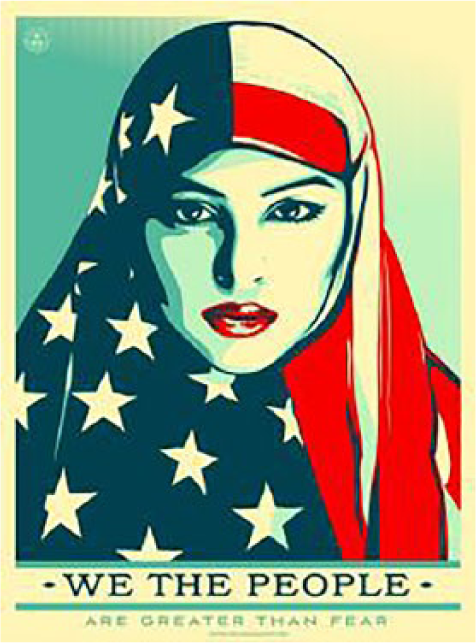
As Muslim females living in the United States, we face multiple levels of oppression and marginalization as we try to survive daily. Islamophobia and similar bigotry discourse is alarming for us and hinder our existence where we feel our rights are lacking and diminishing. According to Figueroa (2012), Muslims currently have limited access to free public speech and more likely foreign Muslim scholars will be rejected to contribute to the country because of their religious background. While living this fear of being rejected and traumatized by the misrepresentation of our visible religious identity, we believe that sharing our experiences as Muslim scholars is needed to raise awareness about our fight for justice and equal opportunities for underrepresented minorities, particularly veiled Muslim girls in public education.
Theoretical Framework: Intersectionality
As our stories emerged out of a long silence in a foreign context, as a theoretical framework, we employed the “embodied intersectionality” that was developed by Mirza (2009) to reconfigure the complexities of the powerful yet hidden stories of Muslim female academics in higher education. According to Mirza (2015), the notion of “embodied intersectionality” seeks “to make sense of the black ‘othered’ woman’s symbolic and narrative struggle over the defining materiality of her educational experience” (p. 2). This framework has originally emerged from Kimberlé Crenshaw’s (1989, 1991) work to configure the ways in which women of color’s race, gender, class, and other social division intersect and shape their lived realities. Intersectionality provides powerful analytical tools to understand the complex everyday lives of Muslim women who are simultaneously positioned in multiple structures of dominance and power and configured as dangerous, oppressed, and powerless (Abu-Lughod, 2002, 2013; Mohanty, 1993, 2003). Furthermore, intersectionality as a framework provides a unique feminist epistemology that is contextual and contingent in which it scrutinizes the ways in which the logics of race, class, and gender along with other social divisions such as sexuality, age, disability, culture, and religion structure women of color’s lives in different historical times and geographical places (Leavy, 2017; McKittrick, 2006; Mirza, 2015; Yuval-Davis, 2006).
This article draws on personalized embodied accounts of veiled Muslim women who face openly hostile hijabophobia in a climate of sanctioned gendered Islamophobic discrimination. In addition “how are our individual biographies differently shaped by the status characteristics and the structure of inequality they produce?” (Leavy, 2017, p. 4). Our lived histories reveal the ways in which our religious, ethnic, and racial identities beings are manifested through our expressions of faith especially when our Islamic attire/dress has become interchangeable with essentialist notions of ethnicity and religion. Therefore, the research question that guides this study is what are the ethnic and gendered experiences that we have in such diasporic space?
Autobiographical Poetry
Although using poetry as research is still skeptical, Faulkner (2018) among other researchers stressed that the power of poetry is “its ability to be embodied experience; to be fun, political, lyrical, and narrative” (p. 209). Poetry has been widely used as a research method across interdisciplinary areas. Researchers within these areas used a myriad of names to refer to poetry when used in research. It has been labeled as poetry as research (Hanauer, 2010), performance poetry (Denzin, 2005), autoethnographic poetry (Faulkner, 2014), and narrative poetry (Furman, 2004), to name just few. Recently, Prendergast (2009) used the term poetic inquiry to “encompass the diversity of poetic forms and labels researchers used labels researchers used in her extensive annotated bibliography of poetry as/in qualitative research” (Faulkner, 2018, p. 209). In this study, we used the term autoethnography (Furman, 2004, 2006; Elbelazi, 2017)poetic inquiry to refer to our intersected embodied experiences within White institutions. There are many reasons why we decided to use our own poetry for this study. First, poetry writing carries artistic and aesthetic features that touch the human emotions and make the work more powerful and influential (Hanauer, 2010; Leavy, 2009; Shapito, 2004); it also highlights the experiences of the marginalized around the globe (Hanauer, 2012a, 2012b, 2014; Sinner, Leggo, Irwin, Gouzousis, & Grauer, 2006). According to Hanauer (2003), autoethnographic poems present “an insight into the hidden conceptual and emotional world of the individual” (p. 78). Furthermore, since we, the researchers, wrote the poems over a period of time as a way to express our feelings being minorities in a predominantly White campus, the current study adds to the existing literature of researcher-voiced poems (Furman, 2004; Furman, Langer, Davis, Gallardo, & Kulkarni, 2007; Furman, Liets, & Langer, 2006; Huss & Cwikel, 2005; Puwar, 2004; Elbelazi, 2017; Hanauer, D. I. 2010; Shapiro, J. 2004).
Data Corpus
According to Leavy (2017), “P[p]ersonal stories are uniquely powerful. Stories connect us to one another. They reveal people and their circumstances, inviting others to develop new understandings, awareness, and at times, empathy. Whether our experiences are similar or different, authentic stories resonate” (p. 4). The data generated from the study are based on our personal story in a poetic rendition. As poems serve as data and evidence (Furman, 2004, 2007; Hanauer, 2014; Shapito, 2004, 2007), this study uses our autobiographical poetry as research methodology built on Furman’s research framework. Our poems also “[have] the credibility to create useful, credible, and trustworthy truths that are hard to discover in other ways” (Shapito Shapiro, 2004, 2004, p. 174). The data compiled in the study are collected over 1 year of writing and reflection. We began by writing poetry as a therapy that involves us in self reflection and recognition (Furman, 2004). Our initial aim was writing poetry as a healing process and to see how our experiences intersect from within our identities as Muslim academics wearing veils and the institutions we engaged with during our stay in the United States. We wrote 32 poems in total; however, because for privacy issues and the sensitivity of the contents, we chose only eight poems. According to Chan (2003), “[p]oetry writing was found to be therapeutic during my doctoral study by relieving stress, promoting self understanding and filling my emptiness” (p. 5). The poems collected in this study were effectively healing because poetry writing created a platform to voice our silence and recognize our existence.
Built on Furman (2004, 2006, 2007), after we gathered the poems, we organized them according to their shared perspectives. We sat everyday for two weeks to code the poems and classify them under themes (Fig. 2). These themes are (a) Conceptualizing Agency, (b) The Muslim Ban, and (c) Challenging Diversity. We decided to exclude other poems about living in the United States with our families for further research. The aim for this study is to shed lights on veiled Muslim women experiences in a predominantly White institution and what does it mean to be a veiled body in a non-Muslim community.
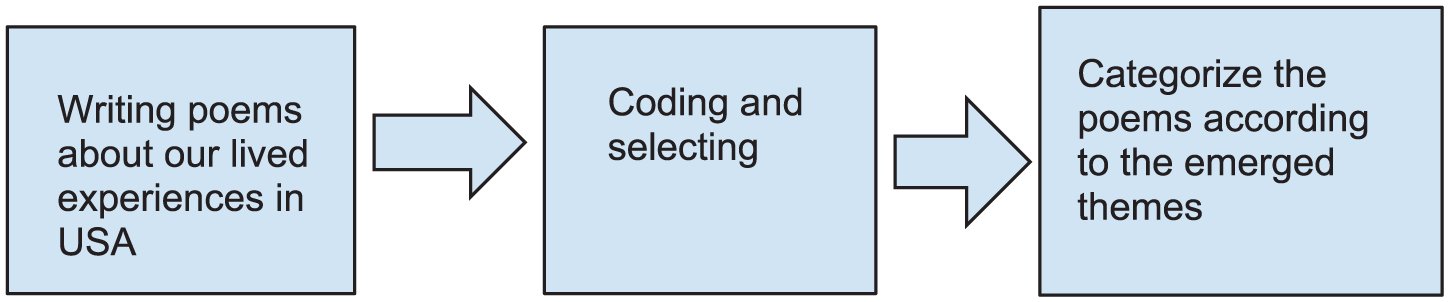
Flowchart of data analysis.
Results
Our poetic testimonies highlight our struggles as minorities in public higher education. After coding the poems, there are three emerging themes: (a) Conceptualizing Agency, (b) The Muslim Ban, and (c) Challenging Diversity. In the following section, we present the poems according to those themes, and then we offer a discussion of each theme.
Normalizing My Existence
Coming to the class as usual This time I wear my Abaya The students were whispering It was not comfortable I collected myself I asked: Do I look different today? They said YES! Reluctantly, replied What you wear is associated With terrorism and oppression
The thing on Your Head
Once in the hospital The nurse asked pointing at my head “Can you take it off? I looked confused She replied The “thing” on your head?” At that moment I realized A piece of cloth on my head Is more visible than me
Banned
A week after the presidential inauguration On Friday January 27, 2017 Everyone heard the news People from six predominant Muslim countries Were banned from entering the United States My country, Libya, was listed The news was everywhere On Facebook On Twitter On all media space I was terrified and lost What should I do? Is it safe to send my kids to school? Is it safe to walk outside with my hijab? How will people react? How will I teach? My students knew I am from Libya Will they ask me to leave their country? I was scared! Looking around expecting support Support, But wait! I am not French I am not white I am not western I am just a Muslim woman of color Not a big deal! Why would anyone care? I went to the class terrified The students were looking at me expecting me to say something I could not say anything This is their country And this is their president I remained silent as usual I went home to find my son crying He was told to leave the country The kids did not want to play with him Because he is Libyan He is banned! “banned” is the word I always hear Even if no one says anything “Banned” is not new for me It only became legal Banned gave people the right to abuse me and my family And people from the same six countries
Scapegoat
It is true that my country was not included in the ban, all the innocent people coming from my country Were blamed again for 9/11. Many people wish that my country was the one banned Because it makes more sense Why do we need to find a scapegoat for injustice? Isn’t humanity indivisible? Why are we looking for reasons to discriminate?
I remember When I shared an Arabic comic in my class The way the students looked at me I felt I am an “exotic other” I need to justify everything The choice The language The clothes All I see is “white” everywhere That’s what it looks like in my class It is not that I only see skin color I want to see mine, I would love to belong
Postscript
Conceptualizing Agency
The first two poems highlighted the teachers’ unique experiences as Muslim woman wearing Islamic traditional attire that includes hijab and Abaya, a full-length garment worn by some Muslim women. These experiences particularly focus on their daily struggle as veiled Muslim trying to sustain their agency without being devalued or humiliated as teachers. For one of the teachers, the first poem was about wearing Abaya in a class in the United States. The students’ reaction was shocking, as they did not expect their teacher to wear that kind of dress, which is usually associated with terrorism, fear, and third world (Abu-Lughod, 2002, 2013). Apparently, the students’ reaction was influenced by the dark image that the American media is presenting about Islam and Muslims around the globe.
The second poem depicts what does it mean to wear hijab in educational contexts for the researchers. The poem also shows that the teachers’ identifiable attire becomes a symbol of their embodied intersectional identities in highly Islamophobic contexts. In these contexts, teachers’ collective expressions of Muslimness overpower their sense of “Self.” This is apparent in the line that expresses the ultimate reductionism when a piece of cloth becomes more powerful and present than the woman herself. This piece of cloth becomes the identifier that indexes a complex layer of this Muslim woman’s racial, gendered, and linguistic identities.
The third poem expresses a strong sense of conceptualizing agency in relation to religious identities which echo Saba Mahmood’s (2005) account on Muslim women’s embodied gendered religious identities that move beyond Western imperialist notions of emancipation, agency, and empowerment. In Mahmood’s (2005) theorization of agency, she argued that it is misguided to construct agentive acts only with the ones that resist the norms, agency can be defined in the many ways that the self-determining individuals inhabit the norms and assert themselves in their culturally mediated and socially situated representation.
The Muslim Ban
In January 27, 2017, the president Donald Trump signed an executive order that ban citizens from six Muslim countries entering the United Stated for 90 days. This executive order created fear and uncertainty within the Muslim communities in the United State even those who were not targeted by the ban. The first poem expresses how the teacher felt while she was directly impacted by the executive order as her country was one of the six-targeted countries. The teacher indicated that she acted normally because she did not want to essentialize herself. However, she was afraid that someone might confront her or attack her for her ethnical, racial, and religious identity because of the gendered Islamophobic discourses. The era of Trumpism revives hostile discourses of bigotry, racism, and discrimination that similar to what Muslims have experienced after 9/11. The teacher expressed that she dealt with her fear and struggle alone without healing strategies or words that help her cope with the anguish that racism and discrimination cause in her daily lives.
Although the teacher in the second poem is not from the six-targeted countries in the executive order, she was impacted by the hatred discourse against Muslims in the United States. All innocent people from her country were blamed for 9/11 and were scapegoated to justify the religious discrimination that underlies the executive order of Muslim ban.
Challenging Diversity
This powerful poem expressed what does it mean for Muslim women in be living “a nonwhite existence” in transitional contexts (Mirza, 2013, p. 3). The Muslim female teacher here problematizes “diversity” stories in which they do not always encompass inclusiveness (Ahmed, 2009). On the contrary, working in institutional spaces of whiteness can invoke feelings of otherness. Such situations, as Mirza (2015) indicated, complicate “the heightened visibility for the ‘invisible’ in our polite and genteel corridors of higher education” (p. 5).
Conclusion
The untold yet powerful stories of two Muslim women teachers in the United States display snapshots of their daily struggles at higher education institutions. Considering the current transitional era in the history of the United States, we as Muslim and non-White teachers of English had to fight against the hatred discourses about Muslims while living and witnessing different layers of discrimination, bigotry, and racism. Our role as educators and Muslim women is to unite our efforts to help in promoting justice, equity for all teachers and students of color regardless of their ethnicity, race, or religion. We should engage more in diversity training programs not only as an audience but as initiator and leaders to support those minorities who are going through similar microagressions and experiences. Instead of being always at the back seats listening to people lecture about us and our needs, we should be the one who involve in this dialogue and lecture the world about those marginalized voices. The educational institutions as a central pillar of democracy should be also the place where teachers and students feel secured and welcomed. By using poetic autoethnography as a research methodology and through intersectionality lens, this study aims at (a) raising awareness of Muslim female academics’ experiences in the United States to highlight the lack of healing strategies and resources of traumatized and endangered minorities; (b) using these experiences to build a higher education that promote justice and inclusiveness; (c) promoting poetic autoethnography as a legitimate methodological approach in qualitative research of TESOL teacher education (Florio-Ruane, 2001; Johnson, 2007; Kamhi-Stein, 2004; Park, 2013) and (d) using poetry writing as a healing practice to the marginalize and traumatized individuals.
Footnotes
Declaration of Conflicting Interests
The author(s) declared no potential conflicts of interest with respect to the research, authorship, and/or publication of this article.
Funding
The author(s) received no financial support for the research, authorship, and/or publication of this article.