




Abstract
In January 2017, six doctoral students and an assistant professor came together under the guise of a “Readings in Educational Research” course that was created on the topic of post-qualitative inquiry. Using St. Pierre’s descriptor of the “posts,” the course involved engagements with poststructural, posthuman, and new materialist philosophies. Inspired by the concept of the meanwhile, this article pulses with the question: What do intra-active qualitative inquiry pedagogies produce? In this inquiry, we (teacher and students) consider meanwhile as entangled, layered, and complex pedagogical events/enactments produced in the post-qualitative readings course, crossing with/through time, place, space, and bodies.
To be honest, this class is one I can’t get out of my head . . . or like, I can’t unfeel it. I saw things and felt things differently than I ever had before . . . We were invited to become differently, and this is what we did . . . and are still doing.
- Briana
m e a n w h i l e

Becoming Posthuman. Photograph and in-process sculpture by Courtney. Created for the class.
m e a n w h i l e
In January 2017, just weeks after a rare Alabama snow, we (the bodies we are, the bodies we felt, the bodies still unfelt) assembled together in a small conference room on the first floor of the education building. Six doctoral students and an assistant professor, we sat around an oblong table under the guise of a “Readings in Educational Research” course that was created on the topic of post-qualitative inquiry. Using St. Pierre’s (2014) descriptor of the “posts,” the course involved engagements with poststructural, posthuman, and new materialist philosophies. Each of us picked up the stapled packet of papers distributed, reading the description on the syllabus:
This course considers and critically examines contemporary dialogues and debates in qualitative inquiry. For spring 2017, the course centers (and decenters) around the notion of the “posts.” The readings engage students with the various theories, perspectives, criticisms, and arguments associated with post-qualitative inquiry. The aim is not to reach consensus, rather to grapple with the layers and complexities in the current qualitative landscape.
Layers and Complexities
At that moment, we had little understanding of how these layers and complexities would manifest in the classroom. What they would do within and outside the spaces of the conference room, what they would do within and outside all the bodies involved. Furthermore, there was no way to predict with certainty how the pedagogical decisions made in the readings class would enact on and with the students, with us all.
As we thought back on that semester, all the students in the course were invited to write this article and were asked to send work from the course, to create something new, and/or to respond to three prompts:
What do posthumanism and new materialism make possible/make different in the classroom?
What events/moments/experiences/intra-actions linger from the semester?
• What questions persist? What are you still grappling with in terms of post-qualitative inquiry?
Of the six students, five accepted the invitation and provided artifacts that are threaded through this inquiry. With these responses we initially asked, what did this course do?
Through the course on post-qualitative inquiry, we engaged with poststructuralism and posthumanism and thought about how related theories might inform and be informed by our methodological work. It was also in the course that we became awakened to how pedagogical decisions about course design and teaching made by Kelly reflected posthumanism. In other words, just as philosophies and theories entangle with qualitative practices (e.g., Jackson and Mazzei’s (2012) notion of thinking with theory), they can also inform pedagogical practices (e.g., teaching with theory). Even as we were situated within a post-qualitative readings class, we also became interested in how Kelly entangled the readings on posthumanism with certain pedagogical practices, asking: How did Kelly embody posthuman theories through her pedagogy? What did/does posthuman theories produce?
As we considered these questions and what would become of our writing, we remembered being affected by a short paper that Maureen wrote and shared with the class. We were rapt with her conceptualization of meanwhile as a framework for exploring the enfolding of seemingly disparate events that zigzagged across time, putting them in relation as they created something new. Inspired by Maureen’s work, described in more detail below, we extend our thinking of meanwhile as a concept with both theoretical and pedagogical implications. Here, we think with meanwhile as a posthuman concept and pedagogical practice that is inspired by Barad’s notion of intra-action and Braidotti’s nomadic philosophy. Through a posthuman perspective, intra-action means that we are entangled with/in a fluid and shifting world, where both living and nonliving bodies perform on and with one another (Barad, 2007). In other words, intra-action means that all bodies in and outside a classroom (human, nonhuman, ideological) have the potential for agency—they can affect. Meanwhile became a pedagogical practice cultivated by Kelly in which the students could consider and attend to intra-actions within the classroom and beyond. A meanwhile pedagogy, then, seeks to awaken individuals to the in-between, akin to the intra-actions of Barad (2007) where once-perceived boundaries between bodies collapse, and the line between affected and affecting becomes unclear.
We also envision meanwhile pedagogy with Braidotti’s (2013) nomadic philosophy, similar to what she described in terms of the nomadic subject as inhabiting “the fleeting co-presence of multiple time zones, in a continuum that activates and deterritorializes stable identities and fractures temporal linearity” (p. 165). Meanwhile nurtures a way for us to consider nonunitary and feminist subjects (us) as inhabiting and moving among nonlinear time and fluid spaces. Thus, the meanwhile inspired a process of pedagogy and—for this article—of writing that embraces a zigzagging inquiry of self and memory, disrupting time zones of then and now. Braidotti (2013) explained, “Freed from chronological linearity and the logo-centric gravitational force, memory in the posthuman nomadic mode is the active reinvention of a self that is joyfully discontinuous, as opposed to being mournfully consistent” (p. 167). Pedagogically, meanwhile emerged through cultivating a tolerance for discontinuity, of incompleteness, of different expressive languages, of being-together, and of process all while students grappled with the complex movements of the course. Meanwhile, then, is the confluence of a nomadic, disruptive, and relational temporality.
Inspired by the meanwhile, this article pulses with the question posed by the guest editors for this special issue: What do intra-active qualitative inquiry pedagogies produce? This work endeavors to show what such pedagogies do, and how they were (and are) part of the living-theorizing of the readings course and beyond. In this inquiry, we (teacher and students) consider meanwhile as entangled, layered, and complex pedagogical events and enactments produced in the post-qualitative readings course, crossing with/through time, place, space, and bodies. Meanwhile is our pedagogical practice.
As meanwhiles enfold, our narratives of then and now, visual and verbal, theoretical and pedagogical, plug into one another. In what follows, you will experience intra-actions of writing and creation (e.g. Figure 1) from the duration of the semester as well as those written/created well after the semester concluded, all intertwined with recent additions as we (now) further explore the meanwhile as a theoretical and pedagogical concept. Notably, at times the text is not attributed and represents a collectivization of we, and other times the writing is attributed to a specific contributor, even as we acknowledge that we are always present. The assumption underlying our process of inquiry might be best articulated by Braidotti (2013): “thinking and writing, like breathing, are not held into the mould of linearity, or the confines of the printed page, but move outwards, out of bounds, in webs of encounters with ideas, others, texts” (p. 166). Thus, we invite the reader to be swept into the meanwhiles that follow, in which theories and events, times and spaces, intra-actions and relations, then and now, plug into each other and create new encounters.
m e a n w h i l e
Following Kelly’s invitation to re-engage with the post-qualitative readings course, I opened a short paper that I had written for the class. Re-reading my writing, I was pulled back to January 2017 and the coffee shop in eastern Wisconsin where I typed the paper, waiting for my flight back to Alabama. I had just facilitated a workshop on dialogue skills with a group of college students from the local university. While writing, my mind was a jumble: from the questions posed by students earnest to engage in dialogue after their campus had been torn apart in the months surrounding the 2016 U.S. presidential election, to the photos and messages I had received all weekend from friends, family, and colleagues participating in the Women’s March. In that moment, I struggled to reconcile the seemingly disparate events of dialogue and protest, activism and deliberation. I wrote,
In Washington, people are marching in the streets, protesting the outcome of an election, the inauguration of a reality TV star into the office of the presidency. “Ratings Machine DJT.” (Cillizza, 2017)
Meanwhile, in Wisconsin, I am telling a group of students to pause and think about the following quote, “Dialogue is a process of genuine interaction through which human beings listen to each other deeply enough to be changed by what they learn . . .” (Sustained Dialogue Institute, 2017, p. 1)
Thinking with Braidotti (2013), I become entangled in the simultaneity of these moments. Wisconsin-dialogue and Washington-protest become meanwhiles, entangled and co-produced across time and space. Meanwhiles are superimposed in space/time, apprehending the relations of multiple possible becomings. Considering these events as meanwhiles produces them differently. Thinking with meanwhile, I wonder how we hold Wisconsin-Washington-dialogue-protest in tension, and what that relation does. How does Washington-meanwhile-Wisconsin highlight the nexus of relations that make both possible and unique? Meanwhile, in Washington, the bodies of hundreds of thousands of protesters are bundled in winter clothes and comfortable shoes, wearing hand-knitted “pussy” hats, holding to-go cups of coffee and homemade signs as they march towards the capitol, proclaiming “not my president.” Meanwhile, November 9th, an email from the university offers counseling services and resources for students affected by the election. Meanwhile students attend a workshop on dialogue. Meanwhile, buses and cars move bodies on roads, an unnaturally warm Wisconsin weekend with highs in the forties.
I found myself turning over and thinking with the definition of dialogue that I had opened the workshop in Wisconsin with, “dialogue is a process of genuine interaction . . .” (Sustained Dialogue Institute, 2017, p. 1). Thinking with meanwhile, the interactions of dialogue extend beyond the human bodies of workshop participants to intra-act with ideologies and identities, zigzagging across spaces and times toward different possibilities and becomings. I wondered how the intra-actions of dialogue might make possible pedagogical becomings, considering the space of the classroom as more than the interactions between students. Dialogue, spiraling outward, working the tensions and middle spaces between previously unconnected and unrelated materialities. Even as I wondered about the possibilities of these connections, I found myself struggling with what to do.
Since initially writing the paper, I had found myself struggling to map a different geography, to plug into the present affirmatively in the face of the relentless waves of executive orders, legislation, and tweets by Donald Trump that the intervening eight months had brought. Braidotti (2011) urges us to “respect the complexity, not drown in it,” and I was hanging on to the life raft with the very tips of my fingers (p. 42). My reply to Kelly’s invitation to collaborate and consider the intra-actions of our readings course returned to these frustrations and wonderings, the material relations that ensued, and especially the tensions between. She asked, “What questions are you still grappling with [from the post-qualitative readings course]?” I wrote back, compiling a word document with images and text produced from the course and expressed
. . . I am still struggling with how to protest AND dialogue . . . the theories we engaged with in the post-qualitative readings class help, allow, encourage you to make connections and relations, to see protest and dialogue as in relation, and not diametrically opposed. AND THEN What do you do with that? What happens next?
Maps have only middles, and as we create a cartography of meanwhiles produced through the post-qualitative readings course through this article, this response is situated in the middle. Temporally after the course, my question of what-happens-next lingers as a geography of meanwhile is mapped around and through it, connections between the virtual, never present past, and the possibilities that are always becoming. Returning to the post-qualitative readings course has become an enactment of the question of what-happens-next-meanwhile.
Meanwhile opens in the middle of our multiple and a/synchronous becomings, enacting the intra-actions that Kelly’s pedagogy produced in our readings course. Entering in the middle through meanwhile entangles memory, space, and time, remapping and redrawing, creating relations and interconnection to suggest multiple becomings and possibilities, and producing the possibility for plugging into the present with hopefulness. I find myself (re)entering a geography of hope, activating “powerful motivating forces . . . [to] construct the future . . . [and] give us the force to process the negativity and emancipate ourselves from the inertia of everyday routines” (Braidotti, 2011, p. 90). Moving with meanwhile evokes discomforts, joys, frustrations, and curiosities, disrupting the relentless linear logic of temporality, producing something different through the process.
- Maureen
m e a n w h i l e
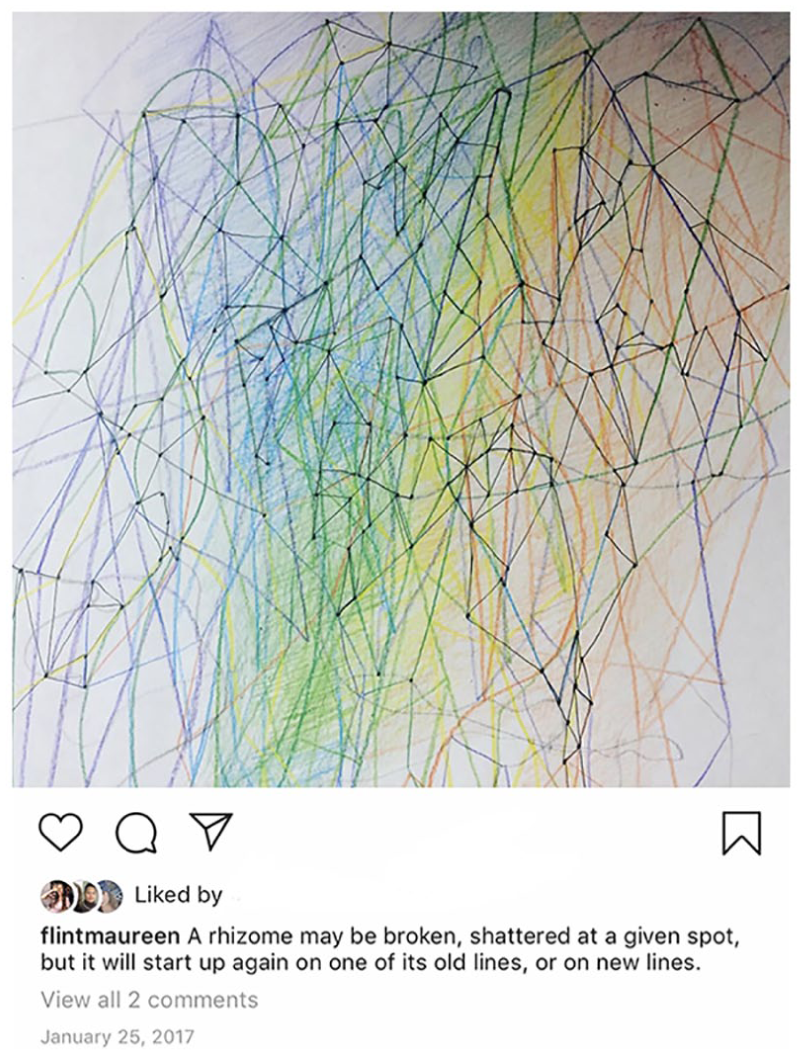
Rhizomes. Instagram post by Maureen (January 25, 2016).
m e a n w h i l e
In the readings course, we moved with Deleuze and Guattari, with Braidotti, with Bennett, with Barad, and with Foucault (among many others). As we read, the cartographies produced through the texts were not linear markings on a map as if we were following a path, rather they were much more chaotic, rhizomatic (Deleuze & Guattari, 1987) in nature. Open, shooting off, pausing, restarting, connecting, expanding. We all loved the notion of the rhizome when we discussed it in class, it made sense to us as it was felt in our bodies as we engaged with the philosophies/philosophers we encountered. We worked (and often created, as seen in Figure 2) rhizomatically with and through various languages—visual and verbal. The visual provided many of us a space to think differently, to work attentive to our process rather than focus on product, to produce images when words would not suffice. Indeed, on the first night of class, I told the students that other modes of (re)presentation were always open—that “papers” could take various formats and that creative conceptualizations were encouraged. Inspired by Braidotti’s feminist approach to posthumanism, I envisioned artful practices in this class of women as working against phallogocentric, hegemonic, and even homogenized (Ulmer, 2017) modes of representation that normalize and often constrain what and how we think. Rather, Braidotti (2011) explained there is “a strong aesthetic dimension in the quest for alternative nomadic figurations, and feminist theory . . . is informed by this joyful nomadic force” (p. 29). Furthermore, the vibrancy (Bennett, 2010) of art materials sparked new potential relations, new assemblages between humans/nonhumans that made new thinkings/doings possible. Thus, aesthetic languages offered another rhizomatic line of flight (Deleuze & Guattari, 1987) in my pedagogy—a means of escaping and intervening in which students might plug into theory and materials differently while disrupting normative habits of thought. For me at least, a meanwhile pedagogy was an artful one.
It was not always comfortable or easy to feel the ground undulate beneath us, yet this was an intentional part of my pedagogy. Moving toward nomadic thinking, it felt necessary to wade in the waters of discomfort and sometimes allow its current to sweep us off to somewhere new. Through the class, the footing we all (had to various degrees) in humanist writing-thinking-inquiry lost stability as we feverishly felt for new ground to stand upon. The readings helped us interrogate our humanist tendencies, reevaluate them, and explore what it means to inhabit the in-between spaces we were mapping in the course—meanwhile spaces that are perpetually transitory. Perhaps not feeling the ground as we thought we knew it might be affirming. Perhaps it meant we were becoming differently as subjects, intra-acting and connecting differently with the world.
Perhaps (I hoped) we were becoming nomads.
- Kelly
m e a n w h i l e
As I reflect on the course, I realize that thinking with posthuman and/or new materialist theories in the classroom (or really any space) completely undoes the humanistic, anthropocentric ways we usually know/become/do (Jackson & Mazzei, 2012). Instead of the classroom as a stagnant backdrop for isolated events to begin, buzz, then fade, it becomes a plane where intensities and bodies of all types are constantly vibrating with unlimited potentiality. For example, instead of me looking out at my middle school students and seeing individuals with separate/isolatable agendas, personalities, desires, and so on, passively surrounded by a bunch of inanimate stuff (desks, books, paper, backpacks), thinking with posthuman theories I see:
Bodies-desks-books-pages-emotions-desires-marks-relationships-connections-shoes-pencils-histories-backpacks.
The hyphens indicate the fusing of members (human and nonhuman) with/in our classroom assemblage. Thinking with Bennett (2010), classrooms (as assemblages) are “mobile configurations of people, insects, odors, ink, electrical flows, air currents, caffeine, tables, chairs, fluids, and sounds” (p. 35). In such an assemblage, everything affects and is affected by everything else. Hierarchies are unthinkable. Things sparkle with potential. Bodies are always/already marked/being marked. Affective flows zip through the air (Stewart, 2007). We (bodies of all types, flattened rather than organized by human, less-than-human, nonhuman pyramids) are all fused together in simultaneous, synergistic becomings.
This is what Kelly’s readings course sparked. Wandering from a once-anthropocentric, Archimedean view of pedagogical spaces into the uncertain yet hospitable territory of posthumanism scrambled my entire outlook on bodies-together. On night one, we all showed up (or believed we showed up) as individuals. As the semester progressed, we began to locate and follow the lines that connected and entangled us all in so many ways. We paused to notice the multidimensionality of each other; we were no longer whole, definable bodies, but we were each segments of assemblages that plugged into the larger assemblage that was our readings class. We (laptops-Lauren-fashion-Maureen-snacks-handouts-pastels-Barbies-April-zipper-families-genders-religions-backgrounds-writers-students-mothers-Courtney-cat lovers-magazines-tea-Kelly-backpacks-articles-books-Briana-you name it) were/are recognized and found ourselves becoming-different-together.
- Briana
m e a n w h i l e
Week 5: Rosi Braidotti and The Posthuman
Map the anthropocene;
Disrupt and map the post-anthropocene;
Disrupt and map the posthuman as becoming-animal/earth/machine;
Discuss.
In the middle of the conference table, a plastic bin of art supplies was unloaded. Markers, oil pastels, colored pencils, scissors, glue, magazines were spread between us, placed beside a large piece of white paper. That night we were thinking with the work of Rosi Braidotti, specifically The Posthuman, and Kelly’s mapping invitation was intended to explore how the students were making sense of the posthuman concepts that permeated the text. Braidotti’s words flowed into our classroom space, her ideas intra-acting with ours as the materials on the table pulsed with aesthetic possibility. As we talked about the text, we released to the call of the art implements and visually plugged into Braidotti’s (2013) discussion on anthropocentrism and post-anthropocentrism.
Just as Braidotti drew inspiration from Deleuze, Kelly turned to Deleuze and Guattari’s (1987) notions of tracing and mapping for this encounter. In many classroom spaces, students take part in the process of tracing knowledge, a logic of reproduction where they make visible facts that are already there. The map (though not a binary of tracing) is connection-making, rhizomatic: “Open and connectable in all of its dimensions; it is detachable, reversible, susceptible to constant modification. It can be torn, reversed, adapted to any kind of mounting, reworked by an individual, group, or social formation” (p. 12). Rather than define a list of concepts or regurgitate Braidotti’s words, it became pedagogically important to seek multiple ways to enter into (post-)anthropocentrism and to actively map our encounters. Our mapping worked in/with actual layers, dis/continuities, and with nonhuman others to consider the place and potential for displacement of humans in the anthropocentric present. We zigzagged through mapping and disruption . . . m e a n w h i l e
In class, mapping the anthropocene came easily, every page of the magazines we flipped through referencing the entangled nature of human and nonhuman life. We cut and pasted and doodled around the central word “human.” Then we paused, wondering how the post-anthropocentric disruption could take place through our mapping. We returned to the words of Braidotti (2013) of “radical relationality, that is to say non-unitary identities and multiple allegiances” (p. 144). With these words in mind, we began enacting this radical relationality, drawing connections between images and text on our shared paper, interrupting and disrupting the hierarchy between human-animal-material with oil pastels and curling ribbons of aluminum foil. Words sprouting [post]hum[achine] [e]a[rth]n[ism], spirals cut from the discarded pages of magazines, images, and words connecting circuits between oil spills-pets-clocks-gas masks-food, layering more images, more connections, plugging in. The tenor of the room changed, too, as we laughed and joked (disruption was fun!), our creativity and imagination zigzagging as arms crossed and connected over the paper, pasting and marking. Again, we paused. What more could be done? What more could be disrupted? Briana reached in, crumpling the paper, and our orientation changed as we again referenced Braidotti, becoming with the world, through a shared and ethical accountability. Suddenly, our hands were not merely the modes of creation, they were implicated, vitally connected with the various ideas and bodies throbbing around us, and with the post-anthropocentric ideas we mapped. Using markers, words were scrawled on porous skin and we all reached in while Kelly snapped a photo of our intra-active pedagogical encounter—an encounter of becoming-together, becoming-with (Figure 3).
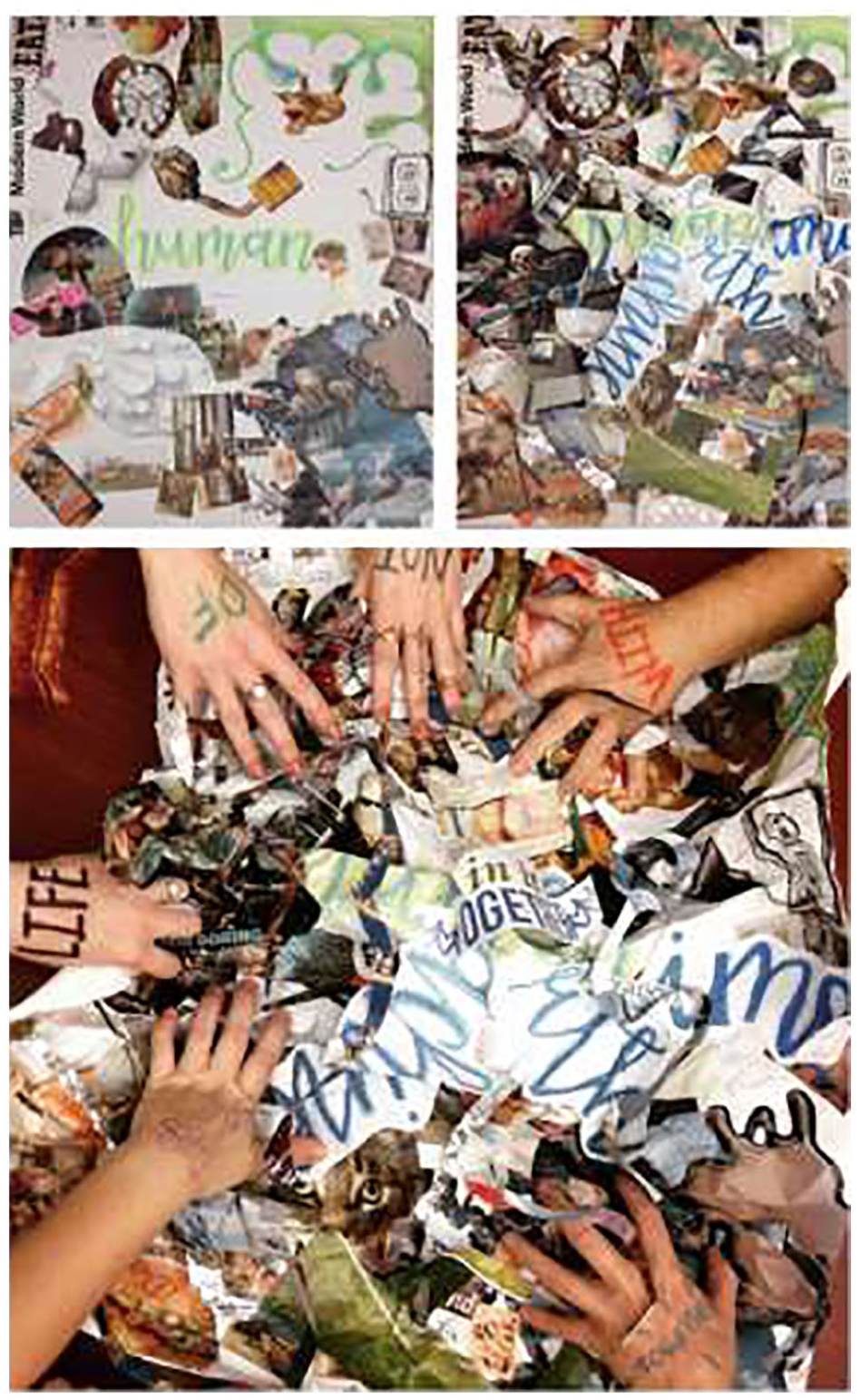
Mapping the anthropocene.
m e a n w h i l e
Even as I am drawn toward post-qualitative theories, I am finding the concepts hard to grasp in relation to my research. I am not sure I know how to engage/play with post-qualitative inquiry or how to incorporate it into my dissertation. Kelly’s embodiment of posthumanism in her pedagogy altered our sense of what it meant to be in the classroom. With her encouragement, we worked through the readings, sometimes using art to move toward the uncomfortable and unknown and away from the familiar. While the theories we read opened up the possibility for (un)folding concepts and ideas, they also seem to complicate the traditional notion of research. Traditional qualitative methodologies provide structured ways of engaging in research and make the process feel manageable—providing a roadmap for how to conduct a research study; however, the post-qualitative readings class shifted my perspective on how to conduct and define research. It disrupted my sense of self and ignited my journey into post-qualitative inquiry. I began to think about the places, bodies, and materials I encounter(ed) through my research within the campus environment where I work/exist as a graduate student/staff member/educator/consumer/fan. This is both exciting and terrifying at the same time—becoming differently as a practitioner and researcher.
- Lauren
m e a n w h i l e
I am disrupted, shook, uncertain, yet somehow I am finding my footing in the ethics of it all. In doing educational neuroscience research, I am watching and participating in the intimate entangling of technological other, psychological norms, and educational implications (Braidotti, 2013). Engaging in the post-qualitative readings course, I find myself feeling the weight of how these forces all touch and intra-act (Barad, 2007). This weight pushes/pulls/turns me to rethink my own explorations of the in-betweens of societal and educational structures that cannot be linear, hierarchical, or anthropocentric.
- April
m e a n w h i l e
Uncertainty, Disruptions, New Ethical Positions
An article from the first week of class resonates with what Lauren and April expressed:
Looking back now, I know that I read Deleuze so early in my doctoral program that the ontology of humanist qualitative methodology could never make sense. For me and others like me, that methodology was ruined from the start, though we didn’t quite know it at the time. (St. Pierre, 2014, p. 3)
As the weeks slipped by, we often joked about the notion of being ruined by the philosophies we read in class. We joked, yet we are ruined. We are ruined because (with different degrees of intensity) we crave joy in discontinuity (Braidotti, 2013), disruption, transformation, and the creativity that accompanies the nomadic thinking/doing of Braidotti’s posthumanism. We are ruined because we can no longer think of inquiry as a roadmap, a linearity, a one-size-fits-all. We are ruined because we choose not to walk the well-worn path that others who preceded us have tamped down. We are also ruined because we sometimes long for the familiar, for the comfort of convention, becoming nostalgic for the stability we once thought we knew. Our conversations in the course (evident in the writings above) reflected this longing and nostalgia even as we came to envision the affordances that these philosophies might bring to our methodological work. The tension of ruin. Our joking gave way to serious discussions of this tension and we realized that such a tension need not be resolved, rather its very presence might be productive (what does it make possible?). Meanwhile, we are filled with possibilities and wonder how to proceed.
How, then, do we work in the ruins of methodology (St. Pierre & Pillow, 2000)? Moving in the ruins of methodology, we oscillate “between the ‘no longer’ and the ‘not yet’” (Braidotti, 2013, p. 119), where students simultaneously feel exhaustion and energization (Kuby & Christ, 2018). The key, perhaps, is not seeking solace in the memories of the “no longer” methodological past, rather it is in joys of the persistent seeking of potentialities to come, the “not yet,” the immanent-now (Kuntz & Guyotte, 2018). What might be(come) through posthumanism? What potential lies therein? What is the unthinkable joy we have not yet known/thought? These are not hypothetical questions, rather they were questions Kelly often posed and with which we grappled throughout the course—questions that were intended to spark more new inquiries rather than resolve.
This search for the “not yet” keeps us moving, shifting, disrupting, resisting the dangerous stasis of continuity and nostalgia . . . Meanwhile, we search, we interrogate, we wonder. m e a n w h i l e
In the process of assembling my posthuman creation (Figure 4), I felt more in tension with my art as I constructed and deconstructed the Anthropocene . . . the process of becoming and the tension of the in-between . . . the p u s h and p u l l. From the old and new, human and non-human; being both and neither . . . becoming and undoing, remaking and evolution. Something more, something new, what was always already, and is now both human and more-than-human.

Mixed media art by Courtney.
- Courtney
m e a n w h i l e
As we continued to discuss the readings and make connections between the post-qualitative theories and our own work, I continued thinking about the power of the things we use for research (Bennett, 2010). As a student of neuroscience, I consider: lab-needle-electroencephalogram (EEG) cap-computer system-latex gloves-children-brains. I realize I should not expect research participants to automatically know what is happening as I walk toward their head, which is covered in an EEG cap, holding a blunted needle tip full of cold gel. How might their experience with other needles in other spaces intra-act with this moment? What do these objects do to/with these “research subjects”? I feel the shift away from humanity as the unit of common reference in descriptions of trends in the social sciences (Braidotti, 2013). Humanist and developmental psychology, with the human at its core, can no longer encompass everything that we want to know. With the rise of neuroscience, we have machines that interpret our brain activity to show us how we are being human. These particular readings of “human,” produced through an unprecedented intimacy with technology, require us to think “human” differently. This leaves me wondering, how can I embrace posthumanism in my research? What do I do now?
- April
m e a n w h i l e
During Courtney’s presentation on affect, bodies, and becoming, we were invited to intra-act with materials (stickers, dolls, clothes, accessories, knives, nail polish, etc.) splayed upon the table. Unlike the times I had written or “theorized” or “philosophized” about Spillers’ “Hieroglyphics of the Flesh” (Spillers, 1987, p. 67)—the marks that always/already mark Black bodies as less-than-human—became embodied differently when I actually picked up a weapon (the X-Acto knife) and maimed the “flesh” of that Barbie™. These marks (or “cuts” as Barad, 2007, might say) we/I make became more real to me than anything I had read, watched, or analyzed before that moment. I understood that in the intra-action of blade-flesh-white hand on Black body-intention-hatred-appearance-wound-history-scholarship-classroom-privilege-oppression-racism-Barbie™, something(s)—mostly the things I had learned to talk all about in pretty words and citations—truly came to matter. I still have that Barbie (Figure 5). Her wounded skin covered in bright-red fingernail polish atop the deep lacerations, and her hair, half shaved/half painted blue, stands upon my bookshelf to remind me that “. . . marks are [always] left on bodies” (Barad, 2003, p. 824).
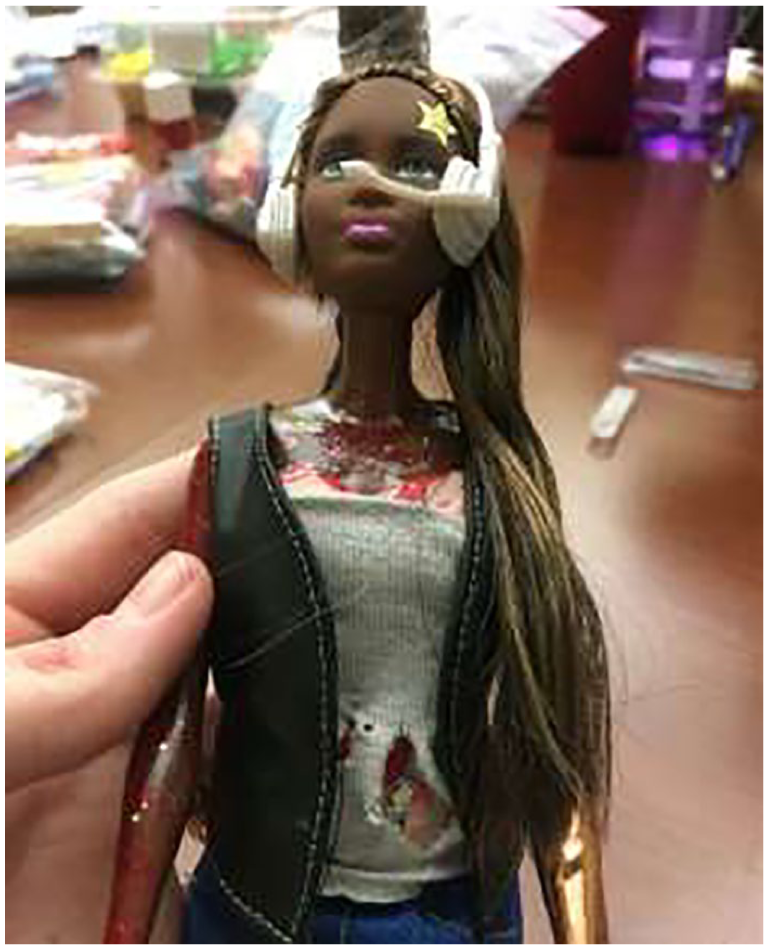
Marked body.
- Briana
m e a n w h i l e
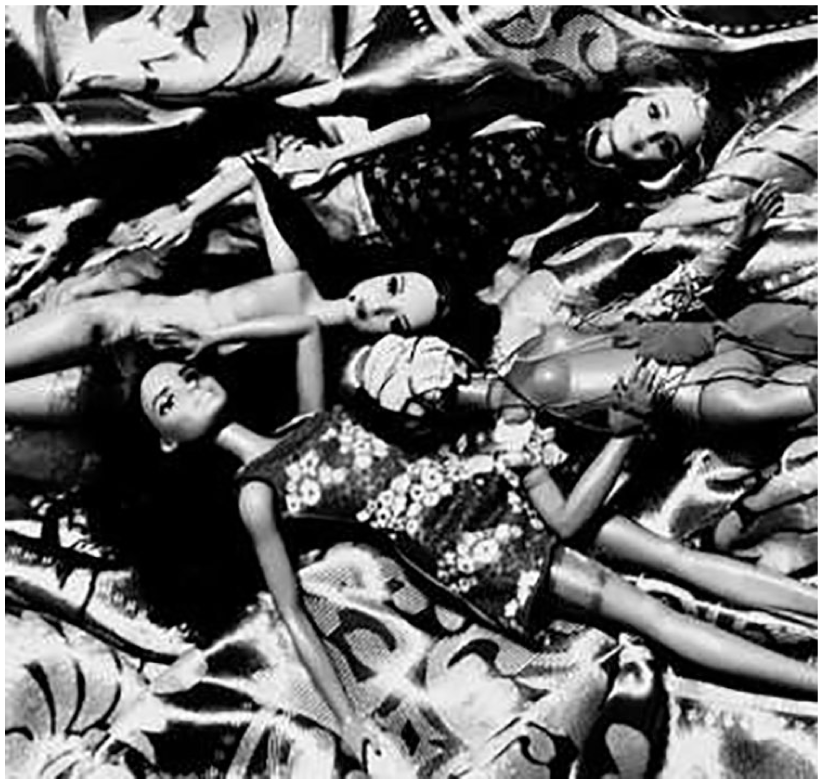
Barbie becoming.
m e a n w h i l e
What marks do intra-active pedagogies leave on bodies?
Moving through the cartography of meanwhile and across bodies in this article puts new things in relation. Events do not unfold, they enfold, becoming differently as they plug into one another in a nonlinear and unfixed fashion. For instance, our dialogues during the semester were an opportunity to learn that the Barbie™ lesson Courtney (Figure 6) presented was an impactful event for many of us as we, quite literally, performed on/with those plastic bodies with nail polish, stickers, markers, ideologies, memories, and, and, and . . . However, the profound resonance felt by Briana between the theories with which she was engaging and the materiality of both Barbie™-event and theories-of-race were not wholly apparent during that moment, or even now, for that matter. The marks were indefinitely felt, even if we could not see them. Even as we try to capture such moments in the classroom through dialogue and/or art, something always evades our grasp as another line opens for escape. Always evading, expanding beyond the confines of the academic semester, absconding from the strictures of evaluation and assessment, the persistent blind spot of the surveilling instructor’s eye. This elusion is both the affordance and the constraint of a meanwhile pedagogy. We can sometimes see what our pedagogies do; yet, such knowledge is, necessarily, incomplete.
m e a n w h i l e
As we began reading Jane Bennett (2010), Kelly encouraged us to consider the materiality and agency of nonhuman and more-than-human bodies as we moved through our week outside of the classroom. “Consider a mundane event in your day,” she suggested, “what bodies and materialities are intra-acting to produce that moment?” And so, I wrote and wondered . . .
Every morning I drive to work with an open coffee cup.
It’s a precarious journey, intra-actions between bodies and non-human bodies.
Walking down the stairs. Shoes, heels, solidly striking the concrete of each step on the way down.
My body teeters slightly, walking through the grass.
On days when the grass is wet, my heels sink into the soft earth, and my body leans forward to compensate,
onto the toe, resisting the moisture, and the liquid coffee in the cup leans forward too, spilling onto the ground (or more often, splashes down my front, leaving dots and marks that are quickly absorbed and forgotten).
I place the coffee cup on the top of the car.
It hasn’t rained recently, and there are rings there from previous cups of coffee, intersecting Venn diagrams of previous days and journeys.
I dig around in my bag for my keys before loading my bags in the back seat and grabbing the coffee cup from the car roof.
I gently balance it in the middle part of the car before I climb in. There’s a stickiness there, in the middle console, from other days . . .
I hold the coffee in my right hand as we right turn, stop sign, left turn.
Stoplight. Stoplight. All moments, possible encounters between car-liquid-cup-skin. Right turn.
This is the moment when it happens, spilled liquid seeping into the fabric of my dress,
sitting on skin.
Following Kelly’s invitation to consider our posthuman entanglement with more-than-human bodies during an everyday encounter, my morning commute became different. Suddenly, this event zigzagged outward, connecting stoplights, weather, heels, grass, skin, producing an awareness of my co-implicated becoming with the world.
- Maureen
m e a n w h i l e
Through the readings class, we became an assemblage of affects and forces, moments of clarity-recognition-connection that spark(ed) in fractals between us, becoming circuits extending beyond the classroom (Bennett, 2010). As an assemblage, the readings course was constantly under construction and production, resonating with affect and agency. The week we read Bennett, we endeavored to consider the agentic quality of nonhuman objects. As we met for class that week, we found ourselves savoring the warmth and slight bitterness of the tea that Kelly brought and laughing as we shared stories of our intra-actions with mundane events and materials—from Maureen’s spilled coffee, to the loss of the zipper pull on April’s boot, to the soft beep of Lauren’s Roomba, unable to change direction as its battery power slowly drained. These seemingly mundane objects/moments vibrated and entangled with our becomings, and we began to dislodge agency from individual subjects, emphasizing the interconnections between humans and matter, allowing us to entertain and attend to the movements of affect and agency within assemblages (Bennett, 2010). Together we asked, what is the productive agency of considering the vibrancy of matter through this course and beyond? m e a n w h i l e
. . . mixed media painting
with golden veins tracing across the canvas layers of speckling paint and essential oils.
As a visual artist, I often accepted Kelly’s invitation to move beyond writing and into a visual space for my papers. Inspired by Bennett’s Vibrant Matter, I chose to focus on something from the earth and then make it appear as if you are seeing the sedimentary makeup, but also the assemblage as a whole, creating a flower (Figure 7). The essential oils I incorporated were rose, frankincense, rosemary, and spikenard for their effect on the brain (nostalgia, reminiscence, positive memories, uplifting, and sedating) intra-acting with the viewer to create a calm, happy, transitive state of contemplation.
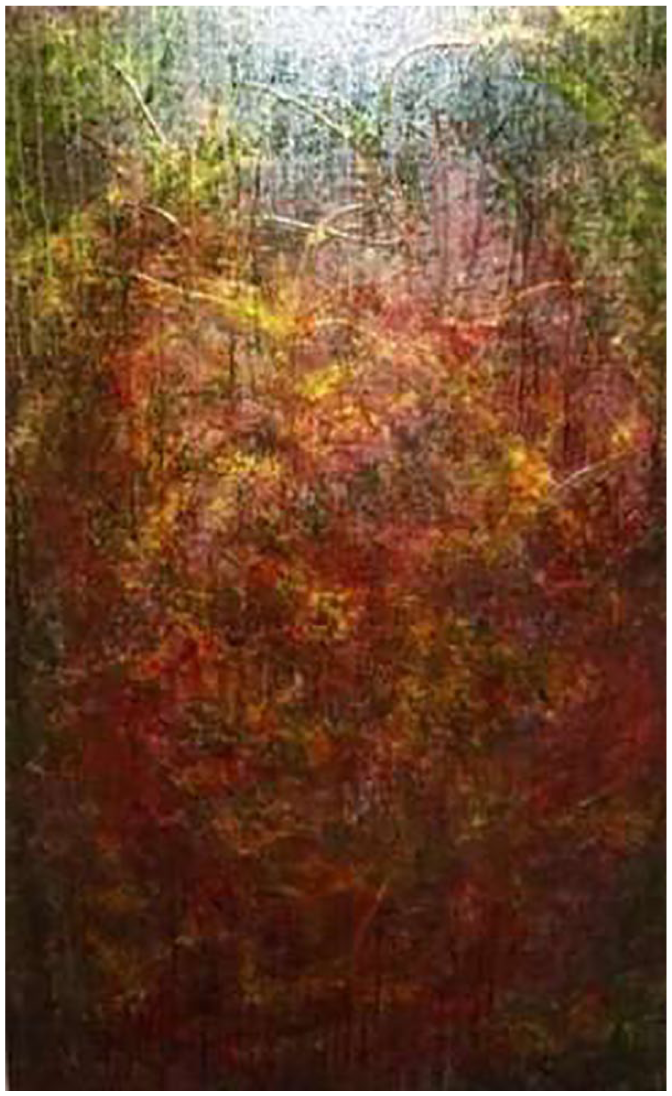
Mixed media art by Courtney.
Using artful methods with posthumanism allowed me to resist the limitations of language, creating new possibilities for encounter.
- Courtney
m e a n w h i l e
I am sitting in the middle of the living room floor, scraps of fabric surrounding me, strips of blues and grays in lines on a square of butcher paper. I’ve ended up here, sprawled out, placing one scrap next to another. It is fall semester, months after the post-qualitative readings course concluded. But my mind continues to return to the intra-actions produced through Kelly’s pedagogy as I work on an assignment for another class to tell the story of my journey (thus far) with qualitative inquiry. As I fit together scraps of fabric, I am retracing geographical and philosophical journeys that are still becoming: New York-Alabama-researcher-practitioner-artist-scholar. Through fabric I am assembling and renegotiating the grooves and lines of the stories I followed before as I create new lines and paths (even as those paths are something I see in retrospect, new diagonals created from the serendipitous connection of quilt blocks). This artmaking, then, is transformative, produced through posthuman intra-actions, a process of connectivity through improvisation, a “processual rhythm of becoming that is activated by virtual, unforeseen, manifold potentialities” (Garoian, 2013, p. 127). Through artmaking, an embodied and creative event, the virtual/actual potentiality of meanwhile becomes possible. Following the post-qualitative readings course, my embodiment of these potentialities becomes different, and I zigzag nomadically through disparate temporal and spatial zones—joyfully incorporating artful practices as a disruption of normative habits of thought (Figure 8).
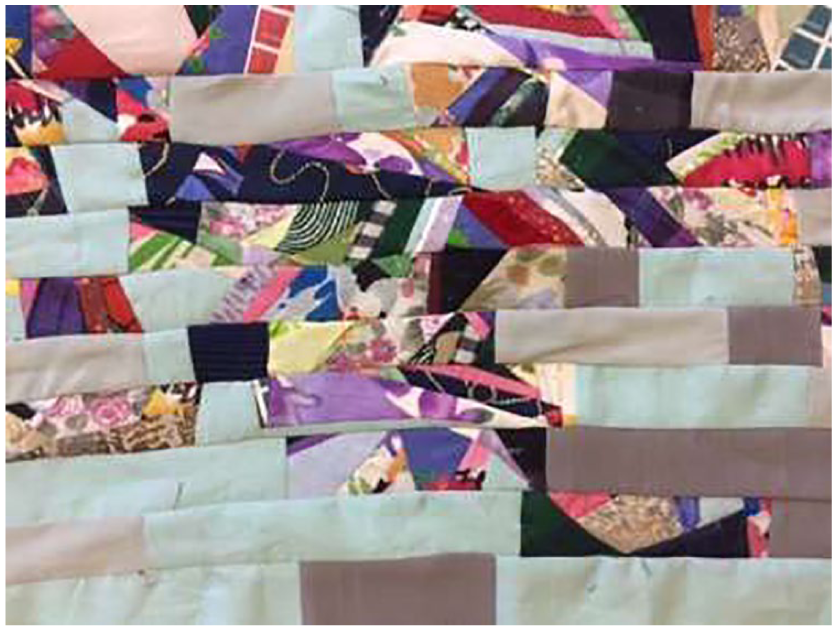
Quilt by Maureen.
Braidotti (2011) reflects, “the difficulty consists in thinking through and expressing the in-between spaces, the transit areas, the transitions, the shifts that make up the nomadic itinerary” (p. 93). Sorting, layering, assembling, pinning, flattening, the act of creating embodies the connections, circuits, and relations of posthuman intra-actions. What happens next? I had asked fretfully in response to Kelly’s invitation, frustrated with an overabundance of connections and nowhere to go. Returning, remembering, imaginatively and creatively through meanwhile makes possible a different becoming, deterritorializing the hegemony and rigidity of the walls and boundaries that had congealed around me. Becoming nomad is an imperfect trajectory, without a guide or predetermined process to help negotiate the circuits and connections. “When you remember to become what you are—a subject in becoming—you actually reinvent yourself on the basis of what you hope you could become with a little help from your friends” (Braidotti, 2006, p. 168). This is what I believe a meanwhile pedagogy makes possible: affirmative and creative reinvention and connection, accountable to the more-than-human world (Figure 9).
- Maureen
m e a n w h i l e

Collaborative rhizomatic mapping created during the final class meeting.
m e a n w h i l e
The early winter snow is now a memory as we, the seven that came together in the readings course, slog through the relentless heat and thick humidity of an Alabama summer. Our bodies each traverse different locales after the spring semester has ended. Moving in and out of our initial point of intra-action in Tuscaloosa, the freedom of summer schedules carries us to new geographies that, for some, grant a temporary reprieve from the sweltering summer heat. Awakened. Anew. Even over a thousand miles away from each other, the class, the bodies, the posthuman theories, the memories, all linger and affect with an awareness of intra-actions.
[Meanwhile] Not all nomads are world travelers;
some of the greatest trips can take place without physically moving from one’s habitat. (Braidotti, 2014, p. 182)
In considering our respective and collective bodily movements of then enfolding with now, we pause to consider Braidotti’s nomadic itinerary. In Braidotti’s (2011) feminist and posthuman conception of the nomadic subject, it is “the in-between spaces, the itinerary” (p. 93), and the journey itself that are of value rather than the destination. To be sure, this processual ontology inspired how Kelly approached the course from the very first night. She carried few expectations of where we might “end up” at the conclusion of the semester, rather it was the relationality of encounters, movements, and moments that incited the what and the how, the curriculum and the pedagogy. The challenge arises when Braidotti argued that “these moments of nomadic transit . . . are both crucial to the process of theoretical creation and also quite resistant to representation” (p. 93). How, then, do we understand and represent our nomadic itineraries through the readings course? Through our engagements with posthuman theories? These are the questions that linger with us.
The meanwhile has, for us, provided a space to situate ourselves in this in-between, to see ourselves as nomadic subjects, and to acknowledge that our grasp of the effects/affects of the course is always incomplete. They persist, lingering across different time zones extending into the past and future. Disrupting the static and linear temporality of Chronos time, meanwhile pedagogy moves toward Aion, or the “cyclical time of becoming” (Braidotti, 2013, p. 165). We disrupt, too, nomadic representation of only-words to map memories of our experiences through art—created both during and after the semester. As Braidotti (2014) explained, “nomadic shifts enact a creative sort of becoming; they are a performative gesture that allows for otherwise unlikely encounters and unsuspected sources of interaction, experience and knowledge” (p. 182). The meanwhile, then, helps us connect differently, creatively even, as we inquire about what is made possible through a posthuman embodiment with the readings course.
Pedagogically, meanwhile was not an a priori concept that guided Kelly’s teaching of the course. It emerged in the middle, through Maureen’s paper, shooting off and restarting in this very work. Even as we now conceptualize meanwhile, we realize it was always already part of our nomadic itinerary—entangled in Kelly’s pedagogy as well as in our thinking of “post” inquiry. Meanwhile cultivated a space for us to think with the theories (Jackson & Mazzei, 2012) that comprised the curriculum of the semester—the relations, memories, layers, and complexities. Meanwhile opened possibilities beyond the confines of written text, through multiple expressive modalities with human, nonhuman, and more-than-human others. For Kelly, meanwhile lines zigzagged between curriculum and pedagogy. What she teaches and how she teaches are interconnected; however, what we all learn(ed) is not the question we ask here. Our focus, instead, is on showing what intra-active post-qualitative pedagogies do.
To be sure, meanwhile gives us no finality, it only points to the relations produced, and the persistence of a nonlinear memory.
m e a n w h i l e
“What questions persist? What are you still grappling with in terms of post-qualitative inquiry?”
Really??? I’m supposed to narrow down this DENSE/ SUFFOCATING-BUT-FREEING/ BROAD/ NEW/ UNDOING/ RETHINKING/ EARTH-SHATTERING encounter into just a few straight-up questions?
I think what matters somehow is that I actually was left with more questions at the end of the semester than I had at the beginning. That is why this entire posthuman thing is so seductive and slippery and elusive all at once. While I often feel myself twisting into Gordian knots over this stuff, those occasional moments when I manage to locate the thin little Ariadne’s thread lying in the labyrinth make it almost an adrenaline rush for me. I love thinking in these ways because, like Bennett (2010) talks about, we have to become re-enchanted with the world. That’s what posthumanism and a meanwhile pedagogy do for and with me.
- Briana
m e a n w h i l e . . .
Footnotes
Declaration of Conflicting Interests
The author(s) declared no potential conflicts of interest with respect to the research, authorship, and/or publication of this article.
Funding
The author(s) received no financial support for the research, authorship, and/or publication of this article.
