




Abstract
This article twists, folds, iterates, and proliferates figurations of field in/of/outside the academy as it works to undercut the taken-for-granted assumptions about the field and its borders and boundaries. I question how making boundaries fuzzy might work to open up radical possibilities for knowledge production and becoming with/in fields. Furthermore, the article considers how the way in which we tell ourselves stories of fields and our place(s) in them matters. How might we do different research or do research differently if we reconsider the cuts we always already make between field/researcher/researched? Can fieldness disappear and would we want it to?
I am of the field, of girl, of woman, of wife . . . , of daughter. I am in the field, of education, of English, of architecture, of mathematics . . . , of qualitative research, There was a girl, of the trees, of the rock, of the sky, of the field, And the field was of her. And them. And sometimes she felt, at home, and mostly, not. Mostly she tried to be good. Mostly she was tired of trying to fit. The rows too confining. The fences too tall. The chemicals used to keep the field productive, too harsh. Is there a not-field? A space undefined, unfenced, untreated, natural, sprawling, wild? She knows it does not exist. Can’t exist. And, she wonders, can she carve out this place? What might it look like to throw open the gates, do they swing easily? Is there a groove in the ground from their frequent opening? Who can pass? Who has the key? What might come? Come what may.
The Gasp, Breaking the Interval in the Liminal
The space between the aisles at the poster session was tight, less than four feet across with posters on both sides, bodies had to turn, shoulders angled to navigate; and it was long—at least a 60-foot tunnel of cardboard and nerves. My co-presenter and I had to press against the table to make room for the bodies to move through. The woman walked past our poster, then her face turned; she must have caught a glimpse of it out of the corner of her eye. She gasped, a response to stimuli, unfamiliar, out of place, frightening? I laughed nervously and smiled. She asked, “Did your kid do that and you brought it anyway?” There were scribbly lines all over the poster, so her response made sense. Was what we had done just nonsense? Kids’ play? The poster had registered to her within a portion of a second as out of line, unorderly and insensible. It certainly did not follow the pattern clearly established and followed by the other 40 posters in our aisle. Block title at the top, university emblem, research question, methods, data, graph, analysis, findings, discussion, and most importantly clear statements as to what was now known because of the research. Our poster was messy, with text broaching boundaries and lines squiggling across it and poetry on one edge (see Figure 1). It was decidedly not in line (see Figure 2). We were refusing convention and were disciplined with a gasp. The woman was provoked though and excited in a space of rationality and order. A space of composure. We spoke for a moment, and she moved on. The image on the poster, that prompted that gasp, has continued with me. I made it then, to signal to the messiness of research, the illusion of clean and linear representations of data and methods. Now, I think it with liminality and fields.
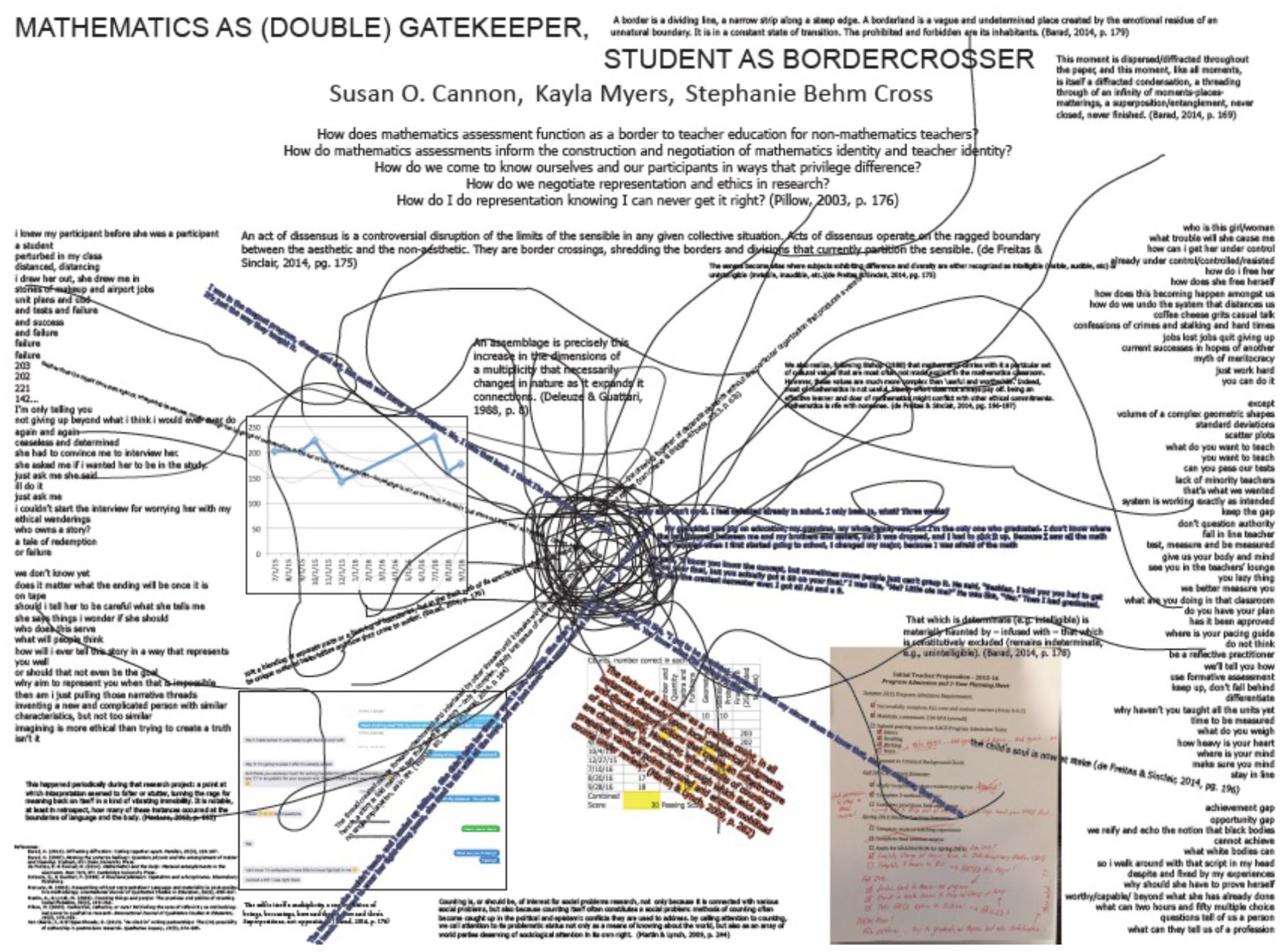
Poster from mathematics education conference (Cannon, Myers, & Cross, 2016).
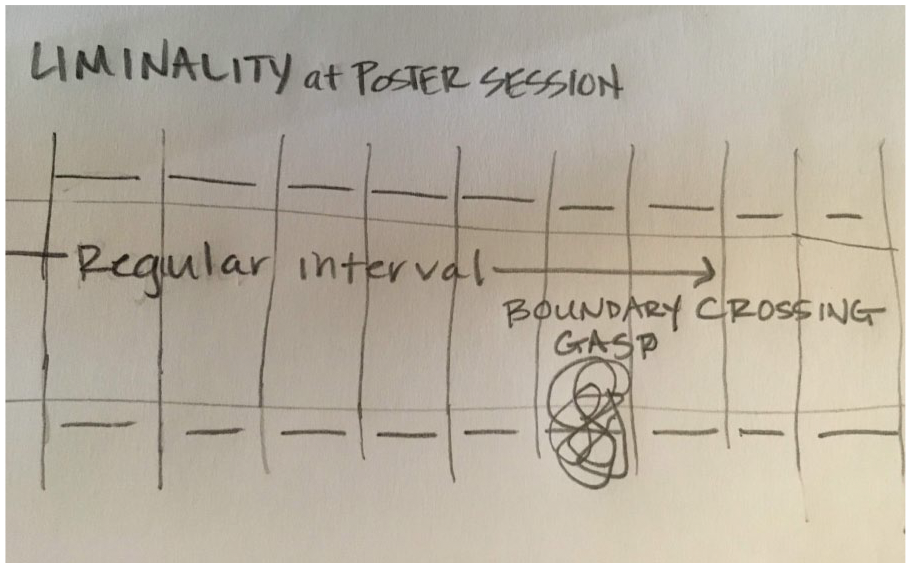
Sketch of the interval of poster session and the gasp of boundary crossing. Without interval, the gasp would never come because all would be irregular.
As I am being prepared to enter the field of mathematics education research, I am nudged explicitly and implicitly to affirm certain ways of being and doing that are designed to help me fit into the field. I am attuned to the sensible and the legitimate, and I reach around for the borders and the boundaries that define my field. The gasp showed me a boundary. I had already seen it when we raised our poster among the rest, but the gasp signaled it again. A couple of other people stopped, who were interested in our work and familiar with some of the scholars that we cited: Our poster was not that out of line to them. They had been straying from the field as well. There was a small opening, a boundary becoming blurred and fuzzy.
Intra-Action, Diffraction, and Making Kin
I struggled from the beginning of my doctoral research to figure out to which field I belonged and how to be in the field. I have come to believe that there is no right field for me to be in. Instead, I will twist field, fold field, and unfield by making connections across fields. As I traverse fields, I make marks and marks are made on me. Both field and I are disrupted. The boundaries of field are called into question as I move across them carrying the marks of other fields. I will argue that this disruption of boundaries matters for more nuanced and responsible relations within and across fields. Each disruption produces a liminality within which values are renegotiated. The production of liminalities is important in the academy because it works against easy sorting and categorization and slows down the neoliberal research machine. When lines are not clear and boundaries are blurred, responsiveness to the particulars of the material arrangements is required. Qualitative inquiry can produce liminalities that demand relational rather than prescribed becomings for researchers, fields, materials, and texts.
The concepts of intra-action (Barad, 2007), diffraction (Barad, 2007; Haraway, 1992), and making kin (Haraway, 2016) are particularly productive for thinking about how academic subjects and fields are produced. Diffraction and making kin are creative and inventive practices within qualitative inquiry that allow for intra-actions that produce liminalities within and between fields. Barad (2007) proposes intra-action in contrast to interaction to acknowledge that all the participants in a phenomenon are mutually constituted and entangled with one another and are not cleanly divided. Participants can include objects, texts, humans, and more-than-humans. I use the term participant to signal the liveliness and involvement of everything within the intra-action. In phenomenon, agency is distributed and the binaries of nature, culture; active, passive; and human, material are flattened. Intra-action prompts me to think fields as in process and inclusive.
In addition to intra-action, I will think fields with diffraction (Barad, 2007; Haraway, 1992). Diffraction allows for a nonhierarchical methodology through which different texts, theories, and thoughts can be placed against one another, so that they are dialogically read to engender creative and unexpected outcomes. Diffraction requires interest in the details of the arrangements and acknowledges and respects the contextual and theoretical differences between readings. The hope is to provoke new thoughts and theories toward inclusion and responsible action. Diffraction is meant to disrupt linear and fixed causalities and to work toward interference patterns that mark difference for its effects, so that we can see how differences matter.
I advocate for a horizontal depth, a moving across fields-in-process as productive for seeing differences across fields and for making kin (Haraway, 2016). Haraway suggests that we “make kin in lines of inventive connection as a practice of learning to live and die well with each other” (p. 1). Diffraction affirms links between seemingly opposite schools of thought, it is one way of making kin. I momentarily unfield myself so that I am permitted to move across fields widely and invent connections that stitch together a liminal space, “the broad folded and intricate expanse of between” (Cannon, 2018, p. 580). In liminalities, words and things do not fall into easy categories, and the work is to maintain uncertainty, a joyful perplexity in the between.
Field Production and Maintenance
In format and content, this article works to put field into liminalities, to blur its meaning in a productive series of iterations so that field refuses stability. Wide travels and lines of connection in the liminal spaces between fields can pull fields into closeness and make what seems distant into kin. Pulling threads across fields allows for a diffractive reading, so that we can see how differences across fields come to matter (see Figure 3). I examine connections between fields, and as Davies, Flemmen, Gannon, Laws, and Watson (2002) explain, look for and work with the lines of fault, the forking and rupture of knowledges that are already in play . . . and to extend our knowledge of how speaking- and writing-as-usual create and sustain cultures of practice that we wish to move beyond. (p. 31)
Davies and colleagues gesture toward work that digs into and upturns the taken for granted to create difference.
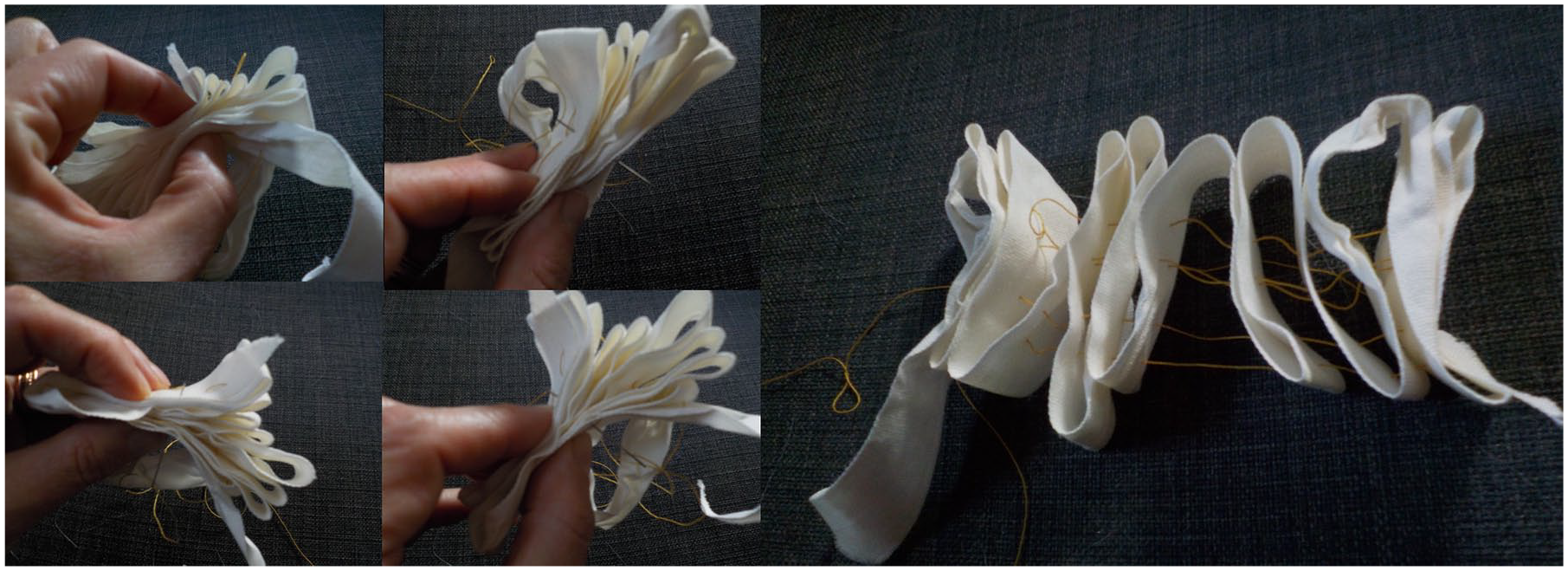
Using threads to pull fields into closeness so that they can be read diffractively.
This article’s format is an experiment in diffractive writing and reading (Cannon, 2020; Hepler, Cannon, Hartnett, & Holbrook, 2019; Holbrook & Cannon, 2018). In academic writing, clear and concise narratives are encouraged and theories or ideas that distract from the main paper are burnished off to care for the reader. This means that scholarly writing most often stays in field in terms of citations, format, and content. I disrupt this notion and deterritorialize academic becoming with a proliferation of field figurations as endnotes—drawing on St. Pierre’s (1997) conception of figuration as something that produces “a most rigorous confusion as it jettisons clarity in favor of the unintelligible” and “enable[s] us to move toward realities in different ways” (p. 281). The endnotes come into intra-action with the more legitimate academic text of the main paper and continuously trouble the notion of field as a stable backdrop to research. As I describe the format of this article, I am furthering the cut between what counts as scholarly writing and what is regulated to the margins, yet this move is still necessary to maintain a care for the reader who expects a linear argument that flows and directly states its point. The field figurations are optional invitations to disrupt the linearity of the text. The resulting unexpected intra-actions allow alternate radical possibilities.
When Does a Field Become a Field?
Building upon Barad’s (2007) intra-action, de Freitas and Sinclair (2014) propose an inclusive materialism in Mathematics and the Body: Material Entanglements in the Classroom in which the intra-action of theories and research allow us to radically reconfigure school mathematics. de Freitas and Sinclair begin their text with the question, “When does a body become a body?” They do not directly answer the question, instead leaving it purposefully open to “trouble assumptions” (p. 16). This seems a useful tactic when considering academic fields. The question, as they explain, “directs our attention to the processes by which bodies—be they human or nonhuman—come to be counted as bodies, processes whereby a body is recognized as a body” (p. 16). Of course, they cannot, and neither can I, account for all the processes or ways that a body/field 1 is recognized, but they read and write body diffractively through many different theorists. In the sections that follow, I take up some of de Freitas and Sinclair’s questions and assertions about bodies and use them to think about academic fields2 and when they become. What are the processes whereby a field is recognized as a field 3 and comes to be counted as a field?
What Is a Body/Field?
de Freitas and Sinclair (2014) consider the body “less an entity and more a process of becoming” and ask, “might it make sense to think of the body as a growing and contracting assemblage of diverse materials?” (p. 16). They draw on complexity and systems theorists’ conception of the body as “an ecological system sustained through boundary negotiations” (p. 17). de Freitas and Sinclair point to the difficulty in addressing the complexity of the multiple scales of interaction of bodies and the “way these different spatial and temporal scales are interwoven” (p. 22). These descriptions are useful in considering academic fields, as they imply the multiple factors that come into play in field 4 production.
New academic fields emerge as an assemblage of scholars, journals, editors, conferences, materials, discourses, universities, technology, texts, handbooks, histories, stories, and on and on converge in a point of kinship or confluence. The influences on the creation of a field are complex and untraceable, yet powerful. Field production is a knowledge making practice and as Barad (2007) attests, “the point is not merely that knowledge practices have material consequences but that practices of knowing are specific material engagements that participate in (re)configuring the world [emphasis in original]” (p. 91). Though there are many participants in fields, their arrangements matter. Academic fields reconfigure the world in assemblage.
When Do Body/Fields Become?
As a part of their theory of the body, de Freitas and Sinclair (2014) question how humans and materials participate to produce assemblages with agency. They broaden the concept of agency so that it includes the force of affect and the potential energy of relations. Only by doing so can we begin to think about the ways that the human and the non-human form bonds that reconfigure the world. (p. 24)
They posit body as assemblage and assert that in such assemblages there is no centralized control and no direct linear causation. Participants intra-act and things happen. In one of their examples, a girl practiced counting with an iPad. The assemblage includes the girl, the table, the iPad, the program, the instructor/researcher sitting nearby, her utterances, the room, the previous uses of the iPad. The girl intra-acts in entanglement with the other participants in the phenomenon, she does not control it, the iPad does not control her, agency is distributed among all participants in the system, whether we would typically think of them as active or not. As researchers intra-act with academic fields, we can consider a similar entanglement: researcher, Google Scholar, handbooks, advisor, college of education, elevator, dean, and on and on in entangled and mutual becoming.
When researchers look back and try to consider how fields have come to be (or from the example above; how the girl learned to count), they can attempt to trace a field’s becoming by pointing to evidence of its existence, but they cannot account for all the participants in the intra-action or how each might have contributed given that actions cannot be separated out but happen in intra-action. Yet, they look for and point to things that prove the fields have become. Kilpatrick (2014) asserts, “one measure of the maturation of the field 5 of mathematics education is that researchers have begun to study its history” (p. 271). Just as I might be able to point to the iPad, child, and researcher as an assemblage and consider how each came to matter in one child learning to count; scholars look back to trace the happenings in a field. Fields are substantiated through evidence in the field—the fruits of the field’s labor (conferences, publications, handbooks, journals).
As scholars (e.g., Gergen, Josselson, & Freeman, 2015; Kilpatrick, 1992, 2014; Preissle, 2006) assert the emergence of their respective fields, 6 they inevitably cite the presence of new journals of their field, 7 handbooks (or chapters in handbooks), conferences (or special interest groups at conferences), textbooks, and the number of publications deemed to be in the field. For example, Adler, Ball, Krainer, Lin, and Novotna (2005) argue for the emergence of mathematics teacher education as a field 8 pointing out the “increased attention to MTE in recently published international handbooks in the field” (p. 362). Handbooks are powerful in establishing and shifting the borders of fields. 9 As Simmons, Olssen, and Peters (2009) contend, it is “through the vehicle of a handbook, [that] the field 10 of study strengthens its disciplinary borders,” (p. ix). writes its history, and conditions the possibility for its future by making space for exploration, introducing new scholars, or reifying prominent names in the field.
What Are the Borders of the Body/Field 11 ?
Handbooks are just one example of disciplining materials that intra-act with fields/researchers. Field 12 -scholar-text assemblages are mutually entangled in their becoming. When a field becomes discernible and legitimate depends on the knowledge that it produces and how that knowledge is taken up and dispersed. Conventional wisdom tells us that a scholar cannot become legitimate or recognizable without a field 13 to which they are aligned or within which they are placed. To be sensible they are disciplined into the boundaries of the field. This disciplining goes beyond what might be thought of in a humanist tradition as the boundaries of person as academic and into all aspects of their life. Colebrook (2017) describes the power of knowledge practices whereby, “discipline is achieved by a series of practices that study and manage life, and this management is not so much normative as normalizing” (p. 653). Becoming academic is not separable from the rest of one’s life. It is entangled. The field 14 -scholar-text-mother-partner-girl-athlete-patient-and on and on become together pulling and pushing in turn toward some shifting yet agreed upon normal. Thus, the ethics of field maintenance and border control and field figuration is an ethics of relational becoming. The gasp is not predetermined or intentional. It comes in relation with posters/bodies/carpet/texts/discourse. The gasp is possible because of a particular material arrangement, and it makes other becomings possible.
Considering field/scholar/text entanglements distributes agency across bodies, but it does not remove responsibility. If anything, considering these entanglements makes response-ability more crucial and complex. If a researcher’s actions in the field matter in both their own and the field’s mutual becoming, then they must consider how particular intra-actions might create space or open up, while others harden boundaries and close down. If difference is seen as unsettling, and causes a gasp, and a field 15 is desiring stability and respectability, then the borders harden toward difference. If, however, difference is taken up as opportunity to notice effects that differences might allow rather than point to or critique difference, borders might open up. Diffraction affirms difference as relational. What happens when we engage with—? What happens when we think with—? Barad (2007) explains that “boundary production between disciplines is itself a material-discursive practice” and asks, “how do these practices matter and for whom?” (p. 90). Each boundary we enact is a cut in the field. 16 It separates the outside and hardens the inside. It is a cut where we and field are “(be)coming together-apart” (Barad, 2012, p. 208). We make boundaries in fields, and they in turn make us in an ongoing coproduction that simultaneously brings us together and makes divisions.
As researchers, we make these cuts and ruts in the field. In reviewing manuscripts or conference presentations, we approve or deny entry to the field, and our bodies are also marked by these cuts. Boundaries are hardened or loosened. These cuts matter. The boundaries of the field are indeterminate and change in assemblages with other materials. They shift through complex intra-actions. de Freitas and Sinclair (2014) promote, “deessentializing” the body with a focus on “difference over identity in the quivering unstable assemblages that constitute bodies” (p. 34), in their processes of becoming. What might happen if we think of the field as quivering and work to deessentialize it? Could deessentializing allow for more or different lines of “inventive connection” (Haraway, 2016)?
The field/scholar/text is quivering with potential. Possibilities are numerous but are not completely open. Differences make fields and differences within fields pull at the borders of the field 17 creating intensities in its becoming. As scholars within a field are disciplined toward the norms of the field, there are always disagreements about what constitutes normal or legitimate scholarship. Each piece of writing or conversation or body carried into a particular space and how it is received in that space matters for how the field 18 continues to become. As I described in the introduction, when I brought a different version of poster, another scholar in the field 19 gasped. I had gone too far out of the field, 20 I stretched the boundaries until they broke, and I was not seen as legitimate, a boundary crossing marked by the gasp of another scholar. Confrey (2017) asks, “what makes a piece of research worthy of recognition, citation or application?” (p. 3). This is a particularly lively question in mathematics education research as mathematics educators consider the frontiers of the field (e.g., Stinson & Walshaw, 2017). As Palmer, Simmons, and Hall (2013) point out the “claiming and creation of boundaries are fundamental in distinguishing subject areas” (p. 496). There is a comfort in stable borders and expectations that will allow for streamlined knowledge production. Uncertainty gnaws at the borders of fields and slows down the knowledge economy. There are reasons for the reduction of uncertainty, and yet liminalities are differently productive.
Intra-Action Across/Between Fields, Field Liminalities
When fields 21 come into intra-action or scholars write or think across fields the borders of scholar/field/text entanglements stretch and shift. Greckhamer, Koro-Ljungberg, Cilesiz, and Hayes (2008) point out that, “the permeability of the disciplinary boundaries varies across scientific fields or disciplines” (p. 311). In some fields, “the forces of tradition are strong” (Gergen et al., 2015 p. 7) and stretching borders seems nearly impossible, whereas in other fields 22 questioning of borders is anticipated. Inter-action among particular fields can lead to an increase or decrease in the speed of change, openings, or calcifications. Gergen et al. (2015) contest that the intersection of the field 23 of qualitative inquiry with psychology allowed the field of psychology to shift in ways that would not have been possible in another assemblage. They explain, “although university policies and disciplinary gatekeeping have tended to balkanize the social sciences, the qualitative movement creates fresh and significant openings for the flow of ideas and practices across the discipline” (p. 7). The effect of the difference in ways of thinking that qualitative inquiry allowed was to open the field 24 to new ways of knowing.
Scholars from senior to emerging students discipline themselves toward their conception of the field 25 and what they think will make sense within it, and they are disciplined to create and perhaps stay in the field 26 as they are pointed to particular scholars or citations to take up in their development as scholar. We create the field, 27 we work the ground, we discipline ourselves and the field. 28 This creating is an ethical matter; it is reconfiguration—each publication and how we write it and where we submit it matters. Certainty, though it allows smooth production, creates fields with hard borders that become unquestionable. In maintaining some uncertainty or curiosity about what belongs in a certain field 29 or what terms within fields are set and have fixed meanings, we can then unthink hardened thoughts and open back up.
Scholar, university, department, handbooks, journals, citations, rankings, are all entangled in a research machine, a field producing machine where counts and efficiency matters.
Workers, machines, managers, are entangled phenomena, relational beings, that share more than the air around them; they help constitute one another (e.g., in some cases machines and workers help domesticate each other, in other cases they help each other run wild). (Barad, 2007, p. 239)
It seems that in most academic fields we work toward domestication, how might we help each other run wild?
Straying From the Field/ Marks on Bodies 30
Academic fields are made through our intra-actions with(in) them. As we test the borders and stray outside the perceived lines, the field is reconfigured and new tracts are laid that might be followed. Straying then is an important action to consider as we participate in fields’ becomings. I have always been between disciplines, in the liminal spaces between fields. Straying for some is a way of being, not a considered action to take. Ahmed (2006) explains, I was “brought up” between disciplines and I have never quite felt comfortable in the homes they provide . . . Disciplines also have lines in the sense that they have a specific “take” on the world, a way of ordering time and space through the very decisions about what counts as within the discipline. Such lines mark out the edges of disciplinary homes, which also mark out those who are “out of line.” (p. 22)
As we find ourselves “out of line” we might ask what the effect of that misalignment is, what are we responding to or with, what connections are being made that matter (see Figure 4). Greckhamer and colleagues (2008) suggest that scholars who do not take up “legitimate” theories within their fields invite rejection and isolation. Further they caution that “legitimate theories cannot be interdisciplinary because theories, in the current academic disciplinary system, are legitimized only within their respective disciplines” (p. 318). Adler and Lerman (2003) described the field 31 of mathematics education’s resistance to research questions that did not center on mathematical activity. Questions that were perceived as outside mathematics were not seen as of value because, “they are not (fully) legitimate disciplinary questions” (Greckhamer et al., 2008, p. 319). Just as some questions are not legitimate, so too are particular methods or ways of knowing deemed as illegitimate within fields. Although bridging these borders is possible, it is argued that only “the most senior members of a discipline can afford to do so” (Greckhamer et al., 2008, p. 322). The senior members of disciplines are often so firmly implanted in the field that this type of work becomes almost unthinkable.
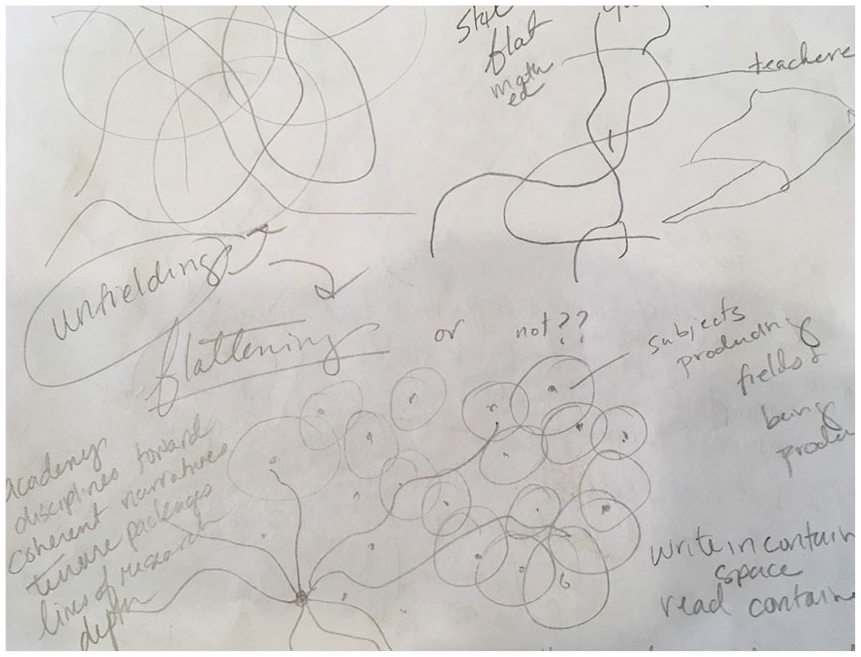
Sketches of conceptions and organizations for field intra-actions.
Becoming With Liminality/Possibility
Both Barad’s (2007) and de Freitas and Sinclair’s (2014) materialisms imply and allow, even insist, that our actions in/with the world impact its/our becoming; and therefore, we have ethical response-ability to that becoming. For me, this lies between hope and despair. It is an accounting of the impact of my presence and a humbling that I cannot control anything independently. So, I must admit that each action I take matters and is outside my direct control.
Possibilities for the field 32 are generated in a mutual becoming. Research can be what de Freitas and Sinclair (2014) refer to as “speculative and creative work” that “pushes the field into new uncharted terrain and allows for new conjectures about teaching and learning” (p. 5). Each manuscript we write, or book we read, or call we write, or abstract we construct, or story we tell a neighbor about the kind of work we do, matters in the field’s and our becoming. Haraway (2016) says it this way.
it matters what matters we use to think other matters with; it matters what stories we tell to tell other stories with; it matters what knots knot knots, what thoughts think thoughts, what descriptions describe descriptions, what ties tie ties. It matters what stories make worlds, what worlds make stories. (p. 12)
If we can bring fields into closeness and make connections in the liminal, we can see points of beauty in difference (see Figure 3). It is a reciprocity like the ones that Kimmerer (2015) describes, “its wisdom is that the beauty of one is illuminated by the radiance of the other” (p. 47). Kimmerer asks us to think two (at least) types of knowledge together and to see beauty in the pairing and importantly to create something in response.
When we make connections across fields and are responsive, we create a liminal (see Figure 5). Barad (2012) explains, “what keeps theories alive and lively is being responsible and responsive to the world’s patternings and murmurings. Doing theory requires being open to the world’s aliveness, allowing oneself to be lured by curiosity, surprise, and wonder” (p. 207). When we are firmly in field, we cannot hear the murmurings as invitations for invention, all we can do is gasp at difference. And, perhaps the gasp produces a liminality—a space for doubt and eventually an opening, however slight.
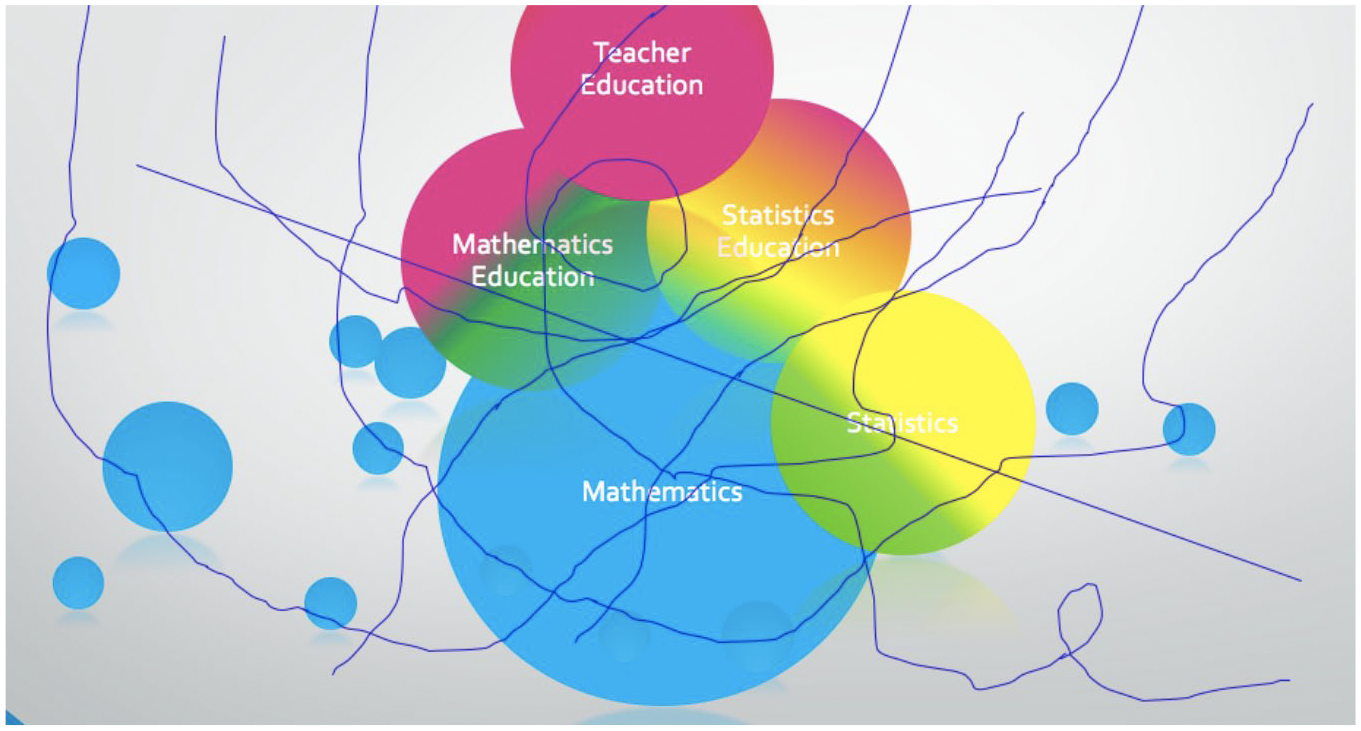
Inventive lines of connection across fields and fuzzy boundaries.
The Not-Field Qualitative Inquiry: A First and Final Figuration
Judith Preissle (2006), in her commentary on qualitative inquiry, asserts that qualitative inquiry is not a field or a discipline. She claims the following: Qualitative inquirers do not agree on who we are, what our purposes might be, and much less on whether we have boundaries and what those boundaries might be (Howe, 2001). We are a messy, contentious bunch who come from a variety of disciplinary and subject-matter backgrounds. (p. 686)
She further asserts that this nonagreement is productive. It keeps qualitative inquiry supple and in movement. Perhaps, researchers should not aspire for their fields to become too mature, so that they are hardened off from creative and innovative practices. Preissle argues that qualitative inquiry is not a field 33 because it continuously questions its identity. Can consistent questioning of our borders, make any group of researchers “the not-discipline, not-field, but maybe community of practice” (p. 686) that Preissle describes? What would it take for Greckhamer and colleagues (2008) postdisciplinarity to undo fields 34 and hierarchies? Could qualitative inquiry be a not field, a community of practice, without other disciplines and fields within which to practice?
Colebrook’s (2017) investigation of education and philosophy implies that making connections between a field and a practice that is open can lead to productive de-disciplining and unfielding. She advocates, “tying education to philosophy, where the latter is not a discipline (in the sense of a specific terrain of know-how or expertise) but a not knowing [emphasis in original]”(p. 652). In a discipline that is trending toward standardized knowledge production, the insertion of practices such as philosophical thinking that provide space for not knowing, is crucial to allow questions of value that are hard to measure. Being responsible in intra-action is an ongoing and moving ethical call that cannot be predetermined. Philosophy and qualitative inquiry produce liminalities, blurring boundaries in fields and between disciplines that might otherwise harden their boundaries toward efficient production of knowledge.
Not knowing leads to blurred boundaries between fields and inventive connections across fields. 35 This work is not about destroying fields 36 but about noticing and questioning the taken for granted and bringing fields 37 into closeness and then expanding them back out to see what difference it makes (see Figure 3).
de Freitas, Lerman, and Parks (2017) assert that qualitative research “performs an important political role by increasing awareness of alternative practices, as well as pointing to inventive and unscripted futures for mathematics education” (p. 177). Unscripted futures are produced in and through liminalities not within hardened categories. Qualitative inquiry attends to things of value that cannot be easily measured or counted. It disrupts easy categorization even as it refers to the structures in fields. 38 The marks and traces of the field remain and provide the interval by which the effects of difference are noted. Whether with the concepts I have proposed or with tools others have suggested—figurations (St Pierre, 1997), concept as method (Lenz Taguchi & St Pierre, 2017), thinking with theory (Jackson & Mazzei, 2012)—we need to continue to unfield, and seek spaces of not knowing, and to do it with responsibility. We are reconfiguring the world as we work in and between the field and across fields. There might be gasping involved. Hopefully, as qualitative inquirers in neoliberal times, venturing into the liminal produces possibility to learn through lines of connection and relationality, how to live and die together well (Haraway, 2016). Living and dying together well is not about smooth lines of production and easy categorization. It is about being willing to be in and produce the liminal and to wonder at its strange beauty.
Afterward
how often I am told where I can go and when I can be there and what I can see there and what that site is for this is the place for research this is the place for exercise this is the place for sleep this is the time for exploring this is the time for 11:31, 29 min to be someplace else what will I be by then. where will I have become what is taking me there, mind, body, thought, soul, spirit, discourse have I made any choices today or am I following the citation trail constituted by my readings I have seen what I was expected to see written what was expected to be written nothing new everything new everything old all traces across field
Footnotes
Acknowledgements
I would like to acknowledge some of the intra-actions of which this article is a part. First, I am grateful to my advisory committee, Dr. Stephanie Cross, Dr. Teri Holbrook, and Dr. Sarah Bridges-Rhoads for their openness in working with me to construct the comprehensive exam question that lead to this article. I would also like to thank Dr. David Stinson and Maureen Flint for their careful readings and reviews of the article.
Declaration of Conflicting Interests
The author(s) declared no potential conflicts of interest with respect to the research, authorship, and/or publication of this article.
Funding
The author(s) received no financial support for the research, authorship, and/or publication of this article.
