




Abstract
Neither inside, nor outside. Between art and non-art. Visual artist, Marcel Duchamp’s readymade art installations of the early 20th century mapped a space of between-ness, of liminality, through previously drawn boundaries in the art world. In this article, we put forth readymade methodology as a liminal approach to (post)qualitative research. Drawing from Duchamp’s readymade art installations, we situate dominant methodological practices as collections of ready-made techniques and technologies for interpreting the world (research as instrumentation); such processes, we argue, are distinct from readymade inquiry (research as immanent and multiplicitous). Readymade methodology disorients knowings and illustrates lines of flight produced from inversions of taken-for-granted technical application of research methods. In this article, we think methodology differently, not limiting ourselves to the constraints/comforts of conventional qualitative methodology. Just as Duchamp interrogated the in-between of art and everyday life, readymade methodology flourishes in/with the potentiality of twisted liminal spaces in (post)qualitative inquiry.
He placed himself in a position that was “neither inside, nor outside.” Instead, he placed himself on the limits, on the boundaries established by the history of art, between art and non-art, between the applied arts and fine arts, between making and acting.
Neither inside, nor outside. Between art and non-art. Visual artist, Marcel Duchamp’s readymade art installations of the early 20th century mapped a space of between-ness, of liminality, through previously perceived boundaries in the art world. Duchamp is most often recognized for his dizzying abstract painting, Nude Descending a Staircase (1912), or for his bemusing readymade sculpture, Fountain (1917/1964)—a white porcelain urinal, flipped upside down, signed with the pseudonym “R. Mutt.” Born in France, yet splitting his time between Europe and the United States throughout his life, Duchamp began his artistic career as an Impressionist painter before shifting to the Cubist style evident in his dizzying abstract painting, Nude Descending a Staircase (1912). Nude Descending a Staircase sparked controversy in the art scenes of both Paris and New York, and Duchamp eventually became known for his subversive and satirically confrontational processes and artworks (Rosenthal, 2004). Duchamp’s later works transcended canvas as he developed his readymade sculptures—which consisted of manufactured objects, slightly modified or combined with other objects in some cases—re-presented to the public as art. Fountain (1917/1964) serves as perhaps his most famous and bemusing readymade. In works like Fountain, Duchamp provokes the mind as it nudges viewers to consider how such “work” could find its way into galleries, museums, and art history textbooks, and how such “work” could challenge capitalist notions of work (of serious work). Furthermore, his readymades, specifically, spark vibratory inquiries into what art is as well as more ontological questions—what art does, what it makes possible. In these “betweens,” the liminal spaces traversed by Duchamp, lurk playful, material, and relational potentialities that, we believe, might also inspire new conceptualizations for (post)qualitative inquiry.
In this work, we put forth readymade methodology as a liminal approach to (post)qualitative research in education. Drawing liberally from Duchamp’s readymade art installations, we situate dominant methodological practices as collections of ready-made techniques and technologies for interpreting the world. As we elaborate below, ready-made as a hyphenated concept refers to conventional practices of procedure in which research methods are believed to pre-exist an inquiry, and can be traced (Deleuze & Guattari, 1987) through replication—research as technocratic practice. A ready-made methodology, therefore, is one that comes to any given inquiry already complete, rounded-out, decipherable, and predictable, much like the original objects that comprise Duchamp’s sculptures. We juxtapose such ready-made procedurism with the disorienting practice of Duchamp’s readymades (one word, non-hyphenated), which we envision as providing philosophical and methodological inspiration for engaging the ontological turn in (post)qualitative inquiry. Duchamp’s readymades involve a re-envisioning, a destabilizing of what was known to map new meaning, a deconstructing of concepts such as work, art, and function. The aim of readymade methodology, then, includes disruptions of accepted truths, unfixing understandings, playful resistance, and palpating otherwise static interpretations. Rather than trace, they map new cartographies (Deleuze & Guattari, 1987). Readymade methodology, then, seeks to disorient knowings and illustrate lines of flight produced from inversions of taken-for-granted technical application of research methods. It is generative, creative, and affirmative rather than destructive or negative. Just as Duchamp created/interrogated the productive in-between of art and everyday life, readymade methodology flourishes in/with the potentiality of liminal spaces in (post)qualitative inquiry.
Before moving on, we feel it is important to clarify our conception of readymade methodology as not a singular methodology, rather as inherently multiplicitous. Deleuze and Parnet (2007) explained that “In a multiplicity what counts are not the terms or the elements, but what there is ‘between,’ the between, a set of relations which are not separable from each other” (p. vii). To us, readymade methodology is liminal as it is multiplicitous, and it is multiplicitous as it is always liminal—breathing through the ands that permeate porous boundaries, connecting, expanding, moving. Liminality is the in-between movements within materialist production (Gildersleeve & Kleinhesselink, 2019; Nail, 2016). Liminal spaces are threshold spaces, moments of both/and, in/between, betwixt/beside. Ontologically, the liminal is movement-centered, rather than static-based (Nail, 2018). Such an approach to methodology resists the stasis of singularity as it is relational, immanent, never-fully formed. Duchamp asserted, “anything systematized becomes sterile very soon” and, to work against such sterility, he searched always for “what [he] had not thought of before” (Tompkins, 2013, p. 60). These ideas begin to construct readymade methodology as multiplicity—activating potentialities of the between, connecting differently through the not-yet, always working against the sterility of systemization.
In what follows, we begin our conception of readymade methodology with a review of critiques that challenge and/or disorient qualitative research as instrumentation. Next, we turn to Duchamp’s readymades as theoretical/methodological inspiration for our conceptualization of readymade methodology, contextualizing them and exploring their genesis in the early 20th century art world. After such artful situating, we consider the ways in which Duchamp’s readymades disrupted the very notion of art as institution, drawing connections to the landscape of qualitative inquiry. Our article then makes explicit connection to the theme of the special issue theme as we position readymade methodology as a twisted liminality in (post)qualitative inquiry.
Critiques of Qualitative Research as Instrumentation
I wanted to find something to escape that prison of tradition. Tradition is the prison in which you live. How do you escape from those pincers? (Marcel Duchamp as cited in Tompkins, 2013, p. 82)
In what follows, we review the broader research literature that criticizes qualitative research methods that instrumentalize methodology. Such criticism broadly claims that qualitative research should not be reduced to prescriptive techniques or technical practices, but rather advocates a more philosophically and theoretically informed emergent practice of inquiry (Jackson & Mazzei, 2012; St. Pierre, 2013). These critiques lead to assertions that conceptualizing qualitative research as an instrumentation of techniques or practices equivocates it to capitalist production (Koro-Ljungberg, 2016; Kuntz, 2015), which forms part of the basis for (post)qualitative inquiry (St. Pierre, 2013). Readymade methodology operationalizes (post)qualitative inquiry, in part, by playfully engaging/disorienting the capitalist imperative of modern academic institutions as well as the instrumentalization of prescriptive qualitative techniques and technical methodological practices.
We follow a chorus of methodologists concerned with the interpretive paradigm of qualitative inquiry. The collection of critique generally follows that the interpretive traditions in qualitative research fixate too much on an empiricism of “the real” that might not afford creative junctures or disruptions for social action (Lather, 2016; Talburt, 2004). Such a fixation shifts the interpretive endeavor to approximate a science using methods that fetishize scientism (St. Pierre, 2013) and ensnare the work of inquiry into a strict instrumentalism (Koro-Ljungberg, 2016). Such an instrumentation of inquiry undermines any emancipatory goals of the knowledge imperative of academe (Gildersleeve, 2016; Kuntz, 2015). To counter the scientistic fetishism that overly instrumentalizes qualitative inquiry, scholars have begun engaging with an ontological turn in inquiry, drawing on philosophies of new materialism (Connolly, 2011), posthumanism (Braidotti, 2013), new empiricism (Taylor, 2016), and the Anthropocene (Guyotte & Flint, 2019; Gildersleeve & Kleinhesselink, 2019), while generating new methodological paradigms such as (post)qualitative inquiry (St. Pierre, 2013). In short, the ontological turn moves inquiry away from interpretation and toward a focus on what things do and what things become in a constantly changing and radically agential reality. In this vein, we put forth our readymade methodology as a counter to the ready-made methods that proliferate across the normative traditions of qualitative inquiry.
A ready-made methodology, therefore, is one that comes to any given inquiry already complete, rounded-out, decipherable, and predictable. To begin, ready-made methodologies prescribe a set of known practices, expected findings, and realistic representations. In a sense, the broad collections of qualitative approaches, when normalized into methodological traditions—even critical traditions—become ready-made, off-the-shelf, off-the-rack, boxed sets of methods, findings, and representations. They perpetuate that which is predictive and predictable. The colloquially commercial metaphors of “off-the-shelf” and “off-the-rack” are intentional here, as we contend, along with others (see Gildersleeve 2016, 2017; Koro-Ljungberg, 2016; Kuntz, 2015) that such closure of method/ology reduces inquiry to an economic transaction. According to Gildersleeve’s (2016) prior theorizing, such reduction inherently undermines the generativity or generosity potential of the knowledge imperative. Even as we make this point, we do not assert that there is no place for ready-made methodologies in the qualitative landscape, after all, we move within a big tent (Denzin, 2010). However, we do take the position that this mode of thinking/doing has the potential to be problematic and even dangerous. In practicing ready-made methodology as pre-existing, regulatory, and normalizing, one can easily slip into a more clinical model of research (Lincoln & Cannella, 2004) that ignores local, relational, and material considerations. Thus, we argue against the ready-made interview, focus group, artifact collection, textual analysis, narrative vignette, case study, or thick description. Therefore, we offer a different way of thinking methodology that attends to such complexity through conceptualizing a readymade methodology built in the spirit and tradition of Marcel Duchamp’s readymade art installations.
Duchamp’s Readymades
Our conceptualization of the readymade emanates from the work of French-born artist, Marcel Duchamp. Duchamp’s readymades, in a basic sense, took found objects, altered them in some way, and re-presented them as art. His earliest readymade, consisted of a bicycle wheel that was affixed atop a common wooden stool, which he aptly titled Bicycle Wheel (1913/1951). In another readymade (see Figure 1), Duchamp took a snow shovel, signed his name to its wooden shaft, and appended it from a wire on the ceiling (1915/1964). Consistent within Duchamp’s readymades is the use of prosaic, mass-produced objects, those we might call ready-made—objects whose “thingness” becomes absorbed by their utility. In other words, the value of such items cannot be thought outside their everyday functionality of making something possible (e.g., movement, clearing a sidewalk, meeting bodily needs). Here, we point to an important distinction in both Duchamp’s work and our readymade methodology—that between the ready-made and readymades, an idea we further explore in this section.
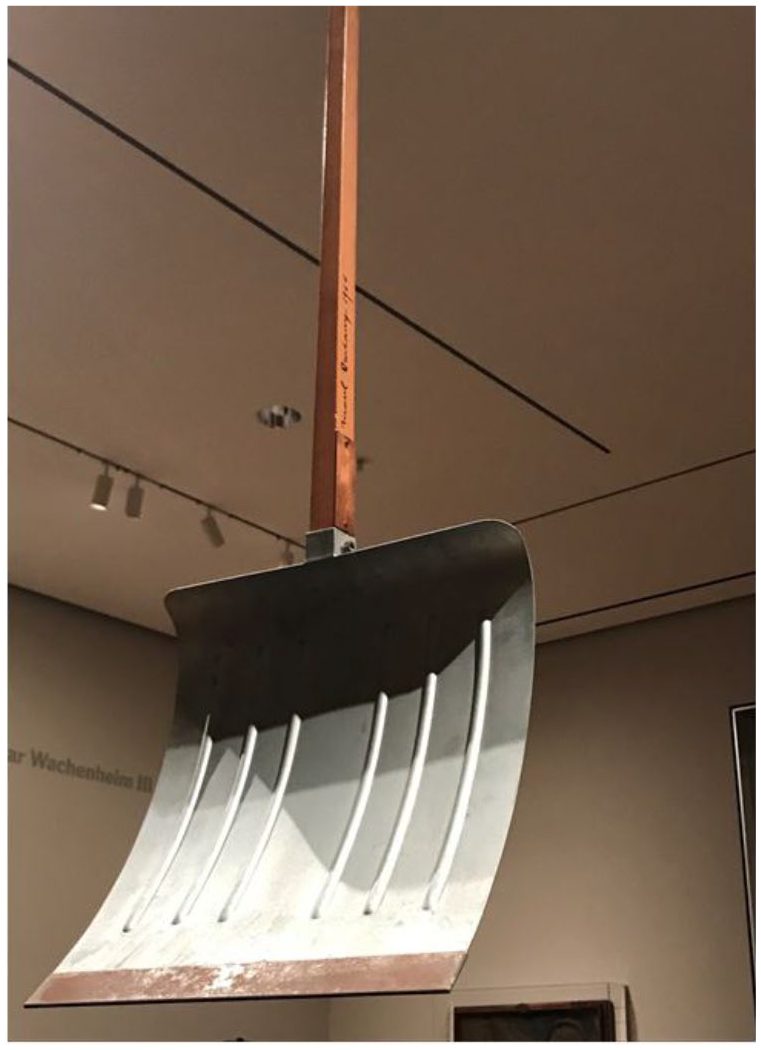
In Advance of a Broken Arm (detail of readymade sculpture). August 1964 (original lost in 1915). Museum of Modern Art.
Societally speaking, the objects that comprised Duchamp’s readymades were ready-made for capitalist production. Presenting such mundane objects as art and subsequently rendering these once useful items useless disorients the everyday sensemaking related to readymades. The objects of the readymade, whose prior value were entwined with their everyday usefulness, become objects of inquiry through Duchamp’s re-presentation—mapping a new liminal space between art and the everyday (Lazzarato, 2010). Luisetti and Sharp (2008) explained, “Yet, because of their provocative ‘thingness,’ [readymades] refuse to be assimilated to the mechanisms of representation and stand as something in between, occupying the interval between everyday objects and artworks” (p. 79). The “thingness” of readymades, then, both points to the utilitarianism of the comprising ready-made objects as well as their ability to be newly conceived outside of capitalist production. In one sense, these creations provide new opportunities for understanding ready-made objects: Do they really save time? Are their purposes really given? Can they be beautiful? In another sense, such disorientation also repurposes the meaning of the objects away from their everyday utility and toward a new conceptual aestheticism: What is/can be art? Does art have to be beautiful, and who decides? What do objects-as-art make possible? Thus, what we think we know is productively and playfully disrupted through the liminality of the readymade.
Along the lines of disruption, Duchamp’s readymades, with the artist’s movement Dada, are often credited with igniting a shift away from retinal art and toward conceptual art. Retinal art speaks “solely to the visual sense” where an artist simply “puts down what he sees” (Tompkins, 1996, p. 58) from passing moments (O’Sullivan, 2006)—tracing as an act of representation (Deleuze & Guattari, 1987). Conceptual art, on the contrary, seeks to energize the mind as a material, sensual, and immanent way of mapping encounters with the world—moving beyond art of the eye to art that provokes the mind.
The readymade [does not] appeal to or flatter the eyes; instead it forces us to think, to think differently, by orienting the mind differently. From this perspective it is possible to define the readymade as a technique of the mind . . . (Lazzarato, 2014, p. 22)
Rather than endeavoring toward representation—presenting again—conceptual art strives for mapping, creating, a becoming. It re-presents—presenting always anew.
Situating these ideas in inquiry, we might think of retinal art in relation to a technical and procedurized research practice where, on the surface, the research appears to be adequate—certain normalizing methodological steps have been followed in both doing and writing. Such a practice we introduced above as ready-made methodology—research as instrumentation. Retinal inquiry, then, speaks to tracing the practices of procedure, making possible a logic of extraction that distances researcher and researched and severs identity from materiality (Kuntz, 2015). It stands ready-made as a static, one-size-fits-most process that speeds toward capitalist production—researcher as technician. Coincidentally, Duchamp discusses extraction through his act of removing ready-made objects from their normalized capitalist context; however, such extraction maps potential: “For new meaning to emerge, for something new to occur, this emptiness which liberates possibility, must be traversed. It is at this empty point, at this nonsensical point, that we no longer see the same things . . .” (Lazzarato, 2014, p. 23). Such extractive possibilities are inherently different from those in a logic of extraction, whereas the materiality reorients (or disorients) through new relations.
Even as extraction is part of Duchamp’s intent in moving art-object toward emptiness, we assert such an emptiness is not an ontological absence, nor guided by a logics of extraction. Instead, in this sense, extraction is an ontological fullness, a becoming, teeming with potentialities (O’Sullivan, 2006). The conceptual inquiry of readymades, then, might align more effectively with the ontological turn in (post)qualitative research; there is no procedure to follow as the logics underlying such doings are both immanent and relational. Furthermore, extraction, according to Duchamp, is liberatory as it releases from the constraints of normativity and makes possible a type of conceptual creativity (Braidotti, 2006) in which new, differential connections are always possible. Conceptual inquiry aspires to orient differently, even disorienting, to map potentiality. This is how we begin to conceptualize readymade methodology—more on this to come.
Duchamp’s shift from retinal to conceptual and his transposition of ready-made objects into readymades cultivated liminal spaces between art and everyday life, between art and non-art, between objects found and objects created. A direct consequence for theorizing any readymade methodology is the recognition that in the spaces between these perceived binaries, choices emerge. “‘How do you choose a readymade?’ someone once asked Duchamp: ‘It chooses you, so to speak’” (as cited in Lazzarato, 2014, p. 23). Such a perspective is reminiscent of Deleuze and Guattari’s (1987) description of Ahab choosing Moby Dick: “a choosing that exceeds him and comes from elsewhere” (p. 244). Choice, then, emerges as an encounter of immanence and affect rather than as grounded in the logics of reason. For Duchamp, choices become art. For us, choices become liminal inquiry.
Disrupting Art (and Inquiry) as Institution
The [bi]cycle become an art object when placed in a gallery; the human body becomes an “artist” when connected to a paintbrush. (Colebrook, 2002, p. 56)
Indeed, Duchamp challenged notions of art and artist and, therefore, disrupted the very institution of art in the early 20th century. Retinal art practices referenced above incited Duchamp’s movement toward the readymade (Lazzarato, 2010). Moving from retinal to conceptual, the readymades created new lines of flight away from established aesthetic values and practices, escaping their perceived limitations and turning to (often) prefabricated and (certainly) mundane objects as the stars of such “work.” Through this practice, he destabilized the foundations on which past art stood. Thus, in Duchamp’s readymades, the very “work” of the artist was in question and the conception of art as institution began to stammer. Similarly, readymade methodology creates an in-between space through which inquirers might create lines of flight that embrace stammering and conceptually playful practices.
Invoking a stammering, the institution of art, made recognizable in its systems of galleries, museums, curators, patrons, and so on, was called into question through Duchamp’s readymades. If everyday found objects could become art, were such institutionalized structures necessary for its production? Did the institution of art itself support art? Or was it indeed an inverse relationship—was art produced to support the institution? Such questions also parallel the contemporary condition of academic inquiry. As Carducci, Kuntz, Gildersleeve and Pasque (2011) lamented, the commodification of research into simple economic units suggests that universities might not be an infrastructure for doing research, but rather that inquiry is becoming part of the infrastructure for universities. In addition, as Koro-Ljungberg (2016), St. Pierre (2013), and Kuntz (2015) have questioned, methods of inquiry might actually serve as neoliberal practices of academic institutions rather than modes of knowledge production. Thus, as the readymades challenged institutionalized structures in the world of art, a readymade methodology might challenge the scientistic regulation of the knowledge imperative in academe.
The readymades challenged and obscured retinal art in practice and appreciation, therefore setting the stage for conceptual art to become something outside itself, outside of the artist’s gaze, outside the institution of art. In a basic sense, the readymades drew attention to the entanglement of capitalist production practice within the institution of art, and through conceptual obfuscation of that institution established a refusal of work on behalf of it (Lazzarato, 2010). Art could become anew.
By taking on the institution of art itself, the readymades forced an ontological question of art. How could art emerge? What discursive-material means of production were really necessary, if any? Did capital (i.e., systems of exchange and value), as represented by the gallery systems, deterritorialize/reterritorialize art? And if so, into what? By questioning the institution of art, ontologically, the readymades also provide a political direction for artists to consider. Specifically, how to upend or avoid the work of/for art and more freely pursue truths through doing art void of the institution. Playing with this notion, Gildersleeve (2018) drew upon Duchamp’s refusal of work in his theorizing of laziness in (post)qualitative inquiry. Gildersleeve points to the political project of reclaiming the knowledge imperative of academe by practicing laziness in inquiry, wherein laziness suggests a refusal of work (and co-optation/commodification) rather than lethargy. Such a politics, made relevant and recalcitrant by Duchamp’s use of the readymades to critique and obfuscate the institution of art, demonstrates the potential for transformation through a readymade ethic.
By critiquing the relationships generated through art as institution, Duchamp and the readymades produced a liminal space through which new technologies for art could emerge and captive innovations could be freed. By producing critique of art through the production of art, Duchamp’s readymades moved in between art-as-subject and art-as-object without needing to produce a continuum or definition of either junction. Subverting the institution did not tear it down, but rather created fractures, opening up a newly liminal space for experimentation and innovation. Here, we draw parallels to the ontological turn and (post)qualitative inquiry (St. Pierre, 2013), wherein the goal is not necessarily to destroy inquiry as it might be known, but to provide pathways for inquiry that is yet-to-be-known. Enter, readymade methodology.
Readymade Methodology as a Twisted Liminality
Readymade methodology as twisted liminality in (post)qualitative inquiry suggests that technes of qualitative research should be playfully re-imagined, re-positioned, and re-engaged, rather than abandoned. To such playfulness, we conclude the article with an extended section on imagining readymade methodology. We realize that our readers may want us to move from the abstract to the concrete through providing suggestions on how to move forward with their own readymade inquiries. Even as we know this, we realize that we walk a tenuous line that pushes against the very dangers we critique in ready-made methodology. Such dangers include a movement toward readymade methodology as a thing, as something concrete that can be brought forth by way of examples and suggestions, as pre-existing methods that can be applied to other inquiries—all this risking the very ready-made procedurization that our approach seeks to disrupt. To borrow from St. Pierre, Jackson, and Mazzei (2016), “Put simply, we can’t tell somehow how to do this new work, how to think, how to experiment . . .” (p. 106; emphasis original). Thus, rather than presenting examples, in this section, we respond to prompts within the readymade ethos, such as: What is inquiry? Who is a researcher? In what ways can a readymade approach expose the critical interstices/fractures inherent in the capitalist production beget by ready-made qualitative research? How might technes of qualitative research be re-presented in ways that interrogate the choices of such technes, while generating new knowledges about/from such choices? Such questions, we believe, provide inspiration for imagining readymade methodology even as they reverberate, and spark new questions, and open up possibilities for liminality in qualitative inquiry. In true readymade fashion, our conclusion is rife with inconclusion.
What Is Inquiry?
In writing about the relationship between experience, art, affect, and knowledge, Simon O’Sullivan (2006) states, “. . . knowledge is not the accretion of signifying sedimentations, but, . . . the formation of adequate ideas which themselves arise from affects” (p. 44). Readymade methodology seeks to disrupt the knowledge imperative of academe’s strict adherence to its scientistic fetish of sedimented representations of what is known. Rather, inquiry becomes a formation—or the building of—concepts that become known through their affects; known from the concepts’ happening. O’Sullivan (2006) continues, “This is to experientially ‘understand’ the conditions and causes of specific encounters, and then to utilize such knowledge in organizing one’s life” (p. 44). Encounters here need not be limited to human-human, but rather any movement through which affect is produced. The goal of inquiry in readymade methodology, then, might become the encounter, focused on movement, and generating knowledge useful in organizing life (broadly conceived). An encounter can take shape across discourses, materials, bodies, spaces. The movement of the encounter, the flows and junctures, provide the conditions and causes for analysis.
Readymade methodology encourages playful entanglement of research method across these encounters. Similar to how Duchamp inverted the everyday materials/discourses of the apartment in his studio by hanging them from the ceiling, we encourage a readymade methodology wherein the everyday, given materials/discourses of qualitative research might be inverted for new experiments with concepts. Such inversion beget Duchamp new ways of producing affect in his art, new ways of thinking art, new ways of producing capitalist critique, and new ways of subverting the institution of art. Readymade methodology, then, could be useful for playfully inverting the ready-made methods that dominate social inquiry and constitute new encounters wherein different affects are given through the experience of inquiry.
As a liminal methodology, we emphasize the notion that readymade methodology operates as a multiplicity. It contains nothing, nor can it be contained. Rather, it emerges from the connections across novel, innovative, subversive, and/or normative inquiry practice. There are innumerable readymade methods, but they should emerge from an ethic and effort to explore, experiment, and expose the fixities that bind us into normative practice by subverting them, just as Duchamp’s readymade installations twisted the notion of art practice and the notion of art institution simultaneously. As a multiplicity, then, readymade methodology always exists in its non-existence within any confines of (post)qualitative research. That is, readymade methodology does inquiry liminally—generating anew the process, practice, outcomes, and representations of (post)qualitative inquiry. The liminality of a readymade methodology contrasts with the stasis of traditional, critical, and even some post-qualitative research that emerges from method-centric approaches to inquiry.
Who Is a Researcher?
A researcher, an artist, a scientist, a philosopher . . . each becomes possible in the movement of readymade methodology. Taken to the extremes, readymade methodology might subvert the disciplinary boundaries established through historical encounter with academia, yet. The inversion of readymade methods might need not be limited to those of social science. Rather, inverting methods across disciplines, entangling methods from humanities, science, and social inquiry could produce encounters of inquiry that generate productive knowledges from understanding their conditions and causes. Such has been the case in art for centuries: from Georges Seurat’s pointillist approach to David Hockney’s deployment of emerging digital technologies, and of course, Marcel Duchamp’s use of the technology of the readymade. Entangling method produces new and fluid subjectivities of artist, researcher, and artist-researcher. Put another way, readymade methodology might be useful in exploring and pushing against the limits of methodology, or research itself.
As Duchamp himself said, “I don’t believe in art. I believe in the artist” (Tompkins, 2013, p. 93). We pause to consider the analogous statement, “We don’t believe in research. We believe in the researcher” as a departure point for readymade methodology. Here, we find it helpful to turn to poststructural scholar Jacques Derrida. Derrida’s (1976/1997) notions of deconstruction destabilize and disrupt the once accepted meanings of art and research, creating spaces of (productive) tension for the readymade methodologist. Much like Duchamp dismantled the very notion of art through his readymades, the notion of research evades, shifts, and creates new openings through a readymade methodology. Therefore, if we resist seeking solace in the in/stability of both the words themselves as well as the institutions of art and research and, instead, put our belief in the practices of the artist and researcher, opening spaces to rethink not only what is but also interrogating the events, the very processes enacted that both fix and unfix. The artist and researcher, then, both make visible and respond to the incessant unsteadiness, the stammering, the possibilities within. Thus, in readymade methodology, the researcher as a role becomes more of an ethical positioning in relationship to the encounter and its conditions and causes, always responding to irruptive movements and slipping subjectivities.
Readymade Fractures
Intentionally destructing the ready-made methods of qualitative research traditions might expose fractures inherent in the capitalist production of research beget by such ready-made methodologies. That is, readymade methodology might be useful in what Lazzarato (2014) has called for in the refusal of work and what Gildersleeve (2018) has called the virtues of laziness in (post)qualitative inquiry. These are ethical stances in opposition to the economic subjectivity of the researcher (and, therefore, the research she produces). Whereas Duchamp’s readymade installations demonstrated how new kitchen appliances did not lessen the day’s work, but simply re-organized the work of the day, readymade methodology should be used as a means for carving out similar fractures in the logics of our contemporary knowledge imperative. Readymade methodology promotes the movement of inquiry rather than fixing knowledges into economized items to be configured as data points for algorithmic analysis (e.g., impact factors) or even scalability. Readymade methodology then allows for new ethics behind the purposes of research and knowledge production to emerge, if desired. These are similar to the virtues of laziness that seek to disrupt the normative and neoliberal co-optation of knowledge production for economic means.
Re-Presentation of Technes
Just as Duchamp challenged and disrupted the technes of the early 20th century art world through his readymades, readymade methodology urges a similar challenging in qualitative inquiry. Expanding from our discussion above, the readymades questioned prior conceptions of visual art aesthetics by positioning everyday objects as art, questioned the capitalistic utility of the objects used, questioned the place of such readymades in artistic institutions, and questioned the technes of capitalist work juxtaposed against the lazy work (or “refusal to work”; Lazzarato, 2014, p. 6) employed by Duchamp. Lazzarato conceived of the spaces between such questions as an anti-dialectalism, in which the perceived boundaries between opposing binaries, in fact, become playful interstices. In the readymades, boundaries are permeable and hierarchies are flattened to create new potentialities “involving a new use of artistic techniques beyond the realm of art that would open up new modes of action and subjectivation” (Lazzarato, 2010, p. 101). Readymades, then, flourished in the liminal spaces where technes of the retinal past began to unravel when new conceptual artistic methods re-presented art differently. Inspired by such twisted liminality, we wonder: How might technes of qualitative research be re-presented in ways that interrogate the choices of such technes, while generating new knowledges about/from such choices?
Of course, such a question does not conjure an easy response. However, we find it helpful to return to Duchamp’s statement on choice in which he indicated that the readymade chooses him, and not the other way around. Through this conception, choice in (post)qualitative inquiry might also be thought of as relationally immanent—not pre-existing, nor exterior—rather, readymade methodology works against ready-made instrumentation and procedurism. Technes and methods cannot precede practice as there are no (post)qualitative methods to begin with, to apply (St. Pierre, 2018). Drawing from the philosophical work of poststructuralists like Deleuze and Guattari (1987), St. Pierre (2018) explains, “In an ontology of immanence, one becomes less interested in what is and more interested in what might be and what is coming into being” (p. 2). Hence, readymade inquiry shifts relationally and there is no stable techne as it “is different each time” (p. 8).
Alluding to poststructural discussions of difference and repetition (e.g., Deleuze, 1994), Duchamp elucidates on his readymades, saying, “If I had systemized the readymades I could have made a hundred thousand readymades in ten years, easily” (Tompkins, 2013, p. 60). Technes of repetition—according to Duchamp, Deleuze, and Guattari and our conception of readymade methodology—risk the sterility of systemization, the logics of extraction, the static nature of much conventional inquiry that is concerned with the replication of methods and methodology rather than experimentation and conceptual creativity. Such technes speak to representation rather than the readymades moving with and toward persistent shifts in re-presentation—re-presentation that resists method. Thus, in returning to our question, we acknowledge that there is no stable answer that we can provide. Instead, such a question, we hope, will continue to spark new lines of flight that might nudge (post)qualitative researchers toward a consideration of ontological immanence, where choice and re-presentation must always be thought of in relation to specific inquiries and the concepts that drive such inquiries. Immanent choice. Choice as conceptual creativity.
In/conclusion
Readymade methodology as a twisted liminality resists conclusion. What we have put forth in this work is a middle that enters through Duchamp, (post)qualitative inquiry, and other scholars who draw inspiration from concepts like the readymade while challenging and affirmatively resisting ready-made methodological practices. Our choice to conceptualize readymade as methodology and not to abandon methodology affirms our position to playfully re-imagine, re-position, and re-engage. Rather than abandon, we have endeavored to think methodology differently, through a (post)qualitative lens, not limiting ourselves to the constraints or comforts of conventional qualitative methodology.
Duchamp once said that he did “not care about the word ‘art’ because it has been so discredited” (Bakewell, 1966). Aligned with a more affirmative perspective, we still care about the word “methodology” even as we seek to challenge what it has meant, what it has done, and how it might inspire new cartographies in (post)qualitative inquiry moving forward. A readymade methodology, then, provides no prescriptive process to apply nor methods to follow. It serves to provoke the eye and the mind, to rethink what we think we know, and to twist and upend prior methodological practices so we might see them anew. Bicycle wheels on stools, urinals signed and turned on their sides, shovels turning slowly from the ceiling—all presented as art. What might such readymade re-presentations look like as (post)qualitative inquiry? Can readymade methodology be thought outside of (post)qualitative inquiry? What might readymade methodology afford and how might it limit? We invite our readers, our colleagues, to ponder such questions alongside us, allowing us to be inconclusive in what readymade methodology might become. In such twisted liminal inquiry spaces breathes potential.
Footnotes
Declaration of Conflicting Interests
The author(s) declared no potential conflicts of interest with respect to the research, authorship, and/or publication of this article.
Funding
The author(s) received no financial support for the research, authorship, and/or publication of this article.
