




Abstract
I wrote this article during and immediately following what I have deemed a serenity quest, where I traveled quite aways from home, by myself, with not all that much pre-planning to “be with” myself. I use this particular moment I am living right now and some of what has been provoked and produced to work through the two questions this special issue is taking up: What does “post-qualitative” mean to you? And why do you think the “post-qualitative” movement is so important to the field of qualitative inquiry?
I wrote this article during and immediately following what I have deemed a serenity quest, where I traveled quite aways from home, by myself, with not all that much pre-planning to “be with” myself. Although I won’t get into, here, the primary catalytic life change for this very literal serenity quest, I will say that I have explicitly been on a SERENITY QUEST for quite some time (at least 15 years)—actively working the 12 steps (for my work addiction) and listening to and learning from folks skilled in mindfulness work. And I am going to use this particular moment I am living right now and some of what has been provoked and produced to work through the two questions this special issue is taking up: What does “post-qualitative” mean to you? And why do you think the “post-qualitative” movement is so important to the field of qualitative inquiry? On its face, it might not seem customary to use something so personal as the pivotal point in a discussion of post-qualitative research. However, as I argue in the next section of this article, to post-intentionally consider post-qualitative inquiry using post-intentional phenomenology (PIP) is not to refuse the personal but to entangle the personal with the social, the conceptual, the theoretical, the human, the non-human, and other phenomenological material.
I begin by sketching a few key principles and concepts in PIP, a type of post-structural AND (in the Deleuzoguattarian way) phenomenological philosophy-methodology that I have been thinking and writing about over the last decade or so (Vagle, 2010, 2011, 2014, 2018) Through this sketching, I first consider, theoretically, the special issue’s central questions. And I then close the article by inviting colleagues and students to live out, methodologically, my theoretical ideas through two key moments, what I have been calling post-intentional phenomenological material, from my current serenity quest.
Some Post-Intentional Phenomenological Principles and Concepts
One important principle is
It is not insignificant to me that post-qualitative in the special issue’s central questions is hyphenated. In most presentations I have attended and papers I have read, the post in post-qualitative has very explicitly, maybe even forcefully, signified refusal of traditional humanist qualitative inquiry—that it is time for something markedly new.
Me? I would like the hyphen in post-qualitative to do what the hyphen does in PIP. I would like it to entangle some post-concepts and some traditional humanist qualitative concepts so that new imaginings can be provoked and produced—qualitative provocations and productions that we cannot see right now. I am a little worried that a post as refusal ethos might stultify what can be provoked and produced. There will be folks who will want to take a hard pivot away from traditional humanist qualitative just because they are now “supposed to.” At the same time, I think one of the main reasons the post-qualitative movement is so important to the field of qualitative inquiry is because it provokes this sort of debate. What should stay? What should go? Does anything have to go? Is it a new space?
And for me I want to keep working the hyphen, the entanglement among various ontologies, epistemologies, and methodologies. I would like fewer demarcations and boundaries—which I think the post-qualitative movement has helped catalyze.
. . . in post-intentional phenomenology the focus is not on a stable human subject, but is on de-stabilized phenomena that are constantly being made and unmade, produced and provoked by all sorts of actants and forces, the human and the other than human. All the while, trying to remember that this sort of theorizing has been around for centuries in Indigenous communities—and all the while trying to remember that people of color are still a long way from being treated humanely in a country and world where whiteness (my whiteness) is not only privileged, but also treated as supreme. (Vagle, 2019, p. 5)
There are a couple very important tensions here that I want to keep in play in PIP—and I hope can be kept in play in the post-qualitative movement more broadly. The first is the tension between seeing what I have developed in PIP as something new and innovative AND not only naming but also turning to Indigenous people and their philosophies for guidance and collaboration. I need and want to do this better. The second is the tension between being excited to engage the human and the other than human in PIP AND the reality that it is very likely felt by people of color as a freedom white people are afforded given their (our, my) racial privilege in a white supremacist society and world, as well as a diversion from the important attention that needs to remain on making sure all people across races are treated humanely.
At the risk of belaboring the hyphen, for me the hyphen in post-intentional and in post-qualitative inquiry can serve as an important reminder of these tensions. I am afraid if the post in post-qualitative inquiry continues to be about refusal, that these two important tensions just named could also be refused. And I think refusing (even without intent) Indigenous knowing and the humanity of people of color would be an incredibly problematic effect of the post-qualitative movement.
Furthermore, then, I think it is essential for the movement to take deliberate and explicit action to not have this be the outcome.
A third important post-intentional phenomenological concept I am going to keep trying to demonstrate that the phenomenon is the coin of the realm, the grand prize, the unit of analysis in post-intentional phenomenology—and not the human lived experience of the phenomenon. All the while, still deeply valuing and respecting the lived experiences of those humans who graciously agree to invite me into their experiences. (Vagle, 2019, p. 4)
In PIP, the phenomenon and lived experiences of the phenomenon are not seen as one in the same. Therefore, there are innumerable sources of material that can be explored to see how they might provoke and produce the phenomenon—lived experience being one. This means, for example, histories of oppression, narratives, discourses, spaces, places, contexts, policies, and philosophical concepts can all serve as post-intentional phenomenological material that are as, but not more, important than lived experience material.
This is delicate as I do not want to diminish the importance of human’s lived experience, especially given my earlier point about honoring the humanity of all people, especially those oppressed and marginalized. And I think there is a danger in the post-qualitative movement writ large for doing the same.
There has been much talk of abandoning method in the post-qualitative and instead beginning with concept—much more like philosophers do. While this might be appealing to many in the field, again, I think wholesale refusal of the “old,” instead of entangling the old with the new might end up leaving too much behind—too many important things that we have done well and continue to do well. For example, I think post-qualitative inquirers can begin with concept, see where it leads, and if it leads to talking to people of color about what it is like to be marginalized, then I think that is a good way to go.
Provoking and Producing the Serenity Quest
In the rest of this article, I pivot to the serenity quest—treating it as a post-intentional phenomenon to illustrate how a hyphenated post-intentionality might be lived out analytically in the hyphenated conception of post-qualitative inquiry I theorized above.
In terms of process, I first identified two bits of phenomenological material that I experienced while on my serenity quest, a mountain peak hike and getting my first tattoo (both, I fully realize, are super predictable and stereotypical serenity questing experiences). I then included a series of photos for each experience that I think engage the phenomenon. By engage, here, I do not mean represent or signify—I mean that I anticipated that these photos would likely provoke insights, wonderings, and questions from others, which leads to the next important part of the process.
I invited colleagues and students to engage the photos. Those I invited are either PIP Friday participants at the University of Minnesota or Crafting Phenomenological Research Course participants at ResearchTalk’s and the Odum Institute’s (University of North Carolina [UNC]–Chapel Hill) Qualitative Research Summer Intensive. I did not ask participants to interpret or analyze the photos to determine or describe what the photos “mean.” Rather, I asked them to write about what came up for them—to write about what the photos provoked and produced for them, generally, and if possible prompted them to reflect on the post-qualitative movement. Although I would have loved to literally just leave exactly what they wrote, because of space limitations I needed to pair their provocations and productions down a bit—trying very hard not to tidy them up in some way, shape, or form. I wanted their insights to speak for themselves.
In keeping with this goal, I only sparingly weigh-in and tie their writings together, as I want these provocations and productions to be seen as post-intentional possibilities, Deleuzoguattarian lines of flight if you will. I want these photos, provocations, and productions to be seen as post-qualitative starting points that could be picked up later and followed to see what might come of them—as this is how post-intentional phenomenologists see, think, and feel phenomena. That said, I do briefly close the article with some final thoughts.
Hiking the Mountain
The selfie
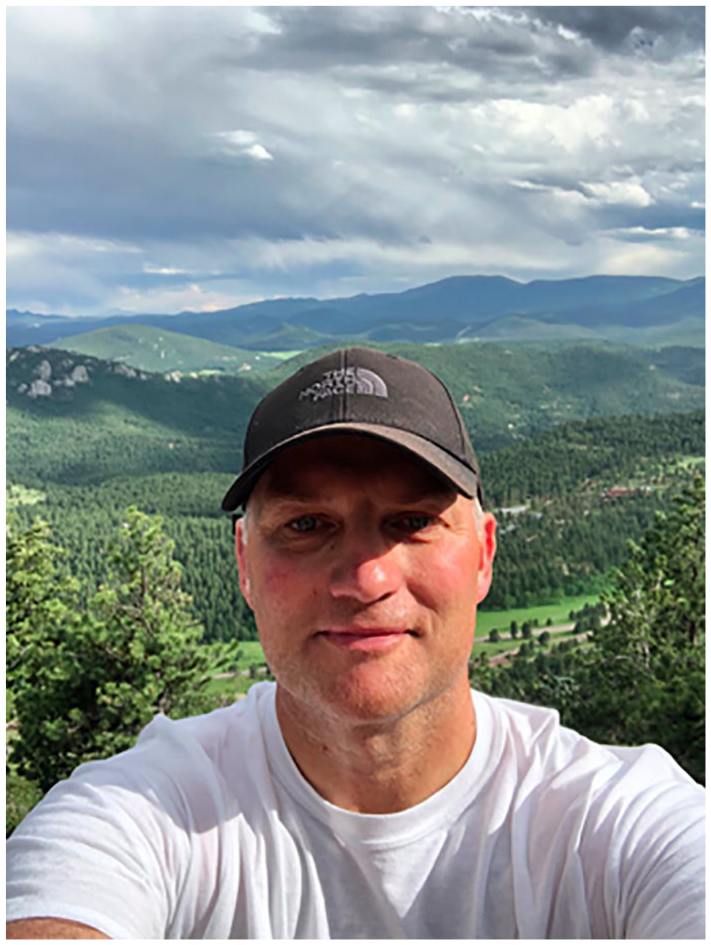
I think the hiking “selfie” pictures are so interesting (having many myself as well!). How we as humans feel the need to document where we are in place/space. It seems to center the experience of the self . . . a declaration of “I am/was here.” When, in actuality, the “here” has existed prior to ourselves (and will likely remain after). Why is this documentation of ourselves so important? . . . The declaration of “here I am” inserted in this place/space. The subject is often front and center. The most important aspect of the photograph. Of the research. Post-qualitative work is important, I believe, because it asks us as researchers, academics, and thinkers to move beyond human experience. To consider what is happening in the background of our selfies, if you will. How can we step aside, both in photographs and our own research, to see other things, new perspectives, different approaches? . . . (
***********************************************
This speaks to me as a centering, perhaps in consideration of how we at first engage and interact with the world or our world. Whereas later, the landscape photos seem to be a decentering, how we come to see the world . . . I am also thinking about how much we miss when we put the world behind us, yet how much we see when we look back at these photos, reflecting on our experiences, the moment, the interactions and engagement. What happens when we turn around? When we then take ourselves OUT of the frame then position the image, the serenity quest artifact, front and center . . .
***********************************************
Surrounded by nature in the serenity quest might lend itself to reconnecting to one’s relationship with the earth and perhaps indigenous ways of knowing. What does this mountain mean to this climber in this context? How does having climbed impact this human? Having hiked in altitude, I imagine there are positive endorphins and exhaustion. Fresh air feels good after living in a city environment. The interaction of the human and the other-than-human (the environment) are entangled in the phenomenon of the serenity quest . . .
***********************************************
There’s something about the selfie that I resist. Why has the selfie proliferated? Why do I resist it? Of course, it seems obvious to document such a serenity search. Who is the selfie for? Is it for Mark to retain the memory and try to capture the moment for later recall and integration? Is1 it for others to see that Mark is doing what so many want to do and value—take time for oneself to grow and develop? What does the selfie bring to Mark?
***********************************************
The selfie immediately brings to mind that there was no one else available to take the picture. That idea, together with your introduction of a major life change, immediately made my mind go to the loss of an important relationship, likely a partner . . . The “alone-ness” is palpable to me in this photo.
***********************************************
I understand serenity quests. I’ve taken a few myself . . . They may provide a demarcation, as someone else has suggested here, of a life change that may or may not be desired. In response also to some of what I’ve read from others above, it seems like a privileged endeavor to be able to make a serenity quest journey, and I wonder about that. I have thought a lot lately about spaces that are safe or unsafe and available/unavailable for different individuals and groups. From taking classes in a hotel and a city modeled on a plantation to reading on Twitter over and again where people of color are chased out of spaces in which they have every right to be in; chased out by white men and women; I think about how we go forward with this understanding; we cannot not speak out about such things, demand remediation, change, remodeling, a new framework and architecture.
The map
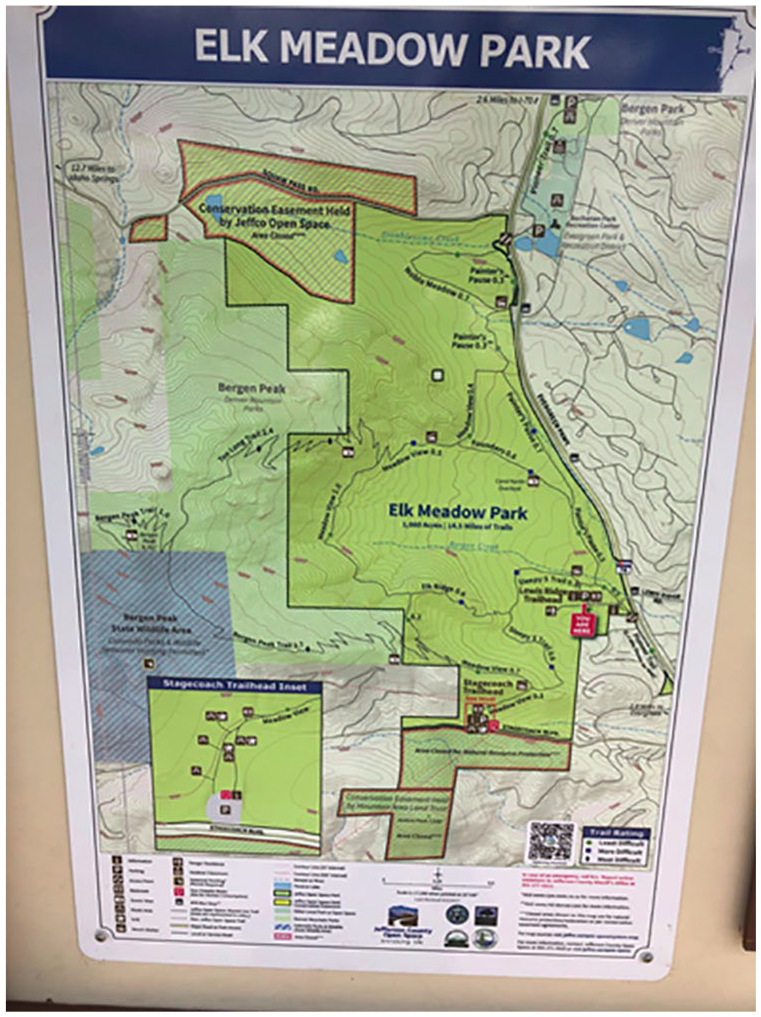
Are maps a purely humanist artifact? Non-human animals have “maps,” too—or, at least, they know the lay of the land. But this particular map is humanist, based on GIS technology, as Western, positivist, colonial maps have for (how many?) centuries. In this way, maps are contained, are produced by, and reproduce power (what was Elk Meadow Park referred to as before an English name was given?) What would it be like to climb the mountain with a post-qualitative directive? Would the map be refused? Would this refusal also complicate the climb? Would this refusal also ignore the colonial history that produced the map? In what ways can this particular picture, without a human subject present, count as post-humanist? To what degree is the human pressing the camera button still present, producing the image? To what degree are the humans who contributed to the map also present? And, importantly, what is with the concern about wanting to know where we are (love the “You are here” box)—the linearity of this particular map . . . what if the map were not topographical, but narrative?
***********************************************
In relation to the questions what comes up for me is what is included or excluded in maps, the discourses that are represented in map, the agency of humans to follow the maps and the destination(s) or journey(s) that it entails . . . If we stake too much in boundaries or bounded maps that we prescribe to for directions, what are we risking or perpetuating in the post-qual so as not to repeat what post-qual and PIP are responding to?
Layered views
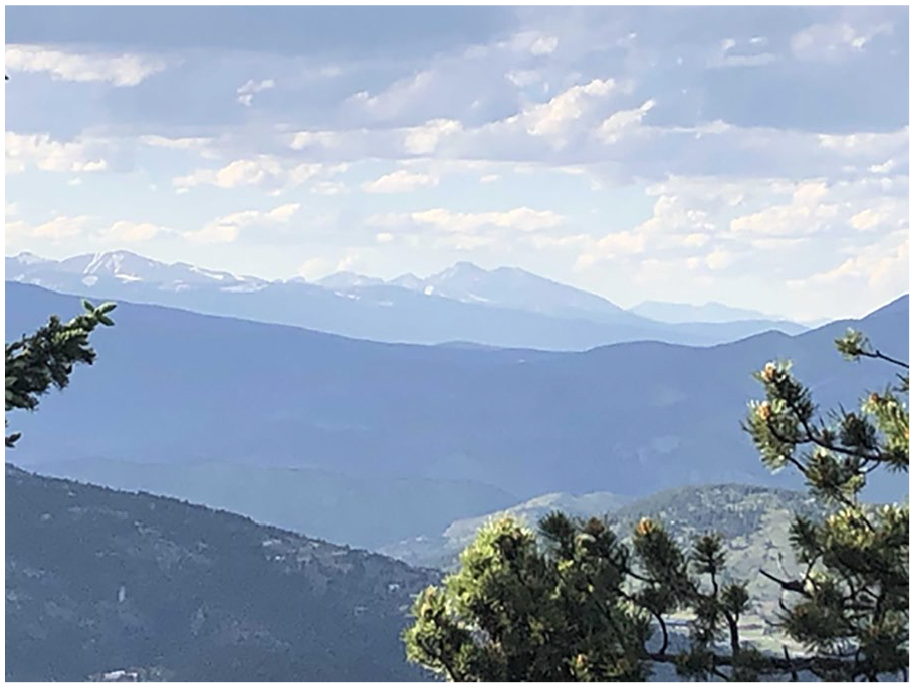
Is this peacefully alarming? Alarmingly peaceful? Both and? How does that edge of layered and entangled meaning play in the post-qual? If it is a refusal or an opening up of possibility? How does the/a refusal take in the layers or deny the layers of meaning where an opening and expansion might highlight them and pull them out into the meaning being made/captured/gathered in the moment. And yet this image is limited (like our abilities to fully grasp/identify/study/name/pin down/understand those sneaky elusive and slippery phenomena) by the camera’s capturing.
***********************************************

I am interested in the human and “post-human” in the three photos featured here. Consider the first two featured photographs. We, the viewer, see a landscape of mountain tops, leaning in from the horizon in deepening shades of blue and purple. At the bottom of the photos, we see the tops boughs of evergreen trees. We cannot in anyway see the human in these first two featured photos. Yet, we know the human is present and that this presence impacted the features of this snapshot—including the frame of the photograph, as well as what is included and excluded . . . There is so much majesty to behold. Yet—not thinking about the human presence does not subtract the human presence. In fact, it could be dangerous to conflate this particular photographic capture of the mountain landscape as the mountain landscape in and of itself . . . As I turn to the photograph which features Mark’s face amid the pines, we (the viewer) still receive information about the mountain, but we see first the human at the center. This seems to give us different kinds of information about human lived experience, community, and structures that we are accustomed to in qualitative research. It is also of no coincidence that the human at the center has visible identities of being white and masculine presenting—this too echoes the legacy of much qualitative (and quantitative) inquiry. I believe my reflections about these three photos can be summarized in the following two sentences: The post-qualitative movement is so important to the field of qualitative inquiry because it shifts the frame of the photograph, that we as researchers, have been taking of the world. In addition, post-qualitative research cannot disown the human from taking the snapshot—when we do, we may very well choose to ignore whom it is taking this particular snapshot, why and from what context. To continue qualitative work for social change, we simply cannot afford this pretending into forgetfulness.
***********************************************
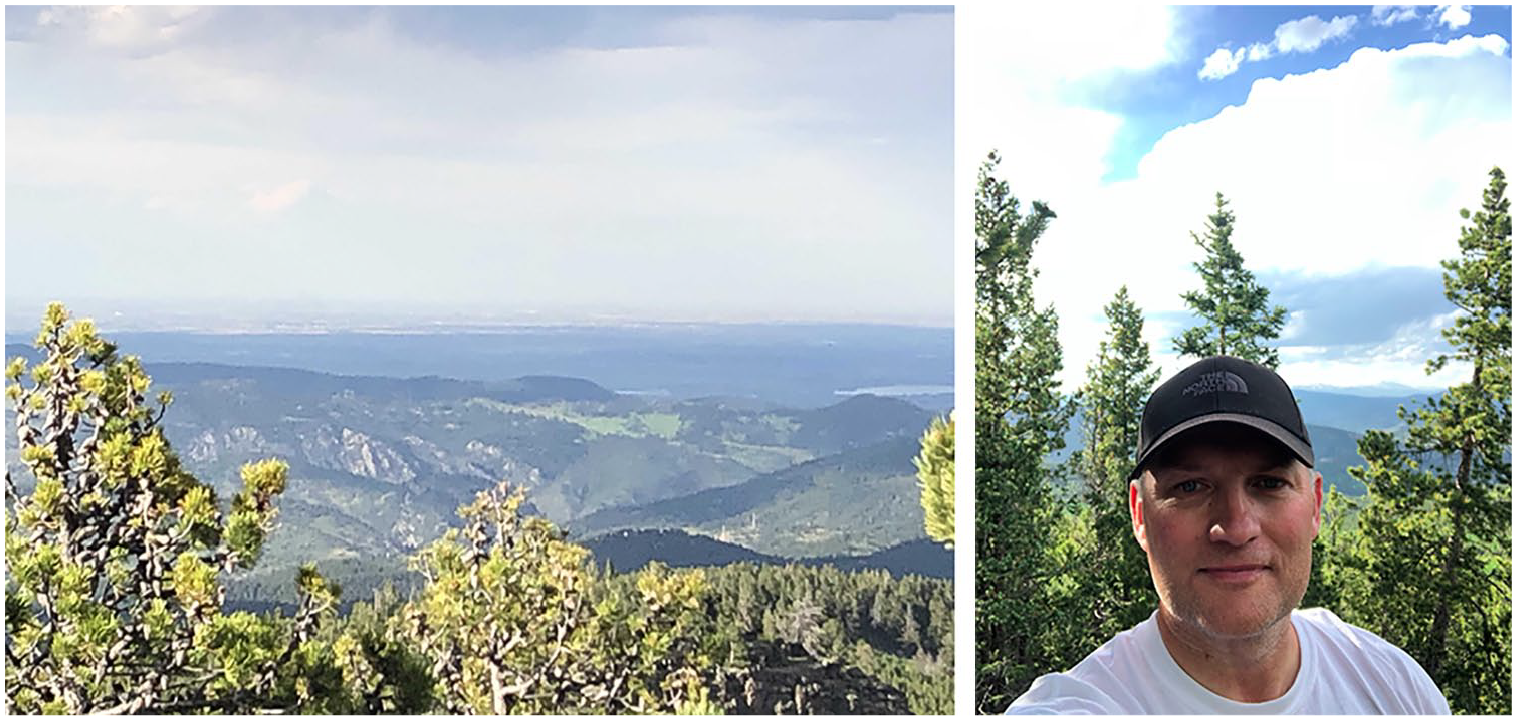
I was drawn to the above photo of the mountains and reflected from my lens as a medical educator. How does one continue to refine their journey in their personal and professional lives? I view the endless pathways through the forest and mountains on the serenity walk as all viable possibilities to achieve the same end goal of the previously defined notion of “work” as a continuously iterative process of pursuit and development. Although the walk was alone, I wonder how more present the voices of peers and mentors in the mindfulness community became more present and increased in strength, that is the frequency of recollection, as one is taking a moment to listen and find internal presence.
***********************************************
In response to the images of the mountain, as a whole, I wonder what these remote areas (mountains) mean for me as a person of color. Activities in remote areas always bring a sense of unease to me. I worry about my safety and the safety of my loved ones. This is something I often think about when my white middle and upper class colleagues share stories of camping, or in this case serenity quest. I even joked about that I really don’t need to sleep outside to feel human, referring to camping activities. Yet, in my birth country, Somalia, as a child I loved going to picnics outside of town with my family as well as going to the countryside for day trips, or spending summers in my aunt’s large farm—where we went on hikes and walked to the river banks. I am realizing that my unease is not related to being out in nature. Rather my unease comes from the feelings evoked by recognizing the geography of these photos. Where the hike is taking place, the ever presence of white supremacist violence and the potential harm that can come to my body in places like the mountain Mark is hiking. This makes me think about Fanon’s critique of Merleau-Ponty’s Phenomenology and being open to the world, in the literal sense, in this case. That is the idea that people of color have to tread the world carefully, our bodies are not always at ease with the world the same way white bodies might feel. It seems in this case Mark’s ease with nature is not shared by people like me. This mountain view, breathtaking as it is, I am not sure if it brings ease and serenity to me. This brings me to my second point, the notion that being alone in an environment like this or my own, brings an even greater sense of unsafety. Violence against indigenous women and women of color, is something that would caution me to consider something like this. Finally, perhaps Mark’s cautioning against the refusal within the Post-qualitative can be interpreted in my initial reaction to these photos—that is my identity does not allow for the refusal of my bodily sensations, and feelings evoked by looking at these images. It would be irresponsible for me to accept such refusal even on a practical level, not only on a theoretical level, but on a somatic level. Such refusal would endanger my existence and the existence of my loved ones, my children. If qualitative inquiry is to bring about social change then my bodily experience should matter, my reaction to spaces, discourse, geographies should matter because white supremacy and colonization do not afford me the same privilege afforded to bodies like the one shown in this picture, Mark’s. As a white male, he can afford to go on serenity quest in a Colorado Mountain, while I will need to make different arrangements to take such an endeavor.
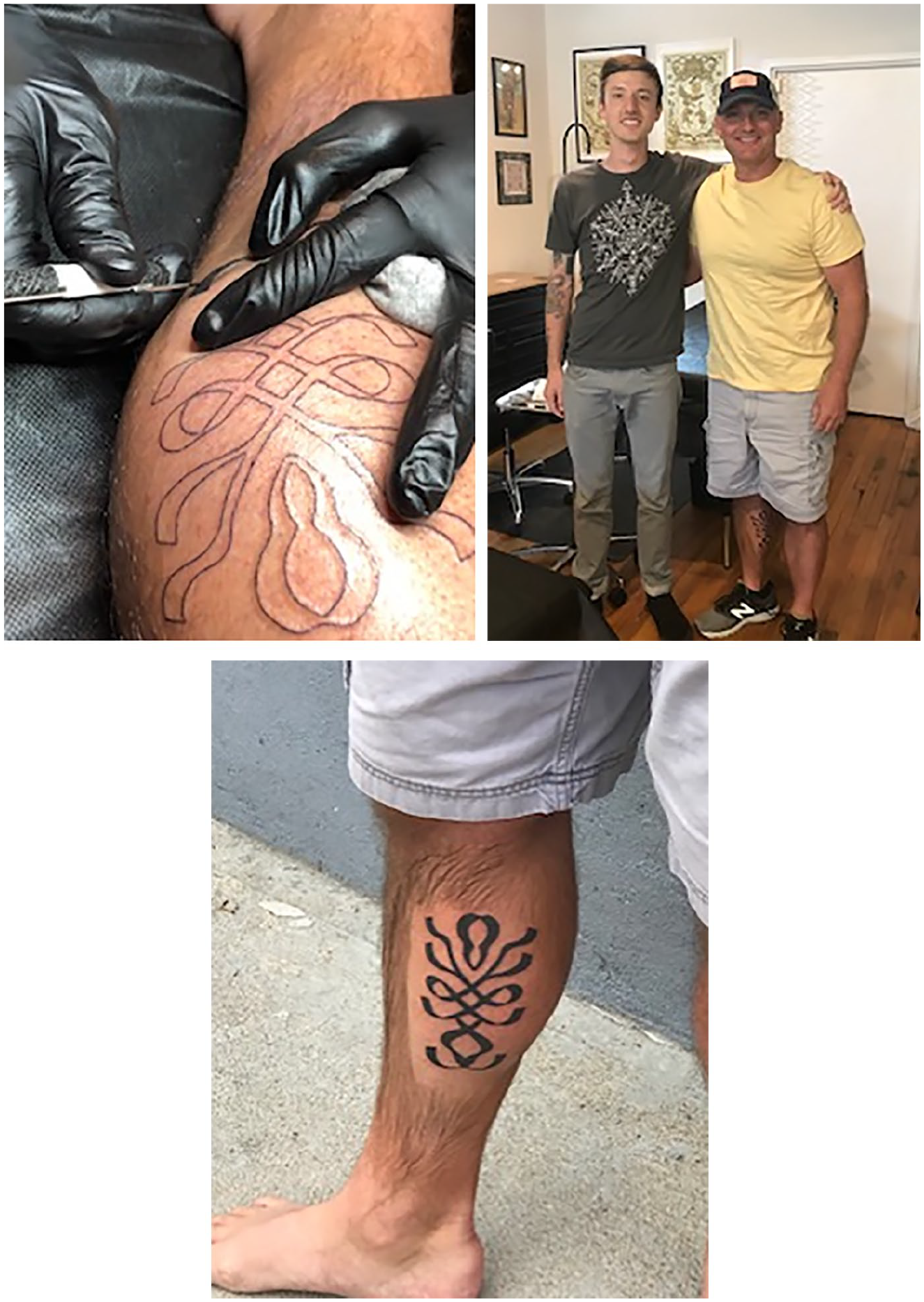
Going on this serenity quest, perhaps emotional pain was recognized and not shoved to the back of the mind, as do as human beings. In the selfie with the mountains there was no smile, but with the tattoo artist (I think) there was a giant smile. What does that mean? Why? Perhaps questioning decisions, the happenings of life, and just being alone in thought, led to the decision to get a tattoo. Was it to make a permanent mark on the body to symbolize emotional hardship and even overcoming that hardship. A tattoo is permanent. It is a constant reminder of something. Is it a reminder of pain? Is it a reminder of overcoming pain?
***********************************************
The tattoo in terms of a life change/life crisis reminds me of the adolescent and young adult cancer patients I have interviewed about their cancer-related experiences. Often they express the pre-cancer/post-cancer self as 2 different entities, with cancer being the catalyst for their rebirths—leaving cancer behind and coming out the other side as a new person, post-cancer. The journey is behind them (citing the above). For this reason, many of them commemorate their moving into survivorship with a tattoo to signify the strong, victorious new cancer-free self. You and I are the same age, so am curious to know, eventually, if what you are going through is part of a larger American-style “midlife crisis.” Moving away from Mark into a new Mark, as defined/declared at the end of the serenity quest. A serenity commemorated with series of selfies—a pictorial farewell to the old Mark.
Broader Provocations Working Across the Phenomenological Material
I can relate to your words from earlier in the paper, “I would like fewer demarcations and boundaries—which I think the post-qualitative movement has helped catalyze” (Vagle, 2019, p. 2). I am a Sagittarius, so that resonates to my core; I can’t stand boundaries and cages. And yet, we need some sort of symbolic structure or foundation to facilitate and ignite our freedom to create. The language of music is one of symbols that follow rules of music theory. Mozart was criticized for pushing those boundaries, and perhaps, was born a few decades too soon. BUT, he paved the wave for Beethoven to shatter those boundaries, and so on, and usher in the Romantic era. The Romantic composers pushed the bounds of tonality through chromaticism, ending up moving towards atonality. Is it possible to be completely without boundaries, or can we somehow push those boundaries without losing ourselves completely? . . . and risking atonality. There was that staggering line from the movie Amadeus [adapted from Peter Shaffer’s play] where Antonio Salieri saw Mozart’s manuscripts for the first time. Old Salieri said, “I was staring through the cage of those meticulous ink-strokes at an absolute, inimitable beauty.” That cage provided Mozart the freedom and boundless expression even if he was confined to the times in which he composed. The beauty of philosophy, and music, is that we have the freedom to express beyond the bar line and the musical staves “or cage of ink strokes.” Beethoven, in his ultimate deafness, made peace with his boundaries which rendered him free, by saying, “Music is a higher revelation than all wisdom and philosophy.” There is my bias, and life experience, which if I understood you in the Monday and Tuesday seminar, that is exactly the point of P.I.P.
***********************************************
It seems to create a false binary to say that we must refuse the human to turn towards the non-human. Aren’t they always already entangled, when we as humans are in any way involved? And do not experiences of any phenomena most closely hew to complicated entanglements between human and non-human agentic elements, when humans engage in sense-making of the phenomenon? Moving to an approach that holds space for these complicated entanglements is no doubt important to inquiry done by humans. Maybe this is the next turn—post-post-qualitative inquiry? To completely reject the human, however, would be irresponsible, as others have argued, when we as a white-supremacist society have yet to fully recognize the humanity of people of color and other marginalized identities. The way non-human agentic elements operate on humans will vary depending on their identity, and to refuse the human would seem to necessarily run the risk of further erasure of the experiences of those whose identities do not allow for full participation in a cishet, white, patriarchal system.
***********************************************
When I think about the word “quest” in relationship to the photographs included, I think about Mark in a Western context—how in English the meaning of “quest” is tangled in the many stories of “quest”—from The Odyssey to Disney movies to Harry Potter to even Into the Wild or Wild—also stories of self-discovery treks. I think about Joseph Campbell’s model for the hero’s quest and can hardly resist my mind’s turn to plugging Mark’s journey into this model: Mark left his home world—Minnesota—and traveled to Colorado to discover something. It seems, similar to the hero’s journey, there was not necessarily an idea of how the person, the soul, would be changed on this journey—or what he would encounter on his road to his new understandings. The hike—irresistible to return to and complete—becomes a part of Mark’s journey into the unknown. The tattoo also part of this journey into the unknown, but also for me, as a mark now on his body, is like a sacred object encountered on the journey—something that shows the way, but that also returns with the protagonist—like Frodo’s invisible cape, like Harry Potter’s scar—objects or imprints that become a part of but also represent the journey. There is a sense of accomplishing something—that the photographs function as symbols of his return to his “home world,” changed by the journey. Are they also a talisman, a sacred object that helped him along his way.
Footnotes
Declaration of Conflicting Interests
The author(s) declared no potential conflicts of interest with respect to the research, authorship, and/or publication of this article.
Funding
The author(s) received no financial support for the research, authorship, and/or publication of this article.
