



Abstract
In this research, we brought together various theories and speculative conceptual connections of otherness associated with liminality especially as seen through one methodological experiment and art-based intervention, namely flash mobs. From our perspective, liminality and liminal spaces are incomplete and always becoming since often they cannot be documented or described through existing language and normative concepts. Moving away from normativity and speaking back from liminal spaces carry risks since complex and intersubjective liminal spaces challenge the authority of the researcher, knowing, and doing in Academia. In this work, we use examples from our flash mob events to bridge theorizing and public performances, actual limit experiences, and twisted forms of (normative) scholarship. We ask what is being produced through art-based interventions, resistance, liminality, and twisted scholarship in the context of inquiry.
The function of education is to teach one to think intensively and to think critically. Intelligence plus character—that is the goal of true education. -------------------------------------------------------- e-d-u-c-a-t-i-o-n, don’t get me? stay in school or learn to spell/ friend or foe, don’t get it twisted, young minds is crumblin’ and we need to fix it/ Open a book, flip the page, Power is where the community will engage/ we’re trying to civilize, some tryin’ minimize, they don’t see the importance so their eyes just criticise/ public education the medication to heal the nation, it ain’t simple—we need an innovation/ the key, discipline, down to the e, grab a p-e-n and a p-a-d/ pedagogy phd’s, thats how to resist the inequities/ the best thing in investing in testing, is less arrestings and less protestings/ -instrumental break- the seed of wisdom is freedom, care and collect the needed fruit of reason/ Can’t we all paint the same picture, open minded people to fix the strictures/ teaching awareness is a stockpile, its gonna grow while the bodies remain docile/ Let’s get building we have the tools, Cause more schools means less fools/ Though the path is riddled in problematics, together we can work some proper magic/ A better future, we got that possibility, let your actions speak and forget the futility/ Don’t hate, love conquers all, Every man every woman we’re all responsible/ And kids, ya’ll don’t need to be geniuses, You go far with some respect and obedience/ I glance at the third world and I see why, we need that U-N-I-T-Y Education aint for life preparation, listen closely homie/ life itself is the education, that’s what J Dewey told me/ ©Arttu Saarela & Antti Ikonen 2015
Spatial Liminality
Liminal spaces offer opportunities to stretch scholarship, play with inquiry and knowledge, and experiment with various forms of research-creations (Manning, 2016). Despite its productive capacities, liminality has historically been a concept operationalized only in philosophy and anthropology, often to describe larger historical or cultural transitions or smaller personal experiences such as initiation rituals (Szakolczai, 2009). We work to extend the concept of liminality into the field of educational research. Too often, guided by current neoliberal discourses, academic spaces form normative borders and generate confirmatory structures that order knowledge, reality, and demand a particular type of scholarship. However, many scholars have recently begun to resist normative neoliberal apparatuses and they have started to re-conceptualize possibilities of work and inquiry in liminal, resisting, and third spaces (see, for example, Cannella, 2015; Cheek, 2017; Scheurich, 2018). In the context of this article, liminal spaces are political and relational. They co-exist with normative spaces, but they offer opportunities to practice a more critical “public” science and transgress borders between disciplines, practices, and different ways of knowing-doing. Since liminal spaces are approached here as speculative and as forms of potential and possible, liminality of scholarship and inquiry (and all relations embedded within) is impossible to define and characterize as a fixed tangible entity (see, for example, Bryant et al., 2011). Instead, liminality might become possible and practiced within third space which are neither this or that, spaces of in or out but instances and events of both and more than and in-between. Furthermore, we use flash mobs as examples, which provide a context and space for relationality. Some of this more critical public science can take place in train stations, market squares, and shopping malls, where the public visits, operates, and transforms spatial configurations. Following Derrida (1982), we wonder how scholars can work through liminal spatial configurations and pass singular liminality and limits (of space) that are not limits but which assure the limit’s permeable and transparent continuity. We also ask how limits of academia and scholarship work in relation to public performances and art-based interventions.
Liminality can take a variety of forms. For example, spatial liminality, which offers un/re/structuring possibilities for normative academic spaces, operates through its personifications, vehicles, and materials. For Murrani (2016), liminality, that is, all that is marginal, ephemeral and on the periphery, is a social and a spatial condition that implies a temporal dimension akin to the becoming of transitional events and situations that are situated neither here nor there, rather in-between. (p. 192)
Spatial liminality rejects binary logic and it offers various approximations of knowledges where being and becoming are reconceptualized. For example, for Soja (1996), third space is an othering space, a thirding, spatial other which expands beyond fixed and stable normative spaces. It is infinitely open space. Similarly, Foucault and Miskowiec (1986) were drawn into space and sites that have curious properties, the marginalia, sites that connect with other sites while suspecting, neutralizing, or inventing relations they mirror or reflect. For Foucault, heterotopic spaces and heterotopias can mix and juxtapose in a single place several spaces which might be foreign or incompatible. Furthermore, heterotopias link to slices of time when traditional time is being broken or time accumulates differently, as in festival time—time that is experienced differently from seconds and minutes, which may be experienced as sped or slowed. A floating piece of space and a space without a space exemplifies for Foucault heterotopia par excellence.
In taking a closer look at the “third space,” we were inspired by postcolonial scholar Homi Bhabba (1990, 1994), especially his notion of the third space as a way to draw attention to (cultural) difference. He puts forward third space as a productive location, as a “position of liminality” (Bhabba, 1990, p. 209). In such a space, as noted by Gannon (2010), human subjects brush against one another and are consequently changed by that contact. And so, instead of understanding scholarly work as a third space that only gathers people together to create knowledge, we shift toward the notion of difference as an integral part in this kind of scholarship. Thus, a third space would be a liminal space that provokes productive instability by capturing the collision of differences, which are brushed against each other highlighting the complexity in, for example, values, beliefs, conventions, and diverse aspects of scholarly work. Instead of just producing “knowledge,” such a space would provide moments of living rupture that might open up new ways to think about the university as an institution as well as the academic and scholarly work, and, moreover, the academics themselves. Third space for us is then more a living inquiry stance to challenge assumptions, unearth unexpected encounters, act differently, and posit complex questions. If scholarly work is understood in this way, the role of the scholar moves in different directions, for instance, toward critical collaborative inquiry (Dyer & Löytönen, 2012; Löytönen, 2016, 2017) and differently structured university institutions such as free and open universities (Koro-Ljungberg & Löytönen, 2016). As we move forward with this third space framework, we wonder how work and inquiry happening in these un-/restructured, collaborative, open spaces build on diversity and otherness as operational assumed practices instead of trying to create institutional structures that are capable of responding to stabilized otherness and fixed and categorized difference. We seek to discover ways in which experimenting and studying within liminal spaces can generate important insights about complexities of human experiences and continuously becoming and changing lives.
Art-Based Interventions
Our inspiration for creating liminal spaces and twisting the normative notions of qualitative inquiry connect with interventionist art or art-based interventions (Richardson, 2010). While in qualitative inquiry, and especially in action research, interventions are typically understood as carefully planned specific activities with expected and predictable outcomes (see, for example, McIntyre, 2008; Reason & Bradbury, 2008). Art-based interventions use artistic activities or art works “to form as a disjunctive event within the ongoing daily activities of public life” (Richardson, 2010, p. 19). Thus, art-based interventions can be understood as performative events or performative interactions (Kester, 2004) that strive to deconstruct a specific situation or practice. One example of an artistic intervention is Lisa Erdman’s art-based doctoral thesis production called Finnexia®. It was presented in September 2012 in the Helsinki Railway Station, addressing the need for international dialogue on social issues in Finland. Using the framework of a satirical medical advertising pitch, the artistic intervention presented an informal discussion format surrounding acquisition of the Finnish language. As described by Tavin and Erdman (2015), the arts-based intervention, Finnexia is situated within the medical realm where the neo-liberal discourse associated with this industry is now familiar to many people on a personal and global level. For example, prescriptions and pharmacy visits have a place in everyday life, and direct-to-consumer medical advertising takes on an increasingly international presence within the media landscape. (p. 8)
Erdman’s artistic intervention is unique as it reveals and challenges the notions associated with medicalization of the society and at the same time opens a space from which public dialogue can emerge in Finland, regarding language acquisition and cultural integration (http://www.finnexia.fi/).
Within the Finnexia example, we see how arts-based interventions may be understood as both liminal and occurring inside the third space. As noted, interventions often occur in structured environments with accountability measures and high stakes. An arts-based intervention has no need for such structures and falls out of the traditional research space. However, it also brings this kind of research space to the public, creating a third space that is at once a research and a public environment, a space that straddles a line, both and neither at the same time. Similarly, our art-based or art-inspired intervention in creating liminal spaces and twisting the normativity of qualitative inquiry aimed to form a context-specific, personal, political, and social inquiry that was explicitly public, as well as one that promoted thoughtful investigation of qualitative scholarship, which is intimately tied to the everyday experiences of the general populace, a publicly academic space, or an academic-public space. Through our participatory and public interventions, we revealed, challenged, and deconstructed the normative practices of qualitative inquiry. Furthermore, art-based interventions did not necessarily offer alternative perspectives to qualitative scholarship or academic work, but they might open up a space for this possibility and redirect our focus away from what qualitative inquiry is, means, or represents toward a greater focus on what qualitative inquiry does. By doing so, the art-based interventions stimulated us to ask different questions and approach qualitative inquiry differently. The art-based intervention then intervened in social spaces as a performative event that took place as an interaction and exchange with people and public in such a way which had potential to generate alternative possibilities for qualitative scholarship to do and think differently.
In our study on liminal academic spaces, we used flash mob events as art-based interventions to twist the normative forms of (qualitative) scholarship, bridge theorizing and public performances, and to encounter (ourselves) actual limits to diverse (e.g., academic, public, private) experiences. We designed flash mobs to twist cultural appropriateness in diverse spatial and geographical contexts. For this purpose, we invited two Finnish artists, Antti Ikonen and Arttu Saarela, to compose a rap. The lyrics for it is based on our initial questions, ideas, and concerns especially related to public education and public’s perception and experiences of public education. Furthermore, it is important to highlight that liminality and twisted normativity in this project are not singular. Different types of liminalities draw cultural margins closer to the center, promote subjective flexibility, and produce some individuals as hybrid, cyborgs, and nomads who continuously move around and within different types of border spaces. Our flash mob is one of what we suspect are many unexplored avenues for leveraging art-based research to twist normativity and drawing these cultural margins inward.
Flash Mobs and Liminality
The very concept of the flash mob invites considerations of the liminal and third space, as it exists as a reimagining of conventional performance, happening sporadically, temporarily, outside the bounds of expected performance space. Flash mobs were initially conceived as a way to upset the conventions of performance. Bill Wasik, the first to organize a flash mob, has said that they “started as a kind of playful social experiment meant to encourage spontaneity and big gatherings to temporarily take over commercial and public areas simply to show that they could” (Urbina, 2010). There is thus an inherent playfulness to flash mobs, one that seems to be its own ends. Flash mobs exist simply to be different, to “disrupt tightly laced social and spatial conventions” (DuComb & Benmen, 2014, p. 34), to show that there are alternate ways of being and interacting in the world, acting out ephemeral suggestions to others that a different way of being is possible. Thus, what constitutes a flash mob is difficult to pin down. It exists as public performance, but it may be choreographed or not; it may include individuals that do or do not know one another; it may include only performers or performers and observers (Grant et al., 2012). Even those who may have initially appeared to be observers may join in and reveal that they are actually performers. Flash mobs exist in a performative space where nearly any kind of performance (or performer) is possible.
Flash mobs also have the capacity to heighten public emotion and participation in unpredictable ways (DuComb & Benmen, 2014; Grant et al., 2012). Grant et al. (2012) performed a study in a marketplace food court in an effort to explore how introducing music and performance might affect consumer buying behavior. Their flash mob consisted of six opera singers who sang selections from Verdi’s Rigoletto and Denza’s Funiculi, Funicula. While the researchers sought to understand consumer buying patterns, results suggested that flash mob performance can affect much less tangible or measurable elements of behavior and affect. Under a heading in their findings called “arousal,” they note that shoppers began singing and dancing with other shoppers. Shoppers interviewed after the performance indicated that they felt a part of something larger, that they were connected to both the performers and shoppers in ineffable ways. The performance brought some shoppers to tears, and descriptors of the environment included “buzz . . . energy . . . swelled . . . startled . . . electric” (p. 248), resulting from shoppers feeling that they were a part of the event. As “pedestrians” are caught in the flash mob, they necessarily “join the restless flow of bodies assembled on the spot” (DuComb & Benmen, 2014, p. 35). Whatever might constitute a division between performer and disinterested observer becomes immediately blurred. There exists no distinct line between participant and non-participant, performer and non-performer, the ambiance of the flash environment dashing labels that divide, stratify, and categorize. The flash mob creates an environment where individuals are simultaneously performer and not performer, a liminal space where participants might fashion themselves and fashionalize inquiry.
At the same time, flash mobs can produce feelings of dis-ease, fear, and terror. DuComb and Benmen (2014) noted that flash mobs, because they upset conventions of social and spatial order, must cause a degree of discomfort in onlookers. They explained that flash mobs always have the potential to erupt in unexpected, violent ways, citing riots in Philadelphia that initially began as flash mobs. This is another way that flash mobs always occupy a liminal space; it is difficult to tell whether they will be whimsical and crimeless or whether they will erupt into violence. DuComb and Benmen attributed this possibility first to the fact that flash mobs already operate by non-rules that push at convention, but also because of social “turbulence,” which can occur “stochastically.” As crowds gather and grow, they become more unpredictable and unstable, creating turbulence, here the potential for legal transgression.
In this way, flash mobs represent liminality in a number of ways: Onlookers may be distanced (even terrified) by the flash mob; they may remain simply onlookers, enjoying a performance, or they may become participants, complicit in the performance of the mob and delighted by their participation. The mob itself may be playful or dangerous depending on seemingly random events at the time of the gathering. In all cases, however, the flash mob turns both social convention and structured performance on their heads, interrupting the mundane synchronicity of the space in which it is performed. This fact has led us to wonder how the flash mob might be leveraged to push the bounds of conventional and sterile research.
Although flash mobs began without a purpose beyond upsetting established order and convention (DuComb & Benmen, 2014; Urbina, 2010), they have more recently been used across contexts and spaces to create greater social awareness, for example, to criticize an overly busy lifestyle, or to protest gun control laws and cigarette companies. Because of their potential to both distance and involve participants at once, flash mobs can function as a kind of Brechtian epic theater performance, where audience members are always aware that they are viewing a performance, as performance has the capacity to highlight and “make strange” or alienate through its hyper-focusing of otherwise normal events. In fact, the flash mob, although it appears sporadically in non-performance spaces, nevertheless requires that viewers recognize the “sanctity” of the performance space that is the flash mob (Peiper, 2015). Aware that the audience can be both separate and included in the performance, we sought to use the flash mob as a form of public engagement in scholarly research.
Flash Mobs on the Go
In our work, we have experimented with flash mobs in public and academic spaces including a shopping mall, railway train station, and university/conference environments. Specifically, we used a flash mob as an approach and engagement tool to collect the public’s concerns and questions about the status of public education, since education is the discipline that joins our scholarships but it is also an issue that relates (easily) to citizens and their experiences. At the same time, flash mobs enabled us to re-conceptualize various aspects and processes of inquiry including responsibility, research design, and inquiry practices. How might participant centered inquiry intersect with art-based encounters? How might these intersections address and speak to liminality? We also asked what is being produced through resistance, liminality, and twisted scholarship in the context of public inquiry and art-based interventions.
One of the purposes of our flash mob and experimental project was to extend existing qualitative research methodologies toward more engaging and contextualized participant-driven research practices. It was our intention to use flash mob events (in this case, collective research inspired events that suddenly emerge in public spaces) to generate research questions for future qualitative studies and to locate inquiry/problem spaces around educational discourses that matter for people. We viewed civic engagement and participation as vital generative force for scholarly inquiry of this kind. Through flash mob events we also aimed to bring educational research closer to the people, especially within contexts outside the Academia and to raise awareness of importance of educational research that activates and involves citizens. We began the flash mobs in pre-determined public spaces and all participants were onlookers and public unaware of our performance and inquiry plans. Members of research team approached those who watched and attended the performance and asked them to respond to the questions outlined on a piece of paper. More specifically, we asked citizens to respond by writing on a card to our prompt: “What questions do you have about public education?” Below, we invite readers to experience the movement and rhythm of our flash mob, followed by questions generated from onlooker-participants.
Methodological Flash Mob
Method o v e m e n t Definitions We see a (fl) s liminal (ash mob) *Sometimes (safe) *(criminal) A point of indeterminacy Corruption of normalcy in a pub lic place A staged space staged b u *t withou* stage To Per(*) (*form)ing actors and viewers in in D Terminacy RE: Who? Joins Who? Views No clues jus* *he Momen* unfolds *he *hreshold Demanding direction but any direction will do Our mob took place three times: in mall (Urbana, IL) on campus (Arizona State University) in station (Finland), globally; we, that is us, ranging 7-3, dancers, prancers, mobsters, hit the street, felt the beat, and moved to a rap on the state of education in the U.S. nation and so Circled across From one another we waited never at loss for each other to clap and [stop] And resume Sothattheeyestheygazeupo nusinsidethepublicspaces Innumerablefacesga zeonourmayhemmethodologies Inthepublicecologies Tothebeatofara Pmadebyoneofouro Wnwithonloo Kerslookingneckshea Dscrooking We be Gan to pass out The cards The cards The cards to tell What do you want to know? We said. Write it down on the card! We said. Throwing the methods askew with our flash mob interview One question for you We wanna know what you know and what you wanna know and what we need to know about school Detecting and Collecting diverse data We consider Anal ysis the onset of our paralysis We look forward To resuming By exhuming thoughts From data And Continue toplay A different Research game
Stepping Through the Thresholds: Thinking With the Questions
Questions of “Who”?
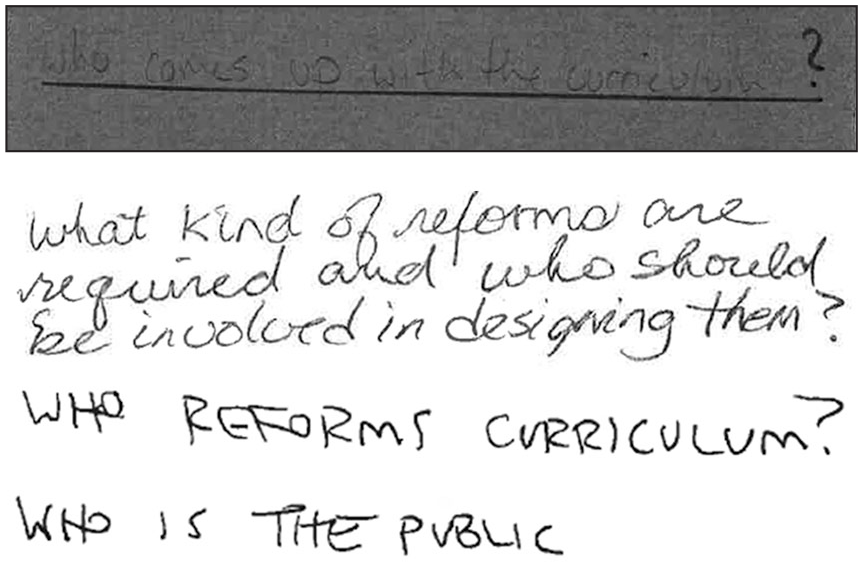
Who comes up with the curriculum?
Who reforms the curriculum?
Who should be involved in designing the reforms?
Who, who?
Who curriculum reforms?
Who requires the reforms?
Who, the public?
Here, we provide images and summaries of questions we received while performing our flash mobs. The responses of the onlookers and participants prompted us to think about our and our community’s relationship with public education. We wondered about the parties and stakeholders involved in public education and their roles. For example, it is obvious that educational reforms and curriculum design are carried out somewhere by someone. But who? Who are the people that are creating and (re)designing the curriculum for the future? Who becomes invited? Who are excluded? And who is the (redesigned) curriculum serving: the individual learners, the teachers, the communities or the society at large, the wellbeing of people or the wellbeing of private corporations? All of them, of course, self-evidently. Maybe. But who have (more) say in this matter, these matters? Who are listening to whom? Who are we serving as educational scholars, qualitative inquiry scholars? Who, who, who? How about stepping through these different thresholds and creating liminal spaces for thinking about the future curriculum, the future of (public) education? Who can do that? Creating possibilities for (accidental) encounters in public spaces, during the everyday experiences and practices of incidental people for envisioning the possibilities in public education. Who can do that?
Questions of “good teaching”
What is the relationship between good teaching and good curriculum? Does it require good curriculum?
How is good teaching related to wellness?
What is good teaching for me? For you?
What are good teaching methods?
From our perspective, while these questions specifically name “good teaching” as a phenomenon worth learning more about, the idea of “good teaching” seemed to underlie most questions asked, including questions about school finances, technology use, and educational standards. It seems that most people want students to get a “good education,” but what does this mean? And might a good education be different for different students? Might good teaching go beyond an established curriculum? These questions suggest that “good” teaching might vary based on who is targeted by or responsible for certain teaching practices. The questions also suggest that the public conception of good teaching is complex and multidimensional. Those who approached us during the flash mob seemed to communicate the difficulty in determining what is good, and the fact that any number of variables might affect both the conception and delivery of a good education. However, practicing the good, whatever that may mean or entail, is also important.
Questions of “public education” (in Finland) 1
Miksi siellä istutaan pulpetissa?
Sitting on the school desk?
Miksi käytetään niin vanhoja opetusmateriaaleja? Old teaching materials?
How different it is from that of my country?
How many hours per week and subjects?
How many students per class?
Miten sosiaalisia taitoja opitaan?
Miten kasvattaa sydämen sivistystä? How to nurture the education of the heart?
Otetaanko eritasoiset oppilaat huomioon luokassa?
Eli onko tasoryhmiä?
Miksi on välitunnut? Why do we have recess?
Miksi ei ole urheilukoulua?
Mitä jos ei halua käydä peruskoulua?
Voiko peruskoulusta saada ammattikoulutusta?
Voiko peruskoulun lopettaa kesken? Quitting school?
Toimii hyvin. Working well?
Liian isot luokkakoot? Too big class sizes?
Homekoulut? Schools with mildew problems?
Eritasoiset oppilaat? Students with diverse needs?
Questions of ‘being in charge”
What kinds of reforms are required and who should be involved in designing them?
To what degree do professors have authority over teacher education curriculum?
Should the public be involved in designing the curriculum?
How soon before we can get rid of teacher unions?
These questions suggest that there is not total clarity surrounding how decisions are made in the educational sphere; indeed, total clarity may be impossible given the complexity and networked nature of educational politics. From educational researchers to unions to the public itself, we see again the question of “who.” In this case, the “who” in question is one of authority: who gets to say what occurs in education? Who gets to produce and define knowledge? These questions suggest that individuals are highly aware of the political nature of education, perhaps curious, perhaps distrustful, perhaps even resentful, but definitely conscious that decision are made by individuals whose jobs are to make decisions. How the decisions are made, however, and the interplay that goes into making such decisions is less public knowledge.
Questions of public engagements
Something else that we may surmise based on these questions is that the public is already highly engaged with educational practices. In short, in both the United States and Finland—dare we say globally—people care about education. This leads to some questions of our own: Does anyone actually need to be trained to do research? How is the public always already engaged in educational research? What might it mean for us and for them to see the public as researchers? There is overlap between the questions asked by our participants as well. We see, for instance, that good teaching involves questions of who teaches and who develops curricula and reform—we see reform driven by the concept of good teaching and by those that should (or should not be) in charge of determining what good teaching is. Who, what, and when questions all appear as necessarily connected, driving what we might call a public research agenda. As researchers consider the questions that need to be asked to drive educational research, they need only look so far as those burning questions that exist in public consciousness. Assuming, of course, that this division between researcher and public is even useful.
Return to Liminality and Liminal Politics (Becoming)
It could be argued that educational research is expected to serve the field of education at large, educational policy and, by extension, the various forms of educational practice from kindergarten to higher education. The research to be applied and disseminated in various educational contexts is often described as evidence-based research: Research needs to find out “what works” in diverse educational settings, and the main way of doing this, is through experimental research (Biesta, 2007; St. Pierre, 2002, 2004). This inevitably leads to narrowing definitions of educational research and teaching-learning practices, epistemologically, ontologically, methodologically, and more.
In addition to narrowing the definitions of educational research, evidence-based research, as understood by Biesta (2007), limits the understanding of educational practice as it favors a technocratic model of education (effective interventions) and neglects the fact that education is a thoroughly moral and political practice at all levels, from researchers to citizens to researcher-citizens. Thus, it follows that the only relevant research questions are questions about the effectiveness of diverse educational means, often posed (only) by scholars. Biesta (2007) even asserts that evidence-based educational research provides a framework for understanding the role of research in educational practice that not only restricts the scope of decision making to questions about effectiveness, but it also restricts the opportunities for participation in educational decision making, let alone research. He (Biesta, 2007) continues that evidence-based education seems to limit severely the opportunities for educational practitioners to make . . . judgments in a way that is sensitive to and relevant for their own contextualized settings. The focus on “what works” makes it difficult if not impossible to ask the questions of what it should work for and who should have a say in determining the latter. (p. 5)
Thus, he argues (Biesta, 2007, p. 6), we must expand our views about the interrelations among research, policy, and practice. We could also expand our views on who is involved in these interrelations: not just teachers, students, policymakers, and researchers, but those who are traditionally understood as “outside” of the educational sphere, namely, citizens in general, whose concerns about education are just as valid as those that push an evidence-based agenda. Flash mobs offer forms of relationality, which could take place outside anticipated scholarly relationship, planned interviews, and researcher-driven focus groups. The emergent and becoming nature of flash mobs utilizes spaces of accidental encounters with citizens and public. Pop-up flash mobs capture and not capture the attention of by-passers, public engaging in their everyday activities, and common spaces. Performative encounters such as flash mobs have potential to create spaces of liminality where academic, public, and performative spaces emerge and disappear in unexpected ways. In contrast to the evidence-based educational research, accidental and relational encounters with public produce different kinds of knowledge, which is less researcher-driven but more situational, context specific, performative, and activating. When research and inquiry are taken to the public spaces and participation is no longer the question of consent driven by institutional needs but one of relating, meeting, and connecting.
The relation between research and practice has been debated for quite some time, and a special issue of Educational Research & Evaluation (June 2007, Vol. 13, Issue 3) was dedicated to this problem. The increasing concern within the educational community has been with how research can support the work of practitioners and users of education. In their preface to the issue, Jules Pieters and Bregje de Vries (2007, p. 200) note that a strong need is felt to improve the ways of communication between educational research and practice, and in particular, to find ways of collaboration and knowledge sharing. The problem seems to be ineffective communication between practitioners and researchers, and thus the ineffective application of research knowledge by educational practitioners. However, as noted by Fitzgerald et al. (2016), we must recognize that research is taking a community-centric or public turn. At one time, the academy “reached out to communities in an expert model of knowledge”; However, “that connection with communities has transitioned over the years to a more engaged model in which community and university partners co-create solutions” (pp. 223–224). Calls for engaging the public are also replete in qualitative research: for instance, Denzin and Giardina (2018) claim that “now, more than ever, we need reasons to believe citizens can reclaim their voice in the public sphere” (p. 12). This means blurring those hierarchical lines that Fitzgerald et al. (2016) refer to wherein the academy produces expert knowledge and the public receives it. It means creating a space where scholars blend with public individuals and the public becomes scholarly, where the very scholarly/non-scholarly division is blurred. We promote a third space wherein identities are in flux. While Watermeyer (2015) suggests that forcing scholars to engage in public scholarship can have deleterious effects on their academic identities and career progressions, effectively becoming “lost in the third space” (p. 331) we contend that losing oneself, wandering, and exploring are more productive than rigid rules and roles. We encourage being lost, intentionally complicating fixed notions of identity, allowing the public to become researchers and vice versa.
Based on our flash mob experimentations, we would like to push the limits of educational research and qualitative scholarship even further and follow Patti Lather (2007, see also 2010) who asks what is the next in postpositivist (new paradigm) inquiry. One of the new possibilities might be what she calls citizen inquiry. Without defining it as being something definite, she leaves the inquiry mode open for scholars to elaborate and work through. Through our performative flash mob events, it could be argued that we elaborated the notion of citizen inquiry by questioning space(s) for research, the objectification of the world and people as well as knowledge and power hierarchies. The flash mob experimentations might open (future) potentialities for citizen inquiry or active citizenship, where citizens are not onlookers or recipients of knowledge but active co-creators in inquiry processes or drivers for research projects. When pondering about the possible potentialities for citizen inquiry, we were inspired by Manning and Massumi (2014) who write about the potential, that it is abstract in nature, in the sense of not yet being this or that, here nor there. What is abstract feeling, if not thought? Movement-moving is thinking-feeling: sensation integrally imbued with singular notional force. Potential is not of the if-then. Potential is allied to what-if. The thinking-feeling that is movement-moving is speculative: notional in the sense in which it can be used as a synonym for speculative. (p. 41, Emphasis in original)
What if we, then, approached the potentialities in citizen inquiry not through fixed ideas or suggestions but questions and indirect questions, such as what-if, for there is no one way to conceptualize citizen inquiry.
What if knowledge creation becomes not owned by the Academia?
What if knowledge and knowledge creation and research are everywhere?
What if citizens define what counts as knowledge?
What if citizens initiated research?
What if research/inquiry becomes everyday life?
What if scholars become citizens?
What if citizens become scholars?
What if categories are not valid in inquiry?
Our aim in the flash mobs was to tackle the notion of citizen-research to link research, people’s daily lives and practices, policy, and points in between. These points in between are points where people’s daily lives might intersect with research and policy, creating unexpected and continuously changing liminal entry/egress points. Furthermore, we desired to create a (sustainable) social space for citizens and scholars, both inside and outside academia, to explore situated and embodied educational questions, concerns and practices, and to stimulate questioning them through differentiated perspectives. We argue that citizen inquiry enables a deeper and engaged investigation of different spheres of life that are connected to diverse (local) educational histories and current socio-material conditions. It is a form of emerging and contextualized participant-driven research practice. Simultaneously this kind of inquiry, similar to the flash mob, turns research conventions on their head, interrupting the normative scholarly apparatuses of current Academia and generates important insights about the complexities of educational scholarship.
Where might (educational) flash mobs go next? We are not sure. Different types of liminalities draw margins closer to the center, promote subjective flexibility, and produce some individuals as hybrid, cyborgs, nomads who continuously move around different types of border spaces. Can these liminalities be lived and sensed (also in the context of public education)? How can a scholar be of assistance and how could the public take over? What else might liminal spaces of inquiry and relationality produce?
Footnotes
Authors’ Note
The research work for Löytönen was supported by the Academy of Finland [project number 253589].
Declaration of Conflicting Interests
The author(s) declared no potential conflicts of interest with respect to the research, authorship, and/or publication of this article.
Funding
The author(s) received no financial support for the research, authorship, and/or publication of this article.