



Abstract
Posthuman theorizations of creativity direct attention to the material, affective, relational happenings as they emerge between networks of more-than-human bodies in interaction. This necessitates a rethinking of how creativity research is conducted, including the kinds of data collected and how they are analyzed. Drawing on two case studies exploring the relationship between empathy and creativity in theater devising workshops, this article outlines how a multimodal research design combined with an empathic approach to diffractive analysis provides the opportunity to look beyond the linguistic and textual to explore multi-sensory worlds and draw out the complexities of emerging affects. Adapting Karen Barad’s diffractive analysis, this empathic approach is embodied and involves experiencing-with data to generate new understandings and questions about posthuman creativity. Rather than speaking for others via observation, recognition, and evaluation, this follows Gilles Deleuze’ proposition that thinking should involve embodied encounter, which can disrupt thinking through relational becoming.
Posthuman theorizations expand creativity beyond the mind of the thinking human individual to incorporate all the non-human bodies that are perpetually affecting, leaving imprints, and co-creating the thinking, feeling, and doing of creative events (Chappell, 2018; jagodzinski, 2015). Such creativity is processual and embodied, with novelty emerging through relational encounters within networks of affected and affecting bodies (D. A. Harris, 2021; Roudavski & McCormack, 2016). How do we explore the complexities of these person–time–place specific, affective, relational, processual creativities? And how can capturing and analyzing data 1 not reduce and omit through processes of identification and categorization that are predominant in traditional materialist, qualitative methods? The last decade has seen increasing value given to research approaches that employ creative methodologies (e.g., A. Harris & McConville, 2020; Hickey-Moody, 2015; van der Tuin, 2011), which are informed by new materialist (e.g., the diffractive approaches of Burnard et al., 2021; Chappell et al., 2019; Taguchi, 2012) and Deleuzian (e.g., Coleman & Ringrose, 2013; Fox & Alldred, 2015; Hickey-Moody, 2015; Rousell, 2017) ontologies that reject mind–body, nature–culture, human–non-human, and animate–inanimate dualisms and advocate affective engagement with the research assemblage—which includes data, theory, and researcher (Fox & Alldred, 2015).
Building on this scholarship, I present an approach to research design and analysis that involves the generation of multimodal data combined with an empathic approach to diffractive analysis, offering a relational means of engaging with the research ensemble. This involves embodied experiencing-with to co-create new understandings, questions, and ideas, rather than observing and analyzing from a distance, which is dichotomizing, hierarchical, and gives rise to representation (Taguchi, 2012). As Gilles Deleuze and Felix Guattari (1987) urge, “It’s not easy to see things in the middle, rather than looking down on them from above or up at them from below, or from left to right or right to left: try it, you’ll see that everything changes” (p. 23); rhizomatic empathies offer a means of enacting this and in doing so draw attention to the agency of human and non-human objects coming together in research creation.
I begin by introducing a study that is an illustrative doing of this novel approach, which explores the relationship between empathy and creativity in collaboration. After discussing the research design, I review the concept of diffractive analysis, trouble humanist notions of empathy, and describe how empathies have been conceptualized for this study, and discuss their potential for application in diffractive analysis to facilitate affective engagement with the research assemblage. I then sketch the process and happenings in the first four diffractions of the study, highlighting how this approach enables exploration of creative events beyond the minds of the human individual actors—drawing out the complex, relational happenings that occur as all the human and non-human bodies affect and are affected by one another in the process of co-creation in the rehearsal space.
A Multimodal Approach to Research Design
This PhD study is attached to an Australian government–funded 4-year, international mixed-method research project exploring creativity in five East Asian and Australian locations (Hongkong, Singapore, Brisbane, Sydney, Melbourne). The PhD draws on the place-based verbatim theater workshops and post-performance discussions that constitute “phase two” of the overall project. The scripts for these performances are composed from earlier Phase 1 interview transcripts from the particular site and are designed to explore the affective resonances of the data (A. Harris & McConville, 2020). Contributing to the larger project, this PhD study exploring the relationship between empathy and creativity addresses two of the Australian sites: Brisbane and Sydney.
Over 3 days, four local actors in each site come together in university or creative industry rehearsal spaces to devise and perform a verbatim theater piece. Verbatim theater draws on the exact words spoken by interviewees to explore a particular issue (Gallagher et al., 2012; Paget, 1987), in this case, site-specific creativity. The devising includes a range of collaborative drama activities, including improvisation, free association brainstorming, creating moving soundscapes, and developing and blocking a script written by chief investigator and playwright Dan Harris (A. Harris & McConville, 2020). This co-creation work makes visible the affective happenings that are otherwise not-quite-seen because they are not always articulable (A. Harris & McConville, 2020; Manning, 2009).
The context of these performance workshops allows the PhD study to explore empathies as they emerge in creative collaborations: from the actors meeting and establishing relationships with one another, the researchers, the script, and the workshop space, through the devising process with all its generation and negotiating of ideas, leading to a public performance. This enables investigation of how empathic connections are (or are not) first forged in the space, how they may re-form throughout the collaborative process, and how they affect the emergence of creativity. In occurring across multiple sites, the workshops also encourage exploration of the situated nature of both empathies and creativity. This approach is a departure from much prior research on manifestations of empathy, which has either been theoretical, or has come from self-reporting questionnaires or imaging studies that specify modes and means of interaction as they strive to limit variables (Neumann et al., 2015). Here, I explore real-world emergences of empathy that are multiplicitous and occur when human and non-human bodies come together in new constellations to be creative.
Method
This study strives to explore creative and empathic happenings that are affectively engaged, complex, and dynamic. To this end, it brings together video ethnography of the theater workshops and daily 45-min semi-structured focus group discussions, storytelling, and creative making activities. This produces a range of data, including video recordings of the devising workshops, transcripts and video recordings of focus group discussions and activities, field observations, photographs, and artifacts such as Menti maps (see Figure 1) and artistic creations of empathy (see Figures 2 and 3). These artifacts not only provide additional data produced by the research ensemble; they also act as provocations for group discussion, as a gateway to deep reflection on the creative and empathic happenings of each day, and as a means of igniting new thinking around creativity (Gauntlett, 2007; Hickey-Moody, 2015; Sullivan, 2008). During these discussions, actors might be asked to identify and discuss moments in which creativity flowed or did not flow, moments of connection or lack of connection, moments in which they felt understood or misunderstood, and moments in which they understood or misunderstood others. They also discuss how experiences of empathic connection influence the creative environment and process; for example, affecting intrinsic motivation, the emergence of atmospheres, how thoughts are expressed, ideas are generated and negotiated, and disagreements and challenges are dealt with.
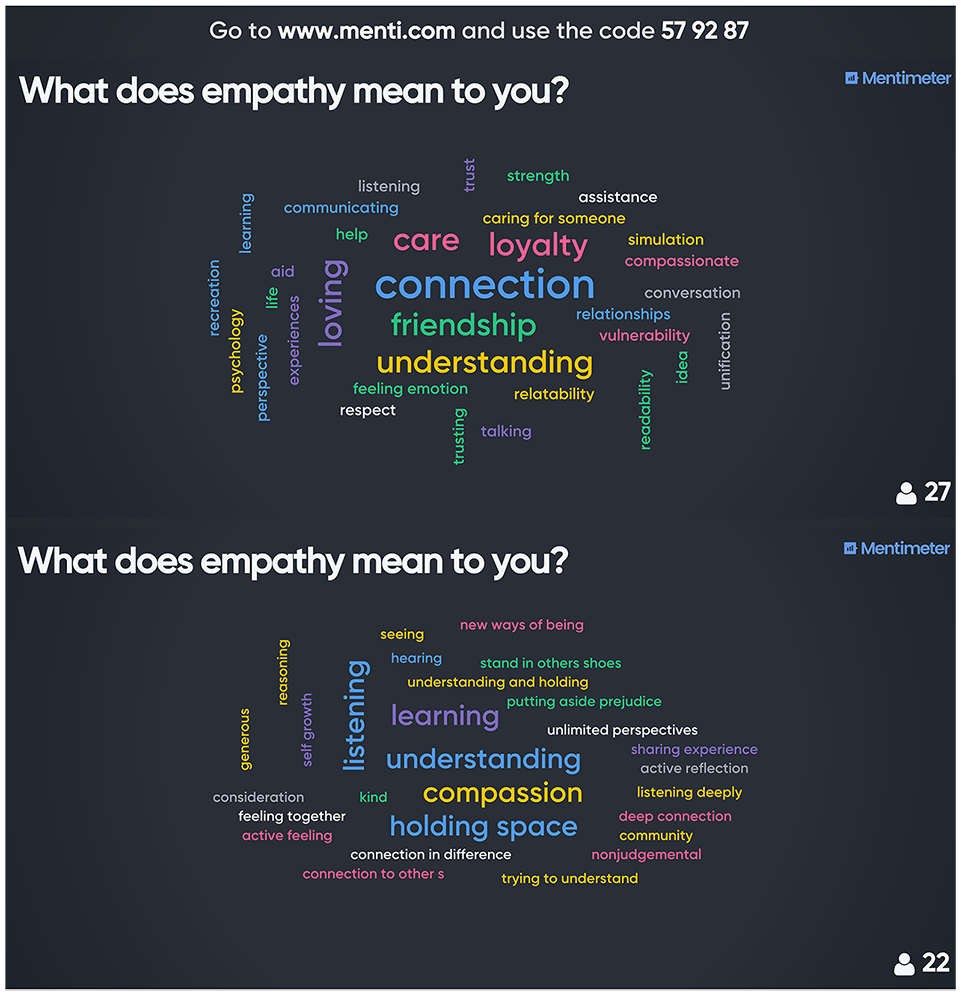
Menti Maps created by actors in Brisbane (above) and Sydney (below).
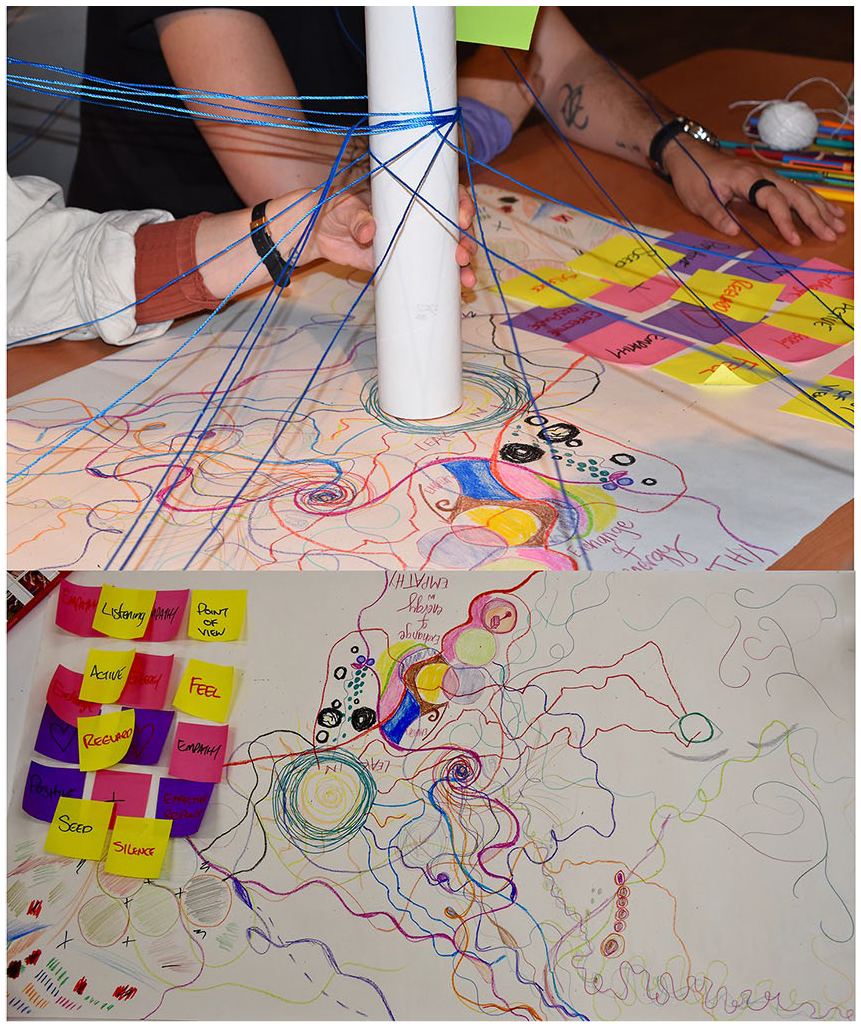
Artistic exploration of empathy by Sydney actors, Sydney Theater Company, 2019.
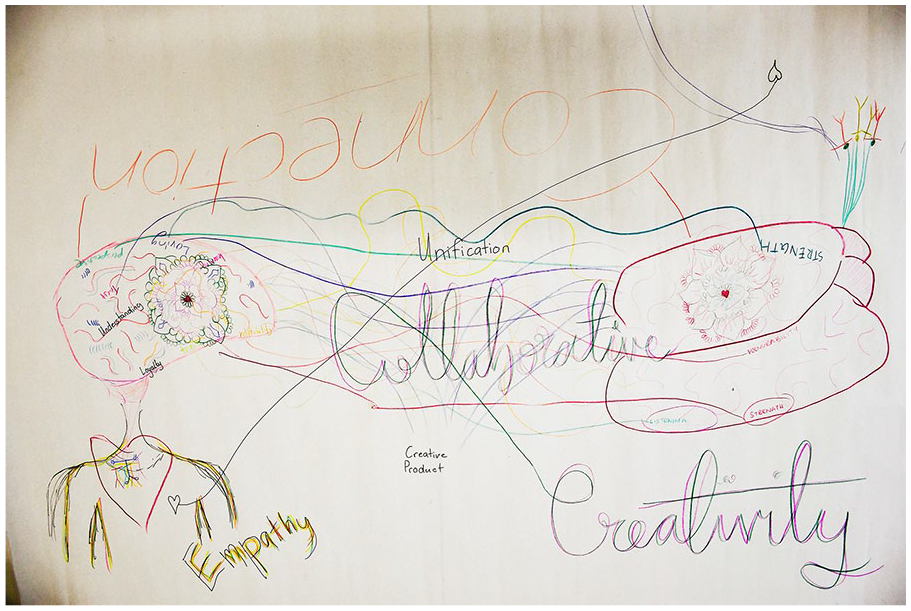
Artistic exploration of empathy by Brisbane actors, Queensland University of Technology, 2019.
These activities take place over the 3 days and require both linguistic and non-linguistic exploration of ideas. This allows happenings that are difficult to articulate—such as the affective—to be explored creatively; the artistic making activity in particular encourages deep investigation, co-creation, and expression of the complexity, layering, possibilities, connections, and imaginaries empathies might involve. It provides freedom from language and from categories and thus encourages questioning and expressing that which the actors experience, but cannot necessarily name (Marks, 2000). These artistic explorations are generative in offering a collective means of situated meaning-making.
Through this exploration of creative practice and reflection, the study strives to avoid criticisms such as those made by Gauntlett (2007), who argues that traditional interviews and focus groups often involve “asking individuals to generate opinions on something about which they did not previously have an opinion” (p. 3), and which may be challenging to immediately evaluate in words, which results in superficial, even misleading responses. Instead, it uses creative explorations as a method of generating knowledge, which “allows participants to spend time applying their playful or creative attention to the act of making something symbolic or metaphorical, and then reflecting on it” (Gauntlett, 2007, p. 3). To further facilitate this, the focus groups take place each day, as opposed to once at the conclusion of the project. This is designed to encourage the actors to iteratively and collectively (re)engage with their experiences and understandings, so as to deeply explore and co-create concepts and allow the evolution of the group’s dynamics to emerge.
The methods brought together for this study are designed to generate complex, multimodal knowledges about empathic happenings in collaboration, their relationship with unfolding creativity, and the influence of the situated environment on their emergence. Generating multimodal data in itself may not achieve this goal, however, if it is then coded, categorized, and reduced. In the next section, I describe how an empathic approach to diffractive analysis can resist these tendencies when conceptualized as embodied experiencing-with the data.
A Diffractive Approach to Analysis
The theoretical and methodological stance I have taken here attends to the material and affective happenings in the creative workshop space; an approach that does not seek to speak for others via observation and analysis, but rather sees the process of analysis as both collaborative and co-produced by the coming together of the research assemblage, which includes data, researcher, and theory (Fox & Alldred, 2015; Hickey-Moody, 2015; Sullivan, 2008). I take empathy as both object and process by adapting the diffractive methodology developed by Karen Barad (2007), who extends Donna Haraway’s (1997) diffractive analysis, to create an approach to analysis that generates new knowledge and questions about posthuman creativity through embodied experiencing-with the research assemblage.
Barad (2007) takes the notion of diffraction to describe the coming together of theory, data, and researcher to generate newness. The term comes from physics, where it is used to describe the combining effects of waves coming together; “diffraction has to do with the way waves combine when they overlap, and the apparent bending and spreading of waves that occurs when waves encounter an obstruction” (Barad, 2007). The original waves perish as they coalesce, yet remain present in the new emergence. Diffractive methodology involves exploring the emergences of a research assemblage coming together, generating newness and difference from their coming together, and being changed by their coming together. In a series of diffractions, methodological “cuts” are made that “interrupt, bend and diverge the object of study in co-productive ways creating the object/s, data and methods together” (Chappell et al., 2019, p. 300); thus, in the same motion bringing together and generating novelty through difference.
Diffractive analysis is therefore a creative process and a transformational process that involves “an embodied engagement with the materiality of research data: a becoming-with the data as researcher” (Taguchi, 2012, p. 265). This becoming-with approach also follows Deleuze’s (1994) notion that thinking should involve encounter rather than recognition, as recognition takes place from the outside and gives rise to representation, which is dichotomizing and hierarchical. Thinking via embodied encounter, on the contrary, “is about thinking otherwise and away from norms and rigid power-producing habits of thinking by ways of new encounters and engagements” (Taguchi, 2012, p. 272). This provokes transformation of thinking and feeling, or becoming, and alters potential future possibilities of thinking feeling.
To become-with data, the researcher needs to focus on the affective flows and the capacities they produce by using all of their bodily faculties to be attentive to the multitude of sensorial happenings in the assemblage. Taguchi (2012) describes this as “using our ‘bodymind’ to explore the co-constitutive relationships between discourse and matter [which includes both human and non-human bodies] in order to transgress what we already know as we extend knowing into other potential realities” (p. 267). It is vital that researchers avoid questions that close down discussions, such as “what is posthuman creativity” and rather ask questions that open up, such as “how does posthuman creativity work?” and “what is emerging from this research assemblage?” This resists the common research goal of producing simplicity from complexity (Fox & Alldred, 2015), and helps to shift the researcher’s understanding of their role in analysis from one of reporting on, or finding what they see from the outside, to activating new thought from within (Springgay & Truman, 2018).
Importantly, this becoming-with data do not strive to uncover the truth of the data, but a truth. Diffractive approaches to analysis are centered on the understanding that the knowledge created through each research assemblage coming into confluence is unique to that assemblage, and that such analysis generates only one of a multitude of realities enacted in the event (Jackson & Mazzei, 2017; St. Pierre, 2015; Taguchi, 2012). Rather than regarding interview data, for example, as truths which the researcher then makes accurate meaning of, in diffractive analysis, the researcher comes together with the data and theory to produce something new, something different. Difference is, as Deleuze (1994) conceives it, a positive force of relational becoming. This relational becoming is inevitably influenced by the researcher’s previous embodied, affective, more-than-human experiences, which consciously and unconsciously shape their experiences and decisions throughout the analysis process (Lupton, 2018, p. 8).
Although theorizing of diffractive methodologies has been ongoing for some time, there are relatively few instances in which it has been put into practice (examples include Burnard et al., 2021; Jackson & Mazzei, 2012; Kotze et al., 2018; Taguchi, 2012). The question remains—how do we do this becoming-with data? How do we engage with data affectively and without objectifying? As Roline Kotze et al. (2018) point out, It is one thing to read, think and talk about these notions and the exciting possibilities they offer for moving beyond a humanist mind-set, but we discovered that it is a different thing altogether to try to harness them in a diffractive analysis of the project. (p. 41)
I propose an approach that involves embodied experiencing-with via empathic engagement. I begin by describing how empathies are conceptualized, then discuss how such empathies can be applied in diffractive analysis, and finally trace the journey of doing this empathic diffraction to affectively engage with the research ensemble and generate new thinking, understandings, and questions about posthuman creativity.
An Empathic Approach to Diffraction
Empathies are theorized here as encounters that involve embodied experiencing-with other human and non-human bodies, leading to transformation of thinking, feeling, and being. These empathies involve entangled cognitive and affective processes and are thus termed rhizomatic (Vagg et al., 2021). This follows posthuman philosophical as well as recent neuropsychological and cognitive scholarship revealing that cognitive processes and affective responses are not separate, but rather continually and iteratively co-create one another such that affective reactions are influenced by cognitive processes, and all thinking is affectively infused (Braidotti, 2019; Duncan & Feldman Barrett, 2007; van der Tuin & Dolphijn, 2010). By dissolving boundaries between body and mind, thinking and feeling—legacies of Cartesian dualism—this framing counters understandings of empathy prevalent in much education, design, and business discourse. These are either limited to cognitive perspective taking and focus on observation, analysis, and evaluation, which has been criticized for reinforcing hierarchies, objectifying, and othering (Ahmed, 2014; Boler, 1999; Bost, 2017; Pedwell, 2014), or are perceived as an emotional personality trait of the human individual (Bost, 2017; Marshall & Hooker, 2016).
In addition to being multiplicitous, rhizomatic empathies are also multidirectional, as they can begin with an affective response or cognitive engagement. They are also not universal and uniform as they are shaped by previous affective-cognitive experiences and influenced by the context of interaction (Ahmed, 2000; Barrett, 2017; Slaby & Muehlhoff, 2019). While one person may empathize in a given situation, another might not. Similarly, while a person might empathize with someone or something in one environment, they may not in another (Cheng et al., 2007). These empathies are therefore unique to the person–time—place of their emergence.
Although rhizomatic empathies are uniquely personal, they are also completely relational, in that they emerge between bodies as they affect and are affected by one another in interaction. Their emergence depends on the affectivity of all human and non-human bodies involved, with empathies more likely to emerge when the empathizer is open to being affected and when the body being empathized with is more expressive (Jeffrey, 2017; Zaki et al., 2008), both of which are affected by the physical, atmospheric, and emotional context of interaction.
The final key feature of rhizomatic empathies is that they are creative. Through empathic encounters, individuals are granted access to experiences beyond their personal histories and understandings. They do not simply gain new knowledge, they gain new felt experiences. This has the potential to disrupt habits of thinking and feeling, prompting existing concepts to be broken down, and new understandings and questions to emerge in novel, possibly unimagined directions (Deleuze & Guattari, 1987; Slaby & Muehlhoff, 2019).
Empathic Engagement With Data
How can researchers engage with data through rhizomatic empathies? First, for empathies to emerge, the researcher must be open to being affected by the data. To this end, I advocate decentering self and allowing the affective to come to the fore by approaching analysis with wonder. Here, I draw on Maggie MacLure’s (2013) notion of wonder as a kind of bodily curiosity that starts from a place of unknowing, disrupting epistemic certainty and resisting the urge to recognize and categorize to make sense of the “other,” in this case, the data the researcher is experiencing-with. Employing such embodied curiosity can act as “a form of self-relinquishing, a willingness to open one’s experience and understanding by exploring other ways, other beings” (Bost, 2017, p. 193). Rhizomatic empathizing is not about making the foreign familiar, fitting data within existing categories or codes to quickly understand and make “sense” of it. It is about experiencing-with, with all the discomfort this may provoke, which requires vulnerability and releasing control to be open and attune to emerging affects, consequent reflection, and re-imaginings.
Experiencing-with data with such openness can generate liminal spaces between bodies that are intimate and connected. The researcher can experience the data in the middle, as Deleuze and Guattari (1987) encourage, and meaningfully engage without imposition to “achieve a kind of felt coalescence” (Slaby, 2014, p. 255). This coalescence does not mean that the empathizing researcher feels the same thinking feeling experience as the data they are empathizing with. Self–other distinction is maintained throughout—the researcher does not lose their sense of self while empathizing with the data (Engen & Singer, 2012; Tousignant et al., 2017), they are one and several, experiencing and becoming together–apart. As such, they can never speak for participants, they can only speak to the thinking/understanding/questions that develop through their rhizomatic empathic entanglement. All elements of the research assemblage are “agentially real” (Barad, 2007) and participate in the emergence of this novel empathic understanding.
Because rhizomatic empathies are embodied and multisensorial, involving entangled thinking and feeling, they enable exploration to extend beyond what is spoken or written. This draws attention to the more-than-human happenings, including how spaces and bodies are affecting one another, generating atmospheres and feelings, and participating in the relational event. This creates nuanced, felt experiential knowledge that can transform the researcher’s present and future thinking, feeling, and doing.
Engaging data with empathy begins with the researcher encountering the research assemblage with wonder, being conscious of and open to affecting and being affected, decentering self, and engaging in embodied experiencing-with the data, rather than observing and analyzing from the outside. It also involves understanding that our experiencing-with is only ever partial, and is steeped in our personal historical experience and therefore not equivalent to the experiences of others. Finally, it is important the researcher recognize that the knowledge produced by the empathic research encounter is specific to the ensemble and its unique time and space. Through this process of empathic experiencing-with, the researcher (and all other actants) is changed, becomes, and new questions, ideas, and understandings emerge.
Four Empathic Diffractions
In the remainder of this article, I describe a doing of this empathic approach to diffractive analysis with case studies outlined above. I briefly take the reader through the key steps involved in the four diffractions completed so far to illustrate how this empathic analysis might unfold in practice and ignite new thinking around posthuman creativity. These are not prescriptive steps; they are a glimpse of the happenings that emerged within this particular research assemblage.
The empathic encounters take place within a responsive research design that involves a sequence of diffractions that are driven by emergent questions. Each diffractive cut generates new knowledge and new questions, which then feeds into the subsequent diffractive cut in an iterative process of knowledge creation. The selection of data to include in each assemblage is not solely in the hands of me, the human researcher, making conscious, considered choices. Rather, it is the encounter between data, theory, and researcher that leads to certain data reaching out and pushing itself forward. MacLure (2013), drawing on Deleuze and Guattari (1987), describes such events as moments that glimmer, or “glow.” I propose that these glow moments not necessarily be individual, they could be several moments that are curious, fascinating, or disturbing in relation, and which reach out to one another in their relationality.
Diffraction 1
Following fieldwork in Site 1, Brisbane, I transcribe the three focus group discussions and activities from the video recordings using the software Transcriva. This is done manually and from video rather than audio recordings to begin what will become an iterative process of experiencing-with the data in a multisensorial way. Manually transcribing in this way forces me to experience-with the data slowly, inching forward a few seconds at a time and with many repetitions. Already, happenings begin to stand out and be noted as interesting for their connection to theory, or stimulation of a new idea or new question.
After transcription, the first cut of the data takes place, which generates a new research assemblage. This cut is made in response to a question generated from engaging with the key theoretical literature, and is also influenced by the initial experiencing-with during data collection and transcription: “How do entangled affective and cognitive empathic connections affect the emergence of creativity?” In addition to theoretical literature, this first research assemblage consists of the transcriptions of the three, 45-min focus group sessions, and myself as researcher. I begin by experiencing-with and annotating the transcripts: commenting, summarizing, connecting to creative skills and capacities from literature, and generating new questions (see Figure 4). This leads to an initial mapping using the software XMind, which allows visualization of interesting emergences and encourages connections to begin to form between them. A few short passages from the transcripts are included to “bring to life” these initial thoughts (see Figure 5). This map is in no way a summary of findings; it is to be read in conjunction with the messy, annotated transcripts. It draws mostly from a conversation during the first focus group that stood out as particularly speaking to the original question posed and is a means of beginning to explore relationships.
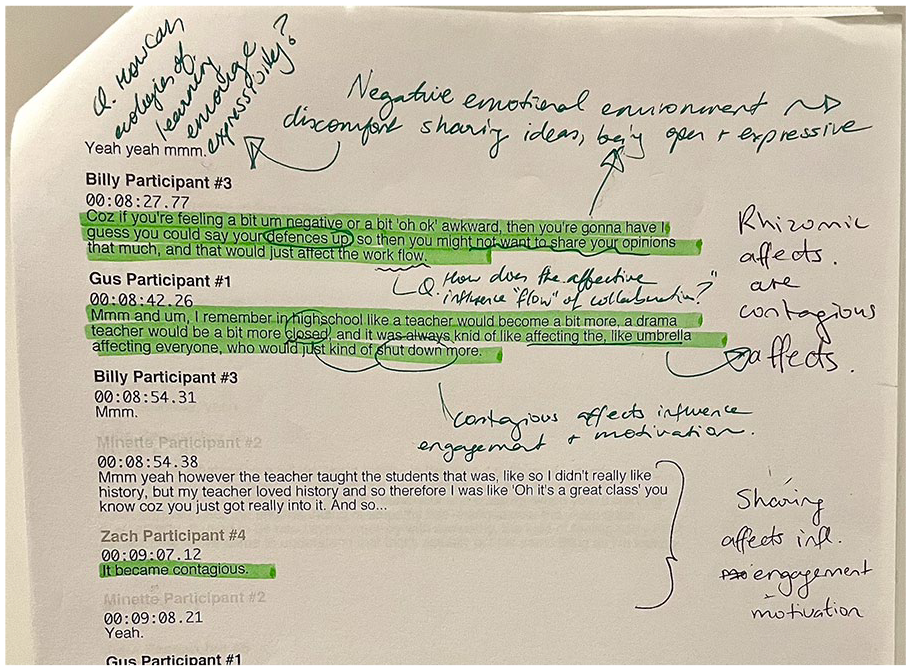
Example of first annotation of the Brisbane Focus Group Transcripts.

Diffraction 1 map responding to initial question generated from engaging with theory and literature.
Following this first cut of the data, three key questions stand out as glowing:
What happens in moments of empathic entanglement?
How do moments of empathic entanglement affect the emergence of creative events in collaboration?
How do creative ecologies affect the emergence of empathies?
Diffraction 2
Although experiencing-with the data in the first research assemblage leads to the generation of new ideas and questions, I feel that I could experience-with the data in an even more embodied way and strive to resist impulses to recognize and rather just be present and open to the affective happenings as they unfold. This is a reminder to decenter self and return to a place of wonder. It also highlights the challenges of this task and the importance of revisiting the goals of this research—from seeking to identify, for example, as opposed to transforming thinking. To aid empathic experiencing-with, the second diffraction of the data then involves the following:
(a) Empathizing with the focus group transcripts through the lens of each key question (this generates three sets of annotated transcripts) with active decentering of self and embodied engagement.
(b) Watching the video recording of the creative making activity in focus group Day 2 and empathizing with each actor individually—feeling the human and non-human bodies coming into relation with mine-with-them and with one another and feeling the atmosphere and emotions as they emerge and transform. This produces an almost stream of consciousness style text accompanied by key stills from the video recording (see Figure 6).
(c) Watching the video recording of the creative making activity in focus group Day 2 and experiencing-with the ensemble with no audio. By removing what was said, this draws out the material happenings between the human and non-human bodies that did not register.
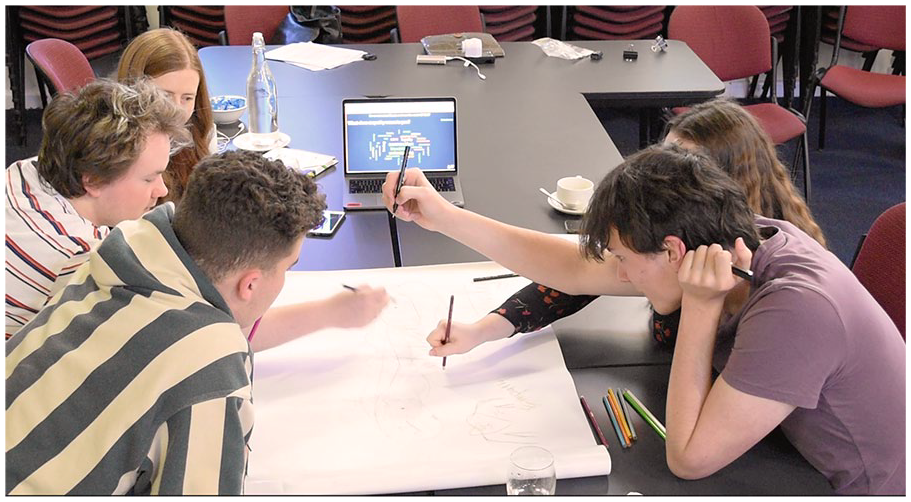
Empathizing with Brisbane focus group video data with and without audio.
From this combination of data, I generate a map using the software XMind for each of the three key questions (see Figure 7). These maps are extremely complex, and this is the goal: to open up and explore the multitude of goings-on in the data and allow them to be situated relationally. The questions themselves encourage this by asking “what happens?” and “how do things happen?” rather than “what is?” thus focusing on the processual and the emergent. As can be seen from the mapping of Question 3 (Figure 7), these maps bring together not only ideas that come forward while experiencing-with the data, they also bring together thoughts from theoretical literature—both emergent connections and dissonances—that erupt through the diffraction of the entire research ensemble. These maps continuously evolve as the encounter with data continues. They are, in this sense, a living picture of the research process. Their inspiration comes from Deleuze and Guattari (1987), who propose that “The ideal for a book would be to lay everything out . . . on a single page, the same sheet: lived events, historical determinations, concepts, individuals, groups, social formations” (p. 9), and in this way counter arborescent thinking and allow complexities to emerge, exist, and interact as multiplicities.
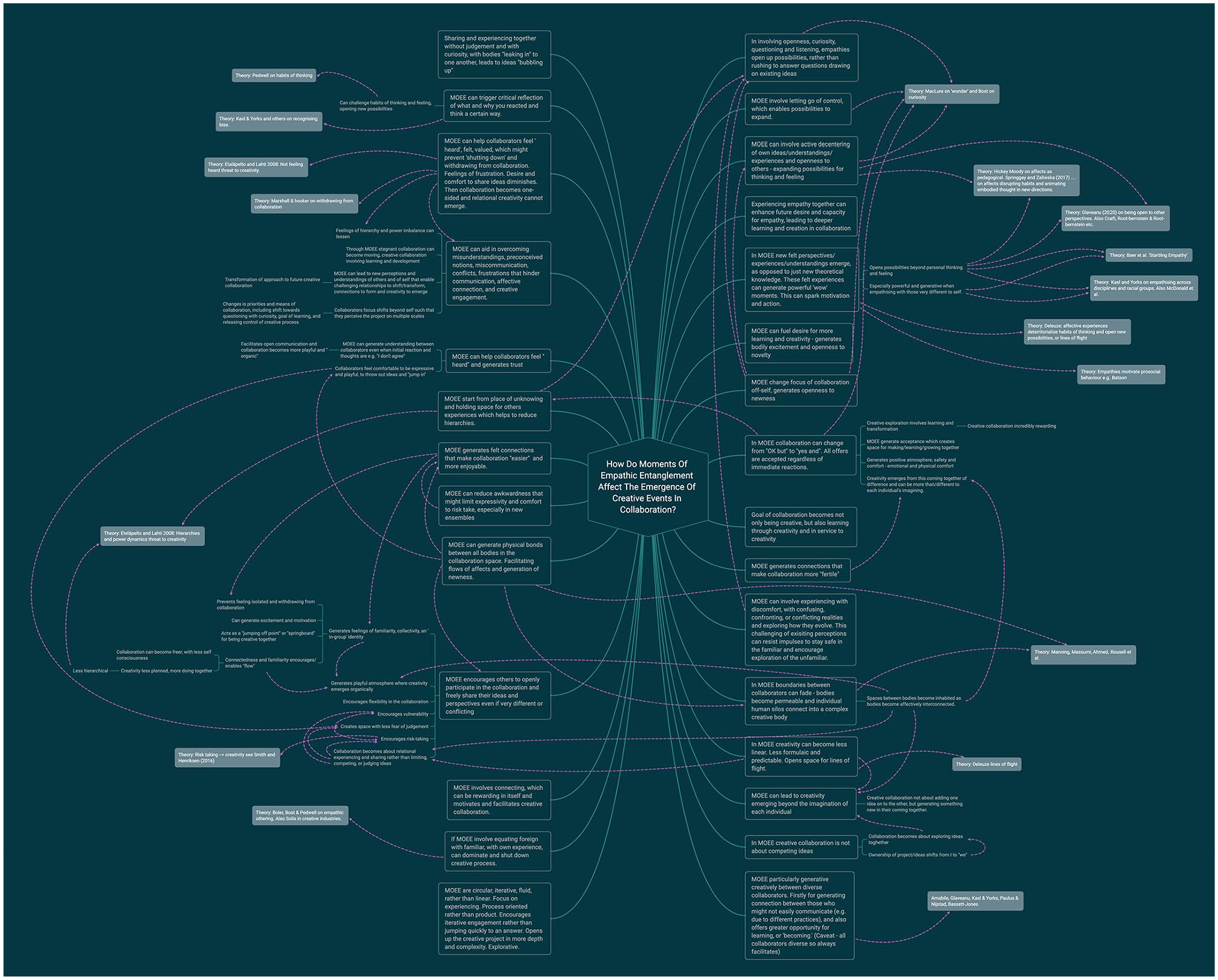
Example of XMind mapping of emergent Question 2 with Sydney data: “How do moments of empathic entanglement affect the emergence of creative events in collaboration?”
Throughout this mapping process, potential glow moments are brought forward for deeper analysis in Diffraction 3. Secondary emergent questions also come forward, such as: “how does empathy involve becoming minoritarian?” which might be further explored in additional diffractions.
A Note on Reflection
Throughout each process of diffraction, I continuously reflect on how I am experiencing-with the research assemblage, to ensure I am—as Veronica Pacini-Ketchabaw et al. (2016) advocate—“sensing and following . . . rather than rushing in to interpret and represent” (p. 157). This is documented throughout. For example, during Brisbane Diffraction 2, I experienced-with the video recording of the creative making activity twice, just a few days apart. After the second day I noted, As I have been writing this I am feeling with the group or feeling with one person within the group; feeling the others in the space, feeling my body and how it is responding moment by moment to the bodies around me, impacting me—an unexpected arm brushing against mine, the table pressing into my stomach as I strain to reach across the paper. I’m also perpetually questioning “am I feeling and reacting as Julia is feeling in this moment, or am I feeling with Billy/Gus/Minette/Zack/the group/the space?” Sometimes the answer is the former, so I need to sweep that writing away and return to experiencing-with. It’s helpful to do this analysis, or rather “exploration” or “encounter,” over again on different days, and reflect on differences that emerge. Some days, such as a few days ago on my first encounter with this data, I can’t feel emotionally present, and on those days I lay the pencil down. None of this means I am experiencing what they are of course, at any time, this is impossible and isn’t my goal. It is rather to explore the affective happenings in the space by experiencing simultaneously with and apart from them. This feels truly empathic. It is also confronting at times as I was present in the space when the activities originally took place, so I “know” what happened; yet when experiencing-with the actors my understanding of those happenings changes and I start to know differently. (Wednesday, March 4, 2020)
Diffraction 3
For the third diffraction, glow moments that came forward in Diffraction 2 are brought together in collage-like assemblages; two to three glow moments relating to each of the three research questions. While Diffraction 2 was all about allowing the complexity of the data to emerge, Diffraction 3 is about focusing in and more deeply exploring smaller cuts. These collages juxtapose passages from focus group transcripts, visual artifacts (artworks and Menti maps), video clips and stills from the devising workshops, and passages from theory. In this way, it brings what Deleuze and Guattari (1987) call tracings and maps together—theory as static tracings, and focus group and workshop creations as living maps—to explore how they/we interact with one another in response to the three key questions. Deleuze and Guattari (1987) recommend always combining tracings with maps as it is in the in-between that newness via difference is generated. In this diffraction, theory and data are not only juxtaposed, they are also read through one another, such that theory generates data, which generates theory, and so on. Bringing together this range of data in a series of mini-assemblages allows exploration of how ideas emerge across and between modalities to enrich and change understanding, be that via adding on to, or sitting uncomfortably with one another.
Diffraction 4
The fourth diffraction brings together selected glow moments explored in Diffraction 3 from both sites—Brisbane and Sydney—to create new data–theory–researcher assemblages. Not all glow moments from Diffraction 3 are brought forward, only those that come forward as particularly interesting in relation. Bringing data together from across contexts leads to new curiosities and tensions emerging, and is especially generative for deeper exploration of the third emergent question, “How do creative ecologies affect the emergence of empathies?”
Conclusion
In this article, I have advanced an embodied experiencing-with data through rhizomatic empathies as a means of exploring the material, human and non-human, conscious and unconscious happenings in creative collaboration. This opens up the phenomena under investigation—in this case, the emergence of empathies and their relationship with creativity—to explore their nuance and complexity. In doing so, I offer an approach that counters inquiry privileging the mind over bodies and matter, and focusing on uncovering macro, generalizable meaning (Jackson & Mazzei, 2012).
Rather than analyzing from the outside, rhizomatic empathies allow the researcher to intimately, affectively experience-with the research ensemble. These new experiences are embodied and have the potential to disrupt sedimented habits of thinking and feeling and generate novel ideas, understandings, and questions. This empathizing is challenging, as it requires the researcher to resist the urge to equate foreign with familiar to quickly make sense of the unknown, and rather approach the research assemblage with an openness to being affected that decenters self and holds space for others. To encourage this, I propose starting analysis from a place of embodied curiosity, or wonder.
This empathic approach to diffractive analysis may be limited somewhat by the kinds of data generated. As discussed here, rhizomatic empathies are relational and depend on the expressivity of one body as well as the openness of the other. Data such as photographs, artifacts, and video recordings can be more expressive than, for example, interview transcripts, by providing complex multimodal sensory information that invites embodied engagement. I therefore propose combining a multimodal research design with an empathic approach to diffractive analysis, as this facilitates engagement with the material happenings as they influence flows of affects and shape emergent events.
This engagement with the material, processual, and affective makes empathic experiencing-with data aptly suited to posthuman ecological approaches to the study and theorization of creativity, which are calling for research to look beyond human individualism and exceptionalism to the relational creative happenings that emerge when more-than-human bodies collide. This approach draws out the complexities of situated creative events, including how their tendencies and potentials are shaped by interconnecting spaces, activities, and contexts of interaction.
Footnotes
Acknowledgements
I would like to thank Professor Harris for designing and conducting the broader study and Kelly McConville for co-facilitating the verbatim theater workshops.
Declaration of Conflicting Interests
The author(s) declared no potential conflicts of interest with respect to the research, authorship, and/or publication of this article.
Funding
The author(s) disclosed receipt of the following financial support for the research, authorship, and/or publication of this article: This study is funded by an Australian Research Council Future Fellowship (2017–2021), Grant FT170100022, Professor Dan Harris sole investigator.
