




Abstract
This article draws from the narratives through oral story telling of my great grandmother’s experience during Girmit. It aims to preserve the past and present for future generations in a creative manner. Narrative and poetic inquiry has been used to bond the Girmit root and the Pacific shoot. Inspiration from Teresia Teaiwa’s (1968–2017) efforts which emphasized creative practice as a path to drawing out and deepening one’s knowledge guided this article. Data, presented as poems, express and communicate the stories pertaining to Girmit and its descendants. Present curriculum should seize opportunities to cultivate the usage of narratives and poetry to create a creative curriculum. This article, hopes that the poems could be used in the curriculum to construct, deconstruct and reconstruct the colonial mind-sets. It is written from my heart to the many hearts who, like me, are still in search for answers and insights of being and belonging to the diasporic/Hybrid identity.
Introduction
While it is important to appreciate the root,
it is equally important to acknowledge the shoot.
Stories bind us to our ancestors and we relive their moments to understand about life and identity. Egan (2012, pp. 96–97) acknowledges that “we are a storying animal; we make sense of things commonly in story forms; ours is a largely story-shaped world.” This view is expanded by Rolling (2010, p. 11) who believes that “stories told and retold become frameworks shaping worldviews, conventions of thought, and common cultural understandings.” Further to this, Bell (2002, p. 208) emphasizes that “stories do not exist in a vacuum but are shaped by lifelong personal and community narratives.” This article retells the Girmit story in a creative way. Indians have been in Fiji, “a volcanic archipelago located in the South Pacific Ocean, since 14 May 1879, when the indentured labourers (also known as Girmitiyas) arrived in the Leonidas from Calcutta and have eventually become part of Fiji’s social fabric” (Shandil, 2017, p. 2).
Girmit has always been associated with a negative connotation. The term itself means to be bounded by rules and laws against one’s wish. Brij Lal (2016) states that people were embarrassed about their history, which they associated with darkness and destruction, shame, and embarrassment and did not want to be reminded about their difficult journey. Although the indenture experience has remained a source of unrelieved sadness (Giri, 2007), there is so much to understand and comprehend about life by reflecting on their experiences. Personally for me as a Girmit descent academic, I strongly believe that Girmit should not only be seen as a time of slavery and bondage! Girmit was a time of building relations, of moving and crossing boundaries which otherwise wouldn’t have been possible.
Teresia K. Teaiwa, an iconic figure in Pacific Studies (Salesa, 2018), a poet and critic, dedicated mentor, and scholar experimented with a concept called “Akamai” which emphasized creative practice as a path to drawing out and deepening one’s knowledge (Teaiwa, 2017). This article tries to utilize the concept of “Akami” in that, it draws on creative poetic reflections on Girmit life and Indo-Fijian life to deepen knowledge in this context.
I trust this article will uplift and acknowledge Grimitiyas lived experiences through my poetic expression thereby giving a voice to the Indo-Fijian descendants. I begin by acknowledging my great grandmother, who was taken from her family as a youth to work in the cane fields in Fiji. This article is also a tribute to the all the other indentured laborers/Girmitiyas who were brought to Fiji, lured away from their homes and the love of their families—May their spirits find their way home. This article presents a personal account of Girmit life in the form of a poems reflecting the narrative accounts, to explore, and enhance understanding of Girmit life from a creative perspective, at the same time reflecting on the Indo-Fijian community in Fiji.
Significance
This article is a creative production retelling the Girmit story from my mother’s narration which is a reflection of the narrative account handed down orally to her through her paternal grandmother. It hopes to capture the essence of these narrative accounts on paper through creative standpoints for present and future generations to see Girmit as not only a time of hardship but an experience where one can draw his or her strength from. The Girmit story should not only be seen as a journey of pain and affliction but also seen as a birth of a new people-the Indo-Fijian people, who though have roots from the Girmit era, but also have shoots in the Pacific era. This, I believe needs to be respected and appreciated, not only by academics but the general public. No longer should the term Girmitiya be seen as a kalank 1 on the Indo-Fijian community but seen as a source of strength. This article aspires to create a link in the emotional ties from Girmit to the present day, binding and bonding the Girmit roots with/to the Pacific shoots. It desires to lessen the stigma related to the Girmit ancestry and create an appropriate understanding of the Indo-Fijian community living in Fiji, a diaspora community. This article is simply a tribute to the Girmit historical past and life experiences of Indo-Fijians as the primary source of information that hopes to connect our diasporic lives with the rest of the world for better understanding. The poems of this article could be used in the curriculum to honor and respect the histories of Grimitiyas and their descendants.
Methodology
This article utilizes narrative inquiry as the methodology to obtain data. Narrative inquiry an as qualitative approach attempts to illuminate participant’s inner stories to adequately understand their experiences and viewpoints (Clandinin, 2006; Wang & Geale, 2015). Narratives as a fundamental process of human research and development allows to make sense and meaning of the world around us (Rolling, 2010). People’s lives revolve and evolve in, around and through stories and narrative researchers describe such experiences through people’s narratives (Connelly & Clandinin, 1990; Pathak & Bee, 2010). In narrative research, stories become the raw data.
My writings, just like Teaiwa (2017), acknowledge the storyteller who recollected the stories and shared the deep painful stories with me. This is the narrative of what my ancestors went through in their personal journey from India to Fiji. Wang and Geale (2015, p. 198) further acknowledge that, “Narrative inquiry is not simply storytelling; it is a method of inquiry that uses storytelling to uncover nuance. Stories heal and soothe the body and spirit, provide hope and courage to explore and grow. The process of storytelling, a fundamental element in narrative inquiry, provides the opportunity for dialogue and reflection, each intertwined and cyclical.”
Poetic inquiry has also been used in this study to report the stories to bridge the gap between stories and historical events. Rooyen and D’Abdon (2020, p. 13) state that, “Poetic inquiry articulates a decolonial perspective in that it delinks from conformist methodologies of knowledge production and reconfigures the relations of power that shape conventional research by invigorating the (often suppressed) voice of the colonised. It is a decolonising strategy in that it encourages greater collaboration and coexistence between researchers and research subjects, in which the former have an opportunity to escape the prison of academic jargon, and the latter are allowed to speak for themselves in new, empowering ways.”
The experiences and feelings in the narration provided by the participant is woven together as poems to value the individual expression and entails poetical exploration and presentation of inner and outward ideas. These are written out as poems to create an aesthetic appeal and understanding of Girmit and Indo-Fijians. The main reason of including poetry in the write-up is because poetry is seen as a means of expression and communication, an art form.
I, as a Pacific academic and poet want my voice to be heard not only through academic works but also through an aesthetic perspective. The poems here are a reflection of the stories told by my mother whose grandmother had passed her experience and stories to her. My great grandmother was from India, most likely from Bihar, 2 assumed from the richness of her accent, however, we are not sure of the exact location though. Figure 1 illustrates the methodology used in the study to collect and collate qualitative data. While narrative inquiry was used as the main methodology, poetic inquiry has been used to present the data.
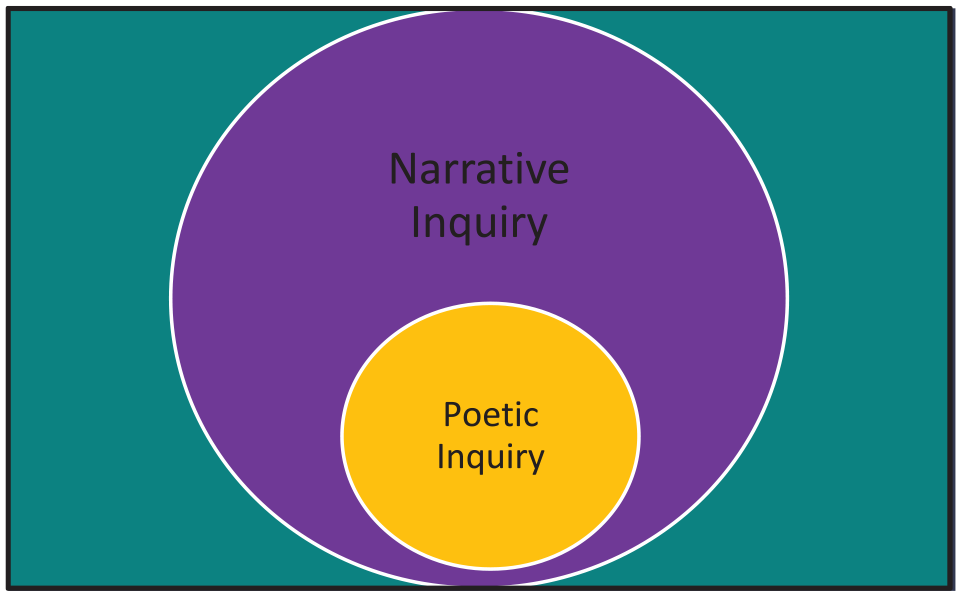
Methodology.
Method
The data for this study were collected through talanoa. Embedded in oral practice, talanoa is a concept acknowledged in many island nations across the Pacific, including Fiji. Farrelly and Nabobo-Baba (2014, p. 319) define “Talanoa as ‘talking about nothing in particular,’ ‘chat’ or ‘gossip.’ It is within the cultural milieu of talanoa that knowledge and emotions are shared and new knowledge is generated.”
Talanoa has recently been taken up by development researchers and others as a culturally appropriate research method in Pacific contexts (Farrelly & Nabobo-Baba, 2014; Tecun et al. 2018). For talanoa may be understood as participating in dialogue with, or relating stories to each other without concealment of the inner thoughts and experiences, removing the distance between researcher and participant (Halapua, 2000; Vaioleti, 2006, 2013). For this study, since the participant is a known person, in this case, my mother, I found talanoa to be the most appropriate tool to dig deeper into the stories and uproot as much information as I could. Figure 2 illustrates the data collection and presentation technique used in this study.
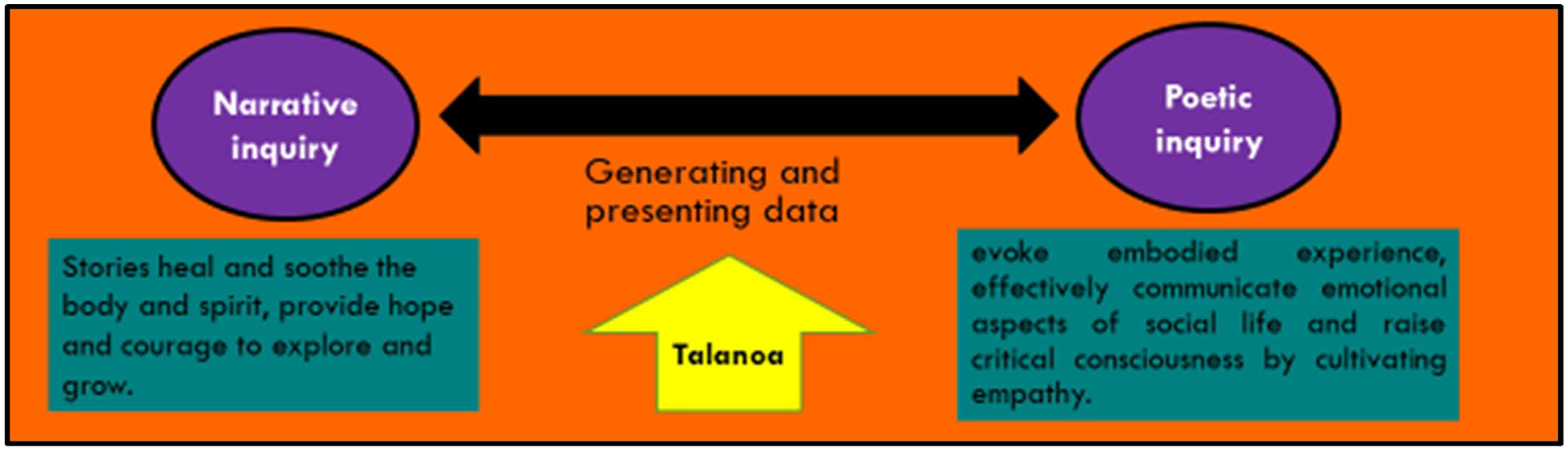
Data collection and presentation.
Participants
Since this study wanted to elicit information from my ancestors, I obtained data from my mother. She is the key participant in this study as the oral stories of Girmit had been handed down to her through my great grandmother.
Poems From Narrations
We all have stories to tell. Our stories make a difference in our lives by justifying the way we do things and the way we think. It reflects on the way we operate as individuals and as collective beings. The ultimate understanding of our stories can provide a feedback not only to us as individual but as research active beings to decide what to venture and how we will respond as we venture out on research to decide certain goals and what we can and can’t pursue as academic leaders.
My story as an individual was always a pain for me when my mom started telling me the stories about her grandmother who was from the Girmit times. For me personally as a technological and modern girl the Girmit stories seemed boring and baseless. They suffered so what? What difference would their suffering make to my life? They came in the boat from India so what? Why would I want to listen to their stories of suffering and of their journeys and so on? I was free, I had everything, every comfort of a good home, loving family, food on my table and so on. So why would I listen to stories of suffering and pain. Why would I be interested in my great grandmother’s stories as an indenture laborer?
As I ventured in to PhD, I started understanding the importance of knowing where one comes from. The importance of one’s being, the importance of one’s stories. The identity crisis then stood in my face and I realized the sad truth. I need to understand their pain and suffering to understand and fully grasp who I am. My identity was a reflection of their suffering and pain. It was their suffering pain and sacrifice that made me who I was today. Now as I rethink my identity as an individual I am proud to say that I am a version of my great grandmother who was a very bold woman. The narrations have been converted and presented as poems to add a creative touch to the life experiences of Girmitiyas and their descendants.
A reflection of the present community
I bring to you
Our Indo-Fijian community
A community close to my heart!
As an academic, and Indo Fijian
A hybrid individual
My voice is a lone voice ringing in this generation
With anticipation
I represent
The dreams of my culture
The hope of reviving identity
I present my people, my culture, and my hybridity
With a pinch of the essence of Oceania
A Pacific co-existence!
. . .
The Initial Journey
My Girmit journey started when my great grandmother, Veidayi (who later changed her name to Sant Kumari), was lured into the indenture ship ready to depart India. She hailed from a large extended family. At an early age (around 7 to 8 years of age), she had been betrothed to my great grandfather, Banwari Singh, who was few years older than great grandmother.
With my dolls in my hands
I rushed out to meet my friends
To play our usual game
“Don’t go out today”
I was told in a secretive way
My doll was taken away
I was adorned in special bright attire
Little I knew
My innocence was put to retire
It was my wedding day
I couldn’t understand a thing
For me it was just like my “gudda guudiya
3
“ play
Great grandfather who had been lured first into the ship, requested the officers to go and bring my great grandmother, who was betrothed to him at an early age. Thus began their journey from India to Fiji.
Girmit
A name, a brand, an ugly stamp
Girmit- is where my life’s journey began
A long journey, destination unknown, unheard of
On the ship
All brought together as one
My caste, our caste
An irrelevant ordeal for now
Caste was not an issue anymore
Loneliness, fear and anxious thoughts
Leaving their home,
They sailed forth to build a new dome!
Far across the seas, wading into new oceans
India you seem so far, so distant
Amma
4
and taji
5
- oh I miss you all just so much!
When the sardar torments
I remember my parents’ gentle caress
Sardar- can you be a bit merciful?
Pretense of bravery, I hold in my heart
Sometimes a look beyond the horizon
And emotions would flow like rivers from inside my heart
Looking down at my hands
Destiny, fate- when will the journey end?
Family, friends all back at home, many miles away
My spirts trapped in an unknown place
Disease and death on the ship
Made life unbearable
Thinking about home filled many eyes with blood and tears
A unique friendship formed between others on the ship
Caste was just forgotten
Survival was needed
Brutality and pain existed
But hope was emerging in their veins
A new land
They set their foot upon
Great lengths of jungle
The spread of the wide wild ocean
Future was uncertain
But this was their home for now
Maybe one day they would see their loved ones
Or maybe never
Maybe this was where they would be buried
Maybe this was home despite the obstacles
. . . . . . . . . . . .. . .
Some Experiences
Missing home and family was part of the Girmit life. However, this did not dampen the spirits of the Girmitiyas.
While the daily chores were attended to,
The mind always drifted back home
The break of the dawn
Brings new struggles, new pain
Each passing day, caused my soul to bleed
The lashes of the sugarcane leaves ripped my skin apart
But it was nothing compared to having a tormented heart!
. . . . . . .
The Girmit life, was full of struggles. The daily routine began with waking up early and doing household chores before rushing off to the cane fields.
The bhajans
6
sounded in the distance
The bon fire crackled away mercilessly
Wind pulled at my scattered hair
As though nudging me to stop grieving
I sat in-between a pile of earthen pots
Molding pots and diyas
7
was such a messy work
So much pain one had to endure
The potter and the clay alike
One being molded and the other so keen in molding
Tears welled up in my eyes
As I thought how familiar the molding just sounded
The Sardar molding us, and we being molded!
Molded into slavery
Molded into a voiceless generation
Earthen pots teach us so much about life’s issues
The beauty of its beginning
The suspense in the making
Diverse usage when complete
Its role as the diya- to light up the world
What a farce it is
To light the whole world
Yet hold such emptiness inside oneself
As I continued molding
I looked at life in a different way
Future looked so unsteady
An urge to go back home was again emerging
Crash!
The earthen pot slipped from my clumsy hands
Clumsy-not so
Tired battered hands
Hands that were nurtured as silk
Now worked on cane fields
So many times I thought of home
Home –just the thought enlightened my battered soul
The clay pot lay shattered in front of me
Picking up its pieces
I struggled to withhold tears
Just like the earthen pot
One day it’ll be all over
Life wouldn’t be this way anymore
No more painful whips
No more living in shame
Rain drops suddenly fell cunningly on my molded clay
I picked up my pots—bits and pieces of it
Rushed into the old shack
This was home
This was where I was bound to stay!
. . . . .
Festivals brought joy and sadness at the same time to the hearts and souls of the Girmityas. While it was a time of celebration, memories of family and home lingered through.
Diwali
The festival of lights
The whole colony is lit up
Alas why is my soul still in dark?
I pinned to give shape to the diya
As I grabbed the potters soil in my soft tender hands
The smell of earth reminded me of my motherland
Diwali used to be a time of happiness
A time of joy, a time of sincere reflection
Will I ever see my family?
Ever?
Diwali
A celebration
Yet my heart just felt rotten
. . . . . . . . . . .
The end of Girmit gave the Girmitiyas a choice of going back to India or staying in Fiji. My great grandmother who was now a mother of seven children, dared not go back home to India. The family tradition was that once the girl has left the home, she cannot just come back. Death would be her ultimate justice. So, she decided to remain in Fiji and settled in Nadi, a town in the western side of Fiji, with my great grandfather.
It’s like the stars were merciful
The thrashings came to an end
Girmit ends- now what?
Time to go back home
Such an immense joy just filled our barren hands
A choice we had
But a dilemma it suddenly became
To go back to our motherland, or to continue in the newfound land?
Going back seemed a plausible thought
But traditions and cultural confinements was like a pinch on my toe
Death awaits at that end
Going back now didn’t seem a good idea at all
Fear gripped, I chose to remain
Now this was my land,
Fiji is where I will build my home
It’s where my life shall end!
. . . . . . . . .
Discussion and Reflection: Indo-Fijian—“Identity in the Making”
I am an Indo-Fijian. Although a natural straightforward statement this is, yet it forms the basis of an identity crisis! I know where I was born, where my ancestors came from, yet time and time again, the identity gets more complicated. Sharma (2018, p. 273) states that “despite the celebratory stance adopted by proponents of globalisation towards migration and transnationalism, many diasporic subjects experience geographical and cultural displacement as dispossession and loss.”
Being born and raised in one of the countries in the Pacific
I may have traces of ancestral ties with insignificant stains of blood
I resonate the fragrance of Oceania
But my girmit blood stains still remains
A blended portion I am
A result of Girmit, Pacific and Oceanic blend
The texture of my hair shows hybridity
The straights and the curls
My skin exposed to the saltiness of the sea
The blue of the sky and the breeze of the ocean
The mountain ranges extends from end to end of my life
Oceania is my home
It belongs to me as much as it belongs to you
My essence as an individual is found immersed in the very fibre of Oceania
My identity is imprinted in my Pacific way of life.
The Pacific is my wellspring of joy, my birthright
The vast mountain ranges and the depths of the oceans reveal who truly I am,
But the twist and turns of the human realm confuse the core of my existence!
It is true that my roots go down to the Girmitiyas which leads toward India, but my shoots are very much Pacific! I am a daughter of this land called Fiji, a Pacific islander or an Oceanian if I may say. This is the dilemma of cultural identities that gets complicated with historical and future endeavors. Trying to “fit in” is what I have been doing to comfortably define myself.
Subsequently, Voigt-Graf (2008, p. 81) supports this view by stating that
“majority have long ago lost all personal contacts with India. During their stay in Fiji, their social, cultural and religious practices have undergone many changes. Their experiences with subcontinental Indians are limited and their views of India and of subcontinental Indians largely based on ignorance, indifference and stereotypes.”
An Indo-Fijian woman
Yes that’s what I am still called
A pull in my identity I feel as an individual
I am neither fully Indian, nor am I indigenous Fijian
I feel like a hybrid
Like a bat hanging upside down
A fuss of identity and authenticity
All these philosophical underpinnings
The process of post modernity
In the process of understanding myself, my history, my past and my future
My identity has developed into invisibility
The concept of identity, even as discussed by Teresia, is still a question that has no resolved spirit, as I try to resolve my identity conflict. Being born in Fiji, this is home to me, yet the Indian tag reminds me that there is a diasporic touch to my being as well. According to Gautam (2013), the term “Diaspora” is derived from a Greek word, meaning dispersion.
The ocean neither belongs to me nor to you
The blue skies reveal its natural essence to you and me alike
Under the sun, we all are the same
Burnt and scorched under its intense Pacific heat
Yet you still ask me-
Questions concerning my identity
To you this just may seem a game
But inside of me
I am shattered
Hurt
I hoard a collapsed soul
Entangled in the invisible knots of slavery
Indenture has perished
But a modern day slave still I am
In seek of a name
Just simply put a stop to this sad hurtful identity game
From generation to generation
The question of who am I?
Do I belong? Where do I belong?
These questions strangle my consciousness
It’s like in the vast ocean,
I am struggling to simply breathe
Uprooted my intimate self
Dug so many graves
To find answers to my plight
Hoping against hope
To be able to see
When will I ever know- just who am I supposed to be?
. . . . . . . . . . . . . . . . . . . . . . . . . . . . . . . . . . . . . . . . . . . . . . . . .
Decolonizing the mind should be an important aspect of any academic pursuit. As academic leaders, we need to understand the importance and the need to first be able to change our mind-set, be able to look in the past, obtain and learn from the past practices but not stay there. There is a need to move forward to the future not forgetting the present generation. Drawing from past experiences and practices of the colonial era would enable us as academics to understand how the show was run in the past. It would help us to comprehend where we come from and why we function the way we do. Decolonizing the mind would enable us to understand that things need to change, the curriculum needs to change, the way in which teachers teach needs to change, and the change needs to come from within us—the decolonized teacher and academic. We are in constant battle with the colonized mind which is trying to decolonize itself but constrained by the rope tied on its waist and as the efforts continue to move forward, the movement is restricted and we go in circles, only to faint in the end or give up future efforts.
Girmit has ended ages ago
Yet bondage remains contained in the thoughts
A wiggly finger we point at our own selves
A wound in our womb we carry
Hassled by the things of the past
A struggle with fractured identity
Seems a never ending farce
. . . . . . . . . . . . . . . . .
Decolonizing the mind as leaders means working for the better. First, we need to learn to appreciate the knowledge/traditional knowledge/knowledge creation in our own context either i-Taukei or Indo-Fijian contexts. We need to see traditional knowledge creation as a value laden process. The colonized person in us tends to accept any ideas thrown to us by the Western ideologies. We offer respect to their ideas and often place little or no value to what we can create as Pacific and Oceania leaders. If we don’t value our knowledge, our epistemologies then our present and future will continue to suffer even more compared with our past.
As present day academics, it would be wise to draw from the past mind-set and create a future worth being in. The education system is one of the places where the construction, deconstruction, and reconstruction of these colonized mind-sets can occur. The curriculum should be designed in ways where students see the vitality of understanding how their people operated and created knowledge (Singh, 2011). It should offer some incentives of looking at traditional knowledge rather than bombarding the young child’s mind with outside ideas. It is not that we don’t need the Western concepts and ideas to move forward in life. We do need their ideas; however, their ideas shouldn’t form the basis or the foundation upon where we function from. Our people need to be grounded in our own roots and not detach from its roots. The more inclined and attached we are with our roots, the more strength we can draw from the vines and thus nourish our minds and face the battles of the future. In an analogy of the tree, roots are important, thus we also need to be attached and be in conjunction with the roots. Without the knowledge, wisdom, and understanding of our roots, we are simply puppets to the master—the colonizer.
A peak I take into the art education curriculum
How much of me is there to be taught or discovered?
A negligible bit, an insignificant clip
Art is my identity
My aura
My being rests in the essence of art in the curriculum
Alas its lack I feel like a thorn in my toe
Traditional quilling, thread work, rangoli,
patch work, marble sculpture and zari work
Has lost its touch from generations to generations
Weaving and pottery making with a wheel
The cultural skill has vanished significantly without even a feel
My ancestors had brought traces of art numerous years ago
In the pursuit of better life, art lost its significance in our own lives
As Pacific people, we need to be embedded in our ways of knowledge. A decolonized mind would be one which is able to comprehend and articulate from the experiences of the past to the present to the future. Our minds have been challenged in such a way that we always tend to undermine our own experiences and knowledge. My people have sort of undergone two types of colonization. Once in India and then coming to Fiji. The Girmit slavery made our people look up to the Sardars as superior and look down on our own selves.
It is quite sad that we allowed this colonization to become a major part of our lives and let it control our local curriculum and education system. Presently, academics are trying to force their way out and away from the colonized mind-set and structure of thinking. We are trying to break free and breaking free would only be successful if we start from within ourselves. The mind is a powerful entity in our body and it is through the change in mind-set to a decolonized mind that will make an immense change to our future and the research initiatives.
Once our minds are decolonized, our perspectives will change and we will be more open to more better improved ideas and ways of disseminating the curriculum. A teacher’s mind-set will make a huge difference in the articulation of the curriculum. The local curriculum needs to be taught from the local knowledge and techniques that we bring from our cultural and traditional knowledge stanzas.
Conclusion
This article has through poetic artistic expression tried to voice the pain, experiences, and plight of the indenture descendants. I understand all descendants will not agree on the journey and stories as this is my personal acknowledgment and expression. I am proud of their resilient and creative spirit that has been handed down to me by my ancestors. This article has allowed me to venture into deep waters and write about issues and experiences that most do not know nor feel about. This is my space, my VA, 8 and my inspiration from my ancestors. I believe in the resilient power of my great- grandmother, grandmother, and mother, who stood firm in their plight and through whom I am who I am today. I am proud to be one of the flock from the Girmitiya clan!
Footnotes
Declaration of Conflicting Interests
The author(s) declared no potential conflicts of interest with respect to the research, authorship, and/or publication of this article.
Funding
The author(s) received no financial support for the research, authorship, and/or publication of this article.
