



Abstract
In this article, we present ideas about developing innovative methods for the sociology of futures. Our approach brings together the literature on sociotechnical imaginaries and the sociology of futures with vital materialism theories and research-creation methods. We draw on our research-creation materials from a series of online workshops. The workshops involved the use of creative writing prompts with participants across a diverse range of age groups and locations. The article ends with some reflections on the implications of our approach for researching the futures of emerging digital technologies and the methodological and theoretical development of the sociology of futures.
Introduction
The topic of the future has begun to interest social researchers beyond the domain of what has been labeled “futures studies” (Kuosa, 2011). Sociologists have traditionally focused their attention on the past and the present and have been somewhat reluctant to engage in futures studies (Beckert & Suckert, 2021). However, in recent publications, calls for a sociology of futures have begun and suggestions for methods to investigate everyday futures have been outlined (Coleman, 2017; Michael, 2017; Oomen et al., 2021; Tutton, 2017; Urry, 2016). In science and technology studies, the term “sociotechnical imaginaries” is often employed to identify future-oriented predictions about novel technologies or services in public forums or industry publications. Sociotechnical imaginaries are positioned as “powerful cultural resources” (Jasanoff & Kim, 2013, p. 190) for making sense of new technologies. Numerous analyses of such imaginaries have been published. However, most address public-facing discourses about future technologies rather than people’s everyday ideas and practices. The relationships between discourse and embodied practices and how sociotechnical imaginaries are enacted as part of mundane routines are often not investigated (Dawney, 2011; Lupton, 2021b).
In this article, we present ideas about how to develop innovative methods for the sociology of futures. In so doing, we bring together the literature on the sociology of futures with the concept of sociotechnical imaginaries as well as incorporating vital materialism theories and research-creation methods. We discuss the approach we adopted in conducting a series of online workshops held in early 2021 as part of the research project “Living with Personal Data: Australians’ Practices and Understandings.” The workshops involved the use of creative writing prompts with participants across a diverse range of age groups and locations, with each workshop featuring a different activity. Four of the eight workshop activities invited participants to create speculative imaginaries around the futures of personal digital data and the devices that generate these data, sparking group discussions. By necessity, due to COVID-19 restrictions on face-to-face research encounters, our methods employed a digital communication platform and image-based software together with a non-digital mode of expression (pen-and-paper).
Our approach to research-creations was theory-driven (Jackson & Mazzei, 2012) and the inspiration for our creative prompts were also based on our previous research and experimentations with arts based methods. In what follows, we begin with an overview of the key concepts from the sociology of futures and vital materialism with which we are engaging. We then provide examples of how our creative writing prompts generated artifacts and group discussions, including the kinds of imaginaries on which participants drew in considering automated futures. The article ends with some reflections on the implications of our approach for researching the futures of emerging digital technologies and the methodological and theoretical development of the sociology of futures.
Conceptual Background
Sociologists of futures have identified the seemingly intractable pessimism that pervades future-oriented imaginaries, noting that in countries of the Global North, the future is increasingly imagined as disastrous, with little hope for redemption (Michael, 2017; Oomen et al., 2021; Tutton, 2017; Urry, 2016). In relation more specifically to emerging digital technologies such as those using artificial intelligence (AI) or automated decision-making (ADM), many portrayals of the futures of these technologies tend to cohere around either techno-utopian or -dystopian visions. The utopian portrayals are usually expressed in industry and government imaginaries of future developments in digital technologies. These imaginaries often border on unrealistic hype, presenting novel digital technologies as almost magical in their capacities for offering solutions to global or local social, environmental, and economic problems (Elish & boyd, 2018; Lupton, 2019b). In stark contrast, news reports and science fiction often communicate dystopian visions of AI and ADM as untrustworthy, repressive of people’s agencies, controlling their lives, stealing their jobs, invasive of their privacy and exploitative (Köstler & Ossewaarde, 2021; Lupton, 2021a). Many analyses in scholarship in Internet studies, surveillance studies, and critical data studies adopt a similar perspective (e.g., Couldry & Mejias, 2019; Noble, 2018).
There are often major differences in the ways that futures are discussed in public forums and people’s everyday experiences of and feelings about futures. Everyday practices play a vital role in contributing to futures imaginaries and experiences. In arguing this point, Michael (2017) defines a distinction between what he calls “Big Futures” compared with “Little Futures.” Big Futures, in Michael’s conceptualization, refer to imaginaries about novel technological developments that are positioned as widespread, far-reaching, and large-scale. These imaginaries are typically generated by actors with vested interests in profiting from or promoting novel technologies and appear in public forums such as news reporting and government and corporate websites and policy documents. By contrast, Little Futures, as the term suggests, are smaller scale, more mundane and less revolutionary. Little Futures are the imaginaries enacted and sited in everyday contexts for publics and stakeholders who are attempting to make sense of what the implications are for their lives. As Michael argues, futures of any kind are performed, achieving certain rhetorical, economic, and governmental ends such as enrolling actors in the cause of enacting the practices that are required to achieve futures imaginaries. However, Big Futures are not necessarily accepted by publics. They are often contested, and publics are called upon to make sense of how best to respond. Little Futures can generate new directions for Big Futures, just as Big Futures can circumscribe how Little Futures are imagined and enacted.
Science and technology studies perspectives such as that offered by Michael, together with a growing body of social practice theory-led research (Oomen et al., 2021; Strengers et al., 2022) provide important insights into the Big and Little imaginaries and activities related to emerging technologies. We argue that futures imaginaries are not simply talked or thought about, but are sensory and affective, felt in and lived through the body (Coleman, 2017; Dawney, 2011). It is in surfacing the vibrant sensory and affective dimensions of futures that vital materialism theory offers a distinctive approach. Recognizing the plasticity and relationality of futures (and of pasts and presents) is a major tenet of vital materialism theory and it therefore has much to offer for futures scholarship.
Vital materialism is one perspective offered in the broad array of theories and concepts that are described as “new materialisms” or “sociomaterialism.” The vital materialism on which we draw builds on pre-Enlightenment, Indigenous and First Nations philosophies (Hernández et al., 2020; Kwek, 2018; Rosiek et al., 2020), together with feminist materialism scholarship, including the work of Karen Barad (2007), Rosi Braidotti (2019), Donna Haraway (2016), and Jane Bennett (2018). Vital materialism perspectives highlight the relational, dynamic, interwoven, and non-linear dimensions of human/nonhuman worlds. Ways of knowing and learning are based in experiencing the complex more-than-human worlds through and with which humans move. From the vital materialism position, humans are always more-than-human, part of constantly changing assemblages with a variety of heterogeneous actors. These assemblages generate lively forces and vibrancies.
This theoretical approach also contributes to the research-creation method within which we site our work. These propositions have implications for research methods, as follows: human researchers are part of human–nonhuman research assemblages; research is a co-production of the actors in these assemblages, including nonhuman actors; and methods are never fixed, but are always partial and emergent, responsive to the dynamic nature of research assemblages (Hernández et al., 2020; Rosiek et al., 2020). Our use of the term “research-creation” builds on previous work by post-qualitative scholars who envisage a meeting of research with creative methods and lean on vital materialism perspectives in doing so (Rousell, 2020). The idea of research-creations calls into question fixed notions of the self, the body and the material world. Encapsulating “a hybrid form of artistic practice between the arts and science, or social science research” (Truman & Springgay, 2015, p. 153), the idea of research-creations positions the artifacts generated from research as always more-than-human: assemblages of scholars, other humans and things. Rather than focusing on “gathering data,” scholars engaged in research-creations are interested in the vitalities and relations generated with and through these assemblages (Renold & Ringrose, 2017; Springgay & Truman, 2018; Sweet et al., 2020). Such an approach can be incorporated under the label of “new empiricisms”: an approach to qualitative inquiry that brings together more-than-human theoretical approaches with the arts and social sciences in creative investigations (Rousell, 2020).
The key concepts of affective forces, relational connections, and agential capacities that we have taken from vital materialism theory can be used to analyze research materials in which imaginaries about technological futures are expressed and everyday practices enacted (Lupton, 2019b, 2021b). In this approach, vital materialism theory and sensory sociology methods come together with the sociology of futures (Coleman, 2017). Futures imaginaries are both collective and individually experienced, simultaneously Big and Little, contributing to and part of affective forces, relational connections, and agential capacities.
Generating material artifacts as part of social inquiry further brings in visual methods, which help to render tangible the otherwise immaterial dimensions of futures (Coleman, 2017). We thought with these onto-ethico-epistemological perspectives (Barad, 2007) in designing our project. We wanted to use methods that could help us to surface the enactments of personal data futures articulated in our research materials, focusing in particular on the shared imaginaries evident in our participants’ creative making and discussions and the vital materialism concepts of affective forces (shared feelings states), relational connections, and agential capacities (forces impelling action) that animated their responses. Specifically applied to artifacts generated by arts based methods, a research-creation approach sees creative artifacts as co-produced research assemblages between researchers, storytellers, other humans, discourses, ideas, affective forces, non-human things, place and space. These artifacts have the power to inspire generative discussions and communicate knowledges and practices: including in relation to imagined futures (Carabelli & Lyon, 2016; Coleman, 2008, 2014; Hernández et al., 2020).
In previous research on people’s understandings, practices, affective responses and imaginaries related to digital technologies and digital data, we have experimented with innovative research methods drawn from participatory design approaches (Lupton & Michael, 2017), video ethnography (Watson et al., 2021), zine-making (Lupton & Watson, 2020), design personas (Lupton, 2021b), and creative writing prompts (Lupton & Watson, 2020). Prior to the outbreak of the COVID-19, these studies were conducted in face-to-face settings. However, from March 2020, due to COVID-related lockdown restrictions, physical distancing and stay-at-home orders, we were forced to improvise ways of conducting research online that had initially been planned to be face-to-face. The creative writing workshops we outline in this article are an example of this turn toward a novel combination of online with innovative methods due to the constraints imposed by the pandemic (see Watson & Lupton, 2022 for further discussion about how we transformed our methods during the pandemic).
Generating imaginaries is a material practice, as the act of imagining draws on people’s embodied experiences and sensory engagements with the world (Dawney, 2011). Recording imaginaries is another embodied practice that generates a materialization: whether this is in written stories, art works, music, design-artifacts, interview transcripts, or many other potential formats. Futures studies scholarship has often employed innovative methods to identify and investigate imaginaries of the future and their social implications. Foresight approaches which involve generating speculative narratives such as horizon scanning, visioning, forecasting, backcasting, and scenario planning techniques are well-known in this multidisciplinary field of research (Bengston, 2019). Speculative fiction has been identified as a way of acknowledging the vibrancies of the nonhuman world and opening up scientific imaginaries about climate change futures (de Freitas & Truman, 2020).
Speculative fiction scenarios or “science fiction prototyping” have been used in futures scholarship to identify possibilities for digitized automation and other emerging digital technologies. Examples are scenarios developed by Birtchnell and Urry (2013) on the futures of 3D printing and McCullagh’s (2013) fictional prototype on the possibilities for digital surveillance of chronic disease management. These scenarios were written by the researchers as ways of thinking through alternative futures of these technologies. Other scholarship has adopted a more participatory approach, inviting publics to create their own speculative fiction narratives. One recent example comes from North American scholars Jordan et al. (2021), who engaged engineering teams in speculative fiction workshops to aid their development of solar power technologies and expand their visions to include the sociotechnical aspects of their anticipated innovations. As these authors recognize, such approaches are valuable for engaging publics in generating narratives of possible and shared sociotechnical futures (Jordan et al., 2021, pp. 14–15).
Using arts based, affective, and sensory methods is also beginning to gain traction in the sociology of futures research. For example, Coleman (2017) outlines a “sensory sociology of the future” that uses participatory art projects to elicit and uncover the affective and atmospheric aspects of futures. As she argues, these approaches can work not only to document imaginaries about the future but to stimulate new ways of thinking about it that go beyond normative assumptions and discourses, generating alternative or resistant imaginaries that think otherwise. Bringing this approach to analyzing futures imaginaries acknowledges the interplay between discourse, affect, and practice and their collective importance in generating meaning and action in people’s lives. Coleman (2017) demonstrates that arts based and sensory methods can work to make futures seem more tangible when people are imagining what lies ahead.
This perspective can readily be adopted to understand futures imaginaries concerning emerging technologies such as AI and ADM: as objects that are both present and absent. They can also highlight the affective and sensory dimensions of future automation. Arts based methods can begin to understand how the thresholds between “comfort” and “creepiness” or between “enchantment” and “betrayal” operate and the broader contexts of these thresholds. By building on vital materialism theory in highlighting the relational connections and affective forces that are generated with and through future automation, the sociomaterialities of sociotechnical imaginaries can be brought to the fore. Identifying these dimensions go beyond focusing on the agents that participate in the enactments of futures to recognizing the forceful and crucial roles played by affect and embodiment in opening or closing down capacities for action.
Details of the Workshops
Our fieldwork involved eight online workshops of approximately 1 hour in length, held through the video-conferencing platform Zoom. Ethics approval was provided by the UNSW Human Research Ethics Committee, and all participants were provided with project information and returned their signed consent forms by email before the workshops commenced. For participants below 18 years of age, written consent was provided by a parent or guardian. All participants were given pseudonyms to protect their privacy.
All workshops took place in February and March 2021 and were conducted by Ash Watson. Each workshop included between six to eight participants, with a total of 59 participants taking part. Our sample comprised 31 women and 27 men (one participant preferred not to indicate their gender), 40 of whom were from metropolitan areas and 19 from regional, rural, or remote areas of Australia. In total, 40 of our participants identified as White (Anglo-Celtic/European), seven as Asian, six as mixed race, four as sub-continental (Indian, Sri Lankan, Pakistani), one as African, and one as Middle Eastern.
The workshops were structured around two activities. Following introductions, all workshops began with a brainstorming activity. Participants were given 1 minute to write notes and then 10 to 15 minutes were devoted to group discussions about how they understand and define “data” and “personal data.” Participants were informed that this activity was not a test, and that we were not trying to determine what they do and do not know about personal data, but rather were interested in all the various objects, concepts, and feelings that they associate with these terms. The initial writing minute was given as a short period of active reflection to help ease participants into immediate group discussion.
The second activity was different for each workshop. Participants were given a creative prompt about digital technologies and personal data, verbally and in text through the chat function, which they wrote and/or drew in response to for approximately 10 minutes. Participants did not know the specifics of the activities in advance of their workshop but were advised to have paper and a pen on hand for writing or drawing. After the activity was completed, it was discussed as a group until the session end (a period of around 20 minutes). Workshops were audio and video recorded, and participants supplied copies of their creative artifacts to the research team following the completion of their workshop. These recordings and artifacts form the research materials for analysis, together with fieldnotes composed by Ash Watson after completing and reviewing the workshop footage.
The methods of these workshops were experimental. The writing prompts were created by the first author as part of a deliberate attempt in this project to surface the sensory and affective dimensions of experiences of digital technologies and data. These were elements of people’s experiences and ideas about digital devices and data that have not yet been fully explored in her previous work. She wanted to go beyond eliciting matter-of-fact recountings, or words that are responses to direct questions, such prompts or cues that require people to think imaginatively or consider their sensory responses can surface phenomena that are usually left unsaid in conventional social research methods (Rousell, 2020). While we have used creative writing or drawing activities in previous research (e.g., Lupton & Watson, 2020; Watson & Lupton, 2021, 2022), we had not previously used these new prompts. Part of our study design, therefore, was to test how well each prompt worked in generating the kinds of responses in which we were interested. The prompts both drew on our previous creative approaches and their findings as well as being explicitly designed to probe our participants to respond creatively to their experiences and predictions about digital technologies and data.
Building on this experimental phase of using our creative writing probes, we also wanted to explore potential differences between age groups in how they responded to our prompts, using any insights gained from this first set of workshops in future iterations. Workshops were grouped according to four age brackets, each with two groups of people: (1) 14 and 20 years; (2) 21 and 34 years; (3) 35 and 54 years; and (4) aged above 55 years. Our youngest participant was 14 and our oldest was 77. Each workshop involved a different prompt, chosen to align with the age group in the workshop, based on assumptions about what the members of the group would find interesting or important to reflect on. We drew on vital materialism scholarship to think through how best to craft the prompts to generate research-creations and discussion that would focus on how people feel about these phenomena: both in terms of affective forces and in sensory ways (Lupton, 2017).
Four of the eight activities used in each of the workshops invited participants to create speculative imaginaries around the futures of personal digital data and the devices that generate these data, used as elicitation methods to spark group discussions. In addition to seeking to inspire thinking about the possibilities or risks of emerging technologies such as future AI or ADM devices, as well as elicit affective responses, we wanted to know if participants might also “think otherwise” by imagining futures in which these technologies did not necessarily feature very prominently or were part of more-than-digital lifeworlds. In what follows, we describe each of these four activities and outline what we were hoping to achieve with them. We provide an example of an artifact made by one of the workshop participants to illustrate what was produced and the kinds of discussion that ensued among the participants in response to their artifacts.
Data Mementos (Workshop 3, Six Participants Aged 35 to 54 Years)
Think about new ways that your digitized personal information or memories that you would like to keep into the future could be recorded and stored. Draw your ideas or write them down.
In previous research, we have found that people can often have strong affective feelings about their personal data (Lupton, 2019a, 2019b; Watson & Lupton, 2021). The future orientation of this prompt invited participants to imagine ways to preserve their personal information going forward. Would they imagine automated or non-automated approaches? What feeling states are involved when people are thinking about the kinds of personal data that mean enough to them that they would want to keep them into the future?
Sofia was one participant who completed the Data Memento activity. Sofia, aged 44, lives in a metropolitan area and describes her ethnic/racial heritage as mixed. She works full-time in a government department, is married and has primary caring responsibilities. In the activity, she designed an app called “This is My Life” (Figure 1). As her writing explains, this app creates a day in the life, month in the life, or year(s) in the life of an individual. The app works by pooling multiple multimedia data from a single person’s smartphone such as voice entries, photographs, and video footage to create a “movie.”
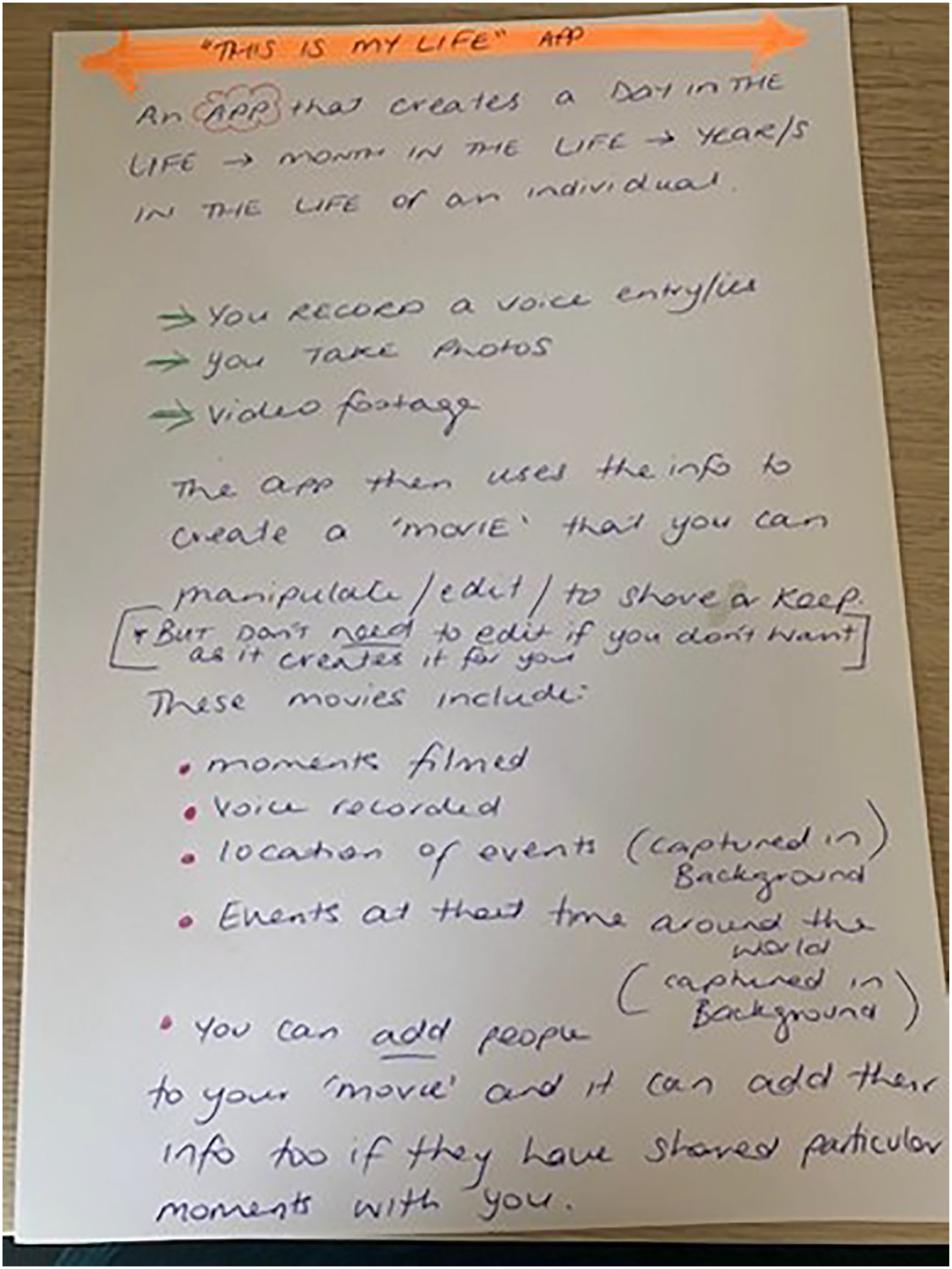
“Data Memento” activity completed by Sofia.
A level of automation is central to the app’s desirable function; Sofia writes that “you can manipulate/edit” the movie “but don’t
Faces Everywhere (Workshop 4, Eight Participants Aged 21 to 34 Years)
Imagine a near future in which smart objects and smart environments constantly scan your face using facial recognition software. What are these smart things? How would this technology make your life easier? Make your life harder?
Our previous research has found that Australians do not usually share dystopian imaginaries about contemporary technologies that may flout personal data privacy (Lupton, 2021b; Watson & Lupton, 2021). This prompt sought to provoke responses about facial recognition, a novel automated technology that has tended to be reported in dystopian terms in popular culture and the academic literature, as invading people’s privacy or lacking accuracy despite grand claims. The scenario presented involved imagining a future in which facial recognition is ubiquitous. Would our participants share these dystopian visions when imagining these futures and their implications for their own lives? What were their concerns about these technologies—and how did they imagine their potential benefits?
When the time allocated the activity was completed and Ash asked the group for their first impressions of doing the task, participants immediately referenced Black Mirror, the speculative technology TV series, before noting other similar dystopian texts including Minority Report and spy movies in general. These popular texts shaped the group’s imaginaries of how a near-future world might feel. Taylah was one group participant whose creative work demonstrated ambivalence. She was interested in dystopian representations but also imagined some significant positive social impacts of facial recognition technologies. Taylah, aged 30, lives in a metropolitan area and describes her ethnic/racial heritage as mixed. She is married with primary caring responsibilities and currently has full-time home duties while on maternity leave.
In her Faces Everywhere activity (Figure 2), while Taylah made the analogy to the dystopian future world of Black Mirror, she also imagined future facial recognition technology as allowing everyday tasks to “become faster” and be more hands-free, which could make everyday life easier for some people with disabilities. Explaining these reflections to the group, Taylah spoke about how greater speeds of identification and greater modes of access to services or activities could be opened up by such technologies, in concrete examples including ATMs and other systems that require the input of a PIN or password. She shared this “positive” part of her activity in direct response to the group’s long discussion about harms, discrimination, and policing in various forms. This example resonated with the group, many of whom enthusiastically nodded all the while Taylah was talking. From there, conversation turned to other concrete examples of devices where facial recognition could be newly embedded in ways that could both enhance human capabilities or close off agencies.
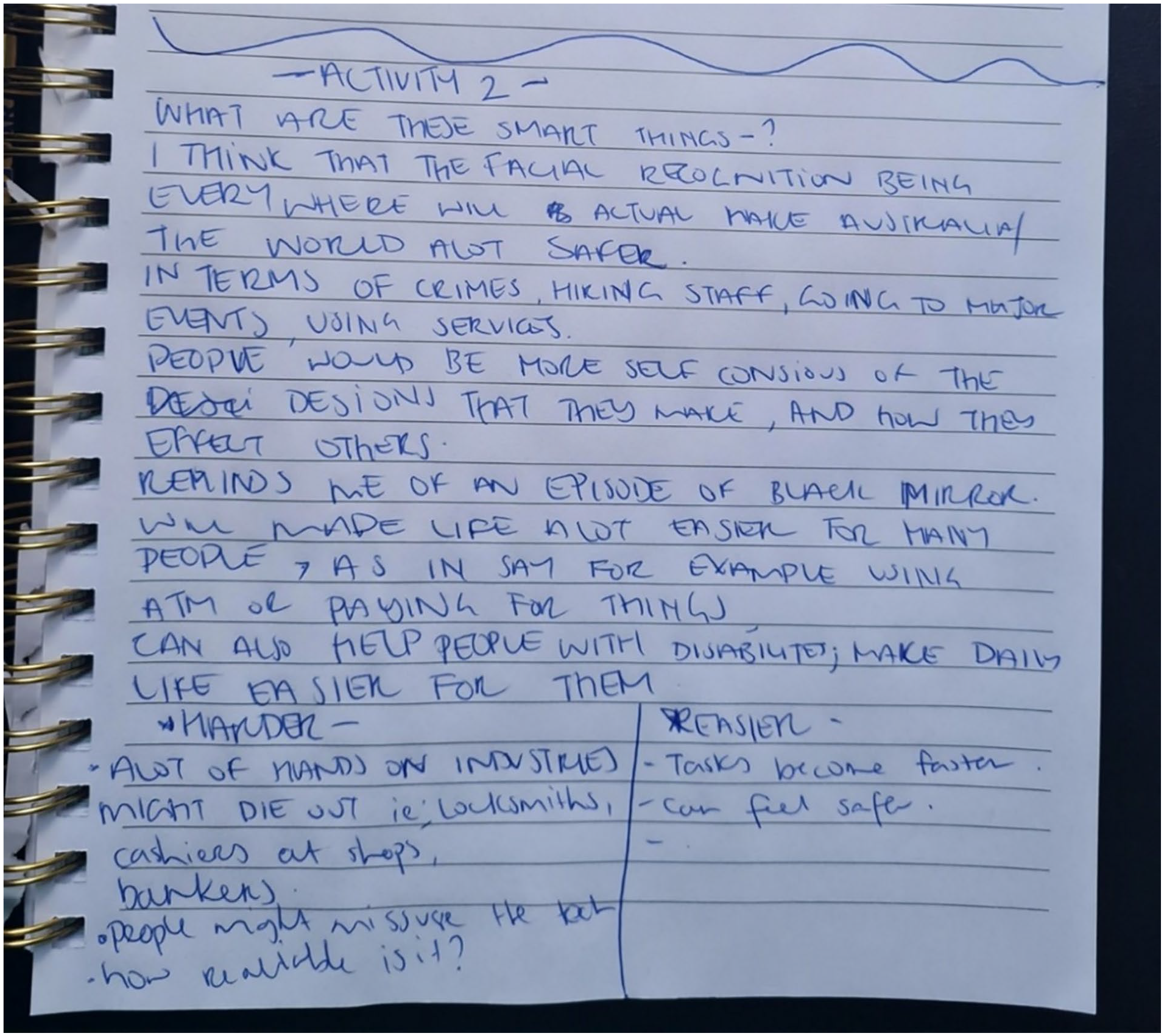
“Faces Everywhere” activity completed by Taylah.
Invent an App (Workshop 5, Eight Participants Aged 55 Years and Above)
Draw and write a description of a new app for your mobile device that could generate information about you that would be useful to you. What is it called? What is its icon? How does it work? What information does it collect and how is this information displayed to you? What will you do with this information? Will you share the information with anyone? Who else might find the app useful?
Since the first release of mobile apps in 2010, tens of thousands have been developed. Many of these languish in the app stores with few downloads or on people’s devices, little used, but a small proportion become incorporated into their users’ everyday lives: sometimes generating strong affective forces and opening capacities for action (Lupton, 2018, 2019c). In inviting participants to “invent a new app,” we wanted to invite them to speculate about what apps can potentially offer them into the future. In including further prompts about the information collected by the app, we were asking people to consider the data generation potentials of these mundane software, including possibilities for automated collection and processing of this information.
Several of the apps imagined by participants drew on automated processes to ease and quicken various annoyances they faced, such as sourcing difficult to find information or offering responsive price and ethical comparisons on everyday shopping items. Teresa was one participant whose automation extended beyond information processing to decision-making—slightly tongue-in-cheek. Teresa, aged 58, lives in a rural area. She works full-time in IT, describes her ethnic/racial heritage as white (Anglo-Celtic/European), and is married with no primary caring responsibilities. Teresa invented a sensor-based app which hyper-localized information to share “what the weather is like outside your window” (Figure 3). Teresa’s app shares the temperature, likelihood of rain, dew point, wind, plus a live view outside the user’s window from a secondary sensor component, and critically could therefore inform its user whether it was “weather to get out of bed.”
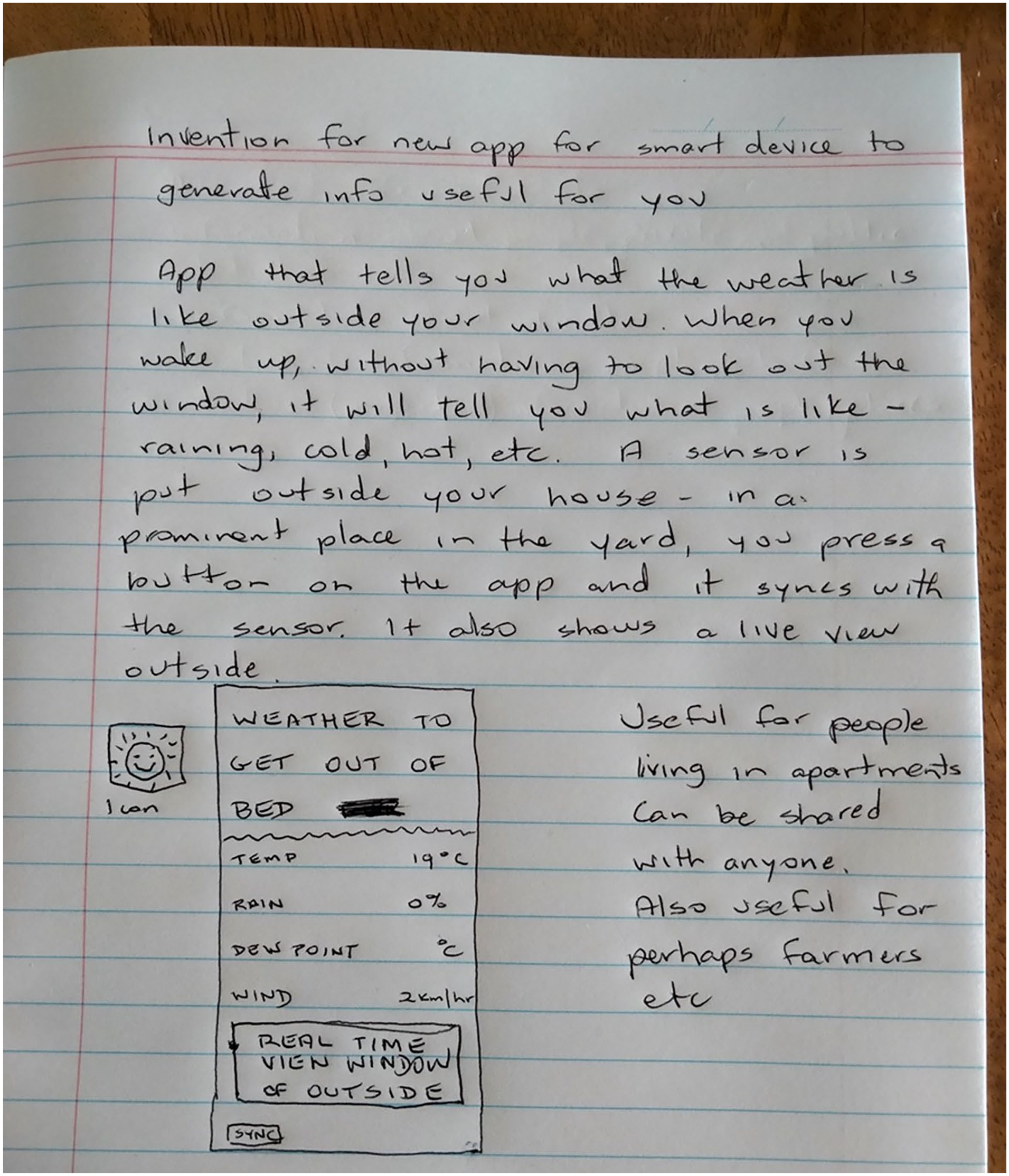
“Invent an App” activity completed by Teresa.
Teresa explained that this was an idea she had well before the workshop, that came to her particularly on winter mornings when she wanted to know what it was like outside before having to get out of her warm bed. The rest of the group found this both an amusing, relatable, and highly practical idea, nodding along in agreement as Teresa explain its further value for people who live in apartment buildings and cannot easily go outside to tell what the weather is like for themselves where they live.
Data Afterlives (Workshop 6, Seven Participants Aged 35 to 54 Years)
Write a story imagining what happens to your data after you die. What kind of data would you like to preserve for future generations to view or use? What data do you want to see destroyed or lost? What kind of life will your data persona have?
This prompt was directed at imagining (at least some) personal digital data as a valuable part of oneself: a kind of legacy about a person’s life, similar to photographs or documents such as a birth certificate. It draws on the idea of “lively data” as being about people’s lives but also possessing their own vitalities and effects (Lupton, 2019b). We were interested in what kinds of personal data people considered to be truly “personal” and reflective of their thoughts, feelings, and experiences as part of their identities. Would they imagine new digital technologies (potentially automated) for preserving information they wanted to keep—or would they speculate about other modes of preservation?
In the group discussion immediately following the activity, participants by and large raised two key kinds of data: the practically important, such as passwords for access to financial accounts or overall health records on hereditary diseases, and the sentimental, such as photographs. One participant, Mai, noted that she had never thought about this issue before the workshop, either what would “live on” after her or how someone like her partner may need to gain access to some of her personal accounts or records. Mai, aged 42, describes herself as of Asian ethnicity. She lives in a rural/remote area of New South Wales (NSW), is married and has full-time home duties and caring responsibilities.
In her “Data Afterlives” activity (Figure 4), Mai distinguished things that “used to be kept as hard copies.” These once-physical records Mai wrote down to keep mainly encompassed photographs and medical history records, similarly to other participants, and were forms she saw could “be kept privately, but not by [a] third party indefinitely.” More novel forms of digital data, such as “location history” and “online activities in general” were records she elected to have deleted. Mai’s reflective writing beneath her two lists shows how her thinking was framed through the specific wording of the speculative prompt, particularly the idea of living on or a data persona continuing to have a life. As Figure 4 shows, Mai writes she would “prefer to live in people’s memories rather than as digital data.”
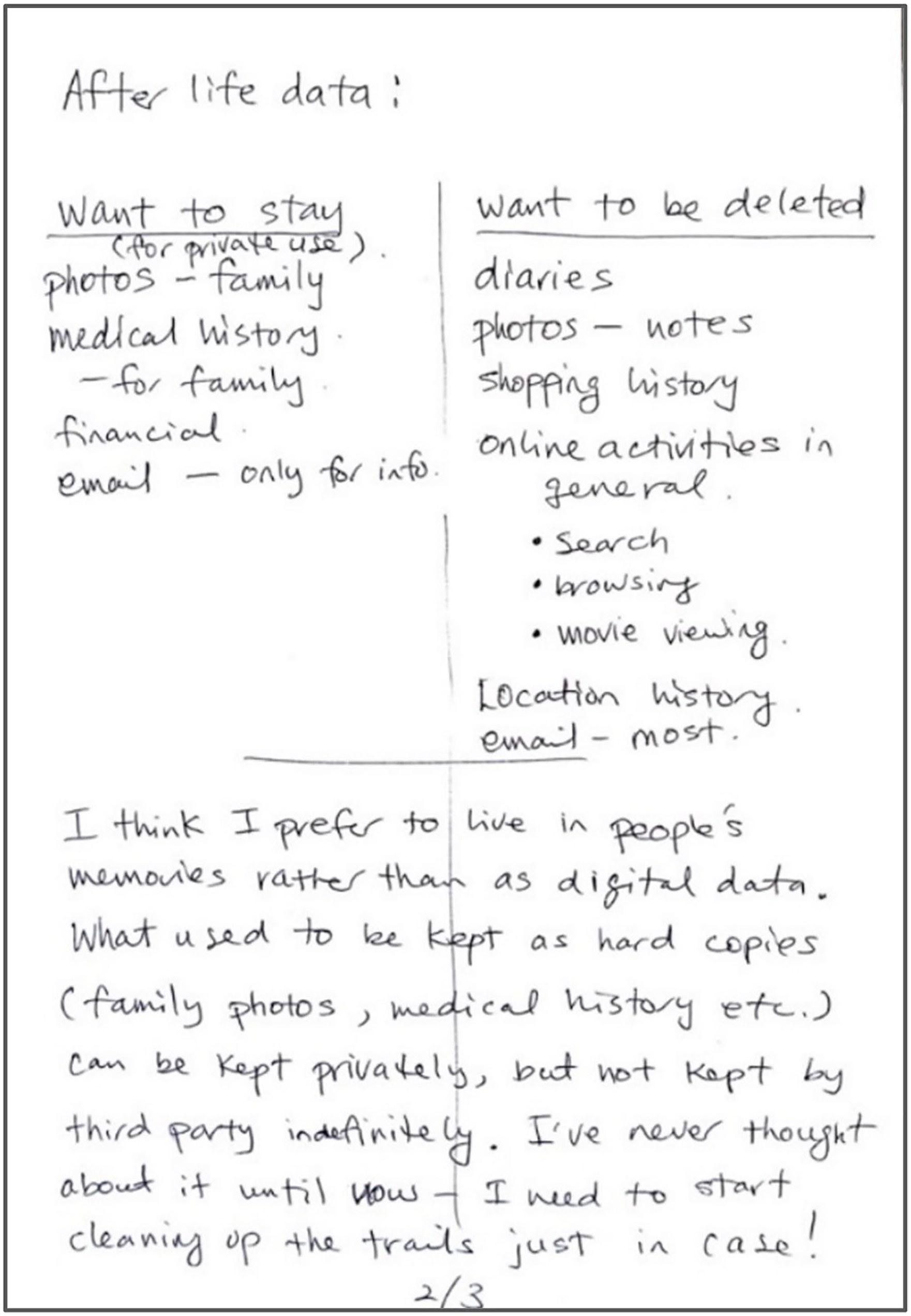
“Data Afterlives” activity completed by Mai.
Discussion and Conclusion
In designing these creative writing activities and centring them in the online workshop setting, we worked to materialize some of the many ways our participants live with, feel, and imagine personal data-generating devices. Like Coleman (2017) in her sensory sociology of the future, in using creative writing prompts, we wanted not merely to document futures imaginaries, but to probe and stimulate responses that could potentially challenge taken-for-granted narratives about the benefits or dangers of emerging technologies. We wanted to provoke our participants into thinking otherwise and developing new ideas by thinking creatively rather than simply answering interview questions. Adopting a research-creation perspective together with vital materialism theory in designing this study and analyzing the research materials generated meant that we were attuned throughout toward vibrancies and forces in our participants’ imaginaries. Thinking with the concepts drawn from vital materialism—affective forces, relational connections, and agential capacities—helped us to design this study in ways that would generate unexpected outcomes about the sensory and affective dimensions of speculative futures.
In working both individually and together on imagining and discussing the futures of digital technologies involving the collection and generation of their personal information, our participants were able to collectively build research-creations that similarly challenged black-and-white thinking. These online workshops contributed to our previous studies on living with and through digital devices and data by making tangible the often-abstracted futures participants project from their own experiences and by locating such speculations in the everyday. Our participants’ research-creations and conversations surfaced a rich range of subtleties across the affective forces, relational connections, and agential capacities that bound together their imagined futures.
As we have found in previous research using arts or design-based methods (e.g., Lupton, 2020, 2021b; Lupton & Michael, 2017; Watson & Lupton, 2021), the futures imaginaries expressed by our participants demonstrated a complicated and ambivalent affective relationship with emerging digital technologies. They also portrayed tangible dimensions of the digital–physical continuum, creatively moving beyond a binary framing of the real versus the virtual or the human versus the technological. As such, through the sensory and affective elements of their responses, we can attune to not only what our participants speculate about automated futures but also how they feel and feel about these imaginaries.
Participants’ research-creations from the “Data Afterlives” workshop directly considered the digital shift of record keeping. Affective forces and relational connections were evident in how the group talked over and imagined their personal information as having—or needing—a future life, which could involve a more physical materialization beyond the digital. The trace of the paper document physically filed away for safe keeping was a key marker of meaning, and then a reference point for identifying other linked kinds of important data, such as a bank account password (Lupton, 2020 had similar findings). As discussed earlier, in Mai’s reflections, she distinguished documents that “used to be kept as hard copies.” Rather than physical records being marked as distinct from all digital data, we see here an historic physicality permeating the digital future and bringing a multisensory dimension to this speculative sense-making exercise.
Research-creations from the “Data Mementos” and the “Data Afterlives” activities also centered the vital relational connections between tangibility, temporality, and affect in their engagements with memory. First, in a more literal sense, in participants’ activities and conversations memories were not positioned as elicited by various artifacts; rather, memories were photographs, video recordings, written messages, and diary entries. Furthermore, across both of these workshops, participants imagined future memories in affective and relational ways. Memories were portrayed as phenomena that could be passed on between family members, things that could be held by someone, and something that could be left behind by someone before they died. Here again, we see future personal data imagined as sensory and lively (Lupton, 2019b), as “living on” and as meaningful through the way in which a tangible sense of feeling colors and augments virtual “things,” like an image on a screen.
Through the “Invent an App” and “Faces Everywhere” prompts, we can also see how they worked to locate participant’s future imaginaries in the relational, sensory, and affective dimensions of the everyday: as “Little Futures” (Michael, 2017). Teresa’s “weather to get out of bed” app imagined an assemblage of sensor hardware and smartphone-based software to craft a future urban scenario. In her app, data collection, analysis, and personalization encircle to the domestic mundane. Rather than drawing on common dystopian tropes of the cold and indifferent night-time cityscape, Teresa localized a technological future in a routine yet essential daily decision, and in warm bedsheets and the promise of winter sunshine.
In the “Faces Everywhere” workshop, participants similarly focused their research-creations on smaller everyday moments, including trying to use an ATM or make a payment at a store. Rather than over-simplifying a complex series of possibilities into an imaginative cul-de-sac, through collaborative speculation our participants moved from the vague specter of surveillance to imagining emplaced assemblages operating with and through data-driven decision-making. Across the participants’ created artifacts and conversations discussed earlier, we read processes of automation as ease, as speed, and as something that is situated and material rather than abstract and digitally ethereal. We also read these future imaginaries “back” to further excavate how participants’ come to “data sense” (Lupton, 2019a, 2019b) in their current lives—where they do and do not feel the presence of such processes in their technological entanglements, and where these data do and do not yet have meaning.
Understanding how publics make sense of and anticipate futures can tell social researchers much about their experiences and feelings in the present day. It can also work toward a position on futures that recognizes that they are dynamic and amenable to change rather than fixed and inevitable. Such research, therefore, can contribute to better futures by emphasizing that things can be otherwise. The words and drawings used by our participants to respond to our prompts are themselves vibrant materializations of thought and feeling. They are inevitably partial and situated, of the moment, created with and through us as the researchers and the other workshop participants as we worked together to configure ideas and feelings about the future of automated technologies.
The affective, temporal, and relational elements of participants’ research-creations reveal the varied ways in which they feel emerging technologies such as AI and ADM in their personal devices through degrees of presence and absence. Like other modes of qualitative inquiry inspired by vital materialism and engaging with research-creations, our further analysis of our research materials will seek to go beyond signification to sociomaterialities. Especially for the development of a sociology of futures, this approach explores not only what participants know about the functions of specific data-generating and automated technologies but also how participants come to sense, feel, and live with sociotechnical imaginaries.
Footnotes
Declaration of Conflicting Interests
The author(s) declared no potential conflicts of interest with respect to the research, authorship, and/or publication of this article.
Funding
The author(s) received no financial support for the research, authorship, and/or publication of this article.
