



Abstract
In this article, I trace landscapes of decolonial inquiry centered on two questions: What is the work of decolonial inquiry? What are the imperatives of researchers committed to decolonial work? I engage with these questions from my relationally rooted place in solidarity with communities at the frontline of decolonial struggles in Northeast India. Adopting a multimodal counterstorytelling approach, I narrate two imperatives of decolonial inquiry: rooting and remembrance and theorizing from struggle, driven by an ethos of desire and refusal. Across these endeavors, I strive to reimagine a radical politics of belonging that transgresses colonially configured nation state borders.
As a South Asian woman with deep roots in the Northeastern borderlands of India, both coloniality and decolonial desires are imprinted on my body and the legacies I am a part of. Coloniality fuels the politics of identity and belonging in Northeast India that relegates so many of our communities to perpetual alterity (see Dutta, 2015). The shackles of coloniality and state violence are embedded in the histories of partition/nation-making and nation state borders that surveil our everyday existence in South Asia (e.g., Dutta, Azad, & Hussain, 2022; Murshid, 2016). Therefore, decoloniality is not solely an intellectual or disciplinary project. It is necessarily political and deeply personal: it is about transforming the conditions, parameters, and imaginaries of what it means to be human—guided by Global South peoples’ onto-epistemologies and struggles (Atallah & Dutta, 2022; Daigle & Ramírez, 2019). Decoloniality is meaningful only in praxis tethered to concrete struggles for justice and liberation (Dutta, 2022). In this article, I am not interested in adjudicating what constitutes the academic terrain of decoloniality. If the term decoloniality is appropriated and disciplined—as we see it already happening—another term will take its place; it is the praxis, the struggles, and the resistance, that matter. Those are the things I strive to engage with in this article as I grapple with the questions 1 : What is the work of decolonial inquiry and what are the imperatives of researchers committed to doing decolonial work?
I engage with these questions from my relationally rooted place in the Global South—in solidarity with communities at the frontline of struggles for justice in the Northeastern borderlands of India. I trace some of the trials and tribulations around the politics of belonging in Northeast India. Belonging is not just a psychological sense of safety or attachment to place, but an entire gamut of politics that include: our social locations (historical, social, political, economic) and relative proximities to power; our affective histories and attachments to place and people; and the ethical and political values/norms/parameters that are used to adjudicate whether or to what extent one belongs (Yuval-Davis, 2006). In contending with the aforementioned questions, I am deeply influenced by the labors (intellectual, political, creative, and emotional) and contributions of fierce feminist activists from around the world, who have shaped my praxis (e.g., Ahmed, 2006, 2012; hooks, 2001; Kerketta, 2016; Lugones, 2014; Smith, 2012; Toppo, 2001; Tuck, 2009). I adopt a counterstorytelling praxis in this article. Counterstorytelling is a method of telling the stories of people whose experiences are distorted or erased by dominant stories and modes of storytelling (Solórzano & Yosso, 2002). Counstorytelling is not limited to countering dominant/majoritarian stories but is as much about articulating experiences and traditions of subaltern struggles, resistance, and survivance (Ikemoto, 1997; Vizenor, 2008). Anchored in collective counterstorytelling praxis, I offer two critical imperatives of decolonial inquiry: rooting and remembrance and theorizing from struggle—infused by an ethos of desire and refusal. Resisting disciplinary and methodological domestication in this article, I seek to evoke a multimodal and multisensory counterstorytelling experience using poetry along with artwork, and photographs inspired by struggles and everyday resistance in my homescapes. Across these endeavors, we strive to reimagine a radical politics of belonging that transgresses colonially configured nation state borders.
Rooting and Remembrance
Decoloniality is a project of unerasing histories and onto-epistemologies from colonial erasures and sub-human invisibility. Therefore, a fundamental imperative in decolonial work is to attend to roots and remembrance (Image 1). This raises onto-epistemological questions such as What is the presumed ground of our existence? What is the ground that we speak from? How does the world as we encounter it, become legible to us? How do we become (un)intelligible to others? The ground that I speak of is not institutional or disciplinary. In decolonial work, we move to a different site of remembrance that queers normative orders of tracing legacies against the uneven terrain of colonial difference. This movement is shaped by a deep and visceral consciousness of the harms caused by sanctioned knowledges. I write and speak as my foremothers’ wildest dream—grandmothers from whom I inherited a profound sense of registering the everyday, the seemingly ordinary (Image 2). History, as I learned from them is located in the interstitial gaps, the unheard, the unthought, the unspoken—brought to life by the stories we craft and tell. It is from my foremothers that I inherited a decolonial imaginary, a way of storytelling that opens up possibilities and agentive spaces for those on the margins (see Atallah & Dutta, 2022).

The language of the earth is the same everywhere (these images capture some possibilities of roots and [up]rooting from my homescapes in Garo Hills, Northeast India).
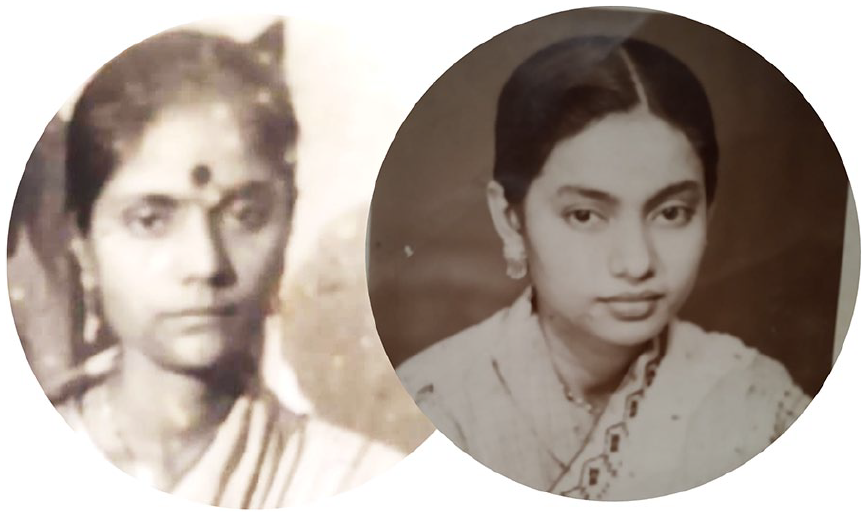
My foremothers, Anita (L) and Kanak (R).
Roots and rooting as an onto-epistemological stance are vital to decolonial praxis. Rooting embodies a particular way of being—one that nurtures rather than occupying or staking claims on. Rootedness is radical relationship to land/water/earth and relationship with/to each other. Rootedness is not beholden to institutional affiliation or colonially configured citizenship status. For people uprooted and displaced by colonialism and coloniality, rooting is a way of moving away from relationships bound by immutable origin stories that establish deterministic links between people and place. The limiting and at times oppressive nature of origin stories infused with coloniality—especially those that construe stringent ideas of “original inhabitants”—are woven into my lived experience growing up in Garo Hills in the Northeastern borderlands of India. It is not so much about specific origin stories per se as much as it is about the ways in which we have come to rely on those to adjudicate who belongs to a place, who is an “authentic citizen” of that place.
One of my earliest encounters with the question of belonging dates back to fifth grade. Sengberth, 2 a Garo tribal boy in my class called me “Bangal.” In common parlance, Bangal refers to Bengalis in India whose ancestral legacies are traced to present Bangladesh (formerly East Bengal during British colonial rule and then East Pakistan). However, in Garo Hills, the term Bangal is deployed as an ethnoracial slur (for more detailed analysis, see Dutta, 2015). It carries with it a connotation of being the outsider, one whose presence is not legitimate. Sengberth called me “a refugee from Bangladesh,” pointing out that I do not belong in Garo Hills. I still have a visceral memory of the wound inflicted by being called Bangal. It denigrated my ancestral legacies, but even more so, it rendered me an outsider in the place that I called home. Years later, that memory was evoked again during my doctoral dissertation work tracing the ebbs and flows of everyday violence in Garo Hills. In the course this work, I interviewed a Bengali youth who offered a vivid articulation of what it means to be called Bangal in Garo Hills: “When this word reaches your ears, it shuts your mouth. There is no opportunity to say anything. Automatically. No one can say anything after that.” (Dutta, 2015). I felt all this that hot summer afternoon when Sengberth called me Bangal. But I felt compelled to defy the imposed silence with a retort, albeit half-heartedly: Who do you think you are? Without a moment’s hesitation, he responded—“a refugee from Tibet or Mongolia.” Although I was taken aback by his response, as a 10-year-old, I did not know how to make sense of the exchange. Now I understand it as the tyranny of relying on origin stories that reduce belonging to a static, essentialized, immutable relationship between people and place; stories that relegate us to perpetual alterity such that we cannot quite belong anywhere. These ways of adjudicating belonging do not account for mass migrations (starting from precolonial times) and forced displacements, including those wrought by British colonial practices of population transfers, violent partitions, settler colonial state violence, and climate change in Northeast India (Chatterjee, 2013; Dutta, 2015, 2017; Kabeer, 2005).
Against this backdrop, I found my way into decolonial praxis as a way of both rooting—via nourishing relationships to/across people, land, and histories—and uprooting colonial narratives and the politics of belonging that render me an outsider. Rooting is an antidote to a core feature of whiteness—what Sullivan (2006) calls ontological expansiveness. She argues, “As ontologically expansive, white people tend to act and think as if all spaces—whether geographical, psychical, linguistic, economic, or otherwise—are or should be available to them to move in and out as they wish” (Sullivan, 2006, p. 10). Rooting—as relationship to place—is a decolonial counterpractice to ontological expansiveness.
I see rooting is a way of coming into shared place through stories—where shared does not imply sameness. Rather, shared is the dynamic realm of navigating meanings and contending with historical complexities that have differential impact on us based on our proximities to hegemonic power (Dutta, Azad, & Hussain, 2022). In rooting, we move toward and illuminate different sites of remembrance that are otherwise obfuscated by forces of coloniality, imperialism, and heteropatriarchy. I speak, write, and work from my radically rooted place in community in Northeast India where I was born and raised. For so many communities in Northeast India, the right to belong is obliterated by colonial cartographies and classifications, by state violence, Hindu Brahmanical supremacy, and neoliberal capitalism (see Bora, 2010; Dutta, 2015; Kikon, 2009). I am rooted in a place of radical love and solidarity with Miya people’s struggles in Northeast India (see Atallah et al., 2022). Miya people in the Northeast Indian border state of Assam are facing mass disenfranchisement, detention, and statelessness (Azad, 2022). In 2019, almost 2 million people were disenfranchised through the National Register of Citizens (NRC). Persecution of Miya people traces back to colonial population transfers or forced displacements. The NRC itself has colonial origins—established by British colonial administration to “detect and deport” so called foreigners. Here, the question of who an “authentic” citizen vs. “outsider/migrant” remains entangled in the morass created by colonial cartographies, ethnoracial classifications and their iterations by the postcolonial India state.
These tangled questions of border, citizenship, and belonging are also at the core of state sponsored efforts to disenfranchise Miya people and render them stateless. There is a collective and deliberate amnesia around the circumstances of Miya people’s migration to Assam, namely, that this was forced displacement; the British colonial administration moved an entire population (as they were wont to doing) for purposes of agricultural labor. This colonial population transfer took place decades before partition or demarcation of nation state boundaries. As Fazirun Nessa, a Miya elder reminds us, “When we came here, there was no border.” Over the years, nationalist and xenophobic forces have erased these histories to create a powerful public discourse that positions Miya people as pernicious outsiders or “illegal migrants” (Azad, 2022). The entanglements of coloniality, sub-nationalism, citizenship, and border regimes have established a tiered structure of citizenship and belonging.
3
It is not only a tiered structure of citizenship that is established but also a tiered structure of humanity; a structure that locates Miya people outside its scope of humanity. In other words, the idea of who is human is now tied to questions of political and cultural citizenship. Miya poet and feminist scholar Rehna Sultana offers an evocative expression (and a painful plea) of Miya people’s struggles of being denied both citizenship and humanity in her 2016 poem entitled, Our Mother
4
(trans. Shalim M. Hussain): I was dropped on your lap my mother Just as my father, grandfather, great-grandfather And yet you detest me, my mother, For who I am. Yes, I was dropped on your lap as a cursed Miyah, my mother. You can’t trust me Because I have somehow grown this beard. Somehow slipped into a lungi
5
I am tired, tired of introducing myself To you. I bear all your insults and still shout, Mother! I am yours! Sometimes I wonder What did I gain by falling in your lap? I have no identity, no language I have lost myself, lost everything That could define me And yet I hold you close I try to melt into you I need nothing, my mother. Just a spot at your feet. Open your eyes once mother Open your lips Tell these sons of the earth That we are all bothers. And yet I tell you again I am just another child I am not a “Miyah cunt” Not a “Bangladeshi” Miyah I am, A Miyah. I can’t string words through poetry Can’t sing my pain in verse This prayer, this is all I have.
Against a colossal scale of dehumanization and violence, Miya people have mobilized themselves to resist multiple vectors of injustice, to reclaim their Miya identities from the dredges of othering, and to fight for their dignity, for their very right to exist (see Dutta, Azad, Mullah et al., 2022). These active spaces of struggle constitute the roots of our praxis and the grounds of our theorizing, as I elucidate in the next section.
Theorizing From Struggle
Theorizing from struggle or as Cherrie Moraga (2015) calls it— theory in the flesh—is for me, the work of decolonial inquiry. Shaped by people’s movements, struggle has a particular meaning in the context of this paper. As Maori scholar Linda Tuhiwai Smith explains (Smith, 2012, p. 199): ln its broader sense struggle is simply what life feels like when people are trying to survive in the margins, to seek freedom and better conditions, to seek social justice. Struggle is a tool of both social activism and theory. It is a tool that has the potential to enable oppressed groups to embrace and mobilize agency, and to turn the consciousness of injustice into strategies for change. Struggle can be mobilized as resistance and as transformation.
As someone who was born and raised in the Northeastern borderlands of India, I have an intimate knowledge of the struggles around belonging where coloniality has severed the links between people and place; that has stunted our capacities to imagine ways of being and belonging outside of colonial registers of difference and dehumanization. It is why as 10-year-olds, we acted upon our inherited legacies of othering and being the other that relegated both my classmate and me to a state of nonbelonging. It is a stunted imaginary of what it means to form community, to belong, that relegate Miya people to perpetual alterity (Image 3).

Everyday struggle in the chars (Riverine Islands).
As we come together in struggle (or in solidarity with struggles), we negotiate the vicissitudes of justice and resistance in everyday life on the margins of nation states and national/global imaginaries. Through these negotiations, we come to understand the world in a different way. We re-story our ways of being, relating, and understanding in ways that trouble the canons and compel us to question hegemonic knowledges, social arrangements/hierarchies, and modes of relating. At the heart of our theorizing from struggle is counterstorytelling against the epistemic violence that enshrines material, cultural, and psychosocial domination in our homescapes in Northeast India. This kind of theorizing in the flesh is a social necessity; it is imperative to our very survival as we rewrite the very conditions of our existence and (re)humanization following the arc of justice.
Counterstorytelling occupies a central place in Miya community struggles for justice. Defying pervasive endeavors by both state and civil society to erasure and distort their personhood, Miya people rewrite their histories from their lived experiences of struggle; they theorize contemporary structural and cultural violence perpetrated against them and articulate critical analyses that are excluded from dominant narratives. For example, using oral histories (e.g., https://www.facebook.com/angokhabarassam/videos/478099476544020) and poetry, they trouble dominant stories of migration and belonging that categorize Miya people as “illegal migrants” or outsiders. This is powerfully illustrated in the following excerpts from Miya poet Khabir Ahmed’s 1985 poem, I Beg to State That
6
(trans. Shalim M. Hussain): I have many things to say Stories older than Assam’s folktales Stories older than the blood Flowing through your veins And yet you talk of the river The river is Assam’s mother, you say You talk of trees Assam is the land of blue hills, you say My spine is tough, steadfast as the trees The shade of the trees my address . . . You talk of farmers, workers Assam is the land of rice and labour, you say I bow before paddy, I bow before sweat For I am a farmer’s boy . . . Sometime in the last century I lost My address in the storms of the Padma A merchant’s boat found me drifting and dropped me here Since then I have held close to my heart this land, this earth And began a new journey of discovery From Sadiya to Dhubri . . . Since that day I have flattened the red hills Chopped forests into cities, rolled earth into bricks From bricks built monuments Laid stones on the earth, burnt my body black with peat Swam rivers, stood on the bank And dammed floods Irrigated crops with my blood and sweat And with the plough of my fathers, etched on the earth A . . . S . . . S . . . A . . . M Even I waited for freedom Built a nest in the river reeds Sang songs in Bhatiyali When the Father came visiting, I listened to the music of the Luit In the evening stood by the Kolong, the Kopili And saw on their banks gold.
Miya poetry and oral histories elevate stories of deeply embodied relationships to the land; they refuse the seeming intractability of binary categories such as migrant/outsider vs. indigenous/authentic/original inhabitants. In such retelling and rewriting of place as affective, lived, and negotiated in struggle, oral histories and Miya poetry reveal possibilities for radically inclusive, nonexploitative, and nonessentialized forms of belonging (see also https://www.asymptotejournal.com/special-feature/siraj-khan-my-son-has-learnt-to-cuss-like-the-city/). Together, Miya people step into their power as storytellers—drawing upon everyday experiences to craft stories that name oppressive practices, acknowledge the scope and depth of suffering, and uplift joy, creativity, and desire (Dutta et al., in press; Image 4). In the process, stories become critical sources of theory and praxis about belonging.
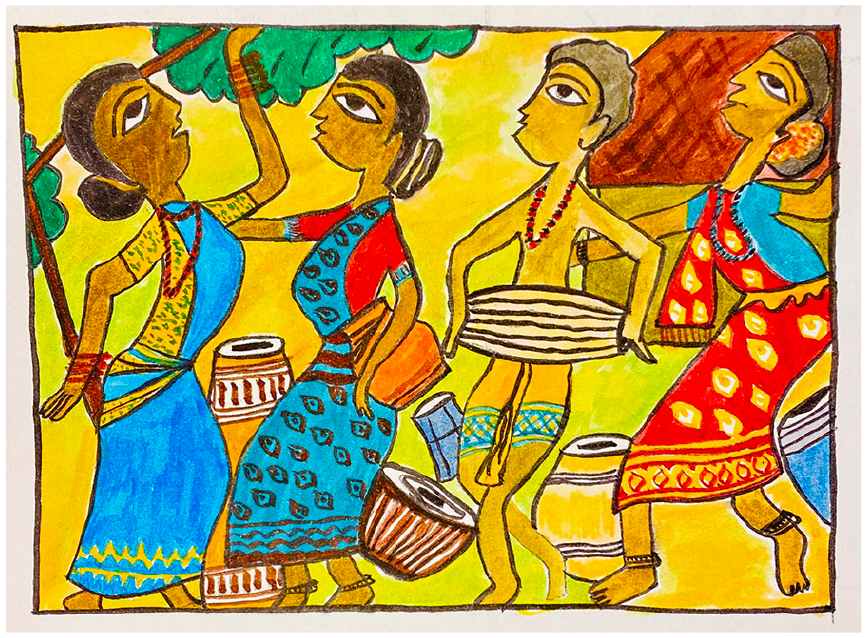
Unrestrained, in community.
Honoring these community traditions, we have created the Miya Community Research Collective (MCRC) to build an assemblage that elevates Miya peoples’ stories and brings those into the public arena to be acknowledged, witnessed, and historicized (www.MiyaCommunityResearchCollective.org). Our work together defies traditional university-community collaboration but is one of political solidarity and radical relationality that are contingent on and produced through struggle. Our work together is based on political intimacy, that Erakat (2020, p. 479) describes as follows: “the visceral knowledge that the relationship exceeds political conditions and is the source of survival in the plural “we.” This intimacy transforms acts of witness into recognition ultimately culminating in the identification with the other’s experience as their own.” This political intimacy as a form of solidarity is not predicated on identity politics, but on witnessing, recognition, and struggle. This is especially meaningful in Northeast India where colonial and neo-colonial schemes of classification/categorization have created fault lines that have eroded and severed complex linkages between people, and between people and place. We see our collective’s work as transgressive, and as transformative—tilling the soil and sowing seeds, building communities of resistance; communities who not only resist the onslaught of colonial and state violence but also co-cultivate imaginaries of belonging that are not adjudicated by colonially configured categories and nation state borders.
Honoring Miya people as knowledge producers, we understand the MCRC’s work as a (re)humanizing project. Centering Miya people’s lived struggles, we interrogate how contemporary and historical citizenship regimes operate as state sanctioned violence; we name the systematic assaults by media and scholarly productions that dehumanize Miya people and legitimize the persecution against them. We seek to understand intergenerational trauma and work toward psychosocial healing in ways that disrupts individualized, neoliberal capitalist notions of self-care. We center Miya people’s struggles as critical sites of knowledge about and resistance against material and epistemic violence as. In these endeavors, communal storytelling is our mainstay. When we talk about stories and storytelling, it is not just orality that matters; aurality—that is, listening/hearing matters just as much (Khatun, 2019). The process of listening together liberates, makes, and remakes stories. Some stories have been years in the making—ripe and ready to be told. Yet other stories begin as an unexpressed feeling, an idea or an experience and transform into powerful narratives in collective tellings and retellings. Yet other stories are birthed in contradictions—fomenting and percolating, still gathering form. Thus, our theorizing is never complete or foreclosed. It is always open to possibilities of being, becoming, and belonging that are ever-expanding and infinite.
A Praxis of Desire and Refusal
Rooting and remembrance as well as theorizing from struggle are deeply rooted in an ethos of desire. An orientation toward desire—as Indigenous feminist scholar Tuck (2009, p. 417) describes—is “longing about a present that is enriched by both the past and the future; it is integral to our humanness. It is not only the painful elements of social and psychic realities but also the textured acumen and hope.” It is desire that animates Miya people’s struggles and our work together toward nonoppressive futures—toward radical dreaming of that which we may not be able to imagine in the present (Dutta, Azad & Hussain, 2022). Desire is a framework for enacting refusal, where we depathologize representations of people on the margins, so that they are seen as more than expendable, disenfranchised, or dispossessed. Embracing desire is about saying NO to research that that co-produces oppressive power arrangements of coloniality, imperialism, and heteropatriarchy (Simpson, 2007). Desire is about a concerted repudiation of research that views Global South peoples through a monochromatic lens, reducing their complex personhoods to their victimhood and suffering (Atallah et al., 2022; Cifor et al., 2019; Tuck, 2009). Refusal, as Tuck and Yang (2014) have argued, is not about traditional objects of research becoming subjects in the academy, but to object to very processes of knowledge claims via reified representation and downward theorizing of colonized and subaltern peoples. Thus, decoloniality is not about bringing marginalized voices to the table; these metaphorical tables—their orientation, terms of inclusion, of whose presence is sanctioned, of what constitutes permissible speech are all set by the those already at the table (Ahmed, 2006). The decolonial imperative is to do away with the table altogether!
Along these lines, our work as the Miya Community Research Collective is about studying to object. I offer here a poem by Miya poet Shalim M. Hussain, entitled Eat Your Inverted Commas, which objects to the kind of hegemonic knowledge production that imprisons marginalized groups in limited parameters of (un)intelligibility: You cursed me with inverted commas. This is what I call myself —Midas This is what you made me—‘Midas’ These inverted commas, these donkey ears: You planted them on my head And praised your own large heart I tear your donkey ears And fling them at your feet Roast them with salt, ginger, garlic, paprika, cumin Or ask me for a better recipe. Eat your donkey ears, my lords Eat your inverted commas.
An ethic of objection is about sustained questioning of coloniality as it manifests in geopolitical and epistemic power arrangements. It is about turning the gaze on to power, rejecting hierarchies of knowledge, methods, and evidence, naming silences, exposing logics weaponized against colonized peoples, (re)claiming the power to narrate our stories. It is about fracturing spaces where colonial difference has come to be crystallized as self-evident truths.
For us in the Miya Community Research Collective, one of the most powerful expressions of refusal is an open letter by Miya community workers Abdul Kalam Azad, Manjuwara Mullah, Kazi Sharowar Hussain, and Wahida Parveez written to researchers who seek to collaborate with them. Many stories, lived experiences, and iterative processes of storytelling, documentation, translation, and reflections coalesced into this letter. In (re)telling these stories in our collective space, in listening and holding together, we were able to birth this letter and offer it as an unequivocal articulation of the terms of any research collaboration—mandating that Miya people’s struggle and resistance ought to be at the front and center of any work (for the full letter, see https://www.miyacommunityresearchcollective.org/about): If you want to get together with us, with our people, with community workers, it cannot be project-based. It must not be the kind of work that ends with the funding cycle. For us, there are no deadlines or end points; this is our full-time work, our life’s work. The scale of our persecution is immense. The state and many factions of civil society are aggressive in their agenda to dehumanize us, harass us, disenfranchise us, and incarcerate us in detention centers. To collaborate with us, you must be prepared to work with people in active struggle. This work will yield little material benefit and you must be prepared to be courageous and share the risks. Researchers often come from different worlds, fortified by their professional tools and theoretical vocabulary. They use these tools to explain what we are going through. When people come to do research in the chars,
7
the assumption is that we do not have the language or vocabulary to articulate our experiences—that someone else needs to tell our stories. They impose their own jargon and sophisticated vocabulary on our experiences and how we understand it. Say you are a researcher, and you must present your findings to your funding agency. Do you really need to describe flooded huts as “swimming pools?” Or describe flood waters as “oceans” if you are a little sensitive? When you come in to conduct assessments in the wake of disasters, how do you quantify the suffering of families huddled in desperation as flood waters rise? We do not need our experiences to be rendered intelligible through your armature of definitions, scales, and criteria or via metaphors that are not our own. We too can speak. We are good enough. As researchers and journalists, honor our vocabulary, our metaphors, and our silences. We are always open to collaborations, to the possibility of our stories, experiences, and struggles being amplified, however incremental or marginal. We are not saying that you should not or cannot tell our stories, but if you do tell our stories, tell those with dignity; tell our stories as an act of solidarity. (Image 5; Emphasis added)
This is decolonial theory in the flesh! It is counterstorytelling from struggle. As is evident from the open letter, refusal and desire go hand in hand in decolonial praxis. Refusal is disrupting patterns where some people are perpetually onlookers while others are always gazed upon. Refusal is saying NO to theorizing on the backs of those in struggle without committing to the fullness of their lives (Tuck & Yang, 2014). Refusal is generative; as we have written elsewhere (Atallah & Dutta, 2022, p. 436): [Refusal] is “using imagination, love, and vision to articulate and dream possibilities. It is re-grounding ourselves in a present not only marked by the past, but also by the imminence of that which is still unsaid, unthought, unlived. It is desire and longing and action. It is (re)mapping, (re)making, weaving together and traversing a landscape of decolonial praxis that is rooted—not in disciplines but in lived experiences and inherited legacies of struggle and survival.
With refusal and desire, we rewrite and reclaim the terms of what it means to be human—elevating stories, experiences, aspirations that are complex, textured, and most importantly, irreducible in their multiplicity.
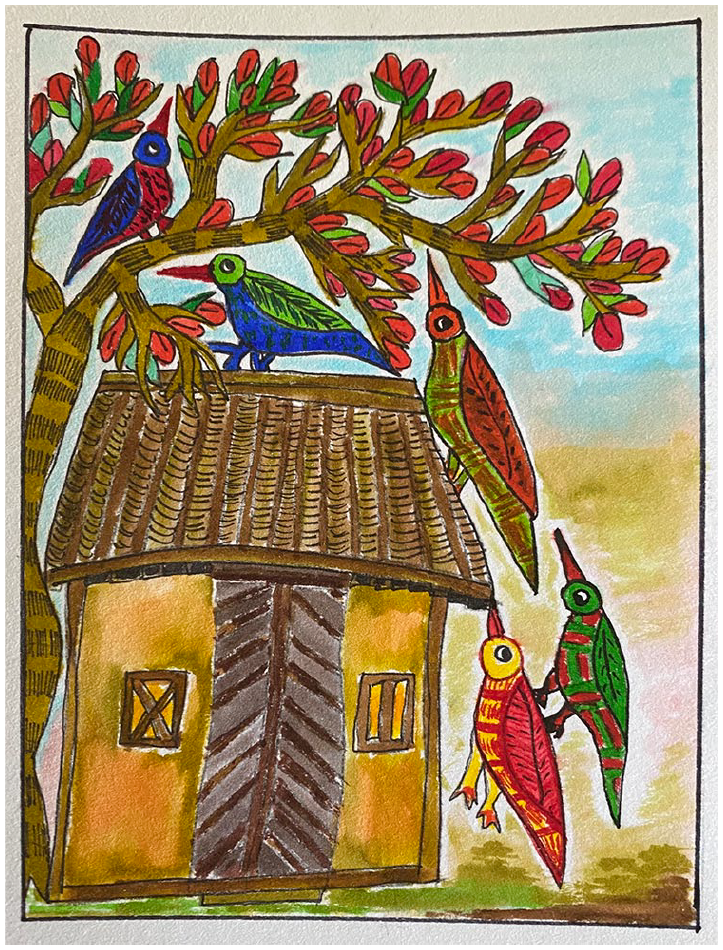
Tell our stories as an act of solidarity.
Desire, refusal, radical love—all coalesce in a specific mode of theorizing in the flesh in our work– in resistance and insurgent poetry. Miya poetry is an important mode of resistance and bearing witness—what Miya poet Shalim M. Hussain calls a roll call of the history of violence (Dutta, Azad, & Hussain, 2022). Miya poetry speaks to the myriad ebbs and flows of injustice. They speak in defiance of identity categories that truncate their personhood. Infused with a radical humanizing politic, Miya poets write actively against assimilation and colonially configured borders as criteria of being human.
8
They speak back to the wider society that deploys the term Miya as a slur; they speak back to public intellectuals who are indifferent to their persecution, who weaponize liberal progressive discourses to undermine their struggles (see Dutta, Azad, & Hussain, 2022). Here I share a poem by Miya poet, Kazi Sharowar Hussain (trans. Shalim M. Hussain), entitled, That land is mine, I am not of that land: The land that makes my father an alien That kills my brother with bullets My sister with gang-rape The land where my mother stokes in heart live burning coals That land is mine I am not of that land The land where my claim over a lungi is suspect Where there are no ears for cries Where demanding rights throws you under the plummeting fists of ghosts The land which demands eternal servitude That land is mine I am not of that land The land where a cap is radicalism A miyah sub-human Every charuwa a Bangladeshi Where earth is weighed and sold to Tatas, Birlas and Ambanis That land is mine I am not of that land The land where limb after limb is chopped and sent afloat the river Where in 83, the executionaries dance a shameless Grisly dance of celebration That land is mine I am not of that land The land where my home and hearth is uprooted Where my heritage is negated Where they conspire to bind me forever in darkness Where they pour gravel, not gruel on my plate That land is mine I am not of that land The land where my throat cracks with appeals and no one hears Where my blood flows cheap and no one pays Where they politics with my son’s coffin And cards with my daughter’s honour The land where I wander crazy, confused as a beast That land is mine I am not of that land
Miya poetry is protest, and it is also a powerful expression of desire and imagination that span many facets of Miya people’s lives and ecosystems. Revolutionary Miya poetry is a life force, as Miya people reclaim their personhoods from perpetual alterity. Miya community worker Wahida Parveez describes what this means (Dutta, Azad, Mullah et al., 2022, p. 363): In Miya poetry, I see glimpses of my home; I see the trees and flowers in and around my home, I see the foliage, animals grazing. In some poems, I see my parent’s childhood, I see rivers, I see the char, and I see our people’s culture—our clothes, food, what we celebrate. I was indescribably drawn to Miya poetry. It was as if this was the one thing lacking in my life and now I have it. That is how I feel about Miya poetry.
For Wahida and many others, Miya poetry is an affirmation of Miya humanity and life worlds. Miya poetry evokes a collective, radical love that resists and repudiates dominant narratives that turn Miya people and ways of being into objects of hate (Azad, 2022). Miya poetry is reclaiming Miya personhood from the realm of sub-human invisibility. It is an assertion of belonging.
Language justice is at the heart and soul of Miya poetry. Miya poetry is written in Miya and other Char-Chapori languages/dialects, Assamese, and English along with translations into these and other languages. Miya poetry is undisciplined; it is characterized by the defiant absence of a syntax. Translations, and at times, even poems are woven together with words from multiple languages. A fundamental ethos of Miya poetry is that it belongs to the people. Refusing gatekeeping practices, Miya poetry is not beholden to colonially configured aesthetic criteria of form or content. The following poem, entitled Poetry Will Belong
9
by Miya poet and translator Shalim Hussain, offers a powerful illustration of this refusal: Poetry will be dadi’s
10
cracked hands Poetry will be turmeric caught in the cracks And the old key she used to scoop it out Poetry will be Mobil,
11
poetry will be grease . . . Poetry will learn its aukaat
12
Ma kasam,
13
poetry will belong.
Much like how Miya poetry defies the exclusionary grammar and aesthetic of categorization, I too turned to insurgent poetry as a way of un-disciplining, of shattering colonial binaries, especially in research. Insurgent poetry, for me, is a mode of registering and relationally responding to that which exceeds epistemological determination (Dutta, 2021). I share some excerpts from my poem, The Char Tells a Story, which is an expression of rooting and coming together in struggle (for the full poem, please see Dutta, 2021; Images 6 and 7): Profound crevices in the earth Telltale signs of Beki’s fury A visceral memory, the color and texture of fear when the Beki flowed with blood and tears of char dwellers. A firm foothold in history, we sit in circles Under the starry sky Eating rice and meat. Lingering smoke from the wood fire Brimming eyes, rambunctious laughter irreverent, unrestrained, and free. stories of where they used to be stories of how far we have come. Fighting, loving, linking. I return Feeling more than when I left feelings that fracture thought. I return Knowing more than when I left Uncomfortable, embodied knowledge. Not wise with answers, But alive with questions. And a promise to feel, To never forget.
In my praxis, insurgent poetry is a way of being in the world and wrestling with it; of articulating horizons, experiences, and ways of knowing that transgress colonial rationalities and hierarchies. It is a unique permission to narrate the radical love that is forged between those rendered as the other by coloniality. As an example, below are excerpts from my ode to a beloved Miya sister, Rehna Sultana—a poet, a teacher, an organizer (see ode to a revolutionary heart in Dutta, 2021): I bow before your mother’s tears The tears that smudged the henna in your palms The henna that was a distraction Maybe, just maybe your mother would worry less. I cry with you, That day when you held on to the iron bars And shed tears From agony and rage birthed by injustice Flowing as the oxygen that galvanizes your revolutionary heart Penning down glimpses of possibility, of freedom and rebellion. And as you soar Your courage plants seeds Your lyrical poetry makes songs, of anger and hope and defiant action. I know not what despair is my heart beats faster In tandem with your revolutionary heart.
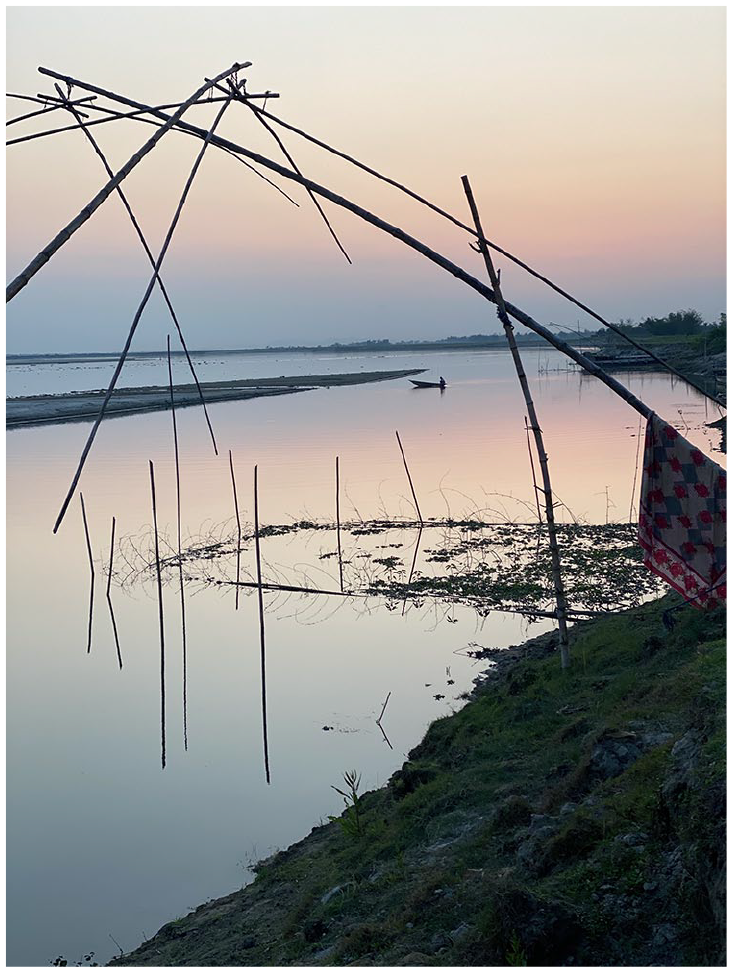
Majidbhita char (Riverine Island), Assam.

Sustenance (this painting is inspired by the hardy and resilient taro plant that is native to the chars or riverine islands. All parts of the plant—the leaves, stems, and root are edible and important source of nourishment).
Coda: Questions and Possibilities
In this article, I have written about decolonial inquiry as the imperative to theorize from struggle, to rewrite the terms of what it means to be human—not as abstractions, but unapologetically rooted in struggle and resistance in our communities in Northeast India. Thus engaged, decolonial praxis can be a powerful mode of centering lived realities and voices of communities at the margins of national and global imaginaries. Crucial to this centering, I argue, is the profound significance of counterstories and counterstorytelling. As colonized and racialized peoples, our stories and storytelling matter to our very existence, and must be reclaimed toward affirmation of our humanity; where humanity is not a universalized idea or a psychologized notion (e.g., positive sense of self), but as Antonia Darder—inspired by Paulo Freire—describes, “a deeply reflective interpretation of the dialectical relationship between our cultural existence as individuals and our political and economic existence as social beings” (Darder, 2011, p. 180). Counterstorytelling is fundamentally collective—rooted in and nourished by community and struggle, by relationships to each other and to land/water/earth. As Devin Atallah (2022), accompanying us in struggle and storytelling, writes in Abolition Fieldnotes: And how we love, dear Miyah resistance poets, how we love dear Black liberation poets, how we love dear Trans Queer and Prismic freedom poets, how we love dear Mapuche poets, and how we love our poets in Palestine—stateless yet homeful—we love our poetry as we love the land, not as conquest, not as property, we love the land as we love life—with all our planetary possibilities . . .
Thus, although I am the author of this article, I do not own or lay claim to these ideas and praxis outside of the everyday struggles of my communities in Northeast India and our transnational communities of resistance. The writing is inseparable from our work together as we strive to fight myriad forms of colonial and state violence. I see the act of academic writing as one of the many forms of labors that go into our collective struggle.
I write about and engage in counterstorytelling by weaving stories, poems, reflections, artwork, and images of homescapes inspired by everyday struggle, along with more traditional critical inquiry. The poems and imageries (artwork and photographs) are not offered merely as illustrations, and they are not subjected to literary or other analyses. Rather, they are offered as ways of being and knowing that are not shackled by colonial and imperialist politics of knowledge production. This is a move to honor the multiple knowledge forms and modalities of knowledge production. It is a form of epistemic dissidence that seeks to resist methodological domestication and the ubiquity of the master’s tools that make us complicit in our own shackles (Lorde, 2003). 14 Using a counterstorytelling modality, I highlight the imperative of rooting in place (bodily and affectively) by unerasing histories, by connecting to the earth (the lands and waters that nourish us, and which we nurture), through everyday resistance, and through our relationships with/in community. For many of us in Northeast India, decolonial praxis is a way of both restoring stories and re-storying what it means to belong, specifically in ways that transgress colonially reified categories of race, stock, ethnicity, tribe, and the borders that surveil these categories. Through our counterstories that take the form of stories, poems, artwork, photographs, and academic writing, we sing songs of freedom and weave (re)humanizing tapestries of recognition, intelligibility, and belonging.
Yet the stories, songs, and tapestries that have made it to this paper—as meaningful as they are—are also abridged and incomplete. They have been molded by ethical, conceptual, affective, and strategic decisions about what to include and exclude. At such crossroads of writing, we inevitably sacrifice complexity and flatten or erase some stories. I want to name those limits in this article and acknowledge the universe of experiences/possibilities that have not been honored here. Our counterstorytelling is never complete or foreclosed. Even as we affirm and assert our stories as answers, we must, just as importantly, “live the questions” (Rilke, 1984). Counterstorytelling toward liberation is always open to new and infinite possibilities of being, becoming, and belonging. In that spirit, I end here, not with answers but with openings into questions. Like Kazi Sharowar Hussain’s poetry earlier in the paper (That Land is Mine, I am Not of That Land), I ask, What are the live burning coals you stoke in your heart? What are your questions of the flesh? Questions of the heart and soul, rather than just the mind? What are the borders that surveil you and seep into the knowledges you produce? Where are your rooted places for collective imaginations and actions?
Footnotes
Acknowledgements
This paper builds upon the Inaugural Lecture that I delivered at the Decolonial Research Collaborative at Nottingham Trent University, UK. I would like to express my heartfelt gratitude to Deanne Bell, for the lecture invitation, for envisioning the questions that frame the paper, and for her support/feedback on drafts (including the title) along the way. Critical to this paper are the meaningful ways in which Devin Atallah and Daniel Rodríguez Ramírez engaged with my work, which helped enrich the paper. I would also like to acknowledge Miya poets Kazi Sharowar Hussain, Shalim M. Hussain, Rehna Sultana, Siraj Khan, and Khabir Ahmed, whose poetry I am honored to share in this paper.
Declaration of Conflicting Interests
The author(s) declared no potential conflicts of interest with respect to the research, authorship, and/or publication of this article.
Funding
The author(s) received no financial support for the research, authorship, and/or publication of this article.
