



Abstract
In this study, I draw upon Endarkened Feminist Epistemology (Dillard, 2012) and Decolonial Feminist Research (Rhee, 2020) to explore the epistemology of my mother, a first-generation Chinese immigrant. Based on data generated from the video-cued qi ethnography methodology, I pay attention to my Mama’s ways of knowing as she cooks in the kitchen. Qi is a Chinese concept that means breath, spirit, and life force. I draw on qi as the ongoing connectivity toward wholeness and movement toward harmony in the way I collected and analyzed data. I share my findings as a series of interconnected poetry, images, and narratives to (re)member my mother’s life as well as mine as we (re)claim what we have forgotten and (re)turn to a place of wholeness. I conclude the article by exploring the implications for the Asian American Pacific Islander community and beyond, as we conduct the work of collective rememory.
Keywords
Introduction
My personal journey to this study started in Spring 2021 during the Covid-19 global pandemic. I was living in Atlanta, Georgia, as a doctoral student, taking a course remotely from Dr. Joseph Tobin, who pioneered the video-cued ethnography (VCE) method. At the end of the course, we were tasked to complete a video ethnography project. As VCE requires in-person video recording, I realized my options were limited due to the ongoing pandemic. My family members were the only ones I interacted with regularly, so I thought about doing the project with my mother, who lived nearby. Growing up as her only daughter, Mama and I had always had a close relationship. However, after my family immigrated to the States from China during my teen years, my relationship with her became more and more distant. Although Mama and I shared the immigrant experience, both becoming citizens, we were walking on parallel journeys. Our identities were positioned differently. As Chinese Americans, I identified more with being American and my mother with being Chinese. I was fluent in English, highly educated, and a practicing Christian. Mama speaks English slowly with a strong Chinese accent, worked through numerous minimum wage jobs, had no college education and no religious affiliation. Going into this research project, I had no idea that it was going to drastically change my understanding of my mother and, ultimately, our relationship.
Theoretical Framework
As a daughter of a Chinese immigrant mother, I have observed Mama living life in the community by depending on her world sense. Although this study is focused on my mother, my positioning also makes this work autoethnographic. I resonate with Rhee’s (2020) journey of immigration to this land. We have come as immigrants, away from home and into “a wake of slavery, genocide, and its afterlives, which are still unfolding” (Rhee, 2020, p. 26). Rhee talks about “hauntings” as ways to notice realities that defy the boundaries of social science research. In this study, I explore the hauntings of m/others through Mama’s ways of knowing and being, particularly in her kitchen. As Rhee (2020) referred to her mother as “m/other” to acknowledge the disconnection between her mother and her embodied self as an educated Korean American daughter, she also acknowledges the fluidity between connection and disconnection. “As much as m/others can be(come) your mothers, you mother can be(come) your m/other” (p. 17). My hope is to tell the story of my mothers and m/others in this study, who are “tirelessly, courageously, and generously sharing their work, mercy, and thick love, with their daughters, communities, and next generations who desire for healing, growth, and connections even when we do not understand the presence (of their past)” (Rhee, 2020, p. 73). Put differently, as I do the work of rememory in my Mama’s kitchen, I come home to who I am and whose I am, a place of (re)claiming myself and my relationship with my mother and m/others.
Endarkened Feminist Epistemology (EFE) also provides a liberatory space for examining Asian immigrant women’s epistemology in this study. EFE challenges Western dichotomies and provides space for the multiplicity within Asian immigrant women’s experiences (Dillard, 2012). Although Asian immigrant women’s experiences are profoundly different from those of Black women, the same structural oppressions are in place against their rememory and solidarity.
Based on EFE, “the work of constructing identities is deeply embedded in acts of memory and of (re) membering” (Dillard, 2012, p. 51). According to Dillard, (re)membering is both the ability to think of again a past experience and the ability to put it back together again (to re-“member”).
(Re)membering is consisted of five interconnected processes: (re)searching, (re)visioning, (re)cognizing, (re)presenting, and (re)claiming (Dillard, 2012). I enact these five processes throughout my study not in a linear fashion, but from inside out:
(Re)searching involves looking for and looking again at something in Chinese heritage and/or culture that will teach me about my own identity and be changed in the process.
(Re)visioning involves expanding my worldview of Chinese immigrants, culture, and knowledge that engages my world sense (Oyewumi, 2004): What I hear, touch, feel, and intuit beyond what I see.
(Re)cognizing involves changing my mind and heart about who Chinese people are, their gifts, strengths, and knowledge in Asia and the diaspora.
(Re)presenting involves telling the story of Chinese immigrant mothers in new and fuller ways that present the length and depth of Chinese culture and heritage. It also takes our bodies, minds, and spirits to retell the stories that reckon with historical injustices.
(Re)claiming involves laying claim to the legacy of Chinese immigrant mothers and to take my place in this legacy.
Using video-cued qi ethnography, this study draws on Endarkened Feminist Epistemology (Dillard, 2012) and Decolonial Feminist Research (Rhee, 2020) to explore the epistemology of my mother, a first-generation Chinese immigrant. What are the different ways of knowing about a Chinese immigrant mother’s embodied life in the United States?
Method
I use what I call “video-cued qi ethnography” based on Tobin et al.’s (1989, 2009) and Kaomea et al.’s (2019) work on video ethnography. Tobin et al. (1989) first developed video-cued ethnography (VCE) in their studies in preschools in Japan, China and the United States. VCE is a research method that uses video to stimulate dialogue from participants (Tobin, 1989). In my study, VCE provides a mechanism to resist a colonial gaze and “shift ethnographic authority” from the researcher to the participant (Tobin, 2019, p. 267). I find VCE useful in redistributing the power to my mother to define her own epistemology. Kaomea et al. (2019) expanded on VCE in the context of Indigenous research by incorporating the Hawaiian multifocal Makawalu methodology. Likewise, I seek to expand on VCE in the context of research with Chinese immigrant women by drawing on the Chinese concept of qi (气).
Qi means breath, spirit, and life force. Qi is the essence of things (human and the more than human) that connects everything together. According to Daoist (or Taoist) schools of thought based on Huangdi Neijing (《黄帝内经》), one of the earliest written work of traditional Chinese medicine (TCM) compiled during the Warring States period (275-221BC; UNESCO, 2017), qi is the connecting medium among all things in the universe, and it unites everything into an organic whole (Kong, 2010). During filming and subsequent analysis, qi allowed me to pay attention to the connectivity between the human and the more than human, such as the ingredients in my mother’s kitchen, how they are grown, prepared, and shared.
According to the Daoist understanding, qi is always in flux, moving through the collecting or dispersing processes between yin and yang. As Dao De Jing (《道德经》) also states: 万物负阴而抱阳,冲气以为和。 Translation: All things carry the females [yin] and embrace the male [yang]. And by breathing together, they live in harmony (Lin, 1992, para. 42).
Qi’s recognition of the constant movement between polarities toward harmony allowed me to listen to my mother’s narratives as she finds balance in her experience as a Chinese immigrant mother.
I draw on the concept of qi as the ongoing connectivity toward wholeness and movement toward harmony in the way I collected and analyzed data. The study started in March 2021. I visited my mother at her home and conducted video recordings of her daily activities. After four visits, I edited the 10 hours of video recordings into a 20-minute film and shared it with my mother. A video-cued interview was conducted based on the final version of the film, and the interview was recorded and transcribed. The analysis did not have a start or end but rather it was continuous and ongoing, as qi weaves concepts together in a rhizomatic fashion, ever becoming in new directions and connections (Deleuze & Guattari, 2003). The analysis was diffractive in the sense that I plugged in the video and interview data from the study as I read “through, with and in relation to” texts from EFE and Decolonial Feminist Research (Mazzei, 2014, p. 744). Finally, I was inspired by Gloria Wilson’s work using arts-based writing practices. Wilson’s (2018) autoethnographic work used concepts of garment construction “as aesthetic interludes” (p. 213). Similarly, I used concepts in my mother’s cooking to organize my analysis. My result is a series of interconnected poetry, images, and narratives.
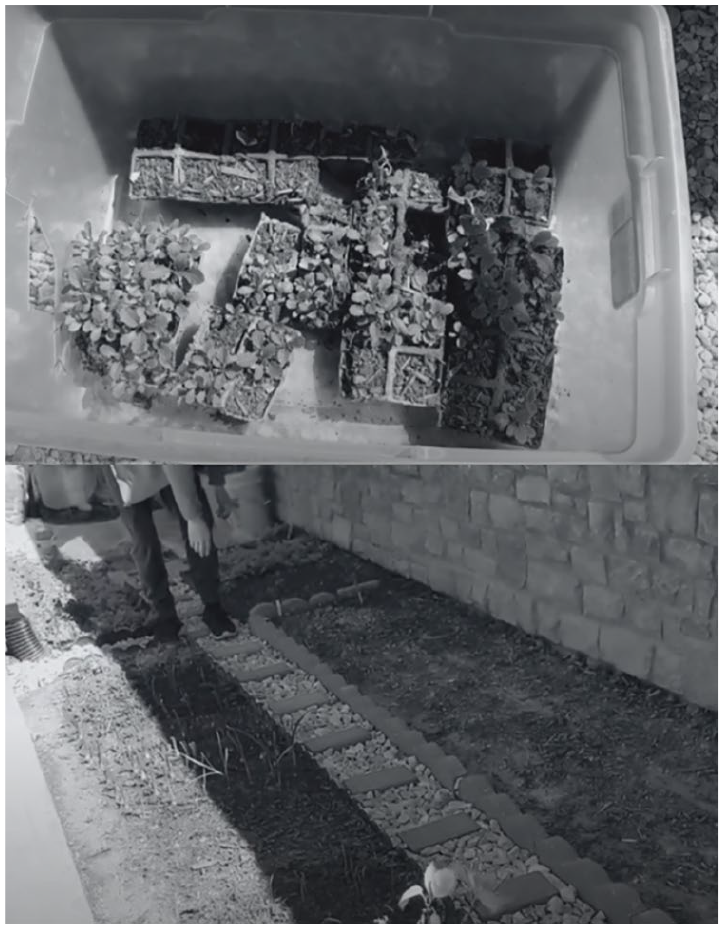
养 Cultivate.
Growing up, Mama has always cooked. I would watch her, and sometimes be her sous-chef. After I have grown, every time I visit Mama, she would still cook for me. Of course, she would always be multi-tasking: cutting, cleaning, kneading, and making several dishes at the same time. Yet, she still made time to talk to me. In fact, it was in her kitchen where she talked to me the most.
Mama talked to me about the value of “养生 yang sheng,” the many ways to cultivate life and maintain good health, and she spoke about the knowledge of her mother passed down to her: After you were born, because Mama wasn’t doing great in health, I was very interested in 养生. I read a lot of related books . . . I also paid attention to this type of knowledge in daily life. For example, when I went to a restaurant, or when I talked to the elderly at home- even though grandma didn’t cook a lot, she was very knowledgeable. Grandma’s health wasn’t great either, so she was very knowledgeable on this type of things.

洗 Cleanse.
The knowledge of my mother, her mother and the m/others are worth (re)membering. Rhee (2020) calls “the work of rememory” as haunting (p. 25). This haunting, like qi, “connects time, space, matter, and histories” and disrupts “the linearity of past, present, and future” to call us back to “that which we know and feel in our spirits, bodies, and minds” (Bhattacharya, 2020, p. 12). As I do the work of rememory in Mama’s kitchen, I get in touch with qi and the realities that I have not noticed before because of “the existing structures and divisions of knowledge” (Rhee, 2020, p. 8).
Every house in the neighborhood had a big yard and very beautiful. We felt that America was an ideal society. Everything was better than in China. However, the longer we stayed here in America, and also after working in American companies, universities, government, corporate, private companies- I did all kinds of jobs everywhere, I then realized that America is not an ideal place. There are many things that need to be changed, and a lot of the dirty things are hidden.

擀 Knead.
In the United States, all of a sudden, I started working as a cashier, not an extremely hard job, but for Mama it was very hard. First, I had to stand for eight hours a day, and you’re not allowed to sit. After the first week, my feet were swollen. I felt very tired. Afterwards, I had a much bigger appetite because of the change from mental work to physical labor. I cooked a lot every day. I also prepared for lunch for the next day. It was all different from when I was in China.
妈妈 Mama
Mama is the only daughter just like me When she was fourteen she left home just like me I always wondered whether I would be just like her Nothing she can’t do- she tells me stories: war flood and death She made it through alive and well! Together with all my m/others I believe we will turn the world right side up
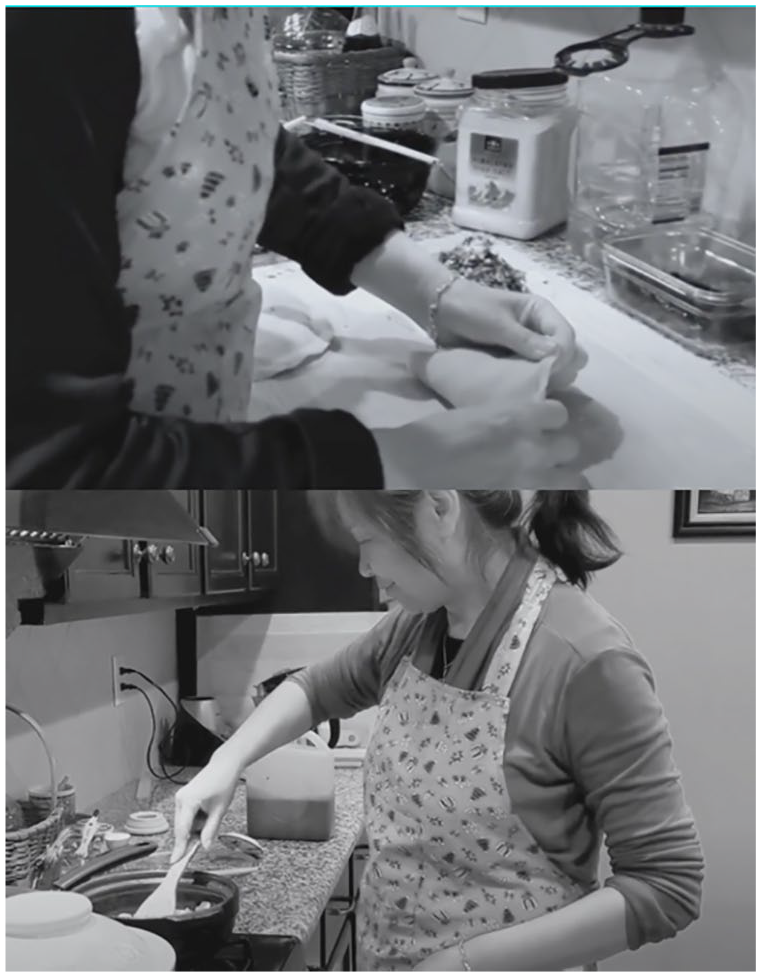
做 Create.
Mama tells me that she would “凭感觉 pin gan jue,” or trust in her feeling when she cooks: Chinese food is different from American food. When Mama’s cooking, I don’t ever use measuring cups, I just 凭感觉. American style of cooking is different . . . When Mama cooks, I look at what [ingredients] I have.
This knowing in her gut is what Mama uses to create beautiful dishes out of often leftover ingredients. Have I always paid attention to this knowing? Perhaps, my academic knowledge and training have caused me to forget what I knew (Dillard, 2012).
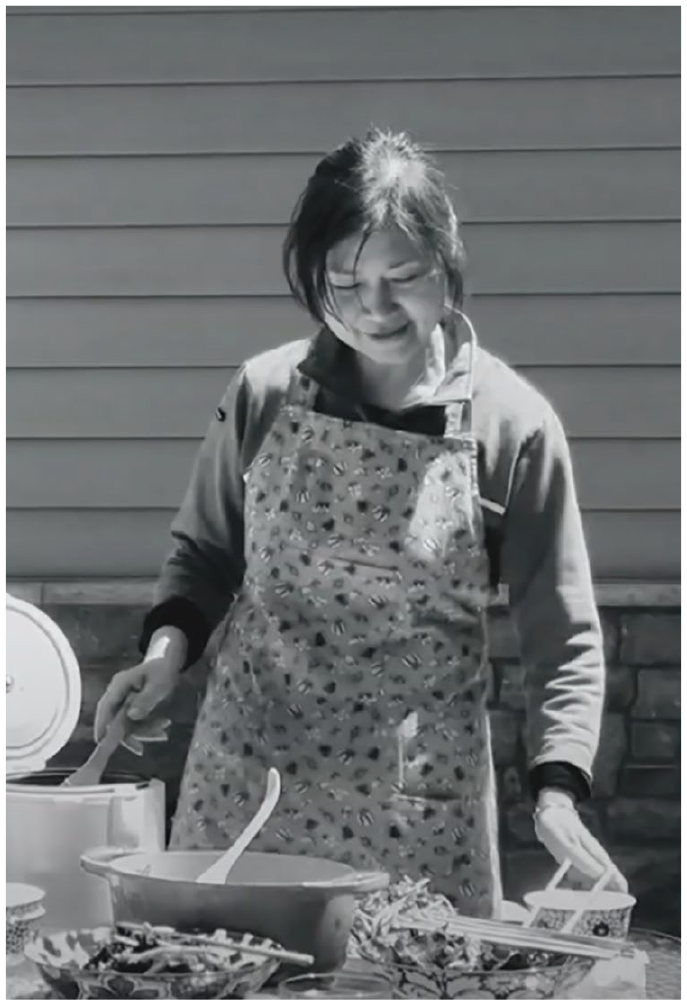
伺 Serve.
Mama is “乐此不疲 le ci bu pi,” so happy to serve that she is never tired: When I’m cooking, I’m happy most of the time, especially when my daughter comes to eat. I’m very glad to cook, and because Mama’s a foodie too- I’m picky at what I eat, I feel proud of myself when I cook well. Then when my child and family members praise me for the delicious food, I’m even happier. So I’m 乐此不疲 and hope everyone can taste what I made.
Through her acts of service, with joy, Mama calls me back to what I knew. Is my research a service of joy? Mama calls me to return to the sacred work that also bears response-ability, “answerable and obligated to the very people and communities being engaged in the inquiry” (Dillard & Okpalaoka, 2011, p. 148).
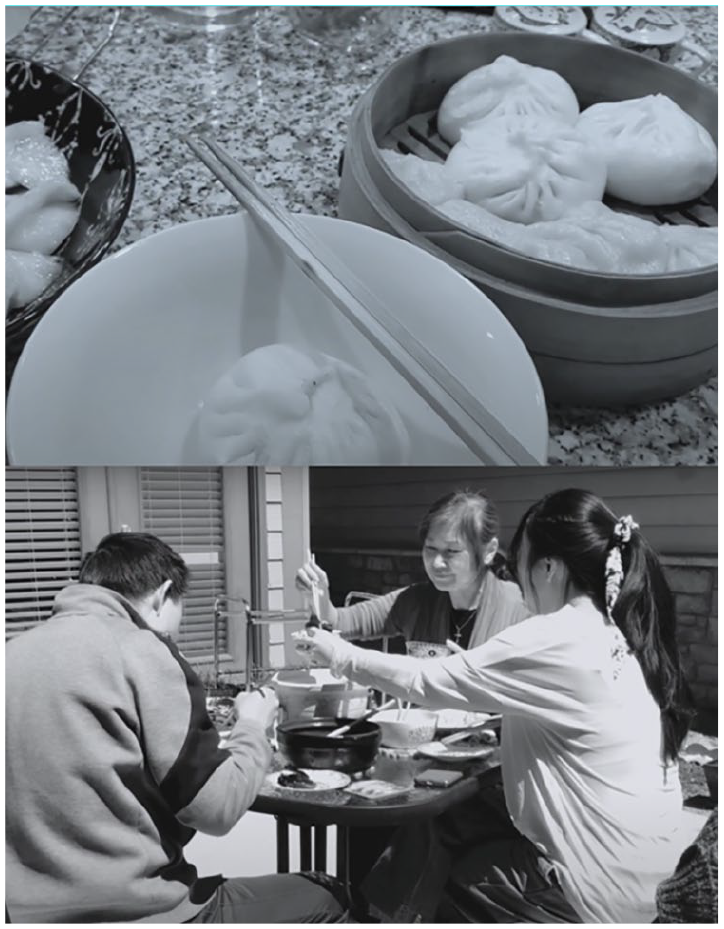
品 Savor.
I stand at the train station have I arrived or am I getting on? People see me they pass me as I run into the hauntings of my past What was and is and will be I stand here like I have always been At Home in the in-between
As a 1.5-generation Chinese American, I live inbetween immigrant generations, geographies, cultures, and languages. However, Mama has prepared a table for me in this space of in-between long before I realized. She continuously calls me back to this table she has built, the one her Mama has built for her, away from “the spirit of autonomy and independence” (Rhee, 2020, p. 31) to reconnect to ourselves, our neighbors, and to this land, to reclaim harmony and balance in our breaths.
Reclaim
To stand your ground and claim it as part of you is to (re)member that we stand on holy ground Those who came before visible and invisible lived and died here where we stand The rock cries out It tells stories of m/others and daughters and calls you your daughter and your daughter’s daughter to (re)member “It’s for you and your children.” My Mama says. Her body A bridge
Discussion
In March 2021, as I filmed my Mama in her kitchen in the light of the spring, eight lives were violently taken half hour away down the street. Of them, six were Asian immigrant mothers and daughters (Stevens, 2022). Under the backdrop of increasing anti-Asian racism and Xenophobia violence, this study seeks to speak to the ongoing violence and provides a space for collective rememory and healing in the Asian American Pacific Islander (AAPI) communities. As I remember the ways of knowing my mother embodied in the United States, I also remember her spirit and those of our ancestors that existed long before we reached this land. By exploring a Chinese immigrant mother’s knowing, my study also amplifies the voices of Asian immigrant women and scholars in defining their own epistemology. As I speak of my mother’s stories in body, mind and spirit, I (re)member her life as well as mine as we (re)turn to a place of wholeness, in our relationship with each other and with those around us. For AAPI scholars and researchers to have a clear understanding of self, in relations to diverse knowledge, cultures, places, and people, we must re-remember and reclaim the things we have been socialized to forget (Dillard, 2012). As Dillard stated, “both recalling who we are and putting ourselves back together is our education” (Dillard, 2012, p. 52). From this work of individual rememory, we “enter into collective rememory that may disrupt and transform our existing bearings on the world” (Rhee, 2020, p. 20).
In addition, Dillard and Okpalaoka (2011) spoke about the “all too common absence of Black voices and voices of scholars of color in the discussions of the meanings and outcomes of the ‘coloring’ of epistemologies” (p. 147). By exploring Chinese immigrant mothers’ knowing and being, my study amplifies the voices of Asian immigrant women and scholars in defining their own epistemologies.
Footnotes
Declaration of Conflicting Interests
The author(s) declared no potential conflicts of interest with respect to the research, authorship, and/or publication of this article.
Funding
The author(s) received no financial support for the research, authorship, and/or publication of this article.
