




Abstract
In this collective biography, we follow the question: What does it do to think~post? We navigate~circle~un/do the entanglements of institutional and disciplinary boundaries and researcher identities, increasing striations of post-thinking within qualitative inquiry, teaching practices, ethics, and becoming. Our data include personal journals, crafts and collages, collective writing, dialogues, and images from a conference session where we engaged participants in our thinking. Our memory work enacts post-qualitative becomings, opening space for questioning and reflecting (&&&), undoing and unfolding individual subjectivities, and examining the vulnerabilities, tensions, and possibilities of becoming~post.
&&&
&&&
We came together at a higher education conference. Pulled together through a mutual friend, recognizing, upon introduction, that we had been following one another around through the conference. Sitting in the middle rows, the aisle seats of the same sessions. The presentations that were sparsely attended, those with titles that had (parentheses), back/slash\es, and ~tildes~, the presentations that lingered with theoretical and methodological questions about ethics, representation, and agency. Sitting together at that hotel bar for the first time, one of us finishing their doctoral program, another in their first year of a tenure track position, another looking to tenure, we shared a common experience of coming up against structures in the academy, boundaries, and striations that became more visible to us through our conversations. Specifically, as three scholars studying the field of higher education, we found connections in our shared experience of thinking and writing in the ontological or post-qualitative turn.
Our conversations together since then have zigzagged between theory, methodology, philosophy, teaching, and ethics. Although speaking and researching from different locations, we share common experiences of grappling with the possibilities and limitations of the posts, our discipline(s), and the neoliberal, corporatized, and post-truth/truth-avoidant university. The collision of post-thinking, our researcher identities, and being with our university environments, jobs, colleagues, and students, often became palpable to us through our regular in-person and Zoom conversations. We have wondered together and apart, what does it do to navigate the posts [in higher education]? How do we teach qualitative inquiry as we situate ourselves in these paradigms? What are the ethical questions of thinking~being~writing in the posts? What does it do to think~post?
&&&
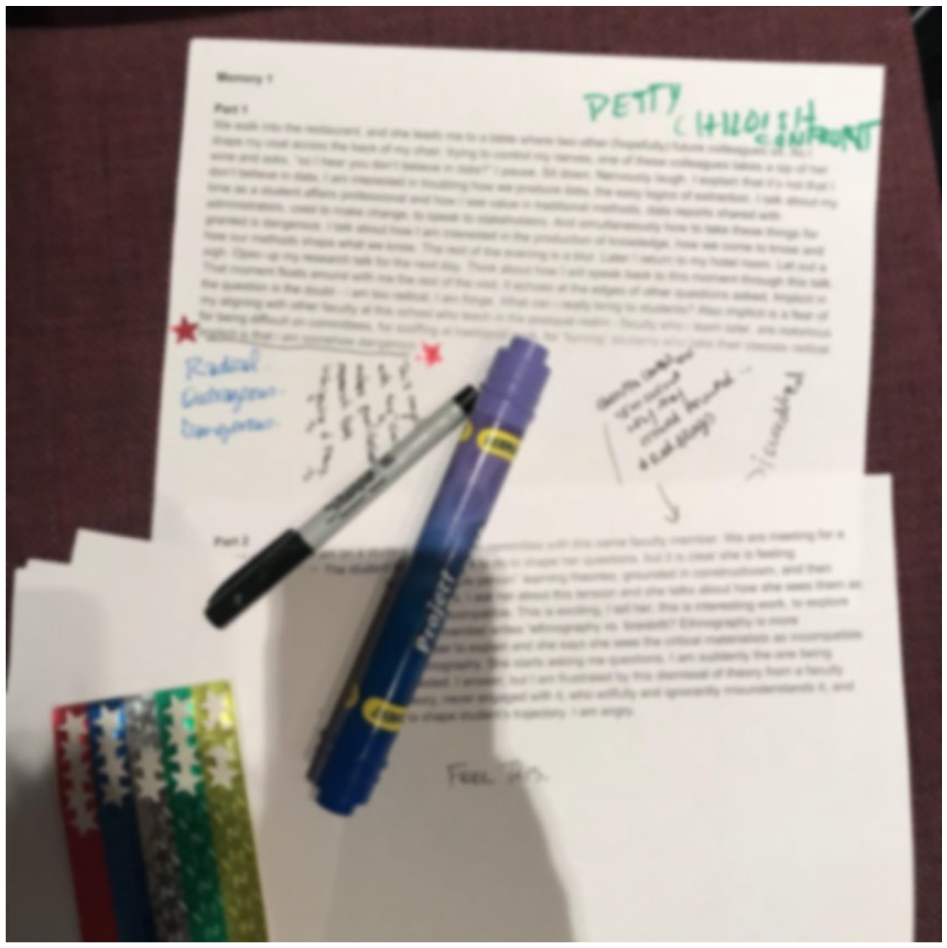
We walk into the restaurant, and she leads me to a table where two other (hopefully) future colleagues sit. As I drape my coat across the back of my chair, trying to control my nerves, one of these colleagues takes a sip of her wine and asks, “so, I hear you don’t believe in data?” I pause. Sit down. Nervously laugh. I explain that it’s not that I don’t believe in data, I am interested in troubling how we produce data, the easy logics of extraction. The rest of the evening is a blur. Later I return to my hotel room. Let out a sigh. Open up my research talk for the next day. Think about how I will speak back to this moment through this talk. That moment floats around with me the rest of the visit. It echoes at the edges of other questions asked.
&&&
What we call post-qualitative inquiry is one strand of a tradition that questions the ethics, methods, and representations of qualitative social science research findings. In the 1970s, researchers such as Bateson (1999) began questioning inductive versus deductive reasoning in inquiry, as well as questions of “data.” In the crisis of representation in the 1980s, ethnographers explicitly took up questions about who counts as an author, what counts as data, and whether aesthetic representation moves research toward objective findings. In Writing Culture (Clifford & Marcus, 1986), for example, the authors discuss how the post-anthropological and post-literary moments of the 1980s (what was then called the “posts”) were challenging how ethnographers approached their work.
Although scholars often point to Bateson and Clifford and Marcus’ challenges to ethnographic inquiry as an early precursor to the post-qualitative work of the present, others argue that feminist, indigenous, and Black scholars were already presenting such challenges to the field. In her history of feminist ethnography, for example, Visweswaran (1994) argued that women anthropologists and ethnographers had been creating texts which included an “implicit critique of positivist assumptions [. . .] evidenced in texts that predate second-wave feminism, for example, Zora Neale Hurston’s (1938) Tell My Horse or Ella Deloria’s (1944) Speaking of Indians” (p. 23). Yet these texts were often written off by (often white, male) experimental ethnographers as “popularized texts” or “confessionalized field literature” rather than standalone works of research that critiqued and troubled questions of knowing, voice, and truth” (Visweswaran, 1994, p. 21).
Women, indigenous, and queer writers in the 1970s and 1980s explored similar questions, presaging the post-qualitative turn. This is evidenced in the multi-genre collection This Bridge Called My Back, edited by Cherríe Moraga and Gloria Anzaldúa (1981), where stream of consciousness entries, poetry, letters, and interviews are combined with theoretical treatises and transcripts of public lectures to (re)member and chronicle the experiences of women of color. The consciousness-raising intent of This Bridge, which builds on cultural histories of storytelling and speculative knowing from African American and Latinx communities, is shared in the 1970s and 1980s by Marxist feminists (e.g., Hartsock, 1983; Haug, 1987). Collective biography owes much of its methodological intervention to the work of Frigga Haug (1987) and colleagues who developed a practice of feminist memory work as a direct counter to the problems they saw in traditional social science research.
&&&
I keep saying yes to projects and groups that create spaces for thinking differently as a way to force thinking differently onto my calendar. If only thinking differently comes in the form of a meeting making me responsible to others and blocking time available for other meetings, then it’ll happen. It codes thinking differently into the discipline of the neoliberal academy. Does it create the spacetime to do all of the things? Absolutely not. It mostly means I’m variously bad at some or all parts of my job on any given day. It overcommits me to everyone. But it does put the logic of the system to work for theoretical ends. In theory?
&&&
What is now termed post-qualitative inquiry, then, pulls together multiple strands of thought and can be mapped with and back to multiple histories and legacies. Overarchingly, in the present, post-qualitative approaches embrace a conceptualization of agency as entangled between human and more-than-human bodies and offer an epistemological and ontological shift from questions of meaning to questions of production, force, intensity, and flow (Lather & St. Pierre, 2013; St. Pierre, 2013, 2014, 2017). In research methodology, thinking with post-qualitative theories necessitates a deconstruction or disruption of taken-for-granted practices. For example, the interview can no longer serve as a neutral extraction of experience from a speaker (e.g., Lenz Taguchi, 2012; Mazzei, 2013). Rather, thinking from a post-qualitative perspective, the talk in an interview is produced through the researcher, the interviewee, and the research questions as well as materials, histories, policies, environments, technologies, and times (Mazzei, 2013; Nordstrom, 2015).
More specifically, post-qualitative inquiry involves thinking with and engaging scholars, theories, concepts, and logics that disrupt humanist, materialist, and interpretivist ways of coming to know the world. Post-qualitative research engages with a diverse range of thinkers across fields: posthumanism, critical and new materialism, poststructuralism, and postmodernism. This is illustrated in the text Thinking with Theory in Qualitative Research by Alecia Youngblood Jackson and Lisa Mazzei (2012). Jackson and Mazzei (2012) argue that thinking with theory is not simply about applying theory to one’s research, but about “plugging in” with concepts, “us[ing] theory to think with data (or use data to think with theory) to accomplish a reading of data that is both within and against interpretivism” (p. vii). Thinking with theory involves disrupting the theory/practice binary through decentering each and instead showing how they constitute one another, and being deliberate and transparent in what analytical questions are made possible by a specific theoretical concept. In other words, shifts to social science research design ushered in by post-qualitative researchers center theory and philosophical concepts, and question the taken for granted in the process of inquiry.
&&&
I have a turquoise folder I started in graduate school. It contains printed copies of articles on post-qualitative research that I intend to read. After my failed attempt at publishing a [post-qualitative] piece in the Review of Higher Education, I put this folder away. In a box. In a closet. Recently, preparing for this presentation and paper writing/collective biography project, I decided to resurrect the folder from the confines of my home office closet. I wondered what gems it might contain; whether it might reignite my desire to write in the space of the post-qualitative realm. But, mostly I began a wonderment at what made these pieces particularly post-qualitative or post. I began thinking of what the posts actually might be about, theoretically and realized that a post is about challenging convention, normality, and hegemony. In these as of yet unread pieces, is there evidence of this challenge? Or, what conventions are reified, reproduced, perhaps intentionally, perhaps unintentionally?
&&&
When thinking with/in a post-qualitative paradigm, language, thinking, and writing produce particular subjectivities, so while we can think with the posts in our own work, we must also think about how the posts think about us, our disciplinary fields, and the world(s) of qualitative inquiry (Hendry, 2009; Singh, 2018). Thus, in the entangled, symbiotic relationships between theories, methods, and ourselves, we question how our thinking produces the posts, unsettles the grounds of our own research trajectories, questions, and aims, and produces our own becoming~post. And yet, we also find that to think post is unsettling in a variety of ways. There are dynamics of power shot through these theories—from the questions we receive from colleagues (is this research?) to the challenges and uncertainties from colleagues within our paradigms (is this post-qualitative enough?) to whether thinking~post qualifies as a legitimate research trajectory or “defined line of research” (SHSU, 2022). Is thinking~post legible to the academy? Is thinking~post legible to the field of higher education? Is this the goal?
&&&
She starts asking me questions. I am suddenly the one being quizzed, the one being questioned, tested. I answer, but I am frustrated by this dismissal of theory from a faculty member who has never read the theory, never engaged with it, who willfully and ignorantly misunderstands it, and then allows her misunderstanding to shape a student’s trajectory. I am angry.
&&&

&&&
&&&
A politics to thinking~post has emerged (Kuecker, 2021). Prominent post-thinkers directly question if one can think~post without the lineage of poststructuralist continental European philosophers such as Deleuze, Guattari, Derrida, or Serres (Jackson & Mazzei, 2012; St. Pierre, 2021). Poststructuralism has pushed our thinking in important ways. Critiques have also come from within the field of the posts. For example, many critiques of thinking post center on its adherence to logics of hierarchizing the human (Tuck, 2010) or its perpetuation of racist theorizing (Bhattacharya, 2021). Simultaneously, we wonder about the politics of colonizing other thought traditions. What are the ethics of white researchers thinking new materialism through Indigenous traditions, for instance? How do we open space for such thinking without perpetuating the colonizing logics of an educational research regime that has so often co-opted and embedded the other without proper attribution, reverence, or regard (Rosiek et al., 2020)? These are particularly important questions for researchers with majoritized social identities. Theoretical and philosophical boundary pushing is about taking up new theoretical and philosophical perspectives and using them to inform your thinking, living, being, and doing of inquiry. However, this is always done from a social location and within the histories of the world. We create a difference from located difference. We are responsible for difference in our reading and thinking practices as well as locating ourselves in relation to these traditions we enter and inhabit. Affirmatively, we are moved by critiques of the disciplining practices of emerging fields of thought, inquiry practices, and citation attributions (Ahmed, 2017; McKittrick, 2021; Nash, 2019; Summerville et al., 2021).
&&&
I was, following my dissertation, on a sort of theory-high. I was enamored of theory. I wanted to read more theory. I wanted theory to help me think differently. I was on the brink of embarking on my faculty career and was conceptualizing how to move through that space of becoming an academic. What and how does one do research after the formal part of schooling is over? How do you stay theoretically sound? Aware? Engaged? There is a lot of anxiety associated with moving into this new phase of one’s life, and I certainly felt that. But mostly what I felt was excitement at all the possibilities laid out before me. What derailed this evening was a comment from a senior scholar. “Be serious, We all know you aren’t really a theorist.”
&&&
&&&
We follow around the question: What does it do to think~post? Thinking leads to reading, listening, and watching, which leads to writing, creating, open confusion, networking, dialogues, and building communities of dissensus. As we think, we become. In becoming, we navigate~ circle~undo the posts. We avoid the concept of methodology consciously, as it is bound up in particular reifying structures of procedure and technocratic adherence to rules, steps, and recipes for how one would become post-qualitative; critiques of methodology are bound up in the scholarship on post-qualitative inquiry (Nordstrom, 2018; St. Pierre, 2021). We do so even as at least one of us positions themselves as a methodologist. A methodologist who thinks~post.
Our inquiry in this article explores the memories, lives, and experiences of the three of us –all faculty members who position themselves with(in) post-qualitative inquiry. Collective biography, as an expansion of feminist memory work, is both our theory and mode of inquiry. Feminist memory work finds its roots in the late-20th century scholarship of Frigga Haug (Davies & Gannon, 2006; Johnson, 2018; Onyx & Small, 2001). Memory work via collective biography orients us to systems through placing our written and oral reflections in dialogue with one another as well as in dialogue with theory, context, history, and culture (Davies & Gannon, 2006). As we began our memory work, we each created an individual document where we wrote narratives and memories in response to the prompt: what does it do to think~post? Thinking from a post-qualitative perspective, memory is multimodal, nonlinear, and multiplicitous. We met regularly for 9 months to discuss our memories and often these conversations would spark other memories, stories, and tellings. During this period of time, we began to think of how to engage each other’s memories differently, and turned to artful methods of collage, cut up, and found poetry to spark ongoing conversation and to entangle our memories together. This was aimed at undoing our individual subjectivity to “make visible, palpable, hearable, the constitutive effects of dominant discourses” (Davies & Gannon, 2006, p. 4).
Artful methodologies address and investigate the nuance and multiplicity of the lived experience and (re)present that complexity in a way that is more complicated than traditional discursive methods alone (Barone & Eisner, 2012; Flint & Toledo, 2021). In addition, aligned with post-qualitative approaches including collective biography, artful methodologies seek to trouble the very nature of being/becoming and knowing (Bright, 2018; Flint, 2018; Renold, 2018). These in-process artful memories and stories were then shared during a conference session at the annual meeting of the Association for the Study of Higher Education (ASHE), placing our collective memories in conversation with our discipline’s culture, context, and history (Davies & Gannon, 2006). At the conference, after sharing our process, questions, and reading aloud excerpts from our memory work, we invited participants to tangle with us, responding to memory narratives using markers, stickers, scissors, and tape. Throughout this article, we include images from different stages of this memory work to demonstrate that undoing~circling the posts necessitates multiple approaches. The images provide a visual representation of this work across space and time.
&&&

&&&
What if the absence of theory in the discipline of higher education isn’t some nefarious exclusion but the result of an overwhelming passive neglect?
&&&
In this collective biography, our memory narratives open space for thinking through the emergent possibilities of post-qualitative inquiry. As described by Davies and colleagues (2013), collective biographies emerged “not as a method to be followed, but as a set of emergent possibilities” (p. 684; see also Davies et al., 2002). As a form of data formation and analysis, this form of writing has been used by other researchers in the field (Brooks et al., 2020; Davies & Gannon, 2006; Mayuzumi et al., 2007). One key way this form of writing differs from methods such as autoethnography or duoethnography is through the application of theoretical concepts from poststructural theorists. In collective biography, memory work serves not to represent the reality of a lived experience, but rather recognizes the contingent nature of how memories shape our past and present (Davies et al., 2013). Put differently, each time we (re)member (Dillard, 2012) a story, each time we (re)tell or (re)narrate, new possibilities emerge for the ongoing creation of our individual and collective subjectivity(ies) (Hendry et al., 2018). In collective biography, stories and memories are entangled (Barad, 2007) with one another. Attending to this ongoing entanglement creates something different than an individual autoethnographic or autobiographical perspective, by focusing on relationality, process, and possibility. In addition, this attunement offers the possibility for embodied reactions, for readers, viewers, or listeners to become caught up in the flow.
Following the question: What does it do to think~post?, we offer excerpts from our collective biography organized by provocations within this central question: What are the ways we navigate~circle~undo the posts? How do we teach qualitative inquiry as we situate ourselves within these paradigms? What are the ethical questions of thinking/being/writing in the posts? To open this inquiry, we turned to theory and philosophy, personal narrative and memory, artful-based inquiry, dialogue, zoom meetings, conference presentations, and collective biography.
What Are the Ways We Navigate~Circle~Undo the Posts?
We navigate the posts in our lives and here on this page as experimentation. Our commitment to navigation is a commitment to contingency—where can we go from here?—against necessity—or the thought that we must get to Real Research (and its kin, Real Post-Research) no matter our current location. Where can we go from here, even as we recognize that here is always on the move. As Massumi (1992) notes, becoming “cannot be adequately described. If it could, it could already be what it is becoming, in which case it wouldn’t be becoming at all” (p. 103). Navigation that privileges contingency resists this closure of research to Real (Post) Research. Real Post-Research: something that can be defined, located, and rubber stamped as doing it right. We seek a navigation of the posts that is guided by affirmation (Braidotti, 2019). We try to resist the binary: Real Post-Research must define Not Real Post-Research, which would be a negation (Manning, 2016). Instead, affirmation opens up the horizon of post-research; it is “the result of a process of transformation of negative into positive passions” (Braidotti, 2011, p. 165). Affirmation transforms the closure of Real and Fake Post-Research into successive, overlapping, contradictory, amplifying experimentation: post-research is _____, post-research is ____, post-research is _____. . .
&&&
My department chair said to me recently that I “read too many books” and “am too smart for this department.” I thought reading was part of the point.
&&&

&&&
&&&
Affirmation denies outcomes like Real Post Research through exploding its logic. Real Post Research requires a boundary—real versus nice try, sufficiently theorized versus humanist remnants, and so on. Affirmation multiplies a concept like Real Post Research in ways that obliterates these boundaries. As Braidotti (2006) writes, “we need actively to desire to reinvent subjectivity as a set of mutant values and to draw our pleasure from that, not from the static contemplation of the perpetuation of the regime of the same” (p. 123). Affirmation is repetitive, recursive, and persistent; it is process without end. As affirmation comes with temporarily located boundaries at best, its successive attempts are messy in relation to each other. They may overlap, they may amplify each other, and they may seem to be in contradiction. Affirmation drives navigation of the post that is not reduced to wayfinding. There is no single point or location that orients our navigation. Navigating the posts constitutes its own end. For Braidotti (2006), There is an ethical choice in favor of the richness of the possible, an ethics and politics of the virtual that decorporealizes and deterritorializes contingency, linear causality and the pressure of circumstances and significations which besiege us. It is a choice for processuality, irreversibility, and resingularisation. (p. 127)
Another way to say this is that the concern of navigating the posts is not this or that end, but rather it is focused on process, flow, intermediation, relation, and connection. The value in navigating the posts is the process of transformation that cannot be reduced to its outcome. Affirmation produces irreducibly qualitative transformation (Braidotti, 2011; Massumi, 2018). Navigating the posts orients researchers to experimentation with critical theory as a means to transform higher education.
&&&
A student told me this week that they had heard things about me before working with me, and that the first few weeks of working together they really didn’t know what to make of things. But now it’s fine.
&&&
Navigating the posts is not without location. Its ethics requires researchers to act “in the situated here and now of our lived experience” (Braidotti, 2011, p. 20). Navigation begins from our locations and experiences. Describing this navigation as opening up research does not mean that it is unmoored, nor is it a retreat to humanist notions of identity or boundary-making around what research counts. Situating our work allows it to explore forms of power that produce our locations as well as specific, located strategies of resistance (Braidotti, 2011, 2019). Navigating the posts opens research in just this way. Its beginnings are not open, but located. Its path is not infinitely open either, it is contingent upon its location. And yet, as its path is not determined by strictures of Real (Post) Research, it carries capacities to become something other than what those strictures would determine. It follows that the value of this research cannot hinge on a predetermined value of Real Post-Research. Navigating the posts requires that “value must also be activated each time anew” (Manning, 2017, p. 105). A navigation that opens up the path and value of research rarely creates new ground distinct from the conditions that produce it. The promise of navigating the posts is instead in shifting the conditions of possibility for the new ground to come.
&&&
&&&
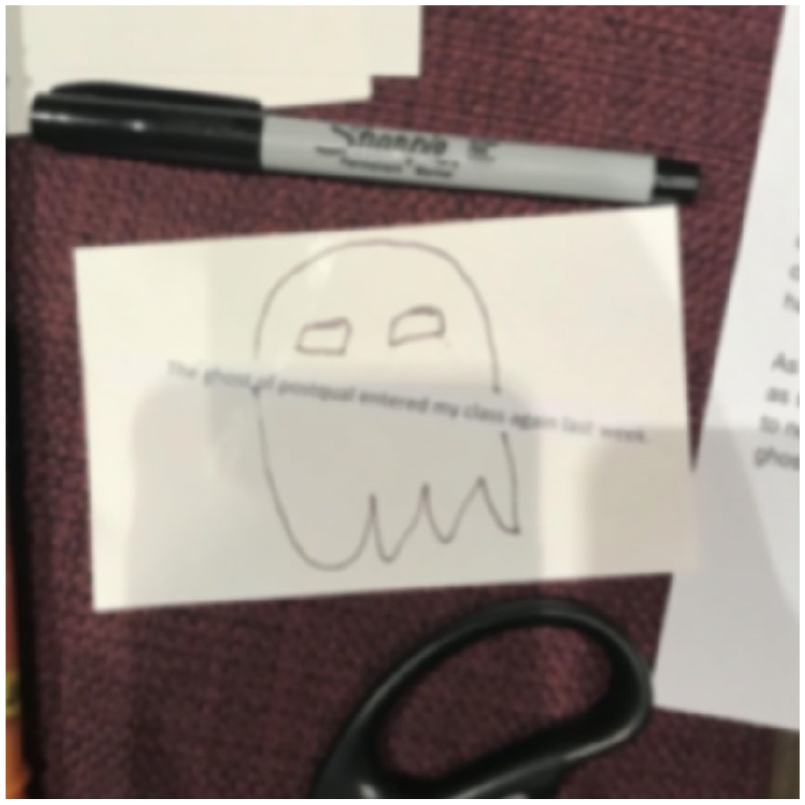
The ghost of post-qual haunts my class. She is an ever present spectre. On the first day, without fail, a student will point to her, sitting in a chair next to them. And the ghost will speak. “I don’t believe in methodology” she will say, in the voice of one of my students. “This reading is too linear,” “this is what is wrong with qualitative research.”
Over time I have had a handful of haunted students refuse to do assignments, pointing to the ghost lingering behind them. The thing about it is, I am not sure if it is the ghost of post-qual speaking when this happens or something else. I finished a book last night, Elatsoe (Badger, 2020), about a young indigenous girl who can communicate with ghosts. Her cousin passes away and his ghost returns, but it is not her cousin anymore. It is a being bent on destruction and chaos. I don’t think this ghost haunting my class is really post-qual. Or at least, I do not want to believe that it is them speaking, causing havoc in my classroom. It is some pale echo of the critique, a ventriloquist.
&&&
How Do We Teach Qualitative Inquiry as We Situate Ourselves in These Paradigms?
As scholars of higher education who locate ourselves in the posts, we each find these theories~philosophies~inquiries seeping into our teaching, into our pedagogy. This becomes especially salient in qualitative methods courses. There are similarities and differences between us as we teach these courses. For Paul, these methods courses are taught within their programs—taught to students within higher education degree programs, as one of the many courses they teach—they are higher education scholars who are qualitative inquirers. Laura is located within a higher education program, but when she teaches methods, they are college-wide courses. For Maureen, methods are all that she teaches, she is a qualitative methodologist who studies higher education. A small doubling, a slight distinction, but one that matters nonetheless in the zigzagging spaces between our narratives.
&&& Hello post-qual, I say to her as she floats in front of my student. I appreciate your perspective. What an important critique. I try to push students to not let the ghost make them reject everything. Here are some other readings you might think with. How might the ghost help you think in the tensions?
&&&
&&&
As a field, qualitative research “crosscuts disciplines, fields, and subject matters [as a] complex, interconnected family of terms, concepts, and assumptions” (Denzin & Lincoln, 2005, p. 2)—or what Denzin (2017) more succinctly describes as a big tent. Instructors of qualitative methodology are “tasked with conveying the complexity and diversity of paradigmatic difference to novice researchers,” all the while simultaneously balancing teaching the logistics of conducting research: collecting, analyzing, and presenting data (Roulston & Bhattacharya, 2018, p. 251). Preissle and deMarrais (2016) encourage instructors of qualitative methods to foreground the “principles guiding the practices of qualitative research,” rather than a focus on techniques (p. 32). Recent special issues have explored the teaching of qualitative inquiry through multiple paradigmatic lenses (e.g., Roulston & Bhattacharya, 2018; Ulmer et al., 2020)—foregrounding philosophy and the teaching of multiple traditions. In other words, much of the literature on qualitative pedagogy emphasizes the teaching of philosophy as the entry point to learning qualitative methods.
&&& I’m just not good at coding—the logic or the mechanics. When I teach it, I find myself replicating the normative logic of the system and not even well. I do contextualize coding (and categorical thinking, through Freeman [2016]) as one of many ways to do data analysis. It helps me sleep at night, but I don’t think it should. I struggle to do research differently myself, and I uphold the system that makes it hard to do research differently. I don’t do my part in making room for others to think of data analysis outside of normative conventions. There’s no outside to this system, there’s no pure location of critique, only struggle.
&&&
And yet, what we have found is that what is expected of us from students (and often our colleagues) in teaching these courses is an offering of logistics, of procedures. We are expected to be the technicians (resonating with the story shared by Kuntz, 2015, p. 32), to tell this is how you do qualitative inquiry, here are the steps, this is what “good” research looks like. And yet, grounded in the posts, we find ourselves, as in the excerpt above, zigzagging between procedure and philosophy, practical and esoteric. We find ourselves pulled between technique and philosophy in ways that are both expected and unexpected.
&&&
Will you have data? That’s not really what she means. She means will you have data in the way that she thinks about data.
&&&
We find ourselves wondering, how to teach. How to teach faithfully in a way that is responsive to the philosophies that guide us. How to teach ethically, response-ably. We lean on other scholars in the field. Lather (2006), Kuntz (2015, 2018, 2019, 2021), Kuby and Christ (2019), Freeman and colleagues (2007), hooks (1994, 2013), Springgay and Truman (2018), Tuck and Yang (2014); Koro-Ljungberg (2015). During our meetings, we share materials and examples. A book Maureen used in her classes gets taken up by Paul and Laura in theirs, an activity Paul leads in his class is modified and facilitated by Maureen in hers. We guest lecture in one another’s courses. We think together about questions like wonder and ethics (Doyle, 2020) as well as more specific questions—responding to challenging situations, troubling the system. We present together in a panel session of ASHE in the fall of 2020, exploring how wonder might function as a pedagogical north star in our teaching.
&&&
Use this class as an opportunity to think in the tensions. Yes, you will do a traditional semi-structured interview. Perhaps you will hate it. Perhaps you will learn something productive from it. I don’t know—use it to critique and think about how you will move differently. Use your other data encounters to think how you might explore these tensions in a way that makes sense for you. The things you lay out here are implicated in the production of knowledge—the methodological choice you make along the way—to interview or not, to code or not, etc etc all produce knowledge. That’s a heavy thing.
&&&
How we all found post-qual, what post-qual has taught us—we want to bring this to our students as well. And also, we want our students to grapple with how post-qual can be a foreclosure. What is our responsibility to teach methods that are legible for our students who will go into administration? Into fields where the posts are not welcome? The posts inspire questions of ethics as well. For us, the posts open up other ways of knowing, doing, and thinking about research and pedagogy. We find that we want to share what the posts have brought us—an emphasis on asking ethical questions.
&&&
&&&
What Are the Ethical Questions of Thinking~Being~Writing in the Posts?
Questions of ethics undergird this article, and our approach to writing~thinking~creating~becoming post. A challenging reality of the modern academy is about the “production” of legible knowledge (McKittrick, 2021). The datafication of research and inquiry, through citation metrics, classification indices, and social media tracking, lead to the false belief that certain forms of knowledge are more credible, worthy, or real. The posts challenge us to think against these forms of datafication, and this has led to many conversations among us about the realities of tenure and promotion systems rooted in purely quantitative logics; or the challenges of having post-research taken up in major academic conference spaces where hard empirical logics undergird systems of article and symposium review (here, we mean to say that if your reviewers are unfamiliar with the posts, your “quantitative” metrics may be lower, and thus preclude your involvement in certain academic conference spaces).
Ethical research takes time, and the posts usher in a belief that slow time, creative, artful time is part of our ethical obligation to entangling with our subjects of inquiry (rather than acting on or at a distance from our subjects of inquiry). Do we have the gift of time to do inquiry more slowly, thoughtfully, and wonder-fully in an academy driven by intense desires for speed, efficiency, and production (Ulmer, 2017)? For extraction (Kuntz, 2015)? Gildersleeve (2018) offers that “perhaps productivity, usefulness, and hard work in the American ethic of entrepreneurialism need not necessarily become the ethical imperatives of post-qualitative inquiry. . .[rather], the lazy, the leisurely, the idle, are thought to be virtuous” (p. 695).
Here, Gildersleeve is not talking about laziness as just not working; he is talking about the ethical imperative needed to give oneself space and time as a researcher to play with concepts, methods, approaches, thinking, and to do so in a way not driven by metrics of modern productivity, or metrics of traditional approaches to inquiry. Is this not what post-qualitative inquiry is all about? Yet, it is a difficult lesson to unlearn one’s approach to doing research. This article took us more than 2 years to write—there were many stops and starts along the way, but also there was a need for us to think in process (Kuntz, 2015). Even the act of working on art projects as part of this inquiry felt, for some of us, “lazy,” although the value of thinking anew about the work we were doing necessitated such artful approaches to the inquiry. Still—the idea of “producing” something which might never be used in a research article, presented at a conference, or find some other utilitarian outlet can feel unacademic, unimportant. Of course we are using these materials—they were part of how we wanted to think post-qualitatively in this paper and this inquiry.
&&&
How do we judge the value of what we write? What’s ‘worth our time’? These metrics can’t be it. The point of all of this cannot be to be the next thought leader or influencer. Poststructural theory in higher education can’t be something that has a webinar promoted by Inside Higher Ed and sponsored by Lumina.
&&&
Post-thinking takes us beyond the realm of the written report, the finalized article, the coded finding, because post inquiry privileges the processual over the extractive. Kuntz (2015) takes this call up explicitly in The Responsible Methodologist, discussing the need for a parrhesiastic relational inquiry aimed at truth-telling. Ethically, this means that inquiry cannot be pulled from its context and that the act of creating something new necessarily intervenes in the world toward more socially just enactments and entanglements. In the posts, we necessarily traverse the difficult and sometimes fraught lines of relativism (being open to all perspectives) and attempting to work in a realm of truth-telling through creative engagement. This is Kuntz’s major contribution to our understanding and thinking about the posts—how do we have a truth, and represent a truth, without cutting off all possibilities for the otherwise? An answer lies in creative entanglements—accounting for the more than human, to be certain, but also valuing the process involved in examining and doing inquiry from multiple vantage points, recognizing the inquiry as always incomplete because “creating something necessarily excludes other relational possibilities” (Kuntz, 2015, p. 57).
For Kuntz, as well as Braidotti (2013, 2019), this starts with thinking about local practices, enacting inquiry and intervention in the immediacy of one’s contextual environment—a form of cartography, according to Kuntz (2018, 2021). For us, this means we must start in the immediate context of what is termed the study of higher education. As alluded to earlier, we are each interested in the ways higher education environments function, work, and become. We enact post-qualitative inquiry within this realm and context. Ethically, we must intervene in the becoming~university. This becoming is about more than the mere mapping of current realities (what Manning, 2016, would call ressentiment), but rather future possibilities and potential.
&&&
When we talk together about this, we talk about the idea of an impasse, a space of potential, of precarity. How the ghost of post-qual creates these impasses for students—there is both the space to become something different but if you stay there you never become different. Laura offers the idea of tensions—how can we think in terms of tension, incommensurability, doesn’t make them binary, doesn’t make them in opposition.
&&&
To envision such futures, post-ing means engaging with critique (Kuntz, 2015) and engaging in the radical and open possibility of difference. Critique has received some negative attention, according to Kuntz, but ethically we must critique if we are to imagine the world otherwise. As we do inquiry—critiquing and being cartographers—we ethically cannot close ourselves off as post-researchers to the possibility that something means more than it does in the immediate moment. We can and should be open to the possibilities of boundary crossing and of something shape-shifting across space and time. In a methodocentric (Snaza & Weaver, 2014) world, we wonder how we can even do such representational work. Perhaps all we can do is create and send out into the world that which entangles with our own becoming in a particular space and time. We think and discuss often how the posts invite us to create, to intervene, and this is an ethical calling beyond the rudimentary logics of Institutional Review Boards or the protection of human subjects. It is about the ethics of entangling with the world—accounting for power and positionality.
Erin Manning (2016) calls this ethical pull the affirmation. In arguing against negation, which continues to situate and smooth over the difficulties of contradictions, affirmation is a positive creative spirit that relishes difference. In the posts, we often feel these contradictions. This is akin to conversations we have had throughout this article: How can we speak of “truth” when all entanglement and the world are ever-changing, ever-becoming? How can we teach qualitative methods in a world where our thinking is guided by posts? Set up in this logic of negation (as either-or questions), such quandaries become unanswerable. But the posts ask us to ethically consider opening the space up. As Manning (2016) states, “affirmation creates the trajectory, and from there the potential of the what else emerges” (p. 203). Ethically, we must be always open to the what else.
&&& As of Yet Unread: becoming cyborg~Thinking critically with Children of the Anthropocene~(Re)Mixing Foucault and Deleuze~Affirmative Critique as Minor Qualitative Inquiry~diachronic loops/deadweight tonnage/bad made measure~The politics of post-qualitative inquiry: History and power~I would rather by a cyborg than a goddess: Becoming-intersectional in assemblage theory~Talking, wrestling and recycling: An investigation of three analytic approaches to qualitative data in education research~Postmodernism and higher education~Close encounters of a critical kind: A diffractive musing in/between new material feminism and object-oriented ontology~The new materialism in qualitative inquiry: How compatible are the philosophies of Deleuze and Barad?~After schwitters: An experiment in qualitative form~’The concept as method’: Tracing-and-mapping the problem of the nero(n) in the field of education~New materialist analyses of virtual gaming, distributing violence, and relational aggression~Possible worlds: Deleuzian ontology and the project of listening in children’s drawing~Vibrancy of childhood things: Power, philosophy, and political ecology of matter~An ontology of a backflip~Methodology in the fold and the irruption of transgressive data~New empiricisms and new materialisms: Conditions for a new inquiry~The empirical and the new empiricisms~The refrain of the a-grammatical child: Finding another language in/for qualitative research~The new empiricism of the fractal fold: Rethinking monadology in digital times~A Deleuzian approach to curriculum.
&&&
Footnotes
Acknowledgements
The authors wish to thank the attendees at our ASHE 2021 conference session for their generous and generative engagements with an early version of this article.
Declaration of Conflicting Interests
The author(s) declared no potential conflicts of interest with respect to the research, authorship, and/or publication of this article.
Funding
The author(s) received no financial support for the research, authorship, and/or publication of this article.
