




Abstract
This article aims to describe a new coding and data analysis method for qualitative researchers, especially in education and health inquiry. We label this method Heroic Coding, a proposal for understanding the role of education and health personnel in apocalyptic scenarios. We propose this method as a subtype within Literature and Language Coding methods described in Saldaña’s The Coding Manual for Qualitative Researchers. Heroic Coding employs, in the first cycle coding, an eclectic strategy and, in the second cycle, an elaborative strategy to refine conceptual dimensions about heroes and heroic subjectivities. This article uses a data set from empirical research in education policy enactments to illustrate Heroic Coding in action. Furthermore, we reflect on future possibilities and limitations of this coding method for qualitative research in apocalyptic conditions.
This article aims to describe a new coding and data analysis method for qualitative researchers. We label this method Heroic Coding, a proposal for understanding the role of education and health personnel in apocalyptic conditions. The Covid-19 pandemic has represented a creeping crisis that has significantly redefined the support systems of human life (Boin et al., 2020). Especially education and health workers have heroically faced the emergency, fighting the sinister effects of this viral threat from the “front line” or “putting out fires” in various areas of social life. We need to creatively understand the deployment of their actions because the conditions in which they have worked have been unprecedented and extraordinary.
Our starting point in this article is that the pandemic, more than a disruption of normality, has meant a space for creating sustainable ways of living and surviving under different epistemological, ontological, and material conditions (Koro & Wolgemuth, 2022). This also involves research processes, where many virtualized environments have invited us to make responsible, respectful, and responsive decisions to new dynamics of data production and analysis and new relationships with the participants in our studies (Richardson et al., 2021). In this scenario, we propose this method, which is elaborated from the considerations suggested by Saldaña (2021) in The Coding Manual for Qualitative Researchers and aims to capture the unique and creative ways with which education and health workers recount what they have experienced during this apocalypse.
Creation Context
We propose this coding method based on what was being studied in a project conducted during the first months of confinement in 2020. This project sought to understand the work of school psychologists in now-virtualized educational settings. One of the striking aspects of the data production process was the immediacy with which participants expressed their adventures and misadventures during the interviews. The stories acquired nuances of a heroic deed. The professionals described how they tried to respond to the management guidelines imposed by ministry and district educational leaders and the specific and situated school needs they faced. Somehow, the pandemic positioned them in front of a chaotic scene of demands and self-demands that were complex to resolve. One of the project participants, Carla, sharply details the sense of monstrosity that was beginning to be articulated in the virtual school everyday life:
Carla: With the pandemic, working in schools has been like having a three-headed boss. You can imagine what a monster it is [laughs cheerfully].
Interviewer: Yes, I know them [laughs next to her].
Carla: Now, you can imagine how monstrous it is. You have a head in your school, which is behind you with the issues of your school. You have another boss in the district department, which is behind you with its ideas, its desires, its aspirations. And besides that, you have the ministry, which has its rules, now saying you “complete these spreadsheets,” “we need this information.” Finally, you are receiving orders of three heads, which ends up drowning you [. . .] It is like having a monster instead of a boss because it has three heads. How do you follow three heads and you will not be crazy? [she laughs intensely again].
The invitation to laugh that Carla gave us perfectly portrayed our positionality as academics because, although we didn’t admit it yet, we were facing that monstrosity. In that complicit laugh, we found a refuge and a shield to defend ourselves from what was then intensifying in our personal and professional lives: new symbolic control mechanisms in the work process, the emergent education needs to support, and new scenarios to navigate in The Matrix, among other aspects. In some sense, that laugh showed that Carla had already started a new journey toward a world of supernatural forces and that, by facing them, she had developed weapons to protect her sanity and her loved ones, especially students and their families.
In a broad sense, exchanging laughs was essential to open our eyes and sharpen our lenses, filters, and angles in our research process (Saldaña & Omasta, 2022). We began to explore from then on how professionals at schools were narrating their heroic deeds. During the first months of the Covid–19 pandemic, it was common to see viral videos where health personnel was intensely applauded for their noble work in the face of the health crisis. Even some anecdotally wore costumes from the Marvel and DC Comics superhero industry. Although they did not receive the same ovations, the education workers had something in common with them: they ended their workdays exhausted but without the desire to give up their mission. This mixture of feelings became understandable when we faced the metaphor proposed by Farhadi and Winton (2021): educating during a pandemic means building an airplane while we fly. Martina, one of the participants of our research project, inscribes this metaphor in her personal life:
Martina: There are a lot of new regulations that the Ministry of Education has recently elaborated. These are the ministerial guidelines that they are promulgating now. What happened? They disregard. They established the procedures in a general sense, but they never said how we should work or what we should do [Martina sighs, expressing exhaustion and discouragement].
Interviewer: I understand this is not easy. From what I have heard, given this lack of specific guidelines, you draw up your weekly schedule and assess what you could accomplish. I see that in your school, you are trying to adjust to what is, with what is coming in this maelstrom. But what do you keep thinking about when you turn off your computer? What do you keep from the day?
Martina: Well, in this case, not much. I usually keep thinking about the students I must call tomorrow, those who didn’t answer me today, or I couldn’t establish communication with them. I keep thinking about the students who have not yet submitted their homework and those who do attend classes and suddenly stop attending. I keep thinking about strategies to help students who don’t want to connect, don’t want to attend classes, don’t want to do their homework, or are even sad at home because the main problems are there.
[There is a silence of about 10 seconds]. I keep thinking about it, and sometimes my mom looks at me and asks: “Hey, are you here?” I answer yes. She tells me that it seems that I am not here. And in part, it is so. My work rarely ends. I feel that way, but it is essential to go ahead.
Heroes and Heroic Subjectivities: Conceptual Sources
To address these emergent positionings, we propose the Heroic Coding method. We consider this a subtype within the Literature and Language Coding methods proposed by Saldaña (2021). It is a method close to Dramaturgical Coding, where “life is perceived as performance with humans interacting as a cast of characters in conflict” (p. 186). This method can be expanded since epics and heroic deeds have distinctive characteristics. In the classic book The Hero With a Thousand Faces, Joseph Campbell (1949) states that the hero is the one who has been able to fight and triumph over his historical limitations—personal and local—to reach general and valid human forms. In a constant movement in the history of humanity, a hero ventures forth from the world of common day into a region of supernatural wonder: fabulous forces are there encountered and a decisive victory is won: the hero comes back from his mysterious adventure with the power to bestow boons on his fellow man. (Campbell, 1949, p. 28)
In their adventures, the heroes follow a path that is comparable to initiation rites (Campbell, 1949): in separation, they receive a call that they initially refuse but which they later start at the request of a supernatural force; then, at their initiation, the heroes travel difficult paths, encounter Gods and temptations, contemplate reconciliation, and enjoy apotheosis; finally, and even though initially they refuse to come back, on their return to the community of origin, the heroes have knowledge and experiences that they can put at the service of their people.
However, while facing lights and shadows, the heroes openly face suffering. In the Latin American context, de la Aldea (2014) has proposed the concept of heroic subjectivity to account for the heroic experiences of mental health workers. She suggests that, for example, school psychologists make enormous efforts to put out fires and to find a stable position in the face of disasters that shake up everyday life. This is the foundation of heroic subjectivity, “a machine of thinking and thinking, of doing and feeling when the community ‘is not what it should be’ and the demand appears that someone corrects it” (de la Aldea, 2014, p. 9, personal translation).
This concept has a high heuristic value to demystify positions that often are invested with what is undoubtedly reasonable, necessary, and proper. From this framework, the heroes face their work from the assumption that they deploy constant sacrifice and that everything they do is always for the good of the other. For this reason, the heroes do not allow questions and distance themselves from collaborating with others, considering that they can always solve problems independently. Therefore, the heroes tend to think about the world and others in terms of faults, deficiencies, and limitations, which vindicates their primary mission of exclusively eliminating what is lacking, what is troubling, and what is limiting. At the end of their deeds, the heroes suffer from their omnipotence: they cannot always change the world, much less the others, even when they think they have the tools to do so.
Heroic Coding for Qualitative Data Analysis
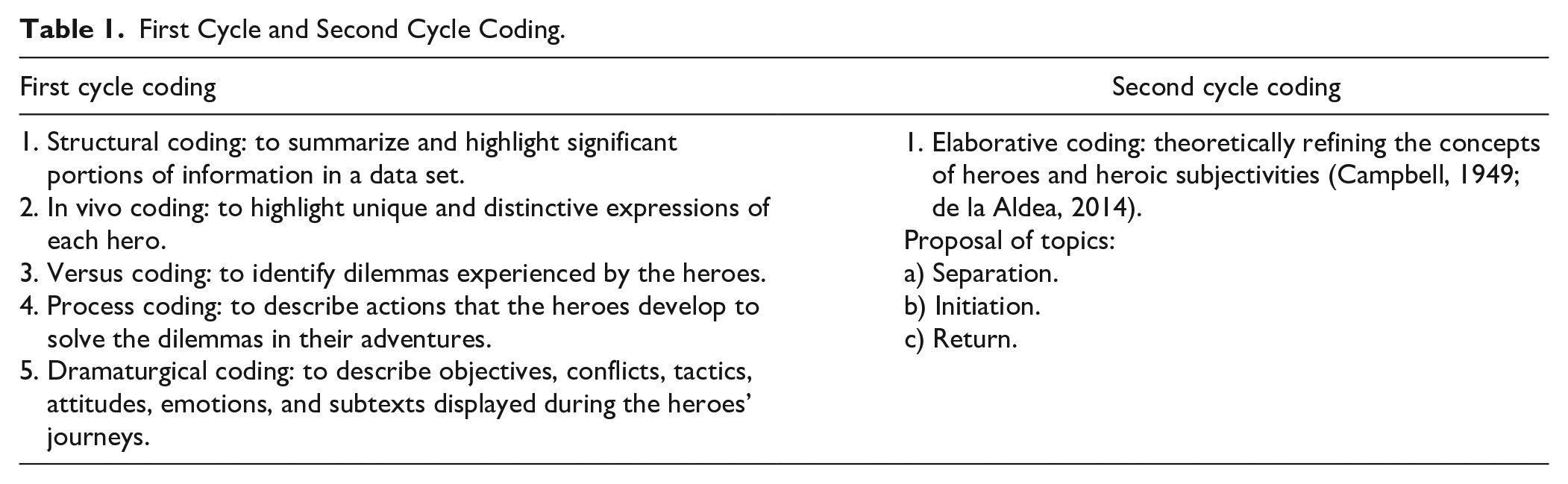
The Heroic Coding that we elaborate in this article can be applied in all kinds of studies related to how various social actors seek to meet specific goals, imposed and self-imposed, in crisis scenarios. It is recommended to study the processes of translating public policies (Latour, 1987), especially in educational and health settings. Considering what Saldaña (2021) proposed regarding the relevance of researchers developing new or hybrid coding methods to fulfill their study purposes, the Heroic Coding that we suggest here is based on several of the coding strategies presented in The Coding Manual for Qualitative Researchers, both at the first and second coding cycle levels. In the first case, an eclectic approach is proposed where various coding strategies coincide; in the second, an elaborative strategy is proposed to theoretically refine the previously exposed concepts of heroes and heroic subjectivities (Table 1).
First Cycle and Second Cycle Coding.
Heroic Coding—Example
The analysis we present in this section was conducted from a data set of interviews with school psychologists who translated education policy guidelines developed to face the crisis caused by the Covid-19 pandemic in Ecuador. These interviews were undertaken in a research project on policy enactments (Ball et al., 2012) of Ecuadorian public policy, which was redefined in the context of the creeping crisis unleashed by the pandemic. The data set is 125 Microsoft Word pages, single spacing, which reflects 490 minutes of interviews conducted virtually.
Structural Coding
First, we applied Structural Coding, which allowed us to capture the specificities of the data set and then select some text passages that grouped similar aspects among the different participants. For this, a treemap was generated in the qualitative analysis software ATLAS.Ti version 23, which allowed us to identify some keywords in the data set. As can be observed in Figure 1, three words were salient: we, they, and do. This represented an ah-ha moment in the analytical process (Saldaña & Mallete, 2017) since it immediately shed light on the conflictive nature that characterizes the hero’s adventures. According to de la Aldea (2014), heroic subjectivities require a structural rivalry: the heroes are linked to the victims, who will be the beneficiaries of their actions since they will receive the redemptive power of the tools that heroes have acquired in their deeds. Other relevant words were verbs to be, to go, and to know, representing fundamental ways of operating in the world.

A Treemap That Shows the Most Frequent Words in the Data Set.
In Vivo Coding
In addition to Structural Coding, In Vivo Coding method was applied to the data set to highlight the singular and creative expressions with which the participants constructed meanings about their work in schools. This method allowed us to show some of the strategies with which the heroes deployed their adventures (Table 2).
In Vivo Coding Method.
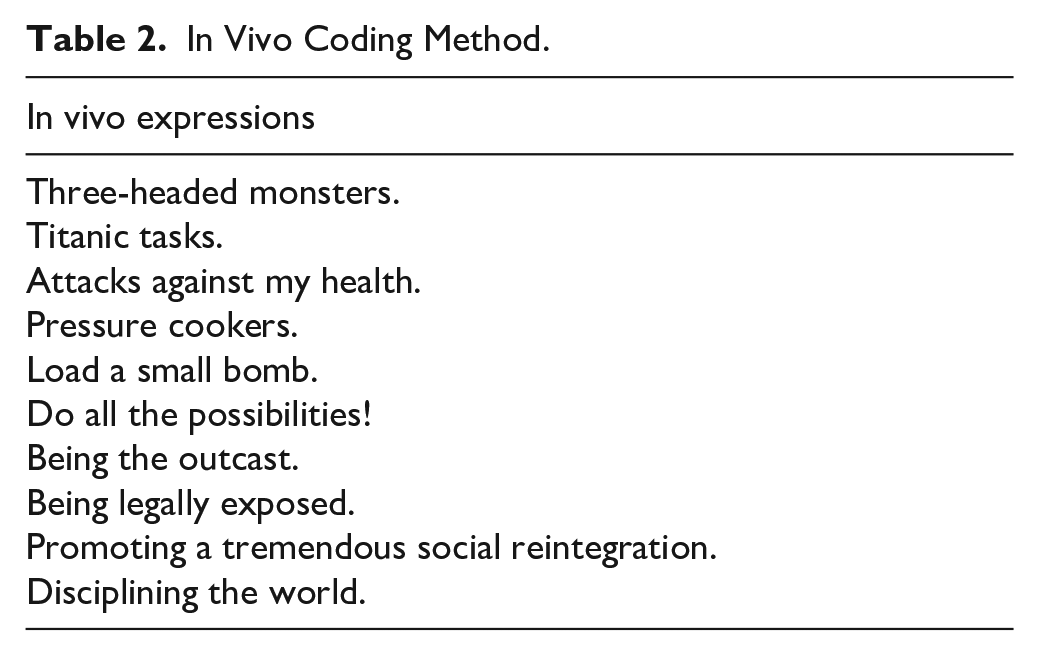
This coding strategy was critical to our data analysis process. It shed light on how the participants were problematizing their position in school life and how they constructed the possible actions to be deployed. It is interesting to observe that while they describe destructive or potentially destructive environments (a small bomb, three-headed monsters, pressure cookers, attacks against my health, titanic tasks), they also propose ways of coping related to courage and rigor (do all the possibilities, being the outcast, being legally exposed, disciplining the world, promoting a tremendous social reintegration).
Versus and Process Coding
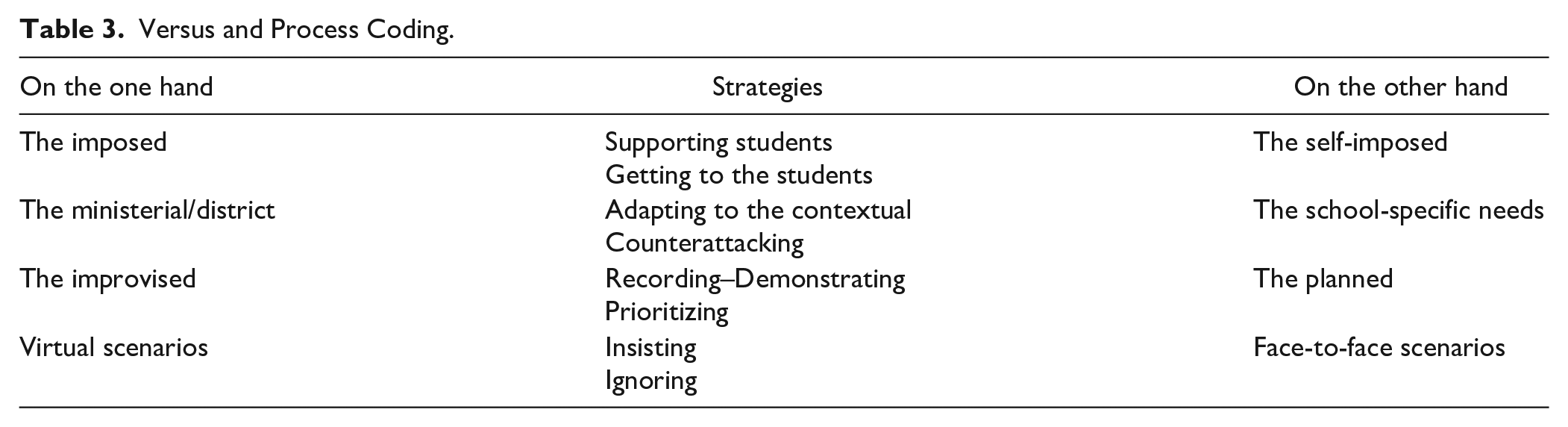
The heroic deeds are tinged with versus, that is, antagonisms that significantly stress the heroes’ mission and that must be overcome through their actions. For example, psychologists debated what educational leaders demand and what they demand of themselves as care practices (especially providing emotional support). Similarly, ministerial and district policies conflicted with social and school-specific needs. Likewise, ministerial guidelines were evaluated as improvised and irrelevant, while local action was planned and pertinent. All these difficulties are framed in the main versus: the face-to-face world and what it made possible and what the virtual world makes increasingly impossible.
Through the strategies they deployed, the heroes sought to reduce the harmful and undesirable effects of these tensions on the schools. In this case, we used the Process Coding method to demonstrate, for example, the deployment in front of the pressure on what is demanded–what is self-demanded, where psychologists assume that they must provide social and emotional support and get with the students in any way, doing everything possible and more. In the same way, in front of the national and district guidelines, they must adapt them to their contexts and counterattack them when possible. Similarly, the improvised nature of the policies and the high levels of planning at the school level invite them to record all actions in the formal registers and, in practice, prioritize what is urgent and necessary to their schools, ignoring ministerial and district prescriptions. Finally, every effort must be made between virtual and face-to-face scenarios to enable virtual classes and psychosocial support services to get to all students, insisting by all necessary means and recognizing when it is time to ignore and start retirement.
Versus and Process Coding.
Dramaturgical Coding
The Dramaturgical Coding method allowed us to provide more colors and nuances to the heroic deeds. This was useful for understanding each hero’s adventure in a differentiated way, deepening diverse singularities. This method includes six facets (Saldaña, 2021; Saldaña & Mallete, 2017): objectives, conflicts, tactics, attitudes, emotions, and subtexts. Despite differences in style, it is possible to raise two common elements in the adventures of the heroes: the first is the type of conflicts they faced, as was already exposed with the Versus Coding method. However, in their relationship maps, the most complex supernatural forces that the heroes face were the apparent disinterest of families and students. They are described, in deficit forms, as actors who lack the motivations and capacities to face the challenges posed by the Covid-19 pandemic. They are repeatedly criticized for not deploying the minimum requirements for the success of educational processes and, therefore, for being the main barriers to fulfilling their professional objectives. Through an analogy, Miguel gives an account of these difficulties:
Miguel: We must consider that it is not easy to establish a relationship with people with whom you don’t have contact. Unless you are an influencer because kids follow what TikTokers say and not what the psychologist can say in a video conference, it is challenging to guarantee educational rights when kids turn on their computers and immediately continue sleeping.
Derived from the above, the second characteristic element of heroic adventures is the discomfort they suffer. To account for this, we coded emotions and subtexts, which express the disagreements they have with families, who are reported as violent and negligent, and with students, who are criticized for the little responsibility they have with their educational processes, especially for “the arguments they have; they are sometimes a little incoherent and incomprehensible because they handle the idiosyncrasy that they acquired at home” (Interview with Jean). This discomfort sometimes deepens and dialogues with the lack of recognition, one of the central tensions that the heroes experience in their deeds:
Carla: You are gradually losing your sensitivity. At some point, you say: “Okay, let me see. The law establishes that this must be done; very good, I do this. No problem.” But you begin to build a barrier, where you try not to get involved, which is healthy; you try to keep your distance, and you say I don’t care; it is not my problem.
Elaborative Coding
Finally, and as a second cycle coding strategy, an Elaborative Coding method was deployed to reorganize and reconstruct the path that transversally constitutes the heroic adventure (Campbell, 1949) and the tensions that mental health workers face when they position themselves in heroic roles (de la Aldea, 2014). Considering that the heroes meet a world that suffers from a symbolic deficiency and that they are a symbol of the divine creation and a redemption image, a possible way of refining the analysis is to reconstruct their journeys, indicating the moment of separation, initiation, and return that Campbell (1949) has defined as the typical path of the hero’s mythological adventure (Figure 2). This is evidenced, for example, in the myth of Prometheus, who ascended to the heavens, stole the fire from the Gods to instruct his people about the importance of its control in mastering all the arts, and then descended to live. Upon returning, he was punished by Zeus and then released by Hercules, who consecrated his return to Olympus.
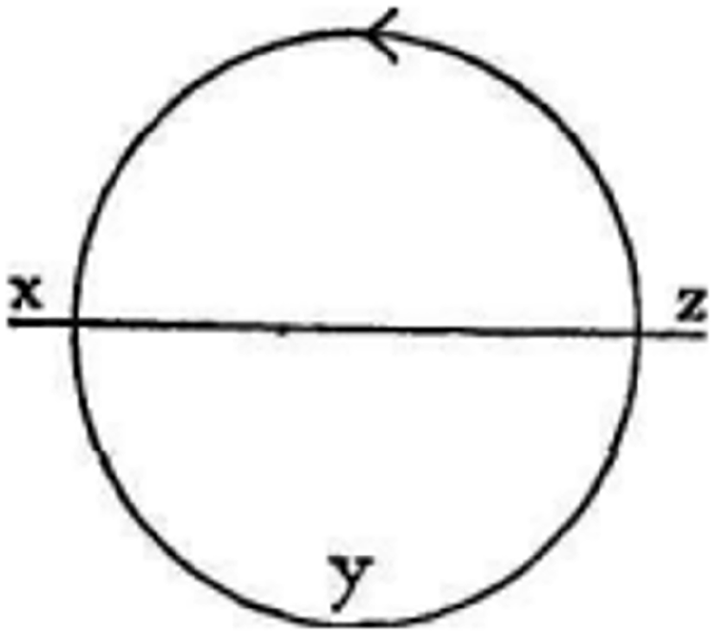
The Standard Path of the Mythological Adventure of the Hero (Campbell, 1949).
In this article, we offer the myth of Carla, who traveled to an aquatic world to face a three-headed monster that had kidnapped the sense of trust in others in school life. Although she felt like drowning, she managed to dodge many reports that the monster used to damage her integrity. When the heads of the beast began to collide with each other, Carla stored as much trust as she could in a pressure cooker that no longer worked and started the return to her community. Upon returning, she realized that the monster had dominated almost all her people since they only communicated through reports. Why don't we get organized? Carla wondered, surprised at the nonsense of her feat. Later she assumed the punishment the monster inflicted on her after her capture: she had to evidence lots of reports, without excuses, every Friday afternoon. In what constitutes until today an uncertain path, Carla believes that only the collective organization of her community will be able to free her from the punishment received.
Elaborative Coding. Some Codes Related to Each Stage in Carla’s Adventure.

Future Research and Limitations
Heroic Coding can be a suitable method to study the role of social actors in complex contexts or, in the words of Koro and Wolgemuth (2022), in apocalyptic conditions where researchers must “slow down, to dwell in the unfolding of methods and methodologies, and to avoid careful and unnecessary planning” (p. 4). The coding method presented in this article offers a tool we hope other qualitative researchers can explore and enrich. We think that the relevance of this coding method is that understanding the heroic meaning of human action allows us to problematize our modes of action in the face of specific circumstances. But it can be an excellent opportunity to break with individualistic positions in the face of chaos and create conditions to articulate collective strategies that enable us to resolve crises and transcend them, significantly when humanity and its actions have severely accelerated the end times.
We want to warn qualitative researchers that Heroic Coding must be used acutely, acknowledging the relevance of times, spaces, and cultures for data production and analysis. It is essential, too, to analyze social class, gender, and ethnic imbrications. The heroes’ adventures must be understood within the framework of the routines, rituals, rules, roles, and relationships with which specific human groups organize their daily lives (Saldaña & Omasta, 2022). In this case, we have presented the strategy we have followed from a data set produced in a specific relational, cultural, and institutional context. Radically in Latin America, the Covid-19 pandemic uncovered the structural weaknesses of the region’s support systems for human life. In this sense, the profuse emergence of heroes constitutes possible and immediate action given the urgent need to protect human life, especially those most disadvantaged. In other sets of conditions, heroism would acquire different tones and, of course, other paths to follow. However, the common tendency is that always the heroes have begun their journeys toward the depths to overcome dark resistances where the forces forgotten by human beings live and revive (Campbell, 1949). Studying heroes and heroic subjectivities is highly significant in apocalyptic scenarios because the hero is the one who, despite the pain, dares to create knowledge and share their experiences to promote the transcendence of humanity.
Concluding Remarks
This article has offered the Heroic Coding method to understand heroisms and heroic subjectivities in apocalyptic conditions. We think this is particularly useful for analyzing policy translation processes in contexts such as education and health. It is oriented, in the first coding cycle, in an eclectic way, while in the second, it follows an elaborative strategy. Its use is suggested for qualitative researchers to delve into the possibilities and orientations of human action deployed on the borders of an old world that disappears and a new one that takes time to appear because in that chiaroscuro, monsters and monstrosities will emerge.
Footnotes
Declaration of Conflicting Interests
The author(s) declared no potential conflicts of interest with respect to the research, authorship, and/or publication of this article.
Funding
The author(s) disclosed receipt of the following financial support for the research, authorship, and/or publication of this article: This article has the support of the Subdirección de Centros e Investigación Asociativa (SCIA) belonging to the Agencia Nacional de Investigación y Desarrollo (ANID), Centro CIE160009, and the Fondo Nacional para el Desarrollo de la Ciencia y la Tecnología (FONDECYT), 1231698 Project.
