



Abstract
Writing poetry over finger-paintings that are created with natural dyes is an embodied reflexive practice that can help students connect with ideas about eco-justice as they develop a deeper relationship with the Earth. As Kimmerer (2013) explains, “The exchange between plants and people has shaped the evolutionary history of both” (p. 124). Writing practices also shape who we are becoming. Through the creation of visual poetry, I investigate the importance of engaging with language and landscapes to develop relationships with one another.
Curatorial Discussion
Creating visual poetry is an expression of embodied reflexivity through the arts. This expression is extended to spaces of social consciousness when it is informed by David Orr’s (1992) research and writing about ecological literacy and environmental learning.
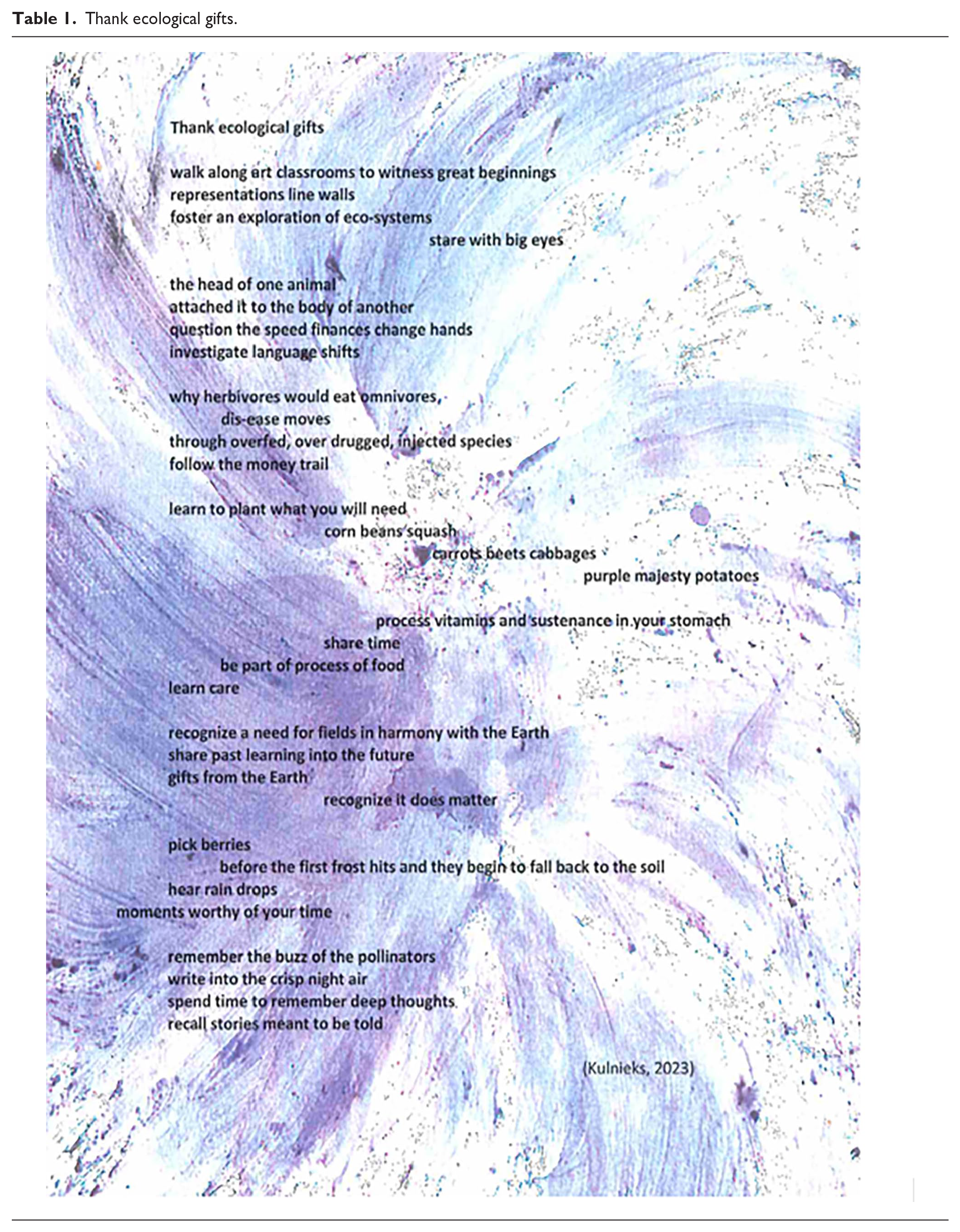
The process of creating visual poetry with the land that supports us cultivates a deep attention to the importance of what Chet Bowers (1993, 2016) calls the commons—places that we use communally. It also encourages us to think more deeply about our engagement with the more-than-human world (Abram, 2006). As an educator whose work spans the arts and eco-consciousness, I use these embodied practices to bring students into the world outdoors with the aim of creating consciousness of sustainable practices and commitment to eco-sustainability. As we wander the landscapes together, we explore how natural dyes created from berries and wild roses can help us create finger painting poems representative of our experiences with/in nature. Recognizing the transformative potential of this eco-artful practice, we investigate how compassion for the Earth is developed through this practice. Writing poetry over the natural dye art is important because this practice allows us to access things deeply held and difficult to express (Lyle & Snowber, 2021). The act of collecting the berries and flowers, making dye, and then creating art helps learners move from sterile cognitive processes to those deeply embodied. These activities, that Borgmann (1992) calls focal practices, connect my pedagogical work with my eco-justice commitments to cultivate eco-literacy with students. In doing so, we connect with the Earth through a pedagogy of landscapes that we share (Kulnieks, 2023; Figure 1 and Table 1).
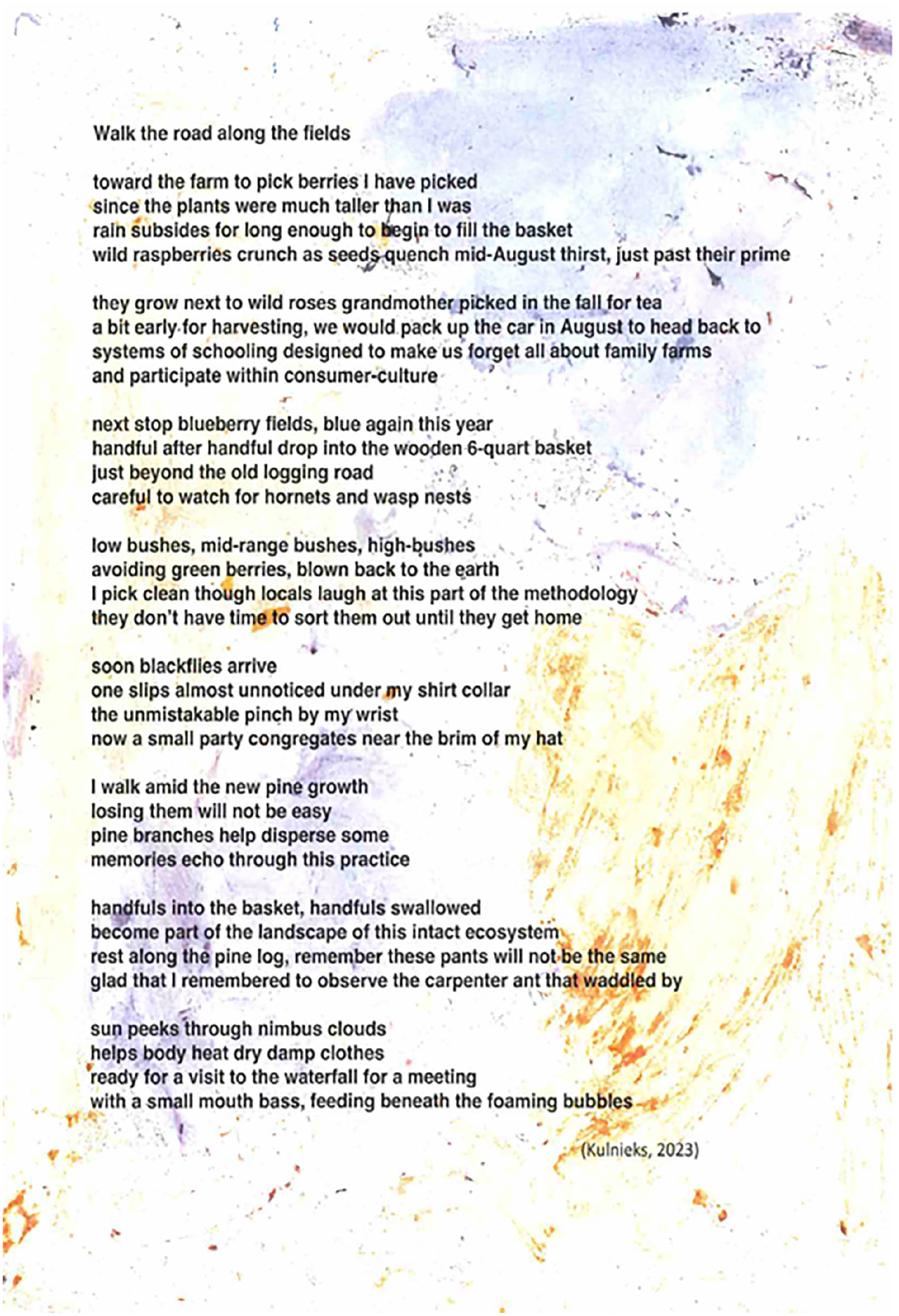
Walk the road along the fields.
Thank ecological gifts.
Footnotes
Declaration of Conflicting Interests
The author(s) declared no potential conflicts of interest with respect to the research, authorship, and/or publication of this article.
Funding
The author(s) received no financial support for the research, authorship, and/or publication of this article.
