




Abstract
Scholars know little of the inner lives of past children. Discovering a large collection of adolescent art, now older than 80 years old, seems like an archival treasure. James “Jimmy” Kugler (1932–1969) of Lexington, Nebraska, drew more than 120 sheets of comic strips, including retelling the Pacific theater of World War II as a violent confrontation of humanoid “Frogs” and “Toads.” The rest of the collection are gangster horror stories and violently humorous, single-panel drawings. What historical context helps make sense of such art? My father died over 50 years ago, and few if any of his classmates and loved ones are still alive. I describe searching through local newspapers, telephone directories, contemporary American propaganda and comic books, movies, just about anything that my father might have read, watched or seen. I treat the project as a microhistory of adolescent rebellion inspired by wartime propaganda and popular culture. What we may want from the past, I argue, contrasts what the past cannot give us. I hope to depict the necessity, and limits, of historical explanation and speculation.
Keywords
Introduction
The late Edward Said recalled the force of comic books on his adolescence in British-occupied Palestine. In the wake of confusion and betrayal after the country’s fall in 1948, Said (2001) described how the wild antics of superheroes like Superman, Captain Marvel, Wonder Woman, and Sheena, Queen of the Jungle, contrasted the staid decency of his British educators and his Baptist household. His school system had banned comic books; making their stories, bright colors and sexual titillation even more alluring. Their taboo, even dangerous, and anarchic character as such, freed Said “to think and imagine and see differently” (pp. i–ii).” Comic books, Said confessed, unleashed what would become this scholar’s interesting questions.
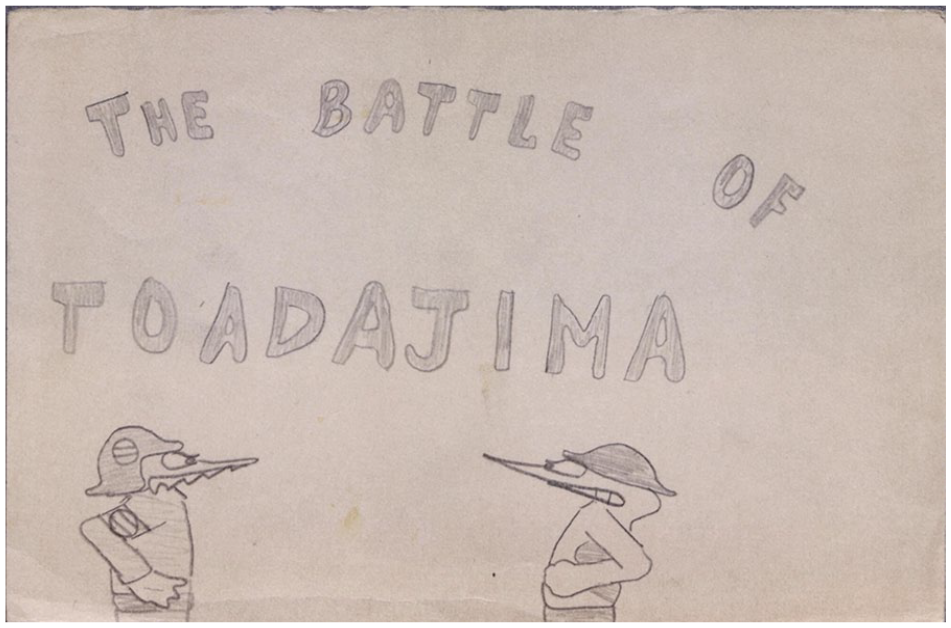
About the same time, a world away, an adolescent white male in the rural U. S. Midwest faced little similar urgency. But comics also marked his creative resistance to authority. Sometime just before or during high school in Lexington, Nebraska, James “Jimmy” Kugler (1932–1969) drew well more than a 100 comic strips, depicting the Pacific Theater in World War II, telling a horror tale, or creating darkly funny, single panels. His subjects, “Frogs” and “Toads,” were distinctive stand-ins for humans in a series of quite violent encounters. As a historian, I have tried to create the widest, densest context for these comics. From popular culture (comic strips and books, movies, radio, newspapers and wartime propaganda) to studies of youth culture and adolescent development, I hoped to make a case for the imaginative inner life of an average small town American youth. The project is inspired more or less by “microhistorical” approaches to individual, apparently unremarkable past people, the small traces of their lives suggesting tantalizing clues about their worldviews (J. Kugler, 2023).
Still, this is only one answer to an interesting problem: what did past children create? What does it tell us about their inner lives? Perhaps there’s some inspiration here from Carolyn Steedman’s argument about the modern child’s interior life, a private place not performed in public. Did Jimmy Kugler’s comics begin as imitations of public events, recast for performance in the imagination, then transferred to paper? (Steedman, 1995). Even the emotional investment I carry in regard to this artist—my father—has been moderated in the 54 years since his death, and the decade or more of research recreating the world of his youth. The research and writing has certainly lessened any paternal intensity the art holds for me. In this work, I’ve taken every effort to obey the discipline of modest objectivity. Objectivity remains a divisive subject for historians. The recent Twitter dustup over reflections on “presentism” by James Sweet, the president of the American Historical Association, is a sad reminder of our wider distrust of one another’s intentions in choosing and pursuing the subjects of scholarly study. Some expressions of objectivity resist attempts at creative recovery of the lives of past people. For example, the circumstances of women or the enslaved made it impossible for them to leave much if any traces in records other than the judicial system (Fuentes, 2016). 1 I’m much more likely to see, surprising as it might sound, this Nebraska high schooler from the 1940s less as my father, and far more as a young man I never actually met (Figure 1).
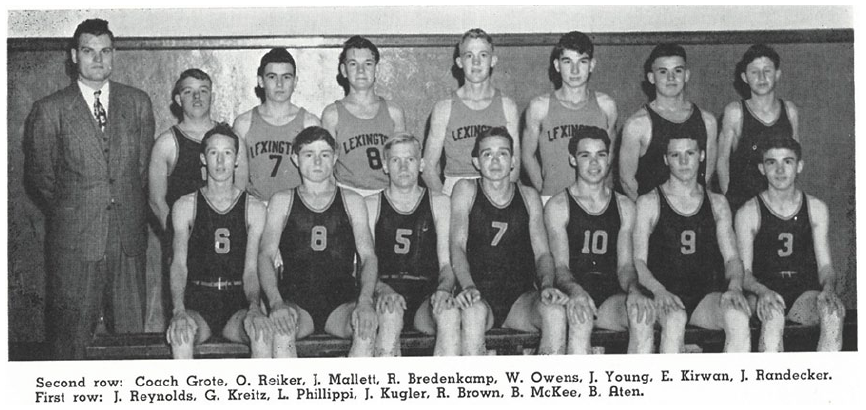
Kugler, #7, on Lexington’s JV Basketball Team, 1947/8 (The Minutemen, Lexington High School’s 1948 Yearbook, Courtesy of the Dawson Country Historical Museum).
I met a version of that high schooler when I was born about a decade later. Some part of that young man survived in the father who introduced me to reading comic books, watching horror movies, and sadly, symptoms of resentment when slightly older, apparently angry, and discouraged. We can imagine we see the seeds of the older person in the younger (Steedman, 2002), because from quite a long ago I have a child’s memories of my father, even then filtered through my mother’s far later testimony. Here I work to deny such experiences or insights. But the temptation lingers.
Historians confront similar desires as the rest of us: just what was going on in those people? Why did they behave like that? But we are typically trained according to protocols, practices, disciplines, and habits (notice how several of these words harken back to monastic orders) as controls over desires. Like most other laborers in modern academic disciplines, I’m confident my colleagues are capable of making moderately objective claims about the past. To do so, we avoid capturing those artifacts and the people they represent by our own autobiographical impulses. We hold one another accountable for resisting the inclination to subject past people to ideological convictions they may not have shared. This modest confidence is surely tested in research about my own father’s adolescent art. And beyond that, the challenges pile up higher. Not only is microhistory unusual, possibly too minimal to say much of anything about the inner lives of other American youth in the war years. But also, in my efforts to create a historical and scholarly context for the comics, I discovered that the published work of scholars of American youth, historians of the comic book, literary scholars of comics, and scholars of popular culture, rarely speak with one another. Monographs and essays pile up around our feet; time becomes precious. We practice our academic habits along narrower scholarly trails. Then there is the challenge of treating comics as a scholarly subject; even today, it still is more or less overlooked (Fass, 2010; Mintz, “Prologue,” 2004; Sterns, 2008). As I conceived this project, the intersection of those fields represented a great opportunity, but one with few models. 2 When seen alongside the effort necessary to interpret a comparatively large body of adolescent art from almost 80 years ago, I worried I could pull it off.
I’ll begin with the academic world most familiar to me, that of modern historical reflection and writing. I’ll describe how historians often create arguments in the form of narrative explanations, confronting the challenges of evidence as well as shared dimensions with fiction. In fact, some academic historians, confronted by the limits of scholarly history, have turned their research to writing fiction (Slotkin, 2005; Smith, 2016). We’re hungry for the kind of story that satisfies our curiosity; our sympathies; perhaps even our hopes.
A distinctive subset of historical research, microhistory, appealed to me for its self-conscious convictions about the frailty of evidence, highlighting also the vulnerability of humans and circumstances. The history of youth culture has its own peculiar questions and methods, from which can follow a discussion of comic book scholarship. 3 The play of image, format, the reader’s active imagination filling in what the artist implies but does not show, and the interplay of writing (descriptive or dialogue) represent a far more complex cognitive experience than comics’ broad reputation as “juvenile.” 4
All of this served, therefore, as the methodological setting for the detailed, three-dimensional world of Nebraska's small-town life and popular culture in the war years of my father’s adolescence. The historian’s academic currency of exchange is the language of likelihoods. My conclusions are therefore speculative, intended to suggest a reasonable assessment of what my father almost certainly did read and see, what he likely indulged, which appears to have resulted in the pictures on the page. I’ve collected the artifacts, like debris from a flooded field, and strung lines of association if not causation from one to the other. We might then see a kind of coherence running back through the 1940s, perhaps earlier. I’ve reserved for this essay what I’ve avoided addressing elsewhere, what I know of the man on the other side of adolescence.
Historical Narrative as Explanation
It’s been more than 50 years since I sat next to my father on my parent’s bed, looking at the comic strips he drew as a kid. He was tall, a talented athlete, sarcastic. I remember his enthusiasm for the preoccupations of childhood: hiking in a nearby woods, roughhousing with my sister, brother, and I, playing baseball, and reading—especially comics. In what appears to be an old candy box, he stored dozens of now sepia-tinted sheets mostly framed in six panels. He let me hold them on my lap, and soon I was lost in a kind of wonder at drawings just like what I read every Sunday morning from the Portland Oregonian.
For years, I just kept his comics. I often looked through them. Later my kids read them, and over time adopted into our own family’s world some of the phrases (“A fitting death for unbelievers!”) and threatening character poses. About a decade into my teaching career, my casual interest in comics, novels, and movies became far more focused. I began creating courses around popular culture portraits of the past (what a friend calls “history outside the classroom”). I had lost my interest in questioning the historical accuracy of movie and comic book accounts, far more interested in the feelings those non-academic narratives created for the past. Something else happened: comic book scholarship became vibrant and serious. I was old enough to ask questions about my dad, now long dead. Would his comics tell me anything interesting about that era in American popular culture, and the creative inner lives of adolescents?
With experience researching historical subjects, some of it in archives, I thought I knew the questions to ask, and where to look for answers. By training historians learn to pick through the details of convictions we might take for granted: where you grow up, when you grow up. For my dad, I had to go back to Lexington, Nebraska. I had to interview people other than my mom who, from the western edge of Nebraska, hadn’t known him in school. I had to look for evidence of his personality and behavior to discipline my mother’s testimony of their complex relationship, and my childhood memories.
So, in a sense I didn’t know what was “in” the comics. It seemed appropriate to call the comic strip collection an “archive.” I had no clear sense of the themes or order; some of that is still an open question. “Archive” seemed a neutral description. But as is often the case, no interesting term is really neutral. Institutional “archives,” in which historians do the bulk of their research, themselves have histories. The founders limit and bind both the collection’s content and access to it. The holding authority may be led by people eager to protect its reputation, its “brand.” This complicates the very notion of the “archive” as a collection of sacred documentary relics, reinforcing a naive kind of optimism about direct access to the past, tuned only to pristinely objective historical accounts. 5
Thinking through it, my father’s collection of comic strips was part of a kind of “archive.” The comics rested in a wooden footlocker, alongside his high school diploma and 1944 confirmation certificate from Lexington’s First Presbyterian Church. It also contained his collections of small animal skulls, a rattlesnake rattle, coral, and so on. Collected with this was a diary (now lost) he apparently kept while in jail in Lexington, photos of him and my mother, and his handgun collection. Into this footlocker, he had gathered the debris of his youth and early adulthood, the comics being just one of many, and only related to the rest by their origins in my father’s interests and persistent attention. “Archive” here is more haphazard, less curated, perhaps as ideologically suggestive yet opaque, as other collections.
I also had to figure out how to integrate my dad’s comics into a historical explanation and narrative, working through the images, and story lines, as signs of his creative choices. I walked slowly into a debris field left behind by my father’s life in small-town Nebraska. I was trying to track down what he lifted from the swirling waters of popular culture in an America engaged in a terrible war. 6 I’m a ragpicker, working a debris field of an inconsequential life, in a place easily overlooked as inconsequential (Toolbeek, 2004).
If “everything is grist for your mill,” for quite some time you really don’t know what you’ll need for a task of building a historical context and argument. You’ll be pretty far into that debris field, your arms and pockets full of bits, a hefty backpack weighing down on you, eventually a sledge piled up, dragged behind. Historians ask interesting questions: What in the artifacts puzzle, confuse, frustrate us? How do they contradict one another? What of the past is not obvious, clear, or readily sorted? These kinds of questions can change with each new artifact. The new question drives you into a different part of the field, and you start piling on new bits. But you also pick up from other historians and scholars what amounts to maps or field guides for navigating similar debris fields. You find yourself engaged in what the philosopher Louis Mink (1970) called the “comprehension” of all this, but at a sheer scale which at times feels impossible, obsessive, maddening. Dragging these materials behind you, shuffling among other historians (who often wave you on with contradictory directions), you may well find yourself assembling more than one description of the past than you first imagined. For some scholars, this confusion, change in direction, revision of research questions, and so on, is the sign that the historian has truly immersed themself in the foreign world of the past. This functions then as a kind of objectivity (Darnton, 1984, pp. 4–5).
I studied yearbooks; looked up addresses in old Lexington phone books; and poured through old photos of the town, buildings, and churches. I discovered that several buildings resemble structures my dad drew in his comics, suggesting he imagined in his comic fantasies of invasions, attacks, and destruction in a small town much like his own (J. Kugler, 2023; Steedman, 2002, pp. 125–127). I conducted interviews, cold calling elderly people in the hope that they would trust me—hoping they could remember someone from almost 80 years ago. I now realize that elderly people often like to talk about their past, tell stories, to find people who care about the bygone days. But what if they remembered my dad, and didn’t want to talk about him? One of his classmates remembered my dad as a hooligan, surprised that he graduated.
I walked Lexington late in the afternoon and evening. Taking photos brought some residents onto their porch to ask me if they could “help.” Not unlike my days spent walking the streets of Edinburgh’s old town, trying to reimagine the titans of Scotland’s Enlightened capital (David Hume, Adam Smith, Adam Ferguson, James Boswell, etc.). Among Lexington’s buildings, I tried to imagine my dad’s young life in the 1940s. It was, I believe, an act of trained, restrained sympathy.
History is not a science in the fashion in which biology, geology, chemistry, or physics have their own distinctive but related methods of investigation. 7 Historians turn to protocols for identifying and analyzing evidence of the lives of past people. They express modest confidence in our ability to make intellectually defensible claims about what happened in the past, who did what, and why. Yet the desire to know past people intimately and to answer moral puzzles are versions of getting the history we want (M. Kugler, 2019). Modern historical protocols, intended to minimize the pull of such desires, grow from the ethical conviction that the past is not my world, its people not mine; they had different challenges and convictions than myself. They have no juice to push back on any manipulation, even distortion, however well-intentioned, I might wrestle onto these artifacts. History is far more of an imaginative enterprise, its narrative explanations far more beholden to fictional story-telling devices than is widely recognized or we might want to admit (White, 1973, 1987) Historians have to fill in blanks, stretching interpretive bridges across disparate pieces of evidence. 8 Historians bring possibly more—or less—unrelated artifacts together in acts of “comprehension,” a form exhibiting thematic coherence, arguing that this arrangement offers a pattern representing the past world (Mink, 1970). This pattern answers the historian’s question: what happened, why did it, what changed, and what stayed the same?
A small subfield of modern history, microhistory, has become a preoccupation for me. 9 This stems from my typical work concentrating on intellectual biographies. My convictions about human dignity and worth find in microhistory an opportunity to concentrate on a single, unremarkable life, hobbled by the scarcity of documents. As one historian sees this, the tendency to use a rich historical context to fill the silence about that subject requires a rigorous self-denying ordinance to prevent the many from speaking for the one (Magnússon, 2001). Yet our sympathy may disguise a too-great love, the single life manipulated into a singular obsession (Lepore, 2001).
The Comic Book as a Historical Document
With no particular model for combining the subjects of the history of youth culture, the history of comics, and comic books as historical artifacts, my journey into the debris field surrounding my father’s comics was wider, messier, and more bewildering than I’d first imagined. Microhistory, graced with few documents for a single life, demands scanning an even wider landscape of information. That horizon of evidence and contemporary argument about that past quickly feels limitless.
We have reasonably good evidence of comic book sales in the 1940s, including readership among servicemen during the war (Wright, 2003, ch. 2). We have some sophisticated and sensitive analytical reading of the comics themselves, revealing their often provocative motifs of violence, sexuality, race, national fervor, and roles in propaganda (Cord, 2014; Goodnow & Kimble, 2017; Lepore, 2015; Murray, 2011; Pustz, 2012; Whitted, 2019). Studies of youth culture describe the popularity of movies, radio, participation in sports, and the Boy Scouts (Jarvis, 2010). 10 Scholars of comic books often concentrate on illustrators whose adult fame makes their childhood worth studying (Jones, 2005; Spiegelman & Kidd, 2001). But at this stage in the discipline of history, what is worthy of study? We have generous models for recovering otherwise unremarkable lives, worthy of interest and rescue. What other collection of juvenile creativity still lies overlooked in a debris field? Since my father never drew comics for a career, this archive remains distinctive as a large surviving collection of youth art.
I quickly realized that, for this strange and taxing research project, I had no training in art or the techniques of comic book illustration. Still, I poured over them for motifs, stylistic decisions, shortcuts, and artistic development. I recalled that my dad drew pictures for me, such as a fire breathing dragon on a homemade kite, speeding Chester Gould/Dick Tracy-like roadsters, and of course, Frogs. I have one surviving drawing from my childhood (Figure 2).
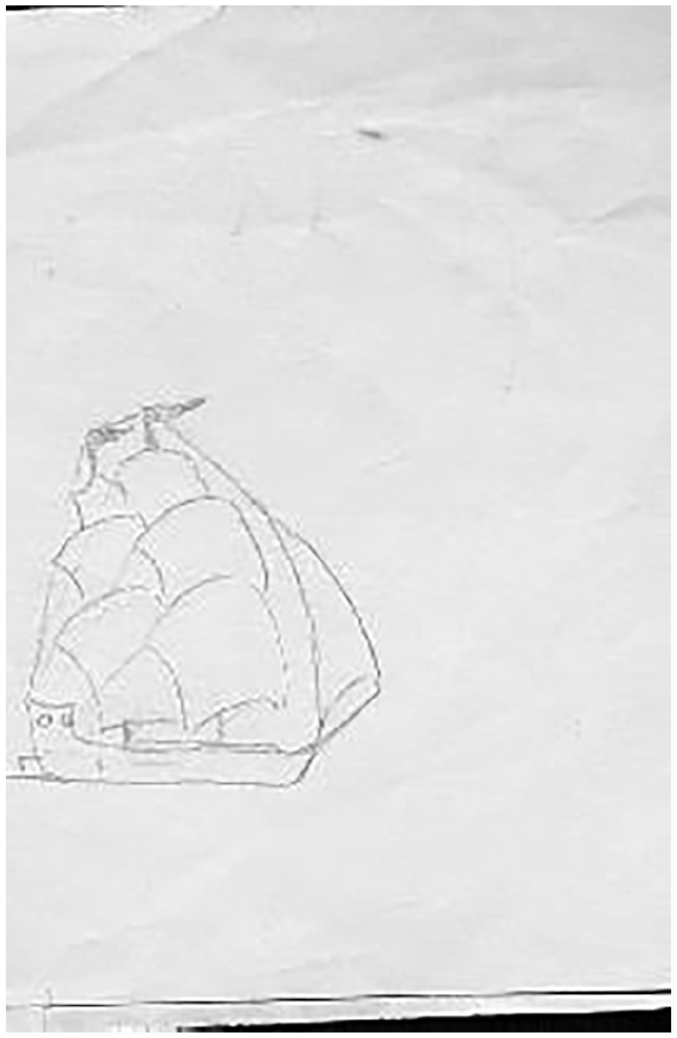
Kugler’s Sketch of a Sailing Ship C. Late 1960s.
Comic artists like Will Eisner (2006a, 2006b, 2006c, 2008) can teach us about his world, New York City—filled with immigrants, labyrinthine, eerie, threatening, reworking noir motifs in a highly surreal style. Emphasizing diverse perspectives, Scott McCloud (1993) described the complex cognitive work going on in the reader’s mind. He suggests the artist recruits the reader as a kind of co-creator, unleashing the reader’s wonder, fear, or empathy. Framing and composition work a kind of magic to conduct the narrative. Karasik and Newgarden (2017) remarkably break down a simple three-panel comic, from Ernie Bushmiller’s Nancy. They illustrated just how much of the story an artist can leave to the reader’s imagination. The simplest possible forms, drawn from widely recognized artistic motifs, create a drama of character and justice. Simplicity is the child of obsessive repetition to discover a style, distilling the narrative to what is necessary and sufficient and therefore vivid.
Historians likely ask different questions about comics. I’ve tried to combine into one approach, what historians and comic book scholars typically do separately. I looked for motifs to suggest the order in which my dad drew the comics. I looked for similar themes or ideas from other comics (Figures 3 and 4).

V.T. Hamlin, Alley Oop, Saturday, March 11, 1939.

From Kugler, “The Famous War of the Frogs and Toads”.
The violence of my father’s humanoid stand-ins for people, unlike the typical superhero, is not distinctively masculine. Their fighting is slapstick (similar to Hamlin’s Ally Oop) but propelled slowly toward abrupt, murderous results. The irony baked into such costly, humor-tinged violence, let him depict extreme assaults at an emotional distance. The following comparison expresses the transition from the slapstick of Hamlin’s Alley Oop to the grotesque in detail from one of my father’s single-panel cartoons (Figures 5 and 6).
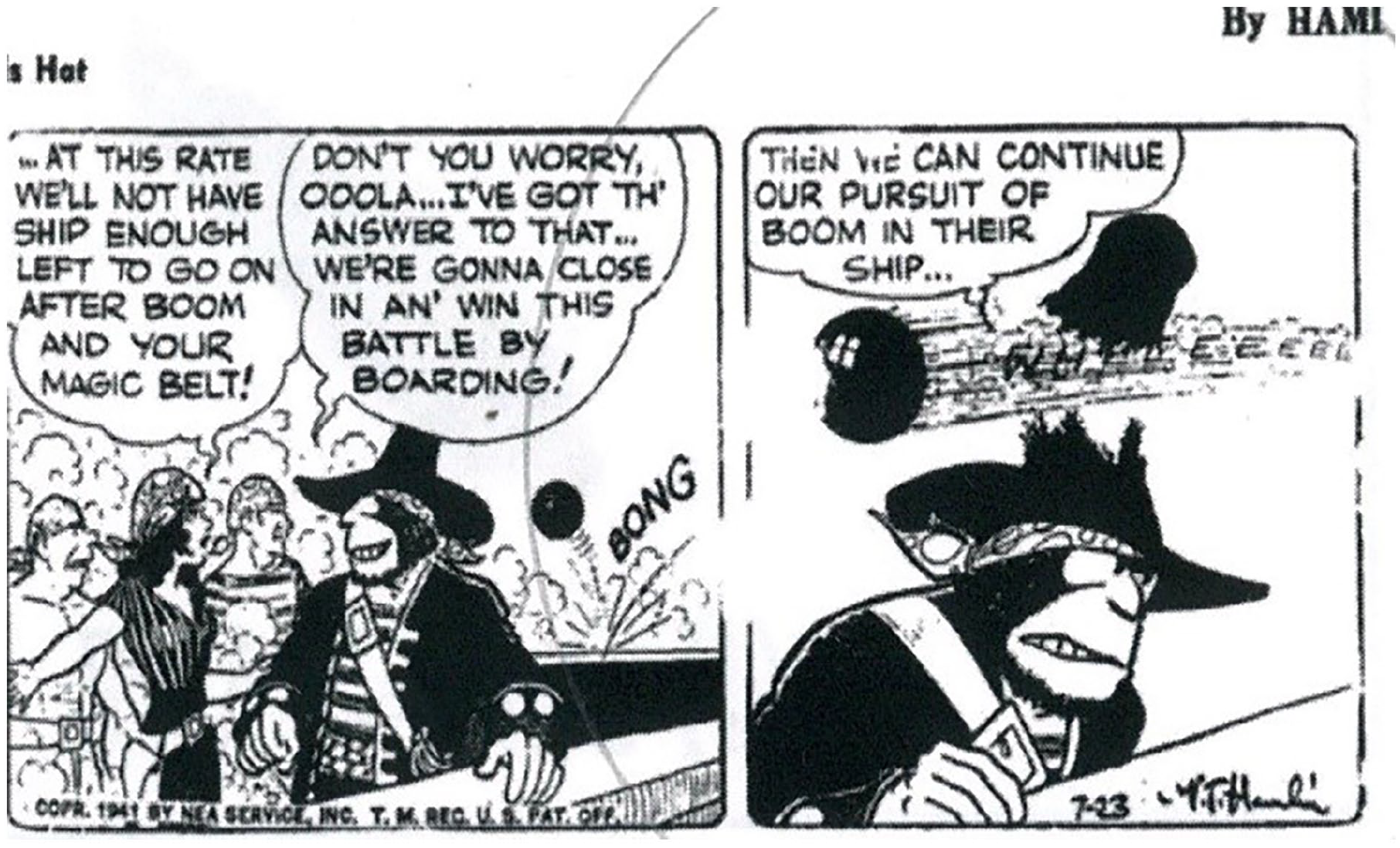
Detail, V.T. Hamlin, Alley Oop.

Kugler, untitled single panel.
The comics suggest a taste in drama and storytelling more extreme than most movies and comics of the same era (Figures 7 and 8) but with some exceptions.
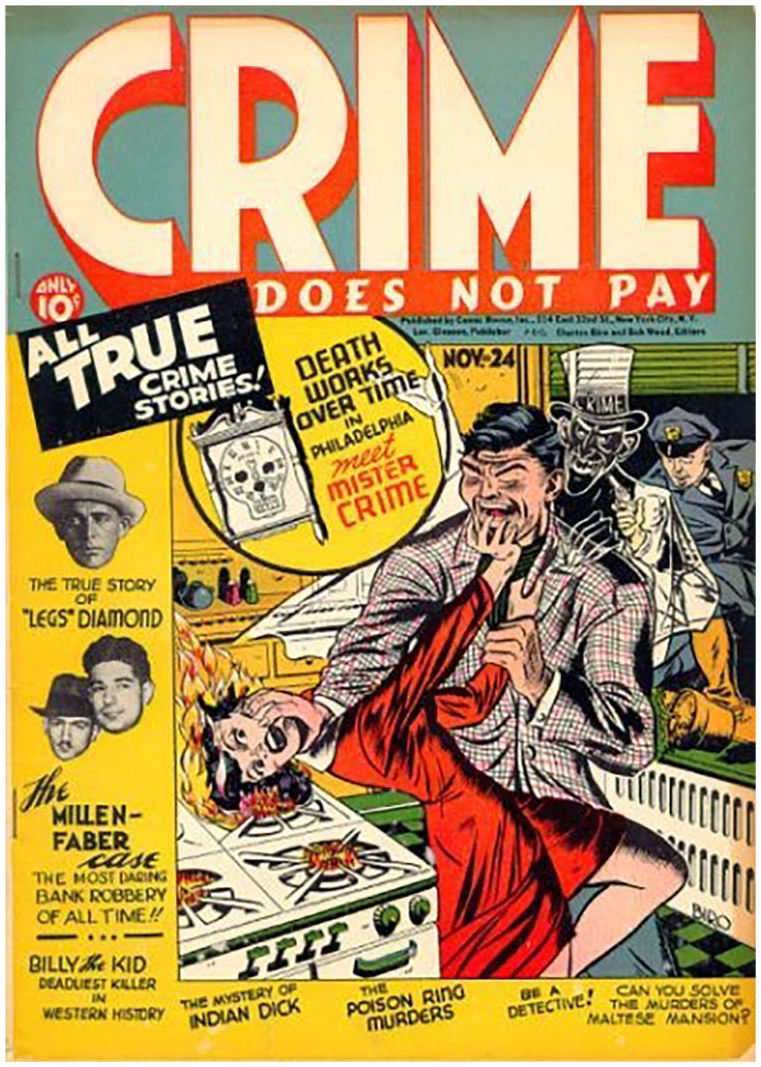
Charles Biro Cover, Crime Does Not Pay (#24, 1942).
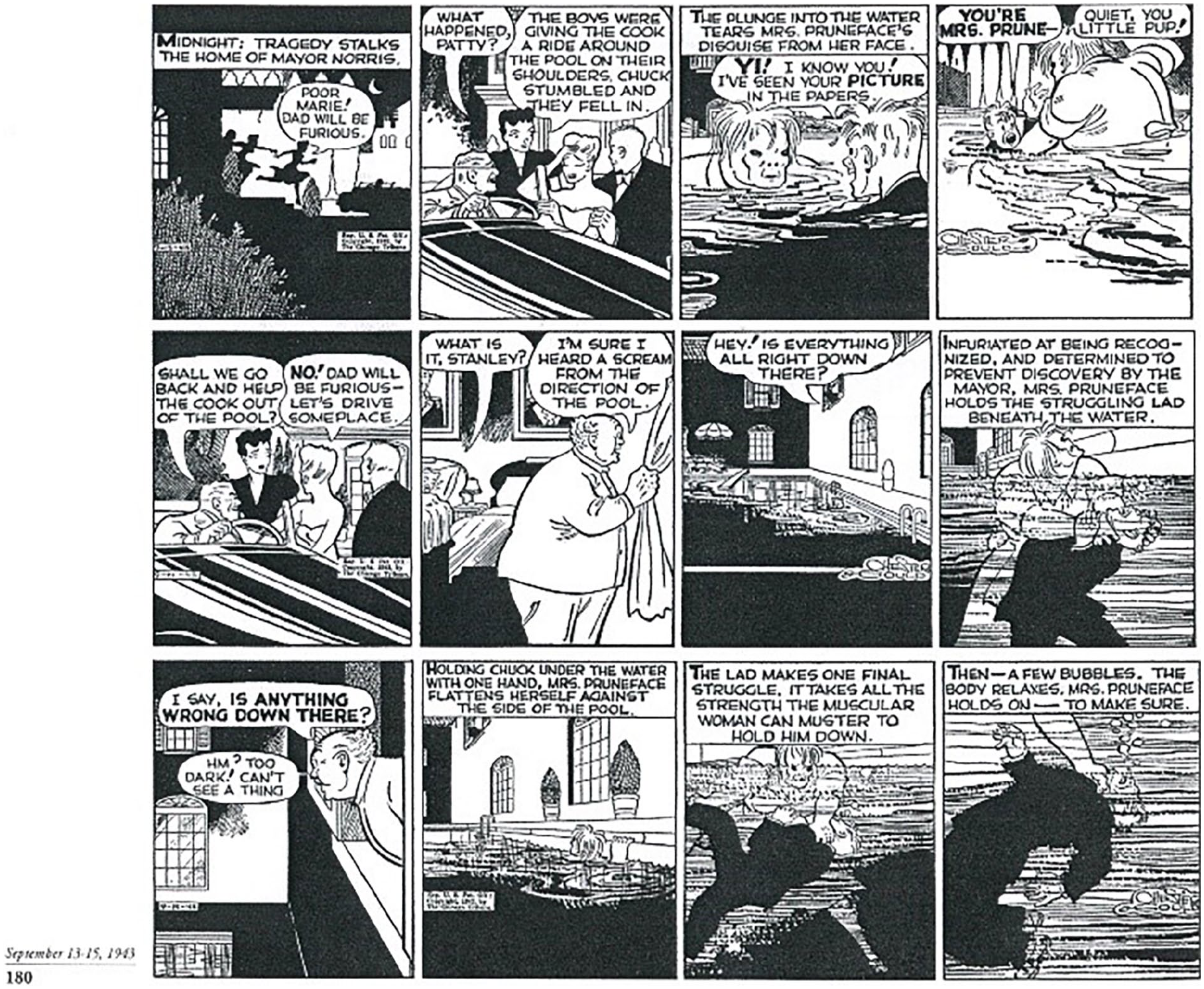
Chester Gould, Dick Tracy (September 13–15, 1943).
Such cruelty likely shocks readers. Biro’s assault is harrowing in its viciousness, while Gould cleverly conducts a slow murder across several frames. Each is intimate, a personal form of assault, completely indifferent to the victim’s cries. Death only completes the torture, inflicting the maximum possible pain with no other end than the victim’s drawn-out agony. A nearly unimaginable kind of humor offers another tone to the depravity (Figure 9).
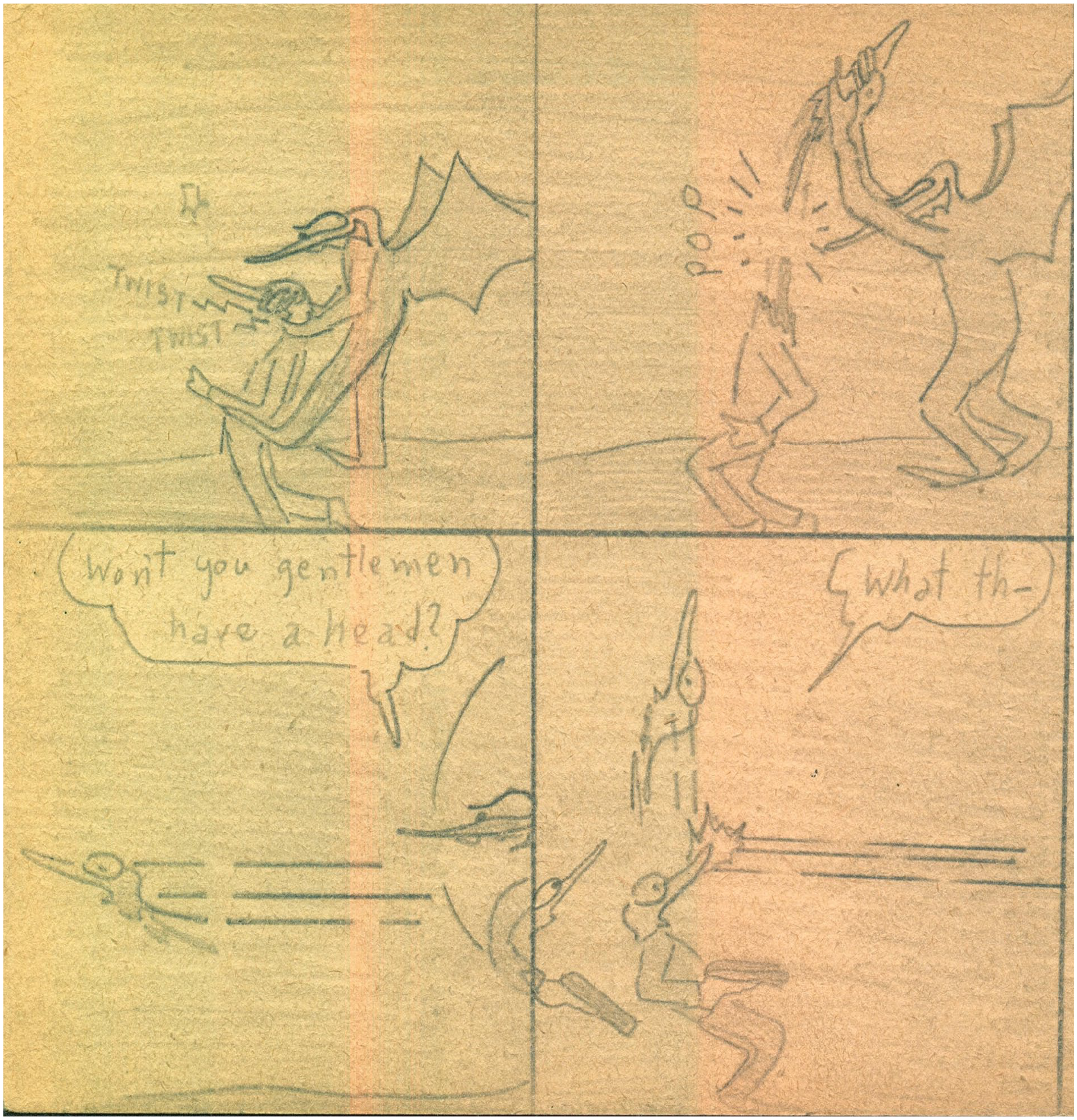
From Kugler, “The Mystery of the Winged Frogs”.
In cinema and comics the human face is perhaps our most defining characteristic. My father “defaced” this character. Does he suggest contempt for the character as a person? Is the humor conducted by this kind of shock?
I’ve concluded that my father drew most, if not all, of his war comics first, the horror and humor comics later. What does the transition from the war comics to the horror comics suggest? One significant carryover was the killer’s uncontrolled, sardonic laughter over his victim’s last struggles against death (Figures 10–12).

Kugler, From “The Famous War”.
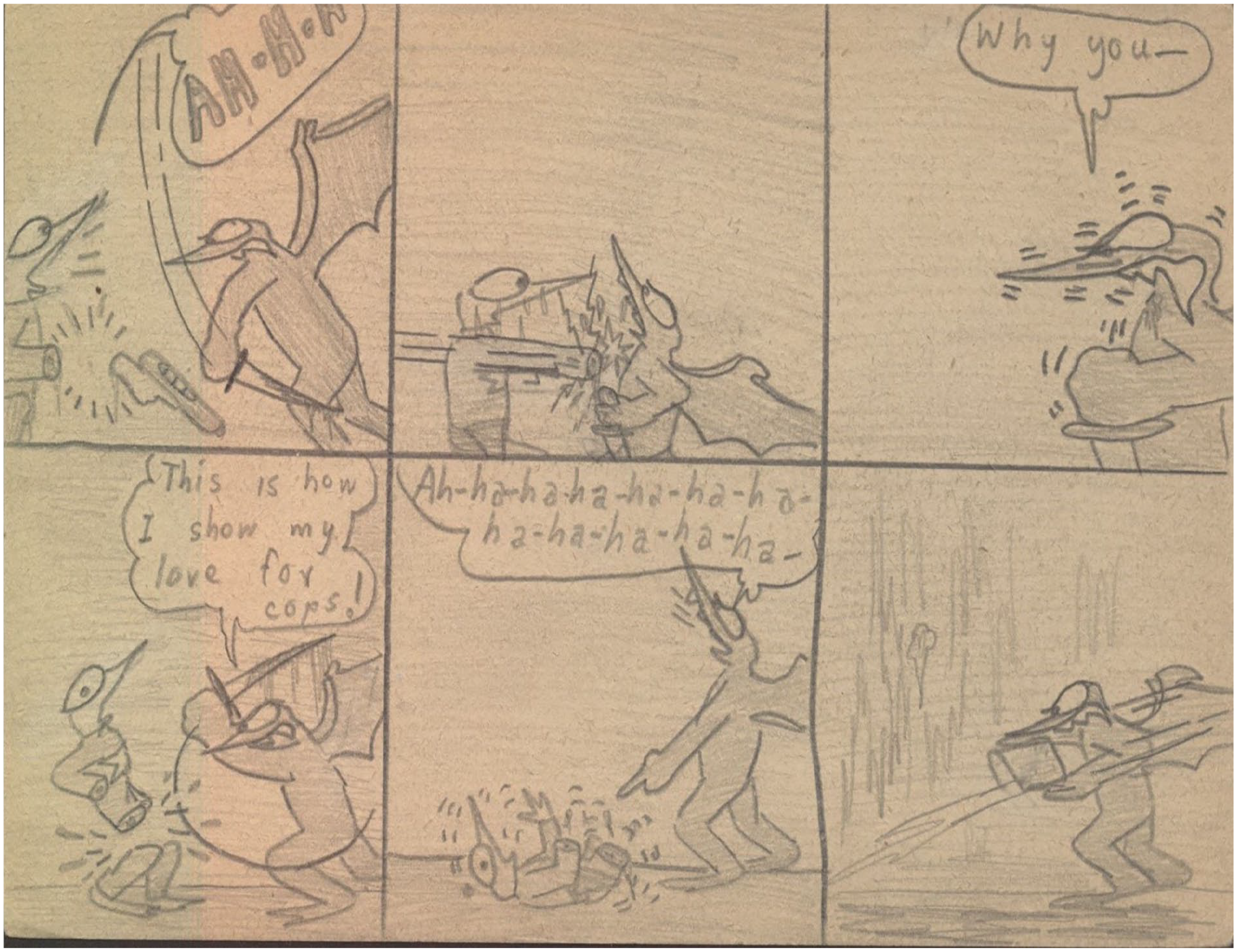
Kugler, From “The Mystery of the Winged Frogs”.
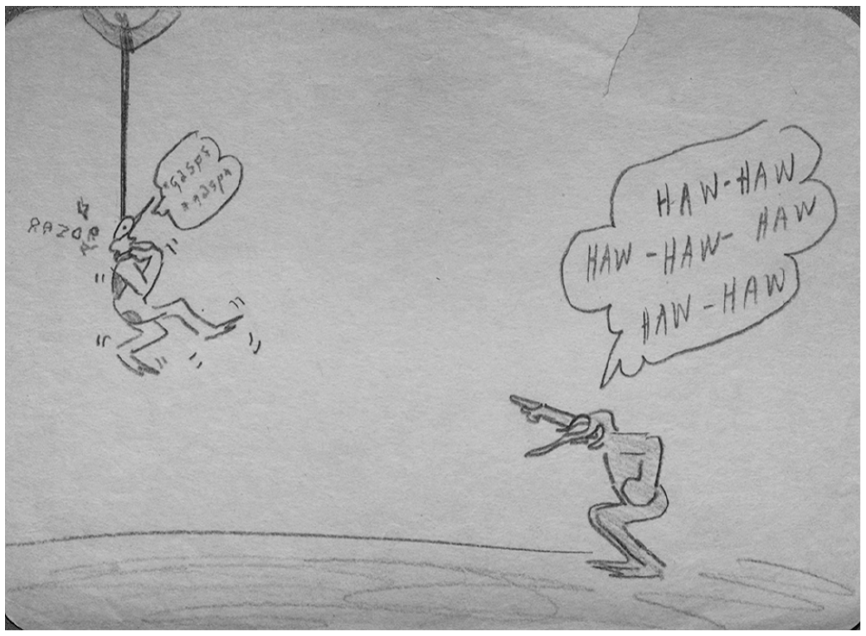
Kugler, From an Untitled Single Panel.
The frame captures a single moment of the victim’s struggles, one scene of a seemingly endless agony. As long as the victim writhes, the perpetrator watches and laughs. This response, the lusty “AH HAW HAW HA HA HA!,” appears to motivate the assault. If the war comics were earlier (or at least many of them; none of the composition sequences is clear), did they encourage a deeper dive into depictions of cruel violence and the accompanying black humor my dad apparently used to entertain his high school classmates? They apparently enjoyed the ludicrously slow, intimate, maiming murder of strangulation; or a ceaseless flogging over a meaningless violation of an arbitrary rule (Figure 13).
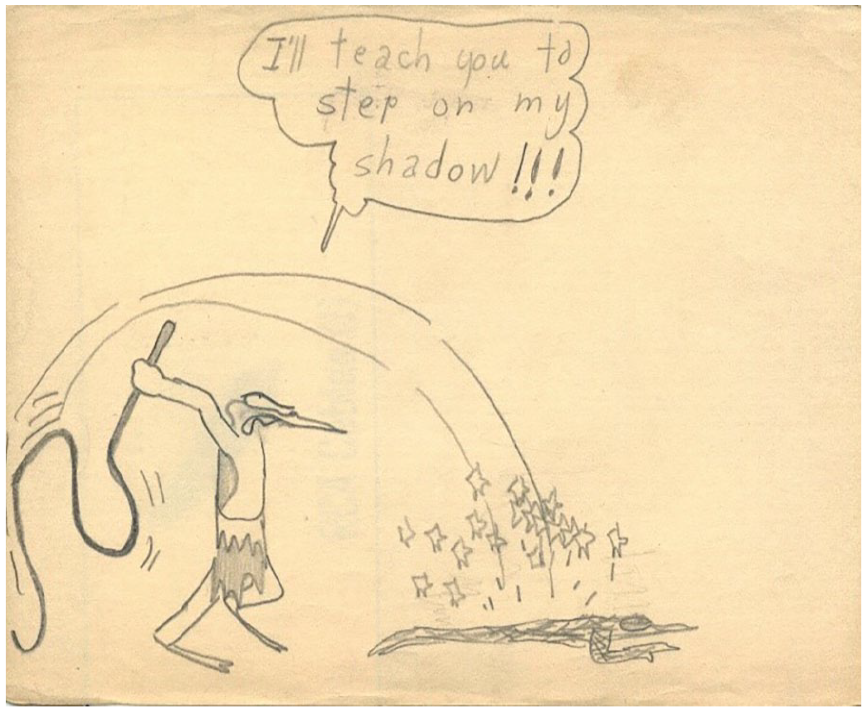
Kugler, From an Unnamed Panel.
Finally, American wartime propaganda, official and in popular media, encouraged my dad’s adolescent rebellion against authority, a kind of resistance to modern “progressive” education (Figures 14 and 15).
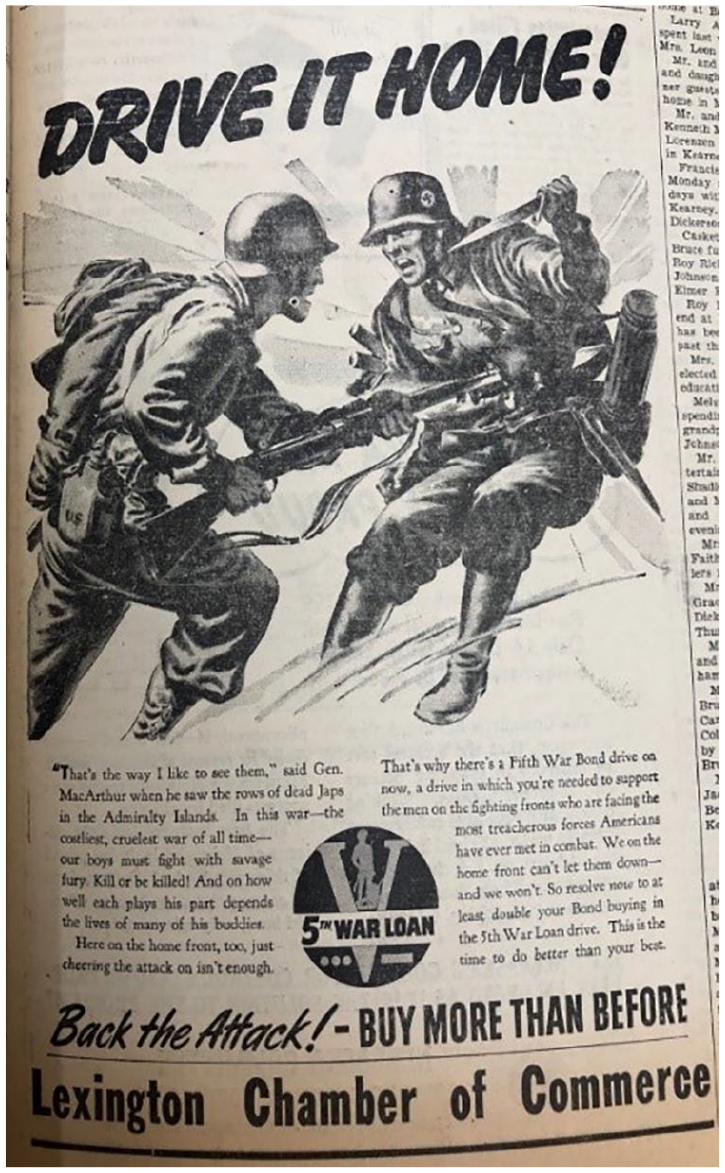
An Ad for the Fifth War Bond, Lexington Clipper, June 22, 1944.
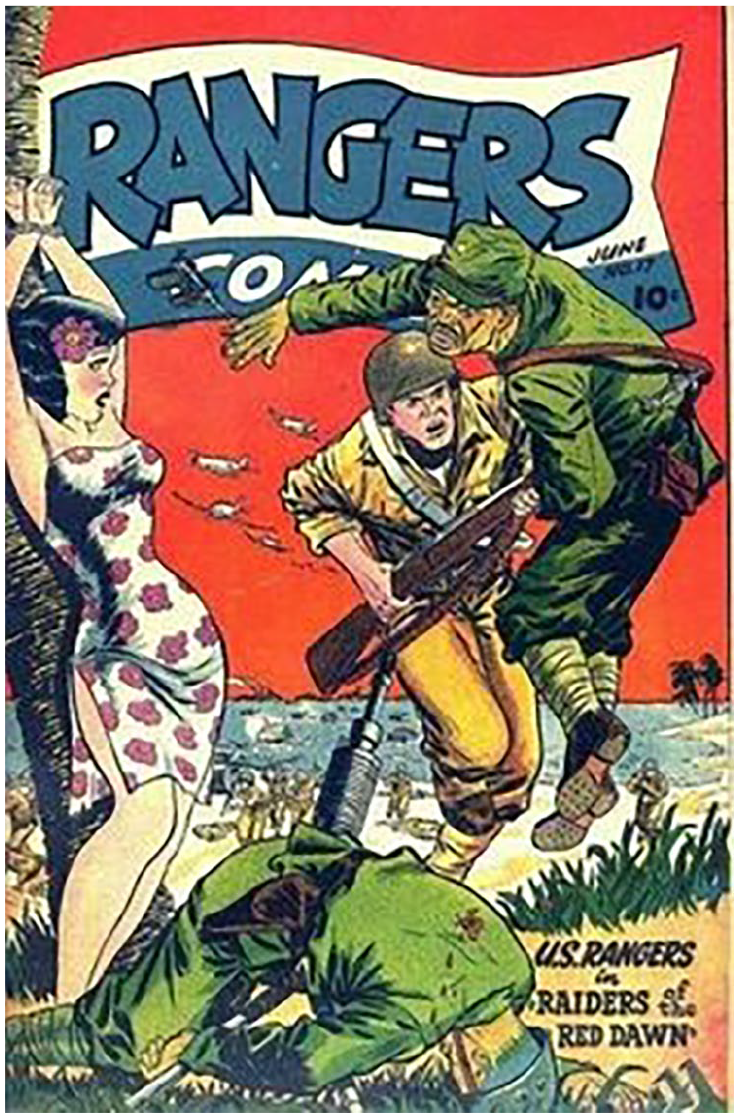
Rangers Comics #17 (June 1944), Cover by Art Saaf.
There is little doubt about official propaganda inspiring artists in supporting the war, enticing young buyers to empty their pockets for a comic whose cover was the down payment on more of the same inside. My father certainly aspired to a similar tone of vengeful violence. His perpetrators responded gleefully to the reader’s observation of intimate killing.
It is one thing to realize that your father’s comics are really violent, perhaps sadistically so. It is perhaps another to reflect that they are racist. What if they were, but not in conventional ways? His depiction of the Toad’s sawtooth smiles, their exterminationist cruelty, was consistent with propaganda and comic portraits of the Japanese military (Figures 16 and 17).
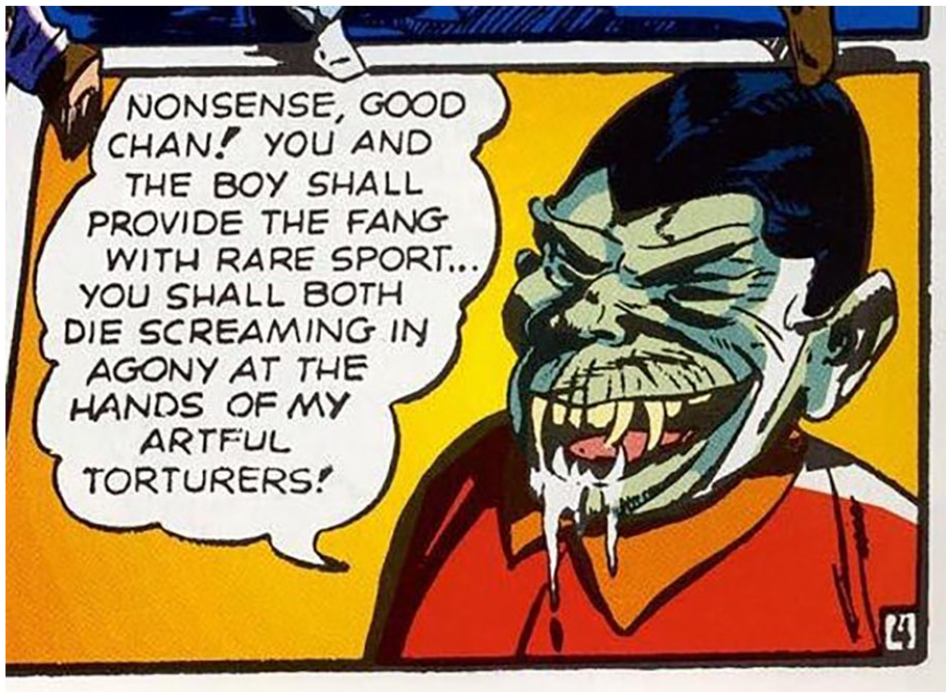
“Meet the Fang, Arch-Fiend of the Orient” Captain America #6, 1941, Jack Kirby and Joe Simon.
Kugler, Detail From “The Famous War”.
Other, apparently later drawings pitted “black” Frogs against “white” enemies. “Black,” capturing there the monstrous and wicked, suggested to my father more dramatically exciting opponents (Figure 18).
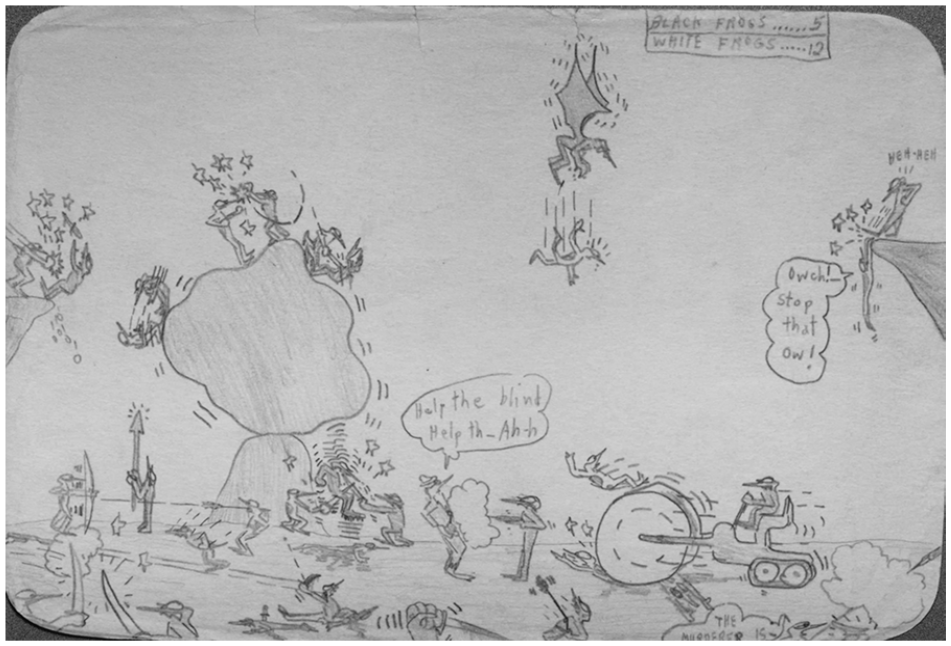
Kugler, Unnamed Single Panel.
Conclusion
Comics invite speculation about their deeper meaning. Parents, teachers, librarians and therapists long worried about the emotional and social consequences for their young audiences. 11 It takes little effort to notice that saving “the children” from pop culture—the theater, novels, athletics, movies, rock music, hip hop, video games—has long preoccupied cultural elites. This research, as I have argued, suggests the limits of such speculations. My mom explained that my father’s unhappy childhood helped draw them together. As a child I heard my dad testify to what he loved, and what frightened him, as a child. I thought of all of this as motives behind his fleeing small-town Nebraska. According to my mother, not long out of high school, my dad was jailed for stealing a car. I found no record of this. I did discover, to my surprise, the newspaper report of an August 1950 incident in which my dad and other high school grads committed a brutal hazing on incoming Lexington High School freshmen. 12 Can the latter person perhaps tell us about his earlier character? All we have is the debris field following a flood. Wading into the mud to collect artifacts, perhaps only leaky partitions separate all this.
Stories are very powerful human attempts to order the chaos around us, to comfort us, and to help explain the inexplicable (Clancy, 2005; Gottschall, 2021). But comfort us how? Historical protocols, academic ones generally, train us to find solace in the truth, beneath a realization that truth is often elusive and frail; partial; and ambiguous. Loving the truth, however, trusting its eventual worth, requires resisting the less relevant truths of the moment. It is remarkable how often historians turn to the poetics of religion for comprehending the “sacred” space of the document archive, traveling there as a “pilgrimage,” seeking in the document a “relic,” restoring the dead to contemporary memory as a kind of “resurrection” (Toolbeek, 2004, p. 241; Burton, 2006, p. 5). The discipline of history can serve as acts of repentance, practices of grace, to the people of the past and their descendants. If these comics deserve some kind of respect, it comes in honoring their rarity, respecting their creator’s earnest creativity, and listening for a voice, however disruptive, released from them, by the equally earnest methods of historical research.
Footnotes
Declaration of Conflicting Interests
The author(s) declared no potential conflicts of interest with respect to the research, authorship, and/or publication of this article.
Funding
The author(s) received no financial support for the research, authorship, and/or publication of this article.
