




Abstract
One increasingly important resource for victims of intimate partner violence (IPV) is domestic violence civil protection orders (POs). Using a transdisciplinary framework, this article critically examines the use of POs by IPV victims seeking shelter services. Previous contact with police and medical professionals are the strongest predictors of having obtained a PO; education level, income, age, race, and having children in the shelter are also significant predictors of having obtained a PO. These findings are discussed in the context of previous research on help-seeking behaviors and the growing body of transdisciplinary research on violence against women.
In 2003, women were the victims in approximately 5.3 million cases of intimate partner violence (IPV; Centers for Disease Control and Prevention [CDC], 2003). One resource for victims of IPV is domestic violence civil protection orders (POs). The purpose of a PO is to prohibit contact between the victim and abuser; an abuser who violates the order can be arrested/prosecuted. Receipt of a PO has been shown to decrease contact with an abusive partner as well as subsequent violence (Holt, Kernic, Wolf, & Rivara, 2003). The number of PO filings in the United States increased by 35% from 1994-2003 and, in several states, POs account for one quarter to one third of all domestic cases in the civil courts (Schauffler, LaFountain, Kauder, & Strickland, 2004).
Though the use of POs to combat IPV is increasing, relatively little is known about women’s decisions to seek POs or the pathways to obtaining POs. Previous research regarding the use of POs has used samples of women who have already filed for an order or sought legal assistance (McFarlane et al., 2004). Other analyses of the use of legal resources by IPV victims have examined the use of law enforcement and satisfaction with police response (Akers & Kaukinen, 2009; Coulter, Kuehnle, Byers, & Alfonso, 1999). By using a shelter-based sample that includes victims of IPV who have not sought orders, this analysis allows for a more comprehensive understanding of the use of POs by IPV victims, thus filling a gap in the PO and legal help-seeking literature.
This analysis is also innovative in that it—like other articles in this special issue—attempts to employ a transdisciplinary approach. Our focus is the contribution of this article to the discussion of transdisciplinarity through its subversion of the traditional relationship between academia and practice (Hoffman-Reim et al., 2008).
Literature Review
Most studies that focus on the use of legal resources by victims of IPV have examined when, why, and how victims contact law enforcement. This body of literature suggests that individual characteristics, relationship characteristics, and use of other resources are associated with reporting IPV to the police. Victims at or below the poverty level are more likely to call the police but less likely to speak with a lawyer in response to IPV (Hutchinson & Hirschel, 1998), and court fees prevent some victims from filing for POs (Eigenberg, McGuffee, Berry, & Hall, 2003). Education has also been found to be significantly and positively related to legal help-seeking among women (Duterte et al., 2008). Some studies have shown that African American women and Hispanic women tend to be overrepresented in their utilization of the criminal justice system in cases of IPV (Rennison & Welchans, 2000); others have shown that White women are more likely to engage in legal help seeking (Macy, Nurius, Kernic, & Holt, 2005).
The relationship between the victim and the abuser is also important. Women currently living with their abusers are less likely to use the criminal justice system (Fleury-Steiner, Bybee, Sullivan, Belknap, & Melton, 2006), and women who sought legal resources for IPV were less likely to be married than women who had not (Duterte et al., 2008). Women with children are more likely to call the police than women who do not have children, perhaps to protect the children from abuse (Bonomi, Holt, Martin, & Thompson, 2006). Previous research has also indicated that women who have experienced physical or sexual abuse (as opposed to psychological abuse only) are more likely to seek legal help (Bonomi et al., 2006; Duterte et al., 2008).
Finally, victims who have experience accessing legal resources, including contacting police, interactions with prosecutors, or filing for previous orders, may have greater knowledge of the law and, therefore, be more likely to file for a PO (Liang, Goodman, Tummala-Narra, & Weintraub, 2005). Some victims are unaware of the differences between the criminal justice and civil court system (Bennett, Goodman, & Dutton, 1999), may be confused as to the difference between POs and other types of orders, or may not know about the existence of POs.
Method
This is a secondary analysis of shelter intake data consisting of all adult female victims of IPV who completed intake forms at a single U.S. shelter (2004-2008) and reported that their abuser is a spouse, partner, former spouse, or former partner (N = 3,924). Due to missing data, the final sample includes 3,433 victims of IPV; of these, 32.25% were classified as having a PO. This includes women who reported that they had a current order of protection upon entering shelter (n = 565) or reported that they previously had an order of protection but do not have one currently (n = 542).
Independent Variables
Individual and relationship characteristics
The intake forms asked IPV victims entering shelter to report their annual income (including benefits), their date of birth (used to calculate age), race and ethnicity, marital status, and the number of years of education completed.
Abuse characteristics
Respondents were asked whether they had experienced physical, sexual, verbal, or economic abuse and whether they had ever been pregnant or had a miscarriage while in a relationship with an abusive intimate partner.
Criminal justice and medical system utilization
Respondents were asked whether the police had been contacted or had made an arrest in the most recent incident of violence, whether the police had ever been contacted or had ever arrested their intimate partner, whether the respondent ever received medical attention due to IPV, and whether the respondent had ever talked to a medical professional about IPV.
Analysis
Multivariate logistic regression was used to examine the effect of these variables on the probability of having obtained a PO. It is important to note that the cross-sectional nature of these data makes it impossible to know whether the significant variables in the model are causally related to the outcome; the relationships found between independent and dependent variables are associations.
Results
Sample Characteristics
As described in Table 1, mean respondent income is US$4,846/year. Less than 20% of respondents were working at the time of intake, and 42% report no annual income. Nearly 70% of respondents have a high school or greater education, and the mean number of years of education is 12.16 years. The average age is 34.94 years. The women are primarily White (45%) and more than two third of respondents were not married to their abusive partner. Forty-one percent of women brought children to shelter. Nearly all women reported physical (90%) and verbal (94%) abuse; 55% reported economic and 44% reported sexual abuse.
Select Respondent Characteristics, Logistic Regression Model
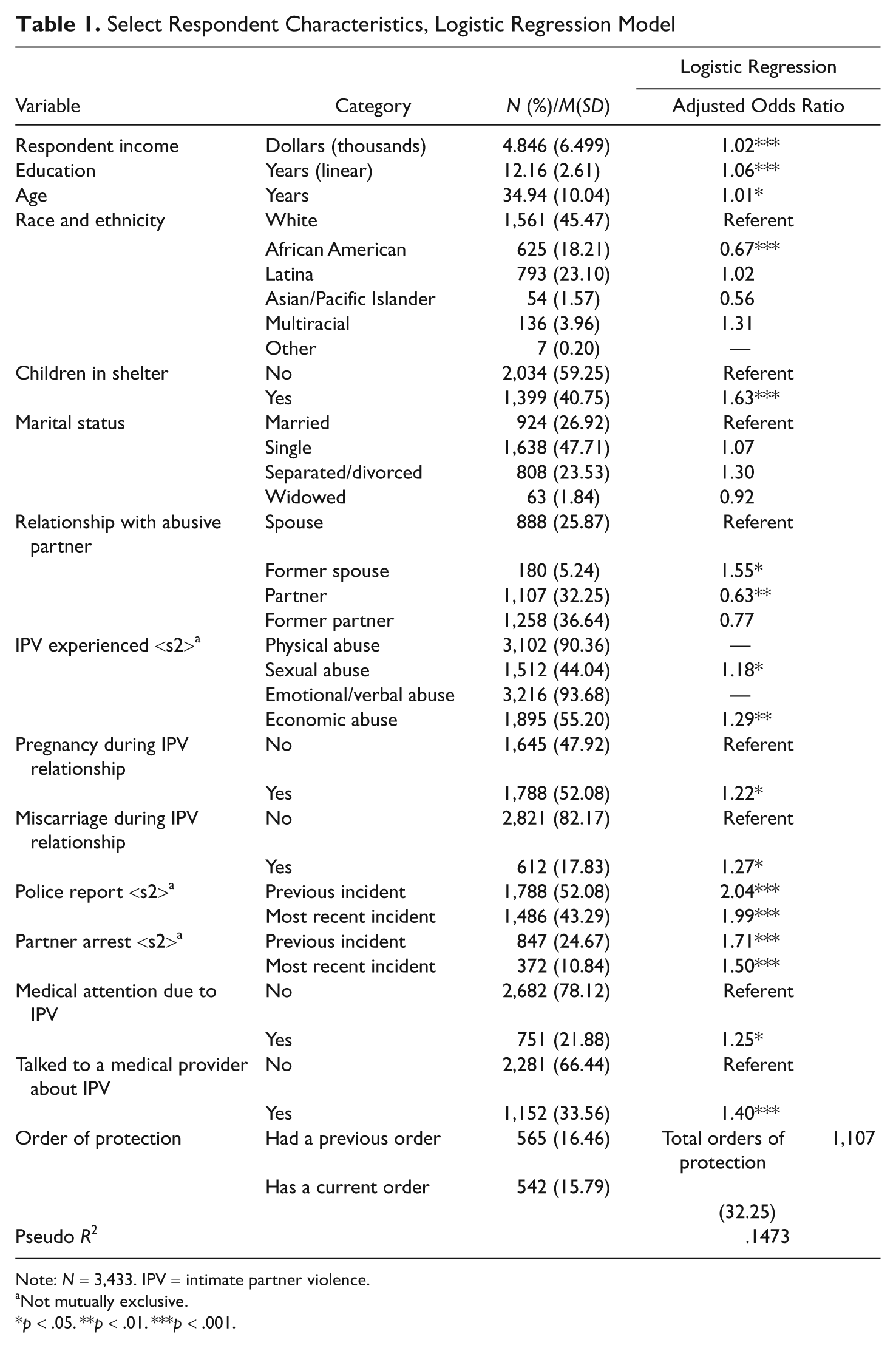
Note: N = 3,433. IPV = intimate partner violence.
Not mutually exclusive.
p < .05. **p < .01. ***p < .001.
Logistic Regression
Table 1 also shows the results of the multivariate logistic regression. Due to the lack of variance in the reporting of physical abuse and verbal abuse, these variables were not included. For each increase of US$1,000 in yearly income, there is a 2% increase in the likelihood of having obtained a PO; thus, someone with no annual income has a 27% likelihood of having obtained a PO and someone at the highest level of income in this sample (approximately US$40,000/year) has a 46% likelihood of obtaining a PO. Each additional year of education is associated with a 6% increase in the likelihood of having obtained a PO. Each additional year of age is associated with a 1% increase in the likelihood of having obtained a PO. African Americans were 33% less likely than Whites to have obtained a PO, though no other racial and ethnic groups were significantly different than Whites. Respondents who brought children with them to shelter were 63% more likely to have obtained a PO than women who did not bring children. Marital status is not associated with having obtained a PO, though the relationship to the abuser is. Describing the abuser as a partner (vs. spouse) was associated with a 37% decreased likelihood of having a PO. Describing the abuser as a former spouse was associated with a 61% increased likelihood of having obtained a PO.
In terms of abuse characteristics, experiences of sexual and economic abuse, as well as being pregnant and/or having a miscarriage during a relationship that involves IPV, are all significantly associated with the likelihood of having obtained a PO. Experiences of sexual abuse are associated with an 18% increase, and experiences of financial abuse are associated with a 29% increase in the likelihood of having obtained a PO. Pregnancy during a relationship that involved IPV was associated with a 22% increase, and having a miscarriage during a relationship that involved IPV is associated with a 27% increase in the likelihood of having obtained a PO.
Variables related to the use of the criminal justice and medical systems for assistance with IPV or IPV-related injury had the strongest relationships with obtaining a past or current PO. Police involvement in previous incidents of IPV is associated with a doubling of the likelihood of having obtained a PO. Police involvement in the most recent incident, previous arrest of the abuser, and arrest of the abuser due to the most recent incident of IPV are related to increases in the likelihood of having obtained a PO by 50% to 99%. In addition, both receipt of medical attention due to IPV and talking to a medical professional about IPV are associated with an increased likelihood of having obtained a PO.
Discussion
This study is one of the first to examine the use of the civil courts among victims of IPV entering shelter and, more specifically, to examine associations between having a PO and victim characteristics, abuse experiences, and other forms of help seeking. Previous studies focusing on POs have generally used samples of women who have accessed the legal system, either by filing for a PO or contacting police. We know very little about the pathways to obtaining POs, both in terms of how women learn about them and how they make decisions to use/not to use this resource.
Our analysis indicates that many victims of IPV who qualify for POs are not obtaining them. Of the women included in our sample, only 32% have ever had a PO—and half of those women did not have a current order in place. Yet some studies suggest that POs lead to increased feelings of safety and security (Logan & Walker, 2009) and improved police response to future IPV incidents (Chaudhuri & Daly, 2009; Connelly & Cavanagh, 2007). Future research should continue to examine the varying decisions that women make about filing for a PO and the factors statistically associated with those decisions, as well as the decision-making process of women who have chosen to seek a PO versus those who have not.
Both income and education level were statistically significant predictors of having obtained a PO. Previous research examining calls to the police has found mixed evidence of the importance of these variables (Akers & Kaukinen, 2009; Hutchinson & Hirschel, 1998; Macy et al., 2005). Obtaining a PO is a fairly complicated process that may take weeks and require the completion of several forms, whereas contacting law enforcement is done through a relatively simple phone call. Thus, filing for and obtaining a PO may be more akin to seeking help from a lawyer, which has been found to be more likely with increased income (Hutchinson & Hirschel, 1998). Those individuals who have higher incomes may be able to obtain POs because they can afford to retain legal representation; those individuals who have higher levels of education may be better able to complete the forms required and convey the necessity of having a PO.
Other forms of help seeking, particularly the use of law enforcement, are related to having a PO in this sample. Previous research has found seeking legal resources is related to seeking medical and social services, though other forms of help seeking are more consistently related to one another than to legal help seeking (Macy et al., 2005). It may also be true that women who have had positive experiences with law enforcement are more likely to consider the civil courts a resource; future research should work to understand the dynamics underlying these relationships. Consistent with previous research, women who reported sexual abuse were more likely to have POs (Duterte et al., 2008). This research also found that economic abuse was related to having a PO; future research should further explore this relationship.
Women who brought children into shelter with them were more likely to have a PO; this is similar to previous research that has found women with children are more likely to call the police (Bonomi et al., 2006). Also consistent with previous research on contacting law enforcement, women whose abusive partner was described as a former spouse are the most likely to utilize POs. The estrangement may be an important aspect of seeking a PO as the purpose of a PO—keeping the abuser away from the victim—is useful only when there is no voluntary contact between the parties. Having a pregnancy and having a miscarriage in a relationship that involved IPV were both significantly associated with obtaining a PO. Being pregnant during a relationship that involves IPV may simply reflect the same positive relationship with obtaining a PO as having children. However, as this effect is significant in a multivariate model that includes having children, this may also represent a differential effect. Having a miscarriage during a relationship that involved IPV is also associated with having a PO and may be an indicator of escalated abuse during pregnancy or abuse that led to a miscarriage. These factors should be examined in tandem to better understand women’s decision making about POs in the context of their relationships, children’s safety, and reproductive health.
It is important to note some limitations of this analysis and the data. First, we were unable to examine the frequency and/or severity of any of the types of violence reported. Women who experience more severe and/or frequent abuse are more likely to contact the police and/or seek medical attention (Akers & Kaukinen, 2009; Bonomi et al., 2006) and may be more likely to obtain a PO. Future research should explore this relationship. Second, we do not have information on the time ordering of independent and dependent variables. In particular, we cannot identify the causal order of other help-seeking behaviors and receipt of a PO. Victims may have contacted police and then made a decision to obtain a PO, but it is equally plausible that victims obtained a PO and then contacted police to report subsequent incidents of violence. Third, we cannot determine which women filed for POs and did not receive them. Finally, the sample may also be limited as shelter-based populations are not representative of all IPV victims (Hutchinson & Hirschel, 1998; Pennell, Burke, & Mulmat, 2002). Despite these limitations, this analysis provides an examination of the factors associated with obtaining a PO in a relatively large sample of abused help-seeking women.
One of the core strengths of this analysis is its transdisciplinary focus. Although transdisciplinary research has historically meant an incorporation of multiple disciplinary perspectives in a single project, we (and other transdisciplinary researchers) argue that an equally important element of transdisciplinary research is the bridging of the gap between academics and practitioners. We work to bridge this gap in two important ways. First, our analysis attempts to address the historical “mismatch between knowledge production in academia . . . and knowledge requests for solving societal problems” (Hoffman-Reim et al., 2008, p. 5). This project focuses on a pertinent issue identified by advocates and practitioners who work with victims of IPV in legal and shelter settings, utilizing the data collected by social service providers. The importance of understanding the use of POs by IPV victims has increased as jurisdictions increasingly rely on POs to prevent further acts of abuse. Data collected by the agency—for the purposes of client assessment, determination of service need, and for reporting to granting organizations—have been used by researchers to answer a question of both academic significance and practical importance to the agency. This research crosses the boundary between research and practice through the utilization of academic research methods to analyze practice-based data with the intention of informing research and practice audiences.
Second, theorists argue that a critical component of the transdisciplinary approach is a “fusion of disciplinary knowledge with the know-how of lay people that creates a new hybrid which is different than any specific constituent part” (Lawrence, 2004, pp. 488-489). We create such a hybrid by using data collected by a domestic violence shelter, incorporating variables identified by practitioners as salient to this analysis, and discussing and collaborating with shelter staff on the project. In doing so, we attempt to collectively generate “transformational knowledge” (Hoffman-Reim et al., 2008) that can be used to better assist victims of IPV. For example, the results presented here suggest that domestic violence service providers may need to engage in targeted outreach to ensure that groups of women who are not utilizing orders are aware of POs, know how to file for one, and that there are no structural barriers preventing them from obtaining orders. By crossing traditional research-practice boundaries, we are better able to understand help seeking among victims of IPV and create interventions that address the problem of IPV.
Footnotes
Acknowledgements
The authors wish to thank the shelter staff and director where these data were gathered, as well as the reviewers at Violence Against Women for their helpful insights and suggestions.
Declaration of Conflicting Interests
The authors declared no potential conflicts of interest with respect to the research, authorship, and/or publication of this article.
Funding
The authors received no financial support for the research, authorship, and/or publication of this article.