



Abstract
Expect Respect support groups, a selective prevention strategy, are designed to prevent and reduce dating violence among at-risk middle and high school students. This preliminary, uncontrolled evaluation examined changes in healthy relationship skills and emotionally and physically abusive behaviors in participants’ peer and dating relationships. Self-reports (N = 144) showed significant increases in healthy relationship skills from baseline to program completion, whereas levels of victimization and perpetration remained unchanged. A subgroup of students who reported baseline levels of victimization and perpetration with means at least one standard deviation above the group mean reported significantly less victimization and perpetration at program completion.
Introduction
The prevalence and consequences of teen dating violence make it a public health concern (Eaton, Davis, Barrios, Brener, & Noonan, 2007) that calls for early and effective prevention. Despite recent legislation in multiple states that requires schools to provide teen dating violence education, to date, only three prevention strategies—Safe Dates, the Youth Relationships Project (YRP), and the 4th R (Foshee et al., 1998; Wolfe et al., 2009, 2003)—have demonstrated reductions in dating violence behaviors in rigorous, controlled evaluations. In order to protect young people and build an evidence base of effective prevention strategies, evaluation of additional programs is needed, including those programs currently in the field (Teten, Ball, Valle, Noonan, & Rosenbluth, 2009).
The Expect Respect program has been developed over the past 20 years by SafePlace, a domestic violence and sexual assault victim service provider in Texas, and offers a comprehensive prevention model, including community engagement; school-wide, universal prevention strategies; youth leadership training; and a selective dating violence prevention program for at-risk youth. In 2003, the Expect Respect program was one of four programs chosen by the Centers for Disease Control and Prevention (CDC) to participate in an empowerment evaluation project that aimed to build capacity in the community agency for program improvement, manual development, and evaluation and to develop a knowledge base of evidence-based prevention efforts (Gibbs, Hawkins, Clinton-Sherrod, & Noonan, 2009; Noonan & Gibbs, 2009).
The empowerment evaluation and the current study focused on a unique component of the Expect Respect program, namely school-based support groups for at-risk youth who have experienced violence at home and/or in their peer and dating relationships. Weekly, separate sex groups, based on a 24-session curriculum (Ball, Rosenbluth, & Aoki, 2008), provide boys and girls a place to share their experiences, give and receive emotional support, and learn skills for healthy relationships. In 2007-2008, SafePlace provided 26 support groups in 16 secondary schools. This preliminary, uncontrolled evaluation is a first step in demonstrating outcomes of a selective, school-based teen dating violence prevention program that is being widely used locally and disseminated nationally. Although violence perpetration and victimization in dating relationships are the targeted outcomes of Expect Respect support groups, this preliminary evaluation asked participants to report on behaviors in their dating or close peer relationships as these behaviors were considered to be interrelated. Both students who were and were not dating at the time of the intervention were intended to be included in the evaluation.
Background: Peer and Dating Violence Among Teens
Prevalence
Teens are at risk for experiencing dating abuse, including emotional abuse and physical and sexual violence, beginning with the initiation of dating relationships during early adolescence. A majority of dating 11- to 14-year-olds (62%) report that they know friends who have been verbally abused and one in five 13- to 14-year-olds (20%) say they know friends and peers who have been physically abused by a dating partner (Teen Research Unlimited, 2008). Rates of dating violence victimization vary based on age, form of violence assessed, and measurement of dating violence with most studies suggesting 10% to 30% of student samples have experienced some form of violence (Hickman, Jaycox, & Aronoff, 2004; Silverman, Raj, Mucci, & Hathaway, 2001). Surveys of teen dating violence consistently indicate a higher percentage of girls than boys perpetrate physical dating violence (e.g., Hickman et al., 2004); however, the effects of male- and female-perpetrated physically violent acts differ substantially as higher rates of injury sustained and fear evoked are reported for male-on-female violence (e.g., Molidor, Tolman, & Kober, 2000). Although the context, meaning, and effect of violent behaviors may differ between boys and girls, studies nevertheless point to the importance of supporting both boys and girls in learning skills for healthy relationships and beginning programs in middle schools.
Risk Factors
A public health approach to prevention suggests targeting risk factors for dating violence that exist at multiple levels, including the individual, relationships, community, and society. Expect Respect support groups target youth with risk factors at the relational level, namely, aggressive or violent family and peer environments. Multiple studies suggest that teens’ experiences with violence in their family (witnessing interparental violence; child maltreatment) are linked with the perpetration of dating violence (e.g., O’Keefe, 1998; Wolfe, Wekerle, Scott, & Pittman, 2001) and with the perpetration of peer and delinquency-related violence (e.g., Brendgen, Vitaro, Tremblay, & Wanner, 2002; Resnick, Ireland, & Borowsky, 2004). Furthermore, recent research (Pepler et al., 2006) points to a continuum of interpersonal violence from bullying in peer relationships to teen dating violence. Boys and girls who use power and aggression in their peer relationships, as evidenced by bullying behaviors or conduct problems, are also more likely to sexually harass same- and opposite-sex peers and are more likely to be physically aggressive with their dating partners (Brendgen et al., 2002; Pepler et al., 2006; Williams, Conolly, Pepler, Craig, & Laporte, 2008). Arriaga and Foshee (2004) found that having friends in violent relationships more strongly predicted dating violence perpetration and victimization than witnessing interparental violence. Multiple experiences of violence in relationships across social contexts, lack of positive role models, and violence-supportive peer group norms (Reed et al., 2008) appear to be interacting factors that increase the risk for experiencing or inflicting peer and dating violence.
Prevention for At-Risk Youth
Prevention approaches for dating violence may be applied universally to all individuals in a population or selective, and more intensive prevention approaches may be developed for those youth who are at increased risk for dating violence perpetration or victimization (Eaton et al., 2007; Pepler et al., 2006; Whitaker et al., 2006; Williams et al., 2008; Wolfe et al., 2003). Universal approaches are often didactic and classroom based, aiming to educate teens about healthy and abusive relationships (e.g., Avery-Leaf, Cascardi, O’Leary, & Cano, 1997; Foshee et al., 1998; Jaffe, Suderman, Reitzel, & Killip, 1992; Schewe, 2002; Wolfe et al., 2009) with the most prominent and rigorously evaluated programs being Safe Dates and the 4th R. In contrast, selective approaches may be tailored to the particular needs of the at-risk group and offered during the school day but outside of a classroom curriculum. Because some students may evidence higher risk for dating violence, the intensity of a selective, in addition to (or in place of), a universal strategy may be needed for these students (e.g., Eaton et al., 2007; Whitaker et al., 2006). Experts have recommended intensive prevention programs for youth who have experienced violence in the family and in the community and who perpetrate or experience abuse in their peer and early dating relationships (Pepler et al., 2006; Williams et al., 2008; Wolfe et al., 2003). Selective prevention programs may counter risk factors, such as violence-supportive attitudes (Capaldi, Dishion, Stoolmiller, & Yoerger, 2001) and enhance potential protective factors, such as establishing positive relationship norms in the peer group (Williams et al., 2008). Cornelius and Resseguie (2007) suggest that a skill-building component to improve proficiency of communication, negotiation, and problem-solving skills increases the likelihood of behavior change. Teens themselves express the importance of learning skills and ask for assistance in learning “how to make relationships work” (Ball, Kerig, & Rosenbluth, 2009; Sears, Byers, Whelan, & Saint-Pierre, 2006).
Thus far, the YRP (Wolfe et al., 2003) is the only published and rigorously evaluated dating violence prevention program that targets at-risk adolescents. The YRP is an 18-session program that provides coeducational groups in community locations for youth with a history of maltreatment. The controlled evaluation demonstrated decreases in abuse perpetration and victimization and emotional distress symptoms; however, participants did not show expected growth in healthy relationship skills.
The Expect Respect Program
The Expect Respect program began in 1988 when school counselors requested services for girls in abusive relationships. SafePlace counselors initially adapted materials and methods from their work with adult battered women to educate girls about abusive and healthy relationships and to increase supportive peer relationships at school. Recognizing the specific needs for preventing dating violence among at-risk youth, SafePlace developed the Expect Respect support group program for girls and then expanded it for boys in middle school and high school. Separate-sex groups are intended to increase participants’ sense of emotional safety and comfort, allow them to bond more quickly and more freely explore their expectations for relationships. Groups are led by same-sex facilitators who endorse and model nonviolent, gender-equitable behavior. To maximize accessibility Expect Respect support groups are offered in the school, a social environment where about 40% of the worst dating violence incidents occur (Molidor et al., 2000).
Expect Respect addresses dating violence among at-risk students as a problem that is fueled by gender norms that promote male dominance, the need to control and exert power, negative role models among adults and peers, acceptance and justification of violence, trauma, and a deficit in social skills. The curriculum (Ball et al., 2008) is based on 20 years of experience with implementing boys’ and girls’ groups and is informed by interviews with group participants and group facilitators. The 24 sessions are structured around five units: (a) developing group skills (5 sessions), (b) choosing equality and respect (5 sessions), (c) recognizing abusive relationships (5 sessions), (d) learning skills for healthy relationships (5 sessions), and (e) becoming active proponents for safe and healthy relationships (4 sessions). Each 55-minute group session consists of a brief check-in (5 min), an educational component (15 min), group activities and discussion (30 min), and a wrap-up (5 min). Group activities include role plays, educational videos, and creative expression through art and poetry and are designed to engage students in a variety of learning experiences. Relationship skills, such as listening, providing emotional support, sharing personal experiences, expressing emotions, and problem solving, are practiced in activities and are also an integral part of the group process. Support group facilitators work creatively with the curriculum, adapt the activities and discussion topics to the specific needs of their group, and allow time for handling crises, individual concerns, and group dynamics (Kendall, Chu, Gifford, Hayes, & Nauta, 1999).
The first, qualitative step in the program evaluation was based on group interviews with participants (Ball et al., 2009). Participants suggested that Expect Respect support groups were valuable in building skills for healthy relationships, developing norms for relationships based on equality and respect, expanding awareness of their own and others’ abusive behaviors, and acquiring knowledge about healthy relationships and warning signs of abuse. Boys and girls expressed that group members developed supportive relationships with each other and with their adult facilitators. They noted that positive relationships modeled in the group setting provided support for learning and applying new skills outside of the group. Although the same curriculum was used in boys’ and girls’ groups, some gender-specific outcomes were demonstrated. Boys emphasized improved communication skills and anger control, whereas girls reported increased assertiveness, self-esteem, and expectations to be treated with respect by a dating partner.
Building on the results of the earlier qualitative evaluation, the current quantitative study examined the extent to which Expect Respect support groups promote healthy relationship skills and prevent and reduce peer and dating violence among at-risk students and explored whether differential outcomes occurred as a function of frequency of perpetration or victimization reported at baseline. We hypothesized that youth who reported high frequency of perpetration and victimization by partners and/or peers at baseline would show a reduction in these behaviors at completion of the program. For students who reported no recent violence, we expected the group would prevent the onset of dating and/or peer violence during the intervention. Measurements were chosen to focus on behaviors, rather than knowledge and attitudes.
Method
Participants
Students were primarily referred by school counselors and teachers, although self-referrals occurred as well. Expect Respect facilitators provided orientation sessions for school staff to raise awareness about risk factors and warning signs of teen dating violence, to promote the program, and to obtain referrals. The program was also advertised in schools through posters and school newsletters.
During the individual intake interview, facilitators explained the confidentiality policy and mandatory reporting requirements. Students gave their own written assent for participating in the support groups and in the program evaluation. A parent notification letter was provided to students explaining that Expect Respect support groups are intended to help youth achieve safe and healthy relationships at school and at home. Parental consent was not required for participation because students eligible for the Expect Respect support groups include youth who have witnessed domestic violence and/or experienced child abuse. These participants might experience fear, anxiety, or danger with respect to obtaining consent for a teen dating violence prevention program evaluation from potentially abusive parents/guardians.
Only students who reported being the victim or perpetrator of at least one form of previous violence (domestic violence, child maltreatment, peer violence, including bullying and sexual harassment, dating violence, sexual violence) were eligible for the program and completed a baseline assessment at the end of the intake interview. Expect Respect facilitators explained to students that the group would last 24 sessions, that participation was voluntary, and that the following topics would be covered: developing group skills, defining equality and respect, recognizing abusive relationships, learning skills for conflict resolution, and raising awareness among peers. Facilitators met with students in weekly group sessions at school, in a private and consistent location.
The program evaluation included Expect Respect support group members from seven middle schools and nine high schools in an urban area in the South Central United States. Because some schools offered more than one group, a total of 26 support groups were provided in 2007-2008. Of these, 14 groups were boys’ groups and 12 were girls’ groups. A total of 276 eligible students completed an intake interview and a baseline assessment; of these, 20 were referred for a higher level of services and 13 declined to participate in a group, resulting in 243 eligible and enrolled participants.
An additional assessment was completed during the next-to-last group session. A total of 144 students, 59% of the eligible and enrolled students, completed assessments at both baseline and completion and constitute the sample for these analyses. Students who did not participate in the completion assessment were not significantly different on measures of perpetration, F(1, 272) = 1.22, p = .27; victimization, F(1, 272) = 2.57, p = .11; or use of healthy relationship skills, F(2, 272) = 0.08, p = .78, as assessed at intake. Reasons for not participating in the completion assessment included dropping out as a result of changing schools (n = 52), unspecified reasons (n = 10), conflicts with academic requirements (n = 7), arrest or removal to the alternative learning center (n = 4), and absence on the day of the completion assessment (n = 27).
Of the 144 students with data at both time points, 54% (n = 77) were male and 46% (n = 67) were female. As much as 65% of students (n = 92) were Hispanic, 21% (n = 30) were non-Hispanic Black, 5% (n = 7) were non-Hispanic White, and 9% (n = 12) indicated their ethnicity as “Other” or “multiracial”. Forty-two percent of students (n = 60) attended groups in middle schools (Grades 6-8) and 58% (n = 84) were in high school (Grades 9-12). Groups consisted of students of various grade levels at their respective school.
During the 2007-2008 school year, the average group length for girls was 23 sessions (SD = 2) and for boys 18 sessions (SD = 2). External circumstances, such as mandated testing days, resulted in a shortened program for some boys’ groups. Due to the flexible nature of the curriculum that provides multiple and repeated opportunities for participants to practice new skills, facilitators were able to condense the curriculum while still covering all content areas. Participants in shorter groups, however, may have had less time to engage in personal sharing and group bonding activities. Girls who completed both assessments at baseline and program completion attended an average of 17 group sessions (SD = 5; 75% of sessions offered); boys who completed both assessments attended an average of 12 group sessions (SD = 5; 71% of sessions offered).
Expect Respect support group facilitators
All support group facilitators (n = 5, 2 male and 3 female facilitators) were employed by SafePlace and included licensed master’s level social workers (n = 1), master’s level counselors (n = 2), or paraprofessionals (n = 2), who had more than 3 years of experience in working with youth and had completed 15 hours of training on teen dating violence and support group facilitation. Facilitators received weekly group and weekly individual supervision with the counseling manager, a licensed social worker with 10 years of experience in developing and implementing Expect Respect support groups. Supervision provided ongoing training and support for implementing the curriculum, problem-solving challenges with group logistics, attendance, or group dynamics, and ensuring adherence to the program model. An assessment documenting facilitators’ adherence to the program model was not conducted.
Measures
Measures were selected to reflect the key program goals of decreasing emotional and physical abuse perpetration and victimization and increasing healthy conflict resolution skills. In the process of developing the assessment instrument, we reviewed the Conflict in Adolescent Dating Relationships Inventory (CADRI; Wolfe, Scott et al., 2001) and the measures used in the Safe Dates evaluation (Foshee et al., 1998). The assessment instrument for this study was developed to match the reading level of participants and to be concise enough to be completed in approximately 20 minutes, which was believed necessary to avoid response fatigue.
In this preliminary evaluation, we did not ask participants whether they were dating or not dating at the time of baseline and follow-up survey as we intended to include all participants in the evaluation. Middle and high school teens typically engage in fluid relationships that may vary greatly in length, level of commitment, and time spent together. They may not be dating at both time points or have multiple partners throughout the school year. Furthermore, research suggests that the quality of peer relationships has a strong impact on romantic relationships. Supportive relationships and skills built in the peer group carry over to positive experiences in dating relationships (Brendgen et al., 2002; Pepler et al., 2006; Williams et al., 2008). We therefore decided for this preliminary evaluation with a limited sample size to assess healthy conflict resolution, perpetration, and victimization, respectively, across the spectrum of peer and dating relationships while acknowledging the limitations.
The instructions for the items in the baseline and completion assessment were: “In the past 3 months, when you had a conflict or an argument with your boyfriend, girlfriend, or a close friend how often did the following things happen?” Each question was asked twice, once in relation to the participant’s behaviors toward a boyfriend/girlfriend or close friend and once in relation to a boyfriend’s/girlfriend’s or close friend’s behavior toward the participant. Participants responded on a 4-point Likert-type scale where, 3 = Often, 2 = Sometimes, 1 = Rarely, and 0 = Never. A copy of the instrument is provided in Table 1.
Expect Respect Survey

Violence in peer and dating relationships
Violence perpetration/victimization was assessed using a 10-item scale, containing 8 items on emotional violence perpetration/victimization (e.g., “I made fun of them in front of others, I blamed them for bad things I did”) and 2 items on physical abuse perpetration/victimization (e.g., “I slapped them, I threw something at them”). At pretest, the perpetration scale had a Cronbach’s alpha of .88; the victimization scale had a Cronbach’s alpha of .90.
Healthy conflict resolution in peer and dating relationships
Healthy conflict resolution was assessed using 10 items (e.g., “I offered a solution that would make us both happy, I put off talking until we both calmed down”). Behaviors reported for self and boyfriend/girlfriend or close friend were combined in one scale. The Cronbach’s alpha for the healthy conflict resolution scale was .90 at pretest.
Data Analysis
A total of 144 participants completed at least part of the baseline and completion questionnaires. Because a few participants did not answer all questions, we utilized listwise deletion, such that for some analyses, the sample population was slightly less than 144. Although only 144 participants completed a posttest, noncompleters and completers did not differ on reports of violence at baseline, though they may have differed on variables we did not assess.
We computed a mean score for each respondent for each of the scales. Following descriptive analyses, we used paired t tests to examine behavioral changes from program initiation to program completion. We then examined the possibility that response to the support groups varied based on the participants’ reports of violence at baseline, as past work has shown that youth who report recent violence may be at increased risk for recurrence of perpetration or victimization (e.g., Williams et al., 2008). For this analysis, we identified participants whose reports of violence at pretest were at least 1 standard deviation above the mean. We reran the paired t tests with this high-risk group. Finally, in an exploratory analysis, we sought to understand what characteristics or behaviors at pretest predicted behaviors at posttest for the full sample. This analysis would identify potential moderators and mediators of change for the intervention. Due to power limitations, we did not perform this test for the high-risk group alone. For this analysis, we performed three simultaneous entry linear regressions for each of the following dependent variables: posttest victimization, perpetration, and healthy conflict resolution skills. Independent variables were pretest victimization, perpetration, and healthy conflict resolution skills. We also included biological sex (male, female), grade-level (middle school, high school), and number of sessions attended as covariates.
Results
Means, standard deviations, and t tests for the full sample are reported in Table 2. No significant mean difference between pre- and post-tests was identified for violence victimization or perpetration. Support group participants reported using significantly more healthy conflict resolution skills at posttest than at pretest, t(142) = −3.31, p = .001.
Means and Standard Deviations for Violence and Healthy Conflict Resolution Skills at Pre- and Post-Tests
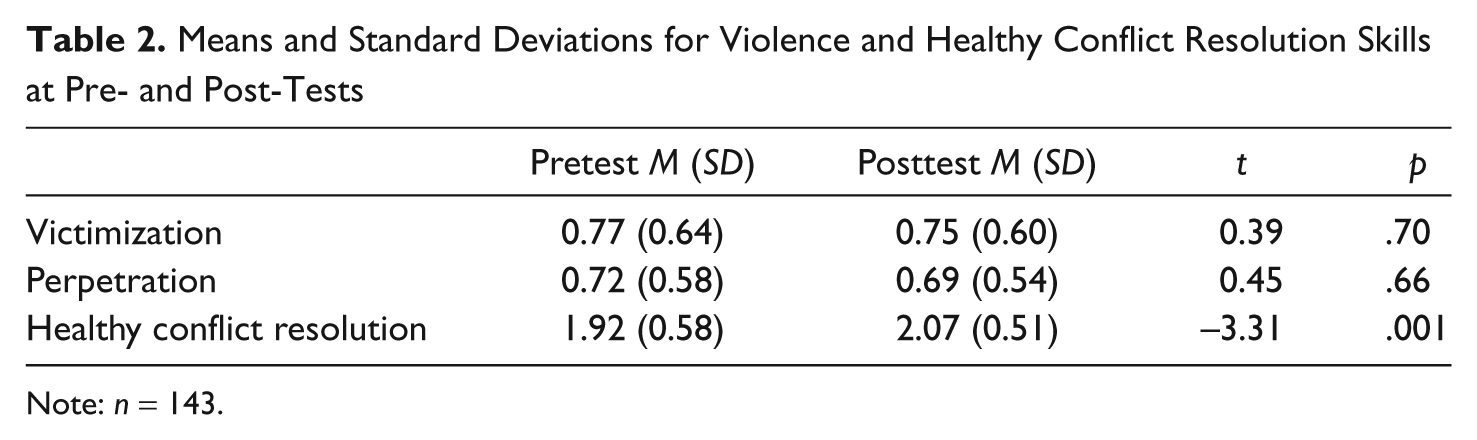
Note: n = 143.
We then identified participants who reported violent victimization and perpetration means that were at least 1 standard deviation above the group mean at pretest. For victimization, 24 participants had means greater than 2.05, and 24 participants had perpetration means greater than 1.88. These groups were not mutually exclusive, and 15 (62.5%) of the students identified as high risk for perpetration were also at high risk for victimization, χ2 = 43.16, p < .001. Because of the substantial overlap between groups, which indicated many of the students who reported victimization at pretest also reported perpetration, we collapsed victimization and perpetration categories, such that participants with means at least 1 standard deviation above the mean for victimization or perpetration were included in the high-risk group (n = 33). As shown in Table 3, the subset of high-risk participants reported significantly less perpetration, t(32) = 3.53, p = .001, and victimization, t(32) = 4.54, p < .001, after participating in the intervention.
Means and Standard Deviations for Violence and Healthy Conflict Resolution Skills at Pre- and Post-Tests for High-Risk Participants
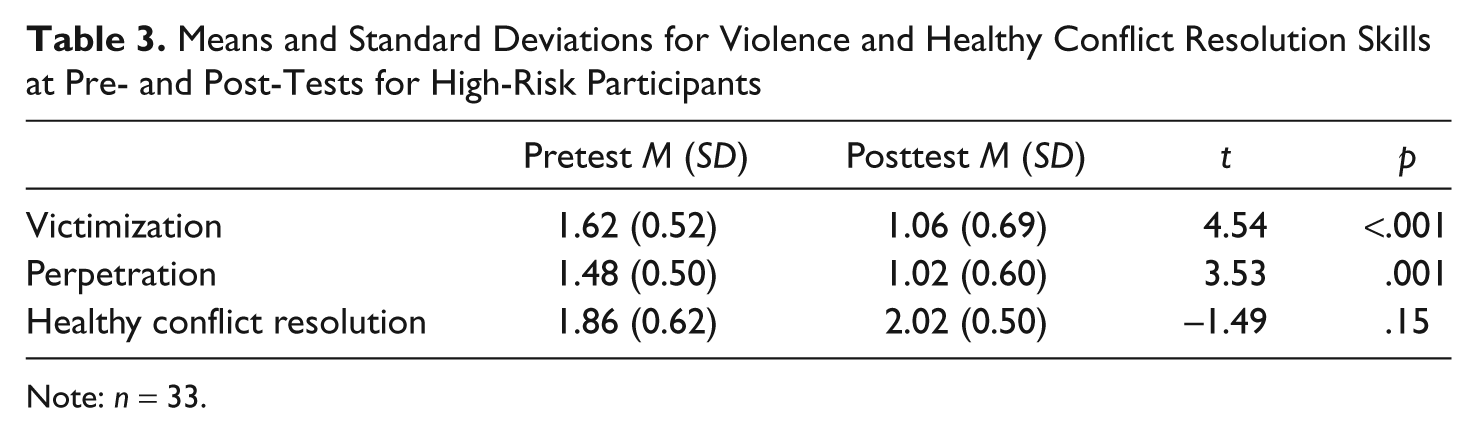
Note: n = 33.
For the exploratory analysis to identify potential mediators and moderators of change, we examined pretest behaviors and participant characteristics that predicted posttest outcomes for the full sample. Power was not sufficient to perform these regressions for the high-risk subsample (n = 33). Table 4 shows the results of the regressions. All regressions were significant overall. Victimization at pretest was a positive predictor of victimization at posttest, indicating participants who reported victimization at pretest were more likely to report they were still experiencing victimization at posttest. Perpetration at pretest negatively predicted victimization at posttest, suggesting participants who reported perpetrating at pretest were significantly less likely to report victimization at posttest. Perpetration at pretest and number of sessions attended positively predicted perpetration at posttest, suggesting participants who attended a greater number of sessions and participants who reported perpetration at pretest were more likely to report perpetration at posttest. The effect of sessions on perpetration, though significant, was very small, β = .02, and may be accounted for by increased awareness and reporting as a result of program participation. Nonetheless, the result bears investigation in subsequent studies. Use of healthy conflict resolution skills at posttest was predicted by the use of healthy conflict resolution skills at pretest as well as by female sex. In other words, girls were more likely than boys to report using healthy conflict resolution skills. Therefore, across outcomes, reporting a behavior at pretest predicted use of the same behavior 24 sessions later for the full sample and some outcomes varied by sex and attendance.
Linear Regression With Pretest Behaviors and Participant Characteristics as Predictors of Posttest Outcomes for Full Sample
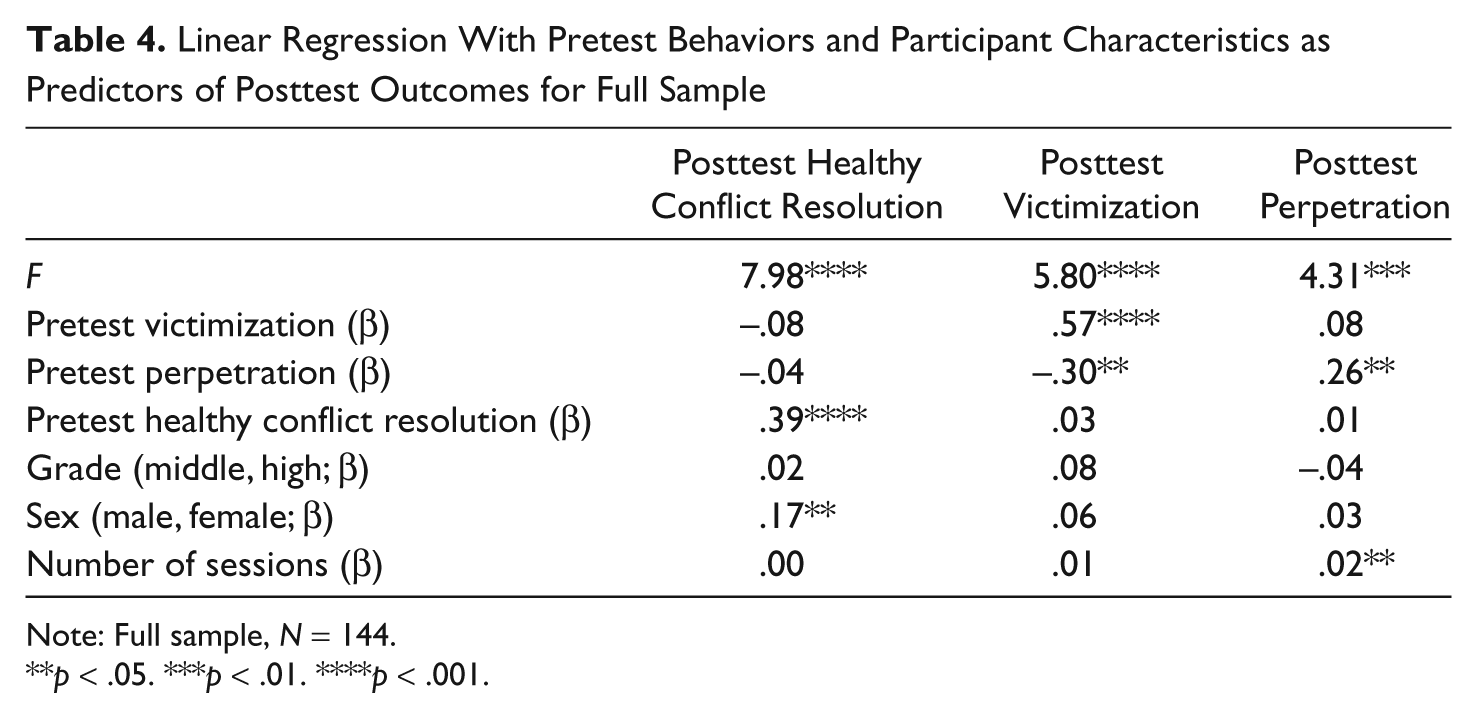
Note: Full sample, N = 144.
p < .05. ***p < .01. ****p < .001.
Discussion
Expect Respect support groups are designed for students who have witnessed domestic violence, experienced child maltreatment and/or sexual violence, or who are involved in abusive peer and dating relationships. The intervention aims to increase healthy conflict resolution behaviors and reduce or prevent dating and peer violence perpetration and victimization by providing opportunities for skill building in a supportive peer group setting. The study showed that among support group participants, there is a subgroup of teens who already experience or perpetrate violence in their peer and dating relationships.
The evaluation of Expect Respect support groups demonstrated that reports of healthy conflict resolution behaviors increased over the course of the intervention for the full sample, indicating that one critical objective of the support group intervention was met. The quantitative results mirror the earlier findings from interviews with support group participants (Ball et al., 2009), who spoke at length about the importance of gaining communication and conflict resolution skills as a result of the program. It appears that the support group format and extended duration of the intervention were successful at increasing the healthy conflict resolution skills of these at-risk students, whereas other prevention programs, including Safe Dates and the YRP, have not consistently demonstrated such outcomes (Whitaker et al., 2006). Interesting questions arise from our finding that higher levels of reported healthy conflict resolution skills at posttest did not appear to translate into less victimization and perpetration.
Contrary to our hypothesis we did not find a reduction in victimization and perpetration over the course of the intervention when considering results for the full sample. Due to the limitations of this study, its reliance on self-report measures and lack of a control group we cannot fully interpret the lack of positive change for the whole group with regard to violence perpetration and victimization. Data from the national Youth Risk Behavior Survey (CDC, 2008) indicate that prevalence rates for dating violence may increase with age. It is therefore possible that though levels of peer and dating violence were unchanged for all the participants, the participants did in fact experience and perpetrate less violence than other at-risk youth who did not receive the intervention. Replication in a larger sample with a comparison group is needed to further understand the nature of these findings
Given our group of at-risk students, it seemed warranted to differentiate participants according to the frequency of perpetration and victimization they reported at baseline. This exploratory analysis offered some critical insights into different profiles of youth and program outcomes. The subgroup of students who reported levels of victimization and perpetration with means at least 1 standard deviation above the group mean at baseline reported significantly less victimization and perpetration after participating in the support groups suggesting that they benefitted most from the intervention. Once a week, confidential support groups may address the unique needs of these students for ongoing emotional support, positive peer relationships, and opportunities to practice new skills in an emotionally safe and supportive environment.
No sex differences in violence perpetration or victimization were found in response to the intervention, but girls were more likely to report using healthy conflict resolution skills at posttest than boys. There was also a small, but significant, effect of number of sessions attended on perpetration reported at posttest. As noted above, the increase in perpetration may reflect greater comfort with reporting perpetration and greater awareness of abusive behaviors as a result of participating in the program, but this finding is in need of further investigation.
The voluntary nature of support group participation and the high mobility of at-risk students contributed to attrition from intake to completion. Although no significant differences were observed between program completers and noncompleters, future studies should include efforts to maintain students in the intervention.
Other limitations resulted from adapting and shortening scales, especially for physical and emotional violence, and given the length of the assessment, the inability to assess context and frequency of violence, impact, and injury. Although adaptations of existing scales resulted in improved readability and reduced the burden on participants, many of whom had reading levels well below their grade level, there is a need to utilize more psychometrically sound measurement instruments that assess a broader range of emotional, physical, and sexual dating violence in future studies. In addition, survey questions were framed based on the Conflict in Adolescent Relationships Inventory (CADRI; Wolfe, Scott et al., 2001) that ascertains behaviors in response to a conflict or argument. Therefore, the study is open to the same kind of criticism that has been leveled against the Conflict Tactic Scales (CTS; Strauss, 1979). Perhaps most important, the CADRI and CTS frame violence within the realm of conflict, whereas a significant amount of dating violence entails control and coercion rather than a response to conflict (e.g., Loseke & Kurz, 2005). The Expect Respect support groups address violence as a tactic for gaining power and control and one that is tied to male gender norms. Future evaluations should therefore choose a framework that corresponds more closely to the intervention.
Finally, we included nondating violence, that is, violence in close, peer relationships, as well as dating relationships. Combining these forms of violence complicates interpretation of results and may have obscured program effects. Future studies may be enhanced by differentiating peer relationship violence from dating violence. Despite these qualifications, our findings begin to lend empirical support to the effectiveness of a support group program that targets students at high risk for violence in peer and dating relationships.
We and others have demonstrated that many students have risk factors that may increase their risk of dating and peer violence. As an alternative or in addition to universal approaches, it may be necessary to tailor programs and resources to the needs of youth with known and modifiable risk factors such as a history of family violence, child maltreatment, and aggressive peer relationships (e.g., Whitaker et al., 2006). This preliminary evaluation of Expect Respect support groups was a step toward building evidence for prevention programs targeting at-risk youth: Expect Respect support groups were useful in increasing participants’ healthy conflict resolution skills, and the program appeared to be most successful for the youth who were at the highest risk for future perpetration and victimization.
Footnotes
Acknowledgements
The authors acknowledge the passing of their co-author, Dr. Merle E. Hamburger, who passed away when this paper was under review. This paper is dedicated to his memory for his contributions to youth violence and sexual violence research and prevention.
Authors’ Note
The findings and conclusions in this article are those of the authors and do not necessarily represent the official position of the Centers for Disease Control and Prevention.
Declaration of Conflicting Interests
The authors declared no potential conflicts of interest with respect to the research, authorship, and/or publication of this article.
Funding
The authors disclosed receipt of the following financial support for the research, authorship, and/or publication of this article: The development of the Expect Respect Program Manual and the program evaluation were supported in part by Contract No. 200-2001-00123 from the Centers for Disease Control and Prevention (CDC), an Empowerment Evaluation Project for Programs Designed to Prevent First-Time Male Perpetration of Sexual Violence.
Bios
References
Supplementary Material
Please find the following supplemental material available below.
For Open Access articles published under a Creative Commons License, all supplemental material carries the same license as the article it is associated with.
For non-Open Access articles published, all supplemental material carries a non-exclusive license, and permission requests for re-use of supplemental material or any part of supplemental material shall be sent directly to the copyright owner as specified in the copyright notice associated with the article.
