




Abstract
The current study addresses the validation of the Checklist of Controlling Behaviors (CCB), an 84-item domestic violence assessment instrument that can be used to address multiple levels of violence and coercive control in violent relationships. Derived from clinical observation and current theories, the CCB makes use of intimate partner violence survivor reports to identify the intensity and frequency of relationship violence. The instrument is divided into 10 subscales including (1) physical abuse, (2) sexual abuse, (3) male privilege, (4) isolation, (5) minimizing and denying, (6) blaming, (7) intimidation, (8) threats, (9) emotional abuse, and (10) economic abuse. To assess validity and reliability of the CCB, 2,135 female volunteers taking refuge at a domestic violence shelter were administered the instrument. Results of principal component analysis of the individual subscales revealed 10 factors having goodness-of-fit values above the desired normative level of .90
Keywords
In spite of vast increases in understanding prevalence, causes and interventions associated with intimate partner violence (IPV), methodological differences continue to make research in this area challenging. Moreover, significant debate exists in the literature regarding how relevant concepts and constructs are defined and measured (e.g., Cook & Snow, 2006; Graham-Kevan, 2007; Johnson, 2004, 2006a; Stark, 2006, 2007). Recently however, a growing consensus recognizes that not all acts of IPV can be equated to a unitary form of battering (Johnson, 2006b; Pence & Dasgupta, 2006) and that there are different types or patterns of abusive behavior (e.g., Graham-Kevan & Archer, 2003; Holtzworth-Munroe, 2000; Holtzworth-Munroe, Meehan, Herron, Rehman, & Stuart, 2000; Johnson, 1995, 2006a, 2006b, 2008; Johnson & Ferraro, 2000; Leone, Johnson, Cohan, & Lloyd, 2004; Pence & Dasgupta, 2006). Systems of classification are beginning to differentiate between these types/patterns with consistent recognition that violence used to coerce and control one’s partner is of the utmost concern (e.g., Graham-Kevan & Archer, 2003; Holtzworth-Munroe, 2000; Holtzworth-Munroe et al., 2000; Johnson, 1995, 2006a, 2006b, 2008; Johnson & Ferraro, 2000; Leone et al., 2004; Pence & Dasgupta, 2006). It is for this reason that coercive controlling violence is the focus of the instrument presented in this article, the Checklist of Controlling Behaviors (CCB). Specifically, the CCB is an 84-item self-report measure designed to help researchers and practitioners measure the intensity and frequency of behaviors that are found in relationships where coercive controlling violence is present.
Coercive Controlling Violence
Coercive controlling violence is a pattern of physical violence that is coupled with emotionally abusive intimidation, coercion and control (Kelly & Johnson, 2008). Described in the literature using many different terms (e.g., patriarchal terrorism, intimate terrorism, abusive controlling violence, coercive control), the concepts inherent to coercive controlling violence in this context have been apparent in the IPV literature since the late 1970s (Dutton, Goodman, & Schmidt, 2005). Seminal to this body of literature, Pence and Paymar (1986) describe IPV as consisting of pervasive patterns of coercive control whereby the batterer asserts power over his partner in multiple aspects of their relationship, not solely relying on physical violence. Their description reflects a continuum of specific behaviors (e.g., isolation, threats, intimidation, minimization) that form the Power and Control Wheel and other tools that are extensively used when working with both IPV offenders and their victims/survivors (Pence & Paymar, 1993).
As stated previously, the vocabulary used to describe concepts relevant to coercive controlling violence has shifted through the years to include a number of different terms including (but not limited to) patriarchal terrorism (Johnson, 1995), intimate terrorism (Johnson, 2006a) and more recently, abusive controlling violence (Jaffe, Johnston, Crooks, & Bala, 2008). Yet these descriptors are controversial as it has been noted that not all violence is (a) considered patriarchal, (b) perpetrated exclusively by men, or (c) fits” (a space is needed between the “men,” and the “or”) traditional descriptions (Kelly & Johnson, 2008). Although such differences are important to study and debate, the purpose of this article is to introduce an instrument that can be used to measure concepts related specifically to coercive controlling violence. Other types of IPV experiences are outside the scope of the current discussion.
When describing the overarching problems inherent to relationships where coercive controlling violence is present, two separate conditions (coercion and control) must first be explained. The first condition, coercion, is viewed as “the use of force or threats to compel or dispel a particular response” (Stark, 2007, p. 228). The second condition, control, is “comprised of structural forms that compel obedience indirectly by monopolizing vital resources, dictating preferred choices, micro-regulating a partner’s behavior, limiting her options, and depriving her of supports needed to exercise independent judgment” (Stark, 2007, p. 229). Structural forms are inherent to coercive controlling violence in that routine barriers are often used to entrap, isolate, and control the victim/survivor (e.g., denial of a car and/or cell phone, withholding money, using beepers, cyberstalking).
Although coercive controlling violence is likely not representative of all relationship violence (Johnson, 1995, 2006a, 2006b, 2008; Johnson & Ferraro, 2000; Kelly & Johnson, 2008; Leone et al., 2004), such critical forms of abuse and manipulation represent an important area where further research is certainly needed. As logically stated by Johnson (2006a), “surveys need to ask questions not just about violence, but also about the use of a variety of other control tactics in the relationship” (p. 1006). To meet these described challenges, the authors developed the Checklist of Controlling Behaviors (CCB). Derived from clinical observation and supported by theory, the CCB uses victim/survivor reports to identify the intensity and frequency of multiple dimensions of behaviors that are violent, abusive, controlling and/or coercive. Specifically, the CCB is an 84-item instrument divided into 10 subscales assessing physical abuse, sexual abuse, emotional abuse, economic abuse, intimidation, threats, minimizing and denying, blaming, isolation and male privilege. Embedded within the CCB are items that measure behaviors that take into account coercive methods intended to gain compliance. Thus, the CCB may be well suited for use in research and clinical settings, such as shelters for battered women and/or mental health centers.
Theoretical Framework
The CCB is based on the notion that coercive controlling violence includes not only acts of physical violence but also other forms of violence such emotional abuse, intimidation and isolation. In this vein, there is some agreement that solely measuring violent acts (e.g., physical/sexual abuse) does not properly characterize the totality of violence within relationships and that the social ecology (i.e., the cultural, institutional and relational systems in which the couple live) are key elements needed to understand IPV (e.g., Dasgupta, 2002; DeKeseredy & Schwartz, 1998; Dutton & Goodman, 2005; Smith, Smith & Earp, 1999; Yllo, 1993). For this reason the CCB is guided by Dutton and Goodman’s (2005) model of coercion (described below).
Coercion in Intimate Relationships
Components of Dutton and Goodman’s (2005) model of coercion can be traced to the early theory of social power developed by French and Raven (1959). In their theory focusing on how personal resources are used to influence one another, French and Raven (1959) developed five bases of influence including coercive power, reward power, legitimate power, referent power, and expert power. A sixth base, informational power, was included later (Raven, 1965). More recently, Raven (1992, 1993) extended the original model to include an expanded conceptualization of power by separating power processes from outcomes of power. In this extension Raven (1992, 1993) makes a distinction between the bases of power (e.g., the ability or potential to control), the processes of power (e.g., how one tries to control), and outcomes of power (e.g., compliance or resistance). For Dutton and Goodman (2005) these differences are important in that researchers and practitioners should consider separately the three constructs (a) potential for abuse of power, (b) use of power to coerce, and (c) achieving control through compliance.
Dutton and Goodman’s (2005) analysis of coercion exemplifies the idea that force (e.g., the use of physical means such as slapping or punching) is not the sole controlling factor to consider in abusive relationships. Instead, coercive control is a multidimensional and repetitive process of responses, usually in the form of demands that ultimately end in compliance because the victim believes (e.g., coercive power) she will experience more negative consequences for noncompliance and has come to believe (e.g., reward power) she will be rewarded in some way for compliance. Dutton and Goodman (2005) have supplemented two further ideas from French and Raven’s theories to support their model. First, coercion involves “setting the stage” (Raven, 1993) in that the perpetrator makes it known he has the means to punish incidents of noncompliance. Second, the perpetrator uses “surveillance” of the victim through various means not limited to phone calls, text messaging, and various stalking behaviors, and sometimes, even third parties (children or family). Stark (2007) has similarly defined these steps as microregulations that are designed to entrap.
Figure 1 presents a visual overview of Dutton and Goodman’s (2005) model of coercion. Their model expands French and Raven’s theories by illustrating coercive controlling violence as a dynamic and systematic process that begins with the social ecology. All interpersonal relationships are seen as having elements of persuasion and influence. However, in relationships where IPV is present, the context of persuasion and influence (e.g., economic, political, familial, and interactional) may be considered coercive. For example, demands for sex and/or threats to withhold financial means for food or household expenses may represent the “foundation” (Dutton & Goodman, 2005, p. 748) on which coercion is built.
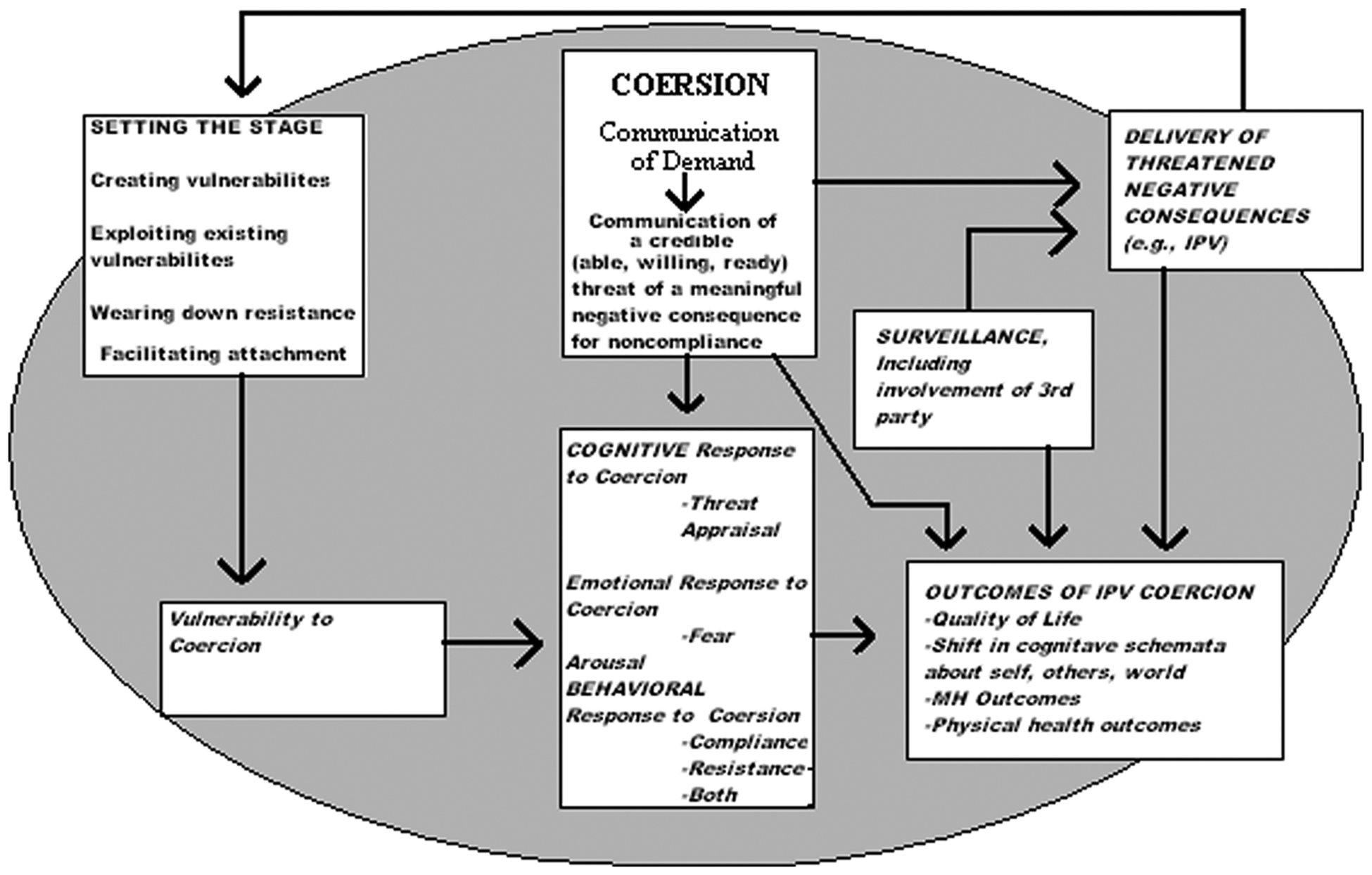
Dutton and Goodman’s (2005) Model of Coercion Visual Overviewa
As may be seen in Figure 1, Dutton and Goodman’s (2005) model of coercion is systemic and circular by design with coercion being central to control. Essentially the model reflects how the process of power used in abusive relationships leads to both control and compliance. Coercion may be overt in that the result can be direct (e.g., “if you don’t follow the rules, I’ll kill you”). Hence, the threat is very real and embedded in it is a demand/expectation that compliance should be immediate.
Coercive control can also be indirect and subtle. Such control is initially less imposing but is still threatening as it follows a similarly perilous path in terms of outcome. Essentially, forms of persuasion and control (e.g., “if you really loved me you’d spend more time with me”) and the expectation of compliance (e.g., “meet my needs”) are seen as following a circuitous and predictable path. In this stage coercion is set up in four ways: (a) creating the expectancy for coercive outcomes (e.g., “I’m going to have you committed”), (b) exploiting vulnerabilities (e.g., “he told me it was his car, his money”), (c) wearing down resistance (e.g., “tried to turn people against me”), and (d) exploiting attachment (e.g., “told me I was lying about the abuse”). More specifically, Stark (2007) identified this path as “structural forms that compel obedience indirectly by monopolizing vital resources, dictating preferred choices, micro-regulating a partner’s behavior, limiting her options, and depriving her of supports needed to exercise independent judgment” (p. 229). In effect, structural forms help differentiate physical violence from coercive control in that one sees how the presence of routine barriers may be used to entrap and isolate women (e.g., monitoring her time, withholding money, treating her as helpless).
Measuring Coercive Controlling Violence
The developers of the CCB searched the literature for an instrument or series of instruments that encompass the discussed theories of IPV. In this search a number of instruments were located that measure aspects of violence, power-and-control, and/or coercive control such as the Psychological Maltreatment of Women Index (Tolman, 1989), the Experience of Abuse Questionnaire (Agnew-Davies, 2006), Relational Entitlement and Proprietariness Scale (Hannawa, Spitzberg, Wiering, & Teranishi, 2006), and the Scale of Economic Abuse (Adams, Sullivan, Bybee, & Greeson, 2008). Although each of these instruments has definite strengths, only the Coercive Control Measure (CCM; Dutton et al., 2005) reflects the multidimensional nature of domestic violence with consideration of all three of the above theoretical areas. The CCM is a 92-item instrument that measures coercion via the three subscales demands, coercion, and surveillance (Dutton et al., 2005). Development of the CCM is significant in that preliminary analysis revealed predictive, discriminate, and convergent validity and the items measure acts of physical violence while assessing the context, culture and specific environment in which the couple lives (Dutton et al., 2005). For this reason, the CCM has applications related to safety planning with survivors of interpersonal violence. What makes the CCM truly unique is that it is grounded in the Model of Coercion (Dutton & Goodman, 2005).
The instrument described in this article, the CCB, expands the Model of Coercion (Dutton & Goodman, 2005) and the intent of the CCM by incorporating specific behavioral areas of coercion and broadening the measured variables. Here, similar items are embedded in the CCB yet are classified differently (see below). In addition, the authors of the CCB used the Power and Control Wheel (Pence & Paymar, 1993; Shepard & Pence, 1999) as a general guide when developing items. It was believed that the overall popularity and usefulness of the wheel are a reasonable fit for practitioners and researchers. Thus, when creating the CCB, the authors incorporated both the Model of Coercion (Dutton & Goodman, 2005) and the Power and Control Wheel (Pence & Paymar, 1993; Shepard & Pence, 1999). The resulting instrument incorporates ideas of coercive control and specific behavioral categories into one instrument that can be useful in either the practice or the research setting.
Developing the CCB
The development of the CCB was guided by a framework that considers violent acts to be a part of an overarching pattern of behaviors that include elements of physical force and coercive control (e.g., Babcock, Waltz, Jacobson, & Gottman, 1993; Brewster, 2003; Cassidy, 1995; Dasgupta, 2002; Dutton & Goodman, 2005; Ehrensaft, Langhinrichsen-Rohling, Heyman, O’Leary, & Lawrence, 1999; Gondolf, 1995, 2002; Hanrahan, 1997; Jones & Schecter, 1993; Pence & Paymar, 1993; Shepard & Pence, 1999; Strauchler et al., 2004; Tang, 1999; Umberson, Anderson, Glick, & Shapiro, 1998). As stated previously, the CCB followed the tenants outlined in the Duluth model’s Power and Control Wheel (Pence & Paymar, 1993; Shepard & Pence, 1999), while also incorporating ideas related to coercive controlling violence that were based on both the clinical experience of the authors and the ideas addressed by Dutton and Goodman (2005). From these models, 101 original items were developed to measure specific constructs. Statistical analysis (discussed below) resulted in the identification of 10 subscales: (1) physical abuse, (2) sexual abuse, (3) emotional abuse, (4) economic abuse, (5) intimidation, (6) threats, (7) minimizing and denying, (8) blaming, (9) isolation, and (10) male privilege. Each subscale contains 7 to 10 questions characterizing the spectrum of controlling behaviors in each category. The three-page, 84-item document included in Appendix A represents the final version of the CCB.
The scoring structure of the CCB is based on a 5-point Likert-type scale with 1 indicating never, 2 indicating rarely, 3 indicating occasionally, 4 indicating frequently and 5 indicating very frequently. Scoring consists of first calculating each individual subscale, then adding the subscale scores into a total CCB Sum (see scoring chart in Appendix B). When analyzing CCB results, individual subscale scores are indicative of specific categories of behaviors, while the CCB Sum depicts the overall level of coercive controlling violence evident in the relationship. As specific subscales consist of a differing number of items (7-10 items per subscale), specific scores vary per subscale. Therefore, a scoring matrix is included on the scoring chart to illustrate significant score ranges per subscale and CCB Sum score (see Appendix B). By identifying score ranges, a better idea of both frequency and degree of respondent’s experiences can be ascertained.
Instrument Validation Method
Participants
To address reliability and construct validity of the CCB, 2,135 women seeking refuge in one north Texas community were anonymously administered the paper-and-pencil instrument. The shelter sampled serves an urban population base of approximately 750,000 people and provides both immediate and follow-up support services for women and children. Following agreement to participate in the study, shelter residents completed the instrument along with a short demographic sheet. The resulting sample mirrors the local ethnic demographic with 517 respondents (40.3%) identifying as Anglo, 318 (24.8%) identifying as African American, 409 (31.9%) identifying as Hispanic, and 39 (3%) identifying as another racial or ethnic group. Respondent ages range from 16 to 68 years, with a mean age of 31.42 years. Slightly less than three fourths of the respondents have children (73.5%), with 307 (23.9%) having one child, 349 (27.2%) having two children, 195 (15.2%) having three children, and 92 (7.2%) having four or more children.
Data Analysis Plan
Data analysis followed a multistep plan designed to refine the instrument, identify subscales, and assess reliability and validity. First, data from the original 101 items were analyzed using correlations and principal component analysis resulting in the identification of 10 subscales after elimination of 17 items. Then, confirmatory factor analysis was conducted to assess construct validity for each of the 10 subscales. Finally, reliability and interrelatedness of items and subscales were assessed using measures of internal consistency (Cronbach’s Alpha, Guttman’s Split-Half), correlations (Pearson’s R), and percent of variance explained (R2).
Whole Instrument Construct Validity
To refine the instrument, the 101 original items were correlated with each other producing a large correlation matrix. Of the 101 items, 17 were dropped owing to very low correlation, < .2, with the rest of the items in the model. The items eliminated represented either theoretical overlaps of information or items not answered by the majority of the participants. The remaining 84 items were selected for the investigation of underlying subdimensions. At the theoretical level, it was argued that 10 factors or dimensions constitute behaviors inherent to coercive controlling violence. The empirical support for this argument can be ascertained using factor analytic methods. The presence of 10 factors may become evident if the factor analyses of data on 84 variables yield at least 10 factors. Thus, factor analysis was conducted using data for the 84 variables. The principle axis factoring methods was used for the extraction of underlying factors because it seeks the least number of factors that can account for the common correlations of a set of variables. Likewise, factors were rotated using the varimax method because it is the most commonly used method of oblique rotation and it also makes it as easy as possible to identify each variable with a single factor. Selected information from the output is presented in Table 1.
Factor Analysis of Domestic Violence Assessment Instrument: Principal Axis Factoring Extraction and Varimax Rotation
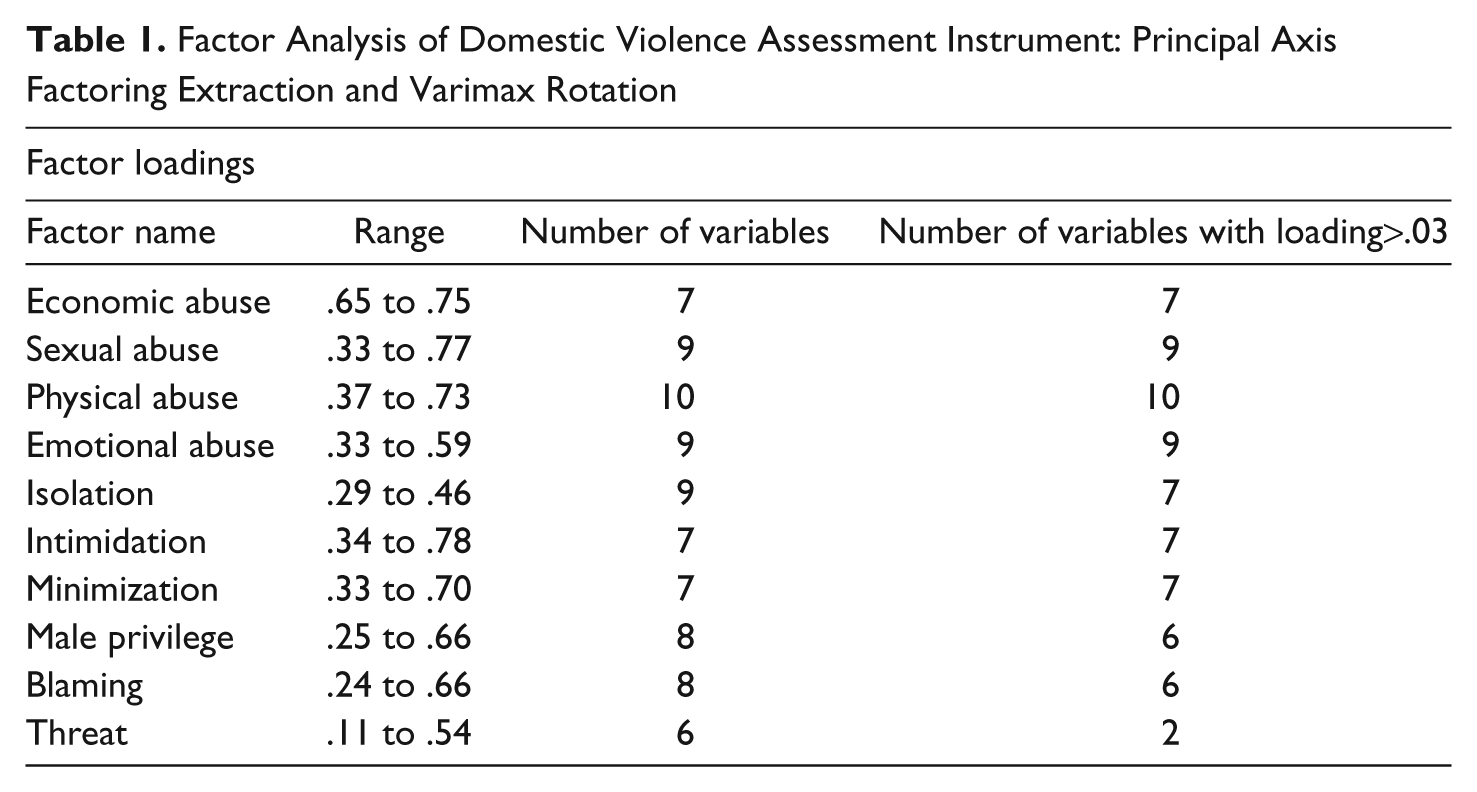
Factor analysis yielded 14 factors with an eigenvalue greater than 1. However, none of the variable loadings for 4 of the 14 factors was higher than .3. The common cutoff used in social science research is .3, while loadings greater than .6 are generally considered high (Byrne, 2010). Discounting the 4 factors with poor factor loadings, 10 factors with significant loadings on any of the 84 variables were obtained. The results from factor analysis support the presence of 10 factors theoretically (see Table 1). For naming these factors it is necessary to take into account the variables that load significantly on any given factor. The factor names were assigned taking into consideration the similarity between the variable sets strongly associated with each of the 10 factors corresponding to the 10 theoretical factors presented in Appendix A. The very first factor was composed of all seven items of the economic abuse dimension. All the loadings were high (i.e., >.6), ranging from .65 to .75. Accordingly, this factor was named the economic abuse factor or subdimension. The second factor was composed of items (all nine of them) theoretically associated with the sexual abuse dimension. Thus, the second factor clearly suggests the presence of the sexual abuse subdimension. The third factor is physical abuse. The rest of the dimensions are named as follows: emotional abuse, isolation, intimidation, minimization, male privilege, blaming, and threat. It is important to note that although the final dimension (threat) is composed of variables with loadings ranging from .11 to .54, this dimension is retained as its correlations with the rest of the dimensions are significant and range in magnitude from moderate to high.
Individual Subscale Construct Validity
The empirical support for the theoretical basis of each of the factors may be assessed at two levels. First, all the proposed variables related to a factor should be significant. Second, the magnitude of the loadings should be at least > 0.3 (Byrne, 2010). Table 1 presents the number of variables associated with each of the 10 factors and the number of the variables with significant loading > .3. Of the 10 factors, 7 possess strong factor loadings for their proposed indicators. Among 10 factors identified, only 1 factor (threat) had fewer than 50% of its indicators with factor loading < .3. The results shown in Table 1 strongly suggest the presence of all 10 theoretical subdimensions. Yet another source of support for the construct or theoretical validity of all 10 factors is the fact that very few of the variables belonging to one subdimension loaded significantly on another factor. There was only one factor, the blaming dimension, that had four of its seven indicators load significantly on another factor. These results clearly support the presence of 10 underlying dimensions of domestic violence as proposed by theories of coercive controlling violence.
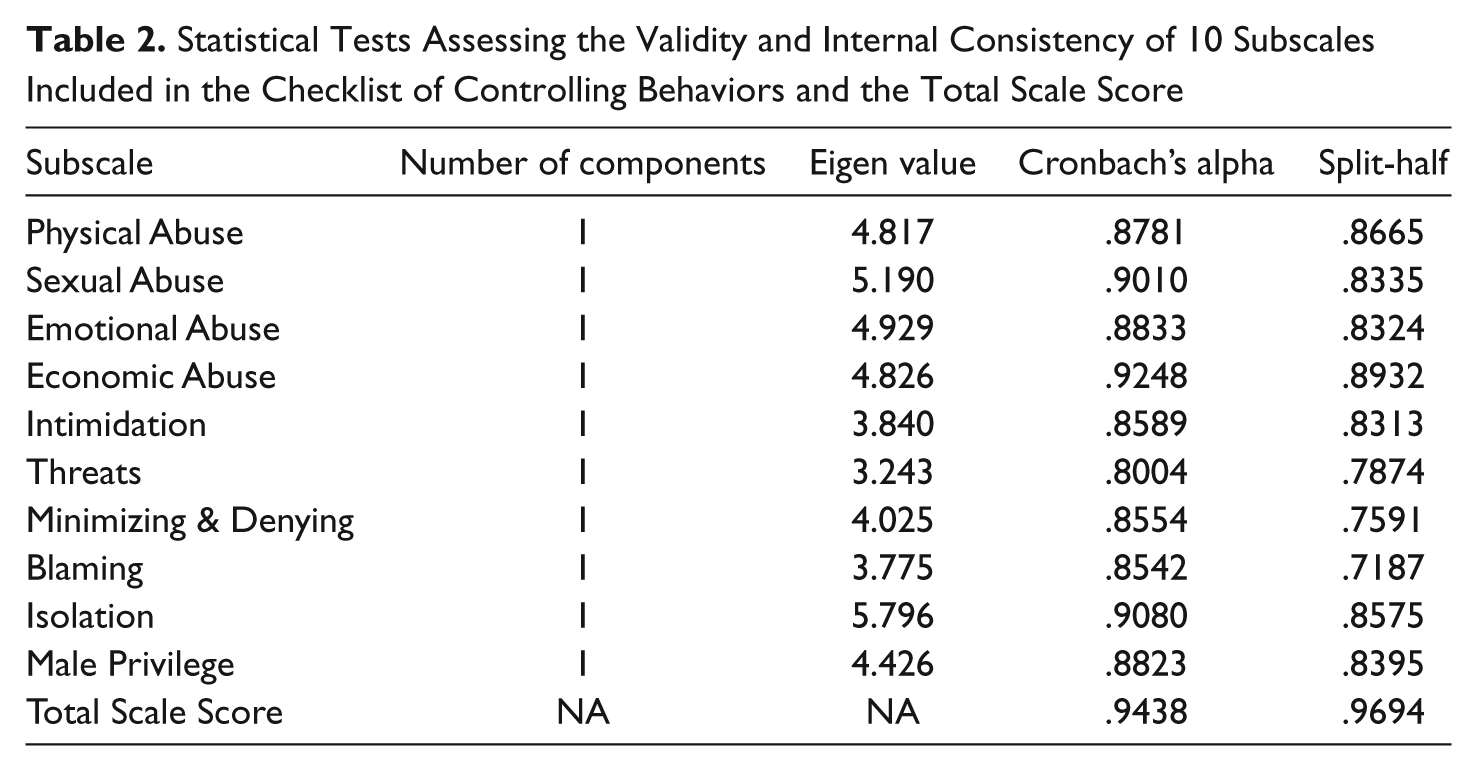
In order to acquire a preliminary assessment of the construct validity of each of the 10 factors, principal component analysis (PCA) of variables associated with each factor was conducted (see Table 2). PCA is a data reduction procedure that forms correlated variables into a smaller number of uncorrelated dimensions called principal components. In this procedure the first principal component accounts for as much of the variability in the data as possible; the second component then accounts for as much of the remaining variability as possible, and so on. Eigenvalues are the proportion of the total variance explained by the component. Scores 1.0 or greater are desired, with higher scores indicating a greater amount of variance explained. In this study, PCA results of the individual subscales revealed one component for each of the subscales with eigenvalues ranging between 3.243 and 5.796.
Statistical Tests Assessing the Validity and Internal Consistency of 10 Subscales Included in the Checklist of Controlling Behaviors and the Total Scale Score
Yet another method for testing the construct validity of each of the 10 factors is confirmatory factor analysis (CFA). Given a cogeneric set of indicators, CFA provides several measures of goodness of fit between predicted and observed correlations among the indicators. The goodness-of-fit measures for each of the 10 indicators were measured. Though several goodness-of-fit measures are available, we report three popular ones: the Goodness of Fit Index (GFI), the Adjusted Goodness of Fit Index (AGFI), and the Root Mean Square Error of Approximation (RMSEA; Byrne, 2010). A good fit is suggested when GFI and AGIF values are above 0.90 and RMSEA values are under .10 (Byrne, 2010). For brevity, AMOS-generated models for each of the 10 subscales are not included in this article. However, all 10 models have goodness-of-fit values above the desired normative level of .90. In summary: physical abuse subscale (GFI = .957, AGFI = .928, RMSEA = .079); sexual abuse subscale (GFI = .956, AGFI = .922, RMSEA = .081); emotional abuse subscale (GFI = .969, AGFI = .944, RMSEA = .070); economic abuse subscale (GFI = .977, AGFI = .955, RMSEA = .071); intimidation subscale (GFI = .974, AGFI = .934, RMSEA = .088); threats subscale (GFI = .973, AGFI = .938, RMSEA = .086); minimizing and denying subscale (GFI = .970, AGFI = .931, RMSEA = .091); blaming subscale (GFI = .969, AGFI = .920, RMSEA = .090); isolation subscale (GFI = .969, AGFI = .944, RMSEA = .072); and male privilege (GFI = .964, AGFI = .927, RMSEA = .080). Thus the results from confirmatory factor analysis further provide evidence in support of the construct validity of each of the 10 factors.
Reliability of Whole Instrument and Individual Subscales
The reliability of the instrument as a whole and of individual subscales was assessed using both Cronbach’s Alpha and Guttman’s Split-Half (see Table 2). These measures also assess internal consistency of both total instrument and individual subscales. Cronbach’s Alpha values range between .800-.924 for the individual subscales, with .943 for the total instrument. Guttman’s Split-Half scores range between .718-.893 for the individual subscales, with .969 for the total instrument. Based on these results, the CCB demonstrates high level of reliability.
Final Stage of Analysis
In the final stage of instrument validation, correlations (Pearson R) and percent of variance explained (R2) were calculated to assess construct validity of the individual subscales (see Table 3). Correlation results indicate a strong relationship between subscales with all meeting significance at ≤ .0001, and percent variance explained (R2) ranging from .150 to .486. Based on these findings, an interrelationship between the subscale constructs that is congruent with views of domestic violence that emphasize coercive controlling violence and percent of variance are ascertained. Therefore, construct validity of both CCB individual subscales and total instrument is supported.
Correlations Between the 10 Subscales Included in the Checklist of Controlling Behaviors
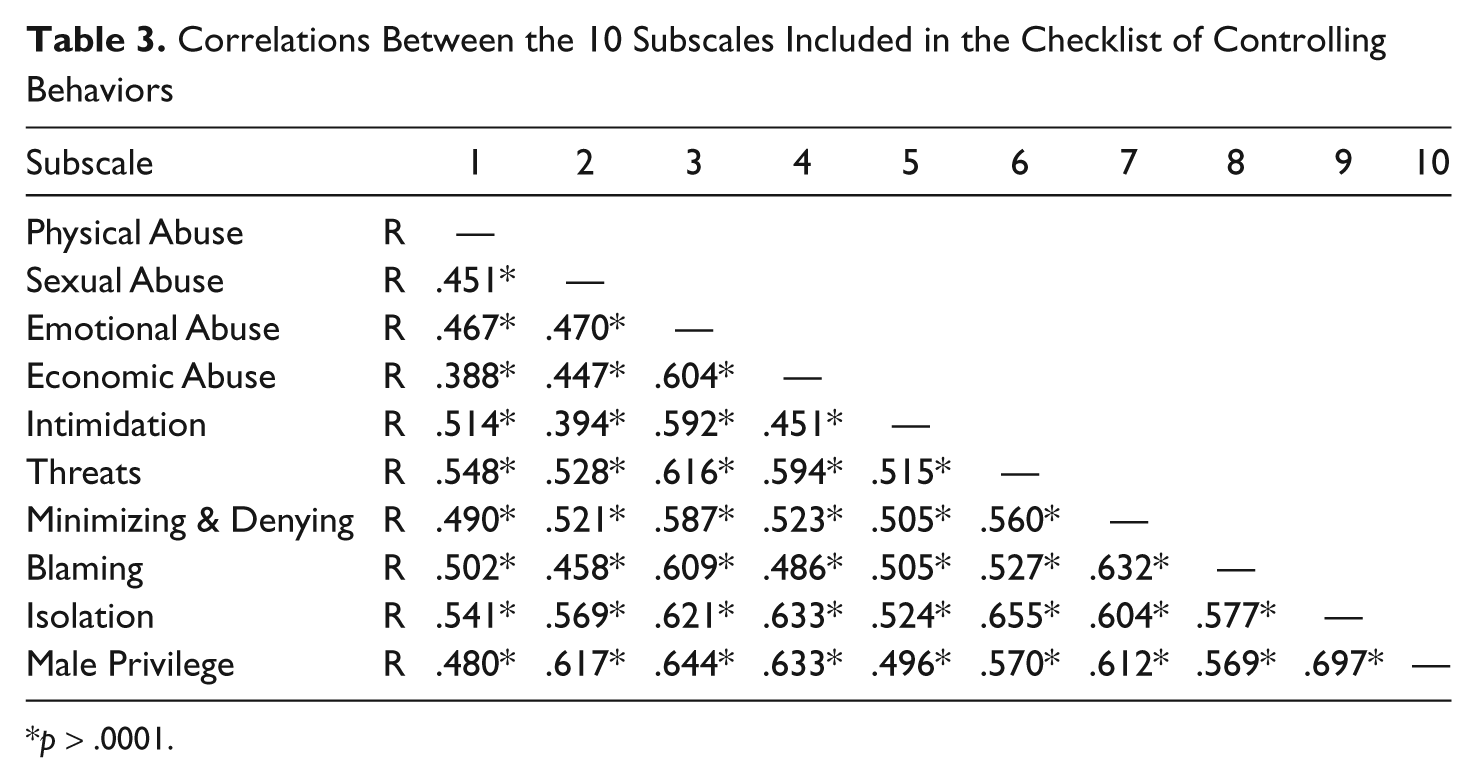
p > .0001.
Discussion of Usage and Conclusion
Empirical evidence of the reliability and construct validity found by the current study indicates the CCB is a noteworthy instrument that can be used to address variables related to coercively controlling violence in various populations. Indeed, the CCB has a number of potential usages in both clinical and research settings. From a clinical perspective, professionals working to end IPV can use the CCB to assess subtleties in the client’s experience, which can help them both better understand the client and provide for their treatment needs. Additionally, although many women in violent relationships can articulate the acts of physical and sexual violence perpetrated against them, they are not always able to identify other behaviors their partner uses to control them. By using the CCB as a teaching tool, professionals working with IPV victims/survivors can help their clients identify the entire structure of coercive controlling violence experienced, including the varying degree of overt and covert acts that constitute coercive controlling violence.
The CCB may also be useful in discriminating the potential risk to women who are in the process of seeking protective orders. Using the CCB in court settings will give judges rendering judgments about protection an opportunity to understand the depth and range of experiences and safety needs. Likewise, the CCB may also be used to study subtleties of coercive controlling violence experienced by IPV victims/survivors in the research setting. For example, the CCB may be useful in highlighting degrees of intimidation and male privilege signaling cultural norms of behavior that are unique or dominant among groups of survivors. In turn, the CCB can provide information useful when developing better ways to respond sensitively to the needs women. It would seem reasonable that other possible uses of the CCB include measurement of these variables in both clinical and non-clinical settings, such as hospital emergency departments, mental health settings, and child protection work.
In addition to practical usage of the CCB, the current study also provides evidence for the model of coercion articulated by Dutton and Goodman (2005). Indeed, the factors identified by development of the CCB supply additional support for conceptual and definitional development of models indicating behaviors other than physical violence are central to understanding coercive controlling violence. These constructs may provide better explanation of behaviors, outcomes, and responses to abuse that have otherwise been attributed to violence alone. In some ways, the CCB furnishes greater clarity for expanding the host of psychological variables that support the threats, demands, and other behaviors embedded in IPV. Here, the authors believe the CCB best represents the invisible cage phenomenon (Stark, 2007), those hidden dynamics that many women in abusive relationships live with on a daily basis. From this a range of protective interventions may be identified for individual victims/survivors. Additionally, a need to focus on coercive and controlling acts outside the traditional definition of violence may be helpful in the counseling setting.
Further Research Is Needed
Further application of coercive control and the use of the CCB may extend to some of the concerns inherent to discussion about heterogeneity and specific typologies of IPV offenders (Lehmann & Simmons, 2009). When studying these issues the CCB could be used to address subtleties of coercive behaviors not otherwise considered rather than relying exclusively on psychiatric nomenclature. In this case, it may be possible to uncover elements of a particular batterer typology by including a series of behaviors that are potentially dangerous. Indeed, expanding research with the CCB to different populations (e.g., same-sex, dating IPV) might be an additional way of assessing whether ideas inherent to coercive controlling violence have broader usage. However, further empirical investigation is needed to determine whether the CCB is applicable when addressing these areas of inquiry.
Although the current study found preliminary reliability and construct validity for the CCB, there are certain limitations. Participants do not represent the entire population of people experiencing coercive controlling violence. The sample was not randomly selected, was recruited from an urban area, and only included women who were in the process of obtaining services from a family violence shelter. Therefore, further research is needed to address reliability and validity of the CCB with samples of victims/survivors who (a) are from rural and suburban areas, (b) have the resources to elicit services/support from places outside the shelter environment, and (c) are not yet ready to seek services from helping agencies. It is also likely CCB will be helpful for work with men IPV offenders; however, more research in this area is needed.
In spite of these limitations, the CCB is a comprehensive IPV assessment instrument that addresses both acts of overt aggression (including physical abuse, sexual abuse and emotional abuse) and factors related to coercive controlling violence. Specific behavioral areas assessed by the CCB include economic abuse, intimidation, threats, minimizing and denying, blaming, isolation, and male privilege. Statistical testing found evidence of reliability and construct validity indicating the CCB is a robust instrument that can be used to address IPV-related variables in various settings.
Footnotes
Appendix A
Appendix B
Declaration of Conflicting Interests
The authors declared no potential conflicts of interest with respect to the research, authorship, and/or publication of this article.
Funding
The authors received no financial support for the research, authorship, and/or publication of this article.