



Abstract
We analyzed data from the National Crime Victimization Survey to test whether individuals from different ethnic groups differentially notify the police after incidents of partner violence. After finding that minority groups notified the police about intimate partner violence (IPV) events more than non-minorities, we found that socioeconomic status differences between minorities and non-minorities explained a statistically significant proportion of the reasons underlying the differences in notification. We suggest that the pattern of our results supports a structural perspective and has potential implications about the subjective and objective efficacy of police involvement in IPV.
Introduction
The fact that a substantial proportion of intimate partner violence (IPV) is repetitive with effects extending beyond the involved parties makes it somewhat surprising that victims report only one fourth to one half of IPV victimizations to law enforcement officials (Frieze & Browne, 1989; Tjaden & Thoennes, 2000). Although several empirical studies have examined the reasons underlying victims’ low notification rates (e.g., Fleury, Sullivan, Bybee, & Davidson, 1988), until recently, few have included minority samples (Ingram, 2007). Studies that do include minority samples have often limited analyses to Black/White differences, have failed to demonstrate applicability to various Latino or other minority groups, or have examined the correlates of police notification within a single ethnic group rather than determining the reasons we find variations between ethnic groups on police notification behavior (García, Hurwitz, & Kraus, 2005).
The historic inattention to minorities is unfortunate because research consistently suggests that ethnic communities experience as much IPV as the general population (e.g., Gondolf, Fisher, & McFerron, 1988), if not much more (e.g., Caetano, Field, Ramisetty-Mikler, & McGrath, 2005). The inattention from researchers regarding Latino groups is particularly unfortunate because Latinos collectively have become the largest minority group in the United States, having surpassed the African American population according to 2000 Census estimates (Valdez, 2006). Moreover, several authors have suggested that additional research on minority communities may help attenuate the differentially high IPV rates among minority groups, which may be due in part to differences in the needs of the victims that current amelioration strategies fail to consider (Castro, Peek-Asa, García, Ruiz, & Kraus, 2003).
In this article, we expand the limited research on police notification about IPV events, which is a subset of the more general topic of victim help-seeking behavior (Liang, Goodman, Tummala-Narra, & Weintraub, 2005). We determine whether notification differences across ethnic groups exist, paying particular attention to Latino groups. We also examine whether cultural or structural factors best explain the notification differences. We begin by differentiating the structural and cultural theoretical frameworks that informed our research hypotheses.
Cultural Versus Structural Frameworks
Scholars have suggested competing explanations for why offending and/or victimization varies across people, place, and time that we might loosely classify according to whether the explanation emphasizes psychological, geographical/neighborhood, compositional, structural, or cultural differences (e.g., Smedley, Stith, & Nelson, 2003; Walker, 1978). A prominent contrast in the sociological literature is between cultural and structural models in general behavioral studies (e.g., Bourdieu, 1986) and crime-specific studies (e.g., Steffensmeier & Harer, 1996).
Cultural models assume that human actions arise largely from conforming to a shared value system. In the study of crime and victimization, cultural models emphasize variation in beliefs such as what constitutes crime, how grievances should be handled, and when the government should be involved in settling normative violations, especially those occurring within families (Brabeck & Guzmán, 2009; Felson, Liska, South, & McNulty, 1994). In contrast, structural perspectives emphasize that classifying people by race and ethnicity often affects their placement in a stratified social system. This placement has substantial and often negative consequences for a wide variety of important outcomes (Sampson & Wilson, 1995). Stated alternatively, structural models maintain that socioeconomic deprivation or uneven resource distribution strongly determine behavioral differences across groups of individuals.
Different structural perspectives contain nuanced views that vary primarily by the type of inequality assumed most important. Regardless of these small differences, most structurally oriented theorists emphasize the salience of accounting for socioeconomic status (SES) differences when examining behavioral variation. Accounting for SES minimizes model misspecification and helps prevent scholars from overstating the effects of culture when economic factors are the more direct determinants of behavior. An example that scholars have long mentioned is that although cultural models have suggested that differences between Southern and Northern values effectively explain the South’s higher violence rates (e.g., Gastil, 1971), structural theorists have found weak or non-existent associations between Southern culture and violence after socioeconomic measures were appropriately controlled (Loftin & Hill, 1974).
Although many structural models are imprecise about the exact causal mechanisms underlying how one’s placement in the social structure affects various outcomes, several authors have successfully developed relatively concrete theoretical frameworks. For example, a few authors have examined the role of neighborhood and geographical characteristics in explaining offender and victim behavior (e.g., Baumer, 2002; Sampson & Wilson, 1995). Research in this area illustrates that behavior appearing to have cultural underpinnings may be more accurately characterized by factors related to the differential access various groups have to securing a residence in preferred geographical space. For example, people who live in disadvantaged neighborhoods (where government agencies are often absent, uncaring, or underfunded) commonly have negative experiences with service agencies. For this reason, we should not be surprised that residents of these areas are likely to have beliefs that reduce their motivation to rely on these organizations (e.g., Carr, Napolitano, & Keating, 2007). We might simultaneously question, however, whether cultural terminology best characterizes the differences between disadvantaged ethnic communities and advantaged majority groups in perceptions about governmental legitimacy. Instead, it may be best to associate these differences with the disadvantages faced by ethnic minorities as a result of their placement within the structure of society.
Unfortunately, because our overview of cultural and structural perspectives is necessarily brief, it also unavoidably overstates the contrast between these perspectives. More accurately, interrelationships exist between cultural and structural models, which occur because cultural values often arise in response to inequality (Wilson, 1987). For this and analogous reasons, contemporary literature increasingly refers to sociostructural and sociocultural influences in ways that emphasize how culture and social structure interact to shape individuals’ lives (e.g., Brabeck & Guzmán, 2009). While acknowledging these complexities, many scholars still emphasize the cultural/structural distinction for reasons including the realization that over time, adherence to group values regularly becomes independent of the structural conditions from which cultures originate (Luckenbill & Doyle, 1989).
Regardless of the precision of the structural/cultural contrast, however, it seems useful to maintain this distinction in our current research to emphasize the importance of accounting for SES differences when examining how police notification differs across ethnic communities. Without doing so, we risk confusing cultural differences with other (and perhaps more direct) mechanisms that may work through less evident factors such as resource deprivation and geographical segregation.
Cultural Models and Police Notification
While some scholars avoid discussions about culture out of concern that public discourse may misuse scholarly debate (see Lilienfeld, 2002), the consideration of cultural viewpoints in the victimization literature has been increasingly bolstered by a more precise realization that understanding cultural variation may reduce implementation problems with amelioration initiatives in ethnic communities. Clinicians, for example, have argued that by failing to consider culture we may erroneously pathologize strengths such as self-sacrifice for the sake of the family or other aspects of familism (Santiago-Rivera, Arredondo, & Gallardo-Cooper, 2002). An interest in cultural models has led scholars to note that ethnic communities differ in whether victims are likely to notify the police after IPV events. Victimization scholars have subsequently questioned whether beliefs regarding outside intervention, family privacy, marital permanence, and government competence explain why the notification differences occur (Kelly, 2003; Lee, Thompson, & Mechanic, 2002; Liang et al., 2005).
The limitations of empirical study often complicate cultural research, however, by requiring dissimilar individuals to be classified into somewhat arbitrary ethnic categories. This is particularly true for individuals broadly and singularly classified as Latino, Hispanic, or Chicano, who are more accurately described as individuals possessing diverse historic, economic, political, religious, and cultural heritages (Portes & Stepick, 1993). Several scholars, however, have justified the aggregation of Latino subgroups for IPV research by noting that individuals whose ancestral backgrounds include Mexico or several Central and South American countries often share basic values that have strong impacts upon family conflict (Perilla, Bakeman, & Norris, 1994). Latino subgroups, for example, often share similar values such as self-sacrifice and adherence to gender roles where a wife is expected to raise children and submit to a husband’s decisions (Fernandez-Esquer & McCloskey, 1999). Scholars have also noted that majority groups often cannot distinguish between the cultures of most Spanish-speaking countries. For this reason, immigrants from those countries often face comparable types of discriminatory treatment (Menjivar & Salcido, 2002), including those types perpetrated or overlooked by government agencies. For this reason, various Spanish-speaking communities may have common understandings about the utility of police intervention for crimes, particularly for offenses originating within the family (Carr et al., 2007; Sampson & Bartusch, 1998).
Some focus groups have implied that police notification after IPV events is lower among those Latinos who lack familiarity with U.S. law (Menjivar & Salcido, 2002). Other ethnographic work has noted that a majority of Latino families are Catholic, a religion that emphasizes the indissolubility of marriage in most cases. Some scholars have cited cases where members of the Catholic clergy have even communicated that IPV is “at best a miscommunication between the couple, and at worst, the fault of the woman who must amend her ways” (Perilla, 1999, p. 123). Regardless of whether these teachings accurately represent the position of the Catholic Church, someone blamed in this way is almost certain to be less willing to notify the police or seek help in other ways.
A number of theoretical statements propose that traditionalism and patriarchy are the principal causes of partner violence (Yllö & Straus, 1984), or similarly, that patriarchy causes the most serious and chronic IPV (Johnson, 1995). The fact that scholars of Latino issues describe Mexican and most Central and South American cultures as more patriarchal than those originating from European countries (e.g., Portes & Rumbaut, 2001) implies that we might better understand victim help-seeking by recognizing the effects of those patriarchal beliefs on the perceived benefits of police notification.
Cultures also differ on how partner violence is considered problematic. Sorenson (1996), for example, noted that recent immigrants sometimes fail to define IPV as particularly serious, thus implying that groups may define dissimilar thresholds for the frequency or severity that IPV must reach before victims consider seeking assistance.
In sum, cultural perspectives consistently assume that the shared values among members of various Spanish-speaking communities act in ways that likely inhibit help-seeking beyond the nuclear family in general and decrease police notification more specifically. Although this literature makes a strong case for these assumptions, confirming evidence is far from conclusive.
Structural Models and Police Notification
Structural models note that in disadvantaged areas of the United States, which most frequently have larger minority populations, access to quality social services is limited (Smedley et al., 2003). For this reason, less attention is generally directed toward assisting underrepresented groups, and in most of these communities that inattention includes victims of IPV (Bent-Goodley, 2005; Whitaker et al., 2007).
A substantial literature has noted that these disadvantages include medical disparities that cannot be explained by compositional differences in gender, age, and SES alone (Smedley et al., 2003). Medical disparities become relevant to questions about police notification if we consider that medical centers often screen for IPV, explain the benefits of third-party assistance for IPV problems, and make referrals.
A more limited literature has addressed police notification across SES lines. Although much of this literature is somewhat dated, it generally suggests that wealth is negatively related to reliance upon police service. The literature is less consistent, however, about the reasons underlying this association.
Some work has suggested that the middle and upper classes involve the police less frequently because they feel that the police are socially inferior (Baumgartner, 1985, 1988). Other work emphasizes that the middle class and wealthy are particularly sensitive to the possibility that revealing family problems may harm community standing (Sherman, 1992; Smith, 1987).
There is a closely related literature that has examined the extent to which the police are truly effective in dealing with IPV. Studies in this area have sometimes noted that the therapeutic or conciliatory assistance that many victims prefer, such as marital or substance abuse counseling or similar treatment modalities (see Campbell, O’Sullivan, Roehl, & Webster, 2005), may be more effective than the retributory styles that police favor. Although the majority of the IPV literature has tacitly assumed that police involvement is universally advantageous through findings of moderate recidivism declines after police involvement (Felson, Ackerman, & Gallagher, 2005; Sherman & Berk, 1984), some findings suggest that law enforcement alternatives may provide more benefit than police assistance (Davis & Smith, 1995). Moreover, some research has noted that police involvement sometimes makes IPV situations worse among certain offender types, such as those who are displaced from the workforce (Sherman, 1992). If police notification can cause additional harm or if its effects are marginal, victims who decide against notification in favor of separation or other alternatives may be making sensible decisions (Davis & Smith, 1995).
Information about victim perceptions of police effectiveness illustrates the complexities about how structural perspectives might predict whether minority IPV victims will be more or less likely to notify the police than the general public. On one hand, it seems reasonable to assume that the generally diminished quality of social services available in many minority communities might predict that Latino and other minority victims of IPV would be less likely to notify the police. On the other hand, if we consider that alternatives to law enforcement are often preferred among victims, and the most effective agencies are less frequently available in minority communities, it becomes reasonable to assume that the constraints imposed upon minority victims may push them toward seeking help from the agencies most readily accessible. The more limited financial capital of many Latino and other minority IPV victims, for example, may impose substantial constraints that limit their ability to access the childcare and transportation services often necessary for obtaining assistance from social service agencies (Brabeck & Guzmán, 2009), while assistance from police agencies likely does not require these prerequisites. Moreover, separation from abusive partners often requires the type of housing and financial independence more accessible to higher SES individuals, whereas adequate financial capital provides upper-SES victims wishing to retain contact with their partners greater access to treatment options (Nash, 2005; Richie, 2000).
In sum, our balancing of these alternative predictions leads us to conclude that unlike cultural viewpoints, the bulk of arguments found in structural models suggest that police notification rates among ethnic minorities will likely be higher than the general public. Structural perspectives also remind us that ethnic communities are clearly exposed to substantial differences in the quality and availability of the IPV amelioration services they receive. For this reason, these viewpoints caution against attributing variations in help-seeking behavior to cultural differences unless we also account for the SES variations that strongly affect the quality and availability of social service agencies.
Theoretical Summary and Prior Research on Police Notification by Minority Victims
Scholars and justice practitioners often assume that minorities report offenses to the police less often than majority groups in a way most consistent with cultural models. They speculate that cultural differences such as privacy concerns, seeking help outside of the family, and beliefs about marital permanence together with related factors such as language barriers, legal system unfamiliarity, and deportation fears underlie the purportedly lower minority reporting (e.g., Davis & Erez, 1998).
Observations consistent with structural models about class differences in the perceived benefits of police involvement, however, raise the possibility that police notification may be higher among minority women because minorities are overrepresented in demographic categories less able to access alternative social services and less able to afford the costs associated with separation. In other words, the lack of human, social, and financial capital among lower SES victims may force these victims to notify the police rather than to seek help in other ways.
The victimization research that concentrates on minority issues, however, has not adequately addressed racial and ethnic differences in police notification, and the few articles that have addressed this matter havefailed to illuminate whether cultural or structural perspectives best explain why these differences occur. For example, in one of the few published works addressing this issue, Rennison and Welchans (2000) found that Latina females were more likely than non-Latina females to report IPV (65% for Latina women and 52% for non-Latina women), however the authors did not attempt to identify the underlying mechanism responsible for these findings. Research by Ingram (2007) was consistent in some ways with Rennison and Welchans’s finding. When comparing a sample of 11,955 victims who told someone about IPV victimization, Ingram found that among Latinos, 7.4% of the time the notified person or agency was the police as compared with non-Latinos where the police was the agency notified only 5.9% of the time. Ingram noted, however, that the difference across ethnicity was marginally significant at best (p = .071) and their models did not include victims who did not notify anyone.
Another empirical article that focused on minority populations and police notification suggested that education, a primary component of SES, was positively associated with police involvement (Brabeck & Guzmán, 2009). As in many other articles we reviewed, the article provided quite useful information, but was not intended to focus on whether SES explained differences across ethnic groups. Because this research was based on a sample of 75 females with a mean income of about US$4,000 per year, the finding essentially represents the effect of education on police notification among low SES individuals.
Although it remains possible that cultural differences in assistance seeking among Latinos are responsible for both findings, the direction of the effect of minority group status on police notification in these results is opposite of what existing cultural models imply. Rather than cultural values underlying these findings, the increased notification rates may indicate a more general attenuated ability among lower-income groups to acquire resources perceived as more beneficial than police assistance. In other words, if victims across all socioeconomic categories equally prefer therapeutic or conciliatory assistance, then the greater rates of police notification among Latino victims may reflect compositional rather than cultural differences. If we consider that Latinos are more likely to reside in disadvantaged neighborhoods, these findings may also reflect a decreased availability of desirable social service resources in areas of higher minority concentration.
The Present Study
We have two primary goals in this study. Our main research goal is to explain the reasons underlying group differences in notifying the police after IPV victimization. A secondary goal is to determine whether minority and majority groups report different reasons for both notifying and not notifying the police.
To test whether cultural or structural models best explain ethnic group differences in IPV police notification, we began by replicating the work of Rennison and Welchans (2000). Similar to these authors, we were particularly interested in whether Latinos are more or less likely to notify the police than other groups.
To achieve this goal, we examined whether SES accounts for notification differences between minority and majority groups as might be implied by the type of structural model we reviewed earlier. Applying the literature about social structure and SES to the work of Rennison and Welchans (2000), we hypothesized that victims across several ethnic categories who are similar along socioeconomic dimensions will have similar police notification rates net of other compositional variation.
Using regression analyses, we accounted for a wide range of potentially important compositional differences across ethnic groups. Including proper control variables is particularly important given the past research detailing the degree to which compositional variation may strongly account for behavioral differences across racial or ethnic categories (e.g., Kitagawa, 1955; Steffensmeier & Harer, 1996). For example, if age is associated with a behavioral outcome of interest, we might mistakenly attribute differences between ethnic groups to cultural dissimilarities rather than age differences if one group is younger than the other. The possibility of improperly attributing compositional variation to cultural differences is a strong possibility in the United States, where Latinos are younger than the overall population (Saenz, 2004) and less apt to cohabitate (Oropesa, 1996). The possibility that age and cohabitation differences across ethnic groups explain variation in police notification becomes more plausible when we consider that both characteristics are known correlates of victimization, offending, and help-seeking behaviors (e.g., S. D. Gottfredson & Gottfredson, 1979).
Because research on offending indicates that employment, poverty, social class, and age strongly affect violence in general and IPV in particular, minority overrepresentation in these demographic categories may explain group differences in behavior (Asbury, 1993). Some research, in fact, has indicated that these sociodemographic differences fully explain IPV offending differences across ethnic groups (Rennison & Planty, 2003; Straus & Gelles, 1990), although other research has suggested that IPV offending differentials remain after accounting for group composition (Cazenave & Straus, 1990; Neff, Holamon, & Schluter, 1995). Unlike the literature on offending, victimization research has not yet determined whether these differences explain variation in notification practices, although several examples exist where victimization scholars have controlled for sociodemographic and other characteristics for alternative purposes (e.g., Felson & Pare, 2005; Rennison & Welchans, 2000). In our first set of analyses, we accounted for both important compositional differences across ethnic groups and other covariates identified by prior research as important to understanding police notification. Those covariates included injury, weapon-use, and whether the victimization was a repeated offense (Baumer, 2002). In a second set of analyses, we tested our hypothesis that relevant compositional and structural variables will partially explain differences in the reasons for reporting and not reporting by minority and non-minority groups.
Data
Consistent with prior studies on police notification, we relied on the National Crime Victimization Survey (NCVS) data. Administered by the Bureau of the Census, the NCVS collects detailed information about victims, offenders, and offense circumstances from approximately 50,000 households each year. Most important for our purposes, the NCVS asks victims whether they reported their victimization to the police.
The NCVS collects information about all members of participating households above 12 years of age and records information about various household-level characteristics such as family structure. Information about each member of the household permits us to generate composite measures of household-level characteristics for use in cases where pre-constructed variables do not exist. For example, although these data contain no pre-calculated measure of the highest educational or occupational level of any household member, it is possible to construct these measures after first linking together all respondents from the same household.
The procedures for linking respondents from the same household are time-consuming and complex (see Conaway & Lohr, 1994; Felson & Ackerman, 2001). Once completed, however, the procedure permitted us to determine several household-level measures that we subsequently used to construct our SES indicator.
For all of our current analyses, we selected incidents recorded in the NCVS that involved threats or actual attacks against females when the respondent identified a male offender as a spouse, former-spouse, or boyfriend. We included cases involving lone offenders and cases where current or former partners were in an offender group. We included violent offenses such as assaults, sexual offenses, robberies, and threats of violence, but excluded property-only offenses. We excluded same-sex couples because there were too few cases to permit a statistical examination of this subsample.
In following the precedent set by most prior research, we retained series victimizations (N = 341) in our analyses, that is, records where the respondent reported six or more victimizations having details too similar for the respondent to distinguish between them. In these cases, the NCVS records each series as one record and the respondent provides details pertaining to the most recent incident. Our results were similar when we excluded the series incidents.
Variables
We coded the dependent variable as “1” if either the respondent or a household member notified the police and as “0” otherwise. We excluded cases where someone other than the respondent or family member notified the police because although victims may have some control over family members and routinely ask family members to notify the police on their behalf, victims typically have little control over non-household members. Following past precedent, we classified cases where the respondent did not know whether the police were called as “0” (M. R. Gottfredson & Hindelang, 1979).
Although it would be ideal to account for the heterogeneity across various Latino groups, NCVS data do not include country of origin. For this reason, we used the self-classification of the respondents as White-non-Latino (the reference group), Black-non-Latino, Other, and Latino. Although the NCVS uses the term Hispanic rather than Latino, and although we realize that different groups differentially prefer the terms Latino, Hispanic, and Chicano, we used Latino for consistency reasons. We examined the offenders’ race/ethnicity, but it was highly correlated with the victims’ racial classification, so we excluded this measure from our analyses.
Because victims may be more likely to notify the police for self-protection reasons if the offender is living in the same residence, and because there may be differences in the cohabitation and marital practices of different ethnic groups, we included into relevant models a set of dummy variables that measure these factors. These measures are somewhat complicated to construct because the NCVS does not directly ask whether the respondent lived with the offender. A full description of the procedure to create these variables is lengthy and can be found elsewhere (see Felson et al., 2005). These controls consisted of a series of dichotomous variables: (a) spouses or ex-spouses living apart, (b) other intimate partners living apart, (c) spouses or ex-spouses cohabiting (the reference category), and (d) ambiguous information. The ambiguous category primarily includes partners but also some spouses whose living arrangements could not be determined with certainty.
To control for demographic characteristics and special features of the incident, we included (a) victim age (in years), (b) estimated offender age (originally coded as six categories, and recoded into an interval-level scale by using the midpoint of each), and (c) victim ethnicity. In a supplementary analysis, we included the number of household residents below 12 years of age because prior literature has noted that victim behavior is often motivated by the desire to protect children or to ensure for their financial support (e.g., Anderson, 2007).
We controlled for past assault history (prior attack by the suspect), presence of a weapon (gun, other weapon, or none), and injury (yes or no) because prior research has found these factors strongly correlated with notification (Felson, Messner, Hoskin, & Deane, 2002). Controlling for these measures also allowed us to address the possibility that one or more of these factors differ across ethnic groups, in which case they may explain group differences in notification.
Because we were particularly interested in whether the compositional/structural effects of SES explain notification differences across ethnic groups, we included in relevant models an SES indicator. For this indicator, we constructed a single composite measure using factor analytic techniques in a manner similar to that described by Filmer and Pritchett (1999, 2001).
More specifically, we used principal component procedures to extract a single factor and compute factor scores from the following measured or constructed indicators in the NCVS data: (a) victim’s household income, (b) highest educational level of any household member, and (c) highest occupational prestige score (OPS) of any household member. We based our decision to use factor scores, rather than a set of measured variables that represent income, education, and other components of SES, on two considerations: First, the various component measures are strongly collinear, a fact that would complicate the interpretation of our results if placed individually into the same model. Second, scholars who have compared alternative ways to conceptualize and measure SES have noted that factor analytic methods often produce the most promising results (e.g., Bollen, Glanville, & Stecklov, 2002).
A primary component of SES in our models was household income. The NCVS measures this with a 14-point ordinal scale ranging from less than US$5,000 to more than US$75,000. Because the ranges within each bracketed point on the scale are unequal, we modified the original scale by scoring each respondent as having income at the midpoint of each bracket to create an interval scale and to permit supplemental analyses where we used income as an alternative to factor scores.
Another SES component, highest education of any household member, was straightforward to construct after performing the time-consuming task of aggregating the yearly files and pooling respondents from the same household as previously described. The highest OPS in the household (OPS) was slightly more complex because we converted the job descriptions provided by the respondents into the interval-level prestige scores commonly used in the U.S. census.
Constructing SES factor scores was further complicated by substantial missing data for family income (11.4%), highest household education level (23.1%), and job description. Although the refusal rate for job description was a relatively low 3.2%, the survey provided a limited number of employment categories, and therefore 53.7% of the respondents answered in the “other” category. We therefore considered both refusals and “other” as missing data for this variable.
To retain statistical power and reduce the biases in parameter estimation that occur when cases are removed from analyses through listwise deletion or similar procedures, we imputed values for cases containing missing household income and maximum household OPS through procedures similar to those discussed in the literature on multiple imputation (e.g., Schafer, 1997a). More specifically, we used a procedure that relies on the expectation-maximization (EM) algorithm (Dempster, Laird, & Rubin, 1977).
A key advantage to our method was the ability to define a separate imputation and analysis model, a technique advocated by Schafer (1997a). In the imputation model, we imputed plausible values for missing data by incorporating a wide variety of NCVS measures strongly associated with our missing income and OPS indicators. The imputation model included the respondent’s education, age, race, ethnicity, employment status, marital status, living arrangements, home ownership, type of living quarters, number of people in the household, school attendance, tenure in the household, neighborhood land-use, geographical place of employment, the public housing status of the residence, and the remainder of the dependent and independent variables used in our analysis models. The fact that these measures are highly collinear in the imputation model is not relevant for the use of the EM procedure for imputation purposes because we did not use the collinear variables in the final analysis model (Schafer, 1997b), but instead used the SES factor scores we described previously. Because we used the imputed measures to construct factor scores rather than directly in our models, we created a single data set imputed using the EM algorithm as described by Schafer (1997a) and Jamshidian (1997).
A different set of analyses examined the various reasons respondents either notified or did not notify the police. NCVS procedures provide the ability to give multiple responses, in which case they were also asked to choose which was the most important. Where respondents provided multiple motives, we used the one identified as most important.
The original data contained 12 different reasons for why the police were notified. These reasons were recorded in the survey by asking the respondents, “Besides the fact that it was a crime, did you have any other reason for reporting this incident to the police?” The survey also contained six different reasons why notification did not occur, which were presented to respondents who did not notify. Motives for not reporting were obtained by asking respondents, “What was the reason this incident was not reported to the police?”
Following Felson and colleagues (2002), we combined many of these reasons because maintaining the original categories would result in too few respondents in several cells. If the respondent notified the police, we classified the reason as self-protection if the respondent answered that the police were called (a) to stop or prevent this incident from happening again, (b) to prevent further crimes against the respondent/respondent’s household by this offender, or (c) to stop this offender from committing other crimes against anyone. We coded as other reason if the police were called (a) because the respondent needed help after incident due to injury, etc.; (b) to recover property; (c) to collect insurance; (d) to punish the offender; (e) to catch or find the offender; (f) to improve police surveillance of respondent’s home, area, etc.; (g) to let the police know about the crime; (h) other; or (i) for no other reason than because it was a crime.
We were able to retain many of the reasons for not notifying in their original form due to greater cell sizes than those observed for the reasons associated with notification. Here, our analysis included six categories: (a) too trivial—represents answers categorized as “minor or unsuccessful crime, small or no loss”; (b) fear of reprisal—represents did not call because “afraid of reprisal by the offender”; (c) private matter—“a private or personal matter or that they took care of it themselves informally”; (d) protect offender—“did not want to get the offender into trouble with the law”; (e) unimportant to police—“thought the police wouldn’t think the incident was important enough or that the police wouldn’t want to be bothered or get involved”; and (f) other reason—all other possible motives for not reporting. The original categories collapsed into this residual category included: “reported to another official (guard, apartment manager, etc.)”; “lack of proof”; “police are ineffective”; “police would be biased or would harass or insult respondent”; and “was advised not to report.”
Method
Our first set of analyses relied upon a series of traditional logistic regressions that incorporated procedures to determine whether mediating effects related to SES and other relevant measures were present (Baron & Kenny, 1986). The first model in this analysis set determined the extent to which an association existed between ethnicity and police notification. Our second model added several compositional variables that might account for notification differences across ethnic groups. Because our main interest was whether SES differences explain group differences in notification, we entered our SES factor scores into a third model.
In a second set of analyses that served a different but related purpose, we examined whether the reasons why respondents either notified or did not notify the police differed across ethnic groups and across SES. Here, we followed a two-stage sequential logistic/multinomial analysis framework suggested by Felson and colleagues (2002). The first stage of this procedure fits a model that examines the effects of various variables on the decision to notify or not notify the police. The second stage fits two different models. In the initial model of this second stage, we estimated a standard logit equation that examined the factors associated with police notification for the purpose of self-protection versus any other notification reason. Although the NCVS data contain additional response categories, self-protection is the reason most commonly provided, and the other categories are listed at rates too low to allow for separate analysis categories. Therefore, we differentiated only between self-protection and other motives among notifying respondents. In the next model of this second stage, we estimated a multinomial logit equation that described the factors associated with the reasons respondents gave for not notifying the police. The final set of models across these two stages can reproduce the predicted percentages of individuals who make decisions about police notification for different reasons. In other words, if we total the percentages of people who both notify and do not notify across all of the reasons for doing either, we will obtain approximately 100%, although rounding error will produce sums that diverge slightly from this total. In sum, the results of this set of procedures can be described as either (a) the probability that an individual possessing certain characteristics will report a certain motive category or (b) the predicted proportion of respondents who each possess these characteristics who report each particular motive category.
Results
Descriptive Statistics and Logistic Regression Models for Police Notification
Table 1 presents descriptive statistics for our sample of 3,534 female IPV victims. Approximately 52.6% of the IPV victims notified the police and 47.4% did not. Of the 3,534 victims, 66.8% self-reported as White non-Latino, 12.8% as Black non-Latino, 10.9% as Other non-Latino, and 9.5% as Latino. These percentages approximate the 1992-2004 U.S. racial/ethnic composition.
Descriptive Statistics.
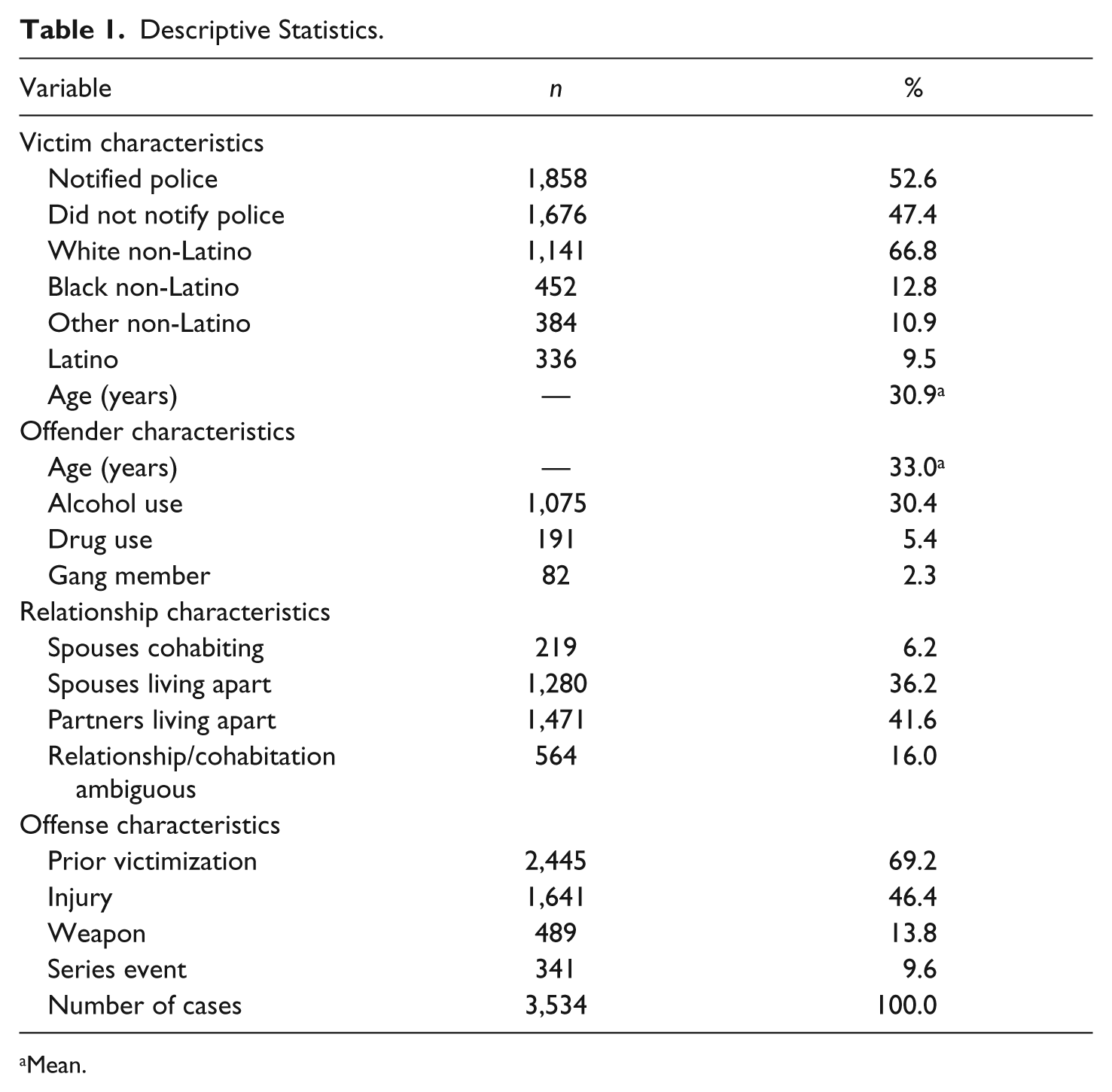
Mean.
Table 2 illustrates notification differences across ethnic groups and provides insight into why these differences exist. Individuals who self-identify as White non-Latino are the reference category in all models. Model 1 presents results from our initial logistic model that regresses notification on a set of race/ethnicity dummy variables. This model confirms Rennison and Welchans’s (2000) findings that minority victims notify the police more often than do majority group members. Latinas are 83% more likely, exp(b) = 1.83, p < .01, than are White non-Latino victims to notify the police, whereas Black non-Latino victims and victims who self-report in other ethnic categories are 92% and 36% more likely, respectively.
Determinants of Reporting Domestic Violence. a
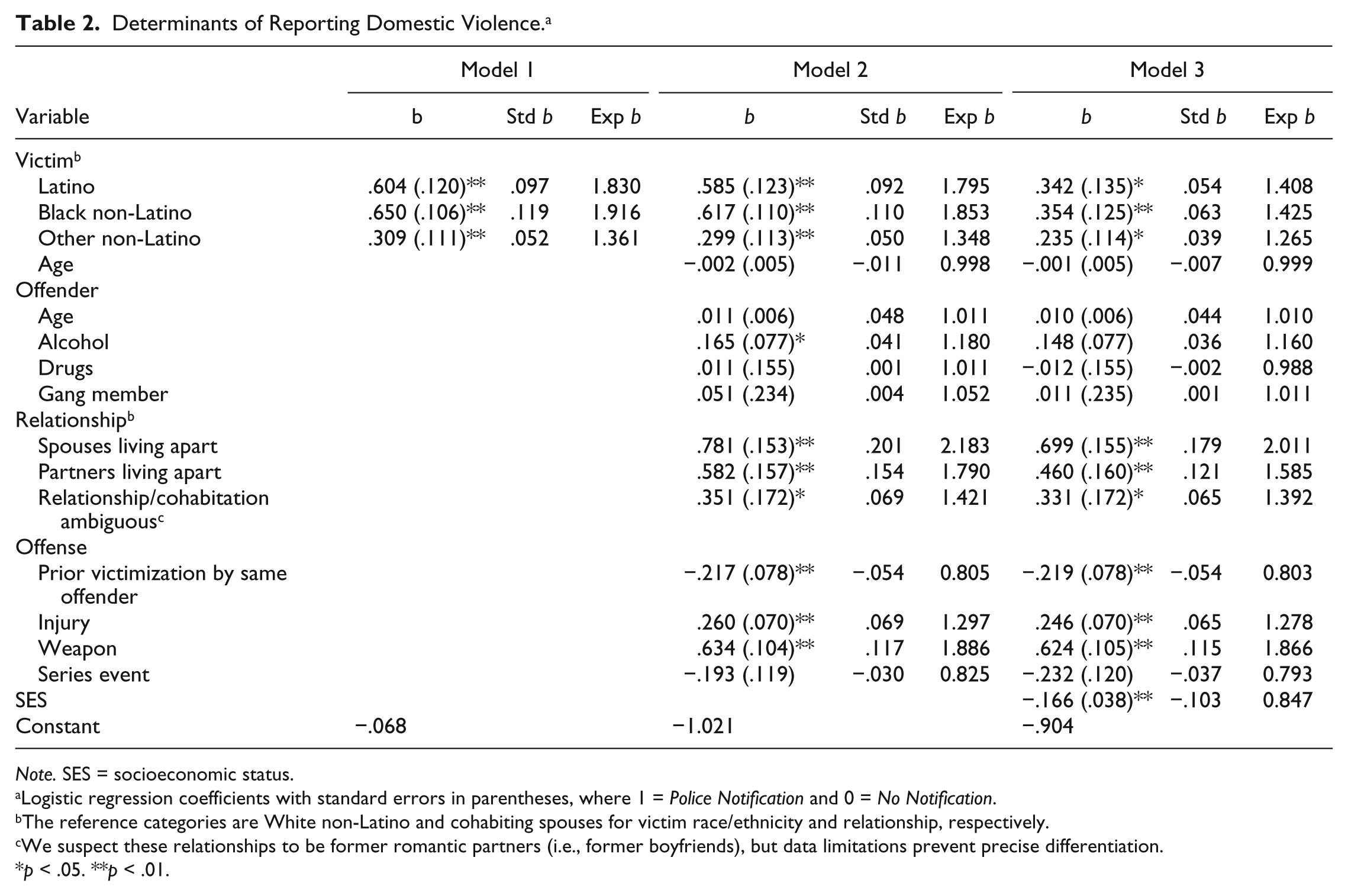
Note. SES = socioeconomic status.
Logistic regression coefficients with standard errors in parentheses, where 1 = Police Notification and 0 = No Notification.
The reference categories are White non-Latino and cohabiting spouses for victim race/ethnicity and relationship, respectively.
We suspect these relationships to be former romantic partners (i.e., former boyfriends), but data limitations prevent precise differentiation.
p < .05. **p < .01.
In Model 2, we add compositional and similar variables (other than SES), which produce only minor changes in the effects of ethnicity relative to the first model’s estimates. These results suggest that this set of compositional differences explain little about why the groups notify at different rates. The estimates for the effects of these factors do confirm, however, findings from prior research that the offenders’ alcohol consumption is associated with notification and that victims who live with a spouse (the reference category) are less likely to notify the police than victims in any of the other three relationship/living classifications. As expected, victims are more likely to notify when injured or when a weapon was involved, and less likely to notify for repeat and series incidents involving the same offender.
In Model 3, the model of most interest, we added factor scores representing SES. Here, we see that higher SES victims are less likely than are lower SES victims to notify the police. More importantly, however, accounting for SES differences decreases the estimate associated with Latinas from .585 to .342 (more than 40%). The inclusion of SES also decreases the estimate associated with Black respondents from .617 to .354, and with the estimate for the “Other” category from .299 to .235. We tested for statistical significance for the mediation effects of SES for Latinas, Black non-Latinos, and Other non-Latinos using methods first described by Baron and Kenny (1986) and Sobel (1982), and modified for dichotomous outcomes by MacKinnon and Dwyer (1993). Our results (7.29, p < .01; 6.91, p < .01; .04, p = .96 for each group, respectively) indicated a statistically significant mediation effect of SES for Latina and Black non-Latino police notification, whereas the mediation effect of SES for Other non-Latinos was not statistically significant. These tests indicate that a substantial proportion of the explanation for why Latino and Black non-Latino victims notify the police more often than do White non-Latino victims is due to the SES differences between these groups. In other words, after accounting for SES, the notification behavior of these minority groups appears more like that of the White non-Latino victims represented by the reference category. The standardized regression coefficients show that SES is among the strongest effects of notification. The standardized SES effect is close in magnitude to weapon-use and surpassed only by the living arrangements of spouses and partners living apart.
In supplementary analyses not presented in our tables, we substituted several of the measured and constructed component variables related to SES in place of our factor scores. Although single-item measures of a complex construct such as SES are less reliable and more prone to error than factor scores and therefore should be expected to produce smaller effect size estimates (Bollen et al., 2002), we wanted to determine whether constructs related to SES have a similar ability to explain ethnic group differences in notification. In the case of each related construct, we obtained consistent results. Police notification was positively related to low family income, public housing, renting (versus owning a home), the number of household individuals below 12 years of age, and living in a mobile home, trailer, or dormitory when we substituted each, one at a time, for the SES factor scores. Moreover, each substitution attenuated the differences between the minorities and the reference group.
Sequential-Response Models of Notification Motives
Table 3 provides the results of the sequential-response procedures that determine whether respondents from different ethnic and SES groups provide different reasons for notifying or not notifying the police. The first data column contains predicted probabilities for providing each of the various motives for calling or not calling the police for “average” victims. For example, we would expect 26.2% of victims whose values on all predictors used in the prior analysis were at their means (including the ethnicity dummy variables) to call the police for a self-protection reason, whereas 26.9% to call for another reason. Overall, 53.1% of these “average” victims would call for one of these two reasons, whereas 46.9% would not call for one of the six reasons listed in lower rows on the table. We would also expect that 2.3% would not call because they thought the matter trivial, 5.4% to not call because they feared reprisal, 12.3% to not call because it was a private matter, 4.4% because they wished to protect the offender, 1.6% because they believed that the police would consider the event unimportant, and 17.3% to not call for some other reason.
Sequential-Response Probabilities of Motives by Race/Ethnicity and SES. a
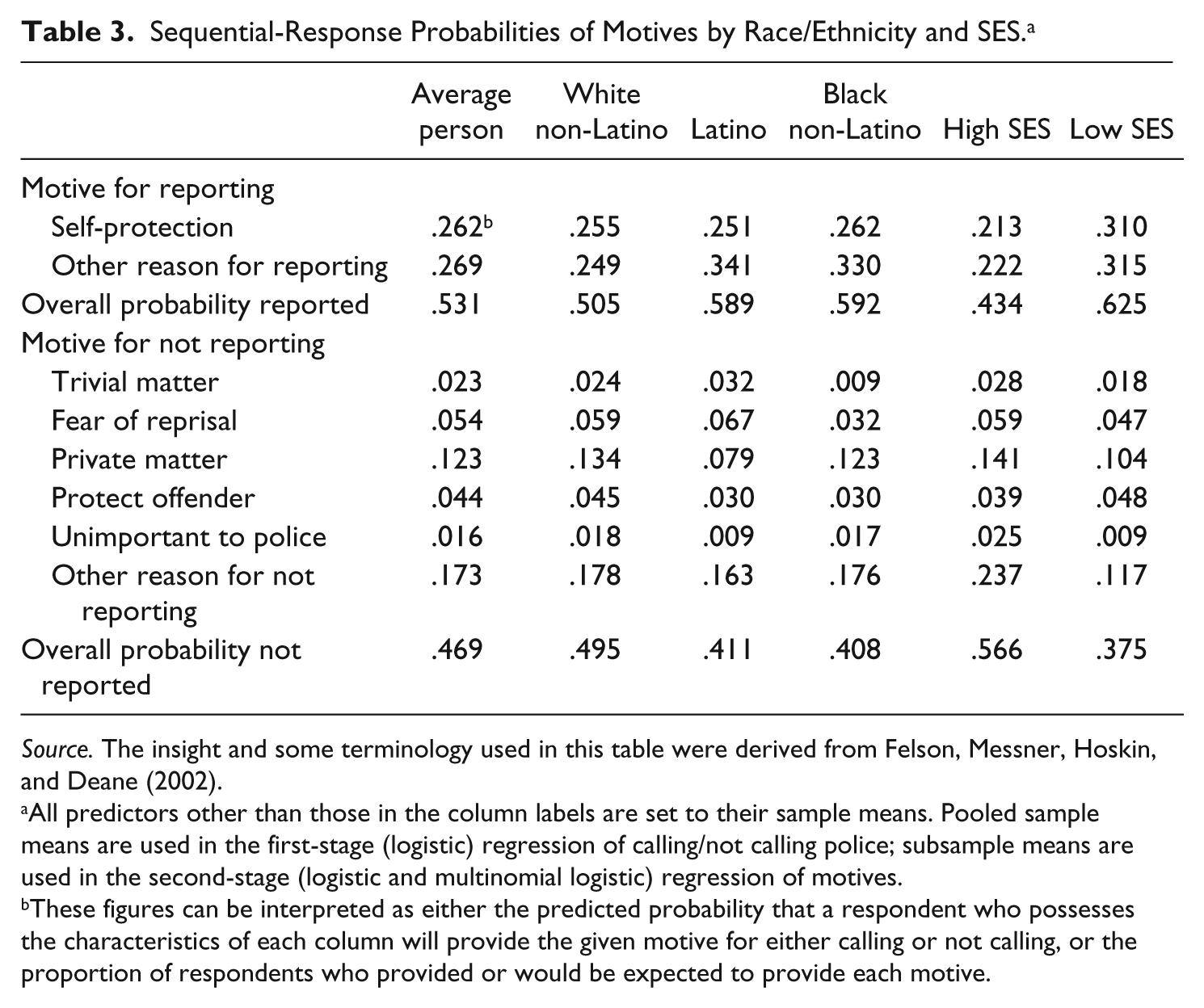
Source. The insight and some terminology used in this table were derived from Felson, Messner, Hoskin, and Deane (2002).
All predictors other than those in the column labels are set to their sample means. Pooled sample means are used in the first-stage (logistic) regression of calling/not calling police; subsample means are used in the second-stage (logistic and multinomial logistic) regression of motives.
These figures can be interpreted as either the predicted probability that a respondent who possesses the characteristics of each column will provide the given motive for either calling or not calling, or the proportion of respondents who provided or would be expected to provide each motive.
The second through fourth data columns contain predicted probabilities for the different ethnic groups when all predictors other than ethnicity are set to their means. As shown earlier, White non-Latino victims are the least likely to report partner offenses, while Latino and Black non-Latino victims are more likely to report. Overall, however, there are few substantial differences in the motives for either reporting or not reporting across ethnic groups. Although the minority groups are more likely to report, when they do report it is usually for one of the miscellaneous motives rather than for a self-protection motive. Looking at the motives for not reporting, the only appreciable difference occurs in the percentage of Latinas who do not notify because the incident was a private matter. While the predicted percentage of White non-Latino victims and Black non-Latino victims was very similar at 13.4% and 12.3%, respectively, only 7.9% of Latino victims mentioned this motivation.
In contrast to the small differences in notification motives across ethnic groups, columns 5 and 6 illustrate more distinct differences across SES levels. In Column 5, we set the SES factor score at 2 standard deviations above its mean, and in Column 6 we set the score at 2 standard deviations below. Again, we set all other predictors at their means.
We again see that high SES victims are less likely to notify the police than are low SES victims (43.4% vs. 62.5%). The reasons for notification, however, are effectively divided equally between self-protection and other motivation types. When examining the various reasons for why the police were not notified, we again see that the largest difference is for those who believe that the matter was a private one (14.1% for high SES vs. 10.4% for low SES).
Discussion
The prior literature has often assumed that IPV victims who fail to notify the police are disadvantaged by an inability to receive beneficial law enforcement assistance. This assumption may be incorrect and may discourage scholars from looking for evidence of resource inequities if alternatives to police involvement are more effective or more widely preferred among victims. If police assistance is less objectively or subjectively beneficial than its alternatives, high notification in identifiable groups may indicate that the group faces disadvantages such as a decreased access to preferred services, leaving police involvement, which is more equally accessible to most victims, as the more viable option. Our results are consistent with this more complex reality because minority and lower SES victims, who are often disadvantaged in ways beyond attenuated financial capital, are more likely to notify the police than majority and higher SES groups. These disadvantages often relate to practices that segregate disenfranchised groups into neighborhoods where service agencies are absent, understaffed, or unresponsive.
Although accounting for SES decreased group notification differences in our models, other compositional differences did not significantly account for this variation. In other words, the reason why minority IPV victims notify the police more frequently than White victims is partially explained by SES differences, but is not substantially explained by group differences in age, alcohol consumption, drug use, gang membership, living arrangements, or characteristics related to offense seriousness and frequency.
Although our second set of analyses that address the reasons for reporting and not reporting do not provide definitive answers about the motivational differences for notification, there are important facts to consider in the results of these analyses. Most importantly, Latinos and Black non-Latinos were less likely than majority group members to say that they did not report because they felt that the incident was a “private matter.” This finding, especially for the Latinos, runs counter to common beliefs about the potentially negative effect of family privacy on police notification for these groups. In other words, if there are cultural differences among Latinas about discussing family problems with others, we found no negative effect of these differences as they may relate to police notification.
Although data limitations prevent us from drawing definitive conclusions about the exact processes that underlie our findings, the results from these two sets of analyses lead us to interpret the patterns we found in our data as consistent with a differential access explanation, one form of structural explanation. We base this conclusion on the fact that it is relatively clear that cultural differences across racial and ethnic lines are unlikely to explain the police notification patterns because prior literature suggests that net of other factors, Latinos and other minorities would be less likely than other groups to discuss family matters to authorities. The fact that all minority groups are more likely than White non-Latinos to involve the police, however, implies that the various minority groups in our analyses share something in common that is related to notification. The fact that accounting for SES decreased the notification differences implies that SES is a major commonality.
We surmise that SES affects police involvement largely because increased financial capital often permits victims to have the independence required to physically separate from an abusive partner. Higher SES also affords victims the ability to pay for the childcare or transportation often required to attend the full range of available IPV prevention modalities, including the ones victims perceive as being most suitable for their circumstances. These suppositions are speculative, of course, and go beyond the scope of our data. For this reason, we must defer to future research and alternative data sources to more fully examine these possibilities.
An important point about our findings is that although our SES measure was able to explain only some of the notification variation across racial/ethnic groups, our data and methods have likely provided a conservative estimate of the SES effect upon police notification for three primary reasons: First, NCVS data do not measure consumer goods expenditure or ownership and these factors are known to better approximate SES constructs (Deaton, 1992; Filmer & Pritchett, 2001). Second, although our factor scoring methods improve upon single-item and summative SES indicators, they remain only proxy measures of the more elusive concepts surrounding the financial, social, geographical, and human capital considerations we believe may explain more fully the relationship between minority group status and police notification. In other words, it is important to note that we should probably consider SES to be a marker of the more elaborate processes that influence the ways in which victims make decisions. Finally, prior research has noted skepticism in some ethnic communities about the legitimacy and effectiveness of law enforcement agencies that may deter residents from police notification. This suggests that the potential effect of SES may be stronger in reality, although offset to some degree by this dynamic. We will defer to others, however, to determine whether it is appropriate to consider this skepticism an element of culture. In other words, our results do not suggest that cultural differences are unimportant, but rather that culture and social structure have complex interconnections that demand careful interpretation.
Summary
Our findings are relatively clear about the effect of SES on police notification and that accounting for SES attenuates some of the observed notification differences across ethnic groups. Although we have suggested that these findings potentially imply something about the objective or subjective efficacy of police involvement relative to the efficacy of alternative options open to victims, only future research can confirm or deny these speculations. We certainly do not suggest that our findings imply that victims be discouraged from seeking assistance through a variety of sources, including those available through law enforcement channels. Instead, we believe that our findings are consistent with the reality that a victim’s decisions about IPV are difficult and personal and that we should avoid making unwarranted assumptions about the utility and rationality of the complex choices that victims make under difficult circumstances. Regardless of the reasons underlying the utilization differences in any type of amelioration initiative across groups, however, we believe that it is clearly appropriate that these initiatives be reasonably available to victims who choose to use them.
Footnotes
Acknowledgements
We wish to thank Ed Murgia, Rogelio Saenz, Zulema Valdez, and the anonymous reviewers of this article for their helpful comments.
Declaration of Conflicting Interests
The author(s) declared no potential conflicts of interest with respect to the research, authorship, and/or publication of this article.
Funding
The author(s) disclosed receipt of the following financial support for the research, authorship, and/or publication of this article: This research was funded by the Texas A&M Mexican American and US Latino Research Center (MALRC).