




Abstract
Resource theory constitutes important explanations of spousal violence in culturally diverse societies. This article extends the theory by adding several subjective indicators: husband’s financial strain and the couple’s appraisal of each other’s financial and nonfinancial contributions to family. We examined the role of these subjective dimensions of resource in spousal violence against the backdrop of other predictors, including the husband’s absolute socioeconomic resources, the wife’s economic dependence, and relative resource differences between the husband and wife. The findings not only partly support absolute and relative resource theories but also suggest the salient role of subjective indicators of resources on husband-to-wife physical assault.
Since the pioneering work of Goode (1971), the role of resources in spousal violence has become a central concern (Gelles, 1985). Scholars have examined the roles of absolute and relative socioeconomic resources, such as income, education, and occupational prestige, in violence (Anderson, 1997; Choi & Ting, 2008; Kaukinen, 2004; McCloskey, 1996; Yount, 2005). However, absolute and relative resource theories focus mainly on socioeconomic resources and have seldom taken into account each partner’s other contributions to the family, such as emotional support, housework, and childcare. As Hobfoll (1989) argued, past research has mostly defined resources narrowly as socioeconomic resources. He argued for a wider definition of resources to include nonmaterial resources, such as support and services, which are valued and sought after. Research has also neglected the role of perceived resource conditions, for example, financial strain, in violence. However, the few studies that have included perceived resource conditions in their analysis of family dynamics found that both men’s and women’s perceived resource security and adequacy were strong predictors of family conflict (Conger et al., 1990), parenting distress (Fox & Chancey, 1998), and spousal violence (Fox, Benson, DeMaris, & van Wyk, 2002).
This article studies the effects of absolute, relative, and subjective indicators of resource conditions on husband-to-wife physical violence. Specifically, we used three indicators to directly measure the husband and wife’s subjective appraisal of each other’s financial and nonfinancial (i.e., emotional care and housework) resource contribution to the family and tested their relationships with violence. We also included measures of husbands’ financial strain in our analysis. We believe that taking into account the role of perceived resource conditions, the nonmaterial resource contribution to the family and each partner’s subjective evaluation of these contributions can help to clarify the relationship between different kinds of resources and violence.
Our data came from a household survey of 871 married Chinese couples in Hong Kong conducted in 2007. As a developed society, Hong Kong exhibits structural conditions that make it an optimal research site for testing the different dimensions of resources on violence. It is a relatively affluent society with a large number of families living in poverty due to high levels of income inequality (World Bank, 2008). This has made the issue of absolute resource deprivation an important consideration for violence research. Hong Kong has a growing number of households with a higher earning wife (Ting & Lam, 2012): Wives’ economic power has posed a challenge to the traditional male-provider norm, and it is therefore relevant to examine the impact of relative resources and subjective evaluations of resources on violence. Finally, Hong Kong is a small economy that is vulnerable to external economic volatility and crises, making the examination of relationships between violence and financial strain, the measurement of perceived financial conditions based on current economic situations, and projections of future economic conditions appropriate.
Domestic violence is a common problem in Chinese societies (Xu, Campbell, & Zhu, 2001). Data from the 1999-2000 Chinese Health and Family Life Survey show that 34% of women reported that they had been hit at least once during their current relationship (Parish, Wang, Laumann, Pan, & Luo, 2004). A study conducted in the coastal city of Fuzhou in China found that 26% of women reported being the victims of violence at the hands of a partner during the previous year (Xu et al., 2005). In Hong Kong, depending on samples and measurements, studies have found that 8.3% to 15.7% of women reported having been physically abused by their male partners in the preceding year (Chan, 2005; Tang, 1999).
Theories: Objective, Relative, or Subjective?
The aim of this article is to extend traditional resource theories, such as absolute and relative resource theories, relating to spousal violence research by adding indicators of subjective appraisal of resource conditions to our analysis. We do not argue against these traditional resource theories. Rather, we intend our analysis to complement and improve the relevance of these theories. In this section, we first review past research on the relationships between absolute and relative resources and spousal violence. We then provide a theoretical rationale for our addition of indicators of subjective appraisal of resources to study husband-to-wife physical violence.
Husband’s Absolute Socioeconomic Resources and Financial Strain
Building on Goode’s (1971) arguments, Allen and Straus (1980) argue that violence is an ultimate resource that is deployed by men who lack other resources to deter unwanted actions and to induce a desired response. This perspective has been used to explain disparities in the levels of violence between different social classes and the higher levels of physical violence among men of lower socioeconomic status (Hoffman, Demo, & Edwards, 1994; Koenig, Ahmed, Hossain, & Mozumder, 2003; Yount, 2005) and men who are unemployed. Some scholars, however, contend that poor men are more likely to perpetrate violence because they experience a higher level of stress and frustration resulting from their socioeconomic disadvantages (Dutton, 1988). They may also have limited access to stress-reduction and coping mechanisms (Steinmetz, 1987; Straus, Gelles, & Steinmetz, 1980). Violence, therefore, is not a direct result of absolute resource deprivation but rather arises as a response to stress originating from such deprivation. Introducing stress as an immediate cause of violence, this perspective highlights the significant role of men’s appraisal of their financial status, such as perceived financial adequacy and debt worries in spousal violence. Several studies have provided empirical evidence to support this perspective by showing that men who physically assault their spouse experience higher levels of stress than those who do not use violence (Hoffman et al., 1994; Straus et al., 1980). In a study that controlled for indicators of absolute and relative socioeconomic resources, perceptions about financial status, such as perceived financial adequacy and worries, were found to be a significant risk factor related to marital violence (Fox et al., 2002). These findings echo those of scholars on economic distress (Voydanoff, 1990) and the conservation of resources model (Hobfoll, 1989), who have argued that the subjective appraisal of one’s resource situation has important implications for marital relationships.
Wife’s Economic Dependence
Women’s economic dependence has long been considered a risk factor for violence (Kalmuss & Straus, 1982; Straus et al., 1980). Some feminist scholars argue that the economic dependence of women grants men “the license to hit” (Dobash & Dobash, 1979), increasing women’s tolerance for violence, reducing their power to negotiate changes in the behavior of their partner, and discouraging them from either seeking outside intervention in instances of violence or from leaving a violent relationship (Gelles, 1976; Strube & Barbour, 1984). Women’s unemployment, low educational qualifications, and the presence of young children are often considered to be circumstances that increase their economic dependence on their spouse (Kalmuss & Straus, 1982). However, empirical evidence of the effect of women’s economic dependence on husband-to-wife violence is inconclusive. Some studies found that women who were homemakers and who were economically dependent on their husband faced a lower risk of violence by their male partner (Hornung, McCullough, & Sugimoto, 1981). Other studies, however, showed that women who were economically dependent on their husband because they were not working, earned 25% or less of the total family income, had a lower occupational status, or had young children faced significantly higher risks of severe violence from their male partner (Choi & Ting, 2008).
Relative Resource Differences Between Husband and Wife
The theory of status inconsistency explains the role of relative differences in socioeconomic resources between the husband and wife in intimate violence against women (Anderson, 1997; Kaukinen, 2004; McCloskey, 1996). This perspective highlights patterns of resource differences between the husband and wife that are inconsistent with gender norms of male dominance and the male-provider role. Based on feminist theory, it emphasizes the symbolic meaning of socioeconomic resources in the construction of masculinity (Macmillan & Gartner, 1999). Employment is critical for the construction of masculinity in both Western and Chinese cultures (Choi et al., 2012). Their role as providers not only gives men dominance in the family but also affirms their masculinity. Within this particular gender framework, women in unions, where they are the sole provider or have a considerably higher socioeconomic status than their husband, are hypothesized to be at an elevated risk of spousal violence. This is because women’s socioeconomic advantage over their husband may contradict gender role expectations, disrupt the patriarchal pattern of male authority, and threaten the masculine identity of their husbands, who may then become motivated to use violence to assert their dominance (Connell, 1995).
Empirical evidence on the relative resource thesis is also inconclusive. In the United States and Canada, several studies have shown that women who exceeded their partners in income, and occupational and educational attainments, were at a higher risk of becoming the victims of physical assault (Anderson, 1997), coercive control (Macmillan & Gartner, 1999), and emotional abuse (Kaukinen, 2004) by their male partner. However, another study in the United States showed that women’s resource advantages over men only increased their risk of victimization if the men held traditional gender role beliefs (Atkinson, Greenstein, & Lang, 2005). Studies in South Africa (Choi & Ting, 2008) and Egypt (Yount, 2005) have found that, contrary to expectation, women’s resource advantages over men either reduced their risk of being physically assaulted or did not have any significant impact on the risk of violence.
Couple’s Subjective Appraisal of Each Other’s Financial and Nonfinancial Resource Contributions
In his conservation of resource model, Hobfoll (1989) proposed that “a lack of resource gain following the investment of resources” (p. 516) is a particularly problematic situation that will generate stress in relationships such as marriages. This is because marriages are never a one-off transaction, and because both partners are contributing resources, such as time, money, and emotion to each other and to the relationship with the expectation of returns in the forms of love, protection, service, and so forth. This line of argument highlights two issues. First, it suggests that marriage is an exchange relationship governed by cultural norms of reciprocity, equity, and role expectations (Clark, 1983). When the rewards are perceived to be lower than the investment, feelings of unfairness may arise. Second, it suggests that the types of resources exchanged within a marriage are often multi-dimensional, including not only financial resources, education, and occupational prestige but also other resources such as daily help, housework, child care, and emotional and social support. This understanding is in line with Hobfoll’s (1989) definition of resources, which are defined as “those objects, personal characteristics, conditions, or energies that are valued by the individual or that serve as a means for attainment of these objects, personal characteristics, conditions or energies” (p. 516). A broader definition of resources not only allows us to understand the different types of resources exchanged in an intimate relationship but also provides an angle to understand why some arrangements, which appear unfair to outsiders, are accepted by the couple. For example, differences in financial resources between husbands and wives that may seem unfair to outsiders may be viewed as equitable or acceptable by both parties because of the nonmaterial services that the partner who is disadvantaged in financial resources provides to the family (e.g., a greater share of housework and child care) or because of the use of gender-based coping strategies (McCloskey, 1996). Therefore, in addition to examining the influence of differences in socioeconomic resources between couples (relative resource) on violence, one also needs to consider the couple’s subjective evaluation of each other’s financial and nonfinancial resource contributions to the relationship, such as emotional care and housework (McCloskey, 1996).
Context of the Study
Despite having been a British colony for more than 100 years until 1997, Hong Kong is essentially a Chinese society: More than 94% of its 7 million people are Chinese (Census and Statistics Department, Hong Kong Special Administrative Region [HKSAR], 2011). Being one of the fastest growing economies in East Asia, Hong Kong’s gross domestic product (GDP) per capita (PPP) in 2008 was US$42,000 (World Bank, 2008). However, behind this impressive economic achievement lies vast income inequalities and economic deprivation for a considerable proportion of the city’s residents. The Gini index stood at 53.3 in 2007, indicating a considerably higher level of inequality compared with other developed nations, most of which had Gini indices between 24 and 40 (World Bank, 2008). The persistent economic deprivation experienced by a large part of Hong Kong’s population provides an important impetus for examining the relationship between absolute resource deprivation and husband-to-wife violence.
As a result of Hong Kong’s rapid economic growth over several decades, women as a whole have gained comparatively more educational and career opportunities. By 2010, women constituted 53.7% of all university students and 43.3% of the total workforce. By 2010, women constituted 30.8% of managers and administrators, and 37.2% of professionals (Census and Statistics Department, HKSAR, 2011). In tandem with these macro trends is the increasing economic contribution of women to the family. By 2009, approximately 40% of Hong Kong’s families were dual-earner households (data from Hong Kong Family Life Survey; Ting, 2009).
However, cultural norms concerning gender have lagged behind structural changes. In 2008, only 38% of all respondents surveyed in a representative study would accept the woman working outside the home while the man stayed at home to take care of the family (Chow & Lum, 2008). When society still upholds traditional attitudes toward gender roles, the progress that women are making in the labor market poses a challenge to marital relations, especially in families where the women have more resources than their husbands. Furthermore, the increase in dual-earner households has inevitably led to questions about who should contribute what and how much. How each partner assesses the other’s contribution may thus become an increasingly contentious issue that will affect marital dynamics and the risk of violence.
Method
Sample Design and Data
Data for this study came from a 2007 household survey of 871 couples (1,742 respondents) in Hong Kong, in which both the husband and wife in the same family were interviewed. By couples, we refer to men and women who are either married or cohabiting. The survey was conducted in a northwestern district of Hong Kong that had a population of 449,070 in 2009. The most up-to-date frame of quarters maintained by the Hong Kong Census and Statistics Department was used as the sampling frame for this survey; from it, valid addresses were randomly selected, enumerated, and contacted for the survey. If more than one couple lived in a selected quarter, only one of the couples in the household was selected randomly for an interview. Separate appointments were made with the husband and wife for separate interviews to be conducted on a one-to-one basis in two timeslots. If either the husband or the wife refused to participate in the survey, it was treated as a refusal case. The response rate was 72%. Nonresponses included noncontacts (15%) and refusal cases (13.2%). Refusal cases included couples with only one member available in the data collection period or in which at least one member declined to participate. Among the successfully interviewed couples, only two were cohabiting couples. The Hong Kong Census has had no separate category for cohabiting couples. According to a 2005 survey of more than 5,000 adult respondents across Hong Kong, 1.9% reported their marital status as cohabitation (Chan, 2005). Judging from this figure, it would seem that cohabitation is far less common in Hong Kong than in Western countries.
The ethical and safety procedures, as set out by the WHO (2003), were revised for local use in the data collection process. The survey was strategically divided into two parts: an interviewer-administered questionnaire and a self-administered questionnaire. All sensitive questions, including those on spousal violence, were addressed in the self-administered questionnaire. After completing the interviewer-administered questionnaire, each of them was given a self-administered questionnaire to complete, which was then placed in a sealed envelope in front of the respondent to ensure confidentiality. Ethics approval was obtained from the ethics committee of the researchers’ university.
Measures
Dependent variable
This research examines husband-to-wife physical assault in the year prior to the survey. Physical assault was measured by the Physical Assault and Injury subscales of the Revised Conflicts Tactics Scale (CTS2 for couples; Straus, Hamby, Boney-McCoy, & Sugarman, 1996). The Chinese translation of the CTS2 used here had been found to have satisfactory reliability (ranging from 0.88 to 0.96) in a previous survey on domestic violence in Hong Kong (Chan, 2005). In total, 15 items from minor and Severe Physical Assault and Injury subscales were used to measure husband-to-wife physical assault. Minor physical assault included “threatened to use violence on,” “threw something at,” “pushed/grabbed/shoved,” and “slapped/spanked” the spouse. Items relating to severe physical assault included “kicked/bit/hit with fist,” “hit, tried to hit with something,” “beat up,” “threatened with a gun or knife,” and “used a gun or knife.” Injuries included “burned,” “scalded,” “sprained,” “bruised,” “caused a small cut,” and “injuries that needed medical attention and hospitalization.” Previous studies have suggested that combining couple data provided more accurate violence prevalence estimates than data based on only one member of the couple (Szinovacz & Egley, 1995). In this study, we took into account both the husband’s and the wife’s reports of violence to construct our outcome variable. Physical assault was a dichotomous variable, in which 0 indicated that neither partner reported violence and 1 indicated that either the woman reported that her partner used violence against her, or the man reported using violence against the woman, or both.
An examination of our data showed that there was a high level of overlap between minor assault, severe assault, and injuries. Among those who reported perpetrating minor physical assault, more than half had also perpetrated severe physical assault or caused injuries. This made separate analysis of minor and severe assault inappropriate in our context. We therefore combined reports of minor assault, severe assault, and injuries to form our physical assault variable. Although CTS2 can be used as a continuous scale to indicate violence chronicity, it is common to collapse the scale into a dichotomous measure in nonclinical samples because the variable is usually extremely skewed and concentrated at 0 (Straus et al., 1996).
We acknowledge the existence of wife-to-husband violence; in particular, there is evidence that women are as likely as men to perpetrate minor and occasional physical violence. Men, however, are the main perpetrators of systematic violence that aims at exerting patriarchal control over women (Johnson, 1995). There are also consistent findings that male violence against women is a more serious problem in terms of frequency, severity, and health consequences (Felson & Cares, 2005).
Independent variables
Variables related to husband’s resources came from the husband’s questionnaire and those related to wife’s resources came from the wife’s questionnaire. Variables on the living arrangements of the family came from the wife’s questionnaire. To test the relationship between husbands’ absolute resource deprivation (Allen & Straus, 1980; Goode, 1971) and men’s perpetration of violence, the “husband’s monthly income” (10 census categories ranging from HK$0 to more than HK$40,000), “educational level” (8 census categories ranging from no formal education to having a master’s degree or above), and “employment status” (coded 1 for employed respondents and 0 for not-employed respondents) variables were constructed. In the employment status variable, the “not employed” category included the unemployed, retirees, homemakers, and those who reported themselves as “not employed but not looking for a job.”
A scale constructed of three standard items commonly used by sociologists to measure felt economic strain (see Voydanoff, 1990, for an overview) was used to capture “husband’s financial strain.” The first item measured husbands’ felt economic stress: “How often do you worry that you won’t have enough money to cover your expenses?” The second item measured stress from debt problems: “Are you stressed by your debts?” The responses on these two items ranged from “never” (coded 0) to “all the time” (coded 3). The last item measured husbands’ satisfaction in terms of their financial condition (0 = very satisfied, to 4 = very dissatisfied). All items were standardized, summed, and averaged into a score (ranging from 0 to 4.54; α = .71), suggesting that the scale had an acceptable level of reliability.
Following Kalmuss and Straus (1982) and Yount (2005), two indicators were used to measure women’s economic dependency, including “wife’s employment status” and “the presence of a young child under the age of five.” Macmillan and Gartner (1999) found that the effect of a wife’s employment on the risk of spousal violence is conditional on the husband’s employment status. Following their study, a further indicator was added to measure whether both the husband and wife were employed, as an interaction term of the husband’s and wife’s employment status.
Relative differences in spousal socioeconomic resources were captured in relation to two aspects. Three categories were used to measure spousal educational difference: The husband had higher educational attainment than his wife (more than one category, served as the reference category), the husband and wife had the same level of education, and the wife had higher educational attainment (more than one category). Further three categories were used to measure spousal income difference: The husband earned substantially more than his wife (more than one category, served as reference category), the husband and wife earned a similar level of monthly income, and the wife earned substantially more than her husband (more than one category).
We used six indicators to measure a couple’s evaluation of each other’s resource contribution to the family. Because couples exchange different kinds of resources such as financial resources, emotional care, housework, and child care, we directly asked our respondents to assess whether they were satisfied with their partner’s contribution in terms of financial resources, emotional care, housework, and child care. However, we excluded child care in this analysis because 8.2% of the couples sampled had no children and including evaluation of the child care contribution would lead to a substantial loss of cases. There were five categories of response to each question ranging from definitely inadequate (coded 0) to definitely adequate (coded 4). In our analysis, we also took into account the husband’s age, spousal age difference, and living arrangements of the family.
Statistical Analysis
Because the dependent variable was a dichotomous measure, we used logistic regression models to analyze the association between independent variables and the log odds of husband-to-wife physical assault. The reported logit coefficients and adjusted odds ratios (OR) measured the associations between the independent variables and the dependent variable, controlling for all other covariates.
Results
Table 1 shows the descriptive statistics for the variables in our analysis. The prevalence rate of husband-to-wife physical assault was 10.30%.
Descriptive Statistics of the Variables Included in the Analysis (N = 845).
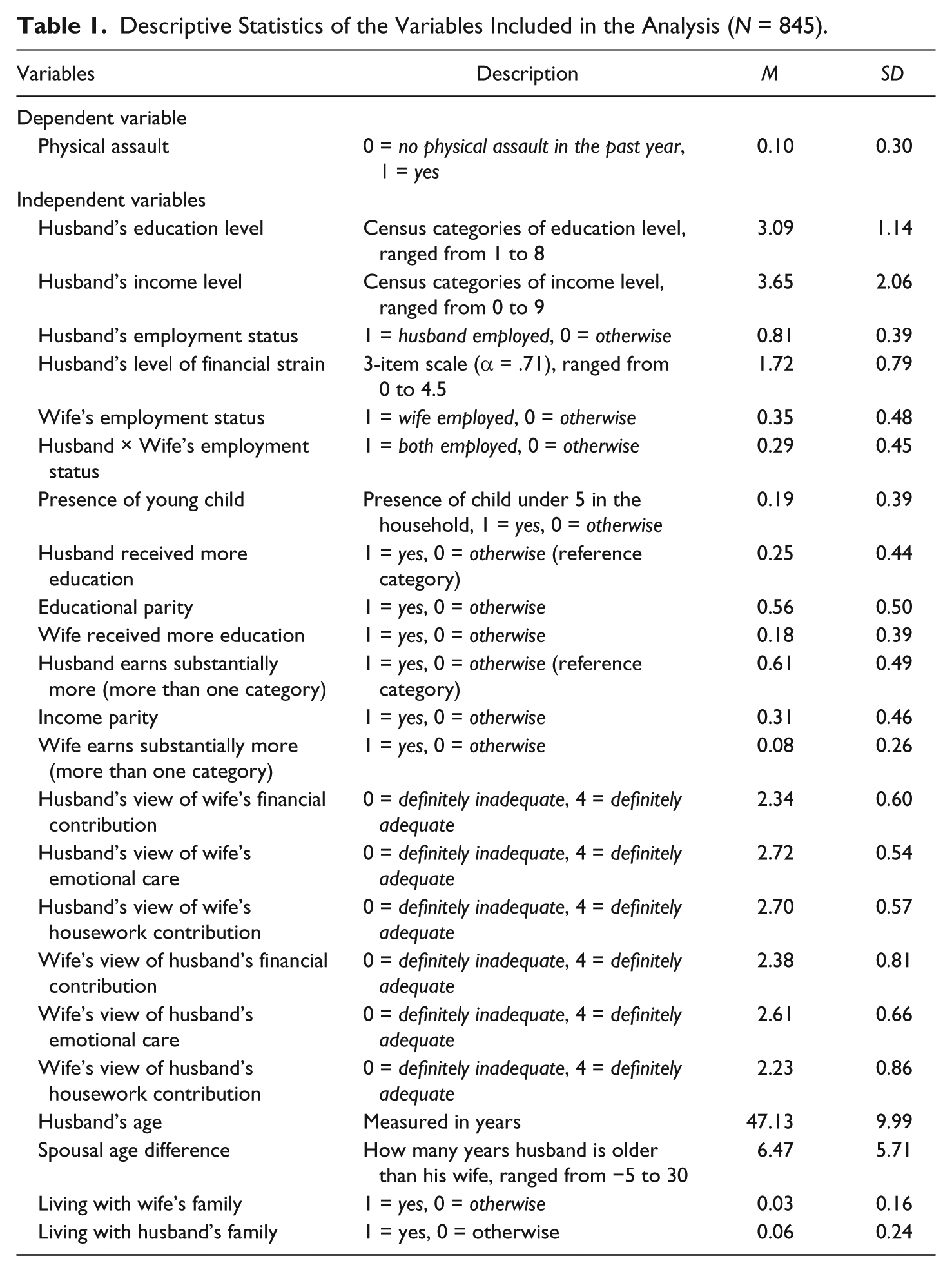
For indicators of absolute resource, the husbands in our analysis on average had a secondary education, earned US$1,026 to US$1,281 monthly, and 81% were employed. The not-employed category of husbands included 54 unemployed (6.35% of total), 68 retirees (8% of total), 20 homemakers (2.35% of total), and 18 not employed but not looking for a job (2.12% of total). Indicators of the husbands’ level of financial strain showed that, on average, husbands in our sample felt a medium level of financial strain with the mean score being 1.72 within a range between 0 and 4.5. Turning to indicators of the wife’s economic dependence, only 35% of the wives were employed. Not-employed wives included 519 homemakers (61% of total), 20 retirees (2.25% of total), 10 unemployed (1.18% of total), and 4 not employed but not looking for a job (0.5% of total). Around 19% were living with a young child under the age of 5. In terms of relative resource indicators, more than half (56%) of the couples sampled had the same level of educational attainment, 25% of the husbands were more educated than their wife, and only 18% of the wives had a higher educational attainment than their husband. With respect to relative income, 61% of the husbands were earning substantially more than their wives, 31% of couples had a similar level of monthly income, and only 8% of the wives earned substantially more than their husbands. On average, the husbands and wives in our sample were positive (above the midpoint of the scale) about their partner’s financial, emotional care, and housework contribution to the family. With respect to control variables, the mean age of husbands in our sample was 47 and the mean age difference between husband and wife was 6.47 years. Of the couples sampled, 3% were living with the wife’s family and 6% were living with the husband’s family.
Table 2 presents the results of logistic regression analysis. In Model 1, the associations between objective resource indicators and husband-to-wife physical assault were assessed. None of the husband’s absolute resource indicators (education, income, and employment status) was significantly associated with the risk of husband-to-wife physical assault at the .05 level. Turning to indicators of relative resource, women in families, where she earned substantially more than her husband, were at significantly higher risk of husband-to-wife physical assault (OR = 10.05, p < .01), compared with women in families where the husband earned substantially more. Wife’s economic dependence, as measured by the wife’s employment status, was significantly and negatively associated with the log odds of husband-to-wife physical assault (OR = 0.09, p < .01) when her husband was not employed. Wife’s employment status was not significantly associated with her risk of husband-to-wife physical assault when the husband was employed. The interaction effect of the husband’s and wife’s employment status was marginally significant at the .1 level. In a separate analysis not reported here, we found that both husband’s and wife’s employment was not significantly associated with physical assault after the interaction term was dropped. This indicates that the impact of husband’s and wife’s employment on physical assault was conditional on the spouse’s employment status.
Results for Logistic Regression of Husband-to-Wife Physical Assault (N = 845).

Note. SE = standard error; OR = odds ratio.
p < .1. *p < .05. **p < .01. ***p < .001.
In Model 2, associations between subjective appraisal of resource conditions and husband-to-wife physical assault were examined. The husband’s level of financial strain was significantly and positively associated with the risk of husband-to-wife physical assault (OR = 2.05, p < .001). The husband’s evaluation of his wife’s financial contribution was significantly associated with the risk of husband-to-wife physical assault (OR = 0.51, p < .01). A husband who considered his wife’s financial contribution sufficient was less likely to act violently against her. Similarly, the wife’s evaluation of her husband’s financial contribution (OR = 0.67, p < .05) and emotional care (OR = 0.61, p < .05) was negatively and significantly associated with husband-to-wife physical assault. A wife who considered her husband’s financial and emotional care contribution sufficient was less likely to be a victim of husband-to-wife physical assault.
Model 3 examined the association between husband-to-wife physical assault and both sets of independent variables. In this final model, one indicator of relative resource differences between husband and wife, women’s economic status, and three indicators of subjective appraisal of resource conditions were significantly correlated with husband-to-wife physical assault. First, women in families where the wife earned substantially more than her husband were at significantly higher risk of husband-to-wife physical assault (OR = 10.02, p < .01), compared with wives in families where the husband earned substantially more. A woman’s employment status was negatively associated with husband-to-wife physical assault when her husband was not employed (OR = 0.10, p < .05). However, a woman’s employment status was not significantly associated with husband-to-wife physical assault when her husband was employed. The interaction effect of husband’s and wife’s employment status was significant at the .05 level. The husband’s level of financial strain was positively associated with the risk of husband-to-wife physical assault (OR = 1.90, p < .001). The husband’s evaluation of his wife’s financial contribution was significantly and negatively associated with the risk of husband-to-wife physical assault (OR = 0.41, p < .001). However, in this final model, only the wife’s evaluation of her husband’s emotional care was significantly and negatively associated with husband-to-wife physical assault (OR = 0.59, p < .05).
As for the control variables, husband’s age and spousal age difference were significantly associated with husband-to-wife physical assault across all three models. In the final model (Model 3), husband’s age was negatively associated with the risk of husband-to-wife physical assault (OR = 0.93, p < .001), but spousal age difference was positively associated with it (OR = 1.08, p < .01).
Discussion
This article draws attention to the salient role of subjective appraisal of resource conditions on husband-to-wife physical assault. We believe that the significance of subjective factors, such as the couple’s perceptions of each other’s financial and nonfinancial contribution to the family and the husband’s financial strain, reiterates an important path of social enquiry and bears social policy relevance. Financial strain may not only arise from objective and existing economic conditions, but also reflect the perception of future economic prospects. For example, the general economic outlook, forthcoming pay cuts, the risk of retrenchment, predictions of a decline in property prices, and high-risk pension fund investments may all increase financial strain. In an increasingly volatile economic environment that is dominated by chronic global financial instabilities, the level of unpredictability and felt strain about the future may dramatically accelerate although the fundamental elements of the family economy may remain the same for the time being. Because financial strain may be shaped in part by the overall economic projection and outlook, residents of small economies such as Hong Kong, which are sensitive and vulnerable to global economic downturns and crises, might be more prone to strain.
Such theoretical considerations have policy implications. They beg the development of a set of standardized indicators to measure subjective appraisal of resource conditions that would inform policy-makers about the level of risk of domestic violence in a community and provide them with an opportunity to launch preventive interventions, such as coping and stress reduction strategies, and advertising campaigns. Data concerning subjective appraisal of resource conditions such as financial strain may actually be easier to collect, for example, via telephone surveys, than enquiries about objective resource indicators, such as income.
Turning to the husband’s and wife’s appraisal of each other’s contribution—financial, housework, and emotional care—to the family and husband-to-wife violence, our results reflected gender differences in men’s and women’s views of what is important in a relationship in contemporary Hong Kong. While husbands in our sample seemed to place more significance on their wives’ financial contribution (a husband who was satisfied with his wife’s financial contribution was less likely to use violence against her), the wives considered their husbands’ emotional care even more important than their financial contribution to the family (a wife’s satisfaction with her husband’s emotional care of the family was negatively and significantly correlated with husband-to-wife violence). These findings are in stark contrast to traditional gender norms that prescribe the male provider/female homemaker division of labor in the household. According to this traditional norm, the woman’s main contributions are housework and emotional care of the family, whereas the man’s main role is to support the family financially. Apparently, this traditional gender norm no longer reflects what men and women in Hong Kong want from a relationship, with men now placing more significance on their wives’ financial contribution, and women stressing their husbands’ emotional care of the family. However, recent studies on gender relationships in Hong Kong suggest that while men and women have changed their expectations of their partner, they might not have communicated these changes to each other, or they may not have adjusted their own behavior to meet these changes. In a recent study on masculinity in Hong Kong, most male respondents still considered their provider role the most important factor in shaping their marital relationship. Although some respondents, most notably middle-class men, have taken note of their wives’ expectations of their emotional care of the family, they saw this as an extra burden and were generally at a loss to know how to meet their spouses’ expectations in this regard (Choi et al., 2012). These findings draw attention to the mismatch between traditional gender norms and changing expectations and call for more attention to examine how this mismatch may influence husband-to-wife violence in future research.
In spite of the prominence of subjective factors, we do not argue against the traditional resource theories. In fact, our results provide some support for absolute and relative resource theories of violence against women and offer some intriguing insights into their effects on violence against women. In line with theories of status inconsistency (Anderson, 1997; Kaukinen, 2004; McCloskey, 1996), our analysis showed that a relative difference in socioeconomic resources with a wife earning more than her husband was a risk factor for husband-to-wife physical assault. However, this result appeared to contradict our finding that a wife’s economic independence, indicated by her paid employment, significantly reduced the risk of physical assault by her husband when he was not employed. If employment protects a wife from physical assault by her husband, why would a higher earning wife be more vulnerable to husband-to-wife physical assault? Why is the status inconsistency theory supported in the case of gender gaps in earnings and not in the case of gender differences in employment status?
This is a contradiction only if one hypothesizes a linear effect of a wife’s socioeconomic resources on violence. However, our results seem to suggest that the effect of a wife’s socioeconomic resources on husband-to-wife violence is nonlinear and is conditional on her husband’s employment status and income. To further explicate this point, we conducted additional analysis to compare the prevalence rates of physical assault in six groups, constructed through combining a couple’s employment status and income: (a) both not employed; (b) wife employed and husband not employed; (c) wife not employed and husband employed; (d) both employed, wife earned more; (e) both employed, income parity; and (f) both employed, husband earned more (Table 3).
Prevalence of Husband-to-Wife Violence by Husband’s and Wife’s Socioeconomic Status (N = 850).
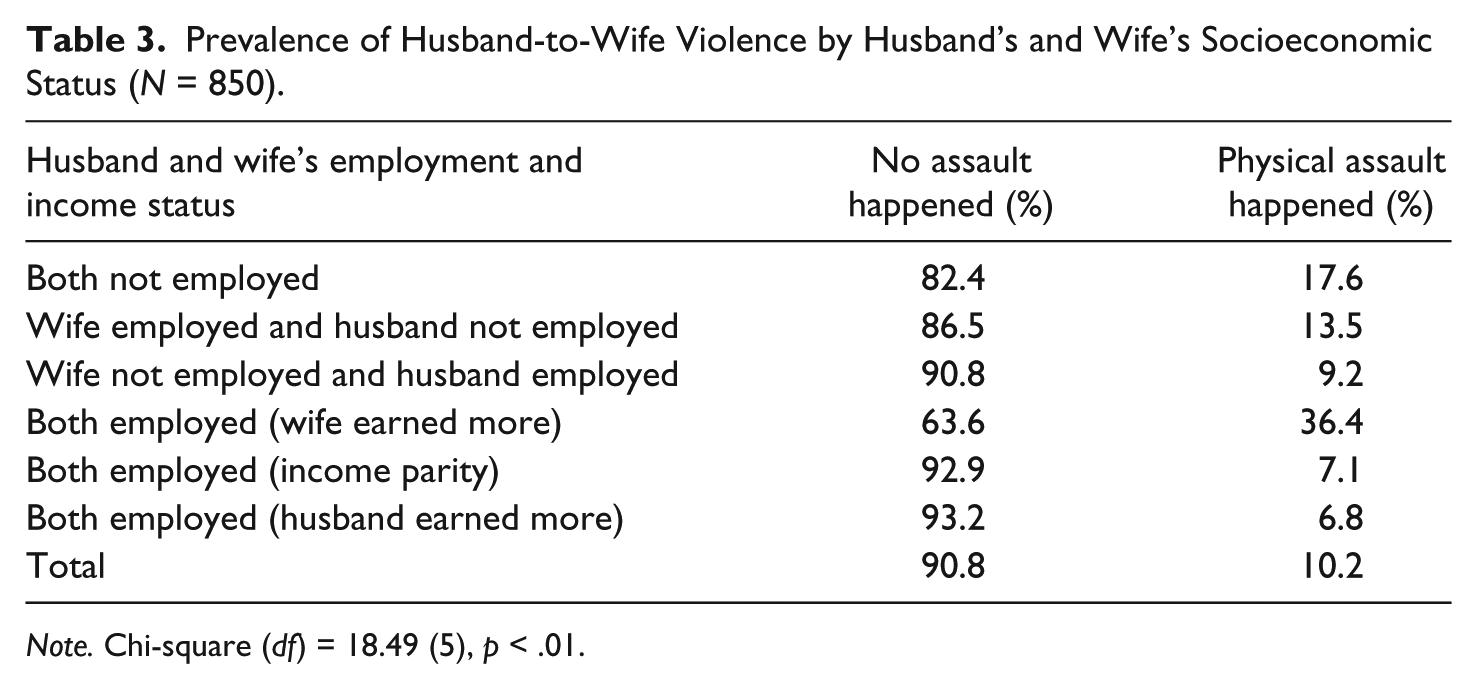
Note. Chi-square (df) = 18.49 (5), p < .01.
The results in Table 3 showed that the women in Group 6 (both employed, husband earned more) reported the least violence, followed by the women in Group 5 (both employed, income parity) and the women in Group 3 (wife not employed, husband employed). However, the women in Group 4 (both employed, wife earned more) reported the most violence. These nonlinear effects of a wife’s socioeconomic resources on violence suggest that when the wife is the sole earner in the household, her economic power may deter her not-employed and financially dependent husband from using violence against her. However, in dual-earner households, when the wife earns more than her husband, her higher income may pose a threat to the masculinity of her husband, who may use violence to regain control or as a means of reasserting his manhood. At the policy level, these findings not only highlight the protective value of women’s economic independence but also suggest that there may be unintended consequences of this independence if improvement in the socioeconomic status of women is not accompanied by concomitant changes in cultural norms regarding femininity and masculinity.
In sum, our analysis reveals the salient role of subjective appraisal of resource conditions on husband-to-wife violence and provides some intriguing evidence concerning the complex relationships between women’s socioeconomic resources and spousal violence. As such, this article extends and complements traditional resource theories on spousal violence and sheds new light on violence prevention policies.
Despite these contributions, several limitations of this study need to be addressed in future studies. First, our data only included two cohabiting couples. Cohabitation is not as common in Hong Kong as it is in Western societies, although it seems to be an increasing form of partnership. Future studies should therefore consider extending our test of the relationships between the variety of resources and violence to a larger sample of cohabiting couples. Second, one of the criticisms of the CTS2 is that it does not measure the contexts of violence, especially if control tactics are used as part of, or in conjunction with, violence (Johnson, 1995). This omission has prevented us from determining whether or not there are two types of violence (i.e., common couple violence and patriarchal terrorism) in our data. Finally, the cross-sectional nature of the survey means that there is a risk of reverse causation. For example, women’s experience of violence may adversely influence their labor market participation. The occurrence of violence may also shape the couple’s evaluation of each other’s financial and nonfinancial contribution to the family. The use of longitudinal data in future research may therefore be more effective in minimizing the potential bias from reverse causation.
Footnotes
Acknowledgements
We would like to thank Dr. Chan Ko-Ling for generously sharing with us his research experience on violence in Hong Kong.
Declaration of Conflicting Interests
The author(s) declared no potential conflicts of interest with respect to the research, authorship, and/or publication of this article.
Funding
The author(s) disclosed receipt of the following financial support for the research, authorship, and/or publication of this article: This research was supported by the Hong Kong Research Grant Council, Grant CUHK4667/05H.