



Abstract
The research for this article used available qualitative data from separate studies of South Asian-, Vietnamese-, and Hispanic-origin women victimized by intimate terrorism. Regardless of country of origin, period, or U.S. community, women used similar ways to cope. Consistent with perpetrators’ misogynistic attitudes and aim of enforcing patriarchal expectations, many women responded to abuse from positions of powerlessness and fear. Instrumental help from family and friends and, depending on the group, advocacy agencies or counseling services assisted women in leaving men or stopping the abuse. Women used multiple coping strategies, often adding new approaches when those used initially failed.
This article examines the responses of immigrant women in the United States from three different world regions (i.e., Central America, South Asia, and Vietnam) to one form of intimate partner violence, intimate terrorism. In a typology developed by Johnson and Ferraro (2000), intimate terrorism is violence used as one of many tactics in a general pattern of extreme effort to control an intimate partner. Intimate terrorism is the combination of physical and emotional abuse with controls such as refusing to let a woman leave the home unaccompanied, extreme jealously about any interaction with other men, constant surveillance of activities, denial of access to money, constant supervision and criticism of a woman’s execution of household tasks, and censorship of communications with others. Intimate terrorism differs from other forms of domestic violence: (a) violent resistance in self-defense, often just once; (b) mutual violence in which domestic partners use controlling and manipulative violence against each other; and (c) common couple violence, which is characterized by sporadic violence between partners, but no pattern of abuse. In recent years, common couple violence has been relabeled and more precisely defined as situational couple violence, which “results from situations or arguments between partners that escalate on occasion into physical violence” (Kelly & Johnson, 2008, p. 485). Research demonstrates that in heterosexual couples, males most often perpetrate intimate terrorism, and that misogynist attitudes and gender traditionalism contribute to this form of abusive behavior (Johnson, 2006, 2011).
Although all types of intimate partner violence may result in emotional and physical harm, the repeated and extreme nature of intimate terrorism creates constant fear that a partner may become physically abusive at any moment and anxiety that anything a potential victim does to “rock the boat” will trigger abuse (Chaudhuri, Morash, & Yingling, 2014; Leone, Johnson, & Cohan, 2007; Rosen, Stith, Few, Daly, & Tritt, 2005). Thus, intimate terrorism victims are at a considerably higher risk for suicide attempts than are victims of situational couple violence (Leone, 2011), and victims with multiple forms of abuse, which characterizes intimate terrorism, suffer more mental illness symptoms and physical injuries (Eshelman & Levendosky, 2012). The continuous and severe nature of intimate terrorism led us to our focus.
Circumstances of immigration, life after immigration, cultural beliefs and norms in the country of origin, and the adaptation or refashioning of those beliefs and norms in the new country may produce special constraints on how women cope with abuse. Variation in availability of resources, including culturally competent service providers, to address intimate partner violence within a U.S. community also affects immigrant women’s efforts to get help (Morash & Bui, 2008). Thus, women in different social locations and U.S. communities and from different countries and cultures may take different approaches to contending with abuse. Policy makers and service providers would benefit from knowledge of both cross-group and group-specific tactics that women use in the face of intimate terrorism, so that they can understand women’s behavior and help them use the most effective approaches. Thus, this article focuses on women in different cultures and community contexts, with different immigration experiences, but who have all experienced intimate terrorism. It identifies the most typical patterns of response and links alternative responses to relationship and abuse outcomes.
Victims of Intimate Terrorism
The few studies specifically on women’s responses to intimate terrorism show that, compared with other abuse victims, intimate terrorism victims more often seek help, and they often turn to the police, a counselor, and other social institutions (Leone et al., 2007). In contrast, because situational couple violence victims see abusive incidents as limited to a specific conflict rather than as part of a continuous pattern, when they do try to get help, they tend to turn to friends, family, and neighbors or to handle the abuse on their own.
Being an immigrant also shapes women’s responses to violence. For instance, Asian and Latina immigrants to the United States often feel isolated and think that nobody is available to help them (Bauer, Rodriguez, Quiroga, & Flores-Ortiz, 2000; Bui, 2003). In her study of Vietnamese women who migrated to marry men in South Korea, Park (2011) similarly found that women experienced social isolation, which for rural women was magnified by physical isolation from people, transportation, and social services. Language barriers further promote and intensify social and physical isolation (Bauer et al., 2000; Dutton, Orloff, & Hass, 2000). A woman’s immigration status also affects her decision to seek help with an abusive partner (Dutton et al., 2000), as many immigrants fear that asking for help to deal with domestic violence will lead to their deportation and separation from children (Bauer et al., 2000; Dutton et al., 2000).
Unemployed women may not seek help because they fear jeopardizing relationships with the men they depend on to support them and their children. Unemployment also negatively affects women by depriving them of coworkers who might inform them about laws, the justice system, and victim services (Bui & Morash, 2007).
Three groups are considered in the present study: South Asian (including women from India, Pakistan, Bangladesh, and Nepal), Hispanic (including women from Mexico, Central America, and Puerto Rico), and Vietnamese-origin women. In these groups, cultural norms regarding marriage and family often constrain women’s choices in dealing with partner violence (T. Abraham, 2002; Dasgupta, 2007; Kasturirangan & Williams, 2003). Many Latina and South Asian immigrants struggle with abuse on their own, because they avoid seeking help for intimate partner violence due to their loyalty to family and the shame and stigmatization of divorce (Bauer et al., 2000). Bui and Morash (1999) found that for Vietnamese immigrants in one location, traditional family values, women’s beliefs about appropriate roles for women, and concerns about racial discrimination kept women from seeking help from formal justice and advocacy agencies. Crowell and Burgess (1996; also see Ho, 1990) similarly concluded from a comprehensive review of the literature that “traditional Asian values of close family ties, harmony, and order may not discourage physical and verbal abuse in the privacy of one’s home; these values may only support the minimization and hiding of such problems” (p. 41). Cultural factors that appear to support intimate partner violence among Hispanics include gender inequality and the ideology surrounding machismo, which at its extreme emphasizes men’s aggressiveness and domination, and hembrismo, which emphasizes women’s self-sacrifice in their roles as wives and mothers (Bell, Harford, Fuchs, McCarroll, & Schwartz, 2006; Caetano, Cunradi, Schafer, & Clark, 2000; Cunradi, Caetano, & Schafer, 2002).
Although cultural characteristics in women’s countries of origin influence how they handle intimate partner violence, after migration these influences are likely to vary. Immigrants (and others) do not necessarily have static cultural norms, values, and practices, but rather their culture evolves as they interact with, manage in, and adapt to changing circumstances (Baca-Zinn, 1982; Kim, 2001). Indeed, advocacy services for battered women often directly challenge traditional beliefs about wife abuse and how to cope with it, and are designed to open alternative responses and ways of coping that are available in the United States.
A vast majority of women in an abusive relationship, especially one characterized by intimate terrorism, seek some sort of help at some point (Langford, 1996; Leone et al., 2007). In addition, they often use various personal strategies to contend with, contain, and stop abuse. Our aim is to document the different methods a very diverse group of women use to address intimate terrorism and to examine how different approaches are related to outcomes.
Method
Sample
The original data sets, each of which included women with and without histories of abuse, provided information on 177 Hispanic, 129 Vietnamese, and 42 South Asian women. These data sets were merged and a subsample of women reporting intimate terrorism was created based on the responses to questions asked of each population group to elicit both qualitative description and quantitative scores on the nature of abuse.
The subsample of women victimized by intimate terrorism consists of 13 Hispanic women (11 Mexican, 1 other Central American, 1 Puerto Rican heritage) interviewed in 1995, 65 Vietnamese-origin women interviewed in 2002, and 31 South Asian–origin women (25 Indian, 2 Pakistani, 1 Bangladesh, 1 Nepalese, 2 Other) interviewed in 2005. This subsample was 7.3% of Hispanic women, 73.8% of South Asian women, and 50.4% of Vietnamese women. The other women in each group experienced another form of abuse or no abuse.
The proportions of women reporting intimate terrorism in the three groups result from how the samples were drawn, and thus do not reflect the distribution of abuse or different types of abuses within the immigrant populations. Johnson (2006) summarized several studies that show that shelter and domestic violence advocacy group samples consist primarily of victims of intimate terrorism, but random samples drawn for surveys have high representation of situational violence victims. For Hispanics, to approximate a random sample, telephone numbers in a Detroit city neighborhood populated primarily by immigrants from Mexico and their offspring served as the sampling frame; the phone number sample was supplemented by snowball sampling to identify women with no phone or unlisted numbers. The South Asian–origin sample was purposively selected to allow for study of women with recent abuse histories and a comparison group of women with similar immigration experiences, but no known abuse. Two domestic violence advocacy agencies for South Asian women, located in two different Northeastern U.S. metropolitan areas, assisted in recruiting women known to be abused as well as women from the same communities with no known abuse history. Similar to the sampling of South Asian women, a purposive sample was drawn to include Vietnamese-origin women from a Northeastern U.S. city and its suburbs. To ensure that the women varied in their experience of abuse, they were recruited from a domestic violence shelter/advocacy program with Vietnamese outreach, health centers serving the local Vietnamese community, civic associations and cultural clubs, and through snowball sampling.
Differences in sampling strategy, region of the United States, interview year, and ethnic heritage created variation in immigration patterns and in the situations and social locations of the women. The Hispanic group lived in a large city’s ethnic enclave, where a family-oriented Latino counseling program was the primary service provider to domestic violence victims. For several decades, Mexicans came to the area, so that men could work in auto-factories; as the industry declined, serial migration continued, with relatives and friends moving back and forth from Mexico. Other Hispanic groups were also drawn to the area. Of the 13 intimate terrorism victims from the Hispanic sample, 6 (and their partners) immigrated from Mexico and 1 couple moved from Puerto Rico, 3 women were born in the United States but had partners who migrated from Mexico, and 3 (and their partners) had Mexican-origin parents, but they were born in the United States.
The South Asian group had all immigrated to the United States. They lived interspersed within two different metropolitan/suburban areas in the Northeast. In one area, a South Asian–specific domestic violence advocacy agency had operated a shelter and provided services in the area for many years; the other area was served by an advocacy agency for multiple Asian groups. In both locations, South Asian men in the geographic region typically had migrated for employment as highly skilled workers, including computer scientists, engineers, professors, and physicians. Wives either followed their husbands to the United States, or they migrated for the purpose of marrying their husbands.
In the third part of the subsample, Vietnamese-origin men and women had most often come to a Northeastern urban enclave as refugees several years after the Vietnam War ended. Some women moved with their husbands. Others came after their husbands. A few recent immigrant women came as picture brides to marry men of Vietnamese heritage in the United States. An Asian-oriented advocacy group with a shelter served the area. Although the nature of the sample makes it impossible to generalize beyond the groups studied, it served our purpose of providing a very diverse group to be considered for a search for similarities and differences in responses to intimate terrorism.
Data
For each of the three projects resulting in the available data, bilingual interviewers elicited responses to open-ended questions about disagreements with partners, fights with partners, partners’ efforts to hurt study participants physically or by what they did or said, changes in conflicts over time, and the series of events and the partner’s motivations leading up to the most serious instances of harm, regardless of whether that harm resulted from words or actions. Interviewers asked women about whether anything ever altered the conflicts, their own and their partners’ actions to resolve disagreements, and the nature and effectiveness of women’s strategies to stop injurious or threatening behavior from their partners.
Quantitative data shed additional light on the nature of women’s relationships with their partners, abuse, and the women’s and their partners’ demographic characteristics (e.g., age, education, work). The quantitative measures were considered along with the qualitative data to improve the validity of categorizing violence as intimate terrorism. Adaptations of Straus’s Conflict Tactics Scales (CTS; Straus & Gelles, 1990) provided quantitative scores reflecting the frequency, in the last year, of the women’s partner’s violence by beating, hitting, punching, kicking, slapping, choking, forcing sex, threatening to hit or throw something, or using a knife or gun (Cronbach’s α = .92).
In addition, for South Asian- and Vietnamese-origin women, the Women’s Experience with Battering Scale (Coker, Pope, Smith, Sanderson, & Hussey, 2001) provided a quantitative measure of battering experience. Examples of the agree/disagree Likert-type scale items are as follows: He makes me feel unsafe even in my own home, I hide the truth from others because I am afraid not to, He has a look that goes straight through me and terrifies me (Cronbach’s α for the South Asian sample = .97; for the Vietnamese sample = .87). This scale appears to have high content validity for detecting intimate terrorism, as it taps into a sense of vulnerability caused by a loss of power and control due to a partner’s use of physical, sexual, or emotional force (Coker et al., 2001; Smith, Smith, & Earp, 1999; Smith, Tessaro, & Earp, 1995). A similar scale reflecting emotional abuse (Sackett & Saunders, 1999) was available for the Hispanic women (Cronbach’s α = .96). Its dimensions were partner’s jealous control, ignoring the study participant, ridiculing her traits, and criticizing her behavior, and the participant’s fear of being abused. The Sackett–Saunders Scale also appears to have content validity for indicating intimate terrorism. An additional quantitative measure of patriarchal family structure (Blood & Wolfe, 1960) that was available from each of the three studies tapped into equality in decision making, with ratings on women’s versus men’s relative influence on decisions about responsibilities for household chores, having and disciplining children, visiting friends, location of residence, women’s employment, family budget, and intimate relations (Cronbach’s α = .79). A patriarchal family structure is consistent with the misogyny and domination associated with intimate terrorism, and adherence to patriarchal social norms is related to tolerance of interpersonal violence (Ahmad, Riaz, Barata, & Stewart, 2004).
Interviewers noted qualitative responses to open-ended questions on paper interview schedules, and if the interview was not conducted in English, later translated them into English. Qualitative data were coded and analyzed in NVivo software; and standard statistical software was used to analyze quantitative data.
Coding
To code the type of abuse (i.e., intimate terrorism, common couple violence, violent resistance, or mutual violence) and to identify women who did not experience abuse, two of the researchers first examined the data for10 cases together, and developed a protocol for using the qualitative data and the quantitative scores for each case to identify whether there was any abuse, and if there was, whether it was intimate terrorism or another form as defined by Johnson (2006). In the qualitative data, some of the words that indicated intimate terrorism were restrict, control, dominate, robot, manipulate, humiliate, degrade, and scared. High scores on the measure of emotional abuse (for Hispanics) or the Experience of Battering Scale (for Vietnamese and South Asian women) were additional indicators of intimate terrorism. Supporting the validity of our categorizations based on the quantitative and qualitative information on abuse, with one exception, within each immigrant group, the women categorized as experiencing intimate terrorism (vs. other abuse and no abuse) had the highest mean scores for the CTS, emotional abuse or the Experience of Battering Scale, and on patriarchal family structure (Table 1). The exception was that Hispanic subgroups did not significantly differ on patriarchal family structure.
Mean Scores on Quantitative Measures by Women Differentiated by Abuse Experience.
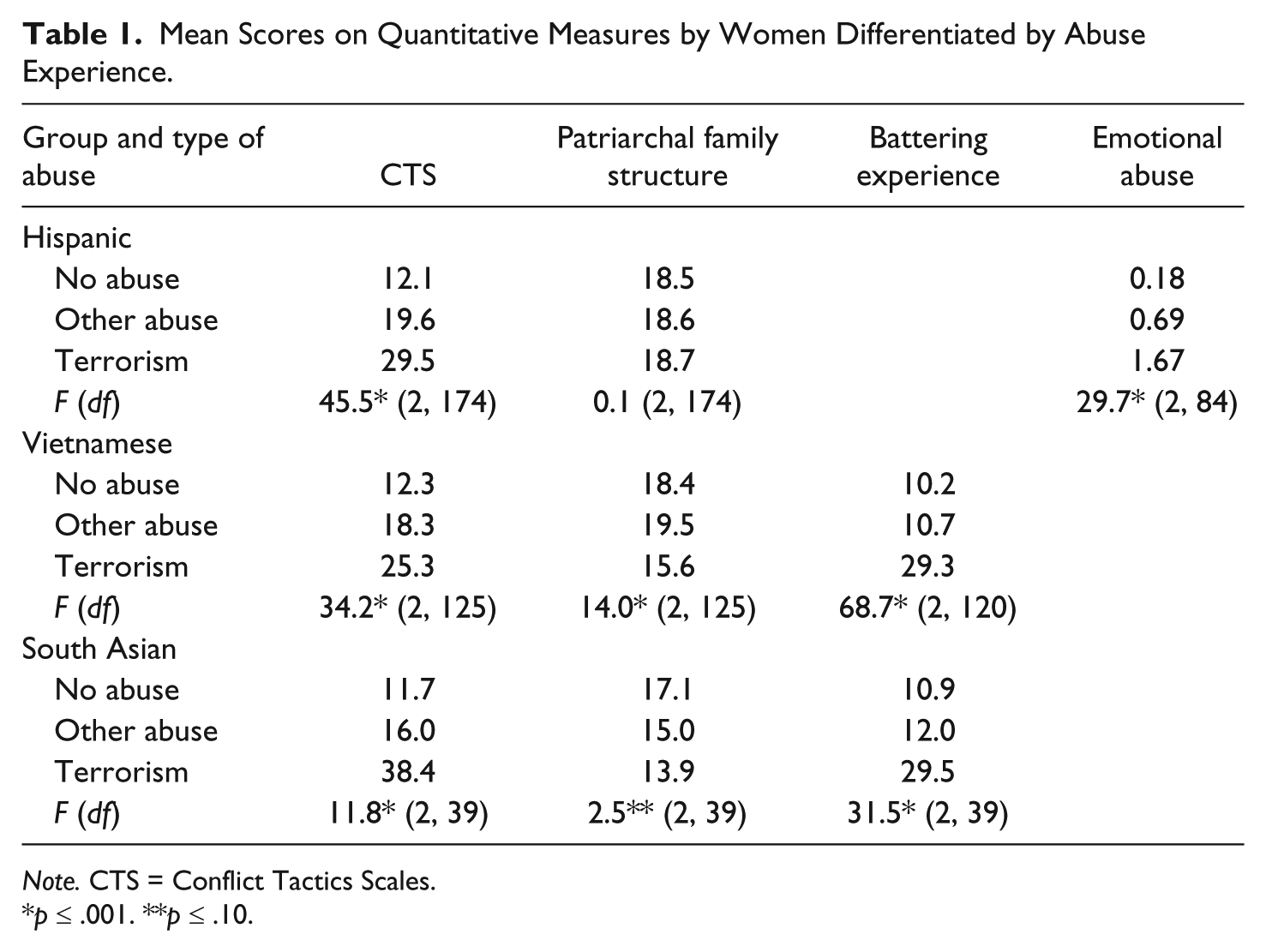
Note. CTS = Conflict Tactics Scales.
p ≤ .001. **p ≤ .10.
For coding themes that reflected women’s responses to intimate terrorism, using an inductive approach we identified the full range of their responses to the abuse. After refining a codebook and establishing a replicable protocol for coding responses, for a sample of 25 cases coded on 15 themes by two researchers, intercoder reliability was established with Cohen’s kappa of .89. Intercoder reliability was based on the match between the characters (spaces, letters, punctuation) coded as corresponding to a certain theme.
Women self-reported whether their abuse was continuing or had stopped, and they reported whether they continued to live with their partners. This information was used to place women into the following categories: (a) no longer with the partner; (b) with the partner, abuse stopped; and (c) with the partner, abuse continues.
Analysis
To place women in context, analysis first compared women in the three immigrant groups on their social locations, specifically quantitative indicators of their and their partners’ work experience, education, and pattern of immigration. Then, we used the qualitative data to identify the most common ways that women responded to intimate terrorism and to determine whether their responses differed by immigrant group. To do this, the NVivo software was used to obtain a count and percentage of the number of intimate terrorism victims in each group who had described using each response to the abuse. In addition to observing the numbers that the software presents in matrix format, we examined the actual content of the women’s responses to obtain more details. For example, by examining the exact responses of women in each group who fought back against men, we could see that a fairly high proportion of Hispanic women physically fought, but women in the other two groups fought back only with words. This approach allowed us to provide a nuanced description and comparison of women’s statements.
Finally, we examined the qualitative data for connections between women’s responses to intimate terrorism and whether they remained in abusive relationships, whether the relationships continued but the intimate terrorism stopped, or whether they had separated from their partners. Again, we created a matrix of numbers representing the number of women in each group who used each response, and then within and across the groups, examined and compared the responses for the different outcomes.
Findings
Differently Situated Groups
Compared with the women in other groups, those from South Asia had somewhat more work experience and considerably more education. About three quarters of Hispanic and Vietnamese women, but 90% of South Asian women currently or previously worked outside the home. Educational achievement levels are displayed in Table 2. Most Vietnamese-origin (71% of 65) and many Hispanic (58% of 12) women had not completed high school. All but one of the other Hispanic women had only completed high school. Of Vietnamese women, 15% had completed high school, 9% finished some college courses, and 5% completed college. In contrast, most South Asian women had a bachelor’s degree (23% of 31) or a graduate degree (48%). Hispanic men had educational levels similar to their wives, with about two thirds having less than a high school education and most of the rest having completed high school. Vietnamese men seemed somewhat more advantaged than their partners, with about one third in each of the two groups, less than high school and high school completion. South Asian men, like their wives, had at least a bachelors’ degree, and the majority had a graduate degree.
Educational Backgrounds of Women and Men in Relationships Characterized by Intimate Terrorism by Group.
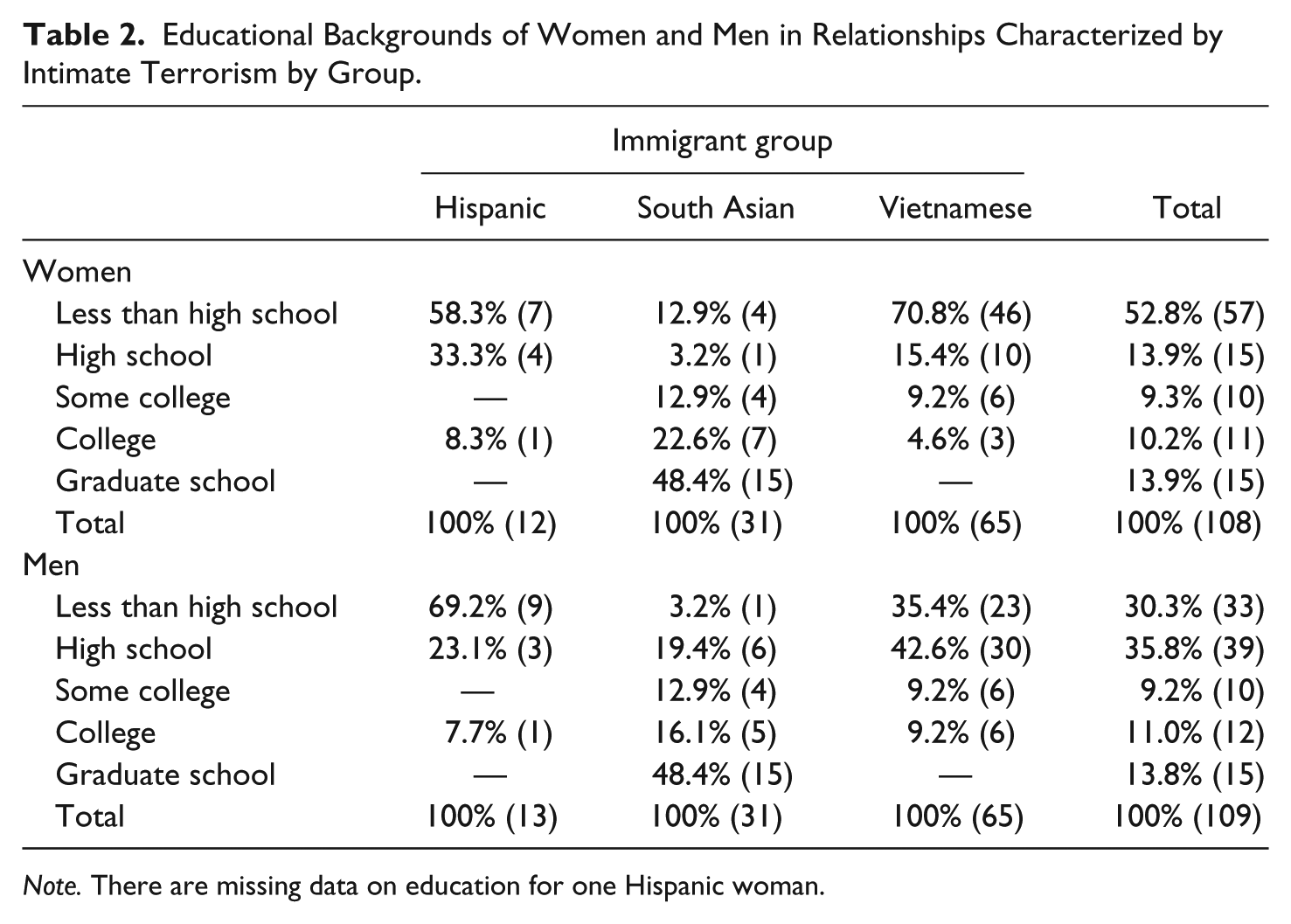
Note. There are missing data on education for one Hispanic woman.
As expected from prior knowledge of patterns of immigration to the study locations, the South Asian immigration experience typically started with men moving to the United States with visas to work in professional positions. Ninety percent of South Asian men moved to the United States before their wives, and women moved to join or to marry them. The South Asian study participants were the only group who did not live in an ethnic enclave. Hispanic women’s immigration experiences differed greatly from those of South Asian women. The labor migration to the Detroit area started decades ago, therefore some study participants were born in the United States; movement to and from Mexico was fluid, however, as friends and family moved or visited back and forth. When women immigrated, about half came to the United States before their partners, and about half came to join their husbands who already lived in the United States. Vietnamese women followed a unique immigration pattern. The first wave of immigrants consisted of refugees who had supported the United States during the war; some women came with their parents, and others accompanied or came after husbands they had married in Vietnam. The second most recent wave of immigrants consisted of picture brides joining men who returned to Vietnam to marry them. About half of Vietnamese women came to the United States after their husbands, a third came with their husbands, and the remainder came before their husbands.
The patterns of education and work differed little for the subsample of women victimized by intimate terrorism and for women from the same world regions who experienced no or other forms of abuse. In the full sample (including women without abuse and forms of abuse other than intimate terrorism), South Asian women were extremely likely to have graduate degrees, and the majority of Hispanic and Vietnamese women had a high school or less education. A majority of Hispanic partners, regardless of the type of abuse or whether there was any abuse at all, at most had finished high school. Vietnamese men had a wide range of education levels, with no clear connection to whether their partners reported any abuse, intimate terrorism, or another form of abuse. South Asian men’s education level ranged from some college to completion of graduate school, again regardless of their partners’ reports of abuse. Thus, within each group of intimate terrorism victims, there were not apparent demographic differences from other women sampled from the same geographic area and with the same country of origin.
Responses to Intimate Terrorism
Women who experienced intimate terrorism ranged from describing no actions in response (5%, n = 5) to describing eight or nine different actions (3%, n = 3). After coding each response for each woman, we used NVivo software to create a quantitative data set with dichotomous variables for each type of response that women described (e.g., threatened to leave, tried to placate, called the police), with the values indicating that the woman did describe using the response (1) or she did not (0). A correlation analysis revealed limited associations between types of responses and almost none that were statistically significant.
As would be expected based on the reliance on advocacy groups to recruit South Asian and, to a lesser extent, Vietnamese participants, a high proportion of the intimate terrorism subsample considered in this article (61%) had used advocacy services. These did not include any of the Hispanic women, as they were interviewed in an area where, and at a time when, there were family counseling services for intimate partner violence victims but no shelters or battered women’s advocacy groups. In contrast, all but 3 of the 31 South Asian women confronting intimate terrorism received advocacy services, and more than half (38 of 65) of the Vietnamese women received advocacy services. As already noted, the method, period, and location of sampling largely explained the proportions of women in each group in touch with advocacy services.
For coping approaches other than obtaining advocacy and shelter services, most commonly (52%) women addressed intimate terrorism by constraining their behavior, so as not to do anything at all that might perturb their partners. This method often required them to be unnoticeable, even in the presence of their partners. In each group, more than half of the women described at some point accommodating to men’s intimate terrorism by making themselves unnoticeable. Other tactics—ordered from the next highest to the lowest proportions of women using them—included (a) turning to family or friends for help (48% of women victimized by intimate terrorism), (b) relying on religion or religious leaders (33%), (c) putting up with the abuse by agreeing with abusive partners (32%), (d) leaving partners (24%), (e) calling the police (24%), (f) temporarily leaving the location of the abusive incident (23%), and (g) standing up to partners (23%). Less than 10% of women described addressing intimate terrorism through another means, for instance, by trying to improve communication with partners or by harming themselves.
Becoming unnoticeable
The metaphor of “walking on egg shells” captures women’s efforts to avoid any behavior or attitude that might trigger abuse by a partner. Both women still in abusive relationships and those who had separated or divorced by the time of the interview had used this strategy, and similar proportions had tried to become unnoticeable in the Hispanic (54% of the 13), South Asian (55% of the 31), and Vietnamese (50% of the 65) groups. (Table 3 presents group comparisons for all coping strategies.) Women remained quiet, avoided arguments, and tried not to bother their partners. Men’s silencing of women through the threat and the use of violence is integral to the definition of intimate terrorism, through which partners try to control even minor actions of their victims. Some women remained in their residences or even the same room as their partners, but they strove to be unnoticeable, being still or quiet and hiding their feelings and thoughts so as not to incite an argument by their words, actions, or presence.
Frequency of Use of Different Responses to Abuse by Group.

Note. Because women could use multiple strategies, the column percentages do not sum to 100%.
One study participant, her husband, and their children had come to the United States together as refugees from Vietnam. She described adverse effects on her mental health because her husband frequently abused her and their children. At one point, he tried to choke her while she slept, but when she woke up, he denied doing this. She stayed with her partner to “keep the family together and have a happy life” and to secure her children’s future marriages, reasoning that no one would want to marry a person with divorced or separated parents. Exemplifying women’s efforts to make themselves unnoticeable, she tried to thwart the abuse: “I avoid talking or discussing about family matters. It does not really work for me. I can avoid conflicts, but I cannot forget the problems and have to restrain myself and depress my feelings.” She went on to say, “I keep my mouth shut and tolerate his abusive behavior. It is effective because I can avoid conflicts, but I feel bad about it.”
An immigrant from Mexico similarly dealt with her husband’s physical and emotional violence. She explained that he wanted to totally dominate her by controlling her associations with her friends and by hitting her. She kept quiet regardless of how much it infuriated her to do so: “[I] don’t answer back, ignore, and just stand there and die inside of anger.” A South Asian woman also divulged that keeping quiet was the best way for her to avoid abuse. After he obtained his green card and could travel back to South Asia, her husband wanted to marry someone younger than she. Thus, he frequently physically hurt her to drive her away. She said that her methods of dealing with his violence were to “keep quiet when he is angry and let him do whatever he wants.”
More than half of the women told the interviewer that to some extent becoming unnoticeable stopped the abuse and was thus effective in the short run. Some realized that the strategy could not permanently stop abuse, because the abuse occurred no matter what they did. For example, one Hispanic woman could not explain what caused conflict with her husband other than his just being “mad and aggravated” to start with, and another said that abuse was triggered by “anything, usually simple, that makes him upset.” However, when they were so controlled by their partners, at times this was the only way they could exercise even limited agency, which in some cases had a temporary effect, as illustrated by women’s statements in the prior paragraph.
Getting help from family and friends
Nearly three quarters of South Asian women (71%) and about half of Vietnamese women (46%) had turned to family and friends for help. (The interview used with Hispanics did not elicit parallel information, but instead interviewers asked women to whom they would go if they needed help.)
Of women living apart from their partners, nearly half had previously relied on friends and a third on family to assist them in containing or escaping abuse. Women’s friends and family often provided tangible help and resources needed to leave partners. Many offered financial help as well as a place for the women to stay, and others provided unique forms of assistance. One South Asian woman’s husband constantly threatened to divorce her and made insulting comments about her beliefs and background. When she filed for a separation, her friends helped her obtain letters of proof of abuse, so she could maintain legal status with immigration officials. A Vietnamese study participant felt that her husband’s only use for her was sex, housekeeping, and cooking. He beat her repeatedly and threatened to shoot her. After she revealed the abuse, her friends provided comfort and gave her information about where she could obtain help. Other types of help from family and friends included money, phone cards to overcome restrictions on phone use, clothes, accompaniment to obtain medical services, and in the case of a sister-in-law, an effort to stop the physical abuse.
The primary type of support from family and friends for women still with abusive partners at the time of the interview was less instrumental and more emotional. About a third of women still in abusive relationships talked about getting advice and emotional support from family and friends. A Vietnamese-origin woman’s husband beat her so severely that, very inconsistent with Vietnamese norms, her parents asked her to leave him. She stayed with him for the sake of their children, one of whom was severely disabled and required constant care. Revealing a common approach of women who felt they could not leave abusive men, she relied on friends for emotional support: “My friends give me advice to make me feel better and family also supports me. My friends listened to my problems and helped me feel better.”
For the few women who managed to stop the abuse but stayed in their relationships, half had relied on friends for help in dealing with abuse. They had received the same sort of help from friends as detailed above, such as information about domestic violence services and emotional support. One Vietnamese woman had called her husband’s parents in Vietnam, and they had intervened by directing their son to stop the abuse.
Reliance on religion
Just a few Hispanic women, but about half of South Asian and a third of Vietnamese women noted that they relied on religion to deal with their terrorizing partners. Religion seemed to help women endure abuse. For instance, when asked how her religion helped her with problems in her marriage, a South Asian–origin woman replied that she had “faith in God that he [her husband] will suffer at the end so it kept me going.” Consistent with Acevedo’s (2005) research on Mexican women showing that women use prayer to cope with their abusive partners, one Vietnamese-origin woman interviewed for the present study explained, “I keep praying everyday for my family. It works sometimes. It helps me forget the problem for a while, and I feel peace in my mind.” The women’s religious leaders generally appeared to offer comfort and advice that encouraged praying and tolerating partners’ behavior (Bui & Morash, 2007; Latta & Goodman, 2005). For example, a refugee from Vietnam said, “When I went to the Buddhist temple, I listened to the advice of the Buddhist monk, and I tried to tolerate [my husband’s] behavior and forgive him.”
Agree and tolerate abuse
In each group, about a third of women explained that they responded to intimate terrorism by acting as though they agreed with their partners and by tolerating the abuse. Asked about her satisfaction with the influence she had when she and her spouse disagreed about something, a Hispanic woman explained, “That problem is very difficult, because most of the times, even though I don’t agree, I end up agreeing with him to avoid more problems.” A woman from Vietnam said, “I have to give him what he wants. Otherwise, he’ll give me troubles.” Very similar to the silencing of women discussed above, being forced to agree with and tolerate a perpetrator of intimate terrorism very much reflects the achievement of men’s goal of controlling their partners with this type of abuse.
Leave home or leave the scene of the conflict
One quarter of intimate terrorism victims either temporarily left their homes to escape abuse or unsuccessfully tried to permanently leave. Seeking immediate safety, a Hispanic participant left home to stay with her mother overnight after her husband threatened to kill her and chased her “all over the house.” Hoping to get away from her husband for good, a Vietnamese woman took steps to divorce her husband, but later his relatives talked her into withdrawing her petition. Consistent with a well-documented pattern of abuse (Cavanagh, 2003; Cavanagh, Dobash, Dobash, & Lewis, 2001; Wolf-Smith & LaRossa, 1992), some women returned home when men promised to stop the abuse, gave them money, or granted them other favors. Others spoke of “running away.” Sometimes their husbands or husbands’ relatives prevented this. Sometimes women returned because they could not manage on their own. Other women were able to stay away, for example, by leaving the state or the country, “hiding” from their partners and living on their own, or moving in with an adult offspring. One quarter of the women did not actually leave their homes, but they removed themselves from the presence of a drunk or an attacking husband, for example, by locking themselves in a bathroom or a bedroom, or going out for a brief period.
Stand up to partners
More than half (54%) of the small number of Hispanic women in our sample confronted men by standing up to them, either hitting back or getting other people involved. One Hispanic woman talked about standing up to her husband: “He turned outrageous and yelled, cursed, acted like he was going to hit me to scare me. But this time I hit him and threw things at him.” None of the Hispanic women reporting using this tactic indicated the need to take cover after such an assault, but two of the three Vietnamese women fled for safety or blockaded themselves in a safe place after hitting their partners. A woman from Vietnam gave the example: “He would swear at me and put me down, watch me, order me around. I couldn’t stand it. I hit him and ran to the bedroom, locked the door, so he couldn’t come after me.”
The very small proportion of South Asian-origin (16%) and Vietnamese-origin (20%) women who “stood up” to abusive men most often did this by “talking back.” Indeed, this was the only way that South Asian women described standing up to their partners. For instance, one woman said, “When I was angry because of his abuse, I also used bad words that hurt him a lot. After that he showed remorse, stepped back and wanted [to] make peace with me.”
Call the police
In each subgroup, approximately one quarter of women called the police (though police came to the homes of 43% of the women, due to other people calling). One woman who moved with her husband to the United States said that his abusive behavior in Vietnam escalated in the United States, where he had “angry spells,” physically and verbally abused her, defamed her parents, periodically kicked her out of the house, and enlisted his family’s help to perpetuate his power and control over her. She finally called the police and obtained a restraining order to start the separation process:
I only wanted him to stop yelling at me, arguing against me, and beating me. When I realized that he could not change, I called the police and got a restraining order, so that I didn’t have to live with him.
The Connections of Women’s Actions to Outcomes
Half of the women no longer lived with their abuser (50%, n = 54), usually because they left, but in a few cases because their partners left them. Slightly more than a third (40%, n = 43) remained in abusive relationships, and the rest (11%, n = 12) stayed with partners, but the intimate terrorism stopped. Almost two thirds (62%, n = 8) of Hispanic women lived with partners whose abuse stopped; the remainder contended with continuing abuse. Most South Asian women lived apart from their partners (74%), the next largest proportion experienced continuing abuse (16%, n = 5), and a few (10%, n = 3) lived with men who stopped subjecting them to abuse. Half of the Vietnamese women described continuing abuse (51%, n = 33), just less than half were living apart from their partners (48%), and one lived with a man who stopped abusing her.
Women who had separated from the men who terrorized them had used a greater variety of coping strategies (n = 54; M = 4.6 different types; SD = 1.6) than either women whose abuse stopped (n = 12, M = 3.8, SD = 2.0) or women who remained in abusive relationships (n = 43, M = 3.2, SD = 2.4); F = 6.1, df = 2, 106; p = .003. Women’s outcomes were associated not only with the number, but with the sorts of actions they took in response to abuse. Compared with other women, those who separated from partners more often described obtaining instrumental help from family and friends, contacting a domestic violence advocacy program, and calling the police. Often, they had sequentially used initial private coping approaches, followed by attempts to get help from family and friends, and then efforts to get help from the police, shelters, and advocacy services. Specifically, many women who lived apart from their former partners had first tried to tolerate abuse or agree with abusive partners to avoid irritating them, make themselves unnoticeable, avoid arguments, avoid spending time with partners, or rely on their faith or religious counsel. Even when they found that these approaches did not fully contain the abuse, they continued trying them, but supplemented them with requests for help from family, friends, and professionals.
A woman who had come from Vietnam provided a typical description of the sequencing of efforts to stop the abuse that culminated in separation. Her husband had repeatedly beaten her to the point of causing serious physical injury. She was so terrified of him she would let him do anything he wanted. There were several points where she received information about the advocacy center for Asian women in her area. The first was from the hospital: “When my neighbor took me to the hospital, I received a general examination. Staff in the hospital also suggested that I stay in a shelter and referred me to [the shelter], but I did not follow their suggestions.” The second time was at the welfare office: “I also went to the welfare office. Welfare staff also suggested that I get help from other agencies or stay in a shelter, but I didn’t want to.” At a breaking point with her abuse-inflicted headaches and depression, she sought help from the advocacy center, which enabled her to leave her husband when she was ready to cut all ties.
Women who continued their relationships but whose abuse stopped were distinct from other intimate terrorism victims in saying that they coped with abuse by trying to improve communication with their partners (25%); they used marriage counseling (33%); and in especially high proportions (58%), they described how they stood up to their husbands, usually by physically fighting them or demanding that they leave the home permanently.
Contending with ongoing abuse
Regardless of the country of origin, women who continued to live with abusive men most often tried to deal with the abuse by using the tactic we called being unnoticeable to avoid disturbing or irritating the men. Few women living with abuse had contacts with advocacy services or shelters, and just a few had ever called the police. One of those few women still living with abuse who had advocacy agency contact had gone to a shelter intending to return, but with the hope that her absence would deter her husband from abuse after she returned, for he would fear she would leave again. She said that the physical abuse lessened, but the verbal abuse continued unchanged. A Vietnamese woman who called the police similarly saw little effect. The lack of translation during the police action accounted for the problem. She and her husband spoke little English, so after their daughter told the police that there was no abuse, the officers just asked her husband to leave for the evening. In both these cases, the limitations of the intervention led to a poor outcome to women’s efforts to get help from the justice system.
Some South Asian and Vietnamese women still in abusive relationships sought comfort from their religion. It is notable that despite the frequent use of this approach by Vietnamese and South Asian women, the data we analyzed revealed no instance of religion providing women with ways to contain, stop, or escape abuse.
Women still in abusive relationships sometimes felt that they benefited from counseling even though the abuse continued. A Vietnamese woman recounted that the abuse started just two weeks after her wedding. Her husband routinely beat her and continued to do so even after she became pregnant. She said when she talked to social workers, “They listened to me, consoled me, and gave me emotional support. These made me feel better.”
Stopping intimate terrorism
Although they make up a very small number in the subsample we studied, Hispanic women stood out because six of the eight women who had partners who stopped being abusive described how they “stood up” to their partners at some point by doing more than just talking back to them. One of them divorced her husband because he beat her, but remarried him later. After he again hit her, she used a new tactic:
He hit me once after I remarried him and then I told him he would never hit me again or he’d move out. . . . I put an end to it. I said, ‘this is how it is now.’ I found out that he was seeing an older woman and confronted him. It was, ‘stop or get out.’
Another said that she temporarily separated from her husband because she did not like how his excessive drinking made him act: “We were separated because I told him that I was not going to tolerate his drinking, and he got better.”
A few women whose husbands desisted from abusing them had called the police, which seemed to produce the change. Only one Vietnamese-origin woman lived in an abuse-free relationship with a man who previously terrorized her. Different from most other women, she described no attempts to be agreeable or tolerate the abuse, to communicate with her spouse, to escape his notice, or to act as a “good wife.” She noted the results of calling the police:
I believe that he changed because I called the police and we went to court. I didn’t go to the court, but I was happy to hear that he agreed to see counselors for help. After that, he got better with his temper.
She felt that he “got better” in part because he would have to pay for additional counseling if he did not change. The advocacy agency helped her through the process:
. . . they helped me and explained to me about everything that I needed to know. They gave me advice so it made me feel better. . . . Now I know a little more about the law. I know what to do when there are problems in my family. I feel more secure when I understand the law better.
This woman’s community had special police services to assist the Vietnamese population as well as proactive work to prevent repeated domestic violence. In a one-year follow-up interview, she described the visits the bilingual police liaison and the police made to be sure that she was not being abused.
Leaving the partner
This section presents findings on just South Asian- and Vietnamese-origin women, as no Hispanic women in our subsample separated from their abusers. Prior research has established that by providing shelter and counseling, battered women’s advocacy services serve as a common source of help for abused women (Acevedo, 2005; Kasturirangan & Williams, 2003; Kaukinen, 2002; Park, 2011). Almost all women living apart from partners (91% of the 31 South Asian women and 87% of the 65 Vietnamese women) received help from advocacy agencies with services tailored to immigrants from their countries of origin. Shelter—the type of assistance that women most often mentioned—provided means to escape the ongoing abuse at home and figure out next steps. One South Asian study participant suffered from physical, emotional, and mental abuse just weeks after she joined her husband in the United States. Her husband totally controlled her by forbidding her going anywhere by herself, using the phone, writing letters, going to work or school, having money, or having a key to their apartment. He would also “burn her, hurt her with [a] belt, make her drink his urine, make her stand naked in the corner of the room while he stared at her, [and] pull her hair.” With the help of a South Asian woman’s shelter, she was able to leave her husband and get a temporary restraining order. She told the interviewer that she currently lived at the shelter and was trying to get a permanent restraining order. She did not intend to return to her husband.
Other women found that advocacy agencies helped them obtain restraining orders and navigate through the justice system, and most important, secure their physical safety. The husband of one South Asian woman belonged to a gang in his home country, though he had moved to the United States. When they were in South Asia, almost daily he would yell, bite, hit, scald, rape, beat, and threaten to disfigure her with acid or kill her. His becoming enraged at the most trivial things caused her to “live like a robot” to avoid triggering his anger. After he migrated, his gang associates threatened her and her parents, so they fled to the United States hoping that the laws would protect them. He continued his threats, but this woman felt safe enough to file for divorce in the United States after the local advocacy agency assisted her in obtaining a restraining order.
More than a third of South Asian and Vietnamese women described the benefits of advocacy agency counseling after they left their partners. A Vietnamese woman pointed out how staff provided “information [and] resources relevant to my situations. Its staff helped me do what I wanted to do, so I got help and my life became better. I don’t have to suffer his abuse anymore.” In addition, nearly all women living separately from their partners who had police contact said that the police had been helpful to them.
Discussion and Conclusion
Despite the different periods, cultures, countries of origin, and circumstances of the women included in our study, we found some key commonalities in how they addressed intimate terrorism. Even for the women who eventually left abusive partners or who stopped the abuse but stayed with partners, high proportions at some point had tried to contain their own behavior, even make themselves unnoticeable, in an effort to cope with intimate terrorism. These strategies can be viewed as not only the women’s efforts to cope with the abuse, but as partners’ successful imposition of intimate terrorism to exert such extreme controls on the other person’s expression of feelings and freedom of behavior. It would be misleading for academics and practitioners to attribute such approaches to coping with intimate terrorism solely to women’s passivity or their cultural beliefs. Rather, these approaches may signify the power and effectiveness of intimate terrorism. Intimate terrorism was highly effective in controlling even the well-educated South Asian women, many of whom had worked as professionals. This finding suggests the theoretical importance of considering victims’ responses to intimate partner violence in relation to the form of abuse. In practice, to avoid blaming victims for not taking more assertive action, justice system professionals and other potential sources of support (including family and community members) need to recognize the high degree to which intimate terrorism constrains women.
The reality of intimate terrorism may affect coping responses as much as or more than women’s cultural beliefs and their resources and options. Quantitative research that allows for study of the effect of the type of abuse on women’s responses to it, net of the effects of other known predictors of various responses, would provide further support for this possibility, and would be a useful focus of future research.
The Hispanic women who took part in the research were in a community that was different from the geographic locations where the other groups lived, because some Hispanic-origin residents were born or raised in the United States. A few of the Hispanic study participants were themselves born in the United States. Thus, community members and individual women may have been more aware of women’s rights and options under U.S. law. Whereas the Asian women typically learned of their options to separate through advocacy programs, the Hispanic women saw options to change abusive relationships by fighting back or in other ways exerting their power, and to a lesser degree, receiving marriage-type counseling that would improve communication within the family. The theoretical implication of findings about Hispanic-origin women is that understanding the influence of ethnic and cultural backgrounds on women’s responses to intimate partner violence requires attention to how fully they and their immediate community are acculturated.
We recognize that the uniqueness of subsamples analyzed in this article severely limits generalizing beyond the study participants. However, it is useful to know that there are commonalities in how women cope with intimate terrorism across time and place and for groups from different countries of origin. In addition, groups were similar in their use of multiple strategies and, especially for those who stopped or left abusive partners, women in all groups used an increasing “mix” of different approaches to trying to manage or stop intimate terrorism. There was also a variation between groups, for instance in the effects of reliance on faith or religious leaders; in our study, Hispanics were unique in the lack of effect of religion on encouragement to tolerate abuse. In another example, not just advocacy and shelter services, but for Hispanics, also counseling services provided women with support in stopping abuse. These findings suggest that women find varying and multiple ways to stop or escape abuse. Therefore, it is essential to provide multiple professional and other groups with awareness of effective ways to engage and intervene with women contending with intimate terrorism.
Prior studies have concluded that culture has important effects on how women cope with domestic violence (e.g., M. Abraham, 2005; Ruhi, 2010; Zakar, Zakar, & Kramer, 2012). The present study findings suggest the need for caution in attributing women’s help-seeking or personal responses to abuse only to their cultural beliefs, level of education, work experiences, or access to services. The nature of intimate terrorism itself appears to powerfully shape women’s responses. Because of the many pressures and barriers that dissuade and prevent women from trying to get help, even faced with the severity of violence that occurs with intimate terrorism, women often try to handle or cope with this form of violence on their own.
It is important to recognize that the outcomes women experienced are not just a result of how they addressed intimate terrorism, but that outcomes are affected by community context. Particularly for intimate terrorism, formal advocacy programs along with community organizations and leaders who are focused more generally on specific communities play an essential role in assisting women in coping with abuse. Writing about prevention of intimate partner violence, Yoshihama, Ramakrishnan, Hammock, and Khaliq (2012) advocated for this type of multiple systems approach. They implemented a plan in one state’s Gujarati (Indian) community that challenged patriarchal ideologies and norms supportive of intimate partner violence by education of individuals, families, organizations, and the community regarding the negative effects of such violence and the benefits and methods of alternatives to violence. The initiative incorporated the use of peer educators, shown by other research (Kugel et al., 2009; Women’s Council for Domestic and Family Violence Services, Western Australia, 2007) to be effective in addressing intimate partner violence in communities and schools. For the South Asian and Vietnamese communities considered in the research for the present study, findings suggest a particular need for work with religious leaders and organizations to educate them to the harm, causation of, and effective responses to family violence. Also, a broad community education effort makes sense in light of the finding that many women first turn to friends and family for help with abuse.
Footnotes
Declaration of Conflicting Interests
The author(s) declared no potential conflicts of interest with respect to the research, authorship, and/or publication of this article.
Funding
The author(s) received no financial support for the research, authorship, and/or publication of this article.