




Abstract
Recent attention has been given by researchers to understanding how abusers use economic abuse strategies. Unfortunately, limited measures are available to accurately understand the prevalence of economic abuse in the lives of survivors. Recently, researchers created the 28-item Scale of Economic Abuse (SEA) but further validation is needed. This article describes the psychometric evaluation of the SEA through confirmatory and exploratory factor analyses using data collected with 120 survivors of abuse. The findings provide evidence for the reliability and validity of the SEA-12 as a shorter instrument to measure economic abuse as a distinct form of abuse.
Intimate partner violence (IPV) includes a variety of strategies an abuser uses over time to coercively control an intimate partner. Research and practice in the field have identified such strategies to include physical and sexual assault, psychological badgering, emotional blackmail, isolation tactics, and threats to harm the children. Recent attention has been given by researchers to understanding how abusers employ economic abuse strategies to control their partner. Such strategies may include economic exploitation and economically controlling behaviors as well as employment sabotage (Adams, Sullivan, Bybee, & Greeson, 2008; Postmus, Plummer, McMahon, Murshid, & Kim, 2012). Unfortunately, limited measures are available to accurately understand the prevalence or impact of economic abuse in the lives of survivors. Only recently did researchers create the Scale of Economic Abuse (SEA; Adams et al., 2008) but further validation is needed. This article addresses this need by describing the psychometric evaluation of the SEA using confirmatory factor analysis (CFA) and exploratory factor analysis (EFA) from data collected with survivors of abuse.
Measuring Economic Abuse
The impact from physical, sexual, and psychological assaults has long been documented by researchers as tactics used by perpetrators to gain power and control over the victim. These forms of abuse are frequently identified and understood by researchers and practitioners. However, in addition to physical, sexual, and psychological abuse, an abuser may also use economic abuse as a tactic to control his 1 partner. These tactics may include hindering economic self-sufficiency and damaging her economic self-efficacy (Adams et al., 2008; Fawole, 2008; Postmus et al., 2012). For example, he may discourage or prevent her from working, harass and disrupt her at work, purposively ruin her credit score, demand to know how money was spent, spend money that was designated for bills, or make important financial decisions without seeking input from his partner (Adams et al., 2008; Postmus et al., 2012; Raphael, 1999; Tolman & Rosen, 2001). Indeed, women who are forced to become economically dependent on their partner are at greater risk of being further abused and are less likely to leave the relationship (Sanders & Schnabel, 2006; Strube, 1988; Turner & Shapiro, 1986; Zorza, 1991).
Most of what is known about economic abuse comes from one or two questions included in larger studies that focus on physical or psychological IPV. For example, using data from the National Violence Against Women Survey (NVAWS), one recent paper focused on identifying non-physical abuse experiences, including economic abuse, by conducting a secondary analysis of the data (Outlaw, 2009). Economic abuse was measured as one dichotomous question that asked if the respondents’ “current partner prevents him/her from knowing about or having access to family income, even when (she/he) asks.” The results indicated that economic abuse was a rare phenomenon, occurring even less than physical abuse. The results also indicated that women experienced more economic abuse and physical abuse than men; additionally, the risk of experiencing physical abuse among those who also experienced economic abuse was 4.68 times greater than those who did not experience economic abuse (Outlaw, 2009). Unfortunately, the NVAWS only had one question on economic abuse, making the results from this study suspect.
Other measures that have a few items on economic abuse include the Abusive Behavior Inventory (ABI; Shepard & Campbell, 1992), the Psychological Maltreatment of Women Inventory (PMWI; Tolman, 1989), the Index of Spouse Abuse (ISA; Sullivan, Parisian, & Davidson, 1991), the abuse questions used by the Safer and Stronger Program (SSP; Curry et al., 2009), and the Domestic Violence–Related Financial Issues Scale (DV-FI; Weaver, Sanders, Campbell, & Schnabel, 2009). The ABI is a 30-item survey that includes two subscales measuring physical and psychological abusive behaviors. Only two items focus exclusively on economic abuse (“prevented you from having money for your own use” and “put you on an allowance”); two other items allude to economic abuse but are blended with other psychological tactics (“checked up on you” and “tried to stop you from going to work or school”). The long form of the PMWI includes 58 items with five items specifically focused on economic abuse; however, the short form of PMWI only retained one item on economic abuse (my partner used our money or made important financial decisions without talking to me about it). The ISA, a 33-item scale that measures the degree perpetrators ridicule, harass, criticize, or emotionally withdraw, only includes one item on economic abuse (tried to control your money). The SSP developed measures of abuse among women with disabilities. Only one question that asked about multiple forms of economic control was included (“In the last year, has anyone you know . . . stolen money, important items, or equipment? Signed your checks to take money from you? Used your credit or debit card without your OK?”) However, the respondent was asked to give only one yes or no answer to this multi-faceted question. Finally, the DV-FI included a subscale on economic abuse as part of an overall evaluation of financial issues facing survivors. Although this subscale expanded the definition of economic abuse when compared with the other previous scales, it too was limited to only five items that primarily focused on credit card debt and credit rating (three items). The remaining items (“My partner prevented me from having access to money” and “My partner prevented me from obtaining necessary skills or education to obtain adequate employment”) are narrowly defined and might miss the nuances of the different types of economic abuse strategies abusers use.
Measuring economic abuse has only recently garnered the attention of researchers, specifically with the creation of the SEA (Adams et al., 2008). This measurement was created from several sources including the existing anecdotal and empirical research as well as from interviews with advocates and IPV survivors. Several economic abuse concepts were identified including (a) preventing women’s resource acquisition, (b) preventing women’s resource use, and (c) exploiting women’s resources. Such concepts provided background for the 120-item scale with Likert-type answers ranging from 1-5. The authors then tested this scale with 103 survivors receiving services from domestic violence organizations. Their analyses resulted in a final SEA of 28 items and two subscales including Economic Exploitation (11 items) and Economic Control (17 items). The total SEA had a reliability coefficient of .93; the two subscales also showed good internal consistency with alpha coefficients ranging from .91 (Economic Control) to .89 (Economic Exploitation; Adams et al., 2008).
Although the authors condensed their 120-item scale to 28 items, their SEA is still lengthy when conducting interviews with survivors whether for research or for practice, especially if other measures are used for physical, sexual, or emotional abuse. In addition, the testing of the SEA was done with a limited, purposive sample of 103 survivors. Further testing is needed to determine if similar results can be replicated. Hence, the purpose of this article is to test the factor structure of the SEA and to reduce the number of items in the scale. We first present the results from a CFA that tested the original two-factor structure of the SEA (Adams et al., 2008). Due to its poor fit, we subsequently conducted an EFA of the SEA using data collected from 120 survivors from 15 domestic violence organizations across 10 states who were participating in an economic empowerment program. Lastly, we tested the convergent validity of the revised SEA scale by correlating the revised scale with other forms of abuse to determine whether it was a distinct form of abuse.
Method
This study is part of a longitudinal, exploratory study evaluating the impact of the Moving Ahead Through Financial Management financial literacy program. This program was created by the Allstate Foundation in partnership with the National Network to End Domestic Violence (NNEDV) and was implemented with IPV survivors in domestic violence shelters and advocacy organizations across the United States. The curriculum was created to help survivors identify the signs of economic abuse and its impact, increase their knowledge of financial issues, enhance their ability to manage their finances, and obtain the confidence they need to rebuild their financial lives (http://www.clicktoempower.org).
Potential participants were recruited from 15 domestic violence programs who had obtained grants to introduce the Moving Ahead Through Financial Management curriculum to their clientele/consumers. Advocates were asked to distribute flyers to those individuals who had attended either group or individual sessions that included content from this curriculum. Individuals at each site were invited to participate in the evaluation if they (a) were a current victim or survivor of abuse, (b) were 18 years or older, and (c) had attended at least one individual or group session during which the economic empowerment curriculum information had been shared.
Individuals who expressed interest in participating in the study completed a contact sheet that requested personal information, including phone numbers and email addresses. Once completed, the sheets were collected by the advocates in each domestic violence agency and mailed to the research team using a self-addressed stamped envelope. One of the research team members then contacted the individual to set up the interview date. The research team members had multiple years of experience working with survivors and were trained on the research protocol. Precautions were taken to ensure all contact with survivors was conducted in a safe and sensitive manner. All data collection procedures and forms for this study (i.e., survey, contact sheet) were approved by the Institutional Review Board (IRB).
Sample
One hundred and twenty-one survivors of IPV participated in this study (120 female, 1 male). The data collected from the lone male participant were removed. The mean age of the female participants was 39 years (SD = 11.5 years), with 55% Caucasian, 20% African American, 18% Latina/Hispanic, and almost 8% identified as “Other” (i.e., bi-racial, Native American, unspecified). Almost half (49%) reported a yearly income between US$0 and US$10,000, and 26% earned an income between US$15,001 and US$25,000, whereas only 4% reported a salary of US$35,000 or more. Many of the participants had either completed high school (31%) or had some college education (38%). Sixty-five percent of the participants were employed; 71% were working full-time jobs and 29% worked part-time. The majority of the respondents (60%) had received less than 12 months of services from the domestic violence organization and 23% had received advocacy and/or counseling services for more than 2 years.
Measures
The survey instrument was comprised of several validated or revised scales that measured a number of variables. For this article, the measures used included the SEA, the ABI, and several questions on demographic variables including age, gender, ethnicity, level of income, and education.
Economic abuse
The SEA (Adams et al., 2008) is a 28-item scale that identifies the frequency of economic abuse participants experienced in their relationships. Participants were asked to rate how often a partner had exhibited financially abusive behaviors since the relationship began. Participants indicated such frequency using a 5-point scale with answers ranging from 1 (never) to 5 (quite often). The SEA includes two subscales including (a) the Economic Control subscale (17 items) and (b) the Economic Exploitation subscale (11 items; Adams et al., 2008). Each subscale in this study demonstrated high internal reliability (Economic Control, α = 94 and Economic Exploitation, α = .92). Table 1 identifies the mean of the responses to the original SEA, divided by the two subscales.
Means and Percentages for the SEA.

Note. Scale of 1-5. Percentage column includes those who reported the abuse never (1), hardly ever (2), sometimes (3), often (4), or quite often (5) occurred. SEA = Scale of Economic Abuse.
IPV
IPV was assessed using a modified version of the Abusive Behavior Inventory (ABI; Shepard & Campbell, 1992). The original ABI includes 30 items and two subscales, Physical Abuse (10 items) and Psychological Abuse (20 items). For the current study, one item from the Physical and four items from the Psychological subscales were eliminated by the research team and community partners since these items were redundant and already captured in the economic abuse scale. Participants were asked to indicate how often a partner had committed specific abusive acts over the last year, or, if they were no longer with the partner, within the last year of their relationship. The survey used a 5-point scale with answers ranging from 1 (never) to 5 (very often). The ABI has exhibited good reliability and construct validity in previous studies (Postmus & Severson, 2006; Shepard & Campbell, 1992). Both subscales in this study demonstrated good internal reliability in the current sample (Physical Abuse, α = .91 and Psychological Abuse, α = .93).
Data Collection
For the larger study, face-to-face interviews lasted approximately 1 hr and covered a wide range of measures including the SEA and the ABI. These interviews were conducted at various locations including the domestic violence agencies and local libraries. The instrument was available in both paper and online format through Zoomerang©, a web-based survey tool. During the interview, the researcher asked the women all of the questions. Answers were either typed into the computer or were written on the paper survey. The choice of who typed or wrote the answer rested with the participant; almost all asked the researcher to complete the form. All the participants signed IRB approved consent forms prior to beginning the interview. A US$25 gift card was provided for participation in the evaluation, with additional incentives of US$35 and US$50 promised for subsequent interviews.
Data Analysis
The goal of this article was to reduce the number of items in the SEA and to determine its underlying factor structure. To do so, the analysis was conducted in three phases.
Phase 1 was a CFA of the original SEA to determine whether or not the two subscales found by Adams et al. (2008) fit the data of this sample. Amos 19.0 was used to test this confirmatory factor model. Chi-square statistics as well as the comparative fit index (CFI), the incremental fit index (IFI), and the root mean square error of approximation (RMSEA) were used as model fit indices (Hu & Bentler, 1999). Ideally a good fit would include a non-significant chi-square, CFI, and IFI values of .90 or higher, and an RMSEA of .05 or lower (Bryne, 2001; Hu & Bentler, 1999).
In Phase 2, we conducted an EFA to reduce the number of items and re-examine the factor structure. This phase included an item selection phase in which missing data were reviewed using SPSS Missing Value Analysis. The Missing Value Analysis showed that missing values were less than 3.5% across all variables. Little’s chi-square indicated that missing was completely at random (p = .07) so that pairwise deletion of cases was chosen for further analysis. We then performed the EFA through a series of principal component analyses with no rotation, followed by a series of principal axis factor analyses with varimax rotation. At last, a series of principal axis factor analyses with oblimin rotation was conducted (Worthington & Whittaker, 2006).
Phase 3 was the validation phase in which correlation analyses between the revised SEA and the ABI were used to examine the convergent validity. The ABI was utilized as economic abuse is hypothesized to be moderately correlated with other forms of abuse (Adams et al., 2008).
Results
Phase 1: CFA
The CFA was conducted to test the fit of Adams et al.’s (2008) two-factor structure of the SEA. When the two-factor structure was tested with our data, the results indicated a poor fit, χ2(349) = 930.186, p = .001, CFI = .740, IFI = .747, RMSEA = .118.
Phase 2: EFA
After running the EFA to reduce the number of items in the SEA, a three-factor solution was accepted, utilizing 12 of the original 28 items (Kaiser-Meyer-Olkin [KMO] = .833), χ2(66) = 872.783, p < .001). The combined three factors accounted for 65.78% of the total variance. The three factors were reviewed for common underlying themes and variable names were assigned accordingly. Items included in the three factors are presented in Table 2.
Pattern Matrix Rotated to Oblimin Criterion.

Note. Percentage variance is post-rotation. Shading identifies the items or questions belonging to each factor. Hence, the first five items make up Factor 1; the next four items make up Factor 2; and the last three items make up Factor 3.
The first factor was named Economic Control (M = 3.40, SD = 1.26) and contains five items that capture the concept of economic control and restriction. The five items represent the abuser’s propensity to monitor and restrict the woman’s ability to freely use resources in her life. Some examples include, “make you ask for money” or “demand to know how money was spent.”
The second factor or theme, Employment Sabotage (M = 2.36, SD = 1.21), is comprised of four variables that address access to employment opportunities. All of the items suggest the abuser is restricting the woman’s ability to obtain her own resources through employment. Some examples include, “demand that you quit your job” or “do things to keep you from going to your job.”
The third factor, Economic Exploitation (M = 2.95, SD = 1.49), contains three items in which the abuser either depletes their existing funds and/or commits certain acts that will either create debt for the woman, or ruin her credit. Some examples include, “spend the money you need for rent or other bills” or “build up debt under your name.”
Phase 3: Reliability and Validity of SEA-12
The internal consistency of the SEA-12 was assessed by examining the Cronbach’s alpha coefficient and item-total correlations of the total scale and each of the three subscales. The total SEA-12 had a reliability coefficient of .89, with corrected item-total correlations ranging from .52-.68. The Economic Control, Employment Sabotage, and Economic Exploitation subscales also showed good internal consistency, with alpha coefficients of .87, .86, and .89, respectively. The corrected item-total correlations of the Economic Control subscale ranged from .66-.74, for the Employment Sabotage subscale from .63-.82, and for the Economic Exploitation subscale from .78-.82.
Correlation and regression analyses were then used to examine the construct validity of the SEA-12. Table 3 depicts the correlations among the three subscales of the SEA-12 along with the measure of abusive behavior (ABI) and its subscales. The SEA-12 was positively correlated with the ABI (r = .775, p < .01) indicating that higher levels of economic abuse are significantly related to higher levels of physical and psychological abuse. The correlations between the three SEA-12 subscales and the ABI were also positively correlated. The Economic Control subscale was positively correlated with the ABI (r = .630, p < .01) indicating that the more abuse that a woman experienced, the more her partner controlled her access to and use of economic resources. The positive correlation between the Employment Sabotage subscale and the ABI (r = .737, p < .01) suggests that a victim who experiences high levels of abuse also experiences high levels of employment sabotage. Finally, the Economic Exploitation subscale and the ABI were positively correlated (r = .461, p < .01) indicating again that women who experience high levels of abuse also experience high levels of economic exploitation. Although the correlations between the three subscales of economic abuse were positively correlated, they were of only moderate strength (ranging from .431-.479). This provides possible evidence that the three subscales of economic abuse are unique constructs. In addition, there are positive correlations between the three subscales of economic abuse and the subscales of physical and psychological abuse from the ABI but also of only moderate strength (ranging from .343-.679) suggesting that economic abuse is a unique form of abuse separate from psychological and physical abuse.
Correlations Between SEA-12 and ABI.
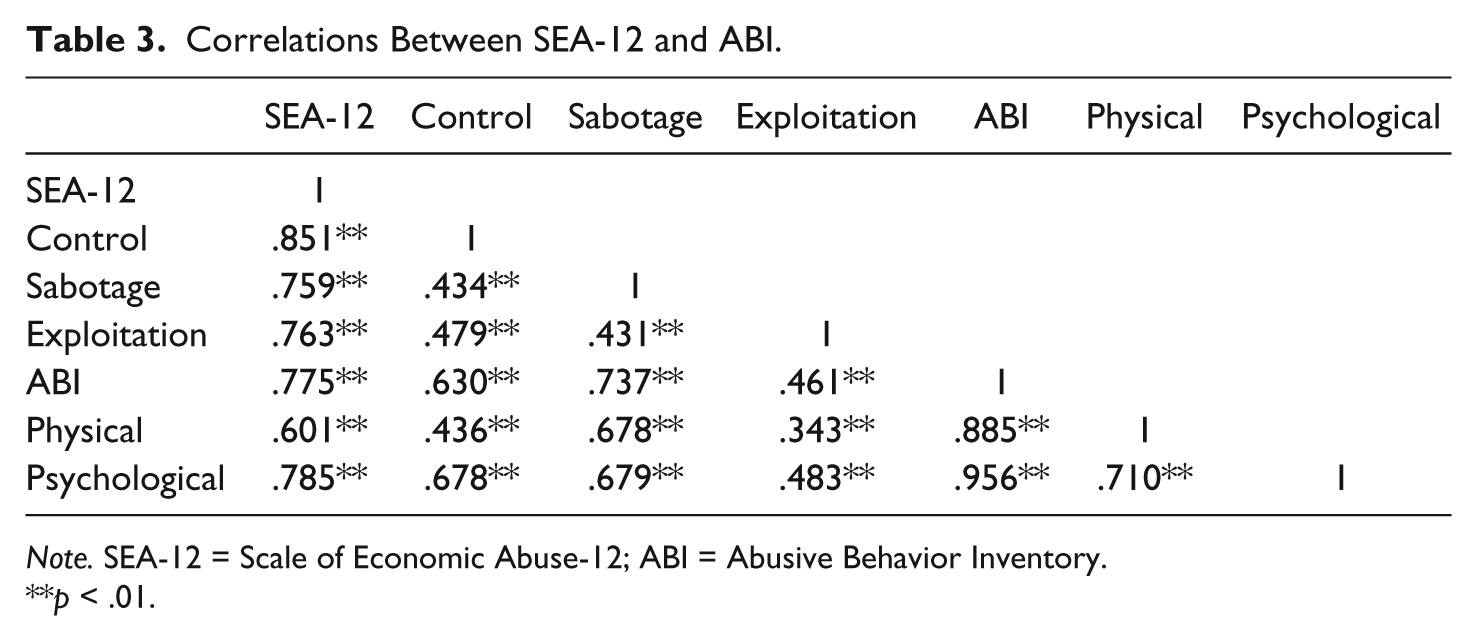
Note. SEA-12 = Scale of Economic Abuse-12; ABI = Abusive Behavior Inventory.
p < .01.
Discussion
The findings of this study provide evidence for the reliability and validity of the SEA-12 as a short instrument to measure economic abuse as a distinct form of abuse. Whereas the original SEA included 28 items with two subscales, the SEA-12 includes 12 items with three subscales including five items capturing behaviors that control a woman’s access to and use of resources, four items that measure behaviors that restrict a woman’s ability to work or attend school, and three items that measure economically exploitive behaviors. Within this sample, these three dimensions were fully distinct and moderately correlated with experiences of physical and psychological abuse. The SEA-12 can be a useful tool to quickly assess a victim’s experience of economic abuse.
This study also demonstrated the importance of assessing economic abuse as a distinct form of abuse as well as how to measure such abuse with a shortened survey (i.e., the SEA-12). Of the 120 women interviewed, 94% had experienced physical abuse in the past 12 months and 95% had experienced psychological abuse. In addition, 94% reported experiencing economic abuse in their relationship; 92% had experienced behaviors of economic control, 88% had experienced employment sabotage, and 79% experienced economic exploitation. These findings demonstrate that economic abuse is a significant component of abuse and, hence, have important implications for advocates working with survivors of abuse. Advocates play a central role in educating women on the concepts of power and control and helping survivors identify abusive behaviors. Advocates need to be trained on the specific economic abusive behaviors used by batterers and, in turn, educate survivors on identifying signs of economic abuse. Having an accessible and short tool with the SEA-12 will afford advocates the opportunity to identify and discuss the different economically abusive tactics batterers use.
Findings need to be considered in light of the study’s limitations. First, the sample size is small (n = 120) and not random. The majority of the women in the sample were primarily Caucasian (54%). Furthermore, the majority of the women reported earning less than US$25,000 annually (74%), a figure not uncommon when using samples from shelters. All women were currently receiving services from a domestic violence agency and had self-selected to participate in a financial education program at the agency. Hence, this sample may have been more aware of economic abuse as a result of their participation, which may have biased their responses. More research is needed to test the reliability and validity of the SEA-12 with diverse populations including different ethnic, socio-economic, and non-shelter samples. Finally, the SEA asks women to identify the different forms of economic abuse since the relationship began instead of measuring more current forms of abuse (past year). Recollection of past experiences that could have spanned multiple partners limits the results of this study; further research is needed to measure past and current economic abuse.
Despite these limitations, this study furthers the importance of measuring economic abuse and provides a brief scale that can be used by advocates with survivors. Indeed, economic abuse warrants more attention as to its prevalence among and impact on IPV survivors. Further research needs to be conducted on economic abuse to support women in escaping abusive relationships and in regaining a new financially secure life.
Footnotes
Acknowledgements
The authors would like to acknowledge the support of Carl Siebert in the data analyses strategies used in this article.
Authors’ Note
Points of view in this document are those of the authors and do not necessarily represent the official position or policies of the Allstate Foundation.
Declaration of Conflicting Interests
The author(s) declared no potential conflicts of interest with respect to the research, authorship, and/or publication of this article.
Funding
The author(s) disclosed receipt of the following financial support for the research, authorship, and/or publication of this article: This project was supported by the Allstate Foundation, Economics Against Abuse Program.