




Abstract
Scripts are influential in shaping sexual behaviors. Prior studies have examined the influence of individuals’ rape scripts. However, these scripts have not been evaluated among diverse groups. The current study examined the rape scripts of African American (n = 72) and European American (n = 99) college women. Results supported three rape scripts: the “real rape,” the “party rape,” and the mismatched intentions rape, that were equally common. However, there were some differences, with African Americans’ narratives more often including active victim resistance and less often containing victim vulnerability themes. Societal and cultural influences on rape scripts are discussed.
Rape remains a largely hidden and stigmatized crime in the United States. The vast majority of victims do not report their experience to the police, and only a small percentage of cases are successfully prosecuted (Chen & Ullman, 2010; Lonsway & Archambault, 2012; Ullman, 2010). A sizable percentage of victims also never disclose their experience or delay doing so, sometimes for years (Littleton, Rhatigan, & Axsom, 2007; Ullman, 2010). In addition, around half of all women who are raped do not conceptualize this experience as rape; instead, they give the experience a more benign label (e.g., a miscommunication) or are unsure how to label it (Littleton et al., 2007). Similarly, men who commit these crimes very rarely regard their behavior as rape (Loh, Gidycz, Lobo, & Luthra, 2005).
The Role of Sexual Scripts
To understand how individuals understand and label sexual interactions, including non-consensual interactions such as rape, it is important to examine how factors including personal experiences and messages from media, peers, family, and broader social institutions (e.g., school, church) lead individuals to define and script consensual and non-consensual sex (Ryan, 2011). It is likely that these scripts influence how victims and perpetrators of rape are viewed and how individuals understand their own experiences as victim or perpetrator (Ryan, 2011). To elucidate the content of these internalized messages, researchers have examined individuals’ sexual scripts. In general, scripts are conceptualized as cognitive structures that guide behavior in social situations (Fiske & Taylor, 1991). Specifically, these scripts define individuals’ roles in a social situation as well as shape expectations for how others should behave in that situation (Fiske & Taylor, 1991). In addition, scripts influence cognitive processing of the social situation, including what information is attended to and how information is organized and remembered (Baldwin, 1992; Schank & Abelson, 1995). Studies of young adults support the existence of shared sexual scripts. One highly influential and commonly held script is what has been termed the traditional sexual script (Byers, 1996). This script dictates that men are the initiators of sexual activity and women are expected to serve as gatekeepers, regulating how “far” a sexual interaction goes (Byers, 1996; Littleton, 2011; Masters, Casey, Wells, & Morrison, 2013). Within this script, men are presumed to have strong, difficult-to-control sexual urges, as well as desire sexual interactions with multiple partners, in part because doing so enhances their reputation and sexual prowess (Byers, 1996; Littleton, 2011; Masters et al., 2013). In contrast, women are presumed to desire relationships and intimacy, to have much weaker sexual urges, and those who take pleasure in engaging in casual sex or sex with multiple partners are viewed as deviant in some way (Littleton, 2011; Masters et al., 2013).
Indeed, despite a growing acceptance in industrialized Western societies of casual and non-committed sexual relationships among young adults (e.g., hook-ups, friends with benefits) and therefore a presumed rejection of the traditional sexual script (e.g., Currier, 2013; Paul, 2006), in reality many aspects of this script appear to be enacted in individuals’ sexual behaviors and attitudes. For example, men are still more likely to serve as initiators of physical intimacy within sexual encounters (Simms & Byers, 2013) and engaging in “hook-ups” or other casual sexual acts is regarded as enhancing men’s reputation, whereas women who do so risk being negatively labeled (Currier, 2013; Littleton, Tabernik, Canales, & Backstrom, 2009). In addition, there is an expectation and emphasis on male sexual pleasure in these encounters, whereas there is little expectation regarding sexual pleasure for women (Armstrong, England, & Fogarty, 2012; Currier, 2013). Finally, women are presumed to be more likely than men to be “clingy” and expect a relationship following a casual sexual encounter (Paul, 2006).
The Content of Individuals’ Rape Scripts
Sexual scripts such as the traditional sexual script are important in shaping how individuals think about non-consensual sex as well. For example, the idea that women are the sexual gatekeepers and men the sexual initiators leads to potential normalization of persistent and aggressive behavior on the part of men to obtain sex. It also supports the idea that women may engage in “token” rather than genuine resistance to sexual advances as a way to maintain their sexual reputation (Frith & Kitzinger, 2001; Littleton, 2011). In addition, this script places the burden of stopping unwanted sex solely on women (i.e., women need to strongly and repeatedly resist unwanted sexual advances; Bay-Cheng & Eliseo-Arras, 2008). This sexual script also contributes to blaming women for sexual assault experiences (e.g., the unwanted sex was her fault because she did not resist more strongly or because her behaviors led the man to think she wanted to engage in sex; Edwards, Turchik, Dardis, Reynolds, & Gidycz, 2011; Scully & Marolla, 1985). Similarly, the idea that men have strong and potentially uncontrollable sexual urges suggests that men are not to blame for forcing a woman to have sex if they were aroused by her or if she engaged in behavior that suggested she was interested in sex (Bay-Cheng & Eliseo-Arras, 2008; Ryan, 2011; Seal, O’Sullivan, & Ehrhardt, 2007). Finally, this sexual script contributes to the idea that some women either deserve or should expect to be sexually assaulted (e.g., because they act in a sexually provocative way or “tease” men; Edwards et al., 2011; Littleton, 2011; Ryan, 2011; Scully & Marolla, 1985). Finally, this script helps perpetuate rape myths (commonly held false beliefs about rape), such as that many women “cry rape” to maintain their sexual reputation and that certain women are not legitimate rape victims (e.g., victims of marital rape, women who participate in the sex industry; Edwards et al., 2011; Scully & Marolla, 1985).
Studies of individuals’ rape scripts have supported the influence of the traditional sexual script on the content of rape scripts as well. Research has consistently supported that the most common rape script held by individuals is the “real rape” script (Krahé, 1991; Ryan, 2011). This script involves a highly violent assault, generally involving an unknown perpetrator attacking an unsuspecting victim, often at night or in a deserted or isolated area (Krahé, 1991; Littleton, Tabernik, et al., 2009; Ryan, 1988). The victim then either engages in strong resistance (e.g., crying, screaming, fighting, trying to escape) or is prevented from doing so by the perpetrator’s use of physical force, threat, use of a weapon, or restraint of the victim (Littleton & Axsom, 2003; Littleton, Tabernik, et al., 2009). The victim is presumed to be terrified during the attack and to experience significant negative long-term effects (e.g., depression, suicidal urges, difficulty trusting others; Littleton & Axsom, 2003; Littleton, Tabernik, et al., 2009; Ryan, 1988). Finally, perpetrators of rape are often presumed to be mentally ill or disturbed in some way (Ryan, 1988). This script clearly differentiates rape from the consensual sexual interactions delineated in the traditional sexual script, and thus can lead individuals to not label as rape assaults that instead more closely resemble these presumed consensual interactions (e.g., Kahn, Mathie, & Torgler, 1994; Littleton & Axsom, 2003). Indeed, women who hold this “real rape” script have been found to be more likely to experience a sexual victimization (perhaps because they are unprepared to respond to an unwanted sexual advance in a dating or casual sexual encounter) as well as to be less likely to label a personal experience of rape as such than women who do not endorse this rape script (Kahn et al., 1994; Turchik, Probst, Irvin, Chau, & Gidycz, 2009).
More recent studies of the rape scripts of college students (the population most frequently studied with regard to rape scripts) have supported that some hold other rape scripts as well. One of these is the “party rape” script. This script often involves heavy alcohol use by the victim and perpetrator, generally occurs at a bar or party, and usually involves two people who were not previously romantically involved (e.g., individuals who just met or friends; Clark & Carroll, 2008; Littleton, Tabernik, et al., 2009). The emergence of this script likely in part reflects increased acceptance of casual sexual encounters among college students (e.g., Currier, 2013; Paul, 2006). Another rape script sometimes held by students is the date rape script. This script generally involves a man and a woman on a traditional date (e.g., going to dinner or a movie) with mismatched sexual expectations; indeed, the man is often depicted as planning for sex to occur on the date (Clark & Carroll, 2008; Littleton, Tabernik, et al., 2009). Some level of consensual sexual activity (e.g., kissing) is also often part of this script (Clark & Carroll, 2008).
Both these scripts often involve rapes occurring within the context of consensual sexual encounters. However, both to some extent reflect an extension of the dictates of the traditional sexual script, where women must be on the lookout for predatory men in dating and casual sexual encounters, as well as be aware of the fact that their flirtatious behaviors could be misinterpreted as evidence that they desire sex or that their consent to some intimate activities (e.g., kissing) could be interpreted as consent to engage in sexual intercourse. Not surprisingly, these scripts also often include many elements of the “real rape” script, including high levels of violence on the part of the perpetrator and strong resistance by the victim, or the assault of a victim who is incapacitated. Indeed, Littleton, Tabernik, and colleagues (2009) found that women’s descriptions of “party rapes” often involved a predatory man who picks out a vulnerable victim (e.g., a woman who is drinking heavily, a woman who is naïve or alone) and either intoxicates or drugs her (Littleton, Tabernik, et al., 2009).
Influences on the Sexual Scripts of African American Women
One primary limitation of research on individuals’ sexual scripts in general and rape scripts in particular is that the vast majority of research has focused almost exclusively on White or European American participants with very little work examining the rape scripts of ethnic minority individuals (e.g., Clark & Carroll, 2008; Kahn et al., 1994; Littleton & Axsom, 2003). One such group notably absent from prior research on rape scripts are Black and African American women. Any discussion of Black and African American women’s attitudes or rape scripts must of course acknowledge the sociohistorical context of African American women’s rape in the United States. This history begins with the institutionalized rape of African American slaves and encompasses the sexual exploitation of Black domestic workers in White households through the mid-1900s (Tillman, Bryant-Davis, Smith, & Marks, 2010).
Throughout U.S. history, African American women who were raped had no legal or social protections, and were regarded as not legitimate victims of rape in part due to their supposed hypersexual nature (e.g., the Jezebel stereotype), which was believed to lead them to desire men’s sexual advances and enjoy forced sex (Tillman et al., 2010). Even today, African American women are viewed as more responsible for rape than European American women, and individuals who rape Black women tend to receive shorter sentences (Dupuis & Clay, 2013; Tillman et al., 2010). In addition, there is evidence that African American women continue to be victims of certain forms of sexual violence more frequently than women of other ethnic groups, particularly childhood sexual abuse and forcible rape (e.g., Bryant-Davis, Chung, & Tillman, 2009; Littleton & Ullman, 2013).
Furthermore, negative stereotypes of African American women’s sexuality remain deeply entrenched in U.S. society and are frequently depicted in popular culture (Stephens & Phillips, 2003). These include the hypersexual “freak” stereotype—a modern incarnation of the Jezebel stereotype (Stephens & Few, 2007; Stephens & Phillips, 2003; Stokes, 2007). Other common negative stereotypes of African American women include the gold-digger stereotype, who uses sex to obtain material goods, and the baby mama stereotype, who uses pregnancy to obtain a relationship or financial support from a man (Stephens & Phillips, 2003; Stokes, 2007). Indeed, even preadolescents are aware of these stereotypes of African American women (Stephens & Few, 2007), and diverse groups of African American individuals have been found to endorse these stereotypes (Gillum, 2002; Stephens & Phillips, 2005; Stokes, 2007). Even if African American women reject these stereotypes, they may still experience concerns about being viewed in these negatively stereotyped ways, as well as face experiences of objectification and unwanted sexual advances as a result (Watson, Robinson, Dispenza, & Nazari, 2012).
Likely in part as a reaction against these negative depictions of African American women’s sexuality, there is often a strong emphasis on the importance of female chastity in African American communities, such as in African American churches (Stephens & Phillips, 2003; Stokes, 2007). Specifically, young women are often encouraged to be modest in their dress and behavior, and personal responsibility for avoiding sexual activity is placed on them (French, 2013; Stephens & Phillips, 2003; Stokes, 2007). Overall, these stereotypes and cultural messages about African American women’s sexuality could contribute to a normalization of blaming rape victims for either inviting sexual advances by their behavior or dress or for not trying harder to resist unwanted advances. In addition, negative stereotypes of African American women as hypersexual and manipulative could lead African American women to believe that society will regard their sexual victimization less seriously, particularly incidents that do not conform to the “real rape” script. African American women may also internalize messages that emphasize personal responsibility with regard to sexual behavior and thus believe that engaging in strong resistance is necessary for an incident to be labeled rape, as well as focus on whether victims dressed or behaved in a way that suggested they were interested in sex.
In addition to these pressures related to women’s sexual behavior, in some African American communities there is an emphasis and valuing of the “strong, Black woman” who is self-sufficient, capable, and unaffected by negative experiences (Thomas, Witherspoon, & Speight, 2004; Tillman et al., 2010; Washington, 2001). While development of this self-view is highly protective overall given the realities of racism, discrimination, and lack of resources faced by many African American women, internalization of this ideal could also inhibit disclosure and potentially lead to a belief in women’s responsibility to avoid rape by minimizing their personal vulnerability to rape (e.g., not dressing in a provocative way) and strongly resisting unwanted advances (Tillman et al., 2010; Washington, 2001). In sum, in addition to overall societal messages faced by all women that often result in blaming them for their victimization or minimizing/denying such experiences as legitimate victimizations, African American women may face additional pressure and burdens. These include the existence of negative hypersexual stereotypes that serve to deny and minimize their victimization, strong pressures to not behave in accordance with negative stereotypes as well as take personal responsibility for their sexual reputation, and an exhortation to African American women to be strong and independent in the face of adversity.
While some prior research has investigated how these factors affect the sexual behaviors and attitudes of young African American men and women, there is a lack of research on the non-consensual sexual scripts of African American women, and thus it is not known if these factors indeed affect African Americans’ sexual scripts, including rape scripts. The current study therefore seeks to address this limitation by utilizing a qualitative methodology to examine the rape scripts of a sample of African American U.S. college women, and to evaluate similarities and differences in the rape scripts of European American and African American college women.
Method
Participants
Participants were drawn from a sample of 354 women enrolled in introductory psychology classes at a large southeastern U.S. university. In the current study, only responses from women who self-identified as Black or African American (n = 72) and a randomly selected subsample of 99 women who self-identified as White or European American were examined. Participants’ mean age was 18.8 years (SD = 2.7 years), 80.7% were freshmen, and 90.1% described their religious affiliation as Christian (Table 1).
Participant Demographics.

Note. CSA = child sexual abuse; ASA = adolescent/adult sexual assault.
Materials and Procedures
Study procedures
Women enrolled in introductory psychology classes were recruited via an online research management website to participate in a study of the sexual scripts of college women. Participants completed the study in classrooms in small groups of 15 or fewer women, and study experimenters (trained undergraduate research assistants) spaced participants in desks around the room to ensure privacy.
After completing informed consent and consistent with prior studies of rape scripts (e.g., Littleton, Tabernick, et al., 2009; Ryan, 1988), participants were given the following instructions:
We are interested in learning about individuals’ ideas about different types of events. In the space below, please describe your ideas about a typical rape. In your description, please include information about what happens before, during, or after a typical rape, the thoughts and feelings of the individuals involved, and the characteristics of the individuals involved. While we understand that each experience is unique, we want to get a better idea of individuals’ ideas about what a typical event is like.
After completing this task, participants were given a series of seven prompts to ensure that as many aspects of individuals’ scripts as possible were elicited. Participants had 15 min to respond to these prompts. Six prompts asked participants to describe either the thoughts and feelings or the behaviors of the individuals involved before, during, or after a typical rape. An additional prompt asked participants to provide as much information as they could about the characteristics of the individuals involved. After responding to these prompts, participants completed several self-report measures, including a demographic questionnaire. They then placed their responses in an unmarked envelope and returned them to the experimenter. All study procedures were approved by the university’s Institutional Review Board (IRB), and participants were provided information about free campus and community counseling resources. In addition, the experimenters monitored participants for any signs of emotional distress and escorted any distressed participants (n = 1) to meet privately with the first or second author. Participants received course credit for their participation.
Self-report measures
Participants were asked about their age and academic classification (e.g., freshman, sophomore) and to indicate their ethnicity from a list of options. Participants were also asked to indicate the highest level of schooling that both of their parents had completed and were asked if they were the first person in their family to attend college (yes or no item). Participants also responded to an open-ended item about their religious affiliation or faith. In addition to providing demographic information, participants were asked if anyone had ever disclosed to them an experience that they considered to be a rape (yes or no item). Participants also completed two behaviorally specific items derived from prior research to assess experiences of childhood sexual abuse (Williams, Siegel, & Pomeroy, 2000). These items asked about experiences of unwanted sexual contact before the age of 14 years with a relative or individual who was older or in a position of authority (e.g., teacher, minister, babysitter). Similarly, participants completed three behaviorally specific items drawn from the Sexual Experiences Survey (Koss et al., 2007) to assess experiences of rape that occurred in adolescence or adulthood. These items asked about experiences of unwanted sex (vaginal, anal, oral intercourse, or object penetration) at the age of 14 years or older perpetrated through the use of verbal threats, physical force, or that occurred when the participant was not capable of stopping the assault from happening, including due to substance-use-related impairment.
Script Coding
A multi-step process was utilized to code the rape narratives. First, like prior studies (e.g., Littleton, Tabernik, et al., 2009), three undergraduates trained by the authors separately developed a comprehensive list of the specific elements present in the narratives. These lists were reviewed by the authors and merged to create a final list of 131 potential elements. Two undergraduate coders then coded the narratives for the presence of these elements. A total of 58.5% of the narratives were coded by both coders and kappa, which assesses the level of agreement between raters corrected for that expected by chance, was calculated as a measure of interrater reliability (Cohen, 1960). Kappa values range from 0-1, with values closer to 1 representing greater agreement between raters (Cohen, 1960). After this coding process, two elements with a κ of less than .70 were removed. A total of 64 elements not present in at least 10% of the narratives of either African American or European American women were also removed, leaving a final list of 68 elements.
Next, again like prior studies (e.g., Littleton, Tabernik, et al., 2009), the narratives were reviewed by the authors as well as a postdoctoral fellow who each independently developed a list of the rape scripts depicted in the narratives as well as broader themes related to the victim, perpetrator, and impact of the rape. They then met and together came up with a final consensus list. This list included three types of rape scripts depicted, characteristics of the victim (two themes), characteristics of the perpetrator (three themes), the long-term negative impact of the rape on the victim, and individuals’ universal vulnerability to rape. The narratives were then coded for the presence of these rape scripts and broader themes by two trained undergraduate coders and the second author. A total of 49.1% of the narratives were coded by two coders, and κ was calculated.
Results
Participant Demographics
Participant demographics are summarized in Table 1. Participants were overwhelmingly traditionally college-aged and were freshmen or sophomores. Most described their religious affiliation as Christian. Approximately half of the participants reported being the recipient of a rape victim’s disclosure, and rates of sexual victimization were similar to those of other college samples (e.g., Littleton, Grills-Taquechel, Buck, Rosman, & Dodd, 2013; McCauley, Ruggiero, Resnick, Conoscenti, & Kilpatrick, 2009; Pereda, Guilera, Forns, & Gómez-Benito, 2009). There were some ethnic differences in demographics. Specifically, European American women were significantly more likely than African American women to report that their father had completed at least some college education, χ2 (1, N = 170) = 10.28, p = .001. African American women were significantly more likely than European American women to describe their religious affiliation as Christian, χ2 (1, N = 171) = 3.95, p = .047. Finally, African American women were significantly more likely than European American women to report being the victim of childhood sexual abuse, χ2 (1, N = 171) = 4.08, p = .026.
Coding of Narratives
Participants’ narratives contained an average of 14.5 of the 68 elements (range = 3-32), and there were no significant differences in the mean number of elements present in the narratives of African American and European American women, t(169) = 0.07, p = .94. The interrater reliability for coding of the presence of these elements was acceptable, κs = .76-1.00.
Looking at all the narratives, there were three rape scripts described: the “real rape,” the “party rape,” and the mismatched intentions rape. There were two victim characteristics themes: the vulnerable rape victim and the deserving rape victim. There were three rapist characteristics themes: the disturbed rapist, the insecure/weak rapist, and the remorseful rapist. An additional theme was the victim is permanently damaged by the rape. The final theme was one of universal vulnerability to rape. The interrater reliability of the coding of these scripts and themes was acceptable, κs = .83-1.00. On average, participants’ narratives included 3.1 of these scripts and themes (range = 0-8). European American women’s narratives on average contained significantly more rape scripts and themes than those of African American women (M = 3.44 vs. M = 2.78), t(169) = 2.87, p = .005.
Rape Scripts
The “real rape”
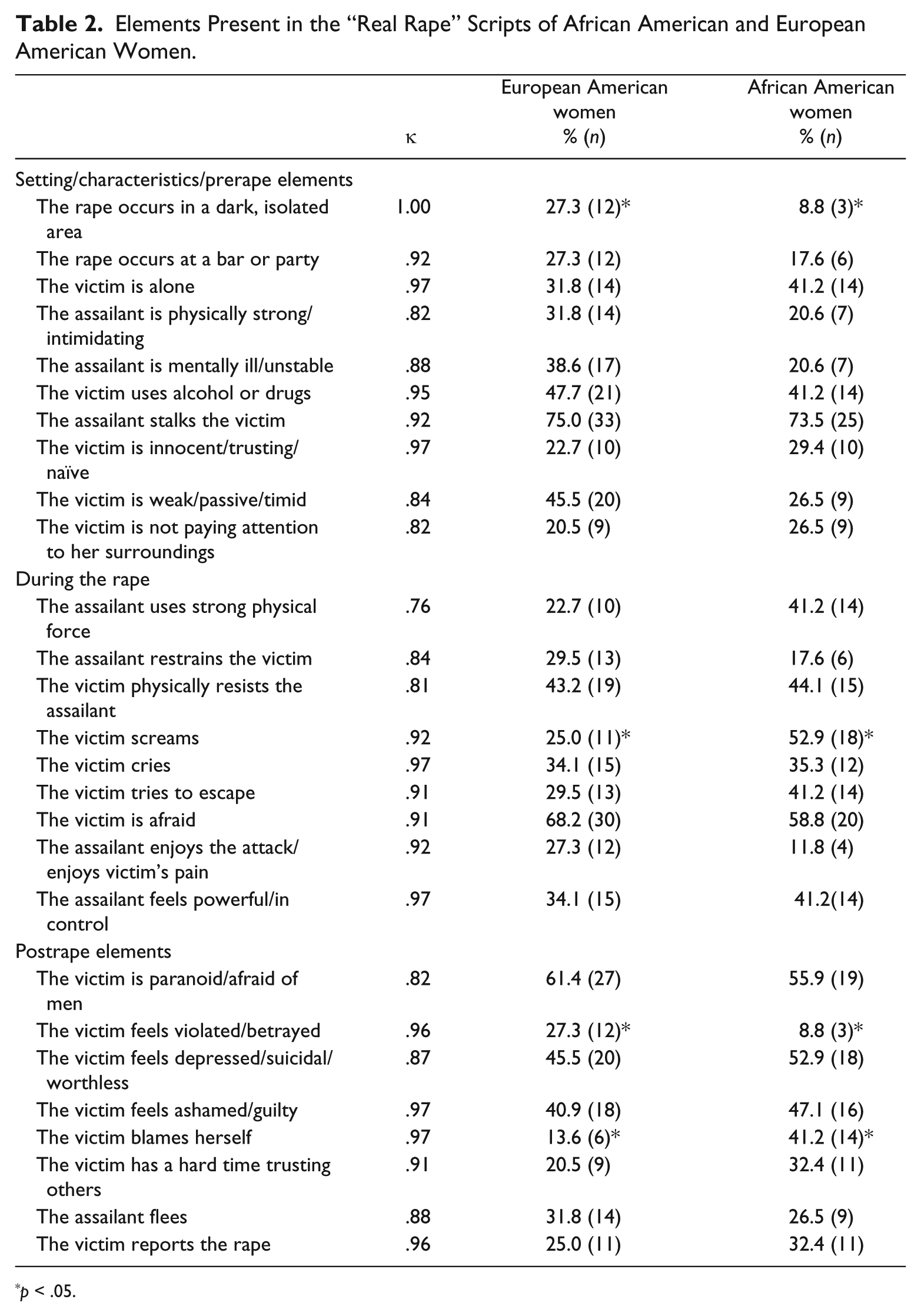
A total of 45.6% of participants’ narratives included a depiction of the “real rape” script, and there were no ethnic differences in the proportion of African American (47.2%) and European American (44.4%) women whose narratives included this script, χ2 (1, N = 171) = .13, p = .72. To elucidate the specific elements that occurred most frequently in this script and evaluate if there were any ethnic differences in the elements described, all elements present in at least 25% of the narratives of European American or African American women whose narratives depicted this rape script were evaluated for ethnic differences in the frequency of occurrence. These elements and the frequency with which they were present in participants’ narratives are summarized in Table 2. Overall, these narratives involved an unknown assailant who attacks the victim at night. The assailant is described as violently assaulting the victim who strongly resists the attack, is terrified during the rape, and then experiences permanent emotional damage (e.g., depression, suicidality, difficult trusting others). The assailant is physically large, intimidating, and mentally disturbed, enjoying the power and control that comes from raping the victim.
Elements Present in the “Real Rape” Scripts of African American and European American Women.
p < .05.
The following two excerpts illustrate descriptions of this rape script, including the use of violent force by the assailant, assault by someone unknown to the victim, and the rape having a long-term negative impact on the victim:
The rapist is aggressive and makes it obvious what they want. . . . The rapist is forcing sexual intercourse onto the victim and doing physical harm, such as choking or hitting. The victim is forced to lay there and not resist, though many may resist, fight back, or yell to catch someone’s attention. . . . Some victims may be killed, further beaten, threatened or just left to die . . . [Afterward] Some [victims] may feel guilty, blame themselves, and go into depression. (19-year-old African American participant) Usually a “typical” rape takes place at night in a dark parking lot. . . . The rapist is usually big/stronger than the woman or uses drugs or weapons to overpower the woman. The man then forces her to have vaginal sex and leaves her helpless and upset. . . . After this [rape] the woman feels alone and doesn’t want to reach out to people for help and gets depressed. (18-year-old European American participant)
Analyses revealed some differences in the elements present in the narratives of African American and European American women who described this rape script. Specifically, the narratives of African American women involved greater levels of assertive victim resistance, with African American women being more likely than European American women to report that the victim screamed for help. European American women were more likely to include a description of the rape occurring in a dark isolated area than African American women. There were also two significant differences in participants’ evaluation of the impact of the rape with European American women being significantly more likely to report that the victim feels violated or betrayed, whereas African American women were significantly more likely to say that the victim blames herself for the rape.
The “party rape”
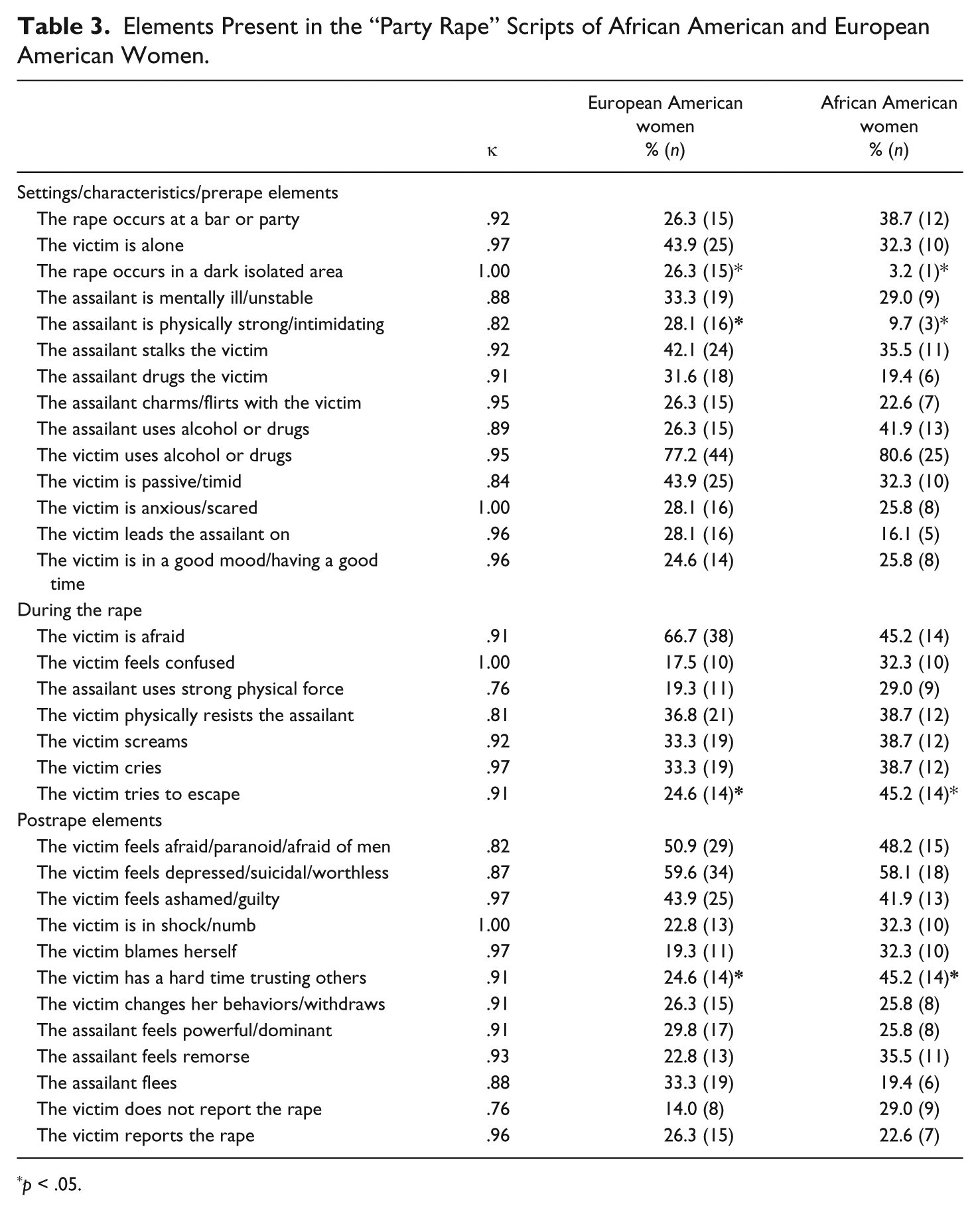
A total of 51.5% of narratives included the “party rape” script with no ethnic differences in the proportion of African American (43.1%) and European American (57.6%) women whose narratives included this script, χ2 (1, N = 171) = 3.52, p = .06. The key elements (e.g., those present in at least 25% of the narratives of women in either ethnic groups) and the frequency with which they were present in participants’ descriptions of the “party rape” script are summarized in Table 3. Narratives including this script most often occurred at a bar or party and involved the victim and assailant drinking alcohol. The assailant is often described as picking out the victim who may be targeted based on either being timid or passive or because she is a tease and leads the man on. The assailant charms or flirts with the victim, and then isolates her and commits the rape.
Elements Present in the “Party Rape” Scripts of African American and European American Women.
p < .05.
Of note, strong physical force by the assailant and strong resistance by the victim were frequently included in these scripts. After the assault, the victim is described as experiencing negative outcomes, including shame, self-blame, and difficulties trusting others. The assailant is described as either feeling remorse for his actions or feeling powerful and dominant. The following excerpt illustrates descriptions of this rape script, including consensual flirting and kissing between the man and woman, alcohol use by both the victim and perpetrator, use of physical force by the perpetrator, and feelings of shame and violation by the victim:
The individuals are being friendly toward one another, with some simple touching and also some drinking. . . . A girl becomes a little too flirtatious with a male and he takes those signs seriously as if she wants to have sex with him. . . . The two will wander off into a bedroom or somewhere private. . . . Then the male will start undressing himself and his partner and this is when the girl . . . will no longer want to continue. . . . The male will want to keep going and will force the female upon the bed and proceed to have sex. Afterwards, the male doesn’t think he did anything wrong. . . . For the female it leaves her heartbroken . . . she was not trying to be violated in such a way which will then leave her ashamed from what happened. (20-year-old European American participant)
There were a few ethnic differences with regard to this rape script, with African American women being significantly more likely to state that the victim tries to escape and that she has difficulties with trust afterward than European American women. In contrast, European American women were significantly more likely than African American women to note that the rape occurred in a dark or isolated area and to describe the assailant as physically intimidating or strong.
The mismatched intentions rape
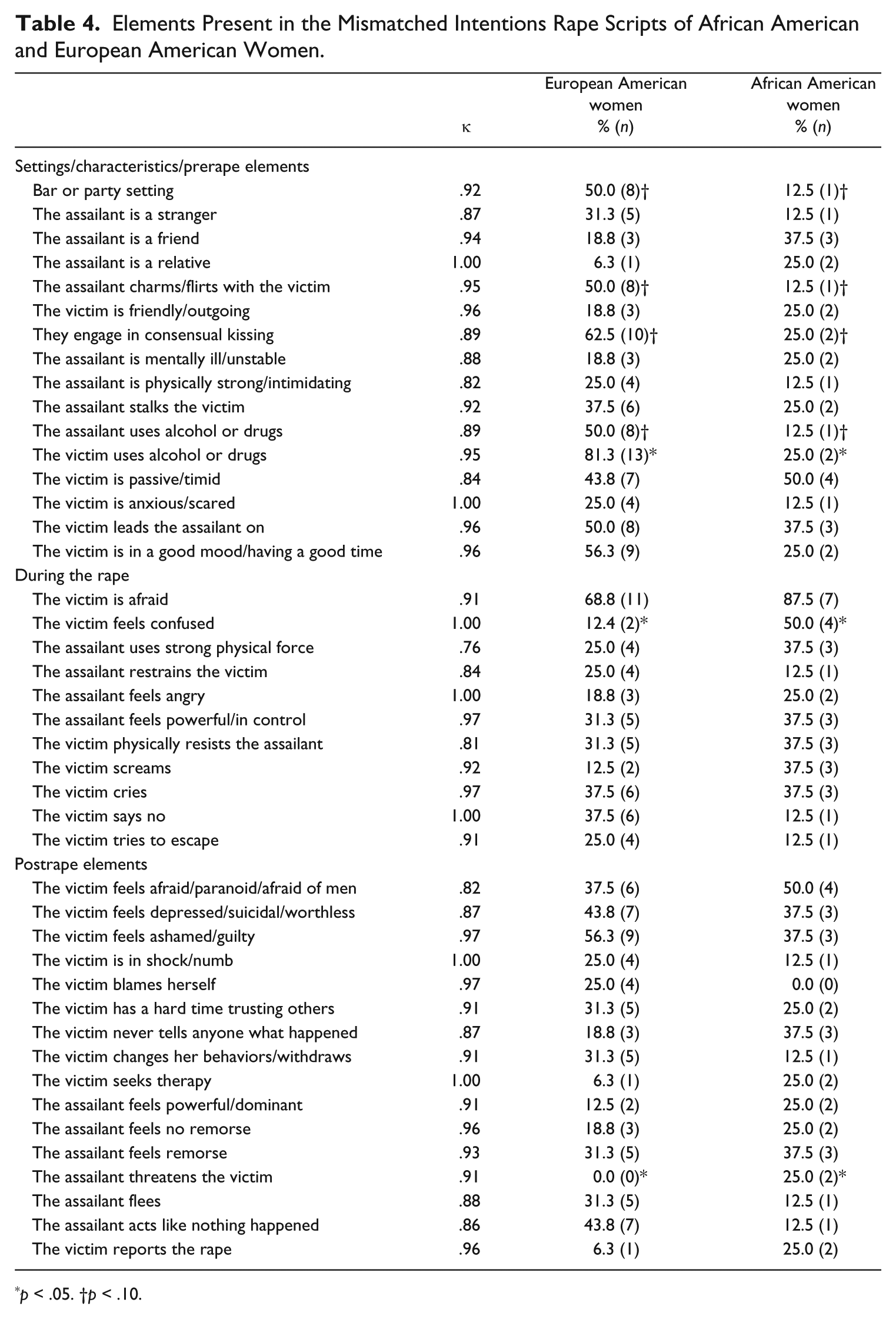
The mismatched intentions rape script was present in 14.0% of the narratives, and there were no ethnic differences in the proportion of African American (11.1%) and European American (16.2%) women whose narratives depicted this script, χ2 (1, N = 171) = .88, p = .35. The elements and the frequency with which they were present in participants’ descriptions of the mismatched intentions rape are summarized in Table 4. Descriptions of this rape script often involved consensual flirting and/or physical contact (e.g., kissing); however, the victim was not planning to have sexual intercourse, whereas that was the intention of the assailant all along. The assailant is described as either a friend or an individual the victim had just met. Like the other rape scripts, strong physical force by the assailant and strong resistance by the victim were also fairly frequently described. As far as the impact of the rape on the victim, the victim feeling ashamed or guilty as well as changing her behavior or withdrawing from others were frequently described. In addition, this rape script frequently included the assailant pretending as if nothing had happened and the victim not disclosing the assault to anyone.
Elements Present in the Mismatched Intentions Rape Scripts of African American and European American Women.
p < .05. †p < .10.
Given that this script was fairly infrequently described, differences in the frequency of inclusion of the elements in the narratives of African American and European American women had to be quite sizable to be statistically significant. Thus, we also identified potential trends. Looking at elements that differed significantly, the narratives of European American women were significantly more likely to include alcohol use by the victim than those of African American women. The narratives of African American women were more likely to include the victim feeling confused during the rape and the assailant threatening the victim afterward as compared with European American women. Looking at elements where there was a trend for the narratives of African American women and European American women to differ, the narratives of European American women were more likely to occur at a bar or party, involve the assailant flirting with the victim, the assailant drinking alcohol, and consensual kissing between the assailant and victim, as compared with African American women.
Thus, there appeared to be some important differences in this rape script between African American and European American women. European American women primarily focused on a party-based “hook-up” scenario where the victim and assailant meet at a bar or party, drink, flirt, potentially engage in some consensual sexual activity, and the assailant uses force to have (planned) unwanted sex with the victim. In contrast, several of the narratives of African American women involved a trusted individual (e.g., a friend or relative) unexpectedly forcing the victim to have sex as exemplified in the narrative excerpt below:
Before the rape the individuals get along well but the other is not aware of the intentions of the other. One person may think that they are just friends while the other has a desire to engage in sexual activity with that person. . . . [During the rape] The rapist may display violent behavior and the victim will be terribly frightened. All along the victim will be thinking of ways to escape and how to find help. . . . [Afterward] The victim is left helpless, hurt, and ashamed. (18-year-old African American participant)
Other narrative themes
A total of 54.4% of the narratives included the vulnerable victim theme. This theme was significantly more likely to be included in the narratives of European American (62.6%) than African American (43.1%) women, χ2 (1, N = 171) = 6.43, p = .01. In this theme, there is an emphasis on the victim’s vulnerability to rape such as due to her small size or naiveté as described in the excerpt below:
[Victims are] weak, alone, needy, trusting, small, gullible, not paying attention to surroundings. (19-year-old European American participant)
A total of 13.5% of narratives included the deserving victim theme, and there were no ethnic differences in the frequency of inclusion of this theme, χ2 (1, N = 171) = .36, p = .55, African American women, 15.3%, European American women, 12.1%. In this theme, the victim is considered to have brought on the assault by the way she dresses or acts as described in the excerpt below:
Before it occurs, the victim probably sent out messages to the assailant that would provoke them to attack whether it be walking alone at night or being at a party and drinking from strangers or being promiscuous and/or a tease. (19-year-old African American participant)
Three themes related to the assailant. The disturbed rapist was the most common, present in 30.4% of the narratives. This theme was more frequently included in the narratives of European American (38.4%) than those of African American (19.4%) women, χ2 (1, N = 171) = 7.07, p = .008. This theme characterized the perpetrator as mentally disturbed and unstable, stalking, and then violently assaulting the victim, and the perpetrator was often described as committing serial assaults as well as enjoying inflicting pain on the victim, as described in the excerpt below:
The rapist has major psychological problems and will most likely continue raping other women/men because they get satisfaction for someone else’s pain and struggle against them. These rapists are often abnormal and lonely people. (18-year-old European American participant)
The insecure/weak rapist theme was present in 14.0% of narratives and was equally common in the narratives of African American (15.3%) and European American (13.1%) women, χ2 (1, N = 171) = .16, p = .69. This theme characterized the assailant as insecure and lacking self-esteem and using the rape as a way to improve his self-worth, as described in the following excerpt:
He might think that he just wants to be in charge of something for once. That nobody loves and cares for him and this is the only way he’ll get affection. (18-year-old European American participant)
The remorseful rapist theme was present in 12.9% of narratives and was equally common in the narratives of African American (16.7%) and European American (10.1%) women, χ2 (1, N = 171) = 1.60, p = .21. This theme characterized the assailant as feeling remorse and regret after the rape as well as fearing being caught, as described in the following excerpt:
After the rape the male may have some regrets, but he won’t do anything about it. He might rape other women to heal his pain because he knows what he did was wrong but does not know what to do about it. He might have been raped or molested as a child and doesn’t know how to reach out for help. So he wants other people to feel how he felt. (19-year-old African American participant)
The victim being permanently damaged theme was present in 63.7% of the narratives and was equally common in the scripts of African American (58.3%) and European American (67.7%) women, χ2 (1, N = 171) = 1.58, p = .21. This theme characterized the victim as experiencing long-term negative consequences of the rape, including depression, suicidal urges, difficulties with trusting others, fear of men, and feelings of shame. Finally, the theme of universal vulnerability to rape was present in 16.4% of narratives. This theme was significantly more common in the narratives of European American (22.2%) than African American (8.3%) women, χ2 (1, N = 171) = 5.87, p = .015. This theme stated that anyone could be a victim of rape, including children and men, and also often included the idea that rape is not related to the victim’s appearance or behaviors.
Discussion
Results supported the existence of three primary rape scripts in this sample of college women, which largely mapped on to those found in prior research: the “real rape,” the “party rape,” and the mismatched intentions rape (e.g., Littleton, Tabernik, et al., 2009). European American and African American women overall were similarly likely to describe these three rape scripts. This no doubt in part reflects the influence of overall societal messages about rape as well as about sexual behavior more generally. Of note, like other recent investigations of the rape scripts of college students (e.g., Littleton, Tabernik, et al., 2009), the “party rape” was described most frequently by participants. However, a sizable percentage of participants still viewed rape as mapping on to the “real rape” script of the highly violent stranger attack. In addition, very few participants described a rape as occurring between individuals with any type of prior relationship, and the majority described rape as involving both physical violence and active verbal and physical resistance on the part of the victim. In addition, very few participants explicitly discussed the role of alcohol in interfering with victims’ ability to resist, or the possibility of a victim being assaulted while unconscious or incapacitated by alcohol. Thus, as a whole, participants’ rape scripts deviated to a large extent from the reality of most rapes experienced by college women, which do not involve severe violence, are perpetrated against an intoxicated victim, and involve a victim and perpetrator with a prior relationship (e.g., Krebs, Lindquist, Warner, Fisher, & Martin, 2009; Littleton, Grills-Taquechel, & Axsom, 2009). Furthermore, many participants included many so-called rape myths in their narratives (Edwards et al., 2011), such as that men who commit rape are mentally ill or disturbed, that rape victims must have done something to provoke the attack such as dressing provocatively or being promiscuous, and that rape victims are permanently psychologically damaged as a result of the assault (e.g., Ryan, 2011). Thus, while some changes in young adults’ rape scripts appear to have occurred over time, many aspects of these scripts remain unchanged, despite changes in young adults’ dating and sexual behaviors, as well as efforts to provide education about sexual violence to adolescents and young adults.
There were some differences in the narratives of African American and European American women. First, African American women were more likely to describe the victim as engaging in active resistance. Furthermore, African American women’s narratives were less likely to include content related to factors that reduced the victim’s ability to resist the rape, such as the rape occurring in an isolated area and the larger physical size of the perpetrator. Indeed, African American women’s narratives overall were significantly less likely to include the vulnerable victim theme and the theme of universal vulnerability to rape. One possible explanation of these findings is that perhaps as a result of internalization of social pressures that African American women should be strong and independent and are responsible for preserving their reputations, African American women expected that they would engage in multiple forceful resistance strategies if they experienced a rape attempt, and thus expect that other victims would behave similarly. These same social pressures may also lead African American women to focus less on their personal vulnerability to experience rape or vulnerability factors to experience rape among people in general, as well as the possibility that victims may have very limited ability to avoid a rape attempt. In addition, societal denial and minimization of the rape of African American women may have influenced African American women’s rape scripts (i.e., for an incident to be rape, the victim needs to demonstrate that she resisted to the utmost).
Some of the differences found in the narratives provided by African American women and European American women also suggested that African American women may have been more likely to reject certain myths about rape. For example, as noted earlier, African American women were less likely to include the vulnerable victim theme and were less likely to describe rape as occurring in an isolated area. They were also less likely to include the disturbed rapist theme in their narrative or the theme of universal vulnerability to rape. Given some evidence that African American women are more likely to experience sexual violence in childhood as well as more likely to experience a forcible rape (Bryant-Davis et al., 2009; Littleton & Ullman, 2013), African American women may be more likely to have both experienced some type of sexual victimization and learned about the sexual victimization of others (either due to being a disclosure recipient or through gossip or other secondhand means). These personal experiences may have led to rejection of a number of myths about rape, such as the idea that most rapists are disturbed or mentally ill or that rapes occur in dark isolated alleyways. In addition, these personal experiences may have led to recognition that certain groups of individuals are more vulnerable to rape, and thus a rejection of the notion that individuals are universally vulnerable to sexual victimization. This may also explain why some African American women whose narratives included the mismatched intentions rape script involved a depiction of a rape between two friends or individuals in an ongoing non-romantic relationship (including family members) where the man forces sex on the woman. These women may have been describing personal experiences of themselves, friends/family, or stories/gossip within their community. Indeed, African American women in this sample were significantly more likely than the European American women to have been the victim of childhood sexual abuse.
There were also ethnic differences in the frequency with which certain consequences of the rape for the victim were included in participants’ scripts. Specifically, African American women were significantly more likely to describe the victim engaging in self-blame, whereas European American women were significantly more likely to describe the victim as feeling violated or betrayed. This difference could again reflect the greater emphasis on active victim resistance and lesser emphasis on victim vulnerability in the scripts of African American women as compared with European American women, which may have led African American women to be more likely to expect victims to blame themselves for not resisting more strongly or successfully thwarting the attack. In addition, messages that African American women may have previously received that place responsibility on them for controlling sexual interactions may have also contributed to African American women’s greater belief that a rape victim would blame herself. In contrast, European American women may have focused more on feelings of betrayal by the victim based on the perpetrator taking advantage of her vulnerable state. In addition, African American women whose narratives included the “party rape” script were significantly more likely than European American women to state that the victim had difficulties with trusting others after the rape. This could reflect the fact that overall African American women’s “party rape” scripts, as compared with those of European American women, appeared to involve less ambiguity as far as the non-consensual nature of the sex that occurred. Therefore, African American women may have expected that the victim would have difficulty with trust, given that the perpetrator had sex with the victim when it was clear that she did not want to do so.
Limitations of the study should be noted. First, limiting generalizability, participants were primarily traditionally college-aged women attending one university in the southeastern United States. Second, African American women’s fathers had overall lower levels of education than those of European American women. As a result, it cannot be definitely determined if the differences found reflect differences between the African American and European American participants in factors such as overall socioeconomic status. Third, because multiple prompts were utilized to elicit participants’ scripts, a number of participants described aspects of more than one rape script in their descriptions, for example, initially describing a “real rape” but then describing the “party rape” in their responses to later prompts. This made it difficult to fully evaluate which particular elements of participants’ narratives were present in which rape script. Finally, although the sample was larger than in prior studies of rape scripts, there was limited power to evaluate ethnic differences in elements within each of the three rape scripts.
Bearing these limitations in mind, results have a number of implications for future research. First, results support that overall societal messages about rape are clearly important in shaping women’s rape scripts but that there is a need for attention to factors that may influence these scripts among diverse groups of women. This includes a need to evaluate the role of cultural influences/norms for sexual behavior as well as broader social factors such as racism, discrimination, and racial/ethnic stereotypes in shaping these scripts. There is also a need to continue to investigate how rape scripts influence individuals’ responses to unwanted sexual advances, as well as conceptualization of, and responses to, sexual victimization. For example, future research could examine if the presence of strong resistance behaviors in one’s rape script is related to greater likelihood of actual enactment of forceful resistance behaviors during a sexual victimization. It is also possible that individuals whose rape script includes forceful resistance behaviors may be less likely to conceptualize an experience as rape (including their own) if the victim did not engage in forceful resistance. Research in these areas is necessary to understand how consensual and non-consensual sexual scripts affect women’s conceptualizations of, and experiences with, sexual violence, as well as identify factors that influence these scripts across cultural and ethnic groups. Work in these areas will also lead to the development of more culturally sensitive and effective programs targeting sexual assault prevention and recovery.
Footnotes
Acknowledgements
The authors gratefully acknowledge the undergraduate research assistants who were involved in data collection and coding: Leanne Brown, Jessica Burstein, Morgan Carter, Faith Fleming, Verlissa Mason, Jade Quintero, Kirsty Timmons, and Julianna Womble. They also acknowledge the assistance of Dr. Katherine Drum in developing the script themes.
Declaration of Conflicting Interests
The author(s) declared no potential conflicts of interest with respect to the research, authorship, and/or publication of this article.
Funding
The author(s) received no financial support for the research, authorship, and/or publication of this article.