




Abstract
Compared with other ethnic groups, African Americans have the highest rate of childhood victimization. The literature is sparse with regard to suicidal ideation among African American women with a history of sexual violence as a minor. Using survey data, this study utilized logistic regression to investigate the roles of a risk factor, criminal justice involvement, and protective factors, ethnic identity, and spiritual well-being, in experiencing suicidal ideation. Findings suggest that criminal justice involvement and the interaction of ethnic identity and spiritual well-being are important factors in understanding which African American women may be at a greater risk of experiencing suicidal ideation.
Introduction
African Americans are at risk of experiencing more frequent and severe traumatic experiences compared with other ethnic groups (Fox & Zawitz, 2002). Specifically, African Americans are more likely than European Americans as well as other ethnic minority groups to be victims of overall violent crime, robbery, aggravated assault, and sexual assault (Breslau et al., 1998; Truman & Rand, 2010). One of the most significant and researched types of trauma is sexual violence as a minor. Compared with other ethnic/racial groups in the United States, African American children have the highest rates of childhood victimization at 16.6 per every 1,000 children (U.S. Department of Health and Human Services, Administration for Children and Families, Administration on Children, Youth and Families, Children’s Bureau, 2010). Research has shown that childhood maltreatment has both short- and long-term consequences on mental health, especially for those with a history of sexual violence (Goodkind, Ng, & Sarri, 2006; Walsh, DiLillo, & Scalora, 2011). However, research is sparse with regard to the long-term effects of sexual violence as a minor among African American women.
Besides the commonly researched outcomes of depression and posttraumatic stress disorder, research has consistently found that a history of childhood maltreatment is a risk factor associated with suicide (Anderson, Tiro, Price, Bender, & Kaslow, 2002; Kaslow, Jacobs, Young, & Cook, 2006; Kaslow et al., 2002; Moeller, Bachmann, & Moeller, 1993). Historically, suicide rates among African Americans have been reported to be lower than for European Americans (National Center for Health Statistics, 1996), but some researchers report that the highest rates of misclassification of cause of death are for women and African Americans because a significant number of deaths were not classified as suicides, despite evidence to the contrary (J. T. Gibbs, 1997; Maris, Berman, & Silverman, 2000; Nisbet, 1996; Phillips & Ruth, 1993; Warshauer & Monk, 1978). Like women from other ethnic groups, African American women are more likely than their male counterparts to attempt suicide (American Association of Suicidology, 2014; Juon & Ensminger, 1997). Also, suicide is a top 10 leading cause of death in 15- to 34-year-olds and a top 20 leading cause for 35- to 64-year-olds in African American females (Centers for Disease Control and Prevention, 2010). In this study, we investigate a risk factor for suicidal ideation, criminal justice involvement, and two potential protective factors, spiritual well-being and ethnic identity, in African American women with a history of sexual violence as a minor.
Criminal Justice Involvement
African American women are disproportionately more likely to be involved in the criminal justice system. Specifically, African American women (149 per 100,000) are imprisoned at a rate 3 times higher than European American women (50 per 100,000) and 2 times higher than Hispanic women (75 per 100,000; Sabol, West, & Cooper, 2009). Research suggests that women involved in the criminal justice system are at a greater risk of having health problems, including but not limited to mental health problems (Bloom, Owen, & Covington, 2005; Marquart, Brewer, & Mullings, 1999; Ross & Lawrence, 1998; Young, 1998). Rates of psychiatric disorders, including mood and anxiety disorders, are higher among incarcerated women than among women in the general population (Lamb & Weinberger, 2001; Peters, Strozier, Murrin, & Kearns, 1997; Ross & Lawrence, 1998; Sacks, 2004). Regarding suicide, adult inmates have been found to have higher rates of suicide and attempted suicide incidents than the larger community (Backett, 1987; Blaauw, Schilder, & van de Lande, 1998; J. J. Gibbs, 1978; Hayes, 1989; Liebling, 1992, 1995).
A disproportionate number of inmates have characteristics that indicate vulnerability for suicidal behavior in the community such as a history of trauma or abuse (Blaauw, Arensman, Kraaij, Winkel, & Bout, 2002; Liebling, 1994, 1995). Research indicates that inmates have experienced a relatively high degree of trauma as children and young adults (Walsh et al., 2011) with some estimates suggesting that 98% of incarcerated women have a history of trauma (Green, Miranda, Daroowalla, & Siddique, 2005). Specifically, many incarcerated women report a history of both physical and sexual victimization, which may have deleterious effects on overall mental health (Young, 1998).
Protective Factors for Trauma Recovery
While identifying factors that increase the risk of experiencing suicidal ideation is important, it is also imperative for protective factors to be investigated in African American women (Bryant-Davis, Ullman, Tsong, & Gobin, 2011; Gall, Basque, Damasceno-Scott, & Vardy, 2007). Feeling more connected with others and developing a greater sense of resiliency have been identified as central themes of the healing process for women recovering from sexual violence as a minor (Phillips & Daniluk, 2004). For African American women, the culturally salient identities of spirituality and ethnic identity have been found to promote connectedness and resiliency (Belgrave, Van Oss Marin, & Chambers, 2000; Bowen-Reid & Harrell, 2002). To advance the literature, this study focuses on the role of spiritual well-being and ethnic identity in the experience of suicidal ideation.
Spiritual well-being
A fundamental aspect of the traditional African worldview is the emphasis on spirituality (Wallace & Constantine, 2005). Spirituality is essentially a belief in a being or force greater than the self (Council of National Psychological Associations for the Advancement of Ethnic Minority Interests [CNPAAEMI], 2009), and it permeates nearly every domain of African American life (Newlin, Knaft, & Melkus, 2002). Spirituality and religious practices have been found to be helpful during times of physical distress (Potts, 1996; Simon, Crowther, & Higgerson, 2007) and mental distress (Neighbors, Jackson, Bowman, & Gurin, 1983), and religious involvement has been consistently linked to greater psychological well-being for African Americans (Frazier, Mintz, & Mobley, 2005). Research indicates that no other group of men or women from any other racial or ethnic background exhibit comparatively high levels of spiritual practices as African American women (Pew Forum U.S. Religious Landscape Survey, 2008). It has even been suggested that the substantially lower rates of completed suicide in African American females, compared with African American males, may be related to African American women engaging in more protective behaviors, including spiritual practices (Griffin-Fennell & Williams, 2006; Utsey, Hook, & Stanard, 2007)
The existing research investigating spirituality and traumatic experiences in African American women indicate that spirituality may serve as a buffer against negative outcomes. African American women who have experienced interpersonal violence have been found to use prayer as a primary coping strategy and, more importantly, those who reported higher levels of spirituality and greater religious involvement reported fewer depressive symptoms and posttraumatic stress symptoms (El-Khoury et al., 2004; Watlington & Murphy, 2006) as well as greater social support (Gillum, Sullivan, & Bybee, 2006). In addition, African American women with higher levels of spiritual well-being have been found to have lower levels of anxiety and decreased trauma symptoms (Douglas, Jimenez, Lin, & Frisman, 2008). With regard to spirituality and suicidal behavior in African Americans, Kaslow and colleagues (2002) found that African Americans who attempted suicide reported lower levels of spiritual well-being. These findings suggest that spirituality may be a positive, possibly protective factor regarding suicidal behavior, but there is no known research investigating spiritual well-being’s relevance to suicidal ideation in African American women who have experienced sexual violence as a minor.
Ethnic identity
Ethnic identity is a multifaceted construct that refers to one’s sense of belonging to an ethnic group and the part of one’s thinking, perceptions, feelings, and behaviors that is due to ethnic group membership (Phinney & Ong, 2007). Ethnic identity is believed to be more important for African Americans than for European Americans (French, Seidman, Allen, & Aber, 2006; Phinney & Ong, 2007), possibly due to the strong need to resolve issues regarding balancing one’s own culture with the dominant European American culture (Phinney, 1992). It is suggested that ethnic identity, along with other cultural factors, is important in understanding the severity of mental health challenges for ethnic minority groups (U.S. Department of Health and Human Services, 2001), and studies have found that ethnic identity serves as a buffer against negative mental health outcomes.
A strong ethnic identification has consistently been linked to positive self-esteem (Phelps, Taylor, & Gerard, 2001; Phinney, Cantu, & Kurtz, 1997; Smith, Walker, Fields, Brookins, & Seay, 1999). In addition, ethnic identity has been associated with resiliency (Belgrave et al., 2000; Miller, 1999), self-efficacy (Smith et al., 1999), and quality of life (Utsey, Chae, Brown, & Kelly, 2002). Although many studies have shown that stronger ethnic identity is associated with psychological health, there is very little research examining the role of ethnic identity in the development of suicidal ideation. One study found that compared with nonattempters, African Americans who made suicide attempts reported lower levels of ethnic identity (Kaslow et al., 2004). Similarly, the strength of the relationship between depression and suicidal ideation was found to be greater for African American college students with low levels of ethnic identity compared to those with high ethnic identity (Walker, Wingate, Obasi, & Joiner, 2008). More research is needed to uncover whether indeed ethnic identity is important in the development of suicidal ideation, specifically with populations that have an elevated risk of suicidal thoughts or behavior.
It is surprising that few researchers have examined the relationship between ethnic identity and spirituality (Mattis & Jagers, 2001; Trimble, 2000). African Americans with higher ethnic identity have been found to have an increased attendance at spiritual activities (Markstrom, 1999). Similarly, in a study of Jewish adolescents, participants with higher ethnic identity scores were more likely to rely on their spiritual beliefs as a coping strategy (Dubow, Pargament, Boxer, & Tarakeshwar, 2000). These studies suggest that there may be a relationship between ethnic identity and spirituality, but it is unknown whether and how these important components of many African Americans’ identities interact to influence mental health outcomes.
Using data from African American women in the Black Women in a Study of Epidemics (B-WISE) project, we investigate the influence of potential risk and protective factors in experiencing suicidal ideation among three groups of African American women: incarcerated persons, persons on probation, and nonoffenders in the community. Specifically, the relationship between sexual violence as a minor and suicidal ideation is investigated along with the role of criminal justice involvement and the interaction of spiritual well-being and ethnic identity. To address gaps in the literature, we examine the following: (a) Does the prevalence of experiencing suicidal ideation vary by criminal justice status? (b) Does involvement in the criminal justice system affect the prevalence of suicidal ideation in women with a history of sexual violence as a minor? (c) Does ethnic identity have a significant relationship with suicidal ideation in women with a history of sexual violence as a minor? (d) Does spiritual well-being have a significant relationship with suicidal ideation in women with a history of sexual violence as a minor? (d) Does the relationship between ethnic identity and spiritual well-being have a significant relationship with suicidal ideation in women with a history of sexual violence as a minor?
Method
Participants
The present study involves a secondary analysis of data collected from African American women in a broader epidemiological study in the state of Kentucky. Data were collected across three criminal justice status groups (prison, probation, and nonoffenders in the community), but for this study’s analyses, only those participants who endorsed at least one incident of childhood sexual trauma were included: prison (n = 91), probation (n = 85), and community (n = 46) with a total of 222 participants. The average age was 36.52, and the average level of education in years was 11.76 or approximately a high school diploma. Most of the participants (80.20%) reported an income of less than US$14,999, which is below the national statistics for African American women (US$25,594; DeNavas-Walt, Proctor, & Smith, 2011). In addition, because of the stratified sampling technique, 68% of the sample reported being a drug user in the past year. Because the high number of drug users could introduce bias, a dummy variable for illicit drug use (1 = yes; 0 = no) is included in all models. Importantly, controlling for drug use does not change substantive findings.
Measures
Demographic characteristics
Three variables were included. Age and education were measured in years. Income was measured in eight ascending categories measured in thousand dollars (0 = US$0-US$4,999, 1 = US$5,000-US$9,999, 2 = US$10,000-US$14,999, 3 = US$15,000-US$19,999, 4 = US$20,000-US$29,999, 5 = US$30,000-US$39,999, 6 = US$40,000-US$49,999, 7 = US$50,000-US$74,999, 8 = US$75,000 or more).
Sexual violence as a minor
Sexual violence as a minor was measured using a single item from the Traumatic Life Events Questionnaire (TLEQ; Kubany et al., 2000). The item, “Before age 18, you had unwanted/unconsenting sexual contact (i.e., rape),” offered the participants seven response options. In this sample, almost half of the participants (43%) endorsed experiencing one unwanted or unconsenting sexual contact. The rest of the participants indicated multiple incidents of abuse. Specifically, 15.3% reported that they had experienced it twice, 5.9% 3 times, 2.3% 4 times, 2.3% 5 times, and 30.6% more than 5 times.
Spiritual well-being
A modified version (Staton, Webster, Hiller, Rostosky, & Leukefeld, 2003) of the 24-item Spiritual Well-Being Scale (Paloutzian & Ellison, 1982) was used to measure spiritual well-being (SWB). The SWB is a 24-item scale intended to subjectively measure a person’s level of spiritual well-being with response categories ranging from 1 (strongly disagree) to 6 (strongly agree). Higher values on this mean scale indicate greater spiritual well-being. This mean scale has good internal reliability in the current sample (α = .88).
Ethnic identity
Ethnic identity was measured by the Multigroup Ethnic Identity Measure (MEIM; Phinney, 1992). This measure includes 12 items with response categories ranging from 1 (strongly disagree) to 4 (strongly agree). Higher values indicate a greater sense of group belonging as well as greater acknowledgment and understanding of the lived and historical meaning of one’s ethnic identity. This mean scale has good internal reliability in the current sample (α = .88).
Suicidal ideation
Suicidal ideation, the dependent variable of interest, was measured using a single item, which asked whether the participant had ever experienced “serious thoughts of suicide,” including having a plan for taking her own life (1 = yes; 0 = no). This item is derived from the Addiction Severity Index–LITE, a shortened version of the Addiction Severity Index (McLellan, Luborsky, Woody, & O’Brien, 1980). In this sample, 41% of the participants indicated that they had experienced suicidal ideation in their lifetime.
Procedures
This study was conducted in compliance with the University of Kentucky’s Institutional Review Board. Data from the B-WISE (Black Women in a Study of Epidemics) project were used for these analyses. The B-WISE study measures protective and risk factors in the epidemiology of health problems as well as health services utilization among African American women. Parallel data were collected from prisoners, probationers, and nonoffenders in the community, but the recruitment strategies and the inclusion criteria varied with each group. To be eligible for the B-WISE, all study participants had to meet the following criteria: (a) self-identifying as African American, (b) being at least 18 years or older, and (c) willing to participate in the study. For the prison sample, each month, all participants who were eligible for community re-entry within the next 30 days were sent individual recruitment letters to attend an information session at the prison. At the information session, interested women were screened for eligibility. If an inmate was eligible and interested in participating, an interview was scheduled for the next few days in the visitation room. Participants in the probation sample were recruited by the trained African American female interviewers from seven probation offices on various probationer report days. Interviewers approached women to describe the study and screen for eligibility. An additional eligibility criterion for the probation sample included currently being on probation. Participants in the community sample were recruited using newspaper ads and fliers with 1-800 (toll-free) phone numbers posted in various parts of the city with a large African American population based on U.S. zip code census data. Interested participants were screened for eligibility over the phone using the criteria listed above and an additional stipulation of not currently being involved in the criminal justice system. Prior involvement in the criminal justice system was not assessed during the screening. Interviews with the probationer and community samples were conducted in private venues such as conference rooms in public libraries or at the University of Kentucky.
Due to the sensitive nature of the material to be discussed in the interview, participants were assured that their responses would be kept confidential and protected by a Certificate of Confidentiality from the Department of Health and Human Services. Interviews were conducted face-to-face by trained African American female interviewers using laptops outfitted with Computer Assisted Personal Interview (CAPI) software. Information covered in the interviews included sociodemographic characteristics, physical and mental health status, spirituality and cultural factors, service utilization, patterns of illicit substance use, and attitudes/behaviors regarding sexual relationships. Respondents who completed the 2-hr interviews were compensated US$20 for their time.
Analysis
One-way ANOVAS and Pearson chi-square analyses were used to determine group differences based on criminal justice status. To examine basic relationships between the variables of interest, a series of bivariate statistics was used. Next, a logistic regression analysis was conducted to examine the effect of controlling for sociodemographics and assess the incremental contributions of the independent variables as significant correlates of suicidal ideation. To investigate the role of criminal justice status, dummy variables were created for the prison and probation groups with the reference category being the community sample. The sociodemographic variables (age, income, education, prison, probation, drug use) were entered into the first model. The frequency of sexual violence as a minor was entered into the second model. Spiritual well-being and ethnic identity were entered after sexual violence as a minor in the third model, respectively, to determine the effects of these variables on the relationship between sexual violence as a minor and suicidal ideation. Finally, the interaction of spiritual well-being and ethnic identity was entered into the fourth model to assess whether ethnic identity has a unique relationship with suicidal ideation at different levels of spiritual well-being. As recommended, scale scores were centered to reduce multicollinearity between the main effect and interaction terms (Cohen & Cohen, 1983) and to ensure interpretation of effects to occur at a meaningful value (West, Aiken, & Krull, 1996). The relationships among the variables were examined for multicollinearity, and Variance Inflation Factors (VIFs) were all below 2.0 indicating this did not present a problem for the regression analyses.
Results
Descriptive and Bivariate Analyses
Table 1 presents descriptive statistics of the ANOVA and chi-square findings on variables in the regression analyses for the full sample and for each criminal justice status. Results indicate that this group had a moderately high level of ethnic identity (M = 3.09) and spiritual well-being (M = 4.92). Education was significantly different based on criminal justice status, F(2, 219) = 3.32, p = .04. Based on Bonferroni post hoc comparisons, the community sample (M = 12.37, SD = 2.23) had a significantly higher level of education than the prison population (M = 11.33, SD = 2.23). More importantly for this study, the percentage of participants who endorsed suicidal ideation differed by criminal justice status χ2(2, N = 222) = 12.63, p = .002. The prison population had the most participants who reported suicidal ideation (54.9%), followed by probation (32.9%) and community (28.3%). The rest of the study variables, including age, income, frequency of sexual violence as a minor, spiritual well-being, and ethnic identity, did not differ significantly by criminal justice status.
Demographic Characteristics of the Full Sample and by Criminal Justice Involvement.
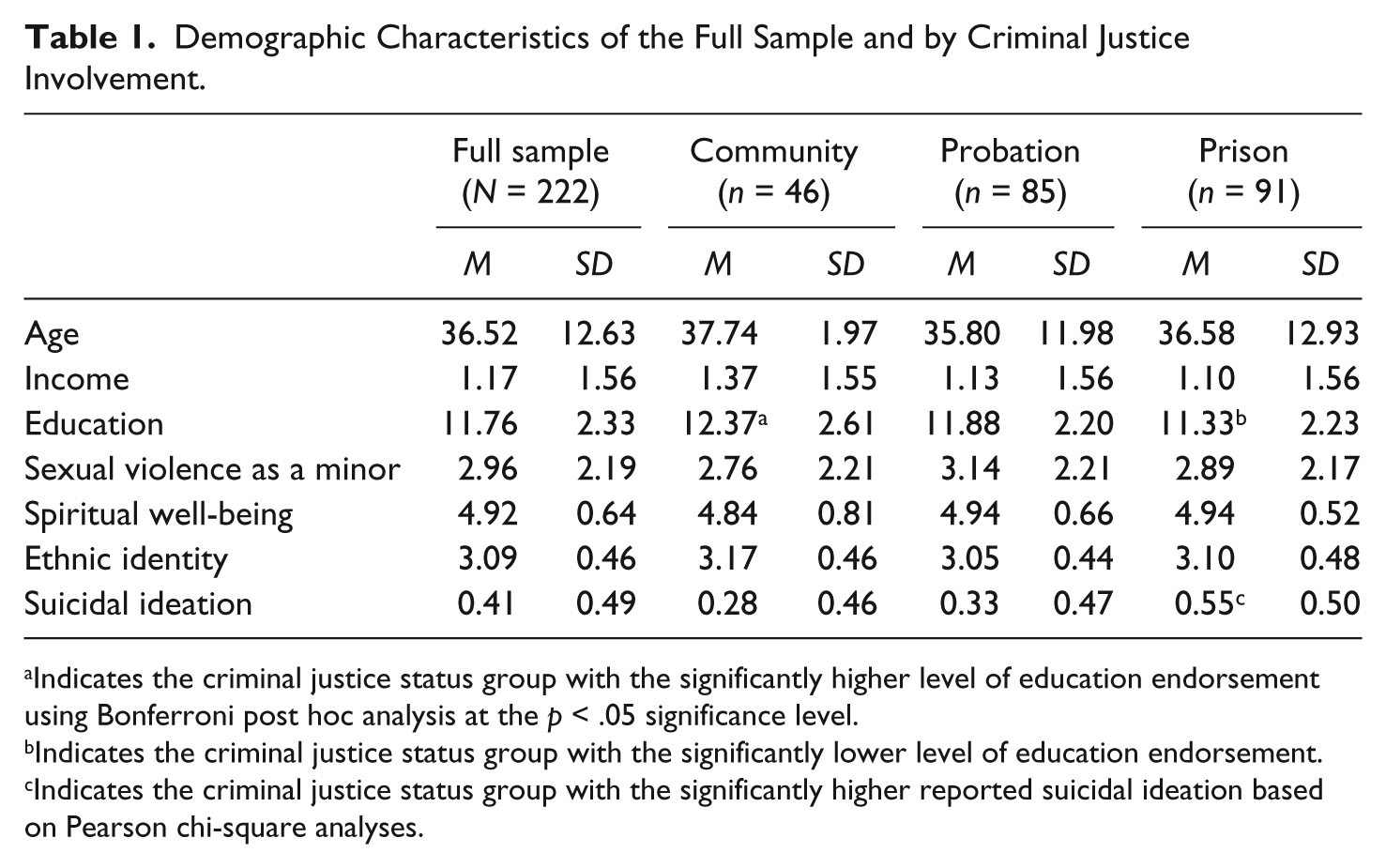
Indicates the criminal justice status group with the significantly higher level of education endorsement using Bonferroni post hoc analysis at the p < .05 significance level.
Indicates the criminal justice status group with the significantly lower level of education endorsement.
Indicates the criminal justice status group with the significantly higher reported suicidal ideation based on Pearson chi-square analyses.
As displayed in Table 2, a series of intercorrelations were computed to examine bivariate relationships between the variables. Income was positively associated with education (r = .41, p < .01) and spiritual well-being (r = .17, p < .05). Education was positively associated with spiritual well-being (r = .18, p < .05) and ethnic identity (r = .22, p < .01) and negatively associated with suicidal ideation (r = −.19, p < .01). Spiritual well-being was positively associated with ethnic identity (r = .26, p < .01) and negatively associated with suicidal ideation (r = −.24, p < .01). Finally, the frequency of sexual violence as a minor was positively correlated with suicidal ideation (r = .15, p < .05).
Bivariate Correlations Among Study Variables.

p < .05. **p < .01.
Regression Analyses
Table 3 presents results from logistic regression models examining the effects of sociodemographic variables, criminal justice status, drug use, sexual violence as a minor frequency, spiritual well-being, and ethnic identity on suicidal ideation. The first model indicated that higher reported educational achievement was associated with lower reports of suicidal ideation (odds ratio [OR] = 0.86, p < .05), and that the participants in prison were significantly more likely to report suicidal ideation (OR = 2.50, p < .05) than the other criminal justice status groups. For the second model, the more counts of sexual violence as a minor the participants experienced, the more likely they were to report suicidal ideation (OR = 1.14, p < .05). The third model indicated that those with a high level of spiritual well-being were less likely to report suicidal ideation (OR = 0.46 p < .01) and that the main effect of ethnic identity was not significant. The final model included the interaction of spiritual well-being and ethnic identity, and the interaction term was found to be significant (OR = 0.33, p < .05). Changes in the predicted probability of suicidal ideation as a function of ethnic identity by low, medium, and high spiritual well-being are presented in Figure 1. Generally, those with high and moderate spiritual well-being and high ethnic identity were less likely to report suicidal ideation. However, those with low spiritual well-being along with a high ethnic identity were significantly more likely to report suicidal ideation. In addition, it is important to recognize that being incarcerated continued to have a significant relationship with suicidal ideation in all four models.
Logistic Regression Models for Suicidal Ideation in African American Women With a History of Sexual Violence as a Minor (N = 222).
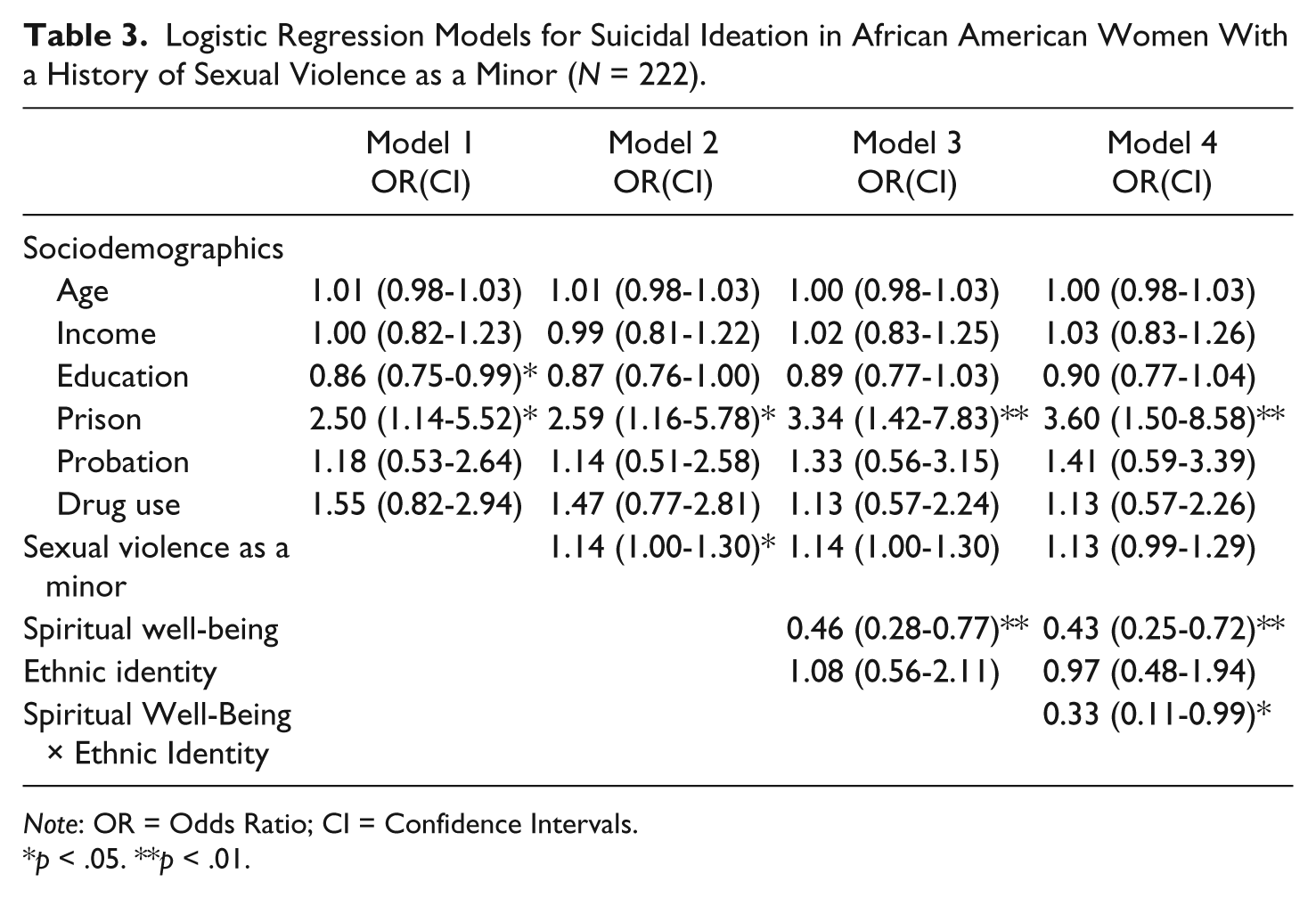
Note: OR = Odds Ratio; CI = Confidence Intervals.
p < .05. **p < .01.

Suicidal ideation as a function of ethnic identity by low, moderate, and high SWB.
Discussion
The current investigation sought to determine the impact of criminal justice involvement, ethnic identity, and spiritual well-being on suicidal ideation in African American women who have experienced sexual violence as a minor. The findings indicate that criminal justice involvement is significantly related to suicidal ideation; specifically, those in the prison sample were more likely to report suicidal ideation than nonoffenders in the community across the models. In this study, the percentage of prisoners who endorsed suicidal ideation (54.9%) was similar to a previous study finding that 53.7% of women inmates reported suicidal ideation or behavior at some point in their lives (Charles, Abram, Mcclelland, & Teplin, 2003). Researchers have suggested that this high risk of suicidal ideation may be a result of the combination of the stressful experience of being imprisoned along with the many vulnerability characteristics of this population, including multiple life stressors and various mental illnesses (Lamb & Weinberger, 2001; Sacks, 2004).
After controlling for demographic variables, the perception of having a developed and positive spiritual quality of life seems to be an important factor in understanding the probability of someone experiencing suicidal ideation, which is consistent with previous research linking spiritual well-being with positive mental health outcomes (El-Khoury et al., 2004; Potts, 1996; Watlington & Murphy, 2006; Wilson & Miles, 2001). However, ethnic identity was not found to be a protective factor against suicidal ideation, which is inconsistent with other research. Kaslow and colleagues (2004) found that compared with nonattempters, those who had attempted suicide had lower levels of ethnic identity. Although that study used a similar population, including exclusively low-income African American adults, it did not limit its investigation to women with a history of sexual violence as a minor. Two distinct possible interpretations of the current finding are important to consider. It is possible that ethnic identity may not be as important for women with a history of sexual violence as a minor as it is for the general African American population in serving as a protective factor against suicidal ideation. Another possibility is that ethnic identity may be important in predicting suicidal behavior but not suicidal ideation. Future research should incorporate the role of ethnic identity as well as related measures such as racial identity and acculturation in African Americans’ suicidal ideation and behavior.
Beyond just the main effects of spiritual well-being and ethnic identity, the interaction of these two essential parts of African American identity was found to be important in understanding those at risk of experiencing suicidal ideation. High ethnic identity seems to be protective for those with high and moderate levels of spiritual well-being, but a risk factor for those with a low level of spiritual well-being. Fiorito and Ryan (1998) found that individuals scoring high on spirituality and ethnic identity are more likely to hold a collectivist worldview, which could be protective. However, what remains to be discovered is how the interaction of low spiritual well-being and high ethnic identity promotes a higher risk of suicidal ideation in this group. Ethnic identity may serve as a protective factor only if a person has a relatively developed sense of spirituality. Jang, Borenstein, Chiriboga, Phillips, and Mortimer (2006) found that the benefits of religiosity were most pronounced among African Americans who had a strong adherence to traditional African American culture. Because these variables are often positively correlated, it is possible that having low spiritual well-being with a high ethnic identity may cause internal conflict that may increase stress and negatively influence suicidal ideation. Although it is hard to make a definitive conclusion about this finding, it does suggest that in addition to studying cultural factors separately, it may be equally important to study how the interactions of these factors may have differential effects in terms of mental health outcomes. Although spirituality and ethnic identity are often considered salient components of African American culture, researchers could also investigate the interactions of additional factors such as religiosity, collectivism, gender identity, and racial identity to form a more complete picture of the role of cultural identities in suicidal ideation.
Although this study has made an important contribution to the literature, the study’s findings need to be considered in light of a number of limitations. One limitation of this study is the cross-sectional design. Longitudinal data sets examining these constructs may provide more information about how criminal justice status, spiritual well-being, and ethnic identity could be more or less important in different stages of life or development. A second limitation is that the participants were primarily from Kentucky, which limits the generalizability of these findings to other states or regions in the nation. Regarding the measurement of sexual violence as a minor, this study did not distinguish between childhood sexual abuse and adolescent sexual assault. Senn, Carey, and Vanable (2008) noted that researchers have used different age criteria to establish whether sexual violence as a minor would be considered “abuse.” In an effort to understand whether the influence of risk and protective factors may vary by age, future research can compare or differentiate sexual violence in pre-adolescence versus adolescence.
Also, this study did not measure suicide attempts, only suicidal ideation. Without investigating suicidal behavior, it is unknown whether the significant variables in this study would also be significantly related to suicidal behavior. Also, suicidal ideation was only measured with one item in this study. In an effort to better capture the complex nature of suicidal ideation, future research should include multi-item instruments with strong psychometrics (e.g., Adult Suicidal Ideation Questionnaire; Reynolds, 1991). Finally, information was only collected about the presence of suicidal ideation along with the frequency of abuse and not on the age the abuse occurred, the perpetrator’s relationship to the abused person, ethnicity of the perpetrator, the number of perpetrators, the severity of the abuse, or the time of the suicidal ideation. These contextual factors of abuse have been found to affect psychological outcomes (Anderson et al., 2002), so they would be important to investigate in the future, especially with variables such as spirituality and ethnic identity, which could have different impacts depending on the characteristics of the perpetrator (e.g., family member, clergy person, ethnicity of the perpetrator).
Despite these limitations, there are several strengths of the present study. It extended prior research by investigating the effect of a specific type of trauma in suicidal ideation in African American women across criminal justice statuses. In addition, this study examined potential risk and protective factors in African American women with a history of sexual violence as a minor specifically. Finally, this study adds significantly to the small body of literature examining the importance of salient cultural factors (i.e., spiritual well-being and ethnic identity) in suicidal ideation of African American women. This approach yielded a more in-depth understanding of suicidal ideation in African American women that would not be uncovered with traditional between ethnic/racial group research study designs. Future research that examines the role of ethnic identity, spirituality, and other cultural factors along with the interplay of these variables may provide greater understanding of mental health outcomes in African American women with a history of trauma.
The counseling implications of these findings highlight the importance of multicultural competence training for mental health professionals. First, it is imperative for mental health professionals, both within and independent of the criminal justice system, to appropriately assess for cultural factors that may promote mental health for their clients. Understanding these cultural factors will allow for the therapeutic process to be more culturally specific in addressing the consequences of trauma. In addition, although there has been increased attention to the idea of cultural competence (Betancourt, Green, Carrillo, & Ananeh-Firempong, 2003), we must go beyond just understanding people’s various identities (gender, ethnic identification, spirituality) as separate entities. The results of this study suggest that we must also recognize the role of intersectionality of culturally relevant identities and how they may influence mental health outcomes in African American women. Attending to the full complexity of these identities in African American women is needed to improve the quality of mental health care and trauma recovery.
Footnotes
Declaration of Conflicting Interests
The author(s) declared no potential conflicts of interest with respect to the research, authorship, and/or publication of this article.
Funding
The author(s) disclosed receipt of the following financial support for the research, authorship, and/or publication of this article: This research is funded by the National Institute on Drug Abuse (R01-DA022967, PI: Oser; K02-DA35116, PI: Oser).