




Abstract
A rapidly expanding natural-resource extraction industry and a growing military presence mean an increasingly male-skewed population for the city of Darwin, Australia. This has sparked concerns about the potential for increased violence against women. In this article, we present qualitative research detailing the views of 13 participants from 10 women’s support services in the Darwin area. We argue that women’s support services bear witness to and are tasked with responding to the impacts of population change on women, yet their work is undermined by uncertainties that stem from neoliberal funding rationales and limited demands on companies to address social issues.
Introduction
In Australia, women’s support services typically provide important assistance to women and children experiencing domestic violence (DV) and/or sexual assault. Services include emergency accommodation, legal assistance, health care, and counseling. While the exact number of such services is difficult to determine in Australia, Wesnet, a national women’s services peak body, has almost 400 member organizations (Wesnet, 2014). In regional Australia, these services are particularly important as research indicates that women in rural and remote settings often face social and geographic barriers to accessing help and leaving violent situations (Eastman, Bunch, Williams, & Carawan, 2007; Wendt, 2009). In addition, in the rural towns on the frontline of Australia’s mining boom and defensive efforts, the rapid influx of highly paid, temporary, and overwhelmingly male workforces is prompting significant demographic, economic, and social changes. This article considers the ability of women’s support services to respond to and prepare for communities that host military and mining investments in one such town.
The profound embrace of neoliberal doctrines in political and economic governance in the “Western world” has reshaped the context for and work of women’s support service providers (Hasenfeld & Garrow, 2012; Ishkanian, 2014). Neoliberalism is characterized by the privileged positioning of market forces and limited government intervention in economic and social affairs, though in policy and practice it is highly amorphous (Cheshire & Lawrence, 2005; Hartman, 2005). Critics discern two factors of particular significance for social service providers in the neoliberal era. Initially, policies downsized government services and support, producing a “roll-back” and “hollowing out” of the state (Kissane, 2012; Simon-Kumar, 2011). This shift reflects the displacement of responsibility for social welfare “from state to market and from the collective to the individual” (Hasenfeld & Garrow, 2012, p. 301). More recent policies tend to be framed in the language of civic participation and emphasize collaboration between government, the private sector, and civil society. These policies find expression in contractual delivery of social services by a range of community, non-profit, for-profit, and state organizations (Hartman, 2005; Jupp, 2014; Simon-Kumar, 2011). Contracts for social services at once support and restrict the work of women’s services. Reliance on and competition for state funding can restrict the traditional activist and advocacy roles of non-profit and community organizations on behalf of disenfranchised and marginalized groups (Hartman, 2005; Hasenfeld & Garrow, 2012; Ishkanian, 2014). Furthermore, contracting social support work leads to the reconfiguration of how this work is conceptualized, shifting the focus from social justice values to efficiency and reframing service users (such as victims of violence) as customers rather than citizens with social rights (Hasenfeld & Garrow, 2012).
Second, feminist critiques of the neoliberal era identify a pervasive “de-gendering” of policy premised on an ethic of (gender-neutral) individual empowerment and responsibility (Berns, 2001; Mayes & Pini, 2010; Simon-Kumar, 2011). Women as subjects of political concern and investment receive ambivalent treatment in policy discourse. While policies and public–private partnerships frequently emphasize women’s roles in communities (Jupp, 2014), women’s interests as a group are “subsumed, eclipsed, and conflated with other social outcomes” (Simon-Kumar, 2011, p. 457). For women’s service providers, such mainstreaming means that advocacy for the rights of women or women’s issues holds little resonance in government policies and funding models.
In this article, we consider the perspectives of members of women’s support service providers in Darwin, in the Northern Territory (NT) of Australia. Specifically, we explore their ability to prepare for and respond to rapid population change driven by political and economic reliance on mining and military investments. These two industries, and their impacts on women, warrant close attention because of their economic importance to host towns and their historically close association with masculinities that emphasize patriarchal roles, toughness, and aggression (Greig, 2009; Hale, 2012; Mayes & Pini, 2010; Roberts, 2012; Saunders & Easteal, 2013). We argue that women’s support services bear witness to and are tasked with responding to the impacts of population change on women, yet their work is undermined by uncertainties that stem from neoliberal funding rationales and limited demands on companies to address social issues. This produces a context where present and anticipated women’s issues receive little attention, and generates a hostile climate for, and an increased burden on, women’s support services. This article, therefore, draws attention to not only the impacts mining and military organizations can have on women but also the challenges that support services face in terms of preparing for these impacts.
The article commences with a review of the literature related to the organizational cultures and social impacts of the mining industry and military, followed by an overview of the Darwin context. The support services available in Darwin and the methods used in this research are then described followed by the findings from the research. While we have focused on one Australian location in this study, the subject has broader importance as oil and gas “booms” create similar demographic changes in North America and Canada (Archbold, Dahle, & Jordan, 2014).
Mining, Military, and Masculinities in the Neoliberal Era
The presence of the mining industry and military typically has a significant effect on local and national economies. In Australia, mining contributed more than Aus$120 billion to the economy in 2010 and has driven increases in GDP since the early 2000s (Australian Bureau of Statistics [ABS], 2012c). Military spending, too, has increased alongside the GDP, and is budgeted at Aus$25.4 billion for 2013-2014 (Australian Parliament, 2013). For states and territories, these industries are important; in the NT, mining has contributed more than 20% of state production since 2006 (ABS, 2012c), and defense spending in the territory was estimated at 7% of state production (Aus$1.42 billion) in 2012-2013 (Northern Territory Government Department of Treasury and Finance, n.d.). The economic promise and importance of mining and military to rural locations often yield political and economic support from governments, and a growing body of work identifies a range of social, economic, and cultural impacts of these industries in regional Australia that require attention (e.g., Carrington & Pereira, 2011; McIntosh, 2012). In this article, we are particularly interested in the gendered impacts of mining and military presences.
In the context of “de-gendered” approaches to policy and social well-being under neoliberal governments, impacts on women can be obscured by narratives that celebrate the economic benefits and opportunities for the population as a whole. Yet, there is good reason to consider the impacts of these industries specifically on women. First, there is a significant male bias in the mining industry and the military workforces. In 2011, women made up just 15.9% of the Australian Defence Force (ADF) and 17% of mining industry employees in Australia (ABS, 2012b, 2012c, 2013). Male-biased populations can affect women’s experiences of danger and isolation (Taylor & Carson, 2014). This bias is significant because violence against women, in all forms, is more likely to be perpetrated by men. As Flood and Pease (2009) explain,
In general, men are more likely than women to agree with myths and beliefs supportive of violence against women, perceive a narrower range of behaviours as violent, blame and show less empathy for the victim, minimize the harms associated with physical and sexual assault, and see behaviours constituting violence against women as less serious, inappropriate, or damaging. (p. 129)
Furthermore, most mining and military projects are located in rural or remote areas where women face additional obstacles seeking support or leaving violent relationships. These include geographic isolation, social stigma, financial dependency, and limited public services and facilities (Eastman et al., 2007; Sharma, 2010; Wendt, 2009). The following literature explores the organizational cultures of mining and military industries and the social impacts of these industries to demonstrate the need to consider the impacts specifically on women and women’s support services, where regional economic development is driven by investments in mining and the military.
Mining
The social impacts of mining in Australia are increasingly dispersed. Fly-in-fly-out (FIFO) and drive-in-drive-out (DIDO) arrangements, where individual workers commute to mine sites, work for a rostered number of days, then return home for a number of days, now dominate mining work in Australia (Reeson, Measham, & Hosking, 2012). These arrangements embrace the “notion of the disembodied worker, who fills the job and performs any work at any time and any place” for immediate economic benefits (Bryant & Jaworski, 2011, p. 1358). This model not only privileges the notion of individual choice and flexibility, but it also precludes job security and unionization (Carrington & Pereira, 2011). Furthermore, through constant movements and absences, FIFO and DIDO work forges a disconnect between work and miners’ personal and social lives and identities, and between miners and the locales in which they work (Carrington & Pereira, 2011). This dislocation of workers from social contexts and issues is a powerful means of circumventing serious discussion and consideration of the social impacts of mining in both home and host communities.
The organizational culture of the mining industry, and the forms of masculinity it promotes, have also received research attention. In mining company towns, gender roles and locations have long been clearly demarcated; as Bell and York (2010) note, “Integral to maximizing profits was reinforcing the traditional gender ideology regarding the ‘appropriate’ roles for men and women in society, that is, men as the breadwinners and women as the caretakers of the home” (p. 120). Notably, FIFO arrangements preserve these roles, even as the locations of work and home have changed. This gender ideology conflates “male” and “miner,” and further equates working-class masculinity with strength and a willingness to work in harsh and dangerous conditions (Bell & York, 2010; Mayes & Pini, 2010). Mining has become a site of ingrained patriarchal masculinity and a work environment where men consistently outnumber and out-earn women, and where verbal and sexual harassment of women is common (Carrington, Hogg, McIntosh, & Scott, 2012; Collis, 1999; Saunders & Easteal, 2013; Sharma, 2010).
Research considering the social impacts of mining and FIFO arrangements seldom focuses solely on the impacts on women, yet there are some relevant studies to draw on (Carrington & Pereira, 2011; Ennis & Finlayson, 2014; Freudenburg, 1981; Reeson et al., 2012; Sharma, 2010). In host communities, mining investments often trigger rapid and profound economic and population changes. The arrival of new, highly paid migrants alongside external investor activity drives dramatic rises in housing prices and the cost of living (Hajkowicz, Heyenga, & Moffat, 2011). For residents not employed in the mining industry, particularly those on low wages, housing scarcity and high living costs increase the risk of homelessness, overcrowding, and out-migration (Haslam-McKenzie, Phillips, Rowley, Brereton, & Birdsall-Jones, 2009; Ivanova, Lockie, Miles, & Rolfe, 2007), and pose a significant barrier for women seeking to leave violent situations (Tutty, Ogden, Giurgiu, & Weaver-Dunlop, 2013).
In addition, in host communities the combination of “frontier” or “rural” cultures and rapid in-migration of male-dominated energy-extraction workforces means that towns can quickly become dominated by competing masculine cultures (Carrington, McIntosh, & Scott, 2010; Ennis & Finlayson, 2014; Sharma, 2010; Sharma & Rees, 2007). Company-provided worker accommodation in work camps or villages is usually male dominated, out of town, and close to the work facility, and interactions between residents and FIFOs are often limited to bars and clubs (Carrington et al., 2010). Furthermore, a link between an influx of mine workers and increasing numbers of sex workers operating in or near mining communities has been reported in numerous studies (Carrington et al., 2012; Scott, MacPhail, & Minichiello, 2012). The presence of increased numbers of sex workers can create tensions as residents feel their community is being “taken over” by outsiders engaging in dangerous, illegal, or immoral activities (Scott, 2013). A demand for commercial sex may also result in the illegal sex trafficking of women and girls. In Australia, there are no comprehensive data on the scale of sex trafficking (Flynn, Alston, & Mason, 2014); however, in the United States and Canada, there are reports of sex trafficking of women and girls in oil and gas boomtowns (Ernst, 2014; Horwitz, 2014). The victims of sextrafficking are extremely vulnerable because of their illegal hidden status.
Community perceptions of FIFO workers as “outsiders” who earn large sums of money, play hard, and engage in high-risk, illegal, violent behavior, all with little connection to, or sense of responsibility toward, their host communities are widely reported (Haslam-McKenzie et al., 2009; Scott, 2013). This can also have implications for residents’ general sense of safety, especially among women (Lawrie, Tonts, & Plummer, 2011).
In home communities, there are different but related issues. Families of FIFO workers face a range of relationship pressures associated with the prolonged absence of one partner. This results in the other partner taking on a disproportionate share of domestic and caring roles for extended periods. When the FIFO partners return, it is often women who are left to deal with the negative, sometimes violent, effects of excessive alcohol and drug use, which some have attributed to the FIFO’s sense of isolation and disconnection from their home families and communities (Carrington et al., 2010; Parkins & Angell, 2011; Sharma, 2010).
In some cases, “host” and “home” converge as miners, and their families move to towns near mineral resources in Australia. Research suggests that many risk factors for DV remain, as traditional, de-valued roles of women are often supported in both mining towns and rural communities (Collis, 1999; Sharma & Rees, 2007). In the Bowen Basin, Queensland, Lockie (2011) found no increased incidence of (self-reported) DV when compared with the rest of the population, yet the presence of risk factors such as drug abuse, family financial arrangements, age, and education was consistent with the general population experiencing DV. The geographic isolation of many energy communities means that the women who live there may be removed from their support networks, which can further add to their vulnerability in terms of DV (Sharma, 2010).
The mining industry, therefore, is dominated by an organizational culture that demands flexibility from its workers, and values a form of masculinity characterized by toughness. The shift to a FIFO workforce has had significant impacts on both host and home communities, and there are specific effects on women in both home and public spheres. Therefore, in regional Australia where mining is particularly prominent, the ability of women’s support services to meet and prepare for the impacts of mining projects is an important topic.
Military
The military’s organizational culture and its demands on personnel also have significant impacts on women. Patterns of deployment and training demand frequent relocations and extended absences and, like FIFO arrangements in mining, rely on women’s unpaid domestic labor to maintain these practices and reinforce men’s role as family breadwinner (Hosek & Wadsworth, 2013). As in mining, separations and returns can be problematic both at home and during deployment (Andres, 2014), and DV has been identified as a serious issue within the U.S. military (Kanuha, Erwin, & Pence, 2004).
Military culture, itself, has also been an important research focus. Hale (2012) notes that military culture typically associates masculinity with aggression and toughness, whereas Flood and Pease (2009) found military institutions to have an overtly masculine culture “in which violence-supportive norms, and violence against women, are particularly intense” (p. 133). Efforts to address these norms and violence against women in the military have been frustrated by a lack of political will to change (Archer, 2013). Yet, sexual assault within the military organizations of both Australia and the United States remains problematic (Saunders & Easteal, 2013; Turchik & Wilson, 2010). In locations such as Okinawa, South Korea, and the Philippines, long-term, significant U.S. military presences have been accompanied by sexual abuse of local women (Akibayashi, 2010; Fukushima & Kirk, 2013; Gerson, 2007; Hoshino & Kirk, 2013; Takazato, 1999, 2000). In Australia, there are multiple public narratives about relationships with the U.S. Marines. For some, they are community-minded “heros” (Crawford, 2012; Turner, 2012), but for others, their image is soiled by multiple reports of rape, indecent assault, and other acts of brutality in various Australian locations (Seeney & Mortison, 2005; Toohey, 2001).
In summary, the significant male gender bias in tandem with the modes of masculinity and the working conditions promoted and demanded in mining and military organizations suggest that careful consideration of women’s safety is required in locations with significant mining and military presences. Although studies of the social impacts of mining and military cultures have contributed to our understanding, there remains little research on the specific impacts on women. Women’s support service providers are witnesses to both the social costs of mining and military developments and the challenges of advocating for and supporting women experiencing violence in a context where neoliberal and masculine values dominate the political and economic landscape. The current study considers the perspectives of women’s support service workers in Darwin, where demographic and social changes due to an expanding liquid natural gas (LNG) industry and an increasing Australian and American military presence are currently occurring.
Darwin
Darwin is a tropical city located on the far north coast of Australia’s NT. The area was colonized in 1869, and the city has been destroyed and rebuilt multiple times—most notably after World War II (WW2) bombing, and again after a cyclone in 1974. Darwin’s identity as a “frontier” town and exotic, remote outpost references its comparatively short history (Carment, 1996). Indeed, the NT only gained self-government from the Federal government in 1978. The current population of Darwin is 127,500, of which Indigenous people make up approximately 9%, and approximately 27% of the population were born outside Australia (ABS, 2011).
As with many other remote “frontier” locations, there is a strong drinking culture, with Darwin having one of the highest rates of alcohol consumption in the world (Whetton, Hancock, Chandler, Stephens, & Karmel, 2009). Violent crime rates are also high; the NT average is twice that of other Australian states and territories (ABS, 2012a). The data available for Darwin do not use gender as a variable, so it is difficult to demonstrate the gendered nature of violence. However, Tables 1 and 2 provide an indication of the impact of violence on women. Between June 2013-2014, 39.8% of all non-sexual assaults were associated with DV, and assaults associated with DV increased 23.1% in the same year. The strong link between alcohol and violence is also noteworthy.
Annual Assaults in Darwin, NT.

Source. Northern Territory Government Department of the Attorney-General and Justice (2013), Northern Territory Police Force (2014).
Note. NT = Northern Territory.
Annual Sexual Assaults/Related Offenses in Darwin, NT.
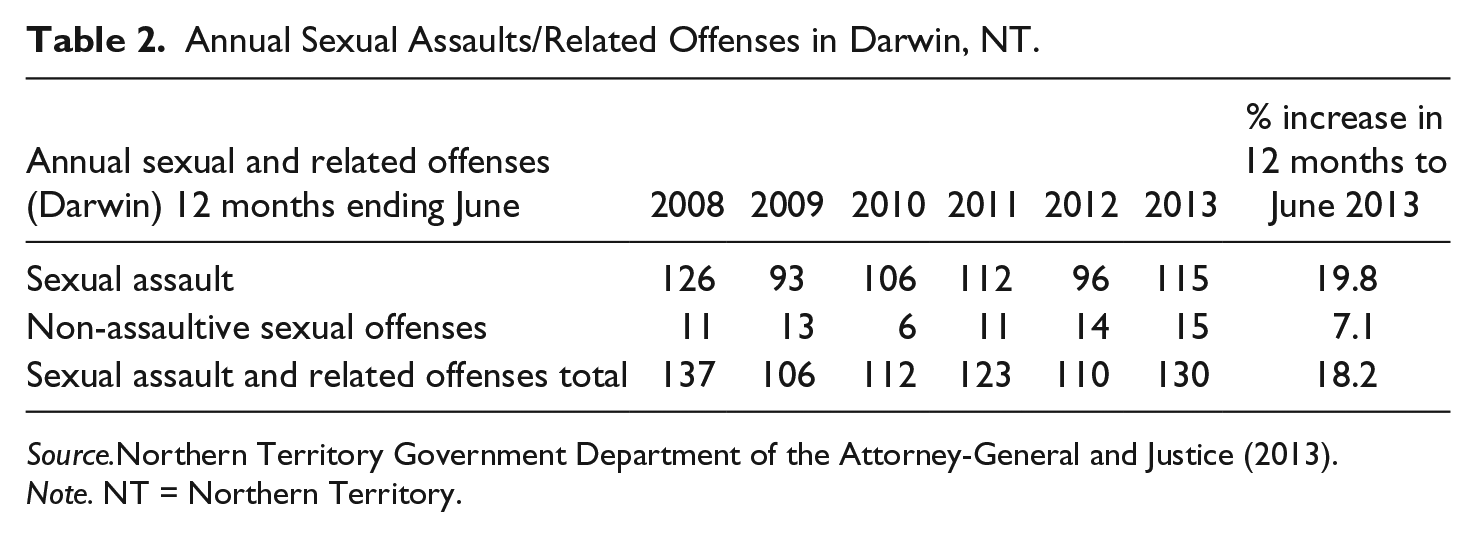
Note. NT = Northern Territory.
Darwin’s economic development, from its inception, has been premised on its strategic location. The city is closer to Dili, East Timor, than to other major cities in Australia, and this proximity to South East Asia has variously made Darwin a frontline where Australia is defended from external threats and an ideal site for trade with northern neighbors. Although treated as a “symbol of the development potential of ‘the north,’” Darwin’s economic development has often been problematic and dependent on attracting external investments from government and international corporations (Carson, Schmallegger, & Harwood, 2010, p. 294). The Northern Territory Government’s (NTG) “open for business” philosophy centers on developing the Darwin area into an international gas hub, and the city has recently become known as a “boomtown” (Winter & Taylor, 2012). International oil and gas company, ConocoPhillips, began constructing a gas plant in 2003 and has been processing LNG in Darwin since 2006 (ConocoPhillips, 2014). With this development came the first influx of LNG construction workers, pushing up housing costs and signaling Darwin as a property investment and business opportunity hot spot (Ennis, Finlayson, & Speering, 2013).
In 2012, LNG company, Inpex, began construction of a gas processing plant as part of the “Icthys” project. The construction phase of the Icthys project will take approximately 5 years and employ at least 3,500 people (Inpex, 2013). This figure does not include the many subcontractors and service industries associated with the project. The majority of workers will be employed on a FIFO basis, and most will be accommodated in a large workers’ village close to the construction site. This resources boom is celebrated in Government and media rhetoric as a promising economic opportunity for the NT.
Darwin is also a highly militarized town. It has hosted ADF personnel since the 1930s. Currently, it is a temporary home to 6,815 ADF personnel (Army, Navy, and Air force) and sometimes their families (Northern Territory Government Department of Business, 2012). U.S. Marines have also begun regular training rotations in the Darwin area as part of an international defense training agreement. While current rotations involve 1,100 marines, this will expand to 2,500 by 2017 (Australian Associated Press Bulletin, 2012), and there is excitement about the political and economic opportunities that are assumed to come with hosting such large numbers of marines in Darwin (Vanovac, 2013).
We have, then, an interesting situation in Darwin where economic development is driven by mining and the military. This has already produced some profound social and economic shifts in Darwin, as Lea (2014) observes,
New Darwin represents the bonanza and cataclysm that is the dazzling Inpex/military build-up. Whole buildings in the many new high-rise complexes in and around the old peninsula are filled with strangers, non-resident workers the fastest-growing demographic. . . . Darwin offers work, but not the hope of a home, the toll price for living in a boomtown. It has become a prosperous, unequal city. (p. 224)
Furthermore, the thousands of men employed in mining, the ADF, and the U.S. Marines are added to an already male-dominated population (ABS, 2011). The ratio of males to females is likely to become further skewed as a result (Taylor & Winter, 2012), with the construction phase of the Inpex project alone being likely to significantly affect the sex ratio in Darwin’s population (Taylor & Carson, 2014).
Concerns have been raised in Darwin about a lack of commitment to address entrenched attitudes in military institutions, in particular the U.S. Marines (Welch, 2012). In a report assessing the potential impacts of an increased presence of U.S. military in Darwin, the risk of “incidents of sexual assault due to USMC presence” was found to be “moderate,” and a “number of controls” used to mitigate this risk, including predeployment training and strict behavioral rules, were recommended (Noetic Solutions, 2012, p. 21). A social impact assessment following the first deployment of 1,100 U.S. Marines estimated a risk of somewhere between “a one in eight” and “a one in 20” chance that “a rotation of 1,100 US Marines for six months could lead to any case of sexual assault” (Deloitte, 2013, p. 34). The report also points out that the risk of sexual assault against a woman from a “local” NT male is much higher than this (Deloitte, 2013, p. 33). Such blasé assessments seem dismissive of evidence from U.S. military base locations across the globe and damaging reports of rape and violence by U.S. Marines during previous visits to Australian shores (Toohey, 2001).
Governmental commitments, both Territorial and Federal, to LNG mining, the Defence force, and the U.S. military suggest that these sectors will drive Darwin’s economic development for some years. In this context, we were keen to understand the impacts of these industries on women’s support services, and the ability of these services to respond to and plan for Darwin’s changing population.
Method
To answer these questions, we undertook a qualitative study, involving interviews with 10 non-government organizations whose focus was on providing assistance to, or advocating for, women experiencing violence. All the services included in the study were based in Darwin. A purposive sampling method was used (Walter, 2006). An Internet search revealed 13 non-government organizations that provide violence-related support services to women. Of the 13 relevant organizations approached to participate in the study, 10 agreed to participate. Face-to-face, audio-recorded interviews were conducted with a service manager or coordinator, and in one instance, three other staff also participated. The interviews were transcribed and analyzed using an inductive thematic approach (Thomas, 2006). Each participant was sent a copy of their interview transcript, along with the draft analysis and an invitation to provide further feedback.
While all participating organizations were based in the Darwin area, a small number also provided services to other parts of the NT. The organizations offered a range of support services, including sexual assault counseling, family violence support, legal advice and representation, emergency and other accommodation services, tenancy advice, advocacy, community education, referral, and policy development. Five organizations provided women-only services, and two were specifically targeted at Indigenous people. Four of the services had a particular focus on DV. Some organizations were local branches of large national non-government organizations, others were small-scale local operations. The services were generally funded through a combination of Federal and NT government funding.
Findings
The research findings have been organized into four sections, beginning with views of the current context. We then explore what boom-related impacts are being experienced before moving on to anticipated changes. Finally, we examine the issue of women’s services’ preparedness for increased male-dominated population growth.
Contextual Issues
This study was conducted between August and November 2013. At that time, changes and cuts in funding to community services that occurred after a shift to conservative, right-wing governments at both the NT and Federal levels were being felt across the community sector. The picture presented in the interviews is of a city already experiencing entrenched social issues, growing economic inequality, and increased demand for support services.
Participants noted that popular understandings of “Territory culture” and “Territory lifestyle” embrace masculine interests and celebrate excessive drinking, risk taking, and activities such as fishing, hunting, and watching sports. As one participant stated, “There’s always been a sense that Darwin is a frontier town and an all-male town” (2). Some participants pointed out that this masculine drinking culture is entrenched, supported, and encouraged from the top down. More than one participant noted that the Chief Minister of the NT publically espoused drinking beer as a key aspect of “Territory culture”:
We are drowning in rivers of grog, we are drowning in dysfunction, not only in the Aboriginal society, across the board and the whole thing is Mickey Mouse, the whole operation. If people could just get off the grog a bit, including the Chief Minister and all of his,[pauses] . . . I think what we are looking up to is wrong, it is skewed. (3)
As a consequence, participants observed differences in socially accepted behavior in Darwin and in other parts of Australia:
Darwin has always been a place that’s got a high proportion of men and a higher proportion of what I consider to be badly behaving men. I mean, I was really shocked when I came here as a young woman in my early 20s. Things that were considered acceptable public behavior by men here was just not the norm in southern states [of Australia]. (7)
Darwin has also long been characterized by high living and housing costs, and recent years have seen steep increases. Participants reported that financial stress has led to or exacerbated relationship problems resulting in violence and family breakdown. Services have also noticed a growing group of people who are in situations where their wage no longer covers their living costs.
I am talking about people who are in-between, they are in that gap area, and I think people don’t realize that a $35,000, $40,000 income is not going to cut it in the NT if you are a sole person. It doesn’t work and I think wages have to reflect that you are living in a place that has got a high cost of living. (9)
Furthermore, the lack of public and affordable housing, combined with very low rental vacancy rates, contributes to a very expensive private rental market. All participants stressed the negative impacts of this on vulnerable populations, especially women in vulnerable populations. A lack of housing options has forced some on low or middle incomes into less than ideal sharing arrangements. Participants pointed out that this has placed many women and children in unsafe situations.
You don’t know who you are inviting into your home and whether they are friends of friends and stuff. I don’t know, I think it forces people to do a lot of shared housing around here, as it is the only affordable way. It is not the ideal scenario. (9)
Assisting people to access safe and affordable housing was a challenge confronting almost every service in this study. Five- to 7-year wait-lists for public housing and lack of other housing options were pointed out by many participants. This issue was particularly difficult for services working with Aboriginal people, and these participants reported that they faced issues of discrimination and racism in addition to economic difficulties.
I mean, we are struggling to get them [clients] into housing commission [public housing], so the likelihood of them getting into an actual private residence is just out of the question. So a lot of our mob [Indigenous clients] can’t even access private rental properties because of the huge cost. And as soon as people saw it in the paper, that Inpex was coming, I mean real estate just went ridiculous. (3)
Participants assisting women with emergency and short-term accommodation discussed how a lack of housing options put women at risk of homelessness or relocation to other places. The desire to stay in the Darwin area meant that many women were forced into making choices that are not ideal and sometimes dangerous:
I’ve heard of families living in a car or a tent at a caravan park site . . . I’m sure if I know of a few, that means that there’s many more. (5)
Participants made it clear that women experiencing DV require safe, affordable housing when they leave the abusive relationship. Access to such housing was considered to be inextricably linked to women’s ability to make a decision to leave and to start a new life. Interviewees reported that in the context of Darwin’s current housing shortages, women in these situations were now facing a choice of staying in an abusive situation or risking homelessness.
Importantly, all participants reported that they had long been under pressure to provide more services, to more clients, with fewer resources, and that this pressure was increasing. The recent change in NT government had resulted in funding cuts for most community services, resulting in staff and service cutbacks and restrictions.
We’re currently, especially women’s services, I think we’re overworked, we’ve had a lot of changes in government and people have had funding slashed. (6)
In sum, participants described Darwin as a city with a highly masculine local culture, where financial stress and accommodation problems are increasing, and where women’s support services themselves are struggling.
Observed Impacts of “Booming”
Most participants reported that they had not yet noted any changes in their work or had just begun to notice changes. The interviews took place in late 2013; at that stage, only a few hundred U.S. Marines had arrived, and the new LNG project worker village was still under construction. What participants did point out, though, were issues that could be indicators of how the mining and military developments may affect women in Darwin.
First, participants discussed the gendered nature of economic benefits flowing from the “boom.” Many noted that there were far fewer employment and training opportunities for women, compared with men, in the energy and defense industries. One service had supported women who had moved to Darwin specifically for boom (mining)-related employment, and reported that despite attending industry-related training, these women remain unemployed. Another participant discussed a particular company’s recruitment drives, pointing out that they all but excluded women:
One company has been out here sort of regularly. Every three to six months they have training information, you know—who wants to do training rah, rah, rah. It is never directed at women, there are no places for women, there has never been a woman training. It’s only for men. (3)
There was also a sense that men were gaining the high-income positions and women were only able to access lower paid work in cleaning and administration support:
I think the real male-dominated workforce has issues for women for safety and for discrimination against women. If you look at the jobs that women are in, in these workforces, they are not the higher paid jobs, they’re the lower paid jobs generally. (4)
Notably, women who did gain employment in the boom industries were vastly outnumbered by men, and this had implications for their sense of safety and their ability to express concerns about workplace discrimination in a highly masculine environment:
The experience that we have had of women working in these industries, it’s not a great place to work for women because it is very male dominated. There are reports of sexual harassment and discrimination, and I’m thinking particularly about mining sites. (2)
Second, negative impacts on individuals, families, and relationships due to the organizational demands on employees in mining and defense have been observed by service providers. Participants noted relationship stress linked to shift work or periodic and long absences due to FIFO arrangements, and that both partners may experience feelings of loneliness, boredom, and isolation:
It’s the fly-in, fly-out workers. It’s very difficult for men and women, I think, to manage family and work when that’s happening. I know that the stresses on families, whether it’s the mum or the dad doing the fly-in, fly-out, the stresses on families are very, very high. (4)
One service provider working with DV survivors further highlighted,
A regular part of our client group are people who are the partners of people in the mining industry, and partners of defense force personnel. I don’t have the statistics, but that’s a reasonably common kind of a client for us, either partner in mining, or partner in defense forces. (10)
Anticipated Impacts
Participants expressed their concern that growth in military and mining would lead to increases in all kinds of violence, and that this would have implications for the safety of both women and men:
From the perspective of a women’s service, I do think that the increase in military and military bases in Darwin, presents safety issues for women, and for men. (4)
Some participants were concerned about increasing numbers of LNG and related industry workers who are “cashed up,” away from home, and seeking alcohol, recreational drugs, and sex in their downtime. Participants felt that this situation posed a real threat to women, particularly homeless Indigenous women:
In the immediate term there is increased risk of sexual assault for women in a whole range of ways. I think there’s the really vulnerable population that don’t necessarily make choices but are vulnerable by the nature of who they are, like people in the long grass [sleeping rough], Aboriginal women, those kinds of populations that are so often disempowered. Then there’s certain categories like there’s sex workers that are going to be more vulnerable because that clientele is so powerful, and so almost above any repercussion if they do break the law in some ways. (1) You know, with the non-aboriginal men, because they have got the money and everything to sort of give them [homeless Aboriginal women], the women can get caught up in those relationships and then put up with a lot of the violence. (9)
The issue of excessive alcohol consumption and its contribution to violent behavior was discussed by most participants. Alcohol abuse was linked to a range of issues, such as the isolation of workers from the local community, the “us and them” tensions between locals and FIFOs, workplace and industry culture, and the local “frontier town” culture. The following comments make clear links between work-camp lifestyles, excessive alcohol consumption, and anticipated violent consequences:
You get that combination of alcohol involved in the mix with loneliness and you see that breakdown of positive mental decision making, it is probable that we will see an increase in sexual attacks on women. (8) When we put a few people in an isolated area for long periods of time and probably the only entertainment is alcohol, it is a recipe for disaster. (9) I worry that with the influx at the Inpex Village we’re just going to see a whole heap of really negative role models and what that does to further perpetuate this idea that drinking ’till you’re plastered and then behaving like a moron is acceptable behavior. (4)
Concern was also expressed for women who work in the mines:
It is not just necessarily the U.S. Military, but the mining, the influx of males in the mining industry might be an issue [in terms of increased violence]. It might also be an issue for women who work in the mines, not just women in communities generally. (9)
All participants anticipated that the prevalence and severity of existing problems would increase with the changing population. In particular, participants were concerned that housing costs would continue to escalate, and family stress would increase as a result of financial hardship and FIFO and rostered working patterns. Services dealing with the negative effects of stress on people’s lives focused on this:
Stress and DV are close friends. So it’s likely that more mining and more soldiers will mean more domestic violence and I guess a greater demand on our service. (10)
Participants expressed their concerns that increased population, without increases in community resources and services, would result in the deterioration of local services, further impeding access to services for the most vulnerable:
The issue for us is we’re already at capacity with the existing issues in Darwin. We don’t have any funding or capacity to take on more workload. We’ve already got queues of people wanting us to assist them. So, there is no capacity. (8)
The participants were also concerned that further service funding cuts would be made at the Federal government level, and their overstretched workloads would become even greater, meaning that fewer services would be available for those who needed them.
Preparing for the Future
Preparing for population changes in Darwin is complicated by uncertainty about both the changes and the services’ own funding. Participants believed that there was a lack of concrete information about the number of expected migrants to Darwin. Many stated that they had no means of direct or meaningful communication with the government or relevant companies. This was highlighted by the range of different understandings expressed by participants about resource developments and the U.S. military presence.
All participants reported that with services already being overstretched and facing continual funding uncertainty, their commitment to delivering services and responding to immediate need has taken priority over planning:
The reality in this sector is that it has been under attack for so long . . . there is not the time or the resources to look forward. I mean, everyone is basically just struggling for immediate survival. There are agencies getting their funding cut one day, then reviewed the next day, and this is happening day to day. So that’s the priority. (4)
Some participants discussed the need to make time to contribute to relevant policy development and undertake advocacy work. However, they did this work while also remaining focused on delivering “frontline” services to clients. The participants expressed frustration at a situation where they felt that there would be significant change but had no time to research or prepare for it in a meaningful way.
None of us are actually prepared for any significant growth over the next three years because we can’t even get funding from our State and Commonwealth Government just to get the basics. (3)
In a resource- and time-poor environment, the ability to fully utilize existing service delivery knowledge and data for effective lobbying, advocacy, and policy work can be lost. To capture the impacts of the trends observed in service delivery requires services to work in partnerships, to be curious, intentional, and planned in their responses, as this comment highlights:
We are very reactive because we don’t have the time or resources to be proactive. So I think when you start putting two and two together and realizing that some issues are repeating themselves with clients, and perhaps some of the reasons are because of these new developments, you know, you start talking to other services, “have you noticed this, is anything happening for you?” . . . Unless there is someone with foresight and the resources to raise it as an issue, it just doesn’t get traction until it affects service users. (4)
There is a strong collaborative approach in many parts of the community sector, and participants pointed out that a number of networks already meet around common issues such as DV and sexual assault. The one major exception to the overwhelming lack of planning and preparedness for population change was the formation of a network aimed at creating constructive dialogue about violence prevention with the U.S. Marines. A number of services involved in this research had been part of this network and had met with the U.S. Marines about developing a shared understanding of the risks to local women. The network was informed by what they had learned from other locations where there has been a U.S. military presence. The effectiveness of the network approach used to set up meetings with the U.S. Marines demonstrates the capacity of the sector to be organized and proactive, even when services are under considerable strain. Participants reported that attempts were made to conduct similar conversations with Inpex, the largest of the current LNG projects in Darwin; however, these did not progress. Participants pointed out that as far as they were aware, Inpex has not publicly released any type of social impact assessment, nor does there appear to be any government requirement that they do so. As one participant noted, the only communication they had with Inpex was one way, via the media. Consequently, updates on construction progress, rather than community engagement, characterize the communication with Inpex.
I’m seeing about the new village but I’m not seeing about their corporate social responsibility program, I’m not hearing anything about their staff welfare program. (8)
Participants believed that the only way they could be effective in their planning and preparedness around the pending changes was with access to reliable information, and support from government and the corporations. One participant believed that despite the challenges, services could be responsive and adapt to changes but they needed support to do so:
I think that the services, just from what I know, they understand exactly what it is that they’re facing now and what they may be facing into the future. They have great ideas and are quite responsive to new ideas, as well as what the issues coming up from the community are, and are well supported by a lot of people in our community. The question is just whether they’ll be supported by the government. (7)
Discussion
This study has highlighted that women’s services in Darwin already face many challenges, and that their ability to prepare for increased military and mining industry presences in the town is limited. Participants reported that services are already overstretched and underresourced in a town with an entrenched masculine, drinking culture, and harshening economic conditions. Despite the optimism often attached to the boom, participants noted that employment in both mining and military industries is overwhelmingly male dominated, and that there has been a lack of opportunities for women in the mining industry (Carrington et al., 2012; Reeson et al., 2012). Many noted concerns that population growth dominated by mining and military will add to already problematic levels of violence against women and alcohol consumption, and increased housing and financial stresses. Indeed, similar social impacts have been documented in much of the boomtown literature (Carrington & Pereira, 2011; Ennis & Finlayson, 2014; Freudenburg, 1981; Haslam-McKenzie et al., 2009; Ivanova et al., 2007; Reeson et al., 2012; Sharma, 2010). Significantly, current workload pressures and a lack of resources mean that many services do not have the capacity needed to respond to current issues or to plan. The services that participated in this study see the effects of systemic disadvantage on a daily basis, yet are thwarted by a lack of resources necessary to tackle the issues.
Furthermore, government cuts to funding across the community sector were broadly known at the time of the study; however, details about the full extent of the impacts on direct services to women were vague. For some, particularly smaller services, this created a palpable sense of fear about the future. In such contexts, the reliance on ever-diminishing government contracts can cripple services’ social justice agendas as they are forced into narrowly focused “efficient” service provision to “customers” (Hasenfeld & Garrow, 2012). Advocating on behalf of client populations, lobbying for desired policy change and much needed resources, engaging with media and the broader community in critical debate, and strengthening sector networks are all strategies for creating longer term change. Yet, as evidenced in Darwin, when services struggle with resourcing their “core business,” these change-making activities are far less likely to occur (Simon-Kumar, 2011).
In addition, there is little accessible, trustworthy information about the population changes, and communication between the service providers, government, and corporations appears poor. This is a common experience in communities undergoing resource development, and it significantly reduces the ability of services to be proactive and strategic (Ivanova et al., 2007). In Darwin, positive press releases and well-designed websites belie the lack of available information about the size, scope, and composition of the growing population and the lack of meaningful public engagement on issues of concern to women’s services. This significant information gap further restricts the ability of women’s support services to prepare for and lobby in regard to future changes in Darwin.
As discussed at the outset of this article, limited government intervention and the privileged position of the market characterize neoliberal policies (Cheshire & Lawrence, 2005; Hartman, 2005). In Darwin, while the U.S. Marines have publicly released two social impact assessments and engaged in meetings with a women’s services network in Darwin, LNG industry players have not worked with women’s support services. The absence of legislated or negotiated requirements for social impact assessments and engagement with support services is suggestive of a political climate in Darwin where being “open for business” is prioritized over scrutinizing “corporate harms” and considering gender-specific social impacts (Carrington & Pereira, 2011). The findings, therefore, suggest little reason to expect positive progress toward the collaborative, meaningful solutions required to address the issues raised in this study.
Limitations
While the findings presented here provide an understanding of the views of the services who participated, the number of organizations included in the research is relatively small (10). Three of the 13 identified non-government organizations who provide services for women who have experienced violence in Darwin did not participate; hence, we do not have the views of all women’s services in the geographic area. This study is also limited in that we did not seek to interview representatives from the range of government services (in the areas of housing, health, child and family, and emergency services). Future research would include this government sector, as their views, and service use data, would provide further understanding of the issue and the context.
Conclusion
The expansion of the highly masculinized military and mining populations in Darwin is likely to have significant impacts on women’s support services and their clients. Yet as this study demonstrates, existing pressures on services, uncertain funding, a lack of information and little communication with relevant companies and government agencies indicate that women’s services have limited ability to prepare for and respond to population changes. Despite concerns about the gendered nature of both the opportunities and impacts of the current “boom,” services reported little capacity for advocacy and activism to facilitate positive changes. In a context where neoliberal logic structures funding models and consideration of the social impacts of development, there seems to be little political will to support women’s services to respond to and plan for Darwin’s changing population.
Footnotes
Declaration of Conflicting Interests
The author(s) declared no potential conflicts of interest with respect to the research, authorship, and/or publication of this article.
Funding
The author(s) disclosed receipt of the following financial support for the research, authorship, and/or publication of this article: The author(s) received a Charles Darwin University, Engineering, Health, Science and Environment Faculty Research Grant to support the research reported in this article.