



Abstract
This study examined women’s subjective experiences with sexual coercion (SC), particularly less forceful forms, in intimate relationships. In-depth interviews with 12 university women highlighted that physical violence need not be present for SC to be harmful, as many experienced guilt, anger, sadness, and self-blame. The severity of SC and the context of women’s relationships affected their interpretations, which in turn affected the effects of SC. Many women not only held negative interpretations of their partners’ SC but also minimized and justified. Thus, the interviews were also critically analyzed for the possible influence of dominant discourses and gendered power relations.
Sexual coercion (SC) involves use of verbal or physical tactics to engage in sexual activity with a person who is unwilling. It can involve verbal pressure or manipulation, persistent pleading, arousal tactics (i.e., unwanted attempts to arouse a partner by sexually touching or removing one’s own or one’s partner’s clothing), use of intoxicants or taking advantage of an intoxicated person, and threatened or actual physical force following an initial refusal (Faulkner, Kolts, & Hicks, 2008; Hartwick, Desmarais, & Hennig, 2007; Raghavan, Cohen, & Tamborra, 2015). SC can also involve or result in any range of unwanted sexual activity from kissing to anal or vaginal penetration (Breitenbecher, 2006; Faulkner et al., 2008; Hartwick et al., 2007). Although research has used inconsistent definitions of SC, we use the term to refer to the range of tactics outlined above (including rape) and specify when we are referring specifically to verbal and physical forms. We conceptualize both verbal and physical tactics on a continuum of increasing forcefulness or exploitation: less forceful verbal or emotional tactics such as persistently pleading and threatening to break up, less forceful physical tactics such as persistently touching in attempt to sexually arouse, more forceful verbal tactics such as yelling, and more forceful physical tactics such as use of intoxicants or physical force. In this article, we focus on less physically forceful, nonassaultive acts, such as verbal pressure, arguments, and arousal tactics, but we also examine experiences of physical force, such as rape, when they also occurred within the context of less physically forceful acts. We also take a feminist stance toward SC, in which the gendered nature is emphasized and SC is viewed as reflecting and contributing to women and girls’ oppression.
SC as a Gendered Phenomenon: An Overview of Research
Prevalence Rates and Contexts of SC
Men are 1.6-2.0 times more likely than women to report committing SC, and women are 1.4-1.8 times more likely to report experiencing it (Brousseau, Hébert, & Bergeron, 2012; Struckman-Johnson, Struckman-Johnson, & Anderson, 2003). When SC is defined to include less forceful acts, such as pressure and arguments, as many as three in four women report having experienced it (Abbey, BeShears, Clinton-Sherrod, & McAuslan, 2004; Struckman-Johnson et al., 2003; Walters, Chen, & Breiding, 2013). University women are particularly likely to be sexually victimized (Kilpatrick, Resnick, Ruggiero, Conoscenti, & McCauley, 2007) and are therefore an important group in which to examine SC. Men’s use of SC has been linked with individual risk factors ranging from rape myth acceptance to alcohol use, relationship factors such as relational conflict, and societal factors such as traditional gender norms and gendered power differentials favoring men (see Tharp et al., 2012, for a review). Such factors contribute to the high prevalence rates of SC.
SC is most often perpetrated by men known to women and is especially common in intimate and longer standing relationships (Edwards et al., 2014; Jackson, Cram, & Seymour, 2000). Although men sometimes use physical force to acquire sex in established intimate relationships, psychological pressure and manipulation are more common (Abbey et al., 2004; Ramisetty-Mikler, Caetano, & McGrath, 2007). SC also often coexists with other forms of relationship violence (Goetz & Shackelford, 2009; Ramisetty-Mikler et al., 2007). Sexual precedence (i.e., a history of consensual sex between perpetrator and victim) also plays an important role. Men with sexual precedence more commonly use negative verbal SC (e.g., threats to end the relationship, verbal aggression), whereas men without sexual precedence more commonly use positive verbal SC, including attempts to make the woman feel attractive or loved, or promising further commitment, and tactics involving gaining access (e.g., taking her to an isolated setting; Livingston, Buddie, Testa, & VanZile-Tamsen, 2004).
Associated Negative Outcomes of SC
Research that has combined both physical and verbal SC has found negative effects on women, including depression, anger, social isolation, self-blame, low self-esteem, negative sexual self-perceptions, and restricted sexual decision making (Breitenbecher, 2006; Katz & Tirone, 2010; Offman & Matheson, 2004; Zweig, Barber, & Eccles, 1997). Limited research has begun to specifically examine the negative impacts of verbal and less physically forceful forms of SC alone but has found similar negative effects including physical consequences such as soreness, pregnancy, and infections, and social or psychological consequences such as anger, disgust, sadness, low self-esteem, self-blame, intrusive thoughts, depressive symptoms, social anxiety, and life disruption (Crown & Roberts, 2007; Livingston et al., 2004; Zweig et al., 1997; Zweig, Crockett, Sayer, & Vicary, 1999). Although women who experienced verbal SC only, compared with those who experienced threats or physical force, experienced fewer or less extreme negative outcomes (Byers & Glenn, 2012; Crown & Roberts, 2007), they did not differ in the extent to which they were upset at the time of the incident (Byers & Glenn, 2012). These findings highlight that physical violence need not be present for SC to be a harmful experience for women, which may be particularly true when it occurs repeatedly in intimate relationships.
Research on relationship outcomes of SC has been inconsistent. Some have found SC to be significantly associated with lower relationship and sexual satisfaction and sexual desire among women (Katz & Myhr, 2008; Shackelford & Goetz, 2004), whereas others have found no differences (Katz, Kuffel, & Brown, 2006). In Livingston et al.’s (2004) qualitative study, most women indicated that SC negatively affected their relationship with the man. For example, some felt angry, resentful, or as if they could not trust him, and some reported ending the relationship. However, 13 (of 114) women reported no consequences and three reported that their relationship improved following the incident.
Descriptions and Interpretations of SC
Some qualitative research has highlighted the normality of SC within heterosexual dating, including men’s and women’s construction of female sexuality with “gate-keeping” functionality (i.e., girls and women are responsible for controlling male sexuality) and men’s sexually coercive behavior as normal and due to physiological need, frustrated sexual energy, and miscommunication (Hird & Jackson, 2001; Romero-Sánchez & Megías, 2013). Gendered norms (e.g., women’s passivity and subordination of women’s sexual desires) and neoliberal norms (e.g., women’s personal responsibility to communicate assertively) also appear to play important roles in women’s discussions of their experiences with unwanted sex (Bay-Cheng & Eliseo-Arras, 2008; Burkett & Hamilton, 2012). Women’s adherence to these ideals may influence their view that verbal SC does not constitute a violation of sexual autonomy (Burkett & Hamilton, 2012). In their descriptions of SC, many women blamed themselves for not saying no and minimized/normalized their sexual assault or coercion by describing it as “not a big deal,” or indicating that “[things like this] just happen” (Edwards et al., 2014, p. 2537).
Context is highly influential on women’s interpretations and subjective experiences of SC. For instance, women perceived less threat and were less likely to say that they would leave or resist a sexually coercive interaction as the intimacy of the relationship was increased (Faulkner et al., 2008; VanZile-Tamsen, Testa, & Livingston, 2005). Women have also reported a number of reasons why they were less likely to label an SC experience (defined broadly as verbal and physical SC, including rape) sexual abuse or assault, including having given coerced consent, self-blame, lack of physical force, having had the ability to stop it but chose not to, having had no serious harm, or being unsure about how to label it (Harned, 2005). This is also consistent with how women interpret vignettes of scenarios that meet legal criteria for rape but are ambiguous due to the presence of rape myths, alcohol, varying degrees of eventual consent, and a known perpetrator. The presence of alcohol, misinterpreted signals (e.g., the woman kissing the man), or the woman not displaying clear nonconsent led some women to excuse the man’s behavior and blame the woman (Deming, Covan, Swan, & Billings, 2013). Some participants also labeled the scenarios common and “just the way men are,” whereas others were unsure how to label it when the rape did not involve penile penetration or when nonconsent was unclear (Deming et al., 2013). The above findings demonstrate the need for a better understanding of SC in both less forceful forms and in the context of intimate relationships. The purpose of the present study was to examine women’s subjective experiences with a male intimate partner’s SC, including emotional responses, accounts of the relational context within which it occurs, and its impact.
Method
Prescreen Questionnaires
Procedure
University women were recruited to complete an online prescreen questionnaire through two sources: (a) psychology students through the Psychology Department Participant Pool and (b) nonpsychology students by posting advertisements around campus. The study was advertised as being about women’s intimate experiences in dating relationships with men, including sexual experiences that may have been unwanted or distressing. We recruited only women whose most recent dating relationship (a) was with a man, (b) was exclusive/monogamous, (c) occurred at least partially in the past year, and (d) lasted at least 3 months. After viewing a consent form and agreeing to participate, women who met the eligibility criteria completed the background and prescreen questionnaires. The prescreen was used to identify women who had at least one experience with SC in their most recent relationship to participate in interviews. The possibility that some women eventually submitted or consented to their partners’ SC and some continued to resist, left, or their partners stopped the SC was left open.
Participants
One hundred fifty-two women completed the prescreen, and 49 (32.24%) had at least one experience with SC in their most recent past or present relationship.
Measures
A background questionnaire was developed for this study to determine age, gender, ethnicity, university information, and dating information. The prescreen questionnaire measured experience with SC using the Sexual Experiences Survey–Short Form Victimization (SES-SFV; Koss et al., 2007). The design of the SES is valuable because items are not labeled; thus, it can include respondents who do not identify with various terms about sexual victimization or who may not have defined their experiences as such. The SES uses a 4-point scale (0-3+) to measure how many times each act has occurred through different sexually coercive tactics.
Interviews
Procedure
Women who indicated any experience with SC in their most recent relationship were ranked in order of precedence to be invited to an interview based on diversity of SC experiences and ethnicity. Although the study’s focus was on less forceful forms of SC, we invited some women who had experienced physical force tactics (in addition to less forceful tactics) because these may be relevant to their experiences with less forceful SC and the relational context within which they occurred. The first 10 women were invited, followed by the next 10 after some declined. Two smaller rounds of recruitment were carried out until the sample was sufficient to acquire a wide range of SC experiences. A total of 27 women were invited and 12 were interviewed for the current analysis. All interviews were audio-recorded.
Participants
Participants were aged 18-21 (M = 19.25), and most identified as heterosexual (one’s response was unclear and another did not respond). The majority of the women identified as White/European (n = 10), and one identified as South Asian and one as Black/African/Caribbean. Participants had been with their most recent partner for between 3 months and 4 years (M = 20.08 months, SD = 13.80 months), and none had lived with him. Half of the participants were still in a relationship with their partner at the time of the interview.
Interview format
The first author conducted the individual, semistructured interviews. Four questions guided the interviews, followed by probes when necessary, including descriptions of (a) the relationship with the man, (b) an incident of SC (i.e., a time when her partner wanted her to engage in sexual activity with him when she did not want to), (c) depending on her response above, an incident of nonphysical or physical (if there was one) SC, and (d) how these incident(s) affected her and her relationship.
Theoretical and Analytical Approaches
Interviews were transcribed verbatim and coded for emergent themes. The data were analyzed primarily from a phenomenological framework, specifically, using Smith’s Interpretative Phenomenological Analysis (IPA; e.g., Smith, 2004; Smith, Jarman, & Osborn, 1999). IPA aims to explore detailed perceptions or accounts of personal lived experiences, while recognizing and emphasizing the active role of interpretation by both participant and researcher in making sense of those personal accounts. It aims to say something in detail about the experiences of a particular group rather than to make general claims. Thus, our results are not considered generalizable outside this group of women. Universal claims will be possible only after further research with university women and more diverse samples.
The analysis began with an empathic phenomenological approach whereby women’s lived experiences were given central focus and their words were taken to reflect that experience, but later introduced “moments of suspicion” (Langdridge, 2007) whereby interpretation of that experience through language was used to explore “how experience is created and shaped by different sets of power relations within the text” (Sullivan, 2012, p. 11). In following with IPA, the critical analysis came after the empathic reading of the text. As such, it was largely incorporated into the discussion section, allowing the analysis section to remain closely grounded in participants’ words. Combining these two levels of interpretation allowed us to simultaneously capture the embodied, phenomenological meaning of the text and hidden meaning through the use of language, including the reproduction of oppressive discourses and ways in which experience is constrained by gendered power relations. Thus, we examined language for both content and function to fill gaps in using either level of interpretation on its own. Although there are limitations to combining two approaches (i.e., conflicting epistemologies), we believe it opens possibilities for new and more nuanced understandings of women’s experiences with SC.
Results
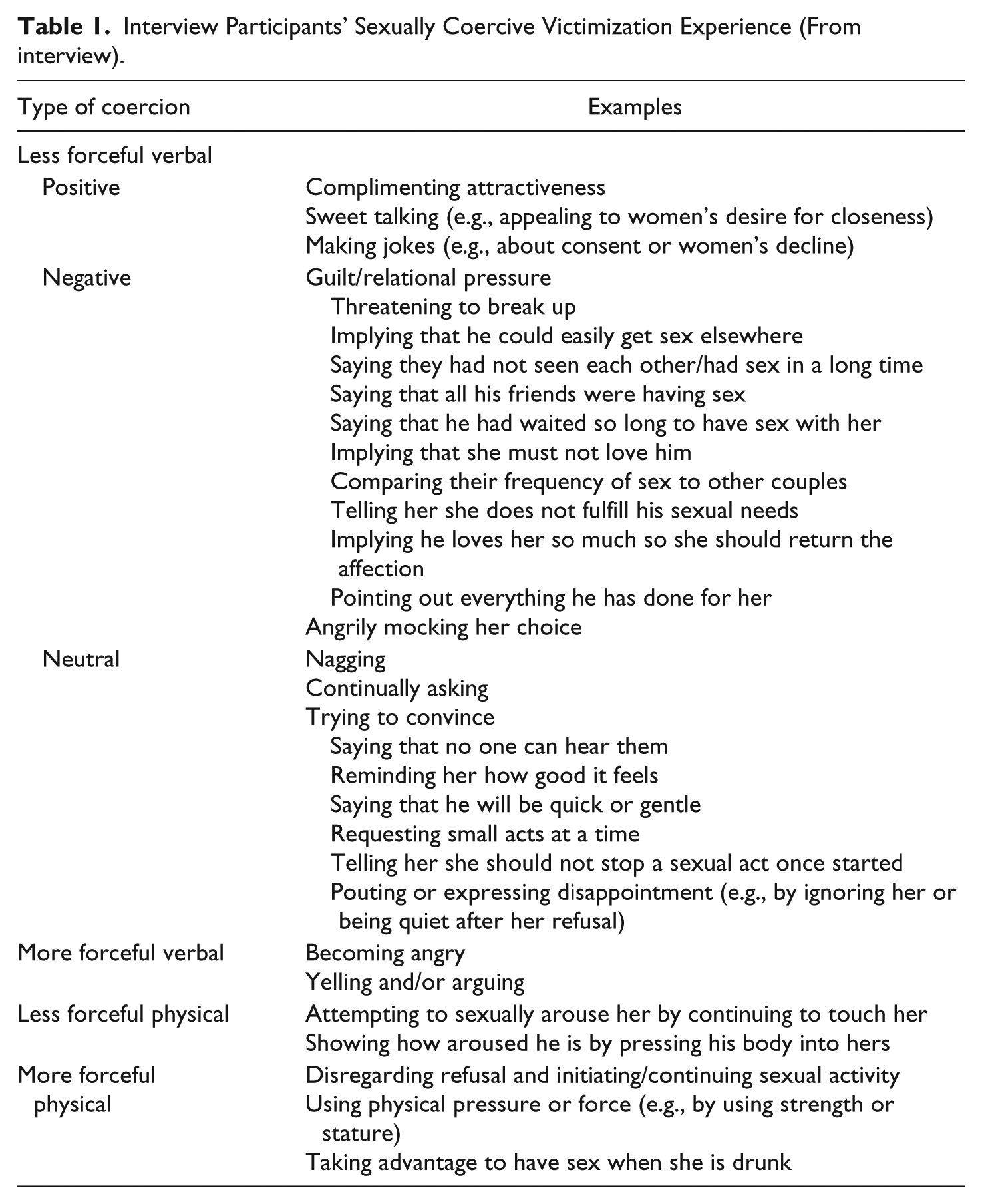
SC was typically an attempt to acquire unwanted intercourse, but was sometimes used for other sexual activities, such as those the woman had not done before. The SC tactics that the women described in the interviews were similar to those in the literature (see Table 1). It was common for the women to experience a number of different tactics during and across encounters. When one tactic was unsuccessful, some men would stop whereas others would continue with another tactic or try the same tactic a little later. The focus of the remaining empathic analysis is on the following themes: (a) Subjective Reactions and Emotional Responses to SC, (b) Interpretations of SC, and (c) Effects of SC.
Interview Participants’ Sexually Coercive Victimization Experience (From interview).
Theme 1: Subjective Reactions and Emotional Responses to SC
Almost all of the women experienced guilt or feeling “bad” in direct response to SC. This was particularly true for men’s use of guilt tactics, expressing disappointment, or ignoring her. Annoyance and frustration were often described as reactions to a partner’s use of guilt or relational pressure, continual attempts to convince, or pouting. Similarly, some were frustrated that their partner would continue to pressure them after they had indicated that they did not want to have sex or if they felt their partner did not understand why they did not want to have sex.
Although less common, some women felt angry or “ticked off” when they felt their partner was being selfish or disrespectful of their decision not to have sex. Some also described a hurt or sad reaction to continual verbal pressure to have sex. Catherine, who was not ready to have intercourse for the first time, felt hurt that her partner continued to pressure her until she finally gave in: “it hurt . . . he knew that like I didn’t want to do it and that I was basically just doing it for his sake.” Hurt feelings were also sometimes experienced in combination with anger and jealousy, particularly if men used relational pressure:
sometimes obviously words hurt . . . he’d be like . . . you’re not the only girl out there . . . all these girls want me. . . . And then that would just make me feel . . . jealous and angry at the same time and that I had to prove a point. (Sarah)
Fear and vulnerability were also expressed, though uncommon. Jade described feeling “hopeless” and “scared to the point that [she] thought [she] was gonna get raped” when her partner was getting angry and yelling at her when she did not want to have sex. Sarah, who described a situation where her partner did not listen to her when she said that she did not want to have sex and went on top of her and started kissing her, similarly described feeling “vulnerable” and “smaller than [her partner].” She felt as if she could not “control the situation” by saying no.
More forceful tactics such as yelling and physical force were generally associated with more negative emotional reactions. For instance, Jade was nervous and mildly angry when her partner used less forceful forms of SC, such as verbal pressure or touching her, but was scared when he used more forceful verbal forms such as yelling. Sarah provided an exception, however. Despite feeling vulnerable when her partner disregarded her declines and went on top of her, she said that she was more hurt by his use of guilt and relational pressure: “I think definitely like telling me that you could find [sex] someplace else would be the worst situation ‘cause that just hurts you like more on the inside.” Nikki provided another exception that demonstrated how repeated SC (even if less forceful) could also elicit a more negative emotional reaction. She experienced SC in the form of compliments, arousal tactics, and trying to convince, but her partner was very persistent both during and across encounters and she felt exasperated by it.
It was also common for the women to worry about their partners’ feelings during a coercive situation. The women were worried that, if they said no, it would hurt his feelings or make him think she was not attracted to him or did not love him. Michaela connected this to her own feelings of guilt: “he thinks I don’t wanna have sex with him and maybe that made him feel bad about himself and that’s why I was feeling guilty.” These types of descriptions were often more prominent than descriptions of the women’s own feelings in response to their partners’ SC.
Theme 2: Interpretations of SC
Commonly, the women did not interpret their partners’ SC as unequivocally negative, but rather minimized, contrasted, and justified it. In a few cases, it was even viewed positively, such as being charming or complimenting. This was generally when the man was persistent, complimented her, made jokes about it, or showed her how turned on he was. For example, Carly said, “He was just really persistent, which made it . . . more attractive.” 1 Some women minimized SC by seeing it as a normal part of relationships. This was particularly true for less forceful forms of SC such as verbal pressure, arguments, and arousal tactics. For example, Jessica viewed her partner’s verbal pressure as “just a part of the relationship . . . an argument that [they] had and [got through].” Minimizing often occurred in response to less forceful SC that ended in acquiescence, but also occurred in response to rape. Carly described a situation where her partner just began having sex with her after she had said she did not want to, yet she minimized it and did not interpret it as rape, but rather as sex just happening suddenly and that she just “didn’t appreciate that.”
Participants sometimes minimized their experiences by contrasting them with something more severe. For example, Jessica said, “it’s not like he hit me or did anything physical. He just would kind of express it in words.” Sexual activity that continued without true consent because of verbal pressure was also downplayed. Catherine said, “he didn’t necessarily . . . force himself upon me, but . . . he knew that there wasn’t really consent. Like I gave it, but not really fully.” Even physical force was contrasted with abuse and thus minimized: “he wouldn’t abuse me, he’d just . . .’cause he’s stronger than I am, right? So, he would just kind of overpower me in a sense and . . . do whatever he’d like” (Ashley).
Many participants included an explanation or justification along with their descriptions of their partners’ SC. For example, Jennifer explained that her partner is “the youngest in his family” and is “used to like pouting and getting what he wants.” She explained that this is why he would get really disappointed and pout when she refused sex. Others justified their partners’ SC based not on their partners per se, but on the situation. For example, Sarah excused her partner’s SC because he was drunk and “alcohol has an effect to make you . . . hornier.” Catherine felt that her partner’s pressure was understandable when a limited opportunity for privacy presented itself. Some justified their partners’ SC based on their own behavior. For example, Ashley justified her partner’s SC as “reasonable” because she had originally agreed to have sex on their prom night and then changed her mind when the time came. Finally, several women justified their partners’ SC on the basis of male sexual urges. Ashley exemplified this when she said, “I’m always kind of thinking something like okay well he’s a guy and he has these desires . . . he has his needs.”
Although less prominent than nonnegative interpretations, most of the women interpreted at least some of their partners’ SC overtly negatively. These negative interpretations included considering their partners’ SC disrespectful, selfish, a poor way to treat a partner, and controlling. Some of the women interpreted it as disrespectful to their feelings and reasons for not wanting to have sex, such as being too tired, not feeling well, or, most notably, wanting to wait to have sexual intercourse for moral, religious, or cultural reasons, for practical reasons such as not wanting to get pregnant, or because they were not ready. Relatedly, some women saw their partners’ SC as selfish, inconsiderate, or as if he was not seeing her side:
I feel like . . . he’s not seeing my side of it, like he’s letting . . . the fact that he’s like so horny like (laughs) get in the way like, oh well maybe she did have to like write a whole paper today or like has to wake up at 8 o’clock in the morning . . . (Jennifer)
Sarah felt that her partner was being inconsiderate about her feelings and related this to his desire to obtain power over her: “I would see that clearly he enjoys like . . . being superior to his partner. That . . . at times he didn’t care to listen or . . . be considerate of your feelings towards [having sex].” Finally, one participant described her partner’s SC as a poor way to treat a partner. Although Carly did not interpret her partner’s SC particularly negatively while she was in the relationship, she later came to understand that it was a poor way to treat her and that men should obtain continuous consent:
I . . . [realized] . . . I didn’t have to be . . . treated that way . . . if you were to have sex with a guy, I think he should . . . ask if you’re okay like every three seconds and like you know you really want to.
Overtly negative and nonnegative interpretations were often made in conjunction. For example, although Ashley felt that her partner was being disrespectful of her wishes when he continued to pressure her, she also justified it based on his male “needs.” Although Jennifer felt that her partner was being selfish, she justified it based on his personality. These simultaneous negative and nonnegative interpretations were particularly common for less forceful verbal pressures, such as complimenting tactics. Carly exemplified this when she said,
He’s like “oh you can’t wear . . . a skirt like that and . . . not expect me to like . . . want you,” which is like nice in like a little way but . . . also not nice.
Theme 3: Effects of SC
SC had negative effects on some of the women’s relationships. For some, continuous pressure to engage in sexual activity made them see their partners differently and contributed to an emotional “barrier between [them].” This was particularly true when men continued to pressure or coerce despite knowledge that the women wished to wait until marriage to have sex. Men’s SC also negatively affected some of the women’s sex lives. Ann, who wanted to wait until marriage to have intercourse, sometimes no longer “[looked] forward” to other sexual activity, such as kissing, because she was afraid he was always going to “try to . . . convince [her] to [have intercourse].” Catherine similarly felt that her partner’s pressure to have intercourse made the sexual activity they did engage in “less enjoyable” and loving.
Although SC did not affect most of the women’s commitment to their partners, it did for Jade and Carly. Jade explained that she broke up with her partner largely because of a recent coercive incident (i.e., getting angry and yelling). Carly said,
. . . it just made me . . . realize that . . . I didn’t want to be with someone where I’d have to be like oh . . . it’s night time like that’s what that means . . . I didn’t wanna have to be . . . afraid of that or . . . felt pressure for that or . . . feel like used for doing sexual activities. So that made me like, yeah definitely . . . less committed.
For others, SC did not have any effect on their relationships, sex lives, or their general lasting views of their partners, and some felt that it was just part of “getting more comfortable” with their partner sexually and learning what he likes. For still others, SC had a positive, albeit indirect, effect on their relationships. For example, although Jennifer was originally bothered by her partner’s SC because “it made [her] think he didn’t really care about [her],” she came to feel closer with him and “on the same page” because of a conversation that came out of a coercive incident.
SC also had negative effects on some of the women themselves. For one participant, SC affected her ability to trust men. She linked this directly to her partner’s use of complimenting and sweet talking to have sex with her:
I don’t trust in their words because of that experience . . . how he talks and how he says he misses me and “oh . . . you’re so beautiful and I really feel like you’re the one for me” and this and that, so when guys would try to like . . . date or talk to me after the breakup, it would sort of sound like something like that. (Sarah)
More commonly, SC affected how the women felt about themselves. Sarah felt as though her partner’s control over their sex life (and relationship in general) made her “feel lesser of . . . who [she was]” and lose her own role in the relationship. The women also internalized their SC experiences by (a) questioning their own behavior or making SC about themselves, and (b) blaming themselves for its occurrence. First, internalization often involved feeling guilty or worrying that there might be something wrong with them for not wanting to have sex. For example, Catherine said,
. . . with all the pressure and the guilt . . . it felt like there was like something wrong with me . . . I was worried I was going to be like a 40-year-old virgin.
Jessica was “ashamed” and worried there was something wrong with her and her feelings about the relationship for not wanting to have sex as often as her partner. Similarly, some described feeling like a “bad girlfriend” or as if they were not “sexually pleasing” their partner. Sometimes, the women acknowledged that they did not approve of their partners’ SC but also were concerned that they were not doing enough for him. Although Ashley did not approve of her partner telling her that she was “not meeting his . . . sexual needs” when she refused sex, she still sometimes felt that “maybe [she] should . . . change in a sense” and do more of what he wants sexually. This type of internalization was generally related to less forceful but persistent verbal SC and occurred whether or not coerced sexual activity ended up happening.
Second, some women blamed themselves for the occurrence of SC. For example, some viewed their partners’ persistence as being their own fault for not being “more firm” in their refusal. Others believed they were at fault for leading him on by engaging in other affectionate or sexual activities. Carly gave an example of this when she said,
. . . maybe my words and . . . the fact that . . . I was kissing him . . . meant to him that I wanted to . . . have sex and so . . . it was my fault . . . I probably could have made that . . . more clear and . . . really adamantly put my foot down.
Others similarly felt that when SC actually led to unwanted sexual activity, it was their fault for not being firmer in their refusal. In describing a situation where her partner’s verbal pressure and taking advantage of her when she was drunk led to sexual activity, Sophie noted that everyone “gets into situations where they can’t say no or like it’s harder to say no” and “that’s why those things happened.” Carly, who described being raped (though she did not label it as such), suggested that her partner would not have disregarded her refusal and initiated intercourse with her had she been firmer in her decline of his advances. She said, “I’m sure he wouldn’t have done it if I like pushed him away. Like, he was a really . . . good, like gentleman and everything.” Carly even focused on her own inability to firmly communicate that she did not want to have sex despite saying that her partner was ignoring her refusals:
I don’t think he was really like listening though, like I think he was already like taking his pants off at that point . . . I was like no like I’m not sure . . . it was hard . . . I’m not that confident to like say no to people so I think he may have interpreted that as like I was just nervous to do it and not that like I didn’t want to do it.
SC also restricted women’s sexual decision making. This was apparent when some women described giving in to both direct and indirect pressure to engage in sexual activity. Nikki described giving in because it was “easier to just [have sex] really quick than to like fight him off all night.” More commonly, the women described giving in to maintain relationship harmony or to appease their partner. For example, Ashley sometimes gave in to pressure to try new sexual activities with her partner even if she did not want to because she “[wanted] things to work out between [them].” After experiencing a lot of pressure from her partner, Catherine described giving in before she was ready to have sex for the first time because she “didn’t want to lose him.” Previous SC also sometimes contributed to women’s acquiescence to unwanted sex in the absence of immediate pressure or coercion (i.e., sexual compliance) to avoid SC.
Interrelatedness of Themes and Impact of Tactic and Context
The three themes were highly interrelated and dependent on the type and severity of SC as well as on the relationship context. Although SC occurred in both otherwise “happy” and “healthy” relationships and relationships already experiencing difficulty, the context affected women’s reactions and interpretations of SC. First, women who discussed relational equality or a partner who treated them “really well” typically experienced less forceful SC, such as trying to convince, pouting, and arousal tactics, which in turn led to fewer strong negative emotional outcomes and was minimized, justified, or internalized. For instance, Madison and Jessica described their partners’ persistent convincing and arousal tactics as though they were mostly unproblematic and normal. Jessica and Jennifer both internalized their partners’ SC as a time they did not want to have sex rather than interpreting it as something negative that he did. This internalization further contributed to their maintenance of relationship satisfaction and commitment following SC. For example, Jennifer said, “it hasn’t really affected our relationship . . . I haven’t lost any . . . love for him or anything like that just because of those certain times [that] I don’t always wanna have sex.” Women who were still in their relationships may also have been more likely to defend their partner. For instance, although Ashley did view her partner’s SC as disrespectful, she also minimized some of her experiences and defended her partner by saying that he was generally a good person and that his SC did not drastically change her view of him.
Other women discussed relational inequality or dissatisfaction, including a partner who treated them poorly or was possessive, controlling, or jealous. These women typically experienced more manipulative or forceful verbal (e.g., guilt, relational tactics, yelling), physical, or persistent SC, which in turn contributed to their stronger negative emotional reactions (e.g., fear, anger, hopelessness) and more overtly negative interpretations of SC. For instance, Nikki and Jade both described how their partners were becoming jealous and possessive, including wanting them to “spend every moment with him,” and Sarah described her partner’s general desire to maintain power and superiority over her. Each of these women also viewed their partners’ SC as a form of control or, in Sarah’s case, saw that her partner “clearly . . . enjoys . . . being superior.” These interpretations further contributed to their loss of relationship satisfaction and commitment following SC. Although Jade and Sarah had been experiencing relational difficulty outside SC, both related their decision to break up with their partners as at least in part due to sexually coercive incidents that they viewed as controlling.
Other relationship factors also affected women’s experiences of SC. For example, SC sometimes occurred in conjunction with more general, underlying, and sometimes unspoken pressure to have sex. This implicit pressure involved knowing that (a) their partners wanted to have sex for the first time or more frequently than them, (b) it was uncommon for them to be able to see their partners without it leading to sex, or (c) sex is a requirement to maintain a relationship. Although this underlying pressure was experienced to some degree by most of the women, it was particularly salient for women in relationships where there was limited opportunity for sex (e.g., still living with parents or in long distance relationships). In these types of relationships, men also often used this limited opportunity as a guilt tactic. Furthermore, implicit pressure contributed to some women’s interpretations of their partners’ SC because it provided an external justification and therefore they did not directly blame him.
Critical Analysis and Discussion
Although some researchers suggest that the cultural gender script is beginning to move in the direction of valuing greater sexual agency for women in mixed-sex relationships (S. L. Dworkin & O’Sullivan, 2005; McCormick, 2010; Simms & Byers, 2013), results from the prescreen show that SC is still a common experience for women, and the interviewed participants described diverse SC tactics that generally match the literature (Faulkner et al., 2008; Hartwick et al., 2007; Raghavan et al., 2015). The high rate of SC experience in the prescreen reflects societal power relations, gender norms, and sexual scripts. The qualitative analysis also sheds new light on patterns in the use of SC in intimate relationships and how various tactics are experienced differently. By connecting participants’ lived experiences with previous research and feminist theory, the remaining sections provide a more critical analysis of why they might have experienced and perceived their partners’ SC in the ways that they did, including the influence of dominant discourses and power relations. In this way, language is viewed as constructing versions of women’s realities.
Emotional Reactions to and Interpretations of SC
The emotional reactions in the current study generally match those found by Livingston et al. (2004) and speak to the potential harmfulness of verbal or less forceful physical SC, especially when it occurs repeatedly in an intimate relationship. Only Jade reported fear. She was afraid because she thought she was going to be raped (though she was not) and because her partner was “supposed to be . . . [her] . . . protector” rather than her attacker. Thus, her experience did not fit her repertoire of a boyfriend, but fit more closely with her repertoire of rape. It was not clear whether she experienced stronger emotional reactions because she interpreted her experience as closely tied to rape or vice versa. This is in sharp contrast to Carly’s experience of rape (although she did not label it as rape). Carly’s partner ignored her refusals and initiated intercourse with her, yet she was no more troubled in her description of the incident than in her descriptions of verbal SC. This may relate to the lack of clear physical violence (or even clear pressure) in her experience. In both cases, there was an association with the strength of the emotional reaction, the partner’s anger (or lack of), and the interpretation of the event. Jade’s experience in which her partner became very angry and yelled at her when she did not want to have sex led her to evoke a rape repertoire and use the word “rape” in explaining her fear, whereas Carly’s experience, which was clearly rape, did not evoke a rape repertoire or a strong emotional reaction. These results also highlight that women do not interpret the forcefulness or severity of their partners’ SC based solely on its physicality.
Some women in the current study interpreted their partners’ SC negatively; however, many saw it as mostly unproblematic and were not particularly troubled by it. This was especially true for men’s use of less forceful verbal (e.g., verbal pressure) and less forceful physical (e.g., attempts to sexually arouse following a refusal) tactics. These results support feminist theory that views SC as being consistent with traditional gender roles and normalized in heterosexual dating culture. Traditional sexual scripts often depict men as sexual aggressors and women as resistors (Simon & Gagnon, 1986), which may act to normalize and perpetuate male sexual violence against women. Previous empirical research has similarly found that many women report expecting to experience SC in a dating situation, despite their rejection of coercive behavior (Cook, 1995; Morry & Winkler, 2001). Like other forms of male domination and violence, SC may act to maintain power differentials between men and women (e.g., Dobash & Dobash, 1992). Radical feminists have critiqued heterosexuality as the “linchpin of gender inequality” (MacKinnon, 1989, p. 113) and inherently linked to women’s oppression (e.g., A. Dworkin, 1987; MacKinnon, 1987). Thus, discourses around rape are interlinked with discourses around heterosex, such that (conceptualization of) sexual victimization exists on a continuum of normative heterosexuality defined by patriarchal ideologies (Gavey, 2005; MacKinnon, 1983, 1987).
Some women in the current study found SC to be attractive, complimenting, or effective at changing their minds about having sex when the man was persistent, complimented her, made jokes about it, or showed her how turned on he was. Despite men’s positive framing of these tactics, we still believe that they are manipulative and represent a violation of women’s right to make free and autonomous decisions about when to engage in sexual activity. Furthermore, women’s positive interpretations in the current study most often occurred in conjunction with negative ones. For example, Carly felt flattered when her partner complimented her but simultaneously felt that it was “not nice” for him to use these compliments to guilt her into unwanted sexual activity by implying that she should not wear revealing clothing if she did not want to turn him on. Use of such positive tactics match Livingston et al.’s (2004) findings; however, no other research to our knowledge has specifically reported on women’s subjective reactions to these types of tactics.
Women’s interpretations of SC in the current study support theory and research that suggest that women are less likely to acknowledge an experience as rape when the perpetrator is an intimate partner and may have a harder time articulating a sexually coercive experience that does not involve physical force (Burkett & Hamilton, 2012; Burt, 1980; Kahn, Jackson, Kully, Badger, & Halvorsen, 2003). For instance, similar to the current study, Harned (2005) found that women sometimes minimized their SC experiences. Adding to this, women in the current study who were no longer dating their partners also sometimes held more negative interpretations of his past SC. This may be because it is easier to define a situation as violent after a relationship has ended because their identities as a couple are no longer interdependent (Chung, 2005).
The woman in the current study who did experience what would be legally defined as rape had difficulty articulating and understanding her experience. This may have been because her experience did not fit either the dominant definition of rape as violent and perpetrated by a stranger or of a typical intimate relationship. Previous qualitative researchers using discourse analysis have drawn similar conclusions (e.g., Kroger & Wood, 1998). Furthermore, given that the term date rape is in common use today, some women may not view their relationships as dates. Because of these dominant definitions, some women also may not have even had the language to articulate and understand their experiences with other forms of SC. This was made particularly clear when the women did not know what to call their experiences and made contradictory interpretations. Making both negative and nonnegative interpretations was particularly common in descriptions of less forceful verbal SC. Thus, the women often had mixed feelings about their partners’ SC or were unsure about how to feel.
The women may also have attempted to distance their experiences from dominant conceptions of rape by minimizing and contrasting their partners’ SC (e.g., use of disclaimers such as “it’s not like he hit me”). Some researchers have suggested that women minimize unwanted sexual experiences so as to avoid the personal and social consequences associated with their victimization, including isolation, stigmatization, blame, and loss of control over the situation (Brown, 2013; Harned, 2005; Koss & Cleveland, 1997). In contrast to repertoires on rape and intimate partnerships, women’s experiences did fit dominant repertoires of heterosexual sex where men want sex more and act as the initiators of sex and women act as gatekeepers (S. L. Dworkin & O’Sullivan, 2005; Hird & Jackson, 2001; Jozkowski & Peterson, 2013; Masters, Casey, Wells, & Morrison, 2013; Simon & Gagnon, 1986). These repertoires allowed the women to justify their partners’ SC based on male sexual urges, for example.
The finding that many women saw SC as mostly unproblematic and were not particularly troubled by it should not be taken to mean that the behavior is unproblematic. SC negatively affected some women’s relationships and views about themselves and hindered their future sexual decision making. Regardless of these impacts, SC, by definition, violates women’s sexual autonomy. Furthermore, from a critical feminist perspective, women’s nonnegative interpretations may reflect the regulating influence of dominant patriarchal discourses on women’s own discourses and experiences. Many researchers have argued that women’s descriptions and experiences of rape are constrained by dominant discourses that act to reinforce gendered power relations (e.g., Gavey, 1992, 2005; Weiss, 2009; Womersley & Maw, 2009). Similarly, women’s own interpretations and descriptions of their sexually victimizing experiences found in the current study may both reflect and be constrained by contemporary rape culture that denies and trivializes sexual assault, blames women for their victimization, and justifies men’s perpetration (Burnett et al., 2009; Edwards, Turchik, Dardis, Reynolds, & Gidycz, 2011; Weiss, 2009). Thus, the current study serves as an illustration of how both rape and rape culture act to control women.
Impact of Relational Context on Reactions to and Interpretations of SC
The current study sheds new light on relational contexts in which SC occurs and how context affects women’s reactions. Results suggest that there is no standard, cookie-cutter relational context in which SC occurs, but there may be factors that contribute to the likelihood of SC, such as distance or infrequent chances to see one another and when women want to wait to have sex for religious or practical reasons. Some women also reflected on how their partner treated them more poorly during times of greater relational difficulty, which sometimes included increased SC. There was also evidence that relational context influences women’s interpretations of and reactions to SC. Perceived relational inequality was often related to more negative reactions and interpretations, whereas the reverse was true for perceived relational equality. The former was particularly common when women, like Sarah, connected their partners’ SC to their general desire to maintain control or “[be] superior.” These interpretations further affected SC’s effects on women’s relationships. Unlike most of the women who did not view their partners’ SC as a form of control, those who did often ended their relationships.
When women are happy in their relationships, it is possible that they want to justify their partners’ SC or frame it in a less negative light. It is also possible that women who view their relationships as more egalitarian and based on mutual respect and sexual autonomy may have a harder time reconciling their partners’ SC with their positive view of the relationship. Thus, they may disregard SC or reframe it as unproblematic. Alternatively, the same tactics may be defined and experienced very differently depending on the context of the relationship. Results provide some support for the idea that women who view their relationships as more egalitarian may experience certain less forceful tactics (e.g., arousal tactics, trying to convince) merely as ways to encourage sexual intimacy and thus not as victimizing. Results, therefore, highlight that the context of the relationship may be more important than the SC tactics in determining women’s reactions to SC and its negative effects. Experiencing SC in an abusive or less egalitarian relationship may be a stronger predictor of negative interpretations and impacts than the tactics themselves. Thus, there is great need to examine context when measuring SC victimization.
Effects of SC
The negative consequences of SC experienced in the current study generally match the literature (e.g., Katz & Tirone, 2010; Livingston et al., 2004) and include diminished romantic feelings for or commitment to their partners, arguments, changed views of their partners, and acquiescence to unwanted sex even in the absence of immediate pressure. With respect to the latter, SC may hinder a woman’s sense of control and assertiveness in expressing her own desires in later sexual interactions (Offman & Matheson, 2004). In addition, some women may not say “no” for fear that their refusal will have no effect and what follows will be construed as rape (Gavey, 1992). Highlighted here, these trends may be particularly important in intimate relationships, where there is repeated sexual contact and potentially repeated coercion.
In the current study, women also often considered their partners’ feelings as more important than their own. These results can be linked with past theoretical and empirical work on gender scripts that suggest that (a) men’s sexual pleasure supersedes women’s (Hird & Jackson, 2001; Jozkowski & Peterson, 2013), (b) women are responsible for maintaining romantic relationships beyond their own self-interest (Schlenker, Caron, & Halteman, 1998), and (c) women must satisfy male sexual needs including submitting to advances to adhere to their “role” in relationships and having sex to signify their love (Chung, 2005; Faulkner et al., 2008; Kirkman, Rosenthal, & Smith, 1998). Women’s guilt and internalization may also be a consequence of dominant, male-defined conceptions of sexual function that (a) pathologize women’s sexual desire and response, including low sexual desire prior to sexual activity and arousal (Basson, 2005; Meana, 2010), and (b) ignore social and psychological contributors of women’s sexual problems (Williams, 2001).
SC may both reflect and perpetuate these traditional views. Women may learn that their refusals are not taken seriously and to ignore or not prioritize their own sexual and nonsexual desires. Acquiescence to unwanted sex in the absence of immediate pressure may be a reflection of disciplinary power that acts to regulate women’s behavior so that direct force or violence are not necessary to maintain power relations favoring men’s sexual desires (Gavey, 1992). Indeed, one participant in the current study felt more in control and empowered when she consented to unwanted sex after an argument or coercion took place compared with consenting in the absence of immediate pressure because it allowed her to make the conscious decision to change her mind.
Many women in the current study were not particularly troubled by their feelings of obligation to have sex and viewed it as a natural way to maintain relationship harmony. However, these untroubled views may be a result of gendered power relations of which women themselves are uncritical. Theory and evidence suggest that women may not distinguish between consent and nonconsent or connect the two to their own desire, particularly given that sex is traditionally defined as something men do to women (e.g., Gavey, 1992; MacKinnon, 1983). There was also evidence in the current study that internal feelings of pressure contributed to less negative interpretations of men’s coercive behavior and to maintained relationship commitment.
Other women did not believe that SC had negatively affected their relationships, sex lives, commitment, or their general lasting views of their partner. Similar to Livingston et al. (2004), a small minority even felt that SC had a positive, albeit indirect, effect on their relationships. This was particularly true (in both the current study and in Livingston et al., 2004) for women with sexual precedence within the relationship. Established relationships marked by commitment and investment may be less vulnerable to negative impacts of SC. Women’s lasting views of intimate partners may also be less hampered by sexually coercive incidents. Alternatively, women in longer standing intimate relationships may be more likely to minimize or justify their partners’ coercive behavior, especially if it does not match how he typically treats her. Katz et al. (2006) further suggested that women may interpret appeasement of their partners’ SC as an obligation that serves as a form of relationship investment, and thereby indirectly promotes relationship commitment. The current research may shed more light on this association. Women’s interpretations of their partners’ SC may influence later relationship satisfaction and commitment. Women who interpreted their partners’ SC as a natural part of relationships, as complimenting, or as justified generally maintained relationship satisfaction and commitment. Katz et al. (2006) suggested that feelings of obligation or internal pressure may also “buffer” satisfaction. Women in the current study who felt an obligation to have sex or who internalized their partners’ SC (e.g., worried that they should want sex more often) sometimes understood where their partners’ pressure was coming from and did not blame him.
Conclusion
This research adds women’s voices and perspectives to the body of knowledge that already exists and contributes a deeper critical examination of the complexities of sexually coercive experiences and the relational contexts in which they occur. Although our findings likely apply to similar contexts, future research is needed across different cultural settings and among more diverse samples with respect to age, ethnicity, country, and sexual orientation. Similar sexual scripts, interpretations of what constitutes rape, and men’s coercive tactics, however, have been found in different contexts such as Australia, New Zealand, and Britain (Burkett & Hamilton, 2012; Hird & Jackson, 2001).
Understanding how SC is actually experienced and interpreted by women is important for informing outreach, counseling, and prevention/intervention initiatives and sexual health research. Findings suggest that women often do not challenge less forceful forms of SC, but rather see them as normal and expected within dating relationships. This is not without consequence, however, as many women internalize SC. Encouraging women to view their experiences on a spectrum of sexual victimization may help challenge men’s use of SC and could lead to better and more empowered sexual experiences for women. Nevertheless, researchers and practitioners should be sympathetic and open to women’s varied interpretations and subjective reactions to SC so that no experience is marginalized.
Footnotes
Declaration of Conflicting Interests
The author(s) declared no potential conflicts of interest with respect to the research, authorship, and/or publication of this article.
Funding
The author(s) disclosed receipt of the following financial support for the research, authorship, and/or publication of this article: This research was supported by the Social Sciences and Humanities Research Council of Canada.