




Abstract
The European legal instruments on human trafficking encourage states to tackle the demand for services of trafficked persons, for example, by making the use of services of a trafficked person a criminal offense. In Finland, buying sex from a trafficked person is a criminal offense. This article reports the results of an evaluation of the Finnish law and shows that the implementation has been inefficient. The authors argue that with an amendment of the law, the implementation could be improved but a truly efficient policy would require a total ban of sex purchase along the lines of the Swedish model.
Introduction: Trafficking and Demand
Targeting Demand?
The European legal instruments on trafficking include a clause that encourages the states to tackle the demand for services of trafficked persons. Among the measures that states should consider is establishing as a criminal offense the use of services of a trafficked person, when the user of services knows that the person has been a victim of trafficking. This recommendation is found in the “Council of Europe Convention on Action Against Trafficking in Human Beings” (hereafter European Trafficking Convention, 2005), which has 46 ratifications (July 2016), and in the European Union Parliament and Council Directive 2011/36/EU on preventing and combating trafficking in human beings and protecting its victims (hereafter Trafficking Directive). The legal policy discussions about enacting such criminal offenses abound in several European countries at the moment.
As the first country to implement the European-level recommendation, Finland enacted the criminal offense “abuse of a victim of sex trade” in 2006, making it a minor crime to buy sex from a person who has been trafficked or procured. This law, which resembles the one adopted in the United Kingdom in 2009, is in contrast with the “Swedish model” that since 1999 prohibits all sex buying. The Swedish model has so far been followed by Norway and Iceland in 2009.
The partial criminalization of sex buying raises questions about the feasibility of its implementation. This article reports the results of the Finnish implementation study of 2013 (Niemi & Aaltonen, 2014) showing that the implementation has been ineffective at all levels: the police investigation, the prosecution, and the courts. These results are compared with the experiences of the Swedish total sex purchase ban, which has been implemented more efficiently. We identify a number of proposals that could make the partial sex purchase ban more efficient, and some of them have already been adopted by the Finnish Parliament. However, we doubt whether a partial ban can be made truly efficient and find the Swedish type of total ban on sex purchase more efficient in deterring trafficking and more feasible to impose.
This article is organized so that we first look at the scale of trafficking and its victims. We also give an overview of the most important international law instruments to tackle trafficking and help victims. We then proceed to give an overall picture of the Finnish situation and prostitution policy as the background for the partial sex purchase offense. The implementation of the ban has been tardy as is explained hereafter in the article. Finally, we make an assessment of the situation and come forward with a number of developed from the evaluation.
Trafficking and Demand in International and National Law
Trafficking in human beings is facilitated by differences in income and wealth that also feed the demand for the services of trafficked persons. Modern transportation and communication technology, together with dismantling the legal restrictions for movement across borders, have changed the conditions under which the traffickers operate. At the same time, images of affluent life in faraway countries are advertised through media all over the world, making vulnerable people easy prey for traffickers and people who are willing to abuse trafficked persons.
The estimates of the number of victims of trafficking vary. For example, the United Nations Office on Drugs and Crime (UNODC) identified 50,000 victims and offenders who have come to the knowledge of criminal justice authorities in 155 countries (UNODC, 2012). The International Labour Organization (ILO) has estimated the number of victims of forced labor, including sexual exploitation, to be almost 21 million, almost half of them (9.1 million) having moved either cross-border or in-country. According to ILO, forced sexual exploitation often takes place in another area than where the victim resides, whereas forced labor occurs in the place of residence of the victim (ILO, 2012).
Most of the victims are women and children. According to the UNODC and European Union, 75-80% of the trafficking had the purpose of sexual exploitation, whereas labor exploitation accounted for 18%. Almost equally, most victims were female, including adult women and girls (European Commission, 2012; UNODC, 2012; Europol, 2011). Thus, trafficking is closely connected to the exploitation of women and children in prostitution.
An important landmark in the recognition of trafficking as a specific, international crime was the United Nations Convention Against Transnational Organized Crime and its supplementary Protocol to Prevent, Suppress and Punish Trafficking in Persons, Especially Women and Children (hereafter the Palermo Protocol) in 2000. According to the UNODC (2012) report, 152 countries have already ratified the Palermo Protocol and 134 countries have enacted specific laws criminalizing trafficking. Trafficking is a serious crime. In the national laws of many countries, other prostitution-related activities, such as procuring or pandering, are also criminal offenses. Furthermore, the “Convention for the Suppression of the Traffic in Persons and of the Exploitation of the Prostitution of Others” (1949) requires this kind of criminalization. The Convention has been ratified by 82 states, including all Nordic countries (except Iceland) and many developing countries. Also the Convention on the Elimination of All Forms of Discrimination Against Women (CEDAW; 1979), Article 6, obliges the states to take all appropriate measures, including legislation, to suppress all forms of traffic in women and exploitation of prostitution of women.
Notwithstanding the Palermo Protocol and national policies against trafficking, the problems of trafficking and prostitution persist. As a novel approach, the idea that the demand side of prostitution also should be targeted has emerged. Also in research, the focus has shifted from the women in prostitution to the demand side (Brooks-Gordon & Gelsthorpe, 2003; Farley, Bindel, & Golding, 2009; Farley et al., 2011; Jõe-Cannon, 2006; Keeler & Jyrkinen, 1999; Macleod, Farley, Anderson, & Golding, 2008; Månsson, 2004; Marttila, 2003; Munro & Della Giusta, 2008; Sanders, 2008; Waltman, 2011). If the demand decreases, trafficking also should decrease. 1
Already in the Palermo Protocol, the states were recommended to discourage demand by legislative, educational, cultural, and social measures (art. 9(5)). This wish was repeated in the European Trafficking Convention in 2005 (art. 6), which also urges the member states to consider making an offense of the use of services of a trafficked person with knowledge of her being trafficked (art. 19). Finally, the obligation to “consider” establishing “the use of services” of a trafficked person as a criminal offense is included in Article 18 of the Trafficking Directive. On February 26, 2014, the European Parliament accepted a resolution recommending the Nordic model of prostitution, that is, forbidding sex purchases, but decriminalizing the women who are abused in prostitution.
At the national level, the Swedish law of 1999 was the first one to tackle demand. The Swedish law prohibits and makes an offense of all purchases of sexual intercourse and equivalent sexual acts (the Swedish Penal Code 1962, chap. 6, sec. 11; 2011:517. The law was originally enacted in 1998 and came into force January 1, 1999). The Swedish law makes no differentiation between persons who sell sex as independent prostitutes and those who have been trafficked or procured: Buying sex is forbidden in all situations and from any person. The “Swedish model” was adopted in Iceland and Norway in 2009. 2 In Norway, the new law was prompted by an influx of prostitutes who were trafficked from third world countries, most notably Nigeria. The “Nordic model” is discussed in other European countries, and such bills have been introduced in the parliaments of France and Ireland. 3
Actually, prohibition to buy sex is not a novelty, but in most countries, it complements the offense of soliciting, that is, offering and selling sex. In the “Swedish model,” the prohibitions directed at the persons who are abused in prostitution are abolished and the prostitutes are seen as clients of the social services.
In contrast to the “Swedish model,” Finland only prohibits buying sex from a person who has been a victim of trafficking or who has been procured (Criminal Code [CC] 39/1889, chap. 20, sec. 8; 743/2006 in English at http://www.finlex.fi/en/laki/kaannokset/1889), which came into force October 1, 2006. The offense carries the maximum penalty of 6 months, which means that in practice, the offenders are fined. The country to follow the Finnish model is Great Britain where a purchase of sex from an exploited person was made an offense in 2009 (The Policing and Crime Act 2009; the sex purchase ban was inserted into the Sexual Offences Act of 2003 as a new section 53A). The British model differs from the Finnish one regarding the intent: In Britain, the punishment can follow notwithstanding the buyer’s awareness of the exploitation.
Evaluation of the Finnish Law
This article reports a review of the Finnish sex purchase prohibition (Niemi & Aaltonen, 2013, 2014). The review was based on statistical data, court cases, decisions made by prosecutors, police protocols, register-based data from the police, and the prosecutor service. We collected all the records of the court cases in which the CC 20:8 (abuse of a victim of prostitution) had been applied (50 cases), and all the decisions by the prosecutors (198 decisions). We also collected judgments on trafficking and procuring after the new law had come into force (31 cases, the number of prosecuted persons being higher). In addition, we had police reports of 55 cases from 2011-2012, in which fines were given for soliciting on the basis of Public Order Act (612/2003; http://www.finlex.fi/en/laki/kaannokset/2003/en20030612). Finally, Aaltonen interviewed 18 experts in Finland: five police officers, one border guard representative, four prosecutors, one social worker, and one civil servant in the Minorities Ombudsman’s office. Six non-governmental organization (NGO) workers were interviewed, and additionally seven NGOs answered a short electronic inquiry.
Prostitution Law and Policy in Finland
Prostitution, that is, soliciting as a prostitute, has not been a crime in Finland since 1936. Until 1986, the Vagrancy Act (57/1936) allowed controlling measures against prostituting women. During the period 1986-2003, the state did not interfere in the relationship between the client and the prostitute. With the term prostitute, we refer to the person whose body is exploited in prostitution. We do not use the term “sex worker” because in our data, we did not find any persons whose conditions would have even come close to normal employment terms. Rather, we find it reasonable to speak about persons who are abused and exploited in prostitution (Niemi & Aaltonen, 2014).
The actions of middlemen have been considered exploitative and criminalized as pandering/procuring in the CC. We use the terms pandering and procuring as synonyms for the persons who benefit financially from the prostitution of others. The legal definition is found in CC, Chapter 20, Section 9-9a. When the sexual crimes were reformed in 1998, the wording of the procuring offense was somewhat modified. The offense of procuring/pandering is fulfilled by offering a room or harboring a prostitute, by providing contact information, and by otherwise taking advantages of another person’s prostitution or by tempting someone for prostitution (CC, chap. 20, sec. 9; 563/1998). The maximum penalty of 3 years in prison for pandering reflects the attitude at that time, favoring liberalization and deregulation of sexuality (about the reform, see Niemi-Kiesiläinen, 2004). Pandering and procuring do not require the specific violent or exploitative requisites that are characteristic of trafficking. The economic benefit, which is a necessary element of pandering, is typically connected to the advertising or organization of the prostitutes’ work. The definitional boundaries between trafficking and procuring are not clear cut (Ombudsman for Minorities, 2010, 2014; Roth, 2011).
The Finnish prostitution scene remained relatively calm during the 1980s. The Finnish economy was flourishing, and both gender and social equality were on the rise. Prostitution was not nonexistent, but it was hardly considered a problem. At the end of 1980s and the beginning of 1990s, the situation quickly changed. Suddenly, traveling between Finland and the post-communist countries was relatively easy. There was a notable gap in the living standards between Finland and the neighboring countries. Finland went through a severe economic recession in the beginning of the 1990s. As a consequence of these changes, prostitution of different forms suddenly flourished in Finnish cities and even in some rural areas. The Finns were surprised and irritated by the most visible forms of prostitution.
These changes led to a number of law reforms. First, in the late 1990s, prostitution was addressed as a problem of public order. Street prostitution was visible in some areas of the bigger cities, and prostitutes and their clients were visible in some restaurants and motels (Penttinen, 2008). The Public Order Act came into force in 2003, making soliciting, that is, offering, selling, and buying sex in public places, a minor offense. According to this Act, the police can give a fine to both the prostitute and the client when apprehended at a public place, usually on the street but also in buildings to which the public has an open access, such as restaurants (Public Order Act, sec. 7). The regulation diminished street soliciting considerably.
International obligations, the Palermo Protocol in particular, led to enacting a new crime of trafficking in human beings in 2004. Trafficking is considered a serious crime, carrying a maximum penalty of 10 years in aggravated form (CC, chap. 25, sec. 3-4; 650/2004). At the same time, the pandering offense was amended and an aggravated form was added (CC, chap. 20, sec. 9a; 650/2004). The maximum penalty for aggravated pandering is 6 years in prison. Further amendments were made to CC (1177/2014) in 2014 to clarify the distinction between pandering and trafficking.
The ratification of the Palermo Protocol was used as an opportunity to discuss in Parliament the Swedish type of prohibition of sex buying. The Government introduced the discussion in two proposals. The first one (2004) weighed the pros and cons of such a prohibition, concluding, however, that a prohibition should wait until experiences of the implementation of the Public Order Act have accumulated (HE 34/2004). The next bill (2005) proposed a Swedish type of prohibition (HE 221/2005). The bill included a number of grounds for the prohibition, including promoting equality between women and men and preventing organized crime. The discussions in Parliament were heated and highly polarized. The Swedish experiences were frequently referred to, with rather opposite interpretations and conclusions, reflecting the contradicting opinions in Sweden (Dodillet & Östergren, 2011; Ekberg, 2004). The official evaluation of the law (SOU 2010:49) gives a cautious but positive picture of the system. An even more positive picture is given in the Report of the Swedish Rapporteur on Human Trafficking (Rikspolisstyrelsen, 2014).
Finally, a compromise to criminalize buying sex from a person who has been trafficked or pandered was accepted in Finland in 2006. In the proposal, sex buying and the prohibition were predominantly argued on the grounds of preventing organized crime (Niemi, 2010). The crime is titled abuse of a victim of sex trade and carries a maximum penalty of 6 months in prison (CC, chap. 20, sec. 8; 743/2006).
The history of the law making shows how different motivations guide the legal-political process. There is no doubt that public order concerns led to the prohibition in the Public Order Act. In contrast, arguments based on equality never attained wide support. Concerns about international organized crime were shared by everyone, or at least none could oppose them, and helped to get the partial sex buying prohibition accepted. In the 1980s, two Nordic sociologists, Kettil Bruun and Nils Christie (1985), defined drugs as the “good enemy.” A good enemy unites the political forces in their moral condemnation and is persistent. In the same way, international organized crime turned out to be strong enough to unite the politicians in their condemnation of it. However, a good enemy is a problem that does not go away but remains as a target of condemnation. Do we find the good enemy also in the enforcement of the law?
Investigations of Sex Purchase
Abuse of a Victim of Sex Trade
The crime “abuse of a victim of sex trade,” that is, buying sex from a person who has been trafficked or is procured, has been in force since October 1, 2006. Until June 2013, the police registered 379 investigations of the crime. As expected, most if not all of the cases were detected in connection with trafficking or pandering investigations.
The investigations were very unevenly divided regionally, temporally, and by case (Figure 1). A group of cases was registered in the capital district in 2008. Most of the 2008 investigations were related to a single trafficking investigation in the Helsinki area. In this case, one young vulnerable Estonian woman was trafficked by two men, and 113 buyers were recorded as suspects of abuse of a victim of sex trade. In 2009, a handful of buyers were investigated in connection with a pandering investigation that focused on porn shops in the North-Central parts of the country. A group of cases was spread out in the North-Eastern parts of the country in 2012-2013. Many of the latter were still under investigation in 2013 when the research was done. The temporal and regional variations indicate that the implementation of the law has been far from uniform.
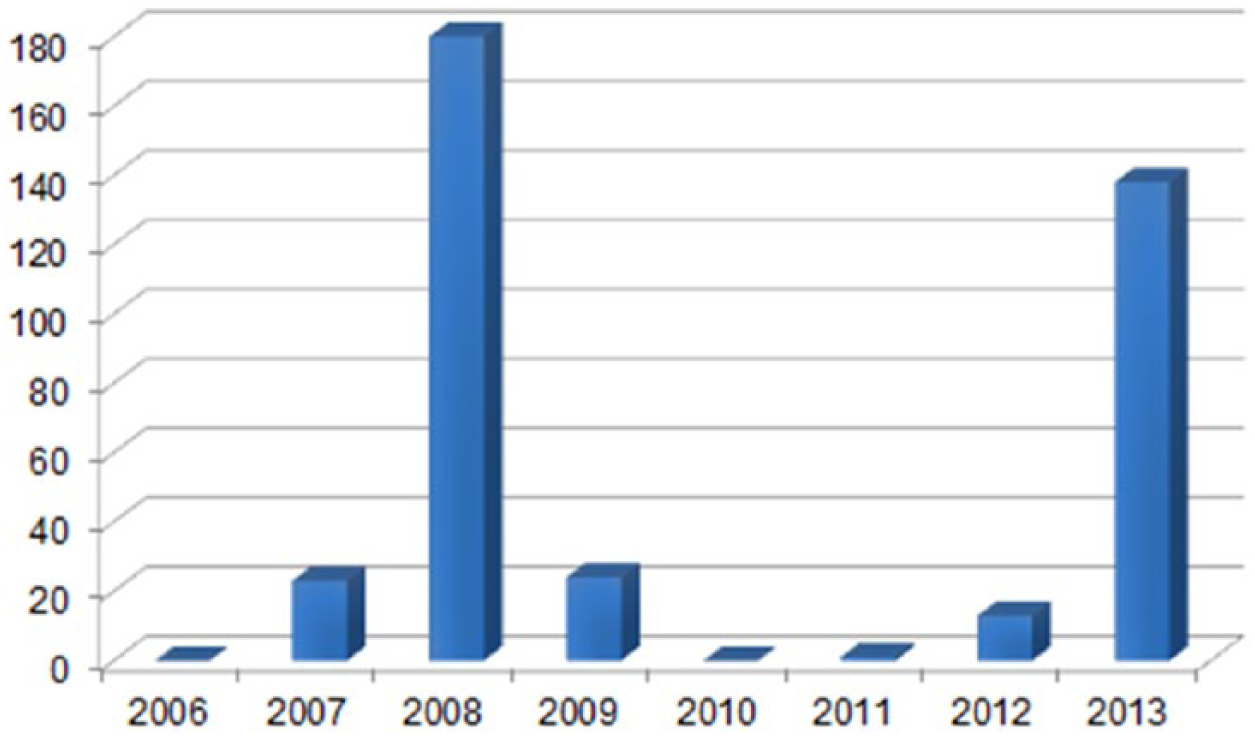
Investigations of the abuse of victims of sex trade (N = 379; October 1, 2006–June 30, 2013).
Sex Buyers in Trafficking and Pandering Cases
The situation appears quite different when we look at the cases of trafficking and pandering. The number of opened pandering investigations went down in 2003, when the Public Order Act came into force. We have not been able to confirm the reasons for this. It is possible that pandering became more difficult and decreased for a while. Likewise, the traffickers may have adapted to the changed circumstance more quickly than the police, who found investigation more challenging than before.
Trafficking became a specific offense in 2004. We found six verdicts of trafficking for sexual exploitation involving some 10 convicts during the period 2005-2013. In all of these cases, the victims were young, either under-age or just older than 18 years old. Three cases, each with an ethnic Finn as a victim, included cruel physical and sexual violence or serious threats of violence. One of the cases ended up in the Supreme Court (SC) after the evaluation was completed (KKO 2014:80). The perpetrator had put up the 17-year-old victim, her friend, who was on the run, and pandered her to quite a large number of sex buyers. The perpetrator, who was 18 at the time of the crime, had threatened the victim, telling that an organized criminal gang was after them. The threat was fabricated, but the victim believed it. The relationship between the two had been unequal and manipulative. The SC found that the perpetrator had recruited the victim to prostitution as is proscribed in the elements of trafficking in CC, Chapter 25, Section 3, and convicted the perpetrator of trafficking.
In three other cases, a woman was trafficked from another European Union (EU) country for exploitation in Finland. One of them was under-age, and the other two were in a vulnerable position because of personal reasons. Only in one of these six cases were the sex buyers investigated, prosecuted, and tried.
We collected 25 pandering judgments, in which the crime took place after the crime of abuse of a victim of sex trade had come into force in 2006. In our reading, these cases gave evidence of two types of use of the services of prostitutes: The first group was prostitution and procuring in massage parlors and sex shops, and the other group was mobile prostitution with trafficking-like features.
The first group of cases, the massage parlors and back rooms of porn shops, were spread around the country. This activity also seemed to be rather mobile, advertising “new girls” in local newspapers and shop windows. However, most of the prostitutes in massage parlors were Finnish citizens or residents with permanent residence permits, who had originally moved to Finland from Thailand to marry a Finnish man. The procurers were in many cases ex-prostitutes or their husbands. The profits seemed to be in many cases quite modest (Sisäasiainministeriö, 2007). This group of cases revealed a serious failure in the integration into Finnish society
In the mobile group, the prostitutes were crossing the borders repeatedly, mostly from neighboring countries. They were selling sex in certain restaurants, apartments, and streets, usually but not only in the capital area. The expert interviews confirmed that different forms of prostitution, in restaurants, apartments, streets, and via the Internet, were overlapping and sometimes involved the same women. The activities were well organized and seemed to be profitable, a conclusion based on the court cases. There were several features similar to trafficking, such as mobility and a high degree of organization. According to the case files, in some cases the prostitutes were heavily indebted to the procurers, indicating some degree of coercion. In many cases, they were strictly controlled by the procurers and often in a very vulnerable situation (Ombudsman for Minorities, 2010, 2012; Penttinen, 2008; Viuhko & Jokinen, 2009). The border line between trafficking and pandering seems to be a blurred one (Roth, 2011). Their procurer could change the rules unilaterally along the way, and sometimes the prostituted woman had to negotiate repeatedly what sexual activities she had to do. Although physical or sexual violence was more frequent and severe in trafficking cases, many characteristics in procuring and trafficking cases were quite similar.
Sex buyers were investigated in one trafficking case, in one porn shop case, and in a number of massage parlor cases. In the court documents, we observed that in any pandering case, there had been a notable number of sex buyers, quite many of whom had been or could have been identified. In massage parlor cases, the buyers were investigated but not prosecuted. Instead, some of them appeared in court as witnesses. In pandering cases with trafficking-like features, the number of sex buyers could be quite high, in some cases some hundreds, but we found no indication of any police interest in them.
Obviously, the number of registered crimes of abuse of a victim of sex trade mainly depends on the resources the police allocate to the investigation of buyers. If the police do not investigate the buyers in the context of the trafficking or pandering investigation, these offenses will not be registered as offenses because there is not really a “victim” who would report the crime.
There are a number of valid reasons why investigation of sex buyers does not succeed in the context of pandering or trafficking investigations. Because abuse of a victim of sex trade is a minor offense, it is legitimate that investigations of trafficking and pandering are prioritized, and the sex buyers have to wait. Afterward, when the trafficking or pandering offense is investigated, it may be difficult to reach the buyers. Even if they are identified, the offense may be difficult to prove as the prostitutes may have already left the country.
The experts with the Helsinki police and the NGO that supports the prostitutes reported that the detection of the clients is not a priority. Rather, the experts were of the opinion that the prostitutes are a source of information to the police and they should be preserved as such. If the clients were fined, the relationship between the prostituting women and the police would be ruined. The prostituting women would no longer be a source of information to the police, and they would not dare call the police if they were violently victimized or if they detected under-age prostitution. There is no real evidence for this risk, but it was believed by both the police and the NGO informants.
Attempts to overcome the difficulties in investigation were made in joint operations with the customs, border control, and different police units in Eastern parts of Finland in 2012 and 2013. These operations were still pending when the evaluation report went to print in 2013, but the operations seem to have been successful in investigating both pandering and sex buying. Some 150 sex buyers were identified, and most of the cases were forwarded to the prosecutor after investigation.
Furthermore, the case materials, expert interviews, and media reporting give a picture of pandering that is far more widespread than the 31 cases brought to court. These sources indicate that in certain restaurants, parlors, and porn shops, there was a pattern of prostitution that most likely is facilitated by different forms of pandering. Moreover, this pandering has features, such as moving across borders and debt relationships, that resemble trafficking, even though elements of trafficking are not fully met or cannot be proven.
Ordinance Law
Visible street prostitution all but disappeared in the beginning of 2000s, first with the City Ordinances and then with the Public Order Act of 2003 (Niemi, 2004), empowering the police to fine the prostitutes for soliciting clients and the clients for buying. According to the ordinance cases and expert interviews, street prostitution is now back—in smaller scale in the capital and mostly limited to early morning hours when bars are closing.
A total of 106 persons were fined for soliciting or buying sex according to the Public Order Act between October 1, 2003 and June 30, 2013. Most of the fines were given in Helsinki (92%), and half of them in a police action during 2011-2012. Most of the fines were given to women in prostitution, and only 16% of fines were given to buyers.
Attrition in the Prosecution and in the Courts
The prosecutors had made decisions in 198 cases of abuse of a victim of sex trade by June 30, 2013 (Figure 2). Thus, the attrition rate from the police to the prosecutors was about one half. 4 The police can shut down the investigation because of lack of evidence or for no reason to suspect a crime.

Abuse of victims of sex trade in the criminal justice system (October 1, 2006–June 30, 2013).
The prosecutors’ decisions were divided between no-prosecution and prosecution. By mid-2013, 73 cases were brought to court. Again, the attrition rate was about one half (not all cases had been decided by the prosecutor yet). The charges were brought in connection with three trafficking and pandering cases: one array of cases in 2007 connected to a motel known for pandering, another array connected to a trafficking investigation and trial in Helsinki in 2008-2009, and a third array of cases in mid-Eastern Finland in 2010.
By mid-2013, the district courts had convicted the accused in 42 cases and dismissed the charge concerning eight accused. Eight defendants appealed the verdicts; six were acquitted in the Courts of Appeal and one in the SC. One verdict was turned down because the defendant died while the case was pending in the SC. All in all, about 350 investigations led to 34 convictions, which means that the conviction rate was about 10%.
All suspects have been male. The standard penalty for abuse of a victim of sex trade has been 20 day-fines and 10 day-fines for attempt. Repeat offenders have received 30-50 day-fines. The day-fine system works so that the gravity of the offense sets the number of day-fines, and the monetary amount of one day-fine is defined according to the income of the offender. The legal minimum for one day-fine is 6 euros for persons with low or no income. Thus, the lowest penalty of 20 day-fines with a value of 6 euros is 120 euros. About two thirds of the offenders have received a higher fine, the highest being 3,100 euros. Such a high fine suggests quite a high income. Also, the professions of the convicted suggest that sex buyers come from every stratum of society, an observations that is in line with earlier research (Kontula, 2008; Månsson, 2004; Marttila, 2003).
Cases
Criminal Intent in the SC
The claim that proceeded to the SC in case KKO 2012:66 was the trickiest one: that of the buyer’s knowledge of trafficking or procuring. The general doctrine of criminal intent requires that the perpetrator must be aware of the elements of the crime. As pandering or trafficking is one of the elements, the prosecutor must show that such awareness existed at the time of the offense. The basic facts of the SC case were the following:
The police revealed and investigated trafficking of an Estonian woman (A) to Helsinki in 2008. X found the woman’s contact information at a popular sex contact site on the Internet. He exchanged several text messages in English with the telephone number given at that site. A meeting was scheduled for a hotel lobby, where A and X met. In the hotel room, X had asked whether everything was all right, after which they had intercourse. The whole encounter took no more than half an hour.
At the first trial, two traffickers were convicted in the District Court for procuring and in the Appeal Court for trafficking. Several sex buyers were brought to court, and the charges against them were processed in four separate trials. The appellant X was charged and summoned to a hearing with 20 other buyers. Only X was personally present at the hearing. X was convicted for abuse of a victim of sex trade in the District Court, and the Court of Appeal upheld the decision.
X appealed to the SC. The SC held a hearing, in which both A and X were heard. X alleged that he had not been able to observe any signs of trafficking or pandering. A stated that she could not remember X anymore (in the police investigation 4 years earlier, A had recognized X as a sex buyer). She told how she had been lured into prostitution in Finland. She also told about her background and how she still suffered from the consequences of trafficking.
The SC made a ruling on two important points, one on the admissibility of evidence and the other on the evaluation of intent (mens rea). The ruling on the admissibility of evidence was preliminary to the evaluation of intent. It may have, however, a paramount impact on future trials. The SC pointed out that only such evidence that was presented at the main hearing and which the defendant had had a possibility to question can be used as evidence. Thus, the minutes of police interviews with other sex buyers, made during the investigation, could not be used as evidence against X. Nor could the documents of the trafficking trial be used as evidence against sex buyers in a subsequent trial (KKO 2012:66, Point 18). The ruling was crucial in this case because the evidence about the state of mind of the woman at the time of the prostitution was mainly based on the evidence presented at the trafficking trial and in the statements of other sex buyers.
The SC formulated the issue of its precedent in Point 3: “The issue is, whether X had from the appearance and behavior of A and other circumstances around the purchase of sex received a sufficient knowledge about this element of crime (intent regarding circumstantial elements).”
As a consequence of the ruling on admissibility of evidence, the SC evaluated intent basically on the basis of the hearings of A and X in the SC. A medical certificate, dated two and half months after the encounter between A and X, is mentioned as giving evidence of the state of mind of A, whether the state of mind of A was so distracted that the buyer should have known that she had been trafficked, but the Court’s own observations almost 4 years after the incident are given more evidentiary value. The SC, like lower courts, referred to the report of the Legal Affairs Committee, in which the Committee had given examples of circumstantial evidence on the basis of which a client should suspect trafficking or procuring: . . . the person is contacted through a middleman, or payment is made to someone other than the person. It is also typical of procuring that a person advertises her willingness for a sexual relationship for payment in a way consistent with an organized and planned broader network of such activities. This may be the case if the same website carries several very similar ads for different persons. Features typical of human trafficking include that the prostitute’s freedom of movement is considerably restricted or that the prostitute is not mentally fully functional. (LaVM 10/2006, p. 6; quoted in KKO 2012:66, para. 6)
The evaluation of what X might have observed is mainly based on what he told at the hearing in the SC. The SC notes, “As the Court of Appeal noted in the justification of its decision, no such factors indicating procuring have emerged that are mentioned in the preliminary works for the provision referred to in Paragraph 5” (KKO 2012:66, para. 25). According to the SC, Young age or foreign origins are not in and of themselves grounds for such a suspicion. The above account of the personality, appearance, language skills and background of A, whether taken separately or considered as a whole, and taking other circumstances into account, does not demonstrate that X must have considered it highly likely that A was a victim of procuring. (KKO 2012:66, para. 32)
The emphasis of the SC was on the subjective state of mind of the sex buyer. In earlier case law, the SC had held that the defendant cannot claim ignorance in all circumstances. Specifically in drug crime, the circumstances can be such that the suspect has a duty of inquiry concerning, for example, the content of a package she or he is carrying (KKO 2001:13; KKO 2001:117; KKO 2006:64). Concerning abuse of a victim of sex trade, the SC does not imply such a duty and, in any case, sets the threshold for it quite high.
Interestingly, lower courts and the SC use the report of the Legal Affairs Committee of the Parliament as their authority. This is understandable, as the Committee was the one to draft the paragraph. However, the courts do not refer to the paragraphs of the CC on trafficking and procuring. CC, Chapter 20, Section 9, on procuring mentions, for example, the keeping or renting of a room for prostitution and the publication of ads for prostitution as forms of procuring. Both elements were at hand in the case, but they are not discussed by the courts. Instead, the mention by the Legal Affairs Committee of organized and planned networks is considered. The crime of procuring (CC, chap. 20, sec. 9), however, does not necessarily require an element of several perpetrators working in an organized manner.
Prosecutors and Lower Courts
Most cases ended on the tables of prosecutors. According to the interviewed prosecutors, the buyers have two distinct ways of reacting. For some, the priority is to avoid the hearing in the court. Therefore, they usually confess and pay the fine quickly. Others present objections to the claim, and if not successful before the prosecutor, they come to the trial and oppose the charges.
The suspects made a number of other objections as well, besides lack of intent, both to the prosecutors and in the lower courts. Some denied that intercourse had taken place, some denied payment, and some denied that they had ever gone to meet the prostitute; some claimed that they had been on a normal date. Some explained that they had just been curious—curious enough to make several phone calls to the prostitute and to go to meet her. In many cases, the objections were successful, leading to non-prosecution or dismissal of the case.
More specifically, a line between a non-criminal inquiry and an attempted offense is beginning to emerge in the decisions. According to the CC, attempted (but not completed) crime is punished with a diminished sentence. In the preparatory works, it was suggested that when the events had proceeded to a contract about intercourse and payment, this would constitute a criminal attempt (LaVM 10/2006). This concept of attempted crime was not accepted in case law. An event could proceed to a meeting in a private room, and if the suspected buyer withdrew or claimed that he withdrew at this stage, he was not convicted or not even charged.
Assessment
The overall assessment of the Finnish sex purchase ban is not very positive. The low number of investigations and the attrition rate of the cases at each level–by the police, by the prosecutors, and in the courts–do not speak of success. There has been some inertia at all stages of the criminal justice system, from the police action all the way up to the SC.
The exact impact on the amount of prostitution is practically impossible to determine. The visibility of prostitution had already diminished once prostitution in a public place was made a minor offense in 2003. In 2013, prostitution in the massage parlors was relatively easy to observe in any Finnish city. The mobility of restaurant prostitution makes the estimation of its prevalence even more difficult. Given the visibility of some forms of prostitution, the low number of cases in the criminal justice system seems to depend on other factors than decrease in prostitution.
To some extent, the inertia in enforcing the law could have been remedied by additional training and education of the actors in the criminal justice system. With proper knowledge of how women in prostitution are exploited in trafficking and procuring and with adequate resources and priorities within the police, it should be possible to investigate, fine, and bring to trial sex buyers. Actually, the recent cases in Eastern Finland show that with proper police work and cooperation among the different police units, customs, border guard, and the prosecutors, procuring and sex buying can be successfully investigated and evidence obtained.
After the SC case in 2012, however, such efforts may turn out to be futile. The SC’s decision confirmed the practice that was emerging in the lower courts that suspects of sex purchase can get away with all kinds of excuses and (pretended or real) ignorance. Thus, only those who admit the crime are fined. In many cases, men admitted buying sex but denied awareness of the exploitative circumstances behind prostitution.
There is an incentive to camouflage trafficking and procuring behind prostitution (Figure 3). This camouflage effect can be illustrated by circles, as shown in Figure 3. In the center is trafficking and procuring that even the buyers have to notice. The outer circle depicts prostitution not involving procuring or human trafficking. The middle circle in the diagram is a “grey area” where procuring and human trafficking are involved. As a rule, attempts are made to disguise procuring and trafficking so as to make the prostitution seem voluntary. In the “grey area,” this deception is successful. In this area, it is difficult even for the police to investigate and for the prosecutor to prove that procuring and human trafficking have occurred, but this depends to a great extent on how many resources are allocated to the investigation. Of course, the camouflage is successful toward a buyer who does not want to know anything.
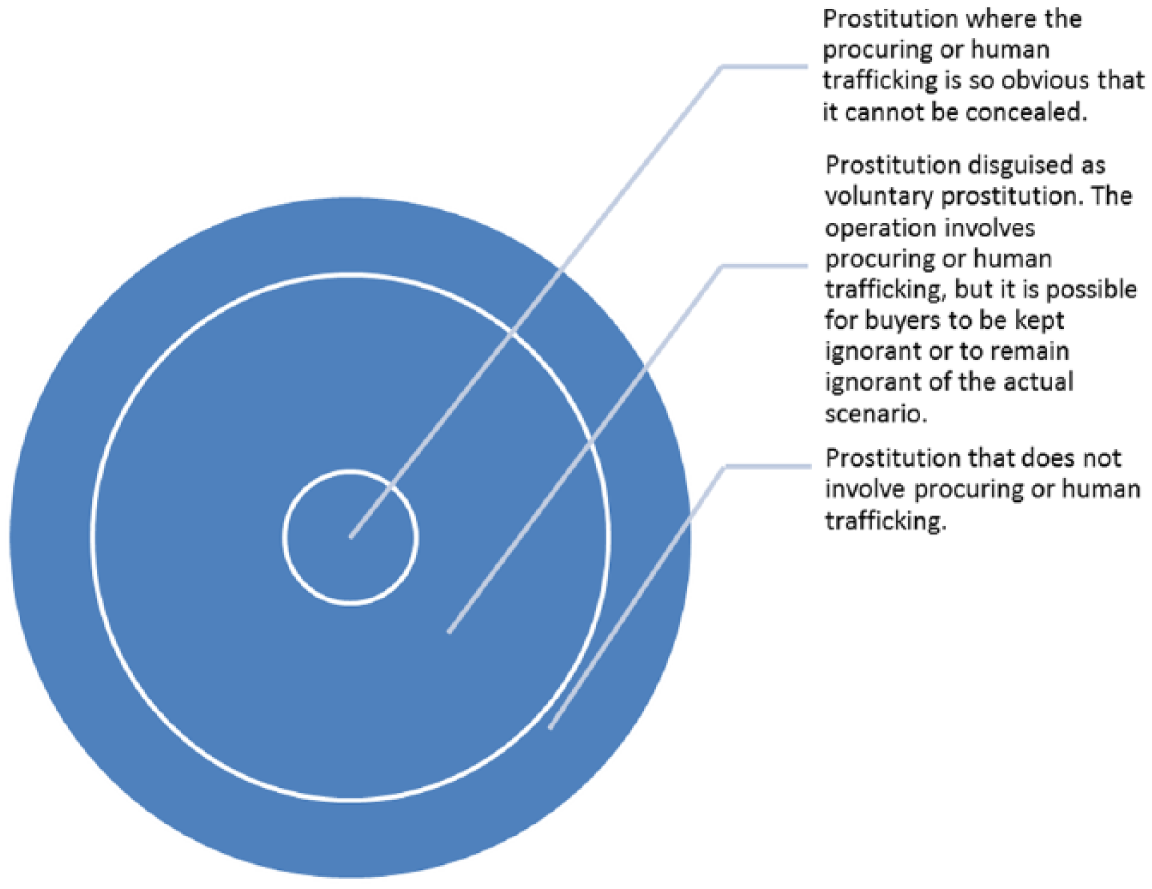
Camouflage effect in prostitution.
As a consequence of the SC’s decision, our assessment is that the Finnish law cannot be made to work just by educating the criminal justice actors. However, trafficking and procuring in Finland have quite exploitative forms, and there is need for stronger protection and prevention. Thus, law reform was necessary.
Conclusion
When we compare the Finnish law to that of Sweden, the most obvious difference is in the ease of implementation. The Swedish law is relatively simple to enforce, and it aids the police in investigation of trafficking. Our conclusion is that the best way to improve the position of women who are abused in trafficking and procuring is to enact a law that prohibits all sex purchase. Also the CEDAW (2014) Committee has paid attention to the fact that other Nordic countries have criminalized buying sex and recommended that Finland also take steps to do so and to discourage such demand.
The most serious misgiving about the total ban on sex buying is the risk that it makes prostitutes more dependent on their traffickers and more vulnerable to physical abuse. These doubts have to be taken seriously even if there is no evidence that the situation in this regard would be any worse in Sweden than, for example, in Finland or Germany. In our opinion, the best way to avoid these risks is to repeal the laws that punish those who are exploited in prostitution. In Finland, the Ordinance Act still punishes those who solicit and offer sex in public places. It should be changed (Niemi & Aaltonen, 2014; Ombudsman for Minorities, 2014). As long as the prostitute fears that she will be fined or deported, the threshold to turn to the police is high. If legislation allows the police to intervene in both the buying and selling of sex, the emphasis in investigations seems to be on fining prostituted women, not tackling the demand side.
A total ban on sex buying may be politically difficult to get passed. There are, however, a number of ways by which the ban against buying from victims of trafficking or procuring can be improved. For instance, the process could be more efficient if the fines were imposed by the police. This is possible without any change of law. Obviously, training of all authorities in the criminal justice system is essential. They need to understand how the trafficking chain functions. It is not enough to train the police; the prosecutors and courts also need to be educated. The police need sufficient resources to successfully investigate prostitution-related crimes.
The level of sanctions should be reconsidered. A small fine (20 day-fines) seems quite a little punishment for exploitation of someone who has been forced, lured, or pressed to prostitution in a vulnerable situation. In Sweden, the scale of punishments for any sex buying (even without the trafficking context) extends to imprisonment for 1 year and, in practice, 50 day-fines has become the default sentence.
The Finnish government has already made an attempt to solve the problem of criminal intent. In the spirit of our evaluation, the law has been amended so that the crime “abuse of a victim of sex trade” is also punishable if committed through negligence, that is, if the buyer had reasonable grounds to suspect that a prostitute was subject to trafficking or pandering (HE 229/2014; Amendment of CC 384/2015; Niemi & Aaltonen, 2014; Tapani 2012a, 2012b).
It is difficult to know what impact this reform is going to have. The experience from the United Kingdom, where the subjective knowledge of the buyer is irrelevant, is not promising. Since 2010, only 47 persons have been fined (Niemi & Aaltonen, 2014). No impact on the volume of prostitution or procuring can be observed.
The Finnish amendment might give the courts an opening to reconsider the interpretation of the case KKO 2012:66 and allow for conviction in similar cases. In the worst case, a new round of contestations of the charges shall follow, with uncertain outcomes. And definitely, it will take another 6 years before we have a new precedent from the SC.
An interesting result of the evaluation was that many sex buyers are rather sensitive to the legal provisions. Some of them knew the details of the legal regulations, at the same time as they did not know anything about the circumstances of their sex partner. Thus, this evaluation showed, if anything, that the law can have an impact on male behavior. Prostitution is not a law of nature, as it is still sometimes depicted, but something that can be influenced.
Demand fosters prostitution, and prostitution is upheld by trafficking. Tackling the demand on prostitution has everything to do with attitudes, both public and those of the authorities. For the general public, social sanctions and the risk of being revealed seem to be the main deterrents. Therefore, the efficiency of the implementation is crucial. Tackling the demand is an essential part of action against human trafficking.
Footnotes
Authors’ Note
In accordance with the 2012 Equality plan of the Finnish government, Ministery of Justice commissioned in 2013 the evaluation of the partial sex buying prohibition, and this article is based on that evaluation. The evaluation was carried out at the University of Helsinki.
Declaration of Conflicting Interests
The author(s) declared no potential conflicts of interest with respect to the research, authorship, and/or publication of this article.
Funding
The author(s) disclosed receipt of the following financial support for the research, authorship, and/or publication of this article: The research reported in this article was funded by the Finnish Ministry of Justice.