



Abstract
Sexual assault history, secondary cognitive appraisals, and a dual-process model of self-regulation were examined as predictors of women’s intended behavioral responses to hypothetical sexual aggression. College women (N = 435) read a sexually aggressive scenario and rated their intentions to engage in assertive, polite, and passive behavioral responses. Results indicated secondary cognitive appraisals predicted less assertive, more polite, and more passive responses. Good self-control predicted assertive and polite responses, while sexual assault history and poor regulation predicted passive responses. Poor regulation significantly moderated the relationship between secondary cognitive appraisals and passive behavioral responses. Implications for the prevention of sexual assault are discussed.
Keywords
Undergraduate women are at an alarmingly high risk of experiencing sexual victimization. Generally, the lifetime rates reported by college women are between 9.6-13.3% for unwanted sexual contact, 3.5-11.5% for verbal sexual coercion, 3.8-12.6% for attempted rape, and 6.4-18.8% for completed rape (Franklin, 2010). Sexual victimization occurring during each year of college is also pervasive, with 24-32% of college women reporting an experience of sexual assault within a given year (Humphrey & White, 2000; Turchik, Probst, Chau, Nigoff, & Gidycz, 2007). Sexual victimization is associated with many negative consequences among college women. Compared with college women without experiences of sexual victimization, those who endorse a history of sexual abuse have significantly more psychiatric diagnoses, trauma-related avoidance and intrusion symptoms, major depression symptoms, substance abuse, pregnancies, sexually transmitted diseases, and lifetime sexual partners (Kaltman, Krupnick, Stockton, Hooper, & Green, 2005; Kilpatrick, Resnick, Ruggierio, Conoscenti, & McCauley, 2007). Although universities that receive federal funding are required to make efforts to protect students from sexual assault (Violence Against Women Reauthorization Act of 2013), the rates of sexual assault on college campuses have remained high throughout the last 15 years (Carey, Durney, Shepardson, & Carey, 2015; Humphrey & White, 2000). Furthermore, very few researchers have reported that existing sexual assault prevention programs actually prevent sexual assault (DeGué et al., 2014). Investigations of factors that can better inform prevention efforts for sexual assault on college campuses are urgently needed.
Enhancing women’s ability to adaptively respond to perpetrators’ sexual advances is an important prevention technique for sexual assault (Rozee & Koss, 2001). Researchers have reported that women’s behavioral responses during sexually aggressive encounters are associated with the event concluding in rape completion (Clay-Warner, 2002; Ullman & Knight, 1993). For example, survivors’ responses to sexual aggression that include running away or physically fighting with the attacker are associated with lower rape completion, while behaviors such as making pleas, begging, and lack of responses are associated with greater rape completion. Researchers have categorized the various potential responses to sexual aggression into assertive, polite, and passive responses (Davis, George, & Norris, 2004; Testa, VanZile-Tamsen, Livingston, & Buddie, 2006).
Assertive responses include yelling, clearly stating to stop with a raised voice, running away, or physically fighting with the attacker (Davis et al., 2004; Testa et al., 2006). Assertive responses are the most effective methods at thwarting unwanted advances (Clay-Warner, 2002; Ullman & Knight, 1993). Polite and passive responses are considered to be non-forceful responses (Davis et al., 2004; Testa et al., 2006) and are less effective in preventing rape (Clay-Warner, 2002; Ullman & Knight, 1993). Polite responses are attempts to divert the perpetrator’s attention, begging, and making pleas to stop. Passive responses are reacting without any physical or verbal resistance. In summary, the literature supports that the use of assertive behavioral responses to sexual aggression may act as a protective factor against experiencing a completed rape, while the use of polite and passive behavioral responses may be risk factors.
Researchers have reported that women’s intention to use assertive, polite, and passive responses to sexual aggression predicts future behavior and risk for sexual victimization (Gidycz, VanWynsberghe, & Edwards, 2008; Kelley, Orchowski, & Gidycz, 2015; Schry & White, 2013; Turchik et al., 2007; Turchik, Probst, Irvin, Chau, & Gidycz, 2010). For example, a woman’s intention to use assertive behavioral responses (Gidycz et al., 2008) and non-forceful responses (Turchik et al., 2007) to hypothetical sexual aggression predicted the actual use of these behaviors during subsequent encounters with sexual aggression. In addition, researchers have reported that in prospective studies, a woman’s initial intention to use less assertive behavioral responses and more polite and passive responses in a hypothetical sexually aggressive scenario predicted the occurrence of sexual victimization 8 months later (Turchik et al., 2010). Finally, lower sexual assertiveness or less perceived confidence in one’s ability to respond to unwanted sexual advances, predicted experiences of sexual victimization in cross-sectional (Kelley et al., 2015) and longitudinal (Schry & White, 2013) research.
Examining women’s behavioral responses to sexual victimization does not mean that women are responsible for assaults; rather, true prevention stems from stopping perpetrators. However, identifying factors that increase the likelihood of a protective versus less effective response to aggression may make it more likely that women can decrease their risk for sexual victimization. Research suggests that secondary cognitive appraisals (Nurius, Norris, Macy, & Huang, 2004; Nurius, Norris, Young, Graham, & Gaylord, 2000; Stoner et al., 2007; Turchik et al., 2007) and self-regulation (Franklin, 2011; Mathes, 2013) are related to sexual victimization; however, more research is needed to understand these relationships. Therefore, the investigators of the current study examined secondary cognitive appraisals and a dual-process model of self-regulation as predictors of women’s intended behavioral responses to hypothetical sexual aggression. The interactions of these two constructs in predicting the various forms of behavioral responses to sexual aggression were also examined.
Secondary Cognitive Appraisals
Nurius and Norris (1996) used the cognitive appraisal-based coping to person-environment transactions theory to better understand the process in which women formulate behavioral responses to the sexual aggression of an acquaintance. In their model, coping appraisals are necessary and influential for the behavioral responses women make during unwanted sexual encounters. In this framework, primary appraisals are initial evaluations resulting in a woman’s perception of a situation as being neutral, positive, or negative. In other words, primary appraisals are an assessment of the degree of benefit or risk present in the situation. If primary appraisals involve the detection of threat, secondary appraisals are activated. Secondary cognitive appraisals further interpret the situation, building a basis for potential behavioral responses. Secondary appraisals include thoughts regarding how capable the woman feels she is at handling the situation, the type of options she ascertains are available to her, and the potential outcomes judged to be likely given a particular response (Nurius & Norris, 1996). In a typical situation involving sexual aggression, a college woman has to evaluate how her response would affect her own desires, the perpetrator’s desires, the future relationship with the perpetrator, and other people’s opinion of her (VanZile-Tamsen, Testa, & Livingston, 2005). This process of weighing risks and benefits associated with potential responses has been termed “walking a cognitive tightrope,” because often any single behavioral response a woman makes may help her come closer to one of her individual goals while moving her further away from another (Nurius & Norris, 1996). For example, a woman may want to respond to the perpetrator in a way that will preserve their relationship; however, doing so may put her at higher risk to be sexually victimized.
The types of secondary cognitive appraisals that make it difficult for a woman to formulate a response that decreases risk for victimization include evaluations involving fear of rejection, concern for the relationship, embarrassment, and self-consciousness (Norris, Nurius, & Dimeff, 1996). Results of experimental and longitudinal research indicated that the presence of these secondary cognitive appraisals predicted the use of less assertive, more polite, and more passive responses in women’s hypothetical and real-life encounters with sexual aggression (Nurius et al., 2000; Nurius et al., 2004; Stoner et al., 2007; Turchik et al., 2007). More specifically, when a woman has initial concerns about responding to sexual aggression, this contributes to the use of behavioral responses that increase risk for completed victimization. However, less is known about other individual factors that are associated with behavioral responses, such as self-regulation. In addition, factors that may increase or decrease the influence of secondary cognitive appraisals on specific forms of behavioral responses have not been adequately investigated. Self-regulation is central to formulating behavior in complex situations (Hofmann, Schmeichel, & Baddeley, 2012) and has been understudied with regard to women’s behavioral responses to sexual aggression.
Self-Regulation
Self-regulation is the ability to accomplish goal-directed behavior when impulses, desires, unwanted thoughts, and habitual patterns of behavior compete for attention (Hofmann et al., 2012). The ability to override competition is possible through utilizing skills to shift or focus attention, contemplate alternative actions, understand the relationship between actions and consequences, and monitor behavior. Deficits in self-regulation have been associated with being a survivor of sexual coercion (Mathes, 2013) and incapacitated rape (Franklin, 2011; Messman-Moore, Ward, & Zerubavel, 2013). These associations may exist because of the relationship between self-regulation and women’s behavioral responses to sexual aggression.
Self-regulation has been conceptualized as a dual-process structure, or consisting of two unique constructs (for a review, see Carver, 2005). It has been theorized that two distinct modes of behavior regulation exist, with one process being more automatic and unintentional, while the other is more effortful and controlled. The automatic system is theorized to process information quickly and require little effort, while the effortful system requires more executive functioning processing (Lieberman, 2007). Will’s dual-process model of self-control differentiates between the two domains, terming them good self-control and poor regulation with each consisting of unique attributes (Wills & Ainette, 2009). Good self-control includes controlled tendencies such as organization, planning, following through on tasks, considering future consequences of behavior, and self-monitoring toward goals. Poor regulation, or automatic tendencies, includes acting without thinking, planning, or restraint; failing to consider future consequences of behavior; and difficulty adapting behavior to the demands of situations. The dual-process model of self-regulation differs from single-factor theories that focus on people either being high or low on a unitary construct of self-regulation (Tangney, Baumeister, & Boone, 2004). Results from previous investigations using confirmatory factor analysis have reported that good self-control and poor regulation factors are distinct constructs rather than a unitary construct (Wills & Ainette, 2009; Wills, Isasi, Mendoza, & Ainette, 2007).
It is important to consider the role of self-regulation when examining behavioral responses to sexual aggression because in a typical sexually aggressive situation, a college woman must process several environmental cues and formulate a response that is consistent with her goals. The facets of good self-control such as organization, planning, patience, future time orientation, self-monitoring, and following through on tasks may assist women to recognize when situational assault antecedents are not in accordance with their long-term goals. In addition, tendencies of good self-control may help women control their own behavior and formulate a behavioral response that is consistent with their long-term goal of refraining from engaging in sexual activity. Therefore, good self-control may be associated with using more adaptive responses (i.e., assertive responses) and decrease the likelihood that non-forceful responses (i.e., polite and passive responses) are used.
Poor regulation is theorized to lead individuals to spend less time focusing on consequences of behavior and quickly formulate responses in social situations (Strack & Deutsch, 2004). Therefore, tendencies to be impatient, distractible, consider immediate rewards and behavioral cues, and act without thinking could decrease a woman’s ability to formulate an adaptive response in sexually aggressive situations. Poor regulation may be associated with less assertive responses, and more polite and passive responses because these responses are in accordance with immediate cues and cognition, rather than distal consequences of action (Carver, 2005). Poor regulation makes it difficult to determine alternative behaviors, solutions, and potential consequences in situations (Curtin & Fairchild, 2003). Therefore, poor regulation may be associated with non-forceful behavior responses because tendencies could make it difficult to overcome the sexual and social cues of sexual situations. In summary, theory supports that self-regulation may affect risk for sexual victimization through directly predicting behavioral responses. More specifically, good self-control may predict more adaptive responses to sexual aggression such that it is associated with more assertive responses, and fewer passive and polite responses to sexual aggression. Conversely, poor regulation may predict less assertive, more polite, and more passive responses.
Secondary Cognitive Appraisals and Self-Regulation
When desires conflict with goals, self-regulation is necessary for successful self-regulation of behavior (Hofmann et al., 2012). Therefore, it is also important to consider how self-regulation affects the influence of secondary cognitive appraisals on women’s behavioral responses. It is possible that factors of self-regulation interact with secondary cognitive appraisals to predict behavioral responses. For example, good self-control may weaken the association between secondary cognitive appraisals and women’s likelihood to engage in less adaptive responses to sexual aggression (i.e., less assertive, more polite, more passive). Women who are high in good self-control may be able to focus on their goal of refraining from engaging in sexual acts and more readily overcome secondary cognitive appraisals that create distraction from formulating an assertive response or support non-forceful responses. Conversely, poor regulation may strengthen the association of the secondary cognitive appraisals on less assertive, more polite, and more passive responses. Poor regulation may increase the influence of secondary cognitive appraisals on less assertive, more polite, and more passive responding because women who have deficits in their ability to inhibit distraction may make it more difficult to overcome secondary appraisals and formulate a response in accordance with self-protection.
Current Study
During sexually aggressive encounters, women’s use of less assertive, more polite, and passive behavioral responses to men’s sexual advances increases the likelihood the event will result in sexual victimization (Gidycz et al., 2008; Turchik et al., 2007; Turchik et al., 2010). The primary goal of the current study was to better understand predictors of women’s intention to use these behavioral responses to hypothetical sexual aggression. To accomplish this goal, female undergraduates completed an online survey in which they read a vignette that asked them to imagine being in a hypothetical sexually aggressive encounter with a male dating partner. Several predictors that are potential targets for prevention were investigated including secondary cognitive appraisals, good self-control, and poor regulation. History of sexual assault was controlled for in all analyses because previous researchers have indicated that it is associated with behavioral responding to sexual aggression (Gidycz et al., 2008; Stoner et al., 2007).
It was hypothesized that while controlling for past history of sexual assault, higher endorsements of secondary cognitive appraisals, lower levels of good self-control, and higher levels of poor self-regulation would be associated with a greater intention to use riskier behavioral responses (i.e., less assertive, more polite, and more passive behavioral responses). It was hypothesized that good self-control would moderate the relationship between secondary cognitive appraisals and behavioral response intentions, such that for individuals high in good self-control, the relationship between secondary cognitive appraisals and responses that are risk factors for sexual assault (e.g., less assertive, more polite, and more passive behavioral responses) would be weaker than for individuals low in good self-control. Conversely, poor regulation was expected to moderate the relationship between secondary cognitive appraisals and responses that are risk factors for sexual assault (i.e., less assertive, more polite, more passive), such that for individuals high in poor self-control, the relationship between secondary cognitive appraisals and behavioral responses would be stronger than for individuals lower in poor self-control. The study is innovative because it provides novel information that increases understanding of the influences involved in women’s decision to select behavioral responses to sexual aggression. Investigating variables associated with females’ behavioral responses to sexual aggression can inform processes that lead to and protect against women’s sexual victimization.
Method
Participants
Participants included 435 female undergraduate students, from a mid-sized midwestern university, aged 18-25 years (M = 19.23, SD = 1.29). Among the women, 91.49% identified themselves as White/Caucasian, 2.53% as Native American, 1.84% as Hispanic or Latino, 1.84% as Asian/Asian American, .46% as African American/Black, 1.61% as Mixed, and .23% as Other. Approximately 55% of the sample were freshmen, 24.37% were sophomores, 12.64% were juniors, and 7.82% were seniors.
Measures
Measures of self-regulation
Good self-control was assessed with the 44-item Good-Behavioral Self-Control Scale, and poor regulation was assessed with the 37-item Poor Behavioral Regulation Scale (Wills et al., 2007). The scales include items from the following measures: Kendall–Wilcox Self-Control Schedule (Kendall & Williams, 1982), Eysenck Impulsiveness Inventory (Eysenck & Eysenck, 1978), Heiby Self-Reinforcement Inventory (Heiby, 1983), Wills Coping Inventory (Wills, McNamara, Vaccaro, & Hirky, 1996), and the Delay of Gratification Scales originated from Chen, Sheth, Elliot, and Yeager (2004). Example items on the Good-Behavioral Self-Control Scale are: “I usually think before I act” and “I plan ahead because I am the one who decides what my future will be like.” Items on the Poor Behavioral Regulation Scale include: “If I find that something is really difficult, I get frustrated and quit,” and “I often do things without stopping to think.” Statements were rated on a 5-point Likert-type scale ranging from not at all true to very true. Previous researchers have reported that these scales form a reliable two-factor structure of self-regulation (Chen et al., 2004; Wills et al., 1996). Averaging standardized scores of each subscale from the Good-Behavioral Self-Control Scale and the Poor Behavioral Regulation Scale formed a mean score for good self-control and poor regulation. In the current study, items on the Good-Behavioral Self-Control (α = .83) and the Poor Behavioral Regulation Scales (α = .83) had good internal consistency.
Stimulus story
The stimulus story utilized in Testa and colleagues’ (2006) research was used in the current study. The story is written from the respondent’s point of view, and prior to reading the vignette, participants were asked to project themselves into the story as if they were experiencing the events as the main character. This vignette was utilized because it reflects the type of situation common for sexual victimization among college women, and involves situational factors that may increase secondary cognitive appraisals that conflict with responding. The story begins with a date between the woman and a man, whom she has been seeing for 2 weeks. During the date, the female character expresses interest in the man and invites him upstairs to her apartment after dinner. Once inside, they begin kissing, and the man makes unwanted sexual advances toward her. The vignette stopped at two time points. The first time is after the man begins kissing the female character more forcefully and begins touching her breasts. The story was stopped, and secondary appraisals were assessed. Then, the story continued with the male character becoming sexually aggressive and ended with the statement, “You feel pinned under the weight of his body. He whispers, ‘Come on, you know you want this.’ He starts to unzip your jeans and presses his mouth firmly against yours” (Testa et al., 2006). Behavioral responses were assessed at this time.
Secondary cognitive appraisals
The Psychological Barriers Instrument (PBI; Nurius et al., 2000) was used to measure secondary cognitive appraisals. The PBI is a self-report measure assessing potential reasons that would make it difficult for a woman to leave a situation in which a man is making unwanted sexual advances. Participants were asked to rate 18 items on a 5-point Likert-type scale ranging from not at all like this to very much like this. An example item is, “I don’t want him to laugh or make fun of me.” Mean scores are used, and higher scores indicate greater psychological barriers. The current study examined the dimensionality of the 18 items from the PBI using Principal Component Analyses. Results indicated that 17 items comprising two dimensions underlie psychological barriers to responding to the sexual aggression depicted in the stimulus story; the first dimension included 11 items related to self-consciousness and concern for the relationship, the second dimension contained six items related to fear of injury, and one item did not load onto either dimension (“I think I can stop him whenever I want to”). For the current study, the first dimension was used to create a mean score of secondary cognitive appraisals and demonstrated good internal consistency (α = .78).
Behavioral responses
A 20-item scale was used to measure female undergraduates’ behavioral response intentions (Testa et al., 2006). Testa and colleagues (2006) used factor analysis to identify three distinct subscales of behavioral responses (i.e., Assertive, Polite, and Passive). The items were scored on a 7-point scale ranging from not at all like my response to very much like my response. Higher scores indicate a greater intention to utilize that form of behavioral responding. Mean scores were formed for each subscale. In the current study, the Assertive Response Scale (α = .91) included six items, such as “Get up and ask him to leave” and “Became physically defensive (e.g., hitting, kicking, scratching).” Ten items were included on the Polite Response Scale (α = .84), such as “Jokingly try to tell him that he is coming on too strong” and “Nicely or apologetically tell him that I don’t want to have sex.” The Passive Response Scale (α = .85) had the following three items: “Become paralyzed and unresponsive to what he is doing because I feel so overwhelmed,” “Not try to do anything because it seems hopeless,” and “Just go along with what he is doing, even though I don’t really want to.”
History of sexual assault
To control for sexual assault history and increase power, one categorical variable representing the presence or absence of a history of sexual assault (0 = no assault, 1 = assault) was created from responses on the Computer Assisted Maltreatment Inventory (CAMI; DiLillo et al., 2010) and the Sexual Experiences Survey–Short Form Victimization (SES-SFV; Koss et al., 2006). The CAMI is a web-based self-report instrument used to assess various experiences of sexual abuse up to the age of 18, and demonstrates good to excellent test–retest reliability (DiLillo et al., 2010). Participants were coded as experiencing sexual assault if they endorsed sexual activity on the CAMI (DiLillo et al., 2010) that occurred before age 18 against the individual’s will, with a family member, or with someone 5 or more years older than the participant. The SES-SF is a revised version of the Sexual Experiences Survey (SES; Koss & Gidycz, 1985) with an internal consistency of .74 and test–retest reliability over a 1-week period of .93. Participants who endorsed a history of sexual activity after the age 18 involving the use of force, threatened harm, or incapacitation were coded as having a history of sexual assault.
Procedure
The Institutional Review Board (IRB) at the data collection site approved the current study before its implementation. Recruitment was conducted via announcements through the online research recruitment program at this university. Participants were given extra credit in college courses after completing the online survey. All participants were required to read an informed consent prior to beginning the survey.
Overview of Analyses
Data cleaning and multiple regression analyses were conducted using Stata 13 (StataCorp, 2013). Data cleaning procedures were performed using recommendations from Tabachnick and Fidell (2007). Outliers (z score of ≥ 3.29, that is, a likelihood p < .001) were examined and there was not strong evidence to suggest the data were invalid. Therefore, the data were not adjusted for potential outliers. Univariate and multivariate assumptions of normality were sufficiently met. Continuous variables were centered at the mean to reduce multicollinearity (Aiken & West, 1991). Each regression model was tested in two steps. Variables were entered in Step 1. In Step 2, self-regulation predictors were entered as interaction terms with secondary cognitive appraisals.
Results
Descriptive Statistics
Approximately 33% of the sample (n = 142) reported an experience of sexual assault during their lifetime. Twenty-five percent of participants (n = 111) reported sexual assault prior to the age of 18. Since the age 18, 21% reported unwanted sexual contact (n = 91), 15% (n = 67) indicated sexual coercion, 13% (n = 56) had experienced an attempted rape, and 13% (n = 58) endorsed an experience of rape since the age of 18. Sixty-eight percent (n = 97) of the women with a lifetime experience of sexual assault reported more than one incident, and 38% (n = 54) indicated that they were incapacitated during their sexual assault. Descriptive statistics are provided in Table 1, and bivariate correlations between all study variables are provided in Table 2. Results for regression analyses are described below and provided in Table 3.
Descriptive Statistics.

Note. 25.52% (n = 111) of the sample reported sexual assault that occurred prior to age 18. 13.33% (n = 58) of the sample reported sexual assault that occurred after age 18.
Correlation Matrix (N = 435).

Note. Assault = categorical scores assault from the CAMI and SES-SF (no experiences of sexual assault prior to age 18 or adult rape = 0, experiences of sexual assault prior to age 18 or adult rape = 1); SCA = Secondary Cognitive Appraisals measured by the Psychological Barriers Instrument mean scores; Computer Assisted Maltreatment Inventory; SES-SF = Sexual Experiences Survey–Short Form.
p < .05. **p < .01. ***p < .001.
Regression Analysis for Assertive, Polite, and Passive Behavioral Responses (N = 435).
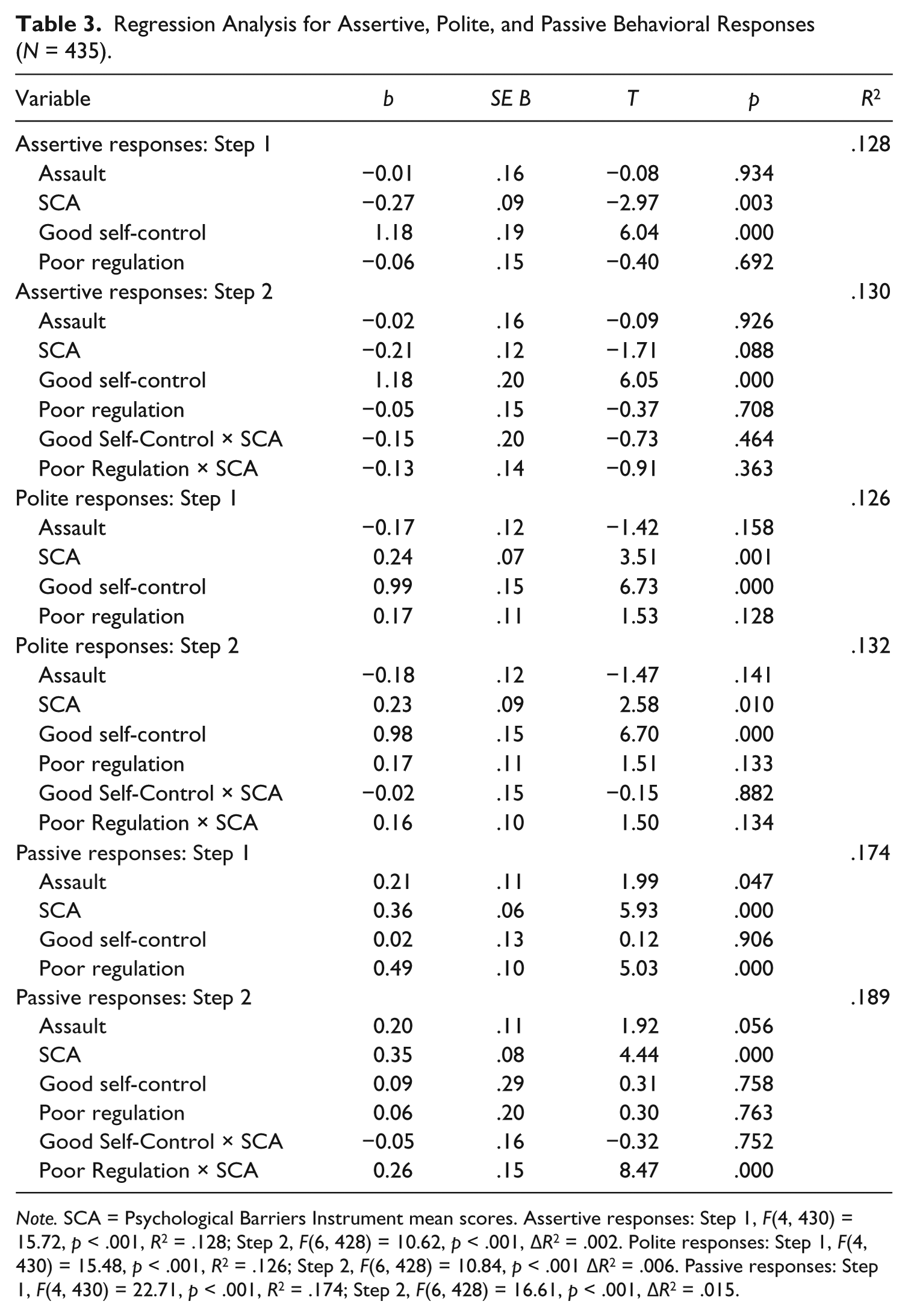
Note. SCA = Psychological Barriers Instrument mean scores. Assertive responses: Step 1, F(4, 430) = 15.72, p < .001, R2 = .128; Step 2, F(6, 428) = 10.62, p < .001, ΔR2 = .002. Polite responses: Step 1, F(4, 430) = 15.48, p < .001, R2 = .126; Step 2, F(6, 428) = 10.84, p < .001 ΔR2 = .006. Passive responses: Step 1, F(4, 430) = 22.71, p < .001, R2 = .174; Step 2, F(6, 428) = 16.61, p < .001, ΔR2 = .015.
Assertive Behavioral Responses
For the first regression analysis, assertive behavioral responses was the criterion variable. At Step 1, sexual assault, secondary cognitive appraisals, good self-control, and poor regulation were entered, F(4, 430) = 15.72, p < .001, R2 = .128. Sexual assault (b = −0.01, p = .934) and poor regulation (b = −0.06, p = .692) were not significant predictors. Secondary cognitive appraisals (b = −0.27, p < .01) and good self-control (b = 1.18, p < .001) were significant predictors of assertive behavioral responses. At Step 2, the Secondary Cognitive appraisals × Good Self-Control, and the Secondary Cognitive Appraisals × Poor Regulation interactions were entered, F(6, 428) = 10.62, p < .001, ΔR2 = .002. Interactions between secondary cognitive appraisals and good self-control (b = −0.15, p = .464), and secondary cognitive appraisals and poor regulation (b = −0.14, p = .363), were not significantly associated with assertive behavioral responses. In other words, the relationship between secondary cognitive appraisals and assertive behavioral responses did not significantly differ depending on an individual’s level of self-regulation.
Polite Behavioral Responses
For Step 1 of the regression analysis with polite behavioral responses as the criterion variable, sexual assault history, secondary cognitive appraisals, good self-control, and poor regulation were entered as predictors, F(4, 430) = 15.48, p < .001, R2 = .126. Sexual assault (b = −0.17, p = .158) and poor regulation (b = 0.17, p = .128) were not significant predictors. Secondary cognitive appraisals (b = 0.24 p < .01) and good self-control (b = 0.99, p < .001) were significant predictors of polite behavioral responses. At Step 2, the Secondary Cognitive Appraisals × Good Self-Control, and Secondary Cognitive Appraisals × Poor Regulation interactions were entered, F(6, 428) = 10.84, p < .001, ΔR2 = .006. Neither, good self-control (b = −0.02, p = .882) nor poor regulation (b = 0.16, p = .134) interactions were significantly associated with polite behavioral responses.
Passive Behavioral Responses
The final regression analysis tested sexual assault history, secondary cognitive appraisals, good self-control and poor regulation as predictors of passive behavioral responses, F(4, 430) = 22.71, p < .001, R2 = .174. At Step 1, good self-control (b = 0.02, p = .906) was not a significant predictor. Sexual assault history (b = 0.21, p = .047), secondary cognitive appraisals (b = 0.36 p < .001), and poor regulation (b = 0.49, p < .001) were significant predictors of passive behavioral responses. At Step 2, the Secondary Cognitive Appraisals × Poor Regulation interaction, and Secondary Cognitive Appraisals × Good Self-Control were entered, F(6, 428) = 16.61, p < .001, ΔR2 = .015. The Cognitive Appraisals × Good Self-Control interaction (b = −0.05, p = .752) was not associated with passive behavioral responses. The Cognitive Appraisals × Poor Regulation (b = 0.26, p < .001) was significantly associated with passive behavioral responses. The Cognitive Appraisals × Poor Regulation interaction demonstrates that the relationship between cognitive appraisals and passive responding was greatest among participants high in poor regulation (see Figure 1). The simple slope of cognitive appraisals on passive responding at 1 standard deviation below the mean of poor regulation was b = 0.23, p < .01, and at +1 standard deviation was b = 0.53, p < .001.

Secondary cognitive appraisals and passive responding moderated by poor regulation (N = 435).
Discussion
The current study examined the role of history of sexual assault, secondary cognitive appraisals, and a dual-process model of self-regulation in predicting women’s intended behavioral responses to hypothetical sexual aggression. The types of behavioral responses examined were adaptive assertive responses, and less effective polite and passive responses. Results indicated that lower levels of secondary cognitive appraisals and higher levels of good self-control predicted more assertive and polite responses. In addition, sexual assault history, secondary cognitive appraisals, and poor regulation predicted passive responses. Furthermore, poor regulation significantly moderated the relationship between secondary cognitive appraisals and passive behavioral responses.
Secondary Cognitive Appraisals
Results from the current study indicated that secondary cognitive appraisals related to sexual aggression, such as worries about losing the relationship with the man or feelings of self-consciousness, uncertainty, embarrassment, or shock, predicted less intention to select an assertive response, and a greater intention to use polite and passive response to hypothetical sexual aggression. Results support the appraisal based coping model, which theorizes that when women have secondary appraisals that create conflict with self-protection they are at greater risk for sexual victimization (Nurius & Norris, 1996). This likely occurs because when women’s evaluations lead to recognition of both risks and benefits to assertive, polite, and passive responses, they must make a quick cost-benefit analysis before implementing a behavioral response. Therefore, women’s ability to make decisive adaptive decisions is impeded.
Self-Regulation
Results support previous researchers’ theory that self-regulation and behavioral responses to sexual aggression are related (Marx, Heidt, & Gold, 2005). Results demonstrated that good self-control and poor regulation are distinct constructs of self-regulation because the constructs uniquely predicted intention to use different types of behaviors. Good self-control was predictive of intention to use more assertive and polite behavioral responses to hypothetical sexual aggression, while poor regulation led to greater intention to use passive behavioral responses.
Poor Regulation
Several important results were related to the role of poor regulation and passive behavioral responses to hypothetical sexual aggression. First, poor regulation predicted passive behavioral responses. Therefore, a woman’s tendencies to act without thinking, be impatient, easily distracted, and consider immediate rewards and behavioral cues may make it more likely that she will respond passively to unwanted sexual advances. This finding offers another potential explanation for the association between self-regulation and sexual victimization (Franklin, 2011; Mathes, 2013). Specifically, higher levels of poor regulation could increase risk for victimization because it leads to difficulty forming behavioral attempts to thwart unwanted sexual advances. In retrospective research, women with a history of responding to sexual aggression with passive responses reported they experienced fear of injury and difficulty responding because of the amount of threat being experienced (Nurius et al., 2000). Automatic forms of cognitive processing (Lieberman, 2007) and processing fearful stimuli (LeDoux, 2003) are associated with activation in the amygdala. It is possible that women, who have stronger tendencies to use automatic processing when regulating behavior, have difficulty forming a behavioral response to aggression, particularly when experiencing fear. Experiencing fear may make it more likely women use automatic forms of processing. It is also possible that experiences of victimization lead to deficits in self-regulation. Hahn, Simons, and Simons (2016) reported that among a sample of college students, more severe experiences of childhood abuse predicted greater impulsivity. There also may be a cyclical relationship such that victimization leads to poor regulation, which then increases risk for revictimization through difficulties regulating behavior in high-risk situations for sexual assault. Future researchers should use longitudinal research to further understand the role of poor regulation on passive responding.
Results revealed that the effect of secondary cognitive appraisals on intention to use passive behavioral responses is stronger among women with high levels of poor regulation compared with those with low levels of poor regulation. In other words, regardless of the secondary cognitive appraisals participants initially endorsed, women who scored low on poor regulation were not likely to indicate passive responses when the man in the scenario placed his body on top of hers. Conversely, high levels of poor regulation weakened women’s ability to overcome initial secondary cognitive appraisals and increased likelihood for them to rate passive responses as more likely once the man forced his body onto hers. Therefore, results suggest that having higher traits of poor regulation may make it difficult to formulate a behavioral response in sexually aggressive situations and overcome thoughts that create psychological barriers to responding.
Good self-control
Good self-control was a significant predictor of intention to use more assertive behavioral responses. Therefore, tendencies to be organized, plan ahead of time, follow through on tasks, consider future consequences of behavior, and self-monitor toward goals may aid women in formulating adaptive responses to sexual aggression. This lends insight into the mechanisms responsible for the association between self-regulation and sexual victimization (Franklin, 2011; Mathes, 2013). Namely, that having higher tendencies of good self-control may be associated with sexual assertiveness, which decreases risk of sexual victimization. Women with greater abilities to rely on controlled executive functioning processing to regulate their behavior may be better able to choose a response that matches their long-term goals and the demands of the situation when encountering sexual aggression.
Contrary to hypotheses, the same tendencies of good self-control that predicted women’s endorsement of adaptive behavioral responses (i.e., assertive behaviors) also predicted the intention to use less effective polite behavioral responses. This finding is sensible when considering women’s goals and the forethought involved in enacting polite behaviors. If a woman has goals to maintain her relationship with the man and to protect herself, then skills of good self-control may make it more likely that a woman will choose a polite response because she may believe it will help her achieve both of these goals. In addition, women may use various forms of responding throughout an encounter of sexual aggression. Therefore, women who have high levels of good self-control may be likely to respond assertively and politely, depending on their goals and how the sexual aggression escalates. Future researchers should examine whether women’s goals or other potential factors influence when traits of good self-control lead women to act politely toward sexual aggression.
Good self-control did not significantly interact with secondary cognitive appraisals to predict assertive or polite responses. Although tendencies related to good self-control help women choose assertive behavioral responses, results did not support that it helps women overcome secondary cognitive appraisals. It is possible that good self-control leads women to form more thoughts that support assertiveness, rather than overcome existing cognitions that act as barriers. In a prospective study conducted by Turchik and colleagues (2007), women’s confidence in being able to assertively respond to a hypothetical sexually aggressive encounter predicted the use of more assertive tactics in actual unwanted sexual situations 8 weeks later. Perhaps tendencies of good self-control help strengthen appraisals that support the goals to act assertively, and therefore minimize internal conflict and promote self-protection. Future researchers should examine the relationship between good self-control and adaptive secondary cognitive appraisals.
Sexual Assault History
Results support previous researchers’ conclusion that women who had a history of sexual assault are more likely to respond to sexual aggression with passive behaviors (Gidycz et al., 2008; Stoner et al., 2007). Sexual assault history increases risk for women to experience subsequent victimization, or sexual revictimization, during their college career (Humphrey & White, 2000; Walsh et al., 2012). Results from this study support that one explanation for the increased risk of revictimization may be the manner in which the women formulate responses to future sexual aggression. It is unfortunate that in the current study approximately one third of women reported a history of sexual victimization. To assist survivors of sexual assault decrease their risk for revictimization, it is essential to help them learn adaptive responses to sexual aggression.
The current investigators did not observe that sexual assault history predicted intention to use assertive and polite behavioral responses. Although some researchers have found past experiences of sexual victimization to be associated with assertive and polite responses (Gidycz et al., 2008; Stoner et al., 2007), others have not (Turchik et al., 2007). These inconsistencies may be due to the variability in the definition of sexual assault and the types of experiences reported by participants. For example, a large portion of participants reported revictimization and being incapacitated during their sexual assault, which is consistent with reports that incapacitated rape occurs more often than forced rape among college women (Carey et al., 2015). In addition, researchers have concluded these are distinct types of rape that are associated with unique outcomes (Brown, Testa, & Messman-Moore, 2009). It is possible that women with forced rape experiences compared with incapacitated rape experiences may respond differently to sexual aggression. Future researchers should use a larger sample size to investigate this possibility.
Limitations
There are limitations to the current investigation. The generalizability of the results is limited due to the sample being comprised of primarily White females from a mid-sized university. In addition, the participants read a hypothetical stimulus story of sexual aggression; therefore, their responses to actual sexual aggression may differ greatly from their responses in this study. A hypothetical scenario does not have the ability to evoke situational factors, emotions, and thoughts that would likely occur and influence subsequent behaviors during women’s actual encounter with sexual aggression from a dating partner. Although the story was chosen because undergraduate women have rated it as being realistic, it is possible that the participants had difficulty projecting themselves into the story. In addition, there are a multitude of potentially sexually aggressive situations in which college women may find themselves, and it is likely that their secondary cognitive appraisals and behavioral responses differ depending on context. Despite these limitations, the current study informs sexual assault prevention programs as described below.
Conclusion
College campuses need to continue to make efforts to provide educational resources and training for women that increase self-regulation and teach strategies to navigate sexually aggressive encounters. Prevention interventions can use cognitive techniques that challenge thoughts women hold that do not support their ability to use self-protective strategies when faced with sexual aggression. It is important to help women adjust the type of secondary cognitive appraisals they formulate in these situations so they can decrease the likelihood they become concerned about the relationship, their self-image, or embarrassment.
Deficits in self-regulation have been associated with behaviors that increase vulnerability for sexual victimization such as sexual risk taking (Messman-Moore, Walsh, & DiLillo, 2010). The current study demonstrates that another mechanism in which self-regulation may be related to victimization is through its impact on women’s ability to formulate behavior in complex social and dangerous situations. Aiding women to develop and strengthen self-regulatory skills may be an effective way to help them enact adaptive behavior in complex sexually aggressive situations that require constant evaluation and adjustment of behavior. There are several interventions that target self-regulation including dialectical behavior therapy (DBT; Linehan, 1993) and acceptance and commitment therapy (ACT; Hayes, Strosahl, & Wilson, 1999). Future researchers should examine whether incorporating aspects of these interventions into sexual assault risk reduction programs has effects on self-regulation skills and one’s ability to effectively navigate risky sexual situations. For example, mindfulness skills may aid women in planning response strategies to sexual situations that are consistent with their goals when experiencing distracting thoughts and emotions. Furthermore, given self-regulation skills begin to develop in childhood continuing through adolescence and young adulthood, these skills should also be targeted for prevention in elementary and high school (Wills & Ainette, 2009). Several interventions have been developed to enhance self-regulation in younger populations including mindful yoga (Bergen-Cico, Razza, & Timmins, 2015; Razza, Bergen-Cico, & Raymond, 2015) and parenting interventions (Sanders & Mazzucchelli, 2014). An important area of further research is examining whether providing self-regulation interventions during childhood and adolescence aids women in formulating adaptive responses to sexual aggression during emerging adulthood.
Footnotes
Declaration of Conflicting Interests
The author(s) declared no potential conflicts of interest with respect to the research, authorship, and/or publication of this article.
Funding
The author(s) received no financial support for the research, authorship, and/or publication of this article.