




Abstract
Socioeconomically disadvantaged adolescents who are exposed to social norms related to violence against women are more likely to experience or be perpetrators of intimate partner violence. This study evaluated factors hypothesized to be associated with acceptance of wife beating among 240 male and female adolescents aged 10-16 years participating in a World Vision program in Armenia. Acceptance of wife beating was associated with relational victimization, perceived social support, and parent and community boundaries and expectations, but was not associated with overt victimization or aggression. These findings highlight several areas that may be important for violence prevention research.
A growing evidence base suggests that social norms are strongly linked to intimate partner violence (IPV; Gressard, Swahn, & Tharp, 2015; Jewkes, Flood, & Lang, 2015; Kiss, Schraiber, Hossain, Watts, & Zimmerman, 2015), and many argue that to end violence against women, the community norms and cultural beliefs that foster violence against women must change (Fleming, Gruskin, Rojo, & Dworkin, 2015; Jewkes et al., 2015; Michau, 2007). One branch of social gender norms or beliefs that are thought to be strongly linked to the actual perpetration of IPV are those related to the acceptability of violence perpetration against a wife, hereafter called wife beating.
Literature Review
According to social learning theory, aggression is learned when a child observes an aggressor receive positive outcomes (Bandura, 1973). It has been posited that children who witness IPV may witness positive outcomes for the aggressor, which may lead to internalization of beliefs that aggression is an acceptable, and even rewarding, means of social interaction with women (Foshee et al., 2016). Acceptance of IPV, including wife beating, may therefore be an important dynamic risk factor for later perpetration of IPV. To date, the studies of justification of IPV have largely involved adult samples, and given that social learning theory has been proposed to account for the intergenerational transmission of violence against women (Foshee et al., 2016), it is notable that little research has examined violence-related beliefs among adolescents. Among the few studies that have surveyed adolescents, adolescent acceptance of dating violence was associated with aggressive behaviors, such as dating violence perpetration (Ali, Swahn, & Hamburger, 2011; Clarey, Hokoda, & Ulloa, 2010; Foshee et al., 2016; Reyes et al., 2015; Reyes, Foshee, Niolon, Reidy, & Hall, 2016; Temple, Shorey, Tortolero, Wolfe, & Stuart, 2013), bullying (Calvete & Orue, 2013; Foshee et al., 2016), and sexual harassment (Foshee et al., 2016). Other factors found to be associated with acceptance of IPV include adolescent childbearing across 25 sub-Saharan countries (Hindin, 2014).
Links between acceptance of dating violence and other maladaptive beliefs have been identified; examples are implicit relationship-to-harm associations (i.e., automatic associations between relationships and harm), and hostile (but not benevolent) sexism in adolescent girls in the U.S. child welfare system (M. S. Lee, Begun, DePrince, & Chu, 2016). Acceptance of IPV is also linked to life experiences, such as perpetration of dating violence and being the victim of dating violence in male and female adolescents (Ali et al., 2011). Previous research specifically evaluating attitudes to wife beating has primarily consisted of epidemiological studies, which focus on identifying demographic variables (e.g., socioeconomic disadvantage; Dalal, Lee, & Gifford, 2012) that can aid in identifying groups at higher risk of acceptance of violence. Unfortunately, these studies do not aid in identifying dynamic factors nor add to the understanding of the relationship between risk factor and outcome. Reducing acceptance of violence against women, particularly wife beating, at an early age may decrease violence against women in communities in the long-term (Dworkin, Treves-Kagan, & Lippman, 2013), and identifying the behaviors associated with these beliefs may be helpful in identifying dynamic factors to inform intervention. Given that socioeconomic disadvantage is a significant risk factor for acceptance of wife beating and IPV (Dalal et al., 2012), identifying dynamic factors specifically for intervention in this context is important.
There are a number of known risk factors associated with socioeconomic disadvantage that have also been linked to attitudes toward violence. As summarized in Table 1, low social support, low boundaries and expectations (lack of clear and enforced rules, low parental monitoring and low expectations of child success), and aggression are associated with both socioeconomic disadvantage and IPV. Evaluating whether these beliefs, behaviors and experiences are associated with attitudes to wife beating is therefore of interest. Similarly, as Table 1 shows, IPV perpetration and victimization in adolescents are indirectly linked to peer victimization of socioeconomically disadvantaged adolescents via internalizing and externalizing behaviors. A similar indirect link may exist between peer victimization and attitudes toward wife beating, but this is yet to be explored.
Risk Factors Associated With Socioeconomic Disadvantage.

Current Study
The current study primarily aimed to evaluate whether acceptance of wife beating by adolescents is associated with risk factors outlined above for socioeconomically disadvantaged adolescents, specifically physical and nonphysical aggression, relational and overt victimization, perceived social support, and parental boundaries and expectations. The study was conducted in Armenia, a low-income country where violence against women is a significant issue. Obtaining reliable data for domestic violence is difficult there, because there is considerable stigma and resistance to speaking out against gender violence due to cultural reasons (Ishkanian, 2007). However, a 2004-2005 study which surveyed 1,200 women in Yerevan (the capital city of Armenia), eight towns, and eight villages found that 46% of women who responded to the survey identified themselves as having been “exposed to violence in the family,” with 25% of these identifying as having been physically abused in the presence of their children (Abrahamian, 2007). Previous research has identified that among Armenian males, 19.9% of adults and 21.3% of adolescents feel that wife beating is justified in particular circumstances, such as a wife burning food, arguing with her husband, going out without informing her husband, neglecting her children, or refusing to have sexual relations with her husband (Rani & Bonu, 2009; UNICEF, 2015). This view is also held by 9.3% of adult females and 7.8% of adolescent females (Rani & Bonu, 2009). The percentage of men and women who accepted wife beating for at least one of these reasons significantly decreased as household wealth increased (Rani & Bonu, 2009).
Given that research has identified links between (a) acceptance of IPV and aggression (Calvete & Orue, 2013; Foshee et al., 2016), and (b) socioeconomic disadvantage and higher levels of aggression (Greitemeyer & Sagioglou, 2016; Romero, Richards, Harrison, Garbarino, & Mozley, 2015), it was predicted that justification of wife beating would be significantly associated with aggressive behaviors (measured in the current study as physical and nonphysical aggression toward peers). In addition, given research suggesting (a) socioeconomic status is associated with victimization by peers (Tippett & Wolke, 2014), (b) victimization by peers is associated with risk factors for IPV (Boyes, Bowes, Cluver, Ward, & Badcock, 2014; Leen et al., 2013; Vagi et al., 2013), and (c) witnessing IPV is associated with overt and relational victimization for both male and female adolescents (Espelage, Low, & De La Rue, 2012; Knous-Westfall, Ehrensaft, Watson, MacDonell, & Cohen, 2012), it was proposed that there may be a link between accepting wife beating and accepting other forms of violence. Although no research has examined this potential link, it seems highly plausible that when internalizing the belief that it is acceptable for a man to beat his wife, beliefs regarding the acceptability of violence in general are also formed, making it more likely for an adolescent to accept being either a perpetrator or a victim of aggression or violence within peer groups. It was therefore predicted that justification of wife beating would be significantly associated with relational and overt victimization by peers. Given that previous studies in Armenia found males were more accepting of wife beating than females, preliminary analyses will investigate gender differences in our sample.
Although family and community social support has been found to be a protective factor for IPV victimization (Van Wyk, Benson, Fox, & DeMaris, 2003; Wright, 2015), and level of parental monitoring is associated with dating victimization and relational aggression (Leadbeater, Banister, Ellis, & Yeung, 2008), no research has previously examined whether these factors are associated with acceptance of wife beating. We suggest that a child who is exposed to high levels of support within the family and community, and perceives their neighborhood and school to be nurturing environments, is more likely to internalize cues from their social context that wife beating is unacceptable than a child perceiving lower levels of support from those same contexts. Similarly, a child who is provided with clear boundaries by their family, school and neighborhood, and believes the adults and peers in their life model responsible behavior, would also be more likely to receive cues from their social context that wife beating is not acceptable. It was therefore hypothesized that perceived family, school and community social support, and boundaries and expectations would be significantly negatively associated with justification of wife beating.
Method
Participants
Participants in this study were involved in an evaluation of an international aid agency World Vision community-based program for adolescents. Ethics approval was provided by Deakin University Ethics Committee, in addition to approval gained from local government and community leaders. The main trial was being conducted with adolescents aged 10-16 years from Aragatsotn Province, Armenia. Adolescents were selected from sixteen schools from two low socioeconomic communities. For ethical reasons, it was deemed important that the children who most needed intervention were included in intervention efforts, and so World Vision’s staff collaborated with school staff, social workers, and community leaders to recruit 240 adolescents from these communities. Plain Language Statements were provided to participants and their parents/guardians, and signed consent was provided by parents, and verbal consent by children, as it is not customary for children to sign documents in Armenia. No child refused to participate in the study. The study sample was comprised of 122 (50.8%) male and 118 (49.2%) female adolescents aged between 10 and 16 years (M = 12.48, SD = 1.33).
Measures
Demographic variables were collected at commencement of the study, including age, gender, parent education, and family structure. The full questionnaire consisted of 176 items related to demographic information, the Developmental Assets Profile (DAP; Leffert et al., 1998), six subscales of the Problem Behavior Frequency Scale (Farrell, Sullivan, Goncy, & Le, 2016), Conflict Resolution Skills—Individual Protective Factors (Phillips & Springer, 1992), Emotional Regulation Questionnaire (Gross & John, 2003), Rosenberg’s (1965) Self-Esteem Scale, Sociopolitical Control Scale (Peterson, Peterson, Agre, Christens, & Morton, 2011), Short Moods and Feelings Questionnaire (Angold et al., 1995) and the Adolescent Measure of Empathy and Sympathy (Vossen, Piotrowski, & Valkenburg, 2015). Only the measures that are relevant to this study are described below.
Acceptance of wife beating
Three items were used to measure acceptance of wife beating. These items were adopted from the 2008 Demographic Health Survey Instrument, which has been widely used internationally in IPV research and has previously been used in research with Armenian youth (UNICEF, 2015). Reliability data are not available for this scale, however some support for the validity of the scale can be found in research indicating an association between responses on this scale and increased risk of experiencing or perpetrating IPV (Kishor & Johnson, 2004; Sambisa, Angeles, Lance, Naved, & Curtis, 2010), although there is some evidence from qualitative data that the scores may underrepresent the proportions of people who condone IPV (Schuler, Lenzi, & Yount, 2011). The acceptance of wife beating scale asks if a husband is justified in beating his wife if she argues with him, goes out without informing him, or neglects her children (Rani & Bonu, 2009). The original measure consisted of five items; however, two items were excluded in the current research as they received comparably low acceptance responses in previous research (Rani & Bonu, 2009), and one of these items related to sexual relations and was therefore considered inappropriate for the age range of the participants in the current study. Responses were coded according to the number of times an adolescent indicated wife beating was acceptable or unacceptable. This led to seven groups being created—(a) yes to three items, (b) yes to two items and no/unsure to one item, (c) yes to one item and no/unsure to two items, (d) no to one item and “unsure” to two items, (e) no to two items and “unsure” to one item, (f) no to all three items, and (g) “unsure” to all items. Because of small numbers in several cells, four of the original groups, (a) yes to three items, (b) yes to two items and no/unsure to one item, (c) yes to one item and no/unsure to two items, and (g) “unsure” to all items, were collapsed to represent acceptance or uncertainty in all three scenarios (n = 65). The three remaining groups were maintained. This categorization is consistent with past research that has grouped any level of acceptance of wife beating as representing an attitude of concern (Koenig, Stephenson, Ahmed, Jejeebhoy, & Campbell, 2006). It could also be argued that adolescents who fail to indicate that wife beating is unacceptable and express uncertainty about acceptability, also demonstrate attitudes of concern. To inform future interventions, it is useful to understand the associated behaviors and beliefs of adolescents who endorse wife beating or fail to refute wife beating in any of the three scenarios, in contrast to those who find wife beating unacceptable in some or all of the three scenarios.
Physical and nonphysical aggression, and relational and overt victimization
Five subscales (31 items) of the self-report Problem Behavior Frequency Scale (Farrell et al., 2016) were administered to measure aggressive behaviors and victimization: Physical Aggression (seven items); Nonphysical Aggression (five items); Relational Aggression (six items); Overt Victimization (six items); and Relational Victimization (six items). For the Physical Aggression subscale, adolescents were asked the number of times in the preceding 30 days they had thrown something at, hit, or pushed someone, or been in a fight in which someone was hit. Nonphysical aggression related to the number of times they had insulted, teased, put down, picked on or given mean looks to another student, and relational aggression related to excluding, spreading a rumor or saying mean things about another child. Similarly, relational victimization related to having another child exclude, spread a rumor or say mean things about the participant, and overt victimization asked how many times another child had hit, pushed or yelled mean things or asked the participant to fight. Items were rated on a 6-point frequency scale and totaled, with higher scores indicating higher levels of aggression or victimization. Previous research has found the internal consistency, as assessed by Cronbach’s α, of these scales ranges from .72 for relational aggression to .84 for victimization (Dahlberg, Toal, Swahn, & Behrens, 2005). In the current study, adequate reliability was maintained for nonphysical aggression (Cronbach’s α = .71) and relational victimization (Cronbach’s α = .81); however, Cronbach’s alpha was below .70 for physical aggression (Cronbach’s α = .69), overt victimization (Cronbach’s α = .69), and relational aggression (Cronbach’s α = .67). For physical aggression, removing three items pertaining to threats of violent acts led to Cronbach’s alpha rising to above .71, which is deemed acceptable (Cicchetti, 1994). Similarly, removing an item related to threatening to hit or physically harm another student led to adequate internal reliability of overt victimization (Cronbach’s α = .70). Relational aggression did not have adequate internal reliability (Cronbach’s α = .67) and was therefore not included in any analyses. The range of possible scores after removing items for each scale were 4-24 for physical aggression, 5-30 for nonphysical aggression, 6-36 for relational victimization, and 5-30 for overt victimization, with higher scores indicating higher levels of aggression or victimization.
Social support, and boundaries and expectations
Two subscales of the DAP (Search Institute, 2013) were administered to measure perceived social support (seven items), and parental and community monitoring and expectations (boundaries and expectations; nine items). Adolescents were asked to indicate the extent to which each item described them in the preceding 3 months, with items scored on a 4-point Likert-type scale ranging from 0-3 (Johnson, 2014). The Social Support scale asks adolescents whether they feel they can approach their parent(s) for advice or to talk, whether their parents try to help them to succeed and are loving and supportive, and whether they have other adults, neighbors, and a school who care. The Boundaries and Expectations scale asks adolescents whether their friends and other adults are good role models, whether their family and school set and enforce clear rules and encourage them to achieve, and their perceptions of family and neighborhood monitoring. Subscales are scored by averaging responses and multiplying by 10, leading to a possible range of 0-30 on all subscales (Johnson, 2014), with higher scores indicating higher levels of support or boundaries and expectations. The DAP has demonstrated high internal consistencies overall (Cronbach’s α = .97); good test–retest reliability (r = .79); and good concurrent validity (r = .82, p < .001; Search Institute, 2013). Cronbach’s alpha indicated adequate reliability in our sample for both social support (Cronbach’s α = .71) and boundaries and expectations (Cronbach’s α =.74).
All measures were translated by an external source into Armenian. Measures were then checked item by item for correct translation by a bilingual team of researchers, and any items that were unclear were discussed with one of the research team members to clarify the original meaning. Consensus among all researchers relating to the accurate translation and meaning of each item was reached. The questionnaire was then pilot tested with a group of Armenian adolescents in Yerevan, and items which proved problematic were flagged. These items were discussed and consensus reached on the wording.
Procedure
Self-report questionnaires were administered in local schools by trained research assistants. Research assistants participated in 3 days of training covering administering quantitative surveys, and were experienced in administering the questionnaire following their involvement in the initial pilot test of the questionnaire. Ice-breakers and energizers were incorporated into the administration process due to the length of the questionnaire and participant capacity to maintain focus. Approximately 1 hr was needed for questionnaire administration, including time taken for ice-breakers and energizers. Questionnaires were completed within classrooms, in which only participating students and those involved in data collection were present. Most adolescents completed the questionnaires independently; however, a small number of adolescents required some support throughout administration due to literacy issues. This support was provided by the research assistants and social workers.
Statistical Analysis
All statistical analyses were conducted using IBM SPSS Statistics version 23. There were less than 5% of missing data, and as Little’s Missing Completely At Random test indicated that the data were missing at random (χ2 = 9,469.80, df = 9,898, p = .99), listwise deletion was used for all missing data. Data were not normally distributed so transformations were applied; however, parallel analyses indicated that transformation did not lead to significant changes in results and so the results presented are for raw data.
MANCOVA was used to evaluate whether level of acceptance of wife beating is associated with physical and nonphysical aggression, relational and overt victimization, social support and boundaries and expectations.
Results
Participant Characteristics
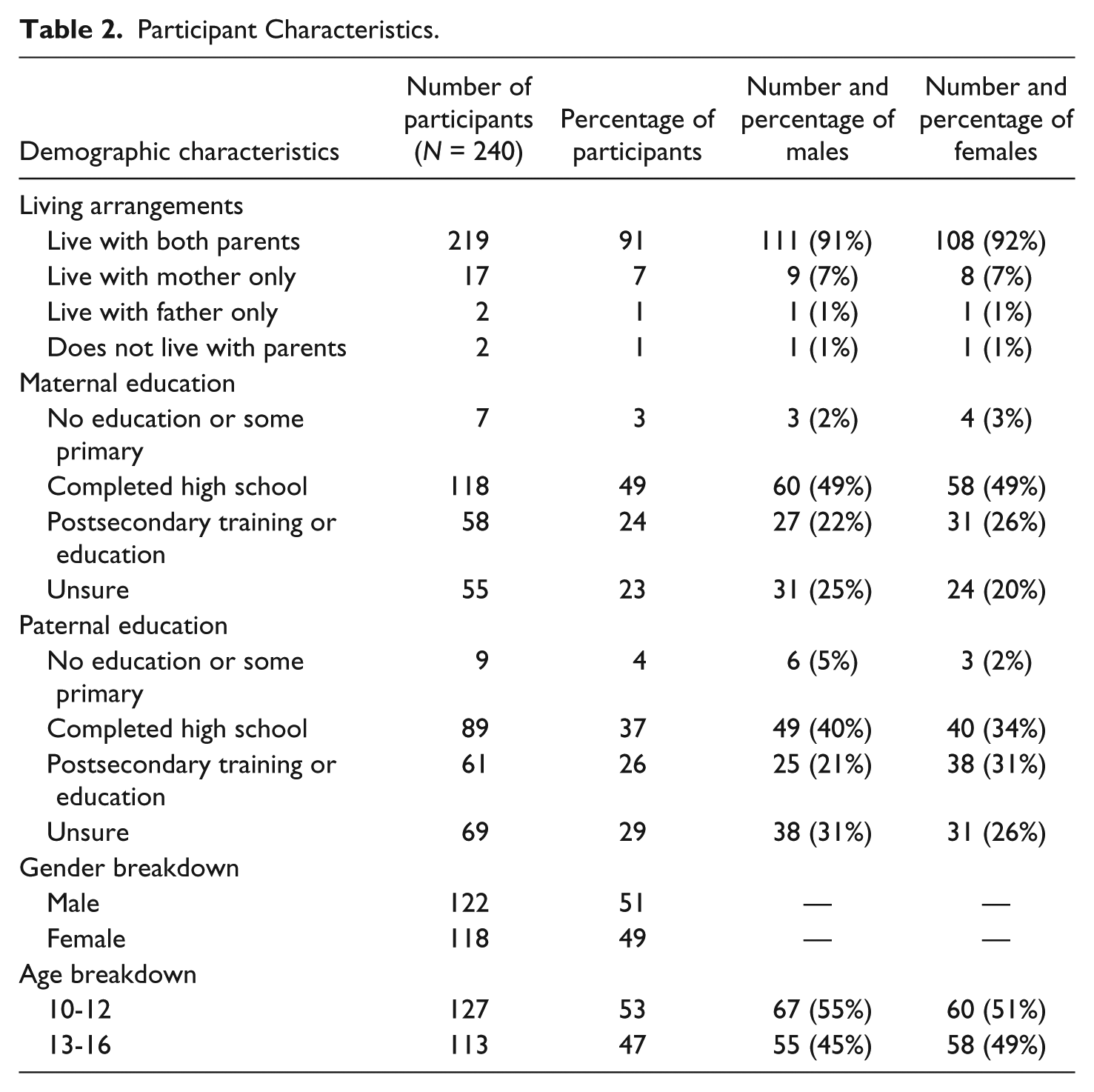
Participant characteristics are summarized in Table 2. Nearly all children live with both parents, and most parents had completed secondary or further training.
Participant Characteristics.
Main Analysis
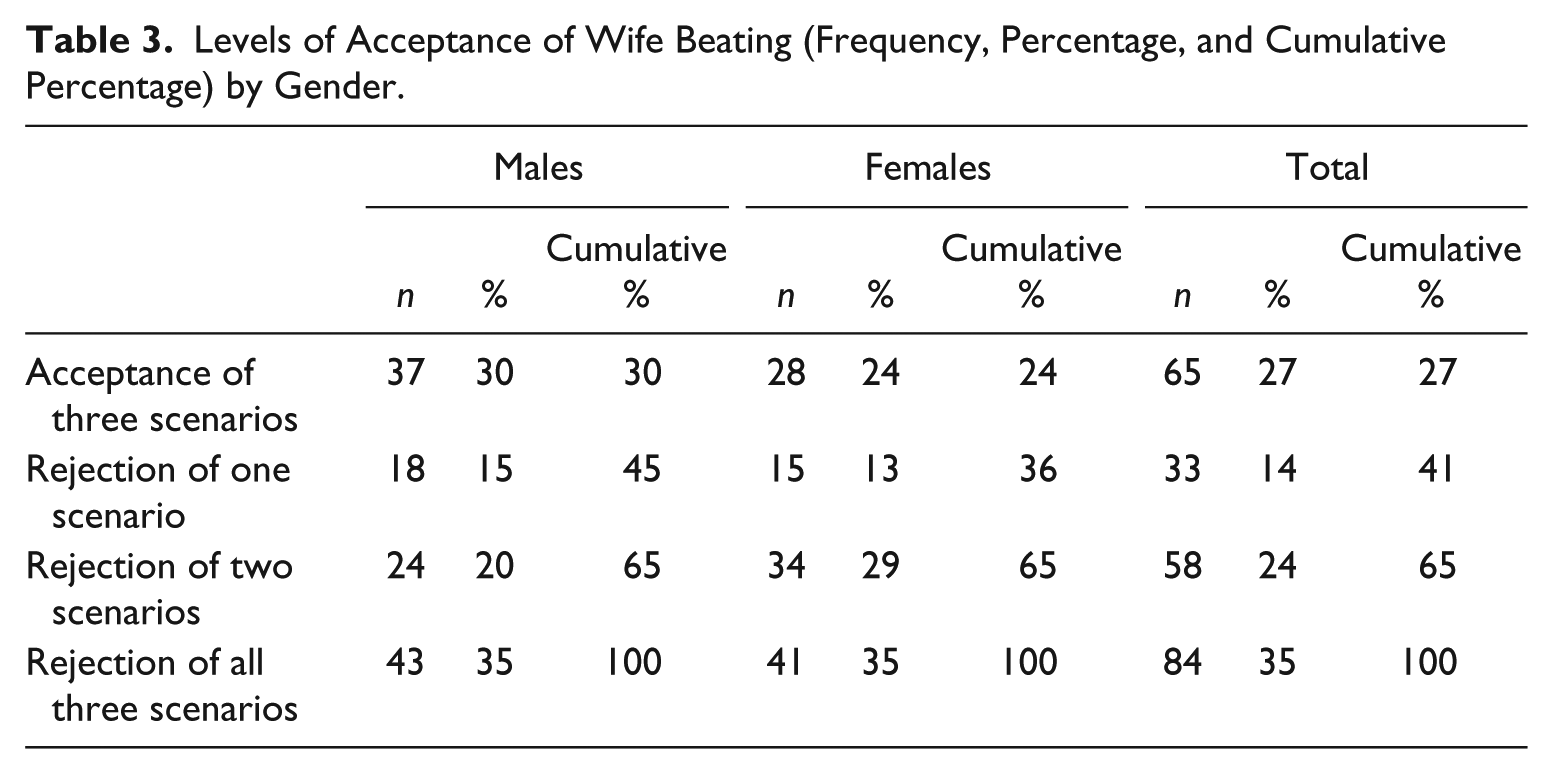
Item analysis indicated overall higher acceptance of wife beating when a wife has neglected her children (n = 44 [18%]; male n = 21 [20%]; female n = 21 [20%]), with lower acceptance for going out without informing her husband (n = 12 [5%]; male n = 8 [8%]; female n = 3 [3%]) and arguing with her husband (n = 8 [3%]; male n = 2 [2%]; female n = 6 [6%]). The number and percentage of male and female adolescents accepting or rejecting wife beating as an acceptable behavior in the three scenarios is summarized in Table 3. A chi-square test of independence did not indicate a relationship between gender and acceptance of wife beating (four groups), χ2(3, N = 240) = 3.23, p = .36.
Levels of Acceptance of Wife Beating (Frequency, Percentage, and Cumulative Percentage) by Gender.
The overall means and standard deviations for each gender for levels of physical and nonphysical aggression, relational and overt victimization, social support, and boundaries and expectations are presented in Table 4. A series of t tests indicated significant gender differences for several variables, namely, males scored significantly higher than females on physical aggression, nonphysical aggression, and overt victimization. Given these gender differences, subsequent analyses controlled for gender.
Descriptive Statistics for Key Study Variables.

Note. Higher scores on aggression and victimization variables indicate higher perpetration and victimization whereas higher scores on social support and boundaries and expectations indicate increased social support and family and community boundaries and expectations.
A MANCOVA was used to determine differences between the four acceptance of wife beating groups on physical and nonphysical aggression, relational and overt victimization, social support and boundaries and expectations, with gender as a covariate. The Box’s M test was significant, indicating a violation of the assumption of homoscedasticity, and so results were assessed according to Pillai’s Trace as this is robust to violations of homoscedasticity. The multivariate results revealed a significant main effect of wife beating beliefs, Pillai’s Trace = .14, F(18, 675) = 1.80, p = .02,
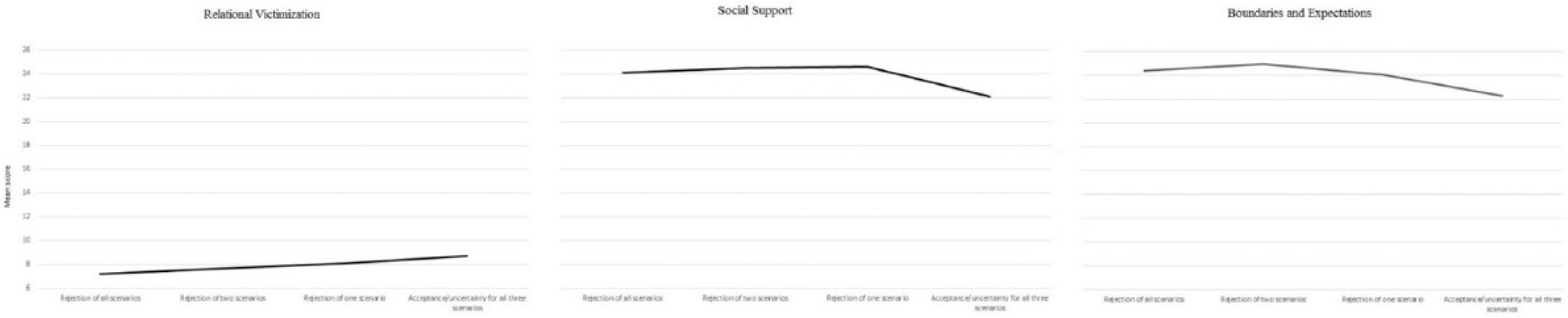
Relational victimization, social support, and boundaries and expectations across the four groups.
Discussion
The current study aimed to determine whether level of acceptance of wife beating by Armenian adolescents aged 10-16 was associated with physical and nonphysical aggression, relational and overt victimization, social support, and boundaries and expectations. A significant association was found between acceptance of wife beating and relational victimization, social support, and boundaries and expectations, but not for physical and nonphysical aggression, or overt victimization. In total, 22% of adolescents indicated that they felt wife beating was justified in at least one circumstance, which for male adolescents is similar to findings of research conducted in Armenia in 2010 when 21.3% of males and 7.8% of females aged 15-19 agreed that wife beating is justified in some circumstances (UNICEF, 2015). In contrast to the 2010 research, however, there were no significant differences in acceptance of wife beating between males and females, with a similar proportion of males (23%) and females (22%) indicating wife beating is justified. The higher acceptance of wife beating by females relative to the 2010 study is concerning, and is possibly due to the low socioeconomic conditions all adolescents included in our sample are exposed to, and the rural location in which these adolescents live. It is also possible that given adolescents in our sample were of a younger age, and therefore different stage of their cognitive development, that this may affect their conceptualization of wife beating. The acceptance of wife beating by both male and female adolescents suggests it is important that interventions target these beliefs in both groups, particularly as previous research has found negative outcomes associated with these beliefs for both genders (Calvete & Orue, 2013; Hindin, 2014; Kunnuji, 2015).
A significant association was found between acceptance of wife beating and relational victimization, social support, and boundaries and expectations, but no significant associations were found for physical and nonphysical aggression, or overt victimization. These latter findings conflict with our premise that acceptance of wife beating may also lead to higher acceptance of other forms of violence, such as peer victimization. In particular, the lack of a significant association between acceptance of wife beating and any form of aggression was not in line with previous research with adolescents that has found that acceptance of wife beating is associated with aggressive behaviors (Calvete & Orue, 2013; Foshee et al., 2016). These previous studies only included adolescents who had witnessed family violence, whereas in our study exposure to family violence was not included as a measure, and so this may explain the difference in results. However, given the high rate of family violence in Armenian homes identified by other research, it is likely that our sample did in fact contain a high proportion of adolescents who had been exposed to family violence. One other possible explanation for this finding is that wife beating may not be considered an aggressive behavior in Armenia, where cultural beliefs have traditionally considered “physical discipline” of a wife an acceptable means of “teaching” a wife (Amnesty International, 2008). This, though, seems unlikely given that only a quarter of the sample indicated acceptance of wife beating, suggesting this view of wife beating as “discipline” is not widespread among adolescents.
Although overt victimization was not found to be significantly associated with acceptance of wife beating, a significant association was found for relational victimization, with adolescents who responded with acceptance or uncertainty for all three scenarios being significantly more likely to have been relationally victimized than adolescents who rejected all three scenarios. Previous research examining relational victimization in youth has found that those who experience relational victimization are more likely to have witnessed domestic violence or experienced physical or sexual abuse in the home prior to the age of 9 years (Espelage et al., 2012; Knous-Westfall et al., 2012). It is unclear whether the results of our study are due to an increased likelihood of witnessing or experiencing violence in the home leading to the internalization of beliefs that allow for greater relational victimization in other contexts, or if there are other factors that may explain these results, such as increased victimization by peers leading to increased acceptance of other forms of violence. Further research evaluating the directionality of these associations is warranted.
Finally, significant associations were found between acceptance of wife beating and lower perceived social support and boundaries and expectations. However, although there was clearly an overall significant trend associating acceptance of wife beating with lower social support, post hoc analyses did not identify any specific significant group differences. In relation to boundaries and expectations, although a clear trend was evident, significant differences were only found between acceptance or uncertainty for all three scenarios and rejection of two scenarios. The overall trends were in line with our predictions, as social support has been identified as having a protective effect in regard to wife beating (Van Wyk et al., 2003; Wright, 2015) and parental monitoring as having a protective effect on dating victimization and relational aggression (Leadbeater et al., 2008). Furthermore, given that gender norms are constructed socially, it was expected that a more supportive and nurturing social environment would provide cues that interpersonal violence is unacceptable, thereby reducing the likelihood of internalizing acceptance of wife beating beliefs.
Caution does need to be exercised in the interpretation of the results for several reasons. First, as this study did not include a measure of family violence within the home, it is possible that adolescents who perceive lower levels of social support and boundaries and expectations may do so because they have been exposed to family violence. Second, the social support scale was self-report, and so although it is clear there is a relationship between perceived social support and acceptance of wife beating, it is unclear whether this reflects actual social support available, or perceptions that may be influenced by other factors.
When the significant findings of this study are looked at in full, the picture that emerges is that adolescents who believe that wife beating is acceptable also perceive lower levels of social support available to them, have fewer boundaries and expectations imposed on them, and experience increased relational victimization. Although the causal links between these risk factors are not yet clear, it seems likely that the combination of these various risk factors may have an accumulative negative effect on the outcomes of adolescents. These risk factors have been found to be associated with increased internalizing (Hurd, Stoddard, & Zimmerman, 2013; Spieker et al., 2012; Walper, 2009), externalizing (Human-Hendricks & Roman, 2014; Hurd et al., 2013), substance use (Lac & Crano, 2009; Omer, Satran, & Driter, 2016), delinquency (Human-Hendricks & Roman, 2014; Spieker et al., 2012; Voulgaridou & Kokkinos, 2015), and poorer educational (Ainsworth, 2002; Bodovski, 2014; Froiland & Davison, 2014) and employment outcomes (Moore et al., 2015; Wagner, Newman, & Javitz, 2014), and so understanding the causal processes that lead to the combination of these risk factors is important.
Limitations
There are several important limitations to consider. First, this research was only conducted at one time point, and so was only able to evaluate whether particular beliefs and behaviors were associated with acceptance of wife beating, rather than establish clear causal connections. Similar research tracking the associations longitudinally is needed to better understand whether acceptance of wife beating changes over time, and what the trajectory and long-term outcomes are for adolescents who internalize these beliefs. Second, acceptance of wife beating was measured using self-report questionnaires, and adolescents with lower literacy required some assistance from social workers. It is therefore possible that social desirability influenced some adolescents’ responses resulting in an underestimate of the acceptance of wife beating.
Another limitation is that this study was conducted in a rural area in Armenia with adolescents experiencing significant poverty. The results therefore may not be relevant to other cultures or socioeconomic groups. In addition, the current study did not measure exposure to violence within the home, and so future research evaluating whether the acceptance of wife beating accounts for associations between violence within the home and negative outcomes would be useful. Finally, the results of the analyses did not indicate linear trends in the associations, as not all groups differed from each other on each measure. This may be due to the nature of the processes used to categorize participants and the lack of equivalence of the wife abuse items. Future studies might focus on establishing a more detailed measure of attitudes to wife beating.
Implications
It is clear from the current research that there are some important areas for future research to focus on. First, given that comparisons between the results of previous studies in Armenia and the current results suggest that acceptance of wife beating may decrease in females throughout adolescence, research is needed to evaluate whether attitudes toward wife beating change throughout adolescence, as understanding the developmental trajectory of these attitudes may help to identify when intervention will be most effective. Second, given that some of the results regarding the relationship between aggression and victimization by peers with acceptance of wife beating conflicted with previous research, further research should be conducted to evaluate whether acceptance of wife beating is associated with aggression and victimization, particularly when controlling for other factors such as exposure to family violence and low socioeconomic status. Finally, these results suggest that not only does intervention need to address the attitudes to wife beating held by adolescents, but it should also target increasing the social support available to adolescents and reducing risk factors for peer relational victimization to mitigate these multiple risk factors. A meta-analysis of school-based interventions designed to reduce dating and sexual violence through targeting acceptance of dating violence and reducing incidents of dating violence perpetration and victimization found that these programs lead to significant decreases in acceptance of dating violence compared with control groups, but not significant changes in behavior (De La Rue, Polanin, Espelage, & Pigott, 2014). As such, further research is needed to evaluate whether interventions designed to address adolescent beliefs regarding gender and/or family violence are more effective when incorporated within an approach designed to increase both social support, and boundaries and expectations, for adolescents. A number of promising programs include Expect Respect Support Groups (ERSG; Ball et al., 2012), Peace Road for Children (World Vision International, 2009), and “Second Step: Student Success Through Prevention” (Espelage et al., 2012). Given that no gender differences in acceptance of IPV or relational victimization were identified in the current study, interventions for this age group that target both genders appear warranted.
Conclusion
Our research, the first to investigate correlates of attitudes toward wife beating among adolescents, found that adolescents who believe it is acceptable for a man to beat his wife were significantly more likely to be relationally victimized by their peers, and significantly more likely to perceive family, school and community social support and boundaries and expectations to be low. This research clearly identifies multiple risk factors associated with acceptance of wife beating, highlighting important areas for future intervention research to focus on. In particular, the association of perceived social support and boundaries and expectations with acceptance of wife beating warrants further investigation.
Footnotes
Acknowledgements
The authors thank World Vision International and World Vision Armenia for their financial, intellectual, practical, and technical support of this research.
Declaration of Conflicting Interests
The author(s) declared no potential conflicts of interest with respect to the research, authorship, and/or publication of this article.
Funding
The author(s) received no financial support for the research, authorship, and/or publication of this article.