



Abstract
This study focused on gender differences in the prediction of adult intimate partner violence (IPV) by subtypes of child abuse and children’s exposure to IPV. Latent classes of adult IPV consisted of a no violence (20.3%), a psychological violence only (46.2%), a psychological and sexual violence (9.2%), a multitype violence and intimidation (6.8%), and a psychological and physical violence with low intimidation class (17.5%). Physical–emotional child abuse and domestic violence exposure predicted a higher likelihood of multitype violence for males. Sexual abuse predicted a higher likelihood of this same class for females. Implications for future research and prevention are discussed.
Introduction
The goal of this study was to investigate the relationship between childhood exposure to abuse and other forms of violence in the home and the risk of later involvement in intimate partner violence (IPV). Although a relatively well-established pattern, we conducted this study to address several limitations and gaps in published research. First, research to this point has been dominated by cross-sectional studies with retrospective measures, which are problematic because they do not allow for the temporal ordering of variables and because responses about child abuse and other forms of early adversity are subject to recall bias (e.g., Capaldi, Knoble, Shortt, & Kim, 2012; Ehrensaft et al., 2003). Second, relevant studies have infrequently explored the connections between different types of exposure in children (e.g., exposure to physical and emotional abuse vs. sexual abuse vs. exposure to IPV) and outcomes of IPV perpetration and victimization in adulthood. Third, research on IPV in adults has used relatively narrow measures and typically does not attend to both perpetration and victimization in a single analysis. And, fourth, there has been a lack of attention to gender differences in the prediction of IPV. Before explaining the analysis model used in this study, we provide a brief overview of the literature and offer some of the key findings from recent reviews.
Review of the Literature
An intergenerational cycle of violence exists within families, such that children’s direct and indirect exposure to abuse (e.g., physical, emotional, sexual) and IPV when they are young tends to elevate their risk of perpetrating and being victimized by violence when they reach adulthood (Capaldi et al., 2012; Ehrensaft et al., 2003; T. I. Herrenkohl et al., 2004; Linder & Collins, 2005; Renner & Slack, 2006; Roberts, Gilman, Fitzmaurice, Decker, & Koenen, 2010; Stith et al., 2000). In fact, research shows that individuals exposed to violence as children often are exposed to other stressful events and are more likely than others to be victimized at other points in their lifetimes (Finkelhor, Turner, Hamby, & Ormrod, 2011; Finkelhor, Turner, Shattuck, & Hamby, 2013). According to Finkelhor and colleagues (2013), this pattern of “polyvictimization” affects a sizable number of young people. According to results of their National Survey of Children’s Exposure to Violence, a cross-sectional telephone survey of children 17 years of age and younger, 15% of youth respondents experienced six or more victimization events, including maltreatment by a caregiver, witnessing violence, and being physically or sexually assaulted. Sadly, many polyvictimized youth continue to be vulnerable to violence in relationships when they enter and progress through adulthood.
Although some research attends to the repetition of violence and vulnerability of children who have been victimized, most studies on IPV are relatively basic in their design; that is, they focus on correlations between one, or perhaps several, predictors (e.g., physical child abuse, witnessing violence) and a single outcome (e.g., IPV victimization). In a meta-analysis of 39 studies published from 1978-1997, Stith et al. (2000) found that growing up in a violent home—experiencing child abuse and/or witnessing interparental violence—was significantly associated with physical IPV perpetration and victimization in adult heterosexual marriages. For perpetration, the researchers documented an effect size of around .18, which is in the small to medium range. Tests of the effects sizes for abuse and witnessing violence in the home showed they did not differ. Similar size effects were documented for adult IPV victimization. Thus, both forms of exposure in children—direct and indirect—predict IPV in adulthood.
Findings summarized in other reviews reflect this pattern. For example, Gil-González, Vives-Cases, Ruiz, Carrasco-Portiño, and Álvarez-Dardet (2008) conducted a systematic review of 10 retrospective studies published from 1995-2004 focused on the association between childhood experiences of violence and later perpetration of verbal, physical, and sexual IPV. They found a consistent association between early exposure to violence and adult IPV perpetration, although the findings apply only to males. Similarly, a narrative review of 228 studies on risk factors for psychological, physical, and sexual IPV found evidence of a low to moderate association of child abuse and childhood exposure to IPV with later IPV perpetration and victimization (Capaldi et al., 2012). Capaldi et al. caution, however, that their results are mostly from retrospective studies. Furthermore, Milaniak and Widom (2015) found those with substantiated abuse in childhood were significantly more likely to self-report adult IPV perpetration compared with nonabused matched controls. It is important to note that the study used an extremely limited measure of IPV consisting of only one item.
An interesting question raised in the literature is whether certain types of child maltreatment are more predictive of later IPV involvement than are others (T. I. Herrenkohl, Sousa, Tajima, Herrenkohl, & Moylan, 2008). However, because of the low base rate of certain forms of maltreatment, and because of the complications inherent in trying to differentiate subtypes of co-occurring risk influences (Capaldi et al., 2012; Dong et al., 2004; Ehrensaft et al., 2003; R. C. Herrenkohl & Herrenkohl, 2009; T. I. Herrenkohl et al., 2008), there have been relatively few well-designed studies on this topic. Casey, Beadnell, and Lindhorst (2009) found that experiences of physical and sexual abuse in childhood, particularly the combined experience of both forms of abuse, were associated with sexually coercive behavior toward an intimate partner for young adult males. Testing multiple forms of childhood abuse and a broad definition of adult IPV, Davis et al. (2018) found support for emotional and physical abuse in childhood, increasing the likelihood of perpetrating psychological and physical violence for adult males. In a review of the literature, T. I. Herrenkohl and colleagues (2008) did address the issue of how direct abuse and children’s exposure to domestic violence compare in their prediction of later outcomes for those who are affected. They determined that both forms of exposure appear to have measurable, long-term consequences for children’s development, and that when these exposures occur together, as they often can, the negative impact on children’s health and social functioning can be worse. In certain respects, this finding is similar to what Finkelhor and others describe in relation to the concept of polyvictimization, which fits a more general pattern of cumulative or additive risk (Dong et al., 2004).
Social learning theory is one perspective used to explain the intergenerational patterns of violence and abuse that exist within families (Akers, 1985; Bandura, 1977; Cochran, Sellers, Wiesbrock, & Palacios, 2011; Dodge, Bates, & Pettit, 1990). According to the theory, children who experience violence when they are young are at higher risk of perpetrating and being victimized by violence because they become socialized to certain models that breed hostility and aggression (Stith et al., 2000). Children incorporate styles of relating to others based on what they perceive as “normal” within the family. If violence is a common occurrence, children come to view it as just part of the way individuals express emotions, such as anger and frustration. Although their own experiences of abuse may leave them emotionally harmed and vulnerable, adults with abuse histories are more apt to resort to, and become victims of, violence in their own relationships because it is what they know and have endured, sometimes over many years. The fact that individuals who were abused and neglected as children often lack problem-solving skills, are inclined to attribute hostile intentions to others, and also partner with others similarly prone to violence adds to the likelihood of certain adult outcomes, including IPV (Ehrensaft et al., 2003). This perspective applies equally well to women and men, although systematic tests of gender differences in patterns leading to IPV are notably lacking (T. I. Herrenkohl et al., 2008).
Gender Differences
Whether child abuse and children’s exposure to domestic violence relate to later IPV similarly for males and females is indeed an open and unanswered question (T. I. Herrenkohl et al., 2008). Although there has been some research on the topic, findings are mixed (Capaldi et al., 2012). For example, Stith and colleagues (2000) found that although significant associations of child abuse/IPV exposure and later IPV perpetration and victimization were evident for both genders, both child abuse and IPV exposure were stronger predictors of later IPV perpetration for males. Notably, Fang and Corso (2008) found a significant association between child physical abuse and adult IPV perpetration only for females, whereas child sexual abuse predicted later IPV perpetration only for males. Magdol, Moffitt, Caspi, and Silva (1998) found a significant association between harsh disciplining at age 7-9 years and IPV perpetration and victimization (physical and psychological) at age 21 years only among females. In a multivariate analysis of that study, harsh disciplining was associated with physical perpetration only for females. Bensley, Van Eenwyk, and Wynkoop Simmons (2003) found no relation between retrospectively measured sexual abuse and past-year physical and psychological IPV victimization among adult women aged 18-64 years. In contrast, Thompson et al. (2006) found that retrospectively measured reports of child sexual abuse were, in fact, associated with IPV victimization for women. So, too, did Whitfield, Anda, Dube, and Felitti (2003). In that findings are very clearly mixed and based mainly on retrospective reports, more research on these topics is sorely needed.
Measuring IPV
Earlier published studies on the link between childhood abuse and later IPV typically examined perpetration and victimization separately (Ehrensaft et al., 2003; Fang & Corso, 2008; Renner & Slack, 2006). However, the perpetration and victimization of IPV are highly interrelated (e.g., Anderson, 2002), and many perpetrators are themselves past and present victims of violence. For example, in the National Surveys of Families and Households, about 64% of dyadic respondents who perpetrated IPV in marital and cohabiting relationships also reported having been victimized (Umberson, Anderson, Glick, & Shapiro, 1998). In the meta-analytic review by Stith, Smith, Penn, Ward, and Tritt (2004), IPV perpetration was moderately correlated with victimization (r = .41).
In measuring and studying violence perpetration and victimization, it is important to include covert as well as overt forms of abuse (P. H. Smith, Tessaro, & Earp, 1996). Doing so will provide a means by which to assess potential gender differences in the form and prediction of IPV. For example, Houry et al. (2008) found that more than a quarter (27.1%) of female victims of IPV reported being intimidated by their male partner, whereas only around 6% of men reported intimidation. At the same time, women and men were affected by physical aggression in their relationships at comparable rates. Houry et al. (2008) found that 22% of women and 21% of men were victims of IPV, and 7% and 5%, respectively, were perpetrators of IPV; 2% of women and 13% of men were both victims and perpetrators.
Measures such as the Conflict Tactics Scale (CTS; Capaldi et al., 2012; Straus, 1979; Straus, Hamby, Boney-McCoy, & Sugarman, 1996) have been criticized for not assessing power and control as a dimension of violence in intimate relationships. The addition of items from measures such as the Women’s Experiences of Battering Scale—an instrument designed to assess perceived susceptibility to physical and psychological danger and loss of power and control in intimate relationships—complement CTS-type items (P. H. Smith, Earp, & DeVellis, 1995; P. H. Smith, Smith, & Earp, 1999; P. H. Smith et al., 1996). Thus, we combine these items to assess IPV victimization and perpetration in the current study.
In summary, findings regarding the association between abuse and children’s exposure to violence and later IPV are generally consistent, in that these experiences are indeed related. Yet, more nuanced questions about the link between different types of exposure and different types of IPV in adults—and about gender differences—have yet to be thoroughly addressed. In addition, measures of IPV are generally limited in the types of behaviors and experiences of violence they capture. Thus, our goal was to add to what is known by addressing some of these more nuanced questions, drawing on an expansive longitudinal data set that is well suited to testing developmental (life course) patterns of violence exposure and perpetration.
To capture variability in the experiences of IPV among adults in this study, we conducted a latent class analysis (LCA) of IPV victimization and perpetration. The analysis incorporates various types of self-reported IPV and perceptions of intimidation and control (see “Measures” section). Measures of physical–emotional child abuse, sexual abuse, childhood exposure to IPV, and control variables were then added to the analysis as predictors of IPV class membership to determine the degree to which each form of exposure in children relates to the IPV outcomes. As described below, we also test for gender differences both in the composition of the IPV classes and in the prediction of those classes.
Method
Data and Procedure
Data are from the Lehigh Longitudinal Study, which began in 1973-1974 as the evaluation portion of a child abuse and neglect treatment and prevention program in two counties of eastern Pennsylvania (R. C. Herrenkohl, Herrenkohl, Egolf, & Wu, 1991). Selection of the sample was accomplished over a 2-year period by referrals from two county child welfare agencies of cases in which there was at least one abused or neglected child aged 18 months to 6 years present in the home. The children served by child welfare agencies participated in one of several group settings (e.g., day care, Head Start). It was from these other settings that children from outside the child welfare system were enrolled in the study. The original sample totals 457 children and is composed of near equal numbers of males (n = 248) and females (n = 209). The racial and ethnic composition of the sample is consistent with the makeup of the two-county area from which participants were drawn: 1.3% (n = 6) American Indian/Alaska Native, 0.2% (n = 1) Native Hawaiian or Other Pacific Islander, 5.3% (n = 24) Black or African American, 80.7% (n = 369) White, 11.2% (n = 51) more than one race, and 1.3% (n = 6) unknown. Eighty-six percent of children were from two-parent households. About 61% of families were in poverty according to income-to-needs ratio (income/federal poverty guideline <= 1) in the year of 1976 (n = 276).
The first “preschool” wave of the study took place in 1976-1977 when children recruited to the study were 18 months to 6 years of age. A second “school-age” assessment was conducted in 1980-1982 when the children were 9 years old on average. A third “adolescent” assessment of all youth participants (91% of the original sample) was conducted in 1990-1992 when they were 14-22 years old. An adult wave of the study was completed in 2010 after intensive locating and interviewing efforts. Approximately 80% of the original sample still living (N = 356) was located and assessed via a comprehensive, interviewer-administered survey. In the adult assessment, participants were 36 years of age (range = 31-41 years) on average. The sample remains gender balanced: 186 (52.1%) males and 170 (47.9%) females. Although more of the original child welfare group was lost to attrition, there were no statistically significant group differences in gender, age, childhood socioeconomic status (SES), or ratings of neglect or parent-reported physically abusive discipline (T. I. Herrenkohl, Hong, Klika, Herrenkohl, & Russo, 2013). Study procedures were approved by the Human Subjects Division at the University of Washington and the Office of Research and Sponsored Programs at Lehigh University.
The current sample was reduced to N = 326. Excluded are the cases of completely missing data on the IPV indicators because they were neither in marital nor romantic relationships at the time of the survey and in the previous year. Table 1 shows the descriptive statistics for the study sample.
Demographics of the Sample and Descriptive Statistics and Gender Differences of the Study Variables.

Note. IPV = interpersonal violence; WEB = Women’s Experiences With Battering Scale; SES = socioeconomic status.
Racial minority group includes African American, Asian, Native American, Pacific Islander, and mixed race.
p < .05. **p < .01. ***p < .001.
Variables
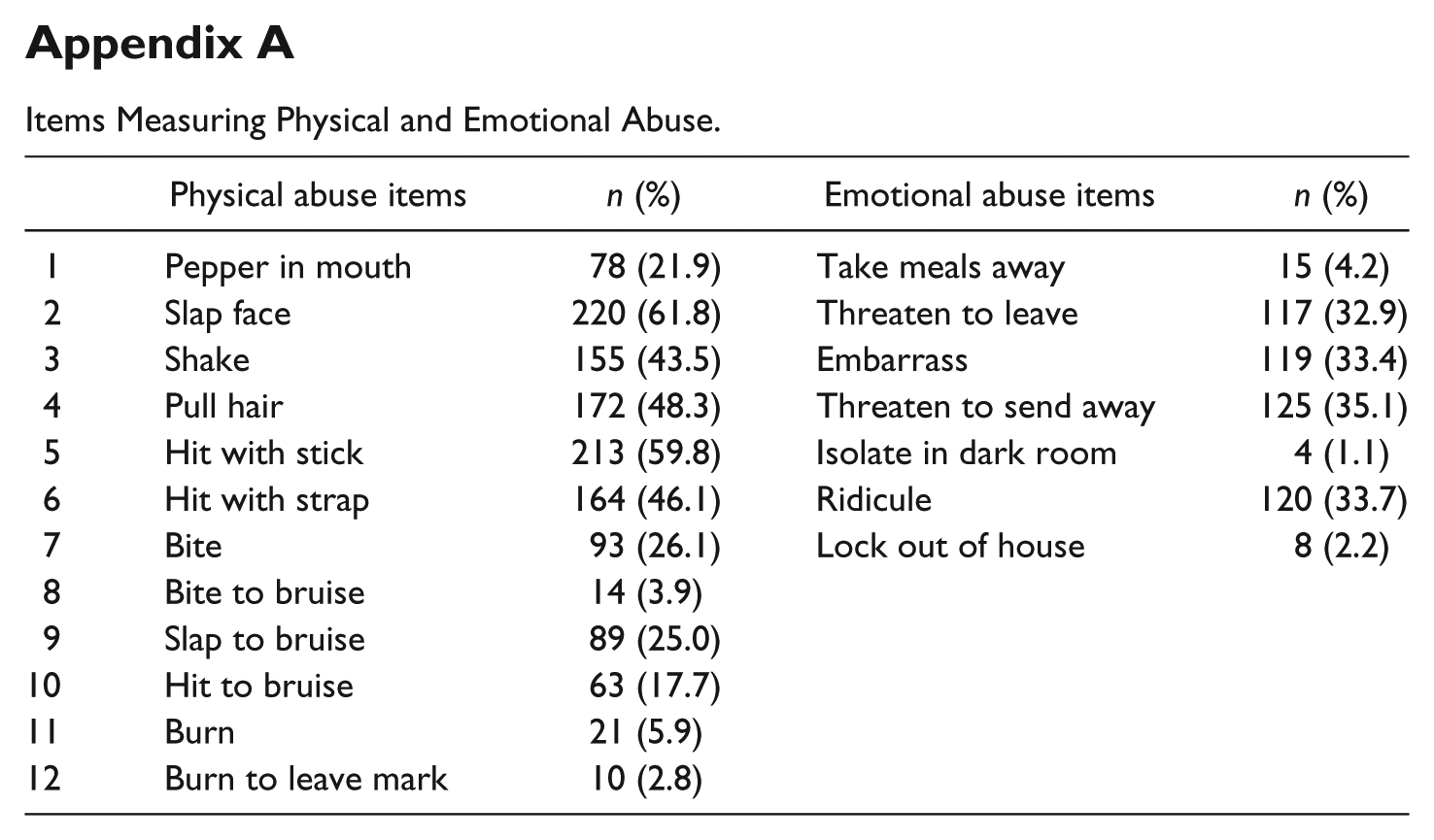
Child physical and emotional abuse was measured in the preschool assessment of the larger study by asking parents (mostly mothers) about their and other caregivers’ use of physically (12 items) and emotionally (seven items) abusive disciplining practices (see Appendix A for the list of items). Mothers responded to questions about their own, fathers,’ and others’ physical disciplining of children for two time periods: (a) in the last 3 months and (b) prior to the last 3 months. Questions asked about emotionally abusive practices referred only to the 3 months prior.
Questions covered a range of practices, some of which were abusive (e.g., shaking a child, slapping a child’s face, hitting a child with a stick or paddle, taking meals away from a child, threatening to leave a child, threatening to send a child away). To differentiate abusive from nonabusive disciplining, each practice was assigned a rating of 0 to 5 to reflect its level of severity. Practices with a severity rating of 5 were considered abusive; those with a 4 were considered severely punishing; those with a 3, mildly punishing; those with a 2, mildly rewarding; and those with a 1, highly rewarding. For the current analysis, practices with a rating of 4 or 5 (severely punishing or abusive) were retained and then combined for each participant.
In scaling the data, our interest was in a child’s overall exposure to physically and emotionally abusive discipline practices across all possible caregivers. The overall scale score a child received on the combined measure can vary both in the number of abusive practices used by a caregiver and by the number of abusive caregivers. Descriptive statistics for the physical and emotional abuse variables are as follows: Physical abuse for the last 3 months had a range of 0-42.9 with M = 7.3 and SD = 8.3, and physical abuse prior to the last 3 months had a range of 0-86.5 with M = 19.1 and SD = 18.3. Emotional abuse for the last 3 months had a range of 0-32.0 with M = 4.3 and SD = 6.4. These three abuse variables were modeled as indicators of a latent construct of child abuse in the preschool period.
Childhood exposure to IPV was measured by parental reports of their experience of IPV. In the preschool wave of the study, parents were asked (on a frequency of 1 = none of the time, 2 = rarely, 3 = frequently, 4 = most of the time) how often they or their partners/spouses (asked separately) threatened to physically harm the other; hit, pushed, or kicked; or destroyed something. Items were recoded (1 = frequent occurrence, 0 = no or rare occurrence) to identify frequently occurring behaviors. Any frequent occurrence of a behavior among the listed three by either partners/spouses was dichotomously coded as IPV exposure. In all, 30% (n = 84) of children were exposed to IPV and 70% (n = 196) were not.
Child sexual abuse was based on data from a number of sources, including child welfare case records and retrospective reports from the adolescent and adult assessments. All abuse occurred before age 18 years. Responses were coded yes (1) or no (0). In total, 127 participants (41.0%) were found to have been sexually abused. Of these, 84 (56.4%) were females.
Adulthood IPV was measured by nine indicators, eight of which pertain to the perpetration and victimization of physical, psychological, and sexual violence. Violence resulting in physical injury was also included. A separate indicator of perceived intimidation and control, based on the Women’s Experiences with Battering (WEB) Scale (P. H. Smith et al., 1995; P. H. Smith et al., 1999), was also included. Reports on the WEB indicate that it is an appropriate measure for both male and female victims and that the scale has good construct validity and strong internal consistency reliability (P. H. Smith et al., 1995; P. H. Smith, Thornton, DeVellis, Earp, & Coker, 2002). Respondents indicated their level of agreement or disagreement with items (1 = strongly agree to 6 = strongly disagree) that include “He or she can scare me without laying a hand on me” and “He or she makes me feel like I have no control over my life, no power, no protection” (see Appendix B for the full list). Item scores were summed into a single continuous variable, which ranged from 10-60 (M = 14.5, SD = 9.2). A binary variable was created using the cutoff point >19 according to the original development of the scale and prior uses of WEB items (C. A. Smith & Thornberry, 1995; P. H. Smith et al., 2002). Scores >19 were coded 1 (intimidation and control; n = 43 [13.9%]) and scores of 19 or lower were coded 0 (no intimidation and control; n = 266 [86.1%]).
Eight indicators for IPV perpetration and victimization were included. Respondents self-reported on the Revised CTS whether they had engaged in certain behaviors (perpetration) or whether the same behaviors had been used against them (victimization). Subscales of Physical Assault, Psychological Aggression, Sexual Coercion, and Physical Injury were created, conforming to the Revised CTS guidelines, which newly included sexual coercion and physical injury given their importance in the context of IPV (Straus et al., 1996). The validity and the reliability of the scale is well established (Archer, 1999). Eight items of Psychological Aggression, 12 items of Physical Assault, seven items of Sexual Coercion, and six items of Physical Injury were dichotomized to indicate whether or not they had happened in the past year. Any occurrence of the listed behavior items was dichotomously coded as IPV for each type. As shown in Table 1, a majority of the sample experienced psychological IPV: 78.6% (n = 254) as perpetrators and 75.2% (n = 243) as victims. Physical IPV was perpetrated by 16.7% (n = 54) of the analysis sample, whereas 16.4% (n = 53) were determined to have been physically victimized. Nearly 12% (11.8%, n = 34) reported they perpetrated sexual IPV and 13.9% (n = 45) reported they have been sexually victimized by an intimate partner. Rates of IPV resulting in physical injuries was low: 3.4% (n = 11). Perpetration of IPV resulting in injuries to victims was also low: 5.3% (n = 17). Overall, there were no statistical differences in rates of IPV across males and females except for physical perpetration (χ2 = 9.69, p < .01) and sexual victimization (χ2 = 4.63, p < .05) being higher among females (25.3% and 18.3%, respectively).
Control variables included childhood SES and official child welfare involvement. Official child welfare involvement was included to account for the group composition of the sample, which distinguishes children involved with child welfare at the start of the study from those not involved: 1 = child welfare group (n = 160, 49.1%) and 0 = comparison (n = 166, 50.9%). Childhood SES is a standardized composite measure of parents’ occupational status, educational level, and family income, with a range −5.43-6.30, M = −1.27, and SD = 1.90.
Analysis
Analyses were conducted in two phases. In Phase 1, we conducted an LCA of IPV victimization and perpetration. The analysis used maximum likelihood estimation with robust standard errors to classify participants on the nine IPV indicators. Models estimating one to six classes were compared on Bayesian information criterion (BIC), Lo–Mendell–Rubin (LMR) likelihood ratio tests (LMR-adjusted LRT), and the bootstrapped likelihood ratio test (BLRT) to gauge improvement in fit with each additional class. To examine the possibilities of gender differences in the LCA, we conducted a second analysis in which gender was added to the model as a covariate. Item thresholds and class probabilities were freely estimated across gender.
Phase 2 introduced measures of physical–emotional child abuse, sexual abuse, childhood exposure to IPV, and control variables as predictors of IPV class membership. Physical–emotional child abuse was analyzed as a latent factor indicated by three child abuse variables (two physical abuse measures assessed for the two different reference periods—the last 3 months and prior to the last 3 months—and one emotional abuse measure assessed for the last 3 months). A confirmatory factor analysis (CFA) for the child abuse construct preceded the predictive models, and supported the fit of the child abuse construct to the data, root mean square error of approximation (RMSEA) = 0, comparative fit index (CFI) = 1, standardized root mean square residual (SRMR) = 0, with the standardized factor loadings in the total sample being 0.83 and 0.51 for physical abuse for the last 3 months and prior to the last 3 months, and 0.50 for emotional abuse for the last 3 months; 0.90, 0.53, and 0.50 for males, and 0.72, 0.49, and 0.47 for females. The loadings were all statistically significant (p < .001). Subsequently, the predictive models were assessed in a one-step approach where two models—the latent class model and the latent class regression model (regressing the latent classes on predictors and interaction terms)—were combined into a joint model using maximum likelihood estimation (Asparouhov & Muthén, 2012). Gender interactions in predictors were also tested.
Results
Latent Classes of IPV in Adulthood
Estimation of a series of latent class models determined that a five-class model best fit the data. As shown in Table 2, the sample size–adjusted BIC was the lowest (1,745.8) for the five-class model. In addition, the BLRT and LMR-adjusted LRT rejected the hypothesis that the four-class model is preferable to the five-class model (p < .05), whereas the LMR-adjusted LRT suggested that the five-class model was preferable to the six-class model (p = .09). The entropy was 0.90, indicating that probability of class assignment for the five-class model is high.
Latent Classification of Intimate Partner Violence in Adulthood (N = 325)—Latent Class Analysis Models With No Covariate.
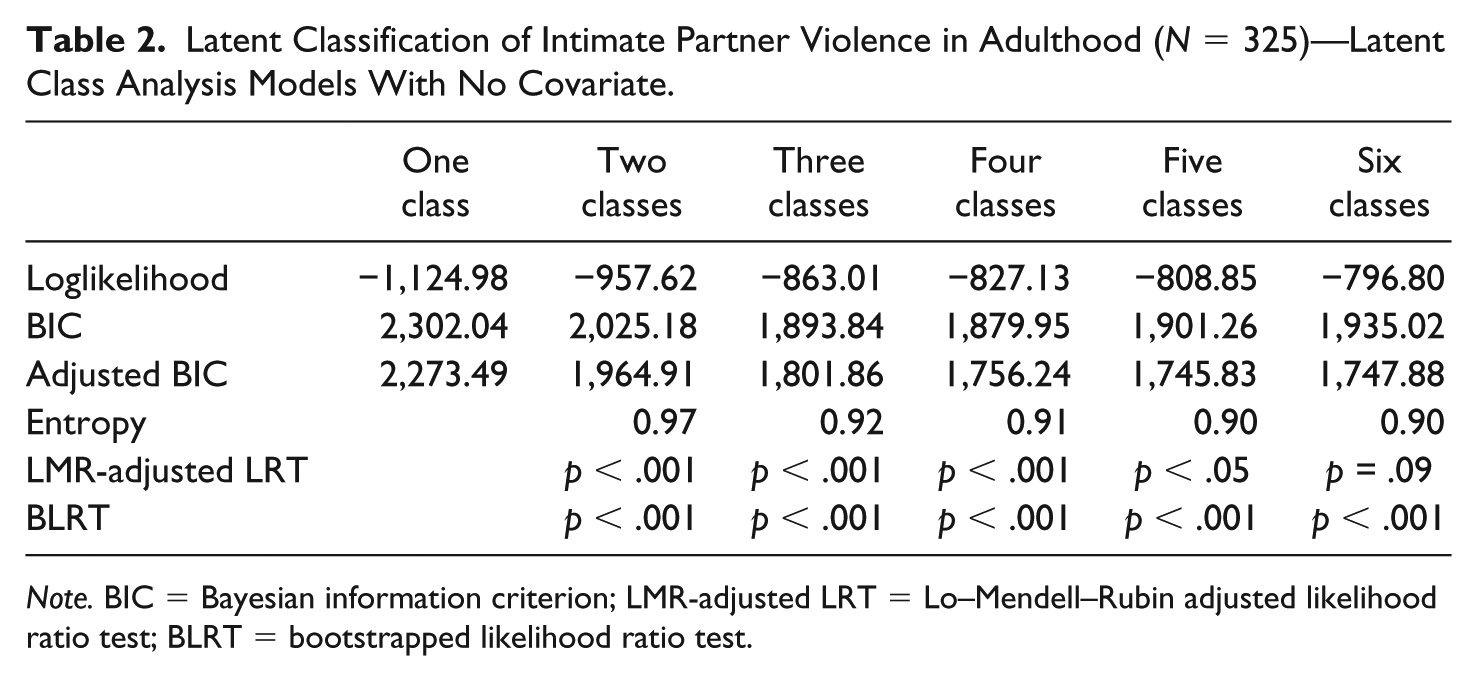
Note. BIC = Bayesian information criterion; LMR-adjusted LRT = Lo–Mendell–Rubin adjusted likelihood ratio test; BLRT = bootstrapped likelihood ratio test.
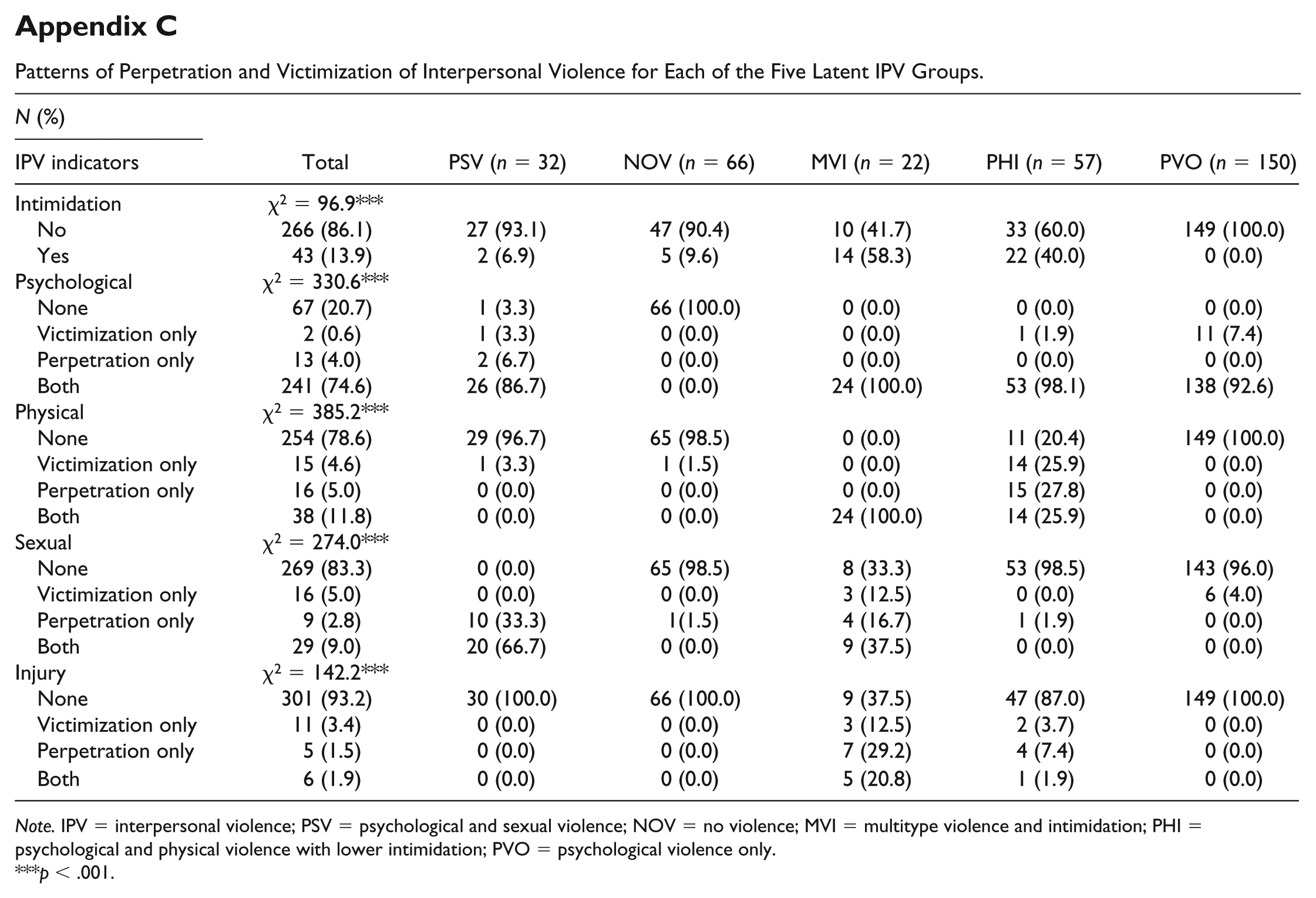
Figure 1 provides a visual representation of the posterior probabilities of each type of violence for the five classes (see Appendix B for exact numeric values of these probabilities and Appendix C for different distributions of the observed IPV indicators in different classes). The same five classes were generated across models with covariates (e.g., child abuse) included and excluded: Posterior probabilities of each indicator were similarly represented, and the sizes of the IPV classes were almost identical.

Posterior probabilities for latent interpersonal violence classes in an LCA model with covariatesa (N = 325).
Effects of Early Violence Experiences on Adult IPV
Two primary research questions were investigated:
In analyses, the psychological violence only (PVO) and multitype violence and intimidation (MVI) latent classes were specified as referents (Table 3).
Child Abuse Predicting Latent Interpersonal Violence Classes Moderated by Gender: Parameter Estimates With Standard Errors.
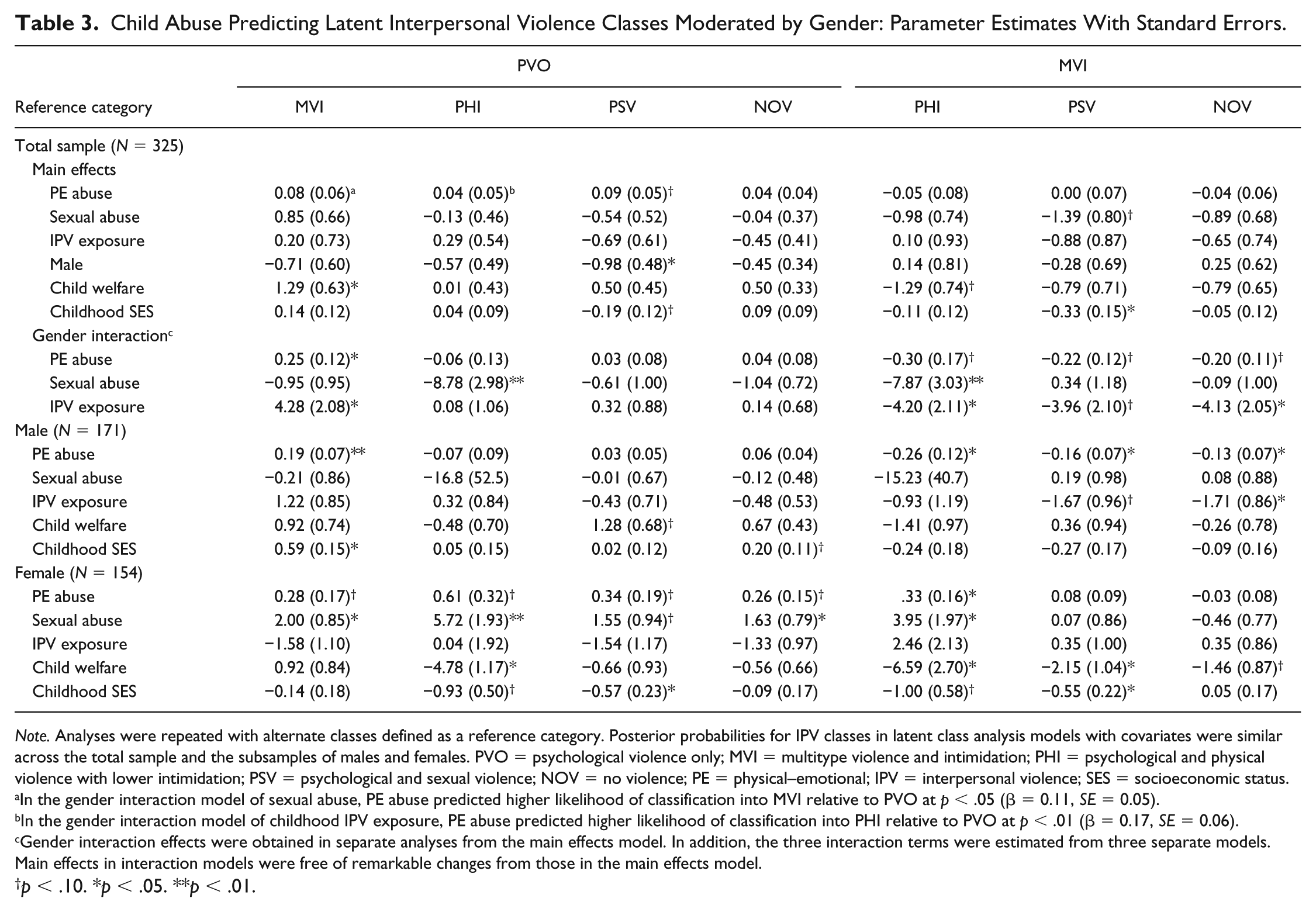
Note. Analyses were repeated with alternate classes defined as a reference category. Posterior probabilities for IPV classes in latent class analysis models with covariates were similar across the total sample and the subsamples of males and females. PVO = psychological violence only; MVI = multitype violence and intimidation; PHI = psychological and physical violence with lower intimidation; PSV = psychological and sexual violence; NOV = no violence; PE = physical–emotional; IPV = interpersonal violence; SES = socioeconomic status.
In the gender interaction model of sexual abuse, PE abuse predicted higher likelihood of classification into MVI relative to PVO at p < .05 (β = 0.11, SE = 0.05).
In the gender interaction model of childhood IPV exposure, PE abuse predicted higher likelihood of classification into PHI relative to PVO at p < .01 (β = 0.17, SE = 0.06).
Gender interaction effects were obtained in separate analyses from the main effects model. In addition, the three interaction terms were estimated from three separate models. Main effects in interaction models were free of remarkable changes from those in the main effects model.
p < .10. *p < .05. **p < .01.
As shown in Table 3, there were no statistically significant main effects of child abuse and child exposure to IPV on later adult IPV. However, significant gender interactions were found for physical–emotional child abuse and childhood exposure to IPV as well as sexual abuse. That is, physical–emotional child abuse was associated more strongly with an increased likelihood of MVI relative to PVO for males compared with females (β = 0.25, p < .05). Further exploration of this moderation effect in subgroup analyses showed that physical–emotional child abuse predicted a higher likelihood of MVI relative to other IPV classes for males, but not for females. For females, physical–emotional child abuse predicted a higher likelihood of psychological and physical violence with lower intimidation (PHI) relative to MVI (β = 0.33, p < .05). In sum, males who had been physically and/or emotionally abused in childhood appear more likely than females to be involved in MVI in intimate relationships, whereas females were more likely involved in PHI as compared with MVI.
Sexual abuse
Sexual abuse effects on adult IPV were also moderated by gender. Sexual abuse was predictive of IPV for females, but not for males. Women with a sexual abuse history were more likely to be involved in IPV relationships of intimidation (MVI, β = 2.00, p < .05; PHI, β = 5.72, p < .01).
Childhood exposure to IPV
Furthermore, the effect of childhood exposure to IPV was also moderated by gender, and the pattern was similar to that of physical–emotional child abuse effects. Specifically, the positive association between childhood exposure to IPV and MVI was stronger for males than for females when compared with PVO (β = 4.28, p < .05), psychological and sexual violence (PSV; β = 3.96, p = .06), PHI (β = 4.20, p < .05), and no violence (NOV; β = 4.13, p < .05).
Discussion
In this study, we used LCA to examine IPV as an outcome of physical and emotional child abuse, sexual abuse, and children’s exposure to IPV. Using LCA, a person-centered modeling approach, we identified five latent classes of adult IPV perpetration and victimization. These classes show considerable overlap in the various forms of perpetration and victimization, which is consistent with prior research (Richards, Tillyer, & Wright, 2017). In fact, previously published studies report co-occurrence rates of more than 30% in some cases. Somewhat surprisingly, results of the current study found no evidence of gender differences in the constellation of the IPV classes, or in their prediction by gender. Efforts to further understand the relationship between violence victimization and perpetration for individuals, and whether there are gender differences in this interplay, are important. To explain this dynamic, some experts attribute co-occurrence, in part, to the tendency for some victims (particularly women) to retaliate against their abusive partners (M. P. Johnson, 2005). Others note that measuring IPV changes across time and relationships is key to understanding gender differences (W. L. Johnson, Giordano, Manning, & Longmore, 2015). Although a strength of the current study lies in its inclusion of both IPV perpetration and victimization, this exploration of qualitative differences in experiences of IPV and motivations for perpetration of IPV is left to future studies.
Findings on the intergenerational transmission of violence within families are increasingly well documented (T. I. Herrenkohl et al., 2016; T. I. Herrenkohl et al., 2008). In Capaldi et al.’s (2012) systematic review of the literature, results suggest a modest, but significant effect of children’s exposure to IPV and child abuse on later IPV risk. Results of the current study are generally consistent in that they provide evidence of this connection; however, they also point to possible gender moderation, which is less well documented. In our study, sexual abuse appeared a stronger predictor of adult IPV classes for females, whereas physical–emotional child abuse and childhood exposure to IPV, to a certain extent, were stronger predictors of adult IPV for males. Interestingly, other studies, such as one by Fang and Corso (2008), found that sexual abuse was a particularly salient predictor of adult IPV for males. According to Capaldi et al.’s (2012) review, findings culled from more than 200 articles (which are mostly retrospective studies) indicate that risk factors for IPV, including child abuse and children’s exposure to IPV, are similar overall for both genders.
One explanation for what appear to be inconsistent findings on gender differences in risk factors for adult IPV is that studies differ sometimes markedly in their sampling, measurement, and data analysis procedures. Whereas much prior research is based on clinical samples or samples from targeted settings, such as hospitals, shelters, and police stations (Hamberger & Larsen, 2015), the current study uses a community sample of individuals originally recruited from child welfare and other group settings (T. I. Herrenkohl, Klika, Herrenkohl, Russo, & Dee, 2012). Moreover, this study used a longitudinal design, and measures of IPV and childhood risks were based on several data sources, including parents’ reports of abuse and children’s exposure to violence in the home. Furthermore, we intentionally broadened the conceptualization of IPV in this study to include experiences of control and domination using items from the WEB Scale (P. H. Smith et al., 1995; P. H. Smith et al., 1999), which are not used routinely in other studies on the topic. Finally, differences might also stem from the manner in which the data were analyzed, which, in our case, centered on IPV classes rather than measured variables. In short, there are a host of factors that can affect the association between constructs that carry similar labels. Of course, findings in all cases should be replicated to assess the degree to which they extend beyond a particular research setting and sample.
Although this study makes important contributions to the literature on the prediction of IPV and intergenerational patterns of violence within families, and on the measurement and analysis of IPV itself, it is not without limitations. Limitations include a reliance on self-reports of IPV from one partner rather than dyadic assessments, as recommended by some researchers (e.g., Capaldi et al., 2012). In addition, results pertain mainly to heterosexual couples and to those of a particular geographic region of the country with relatively limited racial and ethnic diversity. Thus, findings may not generalize to the larger U.S. population or to same-sex couples and, therefore, should be interpreted with those qualifications in mind. However, the study uses a longitudinal design and incorporates various types of child abuse and IPV perpetration and victimization. In addition, it attends to possible gender differences in the prediction of IPV, which is important for prevention and intervention programs (T. I. Herrenkohl et al., 2008).
Footnotes
Appendix A
Items Measuring Physical and Emotional Abuse.
| Physical abuse items | n (%) | Emotional abuse items | n (%) | |
|---|---|---|---|---|
| 1 | Pepper in mouth | 78 (21.9) | Take meals away | 15 (4.2) |
| 2 | Slap face | 220 (61.8) | Threaten to leave | 117 (32.9) |
| 3 | Shake | 155 (43.5) | Embarrass | 119 (33.4) |
| 4 | Pull hair | 172 (48.3) | Threaten to send away | 125 (35.1) |
| 5 | Hit with stick | 213 (59.8) | Isolate in dark room | 4 (1.1) |
| 6 | Hit with strap | 164 (46.1) | Ridicule | 120 (33.7) |
| 7 | Bite | 93 (26.1) | Lock out of house | 8 (2.2) |
| 8 | Bite to bruise | 14 (3.9) | ||
| 9 | Slap to bruise | 89 (25.0) | ||
| 10 | Hit to bruise | 63 (17.7) | ||
| 11 | Burn | 21 (5.9) | ||
| 12 | Burn to leave mark | 10 (2.8) |
Appendix B
Posterior Probabilities in Latent Interpersonal Violence Classes From Latent Class Analyses With Covariates.

| PSV | NOV | MVI | PHI | PVO | |
|---|---|---|---|---|---|
| Total (N = 326) | |||||
| Entropy = 0.89 | n = 30, 9.2% | n = 66, 20.3% | n = 22, 6.8% | n = 57, 17.5% | n = 150, 46.2% |
| Intimidation | .06 | .10 | .56 | .31 | .02 |
| Vic_Psychological | .90 | .00 | 1 | 1 | .92 |
| Vic_Physical | .00 | .00 | 1 | .47 | .00 |
| Vic_Sexual | 1 | .01 | .50 | .05 | .00 |
| Vic_Injured | .00 | .00 | .49 | .09 | .00 |
| Perp_Psycho | .93 | .00 | 1 | .98 | 1 |
| Perp_Physical | .04 | .02 | 1 | .45 | .00 |
| Perp_Sexual | .69 | .00 | .51 | .00 | .04 |
| Perp_Injured | .00 | .00 | .31 | .06 | .00 |
| Female (n = 155) | |||||
| Entropy = 0.93 | n = 18, 11.7% | n = 32, 20.8% | n = 22, 14.3% | n = 25, 16.2% | n = 57, 37.0% |
| Intimidation | .07 | .07 | .53 | .15 | .04 |
| Vic_Psychological | .94 | .00 | 1 | 1 | .91 |
| Vic_Physical | .00 | .00 | .88 | .29 | .00 |
| Vic_Sexual | 1 | .03 | .46 | .00 | .00 |
| Vic_Injured | .00 | .00 | .34 | .07 | .00 |
| Perp_Psycho | .88 | .00 | 1 | 1 | 1 |
| Perp_Physical | .06 | .03 | 1 | .34 | .07 |
| Perp_Sexual | .59 | .00 | .28 | .00 | .00 |
| Perp_Injured | .00 | .00 | .23 | .00 | .00 |
| Male (n = 171) | |||||
| Entropy = 0.94 | n = 16, 9.4% | n = 39, 22.8% | n = 13, 7.6% | n = 20, 11.7% | n = 83, 48.5% |
| Intimidation | .06 | .10 | .38 | .46 | .04 |
| Vic_Psychological | .81 | .00 | 1 | 1 | 1 |
| Vic_Physical | .00 | .00 | 1 | .65 | .00 |
| Vic_Sexual | .63 | .00 | .32 | .00 | .04 |
| Vic_Injured | .00 | .00 | .40 | .09 | .01 |
| Perp_Psycho | 1 | .13 | 1 | .96 | 1 |
| Perp_Physical | .00 | .00 | 1 | .24 | .00 |
| Perp_Sexual | 1 | .00 | .48 | .00 | .00 |
| Perp_Injured | .00 | .00 | .32 | .00 | .03 |
Note. PSV = psychological and sexual violence; NOV = no violence; MVI = multitype violence and intimidation; PHI = psychological and physical violence with lower intimidation; PVO = psychological violence Only; Vic_ = victimization; Perp_ = perpetration.
Appendix C
Patterns of Perpetration and Victimization of Interpersonal Violence for Each of the Five Latent IPV Groups.
| N (%) | Total | PSV (n = 32) | NOV (n = 66) | MVI (n = 22) | PHI (n = 57) | PVO (n = 150) |
|---|---|---|---|---|---|---|
| IPV indicators | ||||||
| Intimidation | χ2 = 96.9*** | |||||
| No | 266 (86.1) | 27 (93.1) | 47 (90.4) | 10 (41.7) | 33 (60.0) | 149 (100.0) |
| Yes | 43 (13.9) | 2 (6.9) | 5 (9.6) | 14 (58.3) | 22 (40.0) | 0 (0.0) |
| Psychological | χ2 = 330.6*** | |||||
| None | 67 (20.7) | 1 (3.3) | 66 (100.0) | 0 (0.0) | 0 (0.0) | 0 (0.0) |
| Victimization only | 2 (0.6) | 1 (3.3) | 0 (0.0) | 0 (0.0) | 1 (1.9) | 11 (7.4) |
| Perpetration only | 13 (4.0) | 2 (6.7) | 0 (0.0) | 0 (0.0) | 0 (0.0) | 0 (0.0) |
| Both | 241 (74.6) | 26 (86.7) | 0 (0.0) | 24 (100.0) | 53 (98.1) | 138 (92.6) |
| Physical | χ2 = 385.2*** | |||||
| None | 254 (78.6) | 29 (96.7) | 65 (98.5) | 0 (0.0) | 11 (20.4) | 149 (100.0) |
| Victimization only | 15 (4.6) | 1 (3.3) | 1 (1.5) | 0 (0.0) | 14 (25.9) | 0 (0.0) |
| Perpetration only | 16 (5.0) | 0 (0.0) | 0 (0.0) | 0 (0.0) | 15 (27.8) | 0 (0.0) |
| Both | 38 (11.8) | 0 (0.0) | 0 (0.0) | 24 (100.0) | 14 (25.9) | 0 (0.0) |
| Sexual | χ2 = 274.0*** | |||||
| None | 269 (83.3) | 0 (0.0) | 65 (98.5) | 8 (33.3) | 53 (98.5) | 143 (96.0) |
| Victimization only | 16 (5.0) | 0 (0.0) | 0 (0.0) | 3 (12.5) | 0 (0.0) | 6 (4.0) |
| Perpetration only | 9 (2.8) | 10 (33.3) | 1(1.5) | 4 (16.7) | 1 (1.9) | 0 (0.0) |
| Both | 29 (9.0) | 20 (66.7) | 0 (0.0) | 9 (37.5) | 0 (0.0) | 0 (0.0) |
| Injury | χ2 = 142.2*** | |||||
| None | 301 (93.2) | 30 (100.0) | 66 (100.0) | 9 (37.5) | 47 (87.0) | 149 (100.0) |
| Victimization only | 11 (3.4) | 0 (0.0) | 0 (0.0) | 3 (12.5) | 2 (3.7) | 0 (0.0) |
| Perpetration only | 5 (1.5) | 0 (0.0) | 0 (0.0) | 7 (29.2) | 4 (7.4) | 0 (0.0) |
| Both | 6 (1.9) | 0 (0.0) | 0 (0.0) | 5 (20.8) | 1 (1.9) | 0 (0.0) |
Note. IPV = interpersonal violence; PSV = psychological and sexual violence; NOV = no violence; MVI = multitype violence and intimidation; PHI = psychological and physical violence with lower intimidation; PVO = psychological violence only.
p < .001.
Authors’ Note
Todd I. Herrenkohl is now affiliated with University of Michigan, Ann Arbor, USA.
Declaration of Conflicting Interests
The author(s) declared no potential conflicts of interest with respect to the research, authorship, and/or publication of this article.
Funding
The author(s) disclosed receipt of the following financial support for the research, authorship, and/or publication of this article: Funds for this project were provided by the National Institute of Child Health and Human Development (R01 HD049767) and the National Institute of Justice (2012-IJ-CX-0023). The content of this article is solely the responsibility of the authors and does not necessarily represent the official views of the funding agencies. The funding agencies played no role in the study design; in the collection, analysis, and interpretation of data; in the writing of the report; or in the decision to submit the article for publication.