



Abstract
This study examined, using structural equation modeling (SEM), gender differences and similarities in correlates of the perpetration of emotional aggression against intimate partners among one of the largest groups of Asian Indians in the United States, Gujaratis. Although most of the correlates of emotional aggression (e.g., patriarchal attitudes, spousal disagreement, and alcohol use) were similar for men and women, higher support for gendered domestic roles was significantly related to higher perpetration of emotional aggression for men but not for women. Multigroup latent SEM served as a unique analytical strategy to investigate gender (a)symmetry, a controversial but critical debate in the field.
Introduction
This study examined the correlates of the perpetration of emotional aggression against intimate partners among a probability sample of an Asian Indian group in the United States. Despite the steady increase in population size, intimate partner violence (IPV) among Asians and Asian Indians in the United States remains understudied. Given the considerable variation across various Asian groups, this study focused on a specific ethnic group, Gujaratis (gü-jə-rä-tēs), one of the largest Asian Indian population groups residing in the United States. Data were collected via computer-assisted telephone interviews (CATI) from a random sample of adult men and women of Gujarati descent aged 18-64 years residing in a large urban region in the Midwestern United States. In this predominantly immigrant sample, we examined the correlates of emotional aggression with a focus on gender differences and similarities. Examining emotional aggression—a less examined form of IPV—in an understudied population group and using structural equation modeling, this study seeks to contribute to the ongoing debate on the gender similarities/dissimilarities in IPV perpetration, often referred to as gender (a)symmetry.
Gender (A)Symmetry, Emotional Aggression, and Sociocultural Variations
Over the last several decades, increasing research attention has been paid to whether perpetration of IPV differs between men and women with respect to its prevalence, patterns, and types; most investigations have examined physical violence (see Archer, 2000, 2002; Johnson, 1995; Straus, 2011). Although previous studies of samples from domestic violence programs (e.g., shelter residents) document the occurrence of severe male-to-female IPV, other studies, such as population-based surveys of the general population, have documented women’s use of aggression at a rate similar to, and sometimes higher than, that of men (see Archer, 2000; Johnson, 1995). These seemingly disparate findings have prompted a growing number of empirical and theoretical investigations, calling for further attention to the context and motives for violence (e.g., who initiated it and whether it was control motivated or in self-defense), outcomes, and effects (e.g., fear, injuries, health consequences; see Dobash & Dobash, 2004; Graham-Kevan & Archer, 2003; Hamberger, Larsen, & Campbell, 2016; Hamby, 2005; Jasinski, Blumenstein, & Morgan, 2014; Langhinrichsen-Rohling, 2010). One line of research has focused on distinguishing different types and patterns of IPV; one often-cited distinction in the type of IPV involves situational couple violence (formerly referred to as common couple violence) and coercive control and intimate terrorism (formerly referred to as patriarchal terrorism; Johnson & Leone, 2005). Kimmel (2002) identifies two types of IPV: expressive violence (to express anger/frustration as part of conflict/argument) and control-motivated, instrumental violence to (re)establish control. Compared with physical IPV, a far smaller number of studies have investigated gender (a)symmetry in the perpetration of emotional aggression (Follingstad & Edmundson, 2010; also see reviews such as Schumacher, Smith Slep, & Heyman, 2001), and there has been none among immigrants in the United States.
Examination of emotional aggression (also referred to as psychological aggression or abuse) is important for several reasons, including the high prevalence and its negative impact on women’s well-being (Black et al., 2011; Coker et al., 2002; Follingstad, 2009; Jun, Rich-Edwards, Boynton-Jarrett, & Wright, 2008; Mouton, Rodabough, Rovi, Brzyski, & Katerndabl, 2010; Yoshihama, Horrocks, & Kamano, 2009), as well as its relatively high perceived abusiveness; when asked about various acts of IPV, respondents tend to rate emotional aggression as damaging or abusive as physical/sexual violence (Follingstad, Coyne, & Gambone, 2005; Marshall, 1992; Yoshihama, 1999). Furthermore, high co-occurrence of emotional aggression with physical/sexual IPV (Coker et al., 2007; Gondolf, Heckert, & Kimmel, 2002; Hamby & Sugarman, 1999; Marshall, 1996; Taft et al., 2006) and the trajectories of escalation from emotional aggression to physical violence (Murphy & O’Leary, 1989; Schumacher & Leonard, 2005; Stets, 1990) make it important to understand factors associated with the perpetration of emotional aggression. A recent meta-analytic review of risk markers for perpetration of physical IPV found gender differences in three out of 60 markers: violence in family of origin, couple’s conflict resolution pattern of demand/withdraw, and alcohol use (Spencer, Cafferky, & Stith, 2016). Examination of gender differences and similarities in risk markers and correlates of perpetration of emotional aggression will provide valuable information to help inform the development of effective prevention programs.
Just as emotional aggression has been understudied, sociocultural variation in the (a)symmetry of IPV perpetration has not been examined sufficiently. The importance of such investigation is illustrated by Archer’s (2006) review of studies of IPV perpetration by gender conducted in 16 countries, which found “this pattern [both sexes committing acts of physical aggression against their partners] did not generalize to all nations” (p. 133). Of note is that the use of nation as the unit of analysis masks ethnic variations that may exist within a specific nation. Using 1996 British Crime Survey data, Archer (2006) found similar rates of perpetration between White men and women but not in African Caribbean, Indian, and Pakistani/Bangladeshi groups. These findings point to the limitation of aggregating diverse population groups and the need for using a disaggregated sample (also see Yoshihama, 2001, 2009; Yoshihama & Horrocks, 2002). Avoiding aggregation, this study focuses on a single ethnic group of Asian Indians, Gujaratis in the United States. In what follows, we first describe the study population, followed by a review of research on IPV among Asian Indians (Gujaratis, where available) in the United States.
Study Population: Gujaratis in the United States
Asian Indians are the second largest Asian group nationwide and the largest in the study site, a major urban area of a Midwestern state, having increased in size by 40% during the last decade (U.S. Census Bureau, 2017). Asian Indians are diverse, comprised of many ethnic groups. Gujaratis are an ethnic group from the state of Gujarat, one of the 28 states of India, located in the western region. Gujaratis are one of the largest ethnic groups of Asian Indians in the United States. Although no literature specifies the total number of Gujaratis in the United States, the Census Bureau reports that more than 10% of Asian Indians in the United States speak Gujarati; however, there are additional individuals of Gujarati decent who do not speak Gujarati, and 20-40% of Asian Indians in the United States are estimated to be of Gujarati descent. Gujaratis have their own language and sociocultural norms. Exemplified by Mahatma Gandhi, who was a Gujarati, Gujaratis place high value on nonviolence and peace.
IPV Among Asian Indians in the United States: Issues of Aggregation
Few studies have investigated IPV specifically among Gujaratis. One study conducted in India reported a high prevalence of IPV among 346 married women in rural Gujarat; 42% reported having experienced physical beatings or sexual assault and an additional 23%, “abusive language, belittlement, and threats” (Visaria, 1999, p. 10). The precipitating triggers of IPV reported include “not preparing meals on time, not cooking meals properly, not caring for the children properly, and economic stress,” many of which reflect gendered domestic role expectations; these expectations are rooted in male domination and female subordination (Visaria, 1999). Outside India, no published study has investigated IPV specifically among Gujaratis.
Despite considerable diversity, studies of IPV in the United States tend to aggregate various Indian ethnic groups or South Asian groups (e.g., individuals of Indian, Bangladeshi, Bhutanese, Nepalese, Pakistani, and Sri Lankan descent) or, worse, lump various Asian groups together. In the absence of Gujarati-specific studies in the United States, the prevalence of IPV among Gujaratis must be inferred from studies of Asian Indians and South Asians in the United States. Most available studies used nonprobability samples. For example, a study of nonprobability samples of aggregated South Asian women in Boston recruited via community outreach reported rates of IPV ranging from 21.2-40.8% (Himelfarb Hurwitz, Gupta, Liu, Silverman, & Raj, 2006; Raj & Silverman, 2002). In another study in which South Asian women were recruited through flyers, women’s groups, grocery stores, cultural organizations, and cultural events, of the 215 respondents, 77 reported psychological abuse at the hands of their intimate partners, 22 reported physical abuse, and 27 reported sexual abuse (Mahapatra, 2012). Other studies also used a nonprobability sample of South Asian women (Adam & Schewe, 2007; Madden, Scott, Sholapur, & Bhandari, 2016). Case studies and descriptive studies also have used aggregated samples of Asian Indians and South Asians in the United Studies. They have documented a wide range of manifestations of IPV, including various forms of emotional aggression in sociocultural contexts such as isolation, deprivation of social and/or economic activities, and immigration-related abuse (e.g., threatening to report a partner to an immigration agency and threatening to have her deported; Abraham, 2000; Chaudhuri, Morash, & Yingling, 2014; Dasgupta, 2000; Jordan & Bhandari, 2016; Krishnan, Baig-Amin, Gilbert, El-Bassel, & Waters, 1998; Liao, 2006; Mehrotra, 1999). Studies of Asian Indians in North America also suggest that IPV is linked to cultural ideals predicated on men’s domination and women’s subordination (Abraham, 2000; Adam & Schewe, 2007; Ahmad, Riaz, Barata, & Stewart, 2004; Chaudhuri et al., 2014; Dasgupta & Warrier, 1996).
Studies examining correlates of IPV among Asians in the United States tend to focus on physical/sexual violence. One study, which used data from the National Latino and Asian American Study (NLAAS), found a higher risk of IPV among Asian couples in which a wife’s income was higher than that of the husband (Chung, Tucker, & Takeuchi, 2008). Another NLAAS-based study of aggregated Asians in the United States found age, socioeconomic status, and partners’ heavy alcohol/substance use to be associated with IPV (Chang, Shen, & Takeuchi, 2009). These correlates are similar to those found in other U.S. population groups (see Riggs, Caulfield, & Street, 2000; Schumacher, Feldbau-Kohn, Smith Slep, & Heyman, 2001; Spencer et al., 2016); however, considerable variation exists in IPV rates and correlates by ethnicity among Asians (Chang et al., 2009; Cho, 2012; Yoshihama, Bybee, Dabby, & Blazevski, 2011), again pointing to the importance of disaggregating Asians and studying specific ethnic groups.
In addition to variation between/across ethnic groups, variation within a particular ethnic group deserves a careful examination; for example, attention to differences by immigration status and length of residency in the host country is critical when studying immigrants. Studies of immigrants have found a significant association between the length of residency in the host country and attitudes toward gender (J. Y. Kim & Sung, 2000; Röder & Mühlau, 2014; Yoshihama, Blazevski, & Bybee, 2014). Studies have also found a higher risk of IPV among those who have lived in the United States longer in studies of the aggregated group of Asians (Chang et al., 2009) and specific Asian groups, for example, Koreans (J. Y. Kim & Sung, 2000), as well as immigrants of diverse backgrounds (Du Mont et al., 2012).
Current Study
This study investigates correlates of emotional aggression, an understudied form of IPV, among an understudied yet fast-growing population in the United States, Asian Indians, focusing on a single ethnic group, Gujaratis. As reviewed above, previous research on (a)symmetry involved comparing the risk of perpetration or victimization by gender or focused on developing (and validating) typologies. We chose to take a somewhat different approach. Using structural equation modeling (SEM), we examined gender differences and similarities in the correlates of perpetration of emotional aggression against intimate partners. We drew from previous research and incorporated feminist theory and the family violence perspective in model building. In line with feminist theory, which posits that IPV is supported by male domination and patriarchal ideology (Bograd, 1988; Dobash & Dobash, 1979), we examined the role of attitudes toward gender and possible gender differences in the perpetration of emotional aggression against intimate partners. Studies have documented positive associations between gender roles and patriarchal attitudes and IPV perpetration and/or victimization (Crossman, Stith, & Bender, 1990; Jakupcak, Lisak, & Roemer, 2002; Smith, 1990; Stith, Smith, Penn, Ward, & Tritt, 2004).
The family violence perspective views IPV as arising from conflict in the family (Gelles & Straus, 1988). Couples’ conflict and dissatisfaction have been found to be associated with IPV (Riggs et al., 2000), including studies of various Asian groups in the United States (J. Y. Kim & Sung, 2000). We thus included conflict between the couple in the model. Informed by these theories, we hypothesized that while both attitudes toward gender and conflict between the couple would be associated with the perpetration of emotional aggression, the effects of attitudes toward gender on emotional aggression would differ for men and women. Drawing on the existing empirical and theoretical work on immigrants, we hypothesized that the effect of length of residence in the United States would operate indirectly via attitudes toward gender, in that individuals with longer residency in the United States would hold more egalitarian attitudes, which in turn would be associated with lower emotional aggression perpetration.
Method
Sampling and Procedures
Institutional Review Board approval was obtained from the first author’s university, and a Certificate of Confidentiality was obtained from the National Institutes of Health. Data collection was conducted by a survey research center of the first author’s university via CATI with a random sample of adult men and women of Gujarati descent aged 18-64 years residing in the study’s target area, a large urban region in the Midwestern United States. Because the target population comprises a small proportion of the general population, an area sampling method (e.g., compiling all the households in specific geographic areas to draw a sample) would not be effective. Thus, we drew a random sample by using an ethnic surname-based list compiled by a major sampling company. This surname-based method has been tested for use in research with various minority population groups, including Asians and South Asians (Elliott, Morrison, McCaffrey, Pantoja, & Lurie, 2009; Lauderdale & Kestenbaum, 2000).
After sending an introductory letter to the randomly selected households, an interviewer from the university’s survey center called each household to identify an eligible respondent. If multiple eligible individuals resided in a household, a CATI-generated random number procedure was used to select one. Both the English and Gujarati interview schedules were available through a CATI system. A total of 431 individuals completed the interview; the response rate was 64.6% per Method 4 of the American Association for Public Opinion Research (2008). On average, the interviews lasted for 66.5 min (SD = 17.4). Respondents received US$25 for participation. Given our focus on perpetration of emotional aggression against intimate partners, this study used a subsample of respondents who reported that they were married and cohabiting at the time of the interview (N = 373; 186 men, 187 women).
Measures
Perpetration of emotional aggression
Perpetration of emotional aggression against intimate partners during the previous 6 months was assessed using four items, including the two items of hurt, insulted, threatened, or screamed (HITS; Sherin, Sinacore, Li, Zitter, & Shakil, 1998; “insulted or talked down” and “screamed or cursed at”), and two self-constructed items that pertain to the forms of emotional aggression identified in the formative research that preceded this study. Gujaratis in the formative research reported giving the silent treatment (“purposely did not talk to the partner to punish him or her”) and strict surveillance (“insisted on knowing where the partner was at all times”) as salient and common forms of IPV. The response scale for these four items ranged from 1 = never to 5 = very often; the scores were log-transformed due to high skew (ranging from 2.6-4.0) and kurtosis (ranging from 7.8-24.2) when using the original metric. Confirmatory factor analysis (CFA) showed that all four items loaded significantly on a single latent construct, with standardized loadings ranging from .29 to .65 and composite reliability (Raykov & Shrout, 2002) equaling .63. Multigroup CFA showed acceptable measurement invariance (Brown, 2006; Byrne, Shavelson, & Muthen, 1989) by gender, with small but significantly different loadings for only one item: screaming or cursing. With loadings for this one item estimated separately for men and women, the measurement model showed excellent fit to the data, χ2 = 7.745, df = 5, p = .17, root mean square error approximation (RMSEA) = .04, 90% confidence interval (CI) = [.01, .08], comparative fit index (CFI) = .99, Tucker–Lewis index (TLI) = .98, standardized root mean square residual (SRMR) = .04.
Attitudes toward gender
We assessed two dimensions of attitudes toward gender: (a) support for gendered domestic roles and (b) patriarchal attitudes. For both dimensions, respondents’ degree of agreement with scale items was assessed on a 6-point scale, ranging from 1 = strongly disagree to 6 = strongly agree. Higher scores mean greater levels of acceptance of gendered domestic roles and patriarchal attitudes.
Support for gendered domestic roles
Support for gendered role division in the domestic sphere—expectations that women take care of domestic chores and responsibilities—is conventionally referred to as “traditional” gender roles. Although this characterization is true for many societies and cultures, what constitutes traditional gender roles can vary (Narayan, 2000). Thus, we use more descriptive terms: support for gendered role division in the domestic sphere or support for gendered domestic roles, for short. Four items were adapted from a simplified version of the Attitudes Toward Women Scale (Nelson, 1988; sample item: “Women should worry less about being equal with men and more about becoming good wives and mothers”). Per pilot test, one original item, “It is ridiculous for a woman to drive a train or for a man to sew on shirt buttons,” was modified as follows: “It is ridiculous for a man to stay home and raise children.”
Patriarchal attitudes
Using the modified Male Privilege Subscale of the Revised Attitudes Toward Wife Abuse Scale (sample item: “A husband is the ruler of his home”; Yoshioka, DiNoia, & Ullah, 2001), we assessed patriarchal attitudes—support for male domination, power, and control in the context of marital relations. Based on the pilot test and on the basis of face validity, two of the original items (“Some wives seem to ask for beating from their husband”; “A husband is entitled to have sex with his wife whenever he wants it”) were dropped. We adopted one item from the Male Role Norms Scale (“Every man deserves the respect of his wife and children, no matter how he behaves”; Thompson & Pleck, 1986); this addition was informed by the formative research and previous studies of this population group that pointed to the salience of the concept of respect in the dynamics of power and control in the family relationship (Yoshihama, Ramakrishnan, Hammock, & Khaliq, 2012).
CFA confirmed significant item loadings on the two attitude-toward-gender constructs: standardized loadings for support for gendered domestic roles ranged from .47-.58, with composite reliability equaling .60; for patriarchal attitudes, loadings ranged from .46-.77, with composite reliability equaling .71. The correlation between the two latent constructs was .71, indicating that approximately 50% of the construct variance was not shared, a level suitable for modeling separate constructs in SEM (Schumacker & Lomax, 2004). Multigroup CFA showed full measurement invariance by gender and good fit to the data: χ2 = 52.963, df = 34, p = .02, RMSEA = .04 (90% CI = [.02, .06]), CFI = .96, TLI = .95, SRMR = .06.
Conflict between the couple
We assessed frequency of disagreement with intimate partner in the past 6 months. This variable was coded on a 5-point scale, anchored at 1 = never and 5 = twice or more per week.
Length of residency in the United States
Based on information on the respondent’s age, country of birth, and age of immigration, we created a variable denoting the percentage of years living in the United States. We used the percentage rather than the number of years spent in the United States to avoid confounding with respondents’ chronological age.
Other variables
Respondent’s age was coded in years, and educational level was coded as 1 = less than a bachelor’s degree, 2 = bachelor’s degree, and 3 = more than a bachelor’s degree. As an indicator of socioeconomic status, we used the respondent’s perceived financial difficulty at the time of the interview; respondents were asked how much difficulty they were experiencing in making ends meet on a 4-point scale ranging from 1 = having a lot of difficulty to 4 = not having difficulty at all. Because few individuals reported a lot of difficulty, we dichotomized this variable (no difficulty vs. some level of difficulty) for further analysis. Income disparity between the couple was assessed by asking “Is your income more or less than your spouse’s or about the same?” We dichotomized this variable as more than spouse vs. equal or lower than spouse. Additional variables included in the analysis were use of alcohol and religious service attendance. Use of alcohol in the past 6 months was coded into a 3-point scale: 0 = never, 1 = less than one day a week, and 2 = one or more days per week. Religious service attendance was coded on a 5-point scale, ranging from 1 = less than once a year to 5 = nearly every day.
Analytical Approach
We used latent SEM to test our hypotheses, controlling for the influence of variables found in previous research to be associated with attitudes toward gender, couples’ conflict, and emotional aggression perpetration, such as age, education, length of residency in the United States, disparity in couple’s income, use of alcohol, and religious service attendance. Because we were interested in possible gender differences in the correlates of the perpetration of emotional aggression, we used a multigroup strategy, simultaneously fitting the model to two groups: men and women. Use of SEM provided several advantages, including statistical assessment of overall model fit, formal statistical tests of gender equivalence in the measurement models of latent constructs and in the structural model of relationships among latent constructs (Byrne, 2004, 2001), and a method for accommodating modest gender differences in construct loadings (Brown, 2006) to test hypothesized relationships among constructs. Although we initially modeled all direct paths from the covariates to the outcome measure, our final model included only significant paths. Sample sizes exceeded 185 in each gender group and were thus adequate for multigroup SEM (Jaccard & Wan, 1996). The sample size for each group provided power of .8 or greater to identify as significant a path coefficient of .2 or greater at 2-tailed p < .05. The total sample of 373 provided power of .8 or greater to test close fit (RMSEA = .05 vs. .08) of any model with at least 25 degrees of freedom (MacCallum, Browne, & Sugawara, 1996).
Results
Respondents’ Characteristics
Over 96% of the respondents were born outside the United States. Table 1 presents respondent characteristics by gender. On average, respondents were 44 years old and had lived in the United States for approximately 41% of their lives (actual years living in the United States ranged from 1-45 years; M = 18.21 years, SD = 11.56). The majority of respondents had a bachelor’s degree or higher, with men having a significantly higher mean level of education. A higher proportion of women than men reported experiencing financial difficulties (32.0 vs. 22.3%), although this difference was not significant (Bonferroni-adjusted). A larger proportion of men than women reported earning more than their spouse. Alcohol consumption was generally low, with 58% reporting that they do not consume alcohol; mean frequency of alcohol consumption was significantly higher for men than women. The majority of respondents reported attending a religious service at least a few times a month (mean frequency of attendance: 2.97 on a 5-point scale anchored at 1 = less than once a year to 5 = nearly every day).
Respondents’ Characteristics by Gender (Women, n = 187; Men, n = 186).

Assessed on a 3-point scale: 1 = less than a bachelor’s degree, 2 = bachelor’s degree, and 3 = more than a bachelor’s degree.
Assessed on a 3-point scale: 0 = never, 1 = less than 1 day a week, and 2 = 1 or more days per week.
Assessed on a 5-point scale: 1 = less than once a year, 2 = a few times a year, 3 = a few times a month, 4 = at least once a week, and 5 = nearly every day.
p < .01, Bonferroni corrected for comparisons on eight dependent variables.
Correlates of Attitudes Toward Gender and Emotional Aggression
Overall, mean levels of the two dimensions of attitudes toward gender did not differ significantly by gender. On support for gendered domestic roles, the estimated mean was 2.48 (SE = 0.12) for women and 2.55 (SE = 0.13) for men. On patriarchal attitudes, the estimated mean was 2.90 (SE = 0.41) for women and 3.18 (SE = 0.44) for men. Women and men also reported similar frequency of disagreements with their spouse: For men, the estimated mean was 2.67 (SE = 0.08), and for women, it was 2.48 (SE = 0.07) on a 1-to-5 scale; these were not significantly different. Most respondents reported experiencing a disagreement with their spouse at least once or twice a month during the past 6 months. Reported perpetration of emotional aggression also did not differ significantly by gender. The estimated mean was 1.29 (SE = 0.07) for women and 1.07 (SE = 0.08) for men, indicating levels between “never” and “once or twice” during the previous 6 months. Men reported a significantly greater frequency of perpetration on one item—screaming or cursing–but even here, the differences were fairly small (M = 1.15 for women vs. 1.24 for men on the original 1-5 scale).
Figure 1 presents the two-group structural equation model; covariances among variables exogenous to the model are not included in the diagram for ease of presentation but are listed in Table 2 as correlation coefficients. Statistical tests of gender differences in model parameters (Byrne, 2004, 2001) identified significant differences in two directional relationships (the paths from age to patriarchal attitudes and from support for gendered domestic roles to perpetration of emotional aggression) and two nondirectional relationships between covariates (between age and financial difficulty and between religious service attendance and education). Accordingly, these parameters were estimated separately by gender; all other parameters were constrained to equality across gender, resulting in a model that fit as well as an unconstrained model estimated separately for men and women (LRχ2 = 39.70, df = 29, p = .09). The final, partially constrained model was an adequate fit to the data: χ2 = 385.31, df = 290, p < .001; RMSEA = .03 (90% CI = [.02, .04]), CFI = .91, TLI = .90, SRMR = .07.
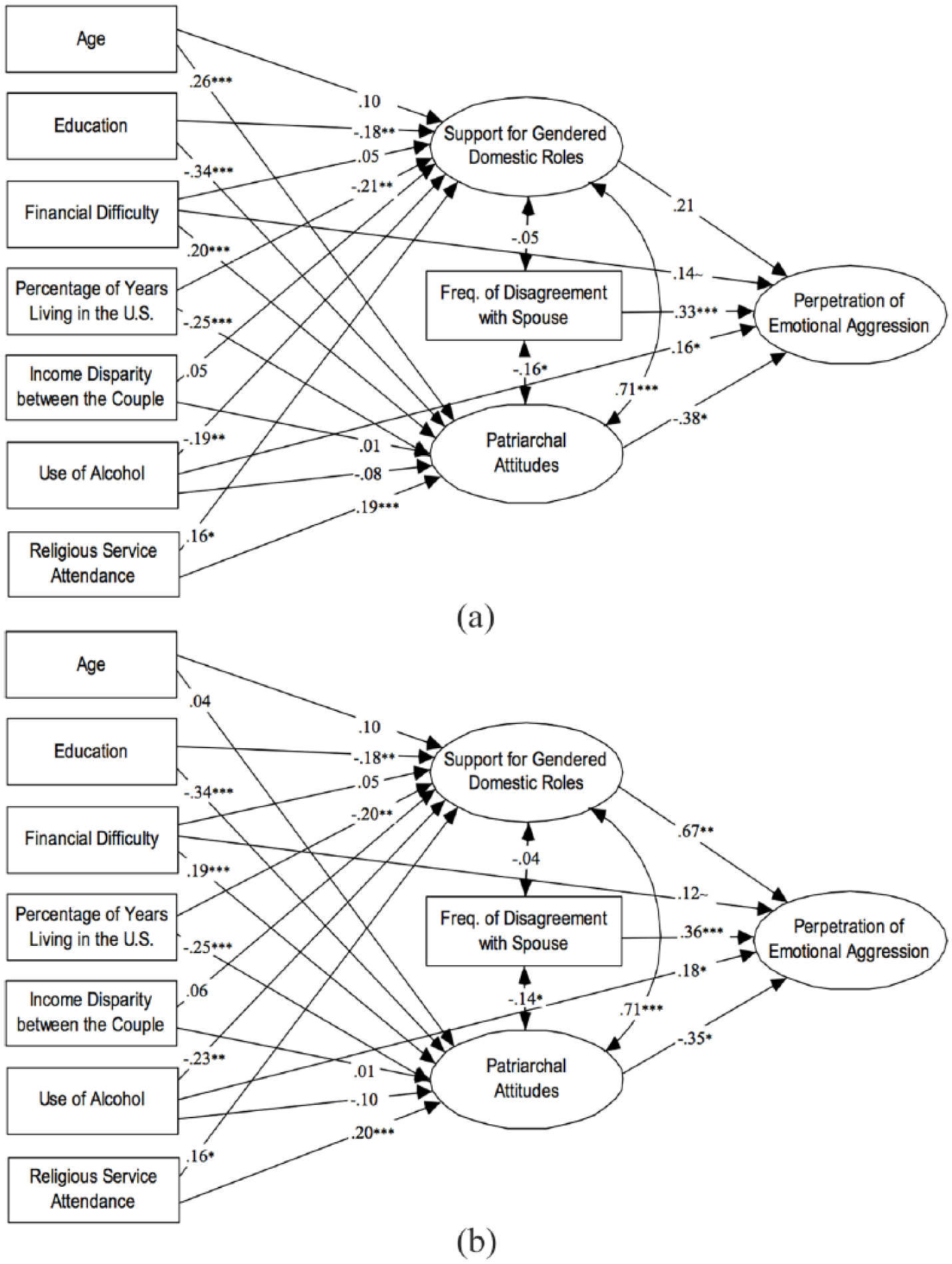
Estimated two-group structural equation model (χ2 = 385.31, df = 290, p < .001; RMSEA = .03, 90% CI = [.02, .04]; CFI = .91; TLI = .90; SRMR = .07): (a) Coefficients for women (n = 187) and (b) coefficients for men (n = 186).
Correlations Among Exogenous Variables in the Structural Equation Model (Women, n = 187; Men, n = 186).
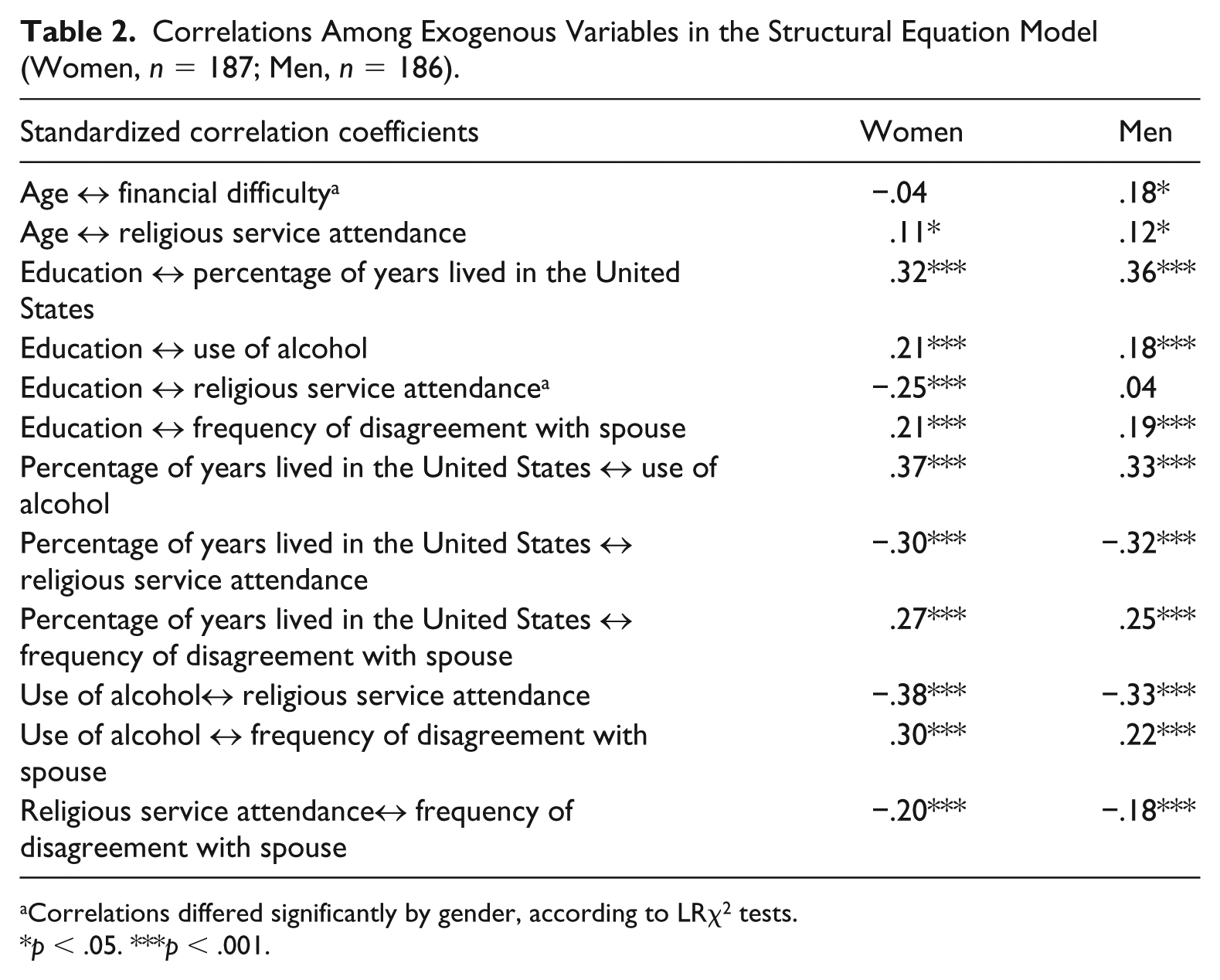
Correlations differed significantly by gender, according to LRχ2 tests.
p < .05. ***p < .001.
As shown in Figure 1, results of the structural analysis of relationships among constructs indicated that for both men and women, having a higher level of education as well as having lived in the United States for a larger proportion of one’s life were associated with lower support for both gendered domestic roles and patriarchal attitudes. In contrast, religious service attendance was associated with higher endorsement of these sets of attitudes. For both men and women, perpetration of emotional aggression was associated with use of alcohol.
As hypothesized, couples’ conflict was significantly associated with perpetration of emotional aggression for both men and women. The two dimensions of attitudes toward gender were found to have different relationships with emotional aggression perpetration. For both men and women, higher patriarchal attitudes were associated with lower frequency of disagreement in the last 6 months; patriarchal attitudes were also negatively associated with the perpetration of emotional aggression. As hypothesized, there was a notable gender difference: Higher support for gendered domestic roles was significantly related to higher frequency of perpetration of emotional aggression for men but not for women.
Percentage of years living in the United States was associated with many of the correlates of the perpetration of emotional aggression. In addition to the above-mentioned inverse relationship between the length of residency in the United States and both dimensions of attitudes toward gender, the length of residency in the United States was positively associated with couples’ conflict and use of alcohol. In terms of the hypothesized indirect effect of the length of residency in the United States on emotional aggression via attitudes toward gender, we found partial support. The length of residency in the United States was indirectly associated with perpetration of emotional aggression through support for gendered domestic roles for men (standardized indirect effect = −.13, p < .04) but not for women (standardized indirect effect = −.04, p = n.s.). The indirect effect of the length of residency in the United States on emotional aggression via patriarchal attitudes was not significant for either gender (standardized indirect effect = .10, p < .06); nor was the effect significantly different by gender.
Discussion
This study found a number of correlates of the perpetration of emotional aggression against intimate partners that are similar between men and women. For example, for both men and women, perpetration of emotional aggression was more common among individuals reporting more frequent disagreement with spouse, consistent with studies of other population groups (Stith, Green, Smith, & Ward, 2008). These associations may reflect expressive use of emotional aggression in the context of situational couple altercations as reviewed previously (Johnson & Leone, 2005; Kimmel, 2002). However, beyond this similarity, a notable gender difference was found. Men, but not women, who professed higher support for gendered domestic roles reported greater use of emotional aggression. This may suggest that emotional aggression may have different meanings or serve different purposes for men vs. women; for example, for men, emotional aggression may serve an instrumental, control-motivated function as conceptualized by Kimmel (2002). A study of college students (Hamby & Sugarman, 1999) found two factors of psychological aggression (minor/expressive and severe psychological aggression) for men but one factor for women (general psychological aggression). This gender difference in factor structure led the researchers to state that “it may be a mistake to assume equivalences between formally similar behavior of men and women” (p. 964). Our findings provide additional empirical data suggesting that underneath what appears to be symmetrical, there may be different pathways for men and women. Because our model did not explicitly address male domination within relationships, this possibility, however, remains speculative because of the cross-sectional design used in this study.
Another notable finding is that for both men and women, patriarchal attitudes were negatively associated with the perpetration of emotional aggression. This may appear counterintuitive; however, coupled with the significant negative association between patriarchal attitudes and frequency of disagreement with spouse, these findings suggest that patriarchal attitudes in (at least) one spouse may contribute to a decreased probability of disagreement. Several pathways are plausible. Men with patriarchal attitudes may have chosen to marry women who tend to agree with them or coerce women into submission as described by Chaudhuri et al. (2014), which could decrease the probability of disagreement and/or resorting to emotional aggression to control them. Similarly, women who hold patriarchal attitudes are less likely to challenge their husband’s authority, thereby lowering the probability of disagreement. These possibilities require further investigation.
The use of alcohol was inversely associated with gendered domestic roles for both men and women in this study, in contrast to the positive relationship found in other studies (Chang et al., 2009). It is possible that this association reflects interrelationships among alcohol use, the length of residency in the United States, and support for gendered domestic roles for Gujaratis in particular. The state of Gujarat in India is referred to as a “dry state,” which prohibits the sale or consumption of alcohol. The longer one lives in the United States, the longer one is likely to encounter the opportunity to drink and be exposed to norms that are more permissive of alcohol use. Alcohol use may be a function of the length of residency in the United States in this population group, which is consistent with the observed positive relationship between alcohol use and length of residency in the United States.
Limitations
A number of limitations should be considered in interpreting the findings of the current study, such as the absence of data on the gender attitudes of respondents’ intimate partners and a measure of male domination within relationships as discussed previously. Also absent in this study was an assessment of conflict resolution styles, which has been found to be a significant correlate of perpetration of IPV in studies conducted in other population groups (Bonache, Gonzalez-Mendez, & Krahé, 2019; Fernet, Hébert, & Paradis, 2016). Future research that includes these partner and couple data would enhance our understanding of the relationship between gender attitudes, conflict, and perpetration of emotional aggression. The cross-sectional design did not allow for examination of the temporal order of influence among the variables assessed. Longitudinal research would be necessary to clarify the direction of influence between attitudes toward gender and perpetration of emotional aggression; as with most attitudes and behaviors, it is likely that they are mutually influential through time. In addition, data were obtained retrospectively from respondents’ self-report, which is subject to social desirability and recall bias; reports of the frequency of perpetration are likely to have been underestimated (Evans, Gregory, Feder, Howarth, & Hegarty, 2016; Schwartz, 2000). Although the response rate was good, the extent to which self-selection bias affected the results remains unknown.
In this study of a previously understudied population group, the absence of measures that have been validated specifically on the study population was a major challenge. Although use of measures that have not been validated can limit the generalizability of this study’s findings, use of measures validated on other population groups would not necessarily improve the validity with this specific population. Faced with this dilemma, our approach was to draw from commonly used validated measures, where possible, and make adaptations guided by careful formative research, ongoing community consultation (Yoshihama et al., 2012), and psychometric assessments through CFA.
Practice Implications
Examinations of gender (a)symmetry have not paid sufficient attention to sociocultural diversity, a serious gap that hampers our effort to prevent and intervene in IPV globally and in the United States, which is becoming increasingly diverse. This study makes an important contribution by examining a predominantly immigrant population group. The length of residency (percentage of years living) in the United States was associated with four direct correlates of emotional aggression perpetration: two dimensions of attitudes toward gender, couples’ conflict, and use of alcohol. In addition, the length of residency in the United States was correlated with education and religious service attendance. The former was associated with support for gendered domestic roles, and the latter, with patriarchal attitudes, both of which were associated with the perpetration of emotional aggression. Although more research with diverse immigrant population groups is necessary, this study’s findings point to the importance of taking into account immigrants’ residency in the host country in developing IPV prevention and intervention programs. For example, in prevention campaigns, it may be effective to use different messages targeting recent immigrants versus immigrants who have been in the United States for a long period of time or those who were born in the United States. The length of residency in the host country (e.g., the United States), though often used as a crude measure of acculturation, is not necessarily associated with adoption of norms of the host country; acculturation is a multidimensional construct involving dynamic changes in values, attitudes, behaviors, identities, among others, and a longer residency in the host country (Berry, 1997; B. S. K. Kim & Abreu, 2001). Tailoring prevention programs to such dynamic acculturative processes would further enhance their effectiveness.
The significant association between support for gendered domestic roles and the perpetration of emotional aggression among Gujarati men suggests that promoting more egalitarian domestic gender role attitudes might help prevent emotional aggression against intimate partners. In addition, frequency of disagreement was associated with the perpetration of emotional aggression. Although this suggests that disagreement reduction could help lessen IPV, the finding of a negative association between patriarchal attitudes and frequency of disagreements raises concerns about this approach. Disagreements are a natural part of (healthy) relationships. Thus, rather than focusing on reducing disagreements per se, it may be helpful to strengthen couples’ capacity to address conflicts (e.g., how to address and negotiate disagreements without resorting to abusive and/or controlling behaviors) to prevent IPV. Attention to conflict resolution strategies could be a fruitful area of further investigation as suggested by recent studies of young adults and adolescents in Spain and Canada (with couples of French–Canadian background; Bonache et al., 2019; Fernet et al., 2016).
Research Implications
This study provided unique empirical data and interpretive insights in several important ways: focused examination of factors associated with the perpetration of emotional aggression, as opposed to more extensively studied physical/sexual IPV; inclusion of two dimensions of attitudes toward gender and couples’ conflict in the model; and use of multigroup latent SEM to examine gender differences/similarities. On the surface, similar reported frequencies of perpetration between men and women can be viewed as additional support for the gender symmetry claim. However, this study sought to delineate underlying factors and paths leading to perpetration.
Support for gendered domestic roles and patriarchal attitudes were correlated yet had different relationships with the perpetration of emotional aggression. This prompts a question that further research needs to explore: In what ways and why do two dimensions of attitudes toward gender operate differently when it comes to the perpetration of emotional aggression? Previous studies of IPV tend not to differentiate dimensions of attitudes toward gender. This study’s results point to the need to examine multidimensionality of attitudes toward gender.
This study provided a good opportunity for testing gender differences in the association between emotional aggression and other variables, such as attitudes toward gender. The use of multigroup latent SEM provided a way to accommodate minor gender difference in the measurement model to allow accurate estimation of associations with other variables (Brown, 2006; Byrne et al., 1989). Small gender differences found in the level and factorial structure of emotional aggression increased confidence that model differences in covariate relationships were not due to measurement nonequivalence or to great disparities in the level of emotional aggression perpetrated by men and women. Use of multigroup latent SEM, simultaneously fitting the model to men and women, may serve as one approach to investigate gender (a)symmetry, a controversial but critical debate in the field.
Footnotes
Acknowledgements
The authors would like to thank the individuals and organizations who contributed to and supported this study.
Declaration of Conflicting Interests
The author(s) declared no potential conflicts of interest with respect to the research, authorship, and/or publication of this article.
Funding
The author(s) disclosed receipt of the following financial support for the research, authorship, and/or publication of this article: This research was supported by the Centers for Disese Control & Prevention (Grant Number U49/CE000507).