



Abstract
This longitudinal study examined whether posttraumatic stress and depressive symptoms, posttraumatic cognitions, and ongoing cyberstalking exposures were independently associated with changes in pain outcomes among 82 young adult women with recent exposure to stalking. Multilevel models indicated that higher sensory pain intensity and pain-related interference were associated with more negative cognitions about the self. Higher affective pain intensity was associated with higher posttraumatic stress and depressive symptoms. Cyberstalking exposures were not associated with pain intensity or pain-related interference. Results reveal persistent pain complaints in recent stalking victims and highlight distinct psychological risk factors for pain intensity and pain-related interference.
Stalking is one type of interpersonal violence (IPV) that disproportionately affects women and is characterized by an intentional pattern of repeated, intrusive, unwanted, and intimidating pursuit behaviors (Miller, 2012). In the United States, an estimated 15.2% of women have been a victim of stalking during their lifetime and 2.4% (approximately 5.1 million women) have been stalked in the previous 12 months (Breiding, 2015). The Internet and social media have provided new avenues for IPV, referred to as “cyberstalking” (Woodlock, 2017), which are comparable with “offline” stalking behaviors in their prevalence and negative impact on well-being (Dressing, Bailer, Anders, Wagner, & Gallas, 2014). Young women who experience stalking and other forms of IPV are more likely to develop posttraumatic stress disorder (PTSD) and major depressive disorder (MDD) than their male counterparts (Kessler, Sonnega, Bromet, Hughes, & Nelson, 1995; Smyth, Hockemeyer, Heron, Wonderlich, & Pennebaker, 2008; Vrana & Lauterbach, 1994). Likewise, women exposed to IPV are more likely than men to develop negative physical health outcomes including persistent or chronic pain (Naylor et al., 2017; Runnals et al., 2013).
Pain is a complex experience that is shaped by emotional, cognitive, biological, and social factors (Turk & Monach, 1996). Furthermore, there does not appear to be a “one-to-one correspondence” between pain and tissue damage (Fernandez & Turk, 1992). In the context of psychiatric symptoms (Chaturvedi, 1987) or trauma exposure (McLean et al., 2012; Ulirsch et al., 2014), pain may even occur in the absence of tissue damage. The frequent co-occurrence of pain with trauma-related psychopathology (Beckham et al., 1997; Fishbain, Pulikal, Lewis, & Gao, 2017) suggests possible shared risk factors (Asmundson & Katz, 2009; Liedl et al., 2010; Sharp & Harvey, 2001). Despite emerging evidence that IPV may increase risk for pain, the prevalence of—and risk factors for—pain in recent stalking victims remain unknown.
Risk Factors for Posttraumatic Pain
Posttraumatic Stress (PTS) Symptoms
Psychosocial risk factors play an important role in theoretical models of posttraumatic pain; these include PTS symptoms, negative cognitions, trauma reminders, and depressive symptoms (Asmundson & Katz, 2009; Sharp & Harvey, 2001). Elevated PTS symptoms following stalking exposure could increase risk for pain complaints. Approximately 10% of individuals with chronic pain meet diagnostic criteria for PTSD (Siqveland, Hussain, Lindstrøm, Ruud, & Hauff, 2017; Von Korff et al., 2005); conversely, up to 66% of individuals with PTSD suffer from chronic pain conditions (Sareen et al., 2007; Shipherd et al., 2007). Longitudinal studies following individuals with traumatic physical injuries indicate that higher PTS symptoms are associated with greater pain severity/interference over time (Mayou & Bryant, 2001; Sterling, Jull, Vicenzino, Kenardy, & Darnell, 2005; Zatzick et al., 2007). Relatively few longitudinal studies have examined pain outcomes in samples with IPV exposure, and none, to our knowledge, have focused on recent stalking victims.
Negative Cognitions
Negative cognitions have been implicated in theoretical models of PTSD–pain comorbidity as potential risk factors for the co-development of persistent pain and PTS symptoms (J. G. Beck & Clapp, 2011; Sullivan, Stanish, Waite, Sullivan, & Tripp, 1998). Negative posttraumatic cognitions are central to cognitive theories of PTSD (Foa, Hembree, & Rothbaum, 2007; Resick & Schnicke, 1992), have received strong empirical support as predictors of PTS symptom severity and PTSD diagnosis (J. G. Beck et al., 2004; Startup, Makgekgenene, & Webster, 2007), and are responsive to cognitive behavioral treatments for PTSD (Kumpula et al., 2017; Zalta et al., 2014). These cognitions could manifest as negatively biased appraisals or dysfunctional beliefs about the self, world, or other people (Ehlers & Clark, 2000; Foa & Rothbaum, 2001). One type of negative cognition central to cognitive theories of pain (Turk, Meichenbaum, & Genest, 1983) is pain catastrophizing, which encompasses the tendency to magnify pain, failure to inhibit pain-related thoughts, and feelings of helplessness when experiencing pain (Quartana, Campbell, & Edwards, 2009). Pain catastrophizing is associated with elevated pain intensity and pain-related interference (Alschuler & Otis, 2012; Keefe, Brown, Wallston, & Caldwell, 1989; Severeijns, Vlaeyen, van den Hout, & Weber, 2001; Wideman et al., 2013).
Despite the frequent co-occurrence of PTSD and chronic pain (Sareen et al., 2007; Von Korff et al., 2005) as well as evidence for shared cognitive vulnerability mechanisms (Asmundson & Hadjistavropolous, 2006), negative posttraumatic cognitions have rarely been examined as predictors of pain outcomes. One study of veterans demonstrated that negative posttraumatic cognitions about the self were associated with higher levels of pain-related interference but were not significantly associated with pain intensity (Porter, Pope, Mayer, & Rauch, 2013). The latter finding suggests that distinct domains of pain experience, such as intensity and functional limitations, may be differentially associated with psychosocial risk factors. The extent to which negative cognitions contribute to pain experiences in stalking victims remains unclear.
Cyberstalking Victimization
Cyberstalking, which includes unwanted text messages and social media harassment, is now more common than physical stalking, frequently involves threats to safety, contributes to feelings of fear (Maple, Short, & Brown, 2011), and could increase risk for pain complaints. Cyberstalking behaviors serve not only as reminders of trauma but are potentially traumatic exposures themselves. According to the Electronic Communication Harassment Observation (ECHO) survey, over 80% of individuals exposed to cyberstalking report fear or distress, with women being more likely to report fear of physical injury than men (28 vs. 15%; Maple et al., 2011). Notably, the ECHO survey suggests that approximately one third of individuals exposed to cyberstalking report PTS symptom severity scores exceeding the clinical cutoff for PTSD (Maple et al., 2011). Whether individuals being cyberstalked are at elevated risk for developing persistent pain in addition to PTS symptoms remains unclear. Studies of female sexual assault survivors presenting for medical care indicate that elevated pain symptoms persist for up to 3 months and frequently occur in body regions not directly affected by traumatic injury (McLean et al., 2012; Ulirsch et al., 2014). Posttraumatic changes in stress response system functioning could alter pain sensitivity even in the absence of tissue damage (McLean et al., 2012), suggesting that being stalked could increase risk for pain complaints. Repeated online harassment could also prompt increased avoidance of occupational, social, or recreational activities (Sharp & Harvey, 2001), which, in turn, could contribute to greater pain-related functional disability (Otis, Keane, Kerns, Monson, & Scioli, 2009).
Depressive Symptoms
MDD is prevalent among stalking victims (Blaauw, Winkel, Arensman, Sheridan, & Freeve, 2002) and also frequently co-occurs with chronic pain (Banks & Kerns, 1996; Fishbain, Cutler, Rosomoff, & Rosomoff, 1997). Depressive symptoms are a well-established risk factor for both PTSD and chronic pain (Asmundson & Katz, 2009; Jakupcak et al., 2006; Poundja, Fikretoglu, & Brunet, 2006; Roth, Geisser, & Bates, 2008; Sharp & Harvey, 2001) and are positively associated with pain complaints over and above the influence of PTS symptoms (Outcalt et al., 2015; Runnals et al., 2013). Some research further suggests that the well-documented association between PTS symptoms and chronic pain may be primarily driven by co-occurring depressive symptoms (Jakupcak et al., 2006; Morasco et al., 2013; Poundja et al., 2006). However, the relative impact of depressive versus PTS symptoms on pain complaints in female IPV survivors has not yet been elucidated.
The Present Study
The purpose of the present longitudinal study was to determine the extent to which pain outcomes were independently associated with PTS symptoms, negative posttraumatic cognitions, ongoing cyberstalking exposures, and depressive symptoms in recent stalking victims. Pain severity and pain-related interference were examined in separate models based on prior work showing differential associations between predictors and these pain outcomes (Morasco et al., 2013; Porter et al., 2013). All models included childhood trauma exposure and lifetime stalking victimization as covariates due to their potential influence on pain experiences in adulthood (Asmundson & Katz, 2009; Davis, Coker, & Sanderson, 2002). We hypothesized that negative posttraumatic cognitions would be associated with greater sensory and affective pain intensity as well as greater pain-related interference. In addition, we hypothesized that greater exposure to cyberstalking and higher levels of PTS and depressive symptoms would be associated with worse pain outcomes over time.
Method
Procedures
Young adult women who reported two or more experiences of stalking behaviors in the past month were recruited from online sources (i.e., ResearchMatch, Craigslist) and invited to participate in a survey-based longitudinal study. Interested participants were contacted for a phone screen to verify that they had been exposed to at least two instances of stalking within the past month. For screening purposes, stalking was defined as an intentional pattern of repeated, intrusive, unwanted, and intimidating pursuit behaviors directed toward a specific person and conducted either online or in-person that would cause a reasonable person to feel harassed, threatened, or fearful (Miller, 2012). Eligible participants were invited to complete online surveys at baseline and at 1-month, 2-month, and 3-month follow-ups. All participants provided informed consent online, and study procedures were approved by the institutional review board.
Measures
Pain intensity
The McGill Pain Questionnaire–Short Form (MPQ-SF; Melzack, 1987) was used to determine the intensity of participants’ ongoing pain at all time points. Participants indicated on a 4-point scale (0 = none and 3 = severe) the extent to which they experienced a variety of pain characteristics. The MSQ-SF includes an 11-item subscale used to assess the sensory dimension of pain (e.g., throbbing, burning, or aching) and a four-item subscale used to assess the affective dimension of pain (e.g., tiring, sickening, fearful, or punishing). In this sample, the sensory pain subscale exhibited excellent internal consistency (alphas from .90-.94) and the affective pain subscale generally exhibited adequate internal consistency (alphas from .66-.81). The MPQ-SF also includes a Present Pain Intensity index (0 = no pain, 1 = mild, 2 = discomforting, 3 = distressing, 4 = horrible, 5 = excruciating) and a visual analogue scale for present overall pain intensity (0 = no pain, 100 = worst possible pain).
Pain-related interference
The Patient-Reported Outcome Measurement Information System (PROMIS) Pain Interference–Short Form (PROMIS-PI) is an 8-item measure used to assess the degree to which participants’ pain has interfered with activities in the previous 7 days. The PROMIS-PI was administered at all time points. In this sample, pain interference scores exhibited excellent internal consistency (alphas from .98-.99). The reference population for T-scores was the U.S. general population (Amtmann et al., 2010).
PTS
The Posttraumatic Stress Disorder Checklist for DSM–5 (PCL-5; Blevins, Weathers, Davis, Witte, & Domino, 2015; Weathers et al., 2013) is a 20-item measure that assesses past-month severity of Diagnostic and Statistical Manual of Mental Disorders (5th ed.; DSM-5; American Psychiatric Association [APA], 2013) PTS symptoms. Instructions were modified to include “being stalked” as an example of a very stressful experience. Participants indicated how much each symptom bothered them on a 5-point scale (0 = not at all, 4 = extremely). Scores were summed to reflect overall PTS symptom severity. PCL-5 internal consistency was excellent across time points (alphas from .97-.98).
Posttraumatic negative cognitions
Negative cognitions and beliefs that may arise in response to being stalked were assessed by self-report with the 33-item Posttraumatic Cognitions Inventory (PTCI; Foa, Ehlers, Clark, Tolin, & Orsillo, 1999). The PTCI is made up of three subscales: negative cognitions about the self (21 items), negative cognitions about the world (7 items), and self-blame (5-items). The “negative cognitions about self” subscale is comprised of items that assess general negative views of self, permanent change, alienation, hopelessness, self-trust, and negative interpretations of symptoms (e.g., I am a weak person). The “negative cognitions about world” subscale is comprised of items that assess beliefs in an unsafe world and mistrust of other people (e.g., the world is a dangerous place). The “self-blame” subscale includes items that assess participants’ sense of blame for the traumatic incident(s) in question (e.g., the event happened to me because of the sort of person I am). Items are rated on a 7-point scale (1 = totally disagree, 4 = neutral, 7 = totally agree) for statements reflecting types of negative cognitions. Subscales are averaged to address differences in the number of items per scale and to allow for comparison. Reliability estimates for the PTCI subscales were good to excellent across study time points: negative cognitions about self (alphas from .95-.97), negative cognitions about world (alphas from .93-.96), and self-blame (alphas from .82-.91).
Cyberstalking victimization
A self-report checklist of exposure to 20 types of cyberstalking behaviors, occurring in the past month and causing participants to feel threatened, was administered at all time points. These behaviors included someone repeatedly sending them unsolicited emails, someone repeatedly making cell phone calls or sending text messages, someone publishing private images or videos of them, and someone attempting to determine their location using social media or applications with GPS location services.
Depressive symptoms
The Beck Depression Inventory–Second Edition (BDI-II; A. T. Beck, Steer, & Brown, 1996) is a 21-item, self-report measure that assesses severity of depressive symptoms experienced over the past week. Each item is scored on a 4-point severity scale. Items were summed to create a total depressive symptom severity score. In this sample, the BDI-II exhibited excellent internal consistency (alphas from .95-.96).
Childhood trauma
The Childhood Trauma Questionnaire (CTQ; Bernstein et al., 2003) is a 28-item, self-report measure that assesses the frequency of different types of abuse experienced during childhood and adolescence. Respondents rate each item on a 5-point scale from never true to very often true. Five items are dedicated to each of the following subscales: emotional abuse, physical abuse, sexual abuse, emotional neglect, and physical neglect. Subscale scores were summed to reflect overall childhood trauma exposure. Internal consistency for the CTQ was adequate (α = .73).
Lifetime stalking victimization
The Obsessive Relational Intrusion Scale–Short Form (ORI-SF; Cupach & Spitzberg, 2014) is a 28-item self-report measure that assesses lifetime exposure to four types of intrusive behaviors: pursuit (e.g., following you), violation (e.g., covertly obtaining private information), threat (e.g., physically threatening you), and hyperintimacy (e.g., leaving unwanted messages of affection). Items reflect frequencies for each stalking behavior (0 = never, 4 = over 5 times). Items were summed to create an overall index of stalking victimization. The ORI-SF displayed excellent reliability (α = .97).
Data Analytic Strategy
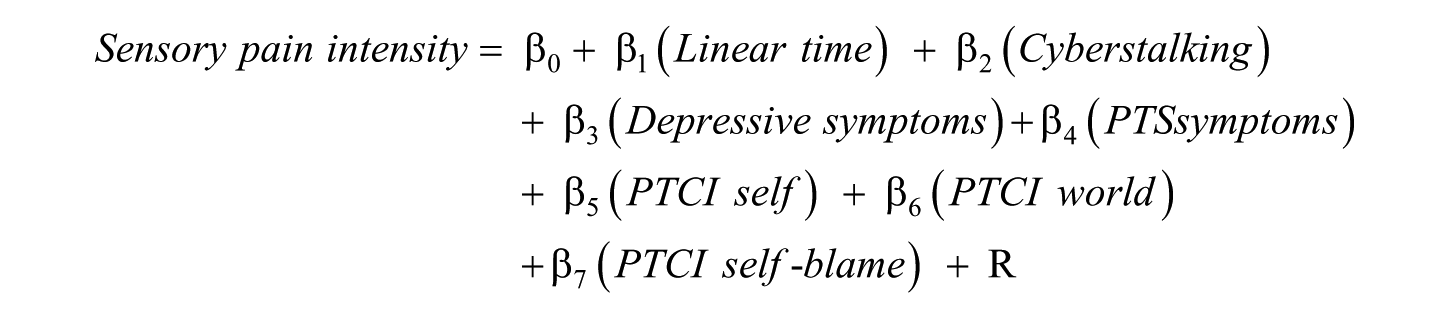
All variables were examined for distributional properties and cases were screened for univariate and multivariate outliers. Multilevel models (MLMs) tested within-person and between-person associations between predictors and outcomes (i.e., affective pain intensity, sensory pain intensity, pain interference) using Hierarchical Linear Models (HLM v. 6) software (Raudenbush, Bryk, Cheong, Congdon, & du Toit, 2004) to account for the nesting of repeated measures within individuals. Time-varying (Level 1) variables were group mean-centered (i.e., the means of these variables equaled zero for each individual), so that estimates reflected changes from person means. Time was coded, so that intercepts reflected main effects at baseline assessment. Person means of all variables (Level 2) were grand mean-centered and included as predictors of intercepts to remove between-person variance from within-person variables and to prevent predictors from correlating with individual intercepts (Hoffman & Stawski, 2009). A coefficient representing linear time was included as a random effect in all MLMs. Separate models examined predictors of changes in affective pain intensity, sensory pain intensity, and pain-related interference. Each model included all three negative cognition subtypes to examine their unique effects on outcomes. The HLM equation for sensory pain intensity is presented below.
Level 1 model:
Level 2 model:
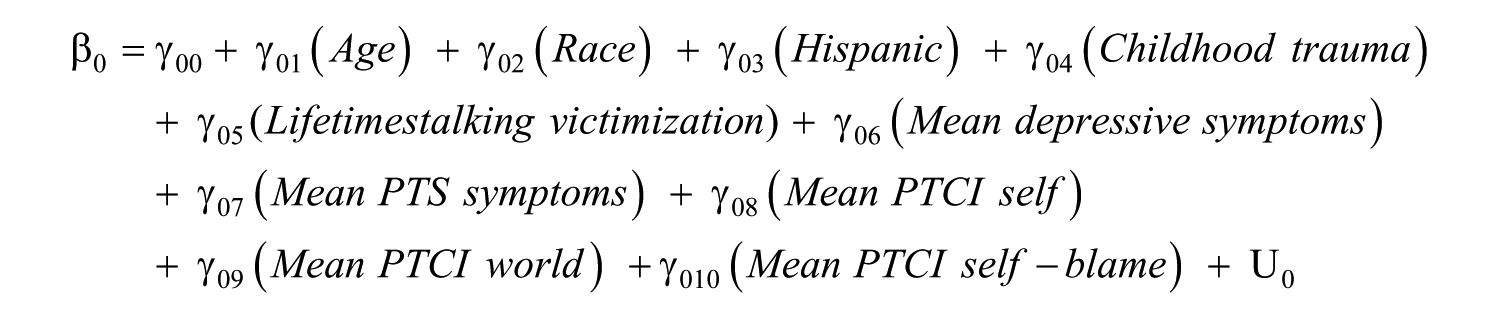

In this model, γ00 represents the mean level of sensory pain intensity at baseline and γ10 represents the linear rate of change in sensory pain intensity throughout the study. The parameters γ20 through γ70 represent within-person relations between predictors and sensory pain intensity over time. Of primary interest are the parameters representing within-person relations between the following predictors and changes in sensory pain intensity: cyberstalking (γ20), depressive symptoms (γ30), PTS symptoms (γ40), negative cognitions about self (γ50), negative cognitions about world (γ60), and self-blame (γ70). The MLMs testing predictors of affective pain intensity and pain interference included identical predictors and covariates. Survey completion rates declined across 1-month (n = 70; 85%), 2-month (n = 54; 66%), and 3-month (n = 49; 60%) follow-ups. The multilevel modeling approach used maximum likelihood estimation to account for missing data; all available data were used and participants with incomplete data were included in analyses. Given high rates of missing data over follow-ups, results were compared with models including only participants with complete data.
Results
Descriptive Statistics
Participants were 82 women with recent stalking exposure, ages 18-30 years (mean age = 25.97, SD = 3.28); 58.5% identified as Caucasian/White; 14.6% identified as Black/African American; 14.6% identified as Biracial; 11% identified as Asian; and 1.2% identified as American Indian or Alaskan Native. Three participants (3.7%) identified as Hispanic. The majority of women were single (61%) and lived with others (78%). The stalker was a former romantic partner for 54.8% of participants, an acquaintance for 20.7% of participants, and a stranger for 23.0% of participants. The most common types of stalking behaviors that caused participants to “feel afraid” were: cell phone calls or texts (74.4%); in-person harassment at home, work, or a public place (54.9%); instant messages (47.6%); emails (31.7%); seeking and compiling information about the victim and using it to harass/defame/threaten/intimidate them (31.7%); assuming different identities to make online contact (28.0%); attempting to determine the victim’s location using social media or applications with location services (28.0%); and requesting or tricking other users to contact/harass/threaten/defame them (17.1%). As a result of the stalking exposure, participants feared physical injury to themselves (42.0%), emotional disturbance (30.9%), damage to their reputation (13.6%), financial loss (3.7%), and/or physical injury to their significant others (2.5%).
At the baseline assessment, 40.5% of participants reported “no pain,” 36.7% reported “mild pain,” 8.9% reported “discomforting pain,” 8.9% reported “distressing pain,” 3.8% reported “horrible pain,” and 1.3% reported “excruciating pain” on the MPQ-SF Present Pain Intensity index. Participants characterized their present pain as “brief” (50%), “intermittent” (22.5%), or “continuous” (27.5%). At the 3-month follow-up assessment, 42.2% of participants reported pain that was “mild” severity or worse on the MPQ-SF Present Pain Intensity index; participants characterized their pain as “brief” (60%), “intermittent” (24.4%), or “continuous” (15.6%). Mean pain interference scores at baseline and 3-month follow-up correspond to T-scores of approximately 56 and 53, respectively (a T-score of 50 is average for the U.S. general population, with higher T-scores reflecting greater pain-related interference).
Sensory Pain Intensity
Results of MLMs predicting changes in pain outcomes are presented in Table 1. Level 1 predictors exhibited an acceptable degree of multicollinearity (variance inflation factors (VIFs) < 2.7; Cohen, Cohen, West, & Aiken, 2003). Within-person increases in sensory pain intensity were associated with increases in negative cognitions about the self (b = 1.20, SE = 0.57, p = .04) and decreases in negative cognitions about the world (b = −0.97, SE = 0.31, p = .002). Neither cyberstalking victimization (b = −0.10, SE = 0.15, p = .52), depressive symptoms (b = 0.06, SE = 0.05, p = .24), PTS symptoms (b = 0.06, SE = 0.03, p = .06), nor self-blame (b = 0.16, SE = 0.38, p = .67) predicted changes in sensory pain intensity. Higher sensory pain intensity at baseline was not significantly associated with lifetime stalking victimization (b = 0.05, SE = 0.03, p = .13), nor with childhood trauma exposure (b = 0.07, SE = 0.04, p = .09). The pattern of results was similar for MLMs including only participants with complete data, except that the effect of negative cognitions about the self was reduced to a nonsignificant trend (b = 1.08, SE = 0.58, p = .06).
Multilevel Models Predicting Pain Outcomes.

p < .05. **p < .01. ***p < .001.
Affective Pain Intensity
Within-person increases in affective pain intensity were associated with increases in depressive (b = 0.07, SE = 0.02, p = .003) and PTS (b = 0.04, SE = 0.02, p = .01) symptoms. Neither cyberstalking victimization (b = −0.06, SE = 0.0, p = .45), negative cognitions about the self (b = 0.54, SE = 0.28, p = .06), negative cognitions about the world (b = −0.27, SE = 0.15, p = .08), nor self-blame (b = 0.003, SE = 0.19, p = .99) predicted changes in affective pain intensity. Higher affective pain intensity at baseline was associated with greater lifetime stalking victimization (b = 0.03, SE = 0.01, p = .01) but not significantly associated with childhood trauma exposure (b = −0.003, SE = 0.01, p = .82). The pattern of results was identical for MLMs including only participants with complete data.
Pain-Related Interference
Within-person increases in pain interference were associated with increases in depressive symptoms (b = 0.26, SE = 0.07, p = .001) and negative cognitions about self (b = 2.20, SE = 0.92, p = .02) but were associated with decreases in negative cognitions about the world (b = −0.96, SE = 0.48, p < .05). Neither cyberstalking victimization (b = −0.01, SE = 0.25, p = .98), PTS symptoms (b = 0.03, SE = 0.05, p = .60), nor self-blame (b = −0.92, SE = 0.60, p = .13) predicted changes in pain interference. Higher pain-related interference at baseline was associated with higher childhood trauma exposure (b = 0.13, SE = 0.06, p < .05) but was not significantly associated with lifetime stalking victimization (b = 0.05, SE = 0.05, p = .35). The pattern of results was similar for MLMs including only participants with complete data, except that the effects of negative cognitions about the self (b = 1.62, SE = 0.94, p = .08) and negative cognitions about the world (b = −0.90, SE = 0.48, p = .06) were reduced to nonsignificant trends.
Discussion
Persistent pain often co-occurs with trauma-related psychopathology (Beckham et al., 1997; Fishbain et al., 2017) even when the traumatic event does not involve physical injury (McLean et al., 2012; Ulirsch et al., 2014). The present study is the first to our knowledge to assess the frequency and intensity of pain complaints in recent stalking victims. Within 1 month of exposure to at least two stalking incidents, 23% of women described ongoing pain that was “discomforting,” “distressing,” “horrible,” or “excruciating” and half characterized their pain as either “intermittent” or “continuous.” Pain interference scores at the baseline assessment were one half standard deviation worse than average for the U.S. general population (Amtmann et al., 2010). Notably, although women were primarily stalked online, 42% reported fear of physical injury to themselves. These findings add to a nascent literature on the emergence of posttraumatic pain not directly tied to physical injury (McLean et al., 2012; Ulirsch et al., 2014) as well as to a broader literature on the mental and physical health consequences of stalking (Blaauw et al., 2002; Coker et al., 2002; Davis et al., 2002).
Pain outcomes were differentially associated with PTS symptoms, posttraumatic cognitions, and depressive symptoms in recent stalking victims. Consistent with theoretical models of PTSD–pain comorbidity (Asmundson & Katz, 2009; Sharp & Harvey, 2001), higher PTS symptoms were independently associated with greater affective pain intensity throughout follow-up. These findings extend previous cross-sectional (Lillis et al., 2018; Morasco et al., 2013; Porter et al., 2013; Poundja et al., 2006) and longitudinal studies (Liedl et al., 2010; McLean et al., 2012; Ulirsch et al., 2014) in trauma-exposed populations by demonstrating that PTS symptoms were specifically associated with changes in affective—but not sensory—pain intensity. Negative emotional states including those commonly experienced by individuals with PTSD (APA, 2013) have been shown to alter the unpleasantness—but not the intensity—of pain (Villemure & Bushnell, 2002, 2009). One potential mechanism linking PTS symptoms to affective pain is heightened fear of pain, which is associated with activation in brain regions (i.e., anterior cingulate cortex) that encode emotional features of pain experiences (Ochsner et al., 2006; Rainville, Duncan, Price, Carrier, & Bushnell, 1997). In contrast to prior work showing higher pain-related interference in individuals with PTSD compared with healthy controls (Morasco et al., 2013) and a positive correlation between PTS symptoms and pain-related interference (Lillis et al., 2018; Porter et al., 2013), PTS symptoms were not significantly associated with changes in pain-related interference in the present study. One explanation for this discrepancy, echoed by other researchers (Jakupcak et al., 2006; Poundja et al., 2006; Roth et al., 2008), is that fluctuations in co-occurring depressive symptoms account for the association between PTS symptoms and pain interference. Another explanation is that PTS symptoms reported by stalking victims were not elevated enough to cause functional impairment. Clinical cutoff scores established in research with veterans (Bovin et al., 2016) suggest that only 20-30% of participants had “probable PTSD” at the baseline assessment.
Posttraumatic cognitions about the self were associated with higher sensory pain intensity and greater pain-related interference over time but were unrelated to affective pain intensity. These results extend cross-sectional evidence for the association between pain-related impairment and negative cognitions about the self (Porter et al., 2013) and support theoretical models of PTSD and pain that emphasize the role of cognitive risk factors (Asmundson & Katz, 2009; Sharp & Harvey, 2001; Turk et al., 1983). Items on the PTCI “negative cognitions about the self” subscale overlap with key dimensions of pain catastrophizing, including pain magnification (e.g., my reactions since the event mean that I am going crazy), pain-related rumination (e.g., if I think about the event, I will not be able to handle it), and helplessness (e.g., I can’t stop bad things from happening to me). Future studies should investigate the extent of conceptual overlap between this PTCI subscale and measures of pain catastrophizing. The present findings could help to refine integrated cognitive-behavioral treatments for pain comorbid with PTSD and/or depression (Otis et al., 2009) by indicating the specific types of negative cognitions most strongly linked to sensory pain intensity and pain interference.
Counterintuitively, negative cognitions about the world were associated with lower sensory pain intensity and less pain-related interference. Although multicollinearity among PTCI subscales was not a concern, these results should be interpreted with caution until replicated. One possible explanation, drawing from fear-avoidance models of chronic pain (Vlaeyen & Linton, 2000), is that beliefs in an unsafe world and mistrust of other people result in disengagement from daily activities; for women being stalked, this withdrawal “may be adaptive in the short term, but may paradoxically worsen the problem in the long term” (Vlaeyen & Linton, 2012, p. 1144). That is, pain behaviors such as withdrawal may serve to protect against symptom exacerbation or further injury in the short-term (Hadjistavropoulos & Craig, 2002) but, if maintained, contribute to greater functional or occupational disability (McCahon, Strong, Sharry, & Cramond, 2005; Öhlund et al., 1994) and lower tolerance for physical activity (Koho, Aho, Watson, & Hurri, 2001) over time. Future studies should examine whether negative cognitions about the world predict worse pain outcomes over longer follow-up periods. Contrary to expectation, self-blame was not associated with pain outcomes. These null findings could be explained, in part, by measurement problems previously described for this PTCI subscale (Startup et al., 2007), including the confounding of adaptive (i.e., behavioral) and maladaptive (i.e., characterological) features of self-blame.
Contrary to expectation, ongoing cyberstalking victimization was not associated with pain intensity or pain-related interference over time. This finding complements prior work indicating that event-related characteristics such as the severity of stalking behaviors account for only a small portion of variance in mental health outcomes (Blaauw et al., 2002; Kamphuis, Emmelkamp, & Bartak, 2003) and supports the examination of individual vulnerability factors in future research. Interestingly, greater lifetime stalking victimization was associated with higher baseline affective pain intensity, and greater childhood trauma exposure was associated with higher baseline pain interference. These findings strengthen support for the link between early adversity and pain in adulthood (Sachs-Ericsson, Kendall-Tackett, & Hernandez, 2007) and provide new evidence that cumulative exposure to stalking may be salient in determining affective pain intensity.
Higher depressive symptoms were associated with greater affective pain intensity and pain-related interference over time but were not significantly associated with sensory pain intensity. These findings contribute to a substantial literature documenting the association between depression and pain (Banks & Kerns, 1996; Fishbain et al., 1997) over and above the effect of PTS symptoms (Morasco et al., 2013). Both depressive and PTS symptoms showed a similar pattern, predicting affective—but not sensory—pain intensity. As noted above, this pattern is consistent with research demonstrating the unique impact of mood on affective components of pain experiences (Villemure & Bushnell, 2002, 2009). According to the serial/parallel model of pain affect (Price, Verne, & Schwartz, 2006), some affective components of the pain response are immediate (e.g., unpleasantness, distress, fear), whereas others are more enduring (e.g., suffering, depression, anxiety). Cognitive appraisals (e.g., long-term implications of having pain) mediate the relation of immediate to enduring pain and reciprocally influence immediate pain. Finally, the serial/parallel model posits that features of enduring pain directly influence immediate pain. The present findings supported this model’s pathway from enduring (i.e., depressive and PTS symptoms) to immediate (i.e., affective pain intensity) pain but did not support the hypothesized pathway from cognitive appraisals (i.e., posttraumatic cognitions) to immediate pain.
Limitations of the present study provide directions for future research. First, this study included a modest sample size of young adult women with recent stalking exposure who were assessed over a 3-month period. It is unclear whether the same pattern of findings would hold for male victims of stalking and whether similar predictors would emerge for long-term pain outcomes. Second, there were lower rates of survey completion at the 2-month and 3-month follow-ups. Although similar patterns of findings were observed for models including only participants with complete data, some key findings were reduced to nonsignificant trends. Third, participants completed self-report measures of predictors and pain outcomes, which are vulnerable to retrospective recall biases—particularly, in the context of ongoing depressive and PTS symptoms. Fourth, we did not assess for the presence/absence of chronic pain conditions at baseline assessment or the development of chronic pain over follow-up. Fifth, due to the “post-post” study design, we cannot determine the extent to which pain complaints were present before recent stalking exposure. Finally, the data are correlational which precludes causal inferences regarding temporal relations between predictors and pain outcomes.
In conclusion, the present findings point to distinct psychological risk factors for pain intensity and interference and could help to inform targeted early interventions for women with recent stalking exposure. Whereas negative posttraumatic cognitions about the self were associated with greater sensory pain intensity and pain-related interference, higher PTS symptoms were uniquely associated with greater affective pain intensity. Higher depressive symptoms were associated with elevated affective pain intensity and pain-related interference but were not associated with sensory pain intensity. One important clinical implication is that cognitive-behavioral treatments for posttraumatic pain may benefit from prioritizing changes in negative cognitions about the self over changes in other cognitions such as self-blame. The present study also revealed that pain complaints were relatively common among female stalking victims and should be monitored by clinicians along with symptoms of trauma-related psychopathology. Future studies are needed to identify the potential mechanisms contributing to elevated pain complaints in victims of stalking and other forms of IPV that do not involve personal injury.
Footnotes
Authors’ Note
Matthew C. Morris is now affiliated with the University of Mississippi Medical Center.
Declaration of Conflicting Interests
The author(s) declared no potential conflicts of interest with respect to the research, authorship, and/or publication of this article.
Funding
The author(s) disclosed receipt of the following financial support for the research, authorship, and/or publication of this article: Completion of this work was supported in part by grants from the National Institutes of Health (NIH; K01 MH101403, G12 RR003032/MD007586, U54 MD007586-31). The content is solely the responsibility of the authors and does not necessarily represent the official views of the NIH.