



Abstract
In this article, we present, as participants and observers, an analysis of the social and political impact of the 2015 art installation “Mendoj Për Ty” [Thinking of You], dedicated to survivors of wartime sexual violence in Kosovo. We argue that art possesses an extraordinary power to unveil the “public secret” of wartime rape, as well as produce a “reparative” reading of the past, creating solidarity for, and recognition of, survivors, which simultaneously empowers them and their advocates. We also confirm the crucial role of women’s networks and subjectivity to the inclusion of women’s perspectives for effective transitional justice.
Keywords
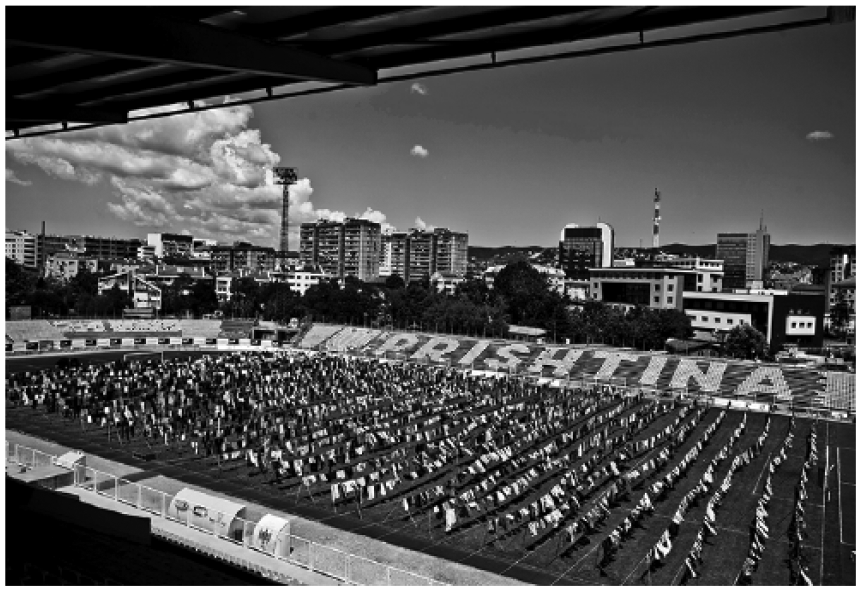
On June 12, 2015, the art installation “Mendoj Për Ty” [Thinking of You] displayed 5,000 dresses on clotheslines in the football stadium of the capital of Kosovo, Pristina (Image 1). The installation, dedicated to survivors of sexual violence during the 1998-1999 war, was the creative idea of Alketa Xhafa Mripa, a Kosovo-born artist based in London. It was produced through the month-long grassroots mobilization of a local network of women and women’s rights groups, with the support of the Office of the President of the Republic, Atifete Jahjaga. With this installation, the issue of wartime rape became the subject of a national conversation in Kosovo for the first time in the 17 years since the war. In the aftermath of the installation, neither the stigma associated with these crimes, nor survivors’ reticence to come forward, has completely disappeared. However, there have been visible changes both among survivors and in the public’s attitude toward them: in particular, increased self-confidence among the former, and increased recognition and acceptance among the latter, from political institutions to the general public, leading to the implementation of the reparation law of 2014.
Alketa Xhafa Mripa.
This article proposes an interpretation of how the installation “Thinking of You” succeeded in energizing advocates and creating solidarity with survivors. It is intended as a contribution to wider understanding of the role that art activism plays in transitional justice, specifically in regard to the issue of wartime rape. This reflective essay merges the experiences and thoughts of the authors, who over the years have cumulatively acquired a deep knowledge of the issues facing survivors of wartime rape. We come from different perspectives, whether human rights and women’s rights activism or academia, and our engagement with survivors also varies in nature and timeframe. Feride Rushiti is the director of the Kosova Rehabilitation Center for Torture Victims (KRCT) in Pristina, an organization that provides psychosocial services to survivors of sexual violence, among other victims of violence. Kadire Tahiraj, director of Qendra për Promovimin e Drejtave të grave [Center for the Promotion of Women’s Rights] in Drenas, has been working on supporting and integrating survivors of wartime sexual violence since 2008. Anna Di Lellio is a professor of politics in New York who has been engaged in Kosovo for two decades, both as an international organizations’ official and as a researcher on cultural memory and oral history. The broader conclusions that we propose are based on a constant conversation between us, which began in 2015 as we worked together on the installation and has since tried to find connections between the field of practice and theories of transitional justice, cultural memory, gender, and human rights transformation. Through this conversation, we intended to generate a subjective voice that included the insiders and an outsider, trying to bridge the divide between those who are represented and those who do the representing.
Our interpretive reflections on “Thinking of You” find their place among other studies that during the past decade have coalesced into the emerging field of arts and transitional justice, without yet constituting a strong scholarly paradigm, but still proposing suggestive arguments (see De Greiff, 2014; Garnsey, 2016; Rush & Simić, 2014). Here we present how “Thinking of You” intersects with some of those key arguments, such as the affective power of art in memorializing a violent past, its ability to connect a plurality of actors both as witnesses and as agents of change, and the contribution of art to a transformation of justice. Although these arguments are intertwined, below we will try to separate them analytically.
First, it is evident that, although the installation was not the first, nor the sole, public initiative in Kosovo by women’s networks and survivors as advocates, it was qualitatively different. 1 It allowed a memorialization of survivors of sexual violence via the artist’s symbolic imagination, which made “the victims visible” as such, while still allowing individuals to maintain the anonymity they prized (De Greiff, 2014, p. 18). The installation also had an exponentially stronger impact. The sustained, month-long media campaign that accompanied its production acknowledged “the presence of the elephant in the room,” by making the history of sexual violence during the conflict “part of the public discourse,” to use Zerubavel’s metaphor (2006, pp. 62-63). This effectively punctured the public secrecy that enveloped wartime rape, weakening the power game inherent to it, and beginning to shift the balance of power in favor of survivors. As Mookherjee’s (2006) ethnography persuasively demonstrates for Bangladesh, albeit with explanatory power for Kosovo as well, keeping sexual violence a public secret allows both general denial and the invocation of this known secret at specific times and in the context of intersubjective power dynamics that established dominance over “the weak, tabooed, anonymous, and subservient” (p. 435). In present-day Kosovo, after “Thinking of You,” although private shaming of survivors might continue, it is impossible to say, “I didn’t know,” and public support has broadened to include previously judgmental and unsympathetic sectors of this society, whether ordinary citizens or political leaders. As a consequence, both survivors and their advocates feel freer to move and speak because the area of recognition and solidarity has expanded, and thus they fear less the condemnatory comments that have made them reclusive.
Second, the installation revealed this public secret in a creative and politically powerful fashion, by directly involving the public. This form of memorialization was participatory. The execution phase mobilized overlapping networks of women loosely connected across civil society and institutions, including women artists, intellectuals, activists, survivors, politicians, and public officials, as well as ordinary individuals. They were able to build on grassroots advocacy dating back to before the war, when activists played a part in the global campaign against violence against women. 2 “Thinking of You” directly engaged survivors, who collaborated with the artist in its making, but also exponentially expanded the survivors’ close-knit community of memory, made up of health workers and activists, by mobilizing individuals from all walks of life in the offering of dresses to the artist. And by showing these offerings as exemplary gestures through an intensive use of the conventional and social media, the installation effectively used those performative gestures to amplify the sphere of witnessing and responsibility (Shefik, 2018).
Third, the installation established connections between the memory of trauma and a reparative mode of transitional justice, helping break the hold of the past without forgetting it, to paraphrase bell hooks (1989, p. 155). The installation brought the past into the present to address the current as well as the future condition of survivors, proposing a “reparative reading” of the past. We take this notion from Marianne Hirsch (2012), who adopted feminist/queer scholar Eve Kosofsky Sedgwick’s approach comparing “reparative reading” and “paranoid reading” in the context of post-memory studies (p. 24 and pp. 74-75). Bypassing a “paranoid reading” of the past, which would be focused on exposing the guilt of perpetrators, the installation did not dwell on the denunciation of sexual violence. Rather, it sought to “repair” broken bonds within a society that had silenced and shunned survivors, by proposing an alternative way of thinking about them: as carrying “no stain,” like the dresses hanging as clean laundry on the clotheslines (Tran, 2015, para. 4).
Through our direct experience and investigation, we believe that “Thinking of You” made an important contribution to the fight against the stigma associated with sexual violence, a fight that has recently become a key concern of international organizations. 3 After “Thinking of You,” survivors and their advocates felt re-energized, perhaps because the process brought their “pain into politics” (Ahmed, 2015, p. 39), that is, by moving from a call for their stories to political action. The social solidarity they could count on gave a new impulse to their advocacy for justice—an effort that has consistently played out beyond the constraints of RECOM, the regional program of transitional justice, mostly focused on gathering testimonies from victims on all sides of the conflict. 4 By the end of 2017, after the mass mobilization created by “Thinking of You,” survivors and their advocates had obtained from the government the budget allocation to implement law 04/L-172 providing a pension to survivors as civilian victims of the war. This law, approved in 2014, was the key piece of transitional justice they had lobbied for, but its implementation had completely stalled in the meantime, amid doubts about its financial feasibility. Conceived alongside a political plan to increase public awareness of the law, “Thinking of You” gave symbolic and emotional meaning to the notion of justice for survivors: To paraphrase Cover (1983), it provided a moral explanation for and purpose to the law (p. 5), which is potentially one of the most effectively transformative roles that art activism could play in transitional justice processes (Buhan, 2015, p. 156).
In this article, we weave empirical observations with our broader conclusions, instead of separating descriptive and analytical observations. We propose a micro-history told by some of the protagonists in the initiative, because we believe that it is the best narrative form to reveal women’s subjectivity, and thus we take the reader on a journey that begins with the conception and realization of the art installation and follows its afterlife over more than 2 years of fieldwork, including oral history interviews and advocacy.
Mobilizing Memory Through Art
In March 2015, Alketa Xhafa Mripa’s solo exhibit “You Just Don’t Talk About It” in London dedicated a small corner room to the installation “Thinking of You.” It was a display of about a dozen dresses hanging on clotheslines, symbolically “airing out the laundry” of the unspeakable and unspoken crime of wartime rape in Kosovo—clean laundry in this case, signifying the cleanliness and purity of survivors. The conceptual artist felt that the time had come to break the silence enveloping the widespread and systematic sexual violence that occurred during the recent war, and was publicly suppressed in its aftermath. She used art, the language she thought could be emotionally understood by everyone, to address this unspoken crime.
Less widely known as a phenomenon than wartime rape in the Bosnian War (1992-1995), rape was equally widespread and systematic in the Kosovo War (1998-1999). Various human rights investigations provide ample evidence that it was committed by the Serbian army, police, and paramilitaries against Albanian women (see Human Rights Watch, 2000; Organization for Security and Co-operation in Europe [OSCE], 1999; Serrano Fitamant, 1999), as do the indictment of Slobodan Milošević and others, or the convictions of Serbian military and security leaders Nebojša Pavković, Vlastimir Djordjević, Nikola Śainović, and Sreten Lukić at the International Criminal Tribunal for former Yugoslavia (ICTY). 5 Although there is no accurate count of the number of survivors, because very few of them came forward, a 1999 survey by the United States-based Centers for Disease Control estimates 20,000 (Kuehnast, de Jonge Oudraat, & Hernes, 2011, p. 72).
During the war, survivors and their advocates reported the violence, but later they refused to speak out, shut down by a society that considers rape a stain on the honor of both individual families and the nation. When the first children were born out of that violence, local media sensationalized the news, calling the newborn “children of shame” (I. Rogova, December 26, 2014, personal interview). Survivors were also failed by judicial mechanisms that did very little to make the perpetrators accountable. When human rights investigators handed evidence of 37 cases of sexual violence to the UN Mission in Kosovo (UNMIK), which was in charge of the Department of Justice until 2008, no prosecution followed (S. Ahmeti, December 27, 2014, personal interview). When survivors agreed to testify at the ICTY as protected witnesses in the very few indictments for sexual violence, their identities were leaked to the public, and they had to be relocated to a third country, never to return to Kosovo (Ahmeti, 2014; Trix, 2013). Survivors found support from each other and women’s rights groups in private settings. They chose a strategy of voice and silence at different times and for different reasons (Di Lellio, 2016). Since the war, rape has become enveloped in public secrecy, both locally and internationally.
Visiting Alketa Xhafa Mripa’s London exhibit from New York, sociologist and policy analyst Anna Di Lellio was deeply moved by the artist’s inspired representation of the many Kosovar rape survivors through dresses. There were immediate comparisons to be made with previous installations elsewhere, which had all succeeded in evoking both absence and immensity, provoking empathy through a sweeping display of objects or fabric: the 2012 arrangement of 11,541 blood-red empty chairs in the center of Sarajevo to commemorate the city’s dead on the 20th anniversary of the conflict; the AIDS quilt made of 1,920 panels, covering the size of a football field in the Washington D.C. National Mall in 1987, to remember the casualties of the AIDS epidemic; and Christian Boltanski’s 2010 installation “Personnes” [Person/Nobody] in Paris, with clothes arranged in a great heap or in smaller piles, symbols of both people and their absence.
Having recently worked on a research project on Kosovo survivors’ silence and activism, Di Lellio also knew that new opportunities for breaking the silence had recently emerged, thanks to the work of a broad transnational network of advocates. In 2012, Igballe (Igo) Rogova, director of the Kosova Women’s Network (KWN), followed up on the idea of Nazlie Bala, an activist, and Aida Derguti, a Member of Parliament, both from the party Vetëvendosjë, to transform the celebration of International Women’s Day on March 8 into a protest. “We don’t want flowers, we want justice for women who suffered sexual violence during the war,” read the banner at the women’s rally that day. Both the Minister of European Integration, Vlora Çitaku, and the President of Kosovo, Atifete Jahjaga, took notice and initiated private meetings with survivors as well as public initiatives to increase awareness. The next year, in 2013, the Law on Veterans and Civilian Victims of the War was amended to include survivors of sexual violence as a separate category, provoking an embarrassing debate in Parliament, during which survivors were both doubted and ridiculed by male representatives. In the end, the law was approved because local and transnational women’s advocates managed to persuade political institutions. Simultaneously, President Jahjaga had in fact joined the Global Initiative for the Prevention of Sexual Violence in Conflict (PSVI), sponsored by the U.K. Foreign Secretary, William Hague, and actress and special envoy of the UN High Commissioner for Refugees, Angelina Jolie. As part of the initiative, the President of Kosovo had set up the National Council for Survivors, a consultation mechanism including all the civil society organizations working with survivors. In 2015, as the implementation of the law was lagging, the Council planned a public awareness campaign to break the stigma surrounding wartime sexual violence.
If the dream of Alketa Xhafa Mripa was to project the small installation dedicated to survivors in London onto the much larger scale of the football stadium in Kosovo, to Di Lellio it sounded like a potentially powerful initiative to reveal fully the “invisible,” thus fitting the Council’s strategy: to generate society-wide solidarity and deal a blow to the stigma associated with rape. Together, the artist and the scholar pitched the idea for the installation to President Jahjaga’s adviser, Garentina Kraja, who responded very quickly and positively and quickly obtained the blessing of the President. It was the possibility of publicly displaying the tragedy of wartime rape, so deeply buried until then, that immediately appealed to everyone—politicians, advocates, and survivors—as they recognized the deep emotions that Alketa, a native Kosovar in the diaspora who nonetheless remained consistently engaged with her country, brought to the project. At first, there was a debate among women’s organizations within the National Council about how to collect the dresses. Some would have liked to concentrate their efforts in Pristina, but the artist and the sponsors of the installation insisted on setting up meetings in all the major towns of Kosovo and on reaching out to all corners of the national society. This decision proved to be extraordinarily effective because it directly engaged thousands of individuals.
Unveiling the Public Secret
The first person to donate a dress was President Jahjaga, which attracted a great deal of media attention. In the documentary film produced about the exhibition in 2015 (Di Lellio & Shale, 2015), we see her clear message to survivors and the broader public: “You are not alone in this. We are one, and we are all together. [Survivors] will always have my support, and the support of all the citizens of Kosovo.” For 1 month, the same message was broadcast by local television and through social media, triggering a wave of donations from individuals and groups, including other politicians and local celebrities. Rita Ora, a Kosovo-born and London-based, internationally renowned pop singer, donated a dress. Every day, there was fresh coverage of the collection campaign on television and on radio. Survivors were dumbfounded by the attention that all of a sudden was being showered upon them. A national icon such as Rifat Jashari embraced the project without reservation. Surviving the massacre of 20 members of his family by Serbian security forces in March 1998, a massacre that targeted Albanian insurgents but also small children, Rifat Jashari is a patriarch presiding over his family and, symbolically, over the Albanian nation. “I support them, and I support you,” he told the artist in an impromptu interview: “They could have been our daughters, our sisters.” When we posted his words on Facebook, the post went viral. When the news reached a group of survivors gathered at a social center, their heads, usually bent meekly, lifted up and stayed that way for a while. That recognition had suddenly elevated their status from ostracized victims to members of the symbolic family that is the nation.
In public secrecy, what is “not known” in the open is discussed in private and the terms of the discussion are decided by power relations. We know from the testimonies of psychologists and activists who have worked for years with survivors in Kosovo, as well as from the survivors themselves, that this dynamic combines lack of public recognition with exposure to ridicule in private or in the “rreth,” the closer community of extended families and neighbors on which reputation depends in Kosovo. And the reputation of a woman depends on her responsibility to uphold social mores, especially chastity, within the framework of the traditional family (Reineck, 1991, pp. 106-109). Survivors experienced the fear of being shamed by “people . . . talking” (Krasniqi & Koliqi, 2017, p. 44) or “the fear to be laughed at” and “be badmouthed” by the sister-in-law, for example (p. 74). Oftentimes, it is simply the anticipation of this exposure, more than its reality, that torments survivors, as we know from experience or are learning from oral history interviews.
This is the classic mechanism of stigma understood in Goffman’s (1963) terms: As they have lost the uncontaminated character of their identity as wives and mothers, survivors suffer not only from a lack of respect, but also from the anxious anticipation of not receiving respect. If, for some of them, stigma led to physical banishment from the family, it led almost all of them to internalize the alleged contamination, feeling guilty and ashamed, and even attempting suicide. They experience a constant feeling of alienation. In a meeting, one survivor described to Feride Rushiti the sensation of being “like a kese e berllogut (sack of garbage) that everyone wants out of the house.”
The public display of the President’s closeness to survivors, and the public acknowledgment and show of support by the country’s elite, produced the most effective breach of the power dynamic of public secrecy, which had made survivors both invisible and visible, both unrecognized and objects of ridicule and condemnation. Public acknowledgment of this type contributed to a transformation in families and communities, initially started after survivors met with the President and the Minister a year earlier: As no male relatives of theirs had ever had nor was likely to have private contact with the country’s leaders, the women’s statuses were elevated. One veteran advocate of survivors told us that the ridicule directed at her husband subsided; there is no more allusive and sardonic questioning from his friends about whether his wife is also a survivor, given that “she always talks on their behalf.” For Kadire Tahiraj, the change meant that she stopped skirting the walls as she entered public offices, feeling the stares of people who recognized her as an advocate of rape survivors; she can now walk without fear as she goes about her business.
The silence was broken internationally as well. In June 2017, having acquired visibility beyond Kosovo thanks to the installation, both Rushiti and Tahiraj participated in a 4-day global gathering in Geneva organized by the Mukwege Foundation for survivors of wartime sexual violence and the activists who support them. Their experience was front and center due to the consensus that the Kosovo government’s plan to compensate survivors was a model to be followed. They felt pride in their work like never before, a sentiment that further energized their advocacy, especially after their new friend, Dr. Denis Mukwege, was awarded the 2018 Nobel Peace Prize for his effort to end the use of sexual violence as a weapon of war and armed conflict.
“Quotable Gestures” and Their Objects
The collection of dresses for the installation “Thinking of You” began in Gjakova, a municipality near Kosovo’s border with the Republic of Albania, where the attacks on Albanian civilians during the war were so brutal that it has a record number of rape survivors and civilian casualties (more than 10,000 killed or missing, according to the count in the Humanitarian Law Center’s (n.d.), online Memory Book). Woman after woman handed a dress to the artist, whispering in her ear, “I am one of them,” “Now I know I am not alone.” They were able to give private testimony in the very public setting of a rally and in front of rolling cameras. The words went unheard even by the closest audience members, but the emotion in the exchanges was visible, touching the artist first and then spreading to all those present (Image 2). We might call these exchanges “quotable gestures,” borrowing Bertolt Brecht’s own definition of his writing style, which Walter Benjamin in turn applied in the context of epic theater to gestures that are framed, and thus made salient, by interruptions in the narrative flow (Benjamin, 1998, pp. 19-20). In our case of art activism, the gesture is accompanied by a language of recognition and acceptance, its power evident in its simplicity (Wizisla, 2004/2016, pp. 106-108). These gestures of offerings were also highly emotional and liberating events, to paraphrase Marianne Hirsch (2017), because something important was exchanged, symbolized by the dresses taken out of the private closet and brought into the public sphere: a personal and collective transfer of trauma (p. 60).

Alketa Xhafa Mripa receiving the donation of a dress.
In Drenas, a town in the area of Drenica where the war began earlier and was bloodiest, women and men approached the artist, offering their dresses and delivering a short speech. From men, carrying dresses donated by female relatives, there was an acknowledgment of the crime and an expression of sympathy. Women’s speeches were more performative, as they gave the artist dresses that meant something to them. One offered her most prized dress, the engagement outfit she had kept for 20 years. Another relinquished her bridal dress, a symbol of shattered dreams.
As the images of these offerings were shown on television, the donation of dresses acquired the form of a ritual, which had not been required nor expected by the artist. Vlora Çitaku, Kosovo Ambassador to the United States, gave the skirt she wore when she signed Kosovo’s Declaration of Independence as a Member of Parliament. Bukurije Gjonbalaj, the Ambassador to Italy, gave the dress she wore at the 1999 Rambouillet Peace Conference. Feminist activist Nazlie Bala donated the only dress she ever owned and wore, whereas Sevdije Ahmeti donated her favorite dress, a colorful sundress that she had not worn since the death of her husband. Another woman gave the dress that her mother-in-law bought her on the occasion of the birth of her first born, after a series of miscarriages. Every dress told a story, and all stories were both private and public, highlighting the variety of women’s subjectivities.
Through the grassroots campaign and the media coverage, those “quotable gestures” saturated Kosovo’s public sphere. No longer kept in the closet, dresses and emotions became part of a public spectacle, during the collection process, the construction of the installation, by volunteers, in large part survivors, and the final display of the 5,000 dresses in the stadium of Pristina on June 12, for 1 day only. The inauguration ceremony was broadcast live by the main national television station RTK, and the installation received streams of visitors for the whole day. It was an extraordinary spectacle, which fulfilled the intention of the sponsors; in the words spoken by Garentina Kraja in the documentary on the making of “MendojperTy,” “nobody will be able to ignore an entire stadium full of skirts.”
The use of fabric and clothes in commemorative contemporary art, as Hirsch (2017) suggests, “evokes past violence . . . as certain clothes carry literal, indexical traces of violence and serve as evidence of it” (p. 53). This trace was even more evident in the case of two skirts, uncovered from the collection pile at the time of the installation, featuring messages that had been anonymously penciled on the fabric by their former owners. “This skirt has been hiding a story since the spring of 1998,” read one. “I have a hidden experience,” declared another (Image 3).

“This skirt has been hiding a story since the spring of 1998.”
The Power of Art to Create Change Through Emotions
Different emotions—pain, shame, anger, and sympathy—were communicated through skirts or dresses, tangible objects exhibited both at the local rallies and in the broader public sphere. Locally, the audience sharing those emotions was mostly composed of survivors and individuals who belonged to the same community ravaged by the war, a proximity exemplified by Rifat Jashari’s statement, “they could have been our daughters.” The connection created was not merely about feeling the other’s pain, but entailed a show of commitment to acknowledge survivors, first through a present action and object—the offering of the dress—and second through a promised commitment. We found that this process clearly exemplified the cultural politics of emotions, to paraphrase Sara Ahmed (2015, p. 39), not as the possibility of an elusive reconciliation, but of learning how to live together. In this sense, “Thinking of You” differed from Patricia Cronin’s almost contemporaneous exhibition at the Venice Biennale, “Shrines for Girls,” which also displayed dresses as symbols of violated bodies. In this case, the dresses from sites of mass violence against women—India, Nigeria, and various countries in Europe and North America where young girls and women were institutionalized in Magdalene Asylums—were piled up on three altars of the deconsecrated church of San Gallo. As Hirsch (2017) notes, despite the artist’s invitation to viewers to donate to humanitarian organizations dealing with survivors of sexual violence, the question remains whether the exhibition’s religious connotation effectively provoked the mobilization of traumatic memory or encouraged change (p. 56). There is no such doubt for “Thinking of You.”
On other occasions, art has provided “a unique opportunity to engage historical traumata at the level of cathartic public action” in transitional justice settings (Buhan, 2015, p. 157). Simić (2010) and Stepakoff (2008) have made a similar argument about the Dah theater in Belgrade and the play performed by witnesses before the Special Court for Sierra Leone, respectively. However, the scale of public participation in “Thinking of You,” beyond the narrower audience of activists or experts, makes it unlike those performances. Despite their different contexts, it is the AIDS memorial “Quilt” that more closely resembled “Thinking of You,” because it was built from thousands of panels individually composed to commemorate a friend or a relative lost to the AIDS epidemic. Both works of art inspired cultural memory to establish a collectivity (Sturken, 1997, p. 185). The larger public sphere created by the media in both cases expanded the communication of emotions to reach individuals who were less involved, but still felt sympathy for survivors and committed to their cause. For survivors, this creation of a public sphere boosted their self-confidence. When they saw the involvement of foreigners in the making of the installation, and in support of the installation—ambassadors, journalists, and scholars—they thought, as Kadire Tahiraj recollects, “America is with us.” This simple statement not only reflects Kosovo’s well-known reliance on U.S. support. It also expresses a certain relief that international silence, something that deeply hurt survivors, had ended (S. Izeti, January 15, 2018, personal interview). Following the installation, a visit to Kosovo by Prince Charles and Camilla Parker Bowles in March 2016 included the Duchess of Cornwall’s visit to the Center in Drenas, where she met survivors who were stunned to see the illustrious visitor cry while listening to their stories.
Survivors felt some consolation after this encounter and many similar ones. Adam Smith’s (1976) sympathetic equilibrium between the spectator and the sufferer is achieved in the context of a spectator who has no direct connection with the sufferer (pp. 13-23). If the first can imagine the suffering of the second, the latter can imagine the feeling that this imagination provokes. The equilibrium is indeed a form of moderation that derives from the expression of feelings on the part of the spectator in sympathy with the sufferer, and the limits that the sufferer imposes on her expression of feelings, not to burden the spectator. Evidence not of erasure, but perhaps of a certain alleviation of pain, is that survivors have since agreed to tell their stories to the public, some collected in the volume I Want to Be Heard (Krasniqi & Koliqi, 2017), putting into words a pain of which they had not able nor willing to speak previously. And by doing so, they have continued to expand their visibility as well as strengthen their advocacy.
There is plenty of evidence to connect changes in the behavior of prominent members of Parliament, such as representatives of the leading Kosovo Democratic Party Kadri Veseli and Blerta Deliu, to “Thinking of You.” Both had opposed the law stipulating the provision of a pension for survivors, but during the installation and in its aftermath, they became committed supporters of the law. Other politicians followed suit, from the Prime Minister to the President who succeeded Jahjaga. The creation of a public sphere emotionally engaged with the issue of survivors changed the members of that public from sympathetic into committed spectators—Smith’s (1976) impartial spectators, the “representatives of humanity within” (p. 130), who observe themselves and their own conduct and are moved to commit to justice, as Boltanski (1993/1999) argues in his critical development of Smith’s idea.
Conclusion
As we reflected on the powerful changes that have occurred in Kosovo since the art installation “Thinking of You” revealed the public secret of wartime sexual violence, we confirmed some certainties and discovered new perspectives for human rights and women’s rights advocacy. We already knew that women’s networks are the most committed and effective actors contributing to transforming women’s rights as well as achieving transitional justice—knowledge garnered through our experience as activists and scholars. However, what this art installation showed was a new way to create the broad solidarity and recognition that survivors of wartime sexual violence need and demand.
By allowing participation through the gesture of publicly offering a dress to the artist, the installation made it possible for survivors and their families to “testify” without speaking out, and for wider society to express their sympathy with victims of sexual violence. It gave participants the opportunity to symbolically touch and see survivors in the disembodied dresses, and thus to emotionally connect to them. As a work of art built upon grassroots mobilization through a media campaign, including the use of social media, it propagated its message in a capillary way. To sum up, by eliciting an emotional acknowledgment of survivors, which was widely communicated, the installation effectively broke the public silence enveloping the crime of sexual violence. It thus began to change the power dynamics inherent in public secrets, which stigmatize and isolate survivors. As a result of this change, survivors and women’s activists were empowered. Finally, because it took the issue of survivors and their pain into the public sphere by communicating their emotions, it expanded not only the sphere of knowledge but also that of moral and political engagement; it made it possible for a community ignored by the state to provide normative sustenance for a law that does some justice to them.
Footnotes
Declaration of Conflicting Interests
The author(s) declared no potential conflicts of interest with respect to the research, authorship, and/or publication of this article.
Funding
The author(s) received no financial support for the research, authorship, and/or publication of this article.