




Abstract
This article is a conversation between two academic experts, Callie Rennison and Nikki Jones, who endeavor to sum up what has been accomplished in eliminating violence against women in the United States during the 25 years of the journal’s existence. Domestic violence, rape, and sexual harassment are discussed. Although prevalence rates are down in domestic violence, rape and sexual harassment remain persistent problems. Looking at violence against women from an analysis of President Trump voters in the 2016 U.S. presidential election, Rennison and Jones observe the extent to which the current ideas and attitudes of women—both young and old—will need to change before violence can be eliminated. Rather than viewing events in the United States as totally negative, they see them as presenting new opportunities for greater understanding of violence against women and for new methods of prevention and perpetrator accountability.
Keywords
Introduction
On this, the 25th anniversary of the journal Violence against Women, I wanted expert opinion about what had been accomplished during these past 25 years in eliminating violence against women. I desired dialogue, and even disagreement, as a way of focusing issues. Scholars and activists Callie Rennison and Nikki Jones took up my offer to sum it all up and make sense of it in an email dialogue taking place in 2018.
Responding to questions and observations from me, and comments from each other, the two experts discuss trends in domestic violence (DV), rape, and sexual harassment prevalence, summarizing what we have learned about the causes of violence against women, the cultural changes needed, and how they may be achieved. A new research agenda emerges as well as provocative thoughts about perpetrator accountability. Looking at violence against women from an analysis of President Trump voters in the past U.S. presidential election, Rennison and Jones observe the extent to which the current ideas and attitudes of women—both young and old—will need to change before violence can be eliminated. Rather than depicting recent events in the United States as totally negative, they see them as presenting new opportunities for greater understanding of violence against women and for new methods of prevention and accountability.
Naturally, the discussion focuses on the United States as it simply did not prove practical to engage researchers in countries throughout the world in dialogue. We hope, however, that much of the material will be relevant to situations elsewhere, even though history, race and ethnicity, and culture may be different, as recently we have seen similar politics and policy outcomes, as well as new levels of activism by women and girls, replicated in countries other than our own.
Raphael: How Have We Done in the Past 25 Years in Decreasing the Amount of DV in the United States?
Rennison: Evidence is clear that DV has decreased dramatically over the past two and a half decades, regardless of the definition used. Using the broadest definition of DV involving any intimate partner or relative and focusing on violence restricted to rape, sexual assault, robbery, aggravated and simple assault, evidence clearly indicates a drastic decline. Analyzing the 1993-2015 National Crime Victimization Survey (NCVS) data, estimates show that DV victimizations decreased an estimated 78.9% over that time (from 14.1 to 3.0 per 1,000 people); see Table 1 and Figure 1. DV victimization decreases were estimated for both female and male victims. During the 1993-2015 period, the rate of DV perpetrated against female victims fell 79.3% (from 22.6 to 4.7 per 1,000 females), whereas the rate of DV committed against male victims decreased 76.9% (from 5.1 to 1.2 per 1,000 males).
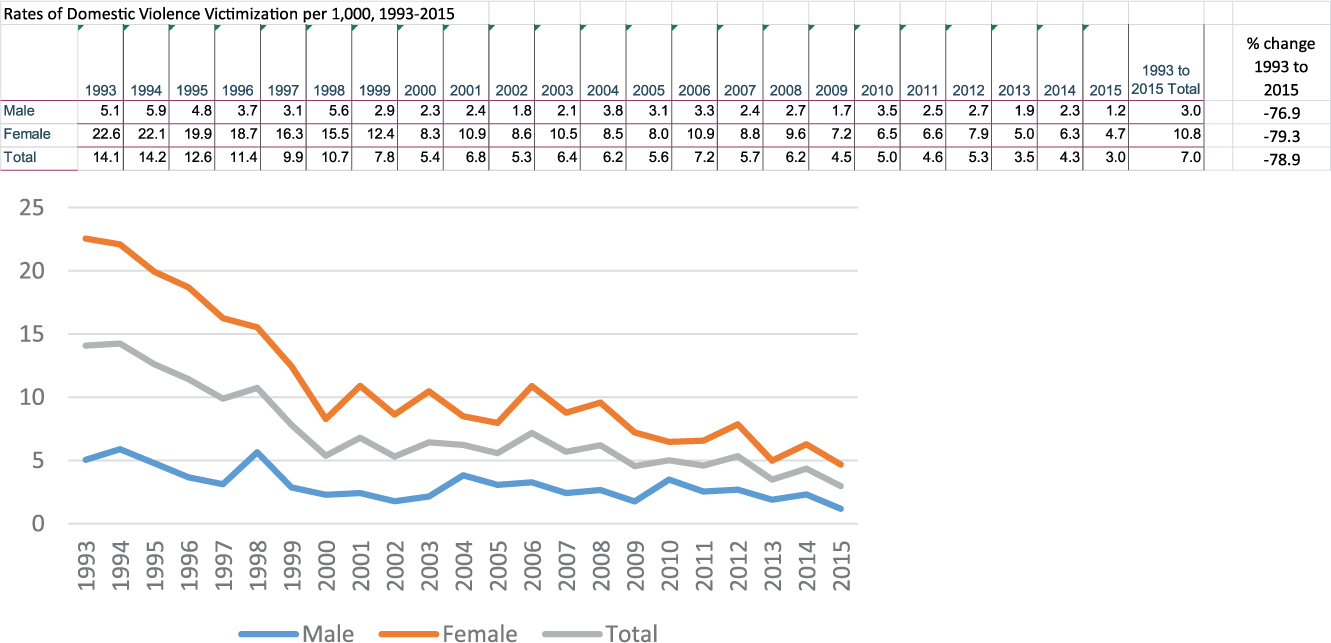
DV Rates per 1,000, 1993-2015, NCVS.
Many use the phrase “domestic violence” to refer to violence committed by an intimate partner only. An intimate partner is a current or former spouse or boyfriend/girlfriend. Using this definition, similarly large decreases in intimate partner violence (IPV) are measured in the NCVS data over this time (see Table 2 and Figure 2). Estimates demonstrate a 78.4% decrease in victimization rates from 1993-2015 as they fell from 10.0 to 2.2 (per 1,000 people) during that time. Dramatic declines in rates were evident for both female and male victims. The rate of IPV perpetrated against female victims fell 77.0% (from 16.9 to 3.9 per 1,000 females), while the rate of IPV committed against male victims decreased 86.7% (from 2.7 to 0.4 per 1,000 males) from 1993-2015.
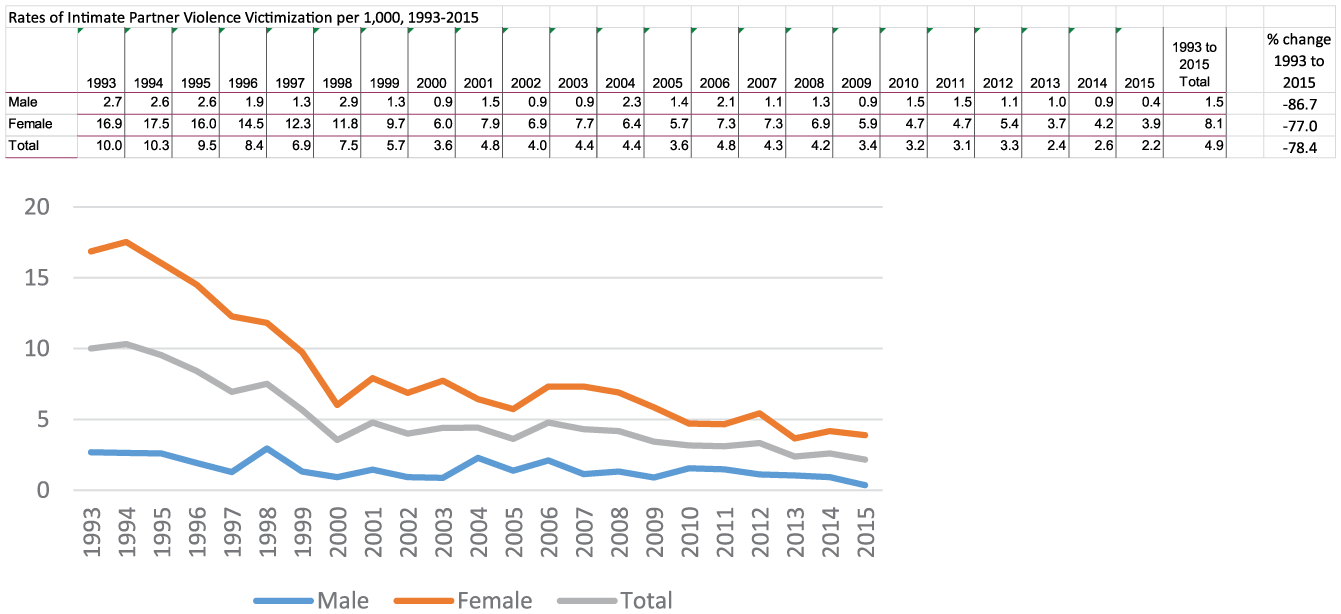
IPV Rates per 1,000, 1993-2015, NCVS.
Given these definitions, and based on NCVS methodology, it is clear that DV and IPV for females and males have decreased over time. Yet, not everyone agrees. A look at Google easily turns up individuals claiming that DV and IPV have not gone down because (mostly cited) shelters are seeing more and more people coming in for assistance. This type of position confuses several things. First, what one or even five shelters see is not representative of the nation and should not be used to provide evidence of increases or decreases in rates of IPV or DV. Second, rates are constructed in such a way that they can decrease as the overall number of people victimized increases. Rates take into account population sizes. If the population increases, then more people may be victimized. However, the rate at which there is victimization can decrease at the same time.
That DV and IPV have decreased greatly over the past 25 or so years is great news! One may argue that the NCVS is not the best data source to use to examine this, but all data demonstrate a marked decrease. In addition, although the NCVS has been criticized as underestimating DV and IPV, it can be used to look at change over time (given the underestimation will be constant over time). It offers strong evidence of a decrease. Even with that good news, however, I don’t know of any researcher, advocate, or citizen who finds that the rates of violence are low enough that we should stop focusing on DV and IPV. On the contrary, I see passion and effort to address this violence are as strong as they have ever been—if not stronger. So while low rates are worthy of celebration, the problem is not solved. In fact, there is much we need to understand even now.
For example, several questions are raised by looking at the changing rates of IPV and DV shown above compared to overall violence (see Table 3 and Figure 3). First, why were the rate declines during the initial part of the period so much greater than during the latter part of this period? What happened from the early 1990s to about the year 2000 that led to such steep drops, or what happened in later years to cause a plateau? That is, what changed in about the year 2000 that has led to much slower declines in the rates of IPV and DV? During that early period, it was noted that the declines in IPV rates were not as great as were drops for overall violence. Knowing this, the data suggest that IPV is an especially persistent type of violence, and that the forces that resulted in such steep declines in overall violence did not translate to equally steep drops in IPV rates. Has that changed? Has education, awareness, access to assistance, and research removed that difference? Will the #MeToo movement make a difference?

Violent Victimization Rates per 1,000, 1993-2015, NCVS.
Looking at the overall trend, a question is who or what are responsible for the decreases in DV and IPV? I think there are many parties responsible for these positive changes. As one of many researchers who have focused on ending IPV and DV, I believe researchers have increased awareness, understanding, and education related to IPV and DV. It is clear that this information is in part behind the drop in IPV and DV. By increasing awareness and educating the public and parties in the criminal justice system about the danger of IPV and DV, and offering empirically based practices as to how IPV and DV should be best dealt with, rates have fallen. I also believe that advocates and direct service providers who deal directly with victims and survivors are responsible for much of this decrease. They work with individuals on a daily basis to give them the resources they need and assist them in finding safety (among other important things). This matters tremendously in the lives of those directly affected.
I also offer credit to leaders in the federal government for the decreases in IPV and DV seen over the past several decades. It was because of these leaders that the Violence Against Women Act (VAWA) was originally signed into law in 1994 (and reauthorized in 2000 and 2005). Between 1994 and 2000, VAWA provided US$1.6 billion toward the investigation and prosecution of violence against women. It also created the Office on Violence Against Women in the Office of Justice Programs at the Department of Justice. Although VAWA is concerned with all types of violence against women, a large proportion of violence against women comes in the forms of IPV and DV. With VAWA, elected leaders in Washington sent the message that DV and IPV will not be tolerated (regardless of the sex of the victim). More than a message, however, this work provided funds that have been distributed broadly to end IPV and DV. This work is responsible for a part of the declines we’ve seen over the past two and a half decades. Sadly, late in 2018, the federal government allowed funding for VAWA to expire. Time will tell what impact this will have in the future. I firmly believe that the work of each group has mattered, and it is an example of the whole being more than the parts. By working together—researchers, advocates, the public, members of the criminal justice system, and legislators—we have been changing the culture for the better. Yet, more change is needed.
Although the culture has been shifting, and the rates of IPV and DV over time demonstrate this, people still die or are violently victimized by an intimate partner or family member every day. Consider that in 2017, the NCVS estimated that 1,237,960 people were victims of nonfatal DV, and that 666,310 were victims of nonfatal IPV. In addition, it is estimated that three women are killed every day in the United States at the hands of an intimate partner. These are not small numbers and they indicate that much work is still needed to raise awareness and knowledge about IPV and DV. We need to continue working together and using our voices collectively to increase awareness and knowledge. This is not a private or personal matter. This is a societal matter. Education and training—beginning at a very young age—remain crucial. Providing resources—including education—for victims/survivors remains crucial. Often overlooked is the critical role that batterer intervention programs play. Simply making one person safe from a batterer is not enough. The batterer must learn a different way of coping that does not involve violence, power, or control against anyone.
Although the past 25 years offer reasons to celebrate in terms of reductions in the rate of IPV and DV, the data also indicate the need to continue working on this important societal problem. It is my hope that funding will be increased for research, training, and direct services.
Jones: When I think about DV, I don’t usually think about the numbers. I think about the stories that people have shared with me over my years of fieldwork in inner-city neighborhoods in Philadelphia and San Francisco. I think about conversations and interviews with incarcerated men and women, conversations I’ve overheard on public transportation, the experiences people share in my classrooms, and tears shed during office hours as yet another student shares her experience with DV, either as a witness or a survivor. Many of these stories—most, really—come from women of color (cisgender, trans, and gender nonconforming). Although each experience is unique, the stories are, as they have always been, strikingly similar.
For some, their ability to address the violence in their lives is as limited as it was prior to the onset of the violence against women’s movement 40 years ago. Poverty exacerbates their experiences, as does the expansion and entrenchment of the criminal justice system into the lives of poor people. The hyper-criminalization of men of color has complicated the calculus of survivors: Whom do I call for help? The police? My male family members? Do I fight back? Do I stay silent? As Amber, a young mother I write about in Between Good and Ghetto who struggled to manage a violent relationship with the father of her young child, once put it, “I don’t want nobody to be in jail.”
When I do think of the numbers, I think about how women of color, especially Black women, continue to experience IPV at disproportionate rates. Consider rates of IPV using data from the NCVS (considered a source of conservative estimates). In 2015, White women were victims of IPV at a rate of 2.4 victimizations per 1,000 White women. In contrast, Black women experienced IPV at more than 3 times that rate: 6.7 IPV victimizations per 1,000 Black women. Why is this disparity so persistent even as a vast institutional infrastructure has developed to address violence against women? As I tell my students in class, the criminalization of violence against women is a real victory, but, as scholars similar to Beth Richie have taught us, and as other feminist scholars have come to appreciate more deeply over time, the movement’s victory is not necessarily a shared victory.
The persistence of this disparity, along with my more recent work analyzing videos of police encounters with young Black men, has led me to think more deeply about the relationship between structural violence—the micro and macro patterns of aggression and exclusion that constitute the infrastructure of social institutions—and violence against Black women and girls more broadly, from DV in private to the harassment and violence Black women and girls experience in public space. As I write in a recently published article, “The Gender of Police Violence,” excerpted from The Chosen Ones, this line of inquiry brings me back to an unfinished Black feminist project: How do we talk about the violence directed at Black women and girls, all too often by Black men or boys, without demonizing Black men and boys or silencing Black women and girls?
I took up this challenge more deeply in a chapter in The Chosen Ones, where I explain how large-scale structural shifts in crime fighting over the latter part of the 20th century, especially targeted and aggressive person- and place-based policing tactics, such as “hot spot” policing and “stop and frisk,” act as a form of social control rooted in the threat of sexual violence for both boys and men, and women and girls in what I describe as high-surveillance neighborhoods. Drawing on the work of Patricia Hill Collins, I show how routine police encounters targeted at Black boys and the street-based harassment targeted at Black girls both operate as what Collins describes as “invisible cage[s] of control.” Reactions to these constraints can send ripples of aggression throughout a community, including onto the bodies of family members, peers, or intimate partners. As I show in that chapter, the hand that local policing efforts play in perpetuating aggression and violence in Black communities, especially violence against Black women at the hands of Black men, is often made invisible. Instead, it is argued that the problem is rooted in the bodies and minds of Black men and boys, which only reinforces the legitimacy of the aggression targeted at them by the criminal justice system. This is why, as I’ve argued elsewhere, feminists should care about stop and frisk, and antipolice violence activists should consider more deeply how the experiences of Black men and boys with aggressive policing mirror the experiences of Black women and girls with sexual harassment and violence at the hands of intimates or strangers.
Raphael: Given All This, What Do We Need to Do Differently to Accelerate and Complete the Work to Eliminate DV?
Rennison: I firmly believe that we must adopt new strategies to end IPV. What we have been doing to date has been valuable, but it can only take us so far. Without new strategies, I fear the work in the field will stall (if it hasn’t already). What is next needed to continue working to stop IPV?
First, we must accept the findings from the huge body of research (while understanding no research is perfect) and acknowledge our successes. Failure to do so will harm work toward ending IPV. We have to stop quibbling about small differences in estimates across studies, acknowledge that research indicates that IPV has declined over time, and stop referring to IPV as an epidemic. Although estimates from one study may differ from another, rarely are the substantive conclusions different. Findings from research tell the same story: IPV is too common and we must do more to prevent it. Finally, the description of IPV as an epidemic must stop. A quick search of “IPV” and “epidemic” turned up 126,000 hits. “Epidemic” is not a synonym for “common.” An epidemic refers to a widespread onset of a problem (e.g., infectious disease) at a particular time. Although IPV may be widespread or common, it has not been characterized by a quick onset. Rather IPV has been too common for a long, long time. Persistent is a more accurate characterization.
Why do these things matter? First, I strongly believe that a social ill does not have to be an epidemic to be important and worthy of attention. IPV, violence, suffering, and death in any quantity are worthy of attention. Second, I strongly believe that this matters because continued arguing about the extent of IPV, the trend of IPV, and claims of IPV as an epidemic has led to a general social fatigue of IPV as a problem. Some view it as a lost cause. Students no longer come to me because they want to focus on IPV. Instead, they are interested in what they perceive to be newer social problems they think can be successfully addressed (e.g., human trafficking). Students have read and heard that after decades of research and millions of dollars spent, IPV is a problem that has only worsened. Even more problematic, funders appear to be moving their available funds to focus on social ills they feel can be positively addressed. How can policy makers justify continual robust support of IPV-related work when so many claim it has only gotten worse over time? Researchers and those working in this area must clearly identify and share the successes of all who are working on ending IPV. In doing so, we can and must identify the myriad of other IPV areas that require more attention and funding to end this problem.
A second way we must continue working to stop IPV is to increase the diversity of researchers. Anyone of us can only bring our own experiences, personal characteristics, privileges, and challenges to the table. Although diversity among researchers has improved over time, far more is needed. In 2011, in a research article in The Criminologist, Miller and Brunson found 81% of the members of the American Society of Criminology (ASC) providing a response that described themselves as White. Only 92 identified as Latinex (5%), and 17 self-described as Native Americans (1%). Clearly, diversity comes in a variety of forms, race/Hispanic origin being one. Research would benefit greatly from the experiences and perspectives of those who are disabled; lesbian, gay, bisexual, transgender, and queer (LGBTQ); poor; or affiliated with different religions (to name a few) to get the broad perspectives needed to fully understand and end IPV. Although this cannot be a fast fix, a start for each of us is to spend meaningful time actively mentoring young people.
Personally, I seek out first-generation college students because I am one of them. I find that in interacting with young people, we must be very direct and tell them clearly: “We need you.” “We need your life experiences.” “We need your unique perspectives.” “Your supposed flaws are what make your input more valuable.” Without a broader range of people, experiences, and perspectives informing our research, we can never fully understand how to end IPV. Imagine if only men worked on the issue of IPV. Could they possibly solve the problem alone? No. What if only the most privileged were working on the issue of IPV? Would certain relevant considerations be overlooked? Absolutely. What if only White people conducted research focused on IPV? Would this matter? Yes! A lack of diversity matters because try as we might, none of us can fully understand any issue fully. Diversity allows us to see a myriad of considerations when trying to eradicate IPV, support and assist those who have been harmed, and work with offenders that none of us could do alone.
Third, as researchers, we must get better at sharing our research findings with policy makers. One way we can do this is to make a concerted effort to build relationships with policy makers and to translate our research into policy briefs that they can digest and use to easily inform policy. In general, researchers do a poor job of this, often believing that if our work is published in a journal, our job is done. A second and even better way we can influence policy is to become policy makers ourselves. We must run for office and become the policy maker to deal with the larger structural issues that facilitate IPV, including poverty, educational hurdles, lack of access to child care, criminal justice system reforms, making the economy work for everyone, and so on. Clearly, our past approach, assuming that policy makers refer to our research in writing policy, is not working. We can continue to educate victims and offenders, we can provide shelters that protect women and men and children, and we can train law enforcement and the criminal justice system on this topic.
These continue to be excellent responses to IPV. What is sorely needed is proactively abolishing the system that allows IPV to begin. It is time to change the larger structure and the only way we can do that is to become the policy makers. We must lead the criminal justice system, become leaders in organizations, and run for office. Although all of us are needed to sustain this movement, the tone is set at the top. To date, waiting for those who have been in power to end violence and harassment has only demonstrated that they will not. Seeing the lapse in funding of VAWA demonstrates this. Furthermore, the appointment of judges who do not appear to understand the problem of violence against women demonstrates this. The rest of us must step forward, take the reins, and lead.
Jones: As Callie points out, it is imperative that we recognize the structural dimensions of the problem of violence against women, as well as the contradictions that characterize the battle. For example, gender equality or equal representation will not, on its own, be the panacea for violence against women. The treatment of Dr. Christine Blaisey Ford during now Supreme Court Justice Brett Kavanaugh’s confirmation hearing, reactions to the #MeToo movement, and, of course, the support of White women for an openly misogynistic president of the United States demonstrate that there are plenty of women who stand ready to defend the ideologies that support violence against women; polls show that this is especially true for White women who identify as Republican. Over the past 2+ years, we have witnessed again and again a backlash against women who fight for equality. This misogynistic backlash is emboldened by the racist and sexist rhetoric of the current administration and, as Callie mentions, has already had consequences for the support and funding of legislative victories of the past.
As in other social domains (e.g., health care, criminal justice, and LGBT rights), there is now a need to defend the victories of the past. Yet, we can also use this moment as an opportunity to intensify our efforts to conceptualize and address violence against women in marginalized communities in ways that are consistent with and respective of the experiences of poor women and women of color (cisgender, trans, and gender nonconforming). To echo my earlier comment, this is why those who are deeply committed to antiviolence against women efforts should be allies in the fight to combat all forms of violence against women, including police violence. The efforts of the #MeToo movement to unite farmworkers and celebrities in the fight against sexual harassment in the workplace is another model. We have to focus not only on acts of violence, but also on the relationships that support violence across and within social institutions and social groups.
I would also caution us against presuming that any future success in eliminating the ideologies and institutional relationships that support violence against women will naturally fade away with the coming of a more enlightened generation. Investment in a patriarchal model of heterosexual relationships, based on possession and control, still exists among adolescents and young people and are no doubt receiving even more support under the current administration. The dominant narrative about Millennials, for example, is that they are more tolerant and more progressive than previous generations. It is imagined that the momentum of enlightenment among this group will carry us into a more fair, just, and egalitarian future. Yet, as recent reports have revealed, 21st-century youth have not entirely eschewed the more traditional understandings of gender and power that form the foundation for violence against women. For example, a report from the Contemporary Council on Families, “Trending Toward Traditionalism,” found that trends toward gender equality in the public realm “diverged from those regarding gender relations within families.” In a somewhat surprising discovery, they found that “After becoming more egalitarian for almost twenty years, high school seniors’ thinking about a husband’s authority and divisions of labor at home has since become substantially more traditional.” This was especially true for young men. Recent studies have also shown that even as women gain a measure of equality in the workplace, they still perform a share of household labor that is not much different from that performed by women in the 1970s. Change does not happen “naturally”; it has to be fought for again and again and again.
Raphael: How Have We Done on the Issues of Rape and Sexual Harassment?
Rennison: As most rapes are not reported to the police, police reports are not an adequate prevalence measure of rape. In 2010, the Centers for Disease Control administered a survey to 16,507 persons who were 18 years of age or older in 50 states and the District of Columbia. Using the most conservative measure of sexual assault, forcible penetration, it found that 12.3% of the sample, or 14.6 million women, said they had been the victim of rape within their lifetimes, and 0.5%, or 620,000 women within the past 12 months. These are significant numbers. Even worse, however, low rape reporting to law enforcement prevents society from holding perpetrators accountable. NCVS data show that from 2014-2016, rape and sexual assault reporting fell from 33.6% to 22.9%. The good news is that in the 2017 NCVS the reporting rate rose to 40.4%, undoubtedly due to the effects of the #MeToo movement, with more women both speaking out and reporting to law enforcement during and after the presidential election.
Victims and survivors are often shamed, blamed, and not believed about the violence they experienced. Those who continue working within the system find that charges are often not filed and convictions are rare. Given the persistence of rape myths and treatment of victims and survivors in the criminal justice system, poor reporting to the police has not been surprising. The real question is why would anyone report rape or sexual assault to the police? The big question now is, with increased reporting, is law enforcement prepared to respond appropriately?
Sexual harassment is similarly poorly reported to authorities although it is common. The Equal Employment Opportunity Commission (EEOC) convened a task force prompted in part by the persistence of sexual harassment claims being brought even though decades have passed since the U.S. Supreme Court recognized claims for sexual harassment as a form of discrimination based on sex under Title VII of the Civil Rights Act of 1964. The resulting EEOC report, published in 2016, cited estimates indicating that between 25 and 85% of women reported they were sexually harassed at work. Additional scientifc research as well as a 2010 Washington Post survey indicate that between 10 and 19% of men are sexually harassed on the job as well. It is estimated that only 30% of those who are harassed complain to someone in their organization. Furthermore, only 8% filed formal complaints with their employer. The response to most of these complaints is terrible, 75% of those who spoke out against sexual harassment experienced retaliation, commonly termination. This history also indicates that the real question is why would anyone make a formal report of harassment? As shown in a recently published report, “The Facts Behind the #MeToo Movement: A National Study on Sexual harassment and Assault,” containing similar statistics, when women have come forward to report patterns of abuse and harassment, they have been ignored by individuals and institutions who should be holding perpetrators accountable.
These facts are dismal. However, there is hope. The recent #MeToo movement suggests that victims and survivors of harassment and sexual violence are finding a new way to “report” and hold offenders accountable, and new reporting data might indicate increased confidence in a proper law enforcement response. I have hope that the #MeToo movement will lead to positive and permanent changes. Why? First, because #MeToo has begun changing the environment to one where it is safer to speak out about violence and harassment experienced. The first time one speaks about her experiences is the hardest. The movement has allowed many to take that first difficult step. This movement has paved the way for victims and survivors to keep talking because they can see for the first time the degree to which they are not alone, and there is power in their numbers.
Second, #MeToo has prompted hope because it has resulted in listening, hearing, and believing that have been absent in the past. People are finally listening and hearing that sexual violence and harassment are real and pervasive. Although many have conducted research, advocated, legislated, and generally shared the facts about the prevalence of sexual violence and harassment for decades, many people missed or chose to ignore this message. With the dialogue opportunities that #MeToo has generated, and the listening that is happening, there is greater opportunity to educate the general population. This understanding is especially critical for younger people who will be raised learning that violence and harassment happen, that they are wrong, and that they must be dealt with. As future leaders, this is important.
A third way the #MeToo movement has sparked change that offers hope is that it has transferred the burden of being a victim/survivor to (some, but not enough) offenders and perpetrators. Offenders and perpetrators of sexual violence and harassment are the ones who should be forced to live with the consequences of their behavior—not the victims. And that is finally happening in that the heads of some perpetrators are rolling. We have witnessed media stars, broadcasting stars, and politicians being fired, removed, or resigning their positions as a result of their offensive and criminal behavior. Holding perpetrators accountable must continue and, importantly, it needs to begin among those who are not media-worthy. When perpetrators of harassment and sexual violence against those with the least power and resources are dealt with appropriately, then we can point to a big change we are all striving for. Although we have a long way to go, I have hope we will get there.
So, yes, #MeToo has brought positive change that elicits hope. Has it led to a violence- and harassment-free world in which all perpetrators are held accountable? No. But it represents a burst of positive change that has been sought for a long time. If all continue to use our voices, then this massively needed change can continue.
Technology may be a big cause of the success of #MeToo. Without platforms such as Facebook, Twitter, and other social media, the victims and survivors of violence and harassment would not have had the ability to say “Me Too” to audiences around the globe. Although all of this has been critical to the cause, the credit also goes to every person who has said “Me Too.” The movement simply would not exist without these individuals.
The #MeToo movement represents a breakthrough, and sustaining it requires at least two actions. First, people must continue to use their voices and speak up whether verbally, in writing, on social media, and so on. This includes people speaking up when they are harassed or victimized. This includes people speaking up when they see others being harassed or victimized. It means people speaking up because they want to live in a world without violence and harassment.
If backlash means some new resistance to or shaming/blaming/challenging/disbelieving victims/survivors, then I do not believe there will be a backlash. What I believe is that the backlash that has been ongoing will continue. There will continue to be attempts to silence victims and survivors. There will continue to be attempts to shame victims and survivors. There will continue to be attempts to blame victims and survivors. And there will continue to be attempts to disbelieve victims and survivors. The long-standing campaign to hush, and force the burden of victimization on victims and survivors, will not change—at least initially. That is why continuing to speak up is critical. That is why continuing to hold perpetrators accountable is critical. If people continue to speak up, their voices will be bigger than the deniers and eventually silence them.
Jones: There is not a great deal to add to Callie’s remarks other than “I agree.” The question, “Why would anyone report rape or sexual assault to the police?” brought me back to a moment I had during field research in San Francisco for The Chosen Ones. My first book, Between Good and Ghetto, was published while I was still in the field. My key respondent, Eric, shared the book with a small group of women from the neighborhood. He had thought that the book reminded him a lot of his sister’s experience and thought that they would appreciate the book too. I offered to sit down and have a conversation with the women as well. The conversation was familiar—their stories brought me back to the women and girls I met during fieldwork in Philadelphia—and revealing. I prepared a presentation the following year for the American Sociological Association’s annual meeting: “I Don’t Want Nobody to be in Jail: A Call for New Feminist Responses to Violence Against Women.” There I talked about Amber’s experience, which I mentioned earlier, as well as my experience with that group. One woman’s comment in particular struck me. It began this way: “I know a girl that had been raped that have never told nobody . . .” We talked about why a Black woman might feel as if she couldn’t call on the police for help, which elicited a chorus of responses from the group. The list of anticipated, and perhaps already experienced, responses from the police if a woman were to report included Are you lying? Let’s do a rape kit (as “proof” of victimization); Well, what do you mean you said “no?”; His semen is inside of you, how do we know it was forcefully? and Is that your boyfriend? Was it consensual?
Nearly 10 years later, these fears and expectations remain. The conversation also revealed the significance of an observation I made in Between Good and Ghetto regarding how we talk about DV, IPV, and sexual assault. One of the women, for example, shared that although she had been made to do things she did not want to do during intercourse, she did not see how that could be rape as she knew the person. Recent research shows that in school settings Black girls are routinely exposed to sexual harassment, from being called out as a “ho” to unwanted touching. Of course, girls and women fight back too. For Tamara Burke (the originator of the #MeToo hashtag), #MeToo was an effort to do so years before the more recent #MeToo movement. I agree with Callie that #MeToo has led to a burst of change and has no doubt increased awareness. There has been a backlash but I think the movement has also motivated a new generation of activists.
Raphael: How Can We, as a Society, Help Facilitate Men Changing Their Sense of Entitlement to Women’s Bodies? What Should Our Response Be to Instances of Exploitation? How Should Accountability Be Structured?
Rennison: It is only in the past several years that I have thought about sexual offenders beyond thinking “they need to be held responsible for their violence and perpetration.” I had not spent much time considering the “then what?” question. How could I have not thought about anything beyond them being held accountable? To be sure, I continue to be 100% for proserious consequences for the perpetration of sexual harassment/victimization. But, where I’ve changed is to listen and recognize that we can’t just hold offenders accountable by removing them from society. Trying to erase people or trying to make their lives so difficult, where they cannot find work, where they cannot support themselves, where suicide seems appealing, is not in the best interest of anyone.
Like it or not, sexual harassers and sexual victimizers are members of our society. Yes, we must hold them accountable for their actions, but we must also focus more on assisting them in becoming positive members of society. I have really come to see the importance of helping those engaging in misconduct while directing an Office of Equity and serving as a Title IX Coordinator for two of my university’s campuses. In that office, personnel work with and support complainants—those who experienced sexual misconduct or other inappropriate behavior. And they also work with and support respondents—those who allegedly engaged in that misconduct. Respondents, if found responsible for violating university policy, are sanctioned. But importantly, they are required to engage with needed resources, such as boundaries training, anger management training, or other approaches. The point is to show respondents why their behavior is problematic, the impact it had on others, and try to teach them ways to behave differently in the future. Punishment alone is not useful because these individuals will just find another environment where they will victimize others. Helping them to learn how to be better people is critical to stop the harassment and victimization. Does this approach help everyone? No. However, that doesn’t mean we shouldn’t continue doing it. Simply making sure heads roll is not enough.
Jones: As we’ve seen in the last election, it is not only men who embrace hegemonic masculinity or misogyny. Women participate in the construction of masculinity too, which means that any effort to change the belief that men are entitled to women’s bodies has to go beyond efforts to merely change the hearts and minds of men.
As Bryan Stevenson has written, proximity holds the potential for change. We have to get close to the problem to change it. We wake up each day close to the problem in our homes, families, neighborhoods, schools, jobs, and so on. So, that is the first place to start—where we are. This also seems to be a defining moment for women’s participation in the political sphere. Again, to return to my experience teaching college students, it seems that the apathy and then cynicism that seemed to characterize young people’s view of politics early in my career has shifted. I’ve witnessed (as the research has shown) a distrust and anger with a system that has let the families of young people down and seems positioned—with the increasing burden of student loan debt and high costs of living in major cities—to let them down too. As Audre Lorde has taught us, anger can be a motivating emotion. It may move a younger generation to fight in a decentralized but still unified way for a more egalitarian system. Again, it has to be a fight. None of this will unfold “naturally.”
The question of accountability is a difficult one. Again, this question circles back to the unfinished Black feminist project I described above. Before the shift to the criminalization of violence against women, Black women advocated for a system of accountability that did not require a reliance on a system that was rooted in the control and domination of Black people. From this perspective, the system, as a site of violence and a co-constructor of violence against women, is an ill-prepared adjudicator of wrongdoing. How can we call on such a system for justice knowing that it is quite likely to deliver justice for some, but not all and not equally? We don’t yet know the answer to this question. In the meantime, survivors deserve the justice they demand, in the forms they demand, including justice delivered from an imperfect system.
These questions, contradictions, and dilemmas are not new—I’ve heard them firsthand for much of my career and have considered them myself and in conversation with students—but they have shifted to the forefront with the #MeToo movement. The movement provides us with the opportunity to ask, once again, what does justice look like? I don’t have the answer to this question, so I look to survivors who have dedicated their lives to this question for guidance—people such as Aishah Simmons, whom I first met early in my career when I organized a screening of her film, No! The Rape Documentary—Ending Violence Against Black Women (2006) at the University of California, Santa Barbara (UCSB).
No! The Rape Documentary centered on the experiences of Black women with child sexual abuse and rape. The film illustrated and unraveled the ways that racism, sexism, and homophobia shaped women’s experiences with intraracial sexual violence. A Black feminist lesbian and survivor of incest/child sexual abuse and rape, Aishah Simmons recently launched the #LoveWITHAccountability campaign. As she writes on the project’s website, the campaign is an effort to break the silence within families around child sexual abuse, which was an important part of her own healing work. The project acknowledges the connection between violence within the home with violence outside of the home. The work also critically considers what accountability means in these situations. For Aishah Simmons, accountability included an acceptance that “her deep love for her parents could not shield their lack of accountability for the sexual violence she endured as a child and their subsequent 30-year cover up.”
As with #MeToo, accountability begins with breaking silences. Radical accountability also includes love and healing, which is not a central value of the traditional criminal justice system. This approach is not presented as a substitute for a criminal justice response. It operates apart from the system. It is described as “part of a community response added to, but separate from the criminal justice system.” The campaign’s website includes a forum that links to responses from “over twenty-five diasporic Black cisgender women, trans men & gender non-conforming people, and cisgender men child sexual abuse (CSA) survivors and/or advocates [who] were invited to share their experiences and perspectives about what accountability looks like when tackling CSA.” The visual representation of excerpts from the forum highlight the contours of the debate this question addresses and its challenges. The various views expressed on the page reveal that we don’t yet know what accountability or justice looks like. A Black feminist epistemology tells us that the answer will emerge from the wisdom of survivors and the type of dialogue that #LoveWITHAccountability is fostering in virtual and in real-life communities.
Raphael: Can Research Play a Role in Facilitating Needed Cultural Change? What Does the Research Agenda for the Next 25 Years Look Like?
Rennison: Speaking out is the only way things will continue to change, and research and researchers can and should play an important role in that change. There are many research topics that are related to speaking out and change. Although I suspect that speaking out about sexual violence is needed and beneficial, the fact is whether it is, or how it is, an empirical question. It may be that speaking out benefits victims, but it negatively affects how the criminal justice system responds. Or perhaps speaking out affects offenders and society in a positive way, but fails to address the needs of the victims. Only research can provide answers to these types of questions—questions about impact on victims, offenders, the criminal justice system, and society in general.
For example, a basic research question is “Does speaking out offer benefits to those victimized by sexual violence?” If so, what benefits are gained? What negative consequences are experienced? In addition, there can be exploration in the way one speaks out and related outcomes. For example, a survivor can speak out by offering only general information, or he or she can offer details—does the detail of what is shared lead to different benefits for the victim/survivor?
A second important line of questioning and research should focus on how speaking out affects perpetrators. Does speaking out influence how offenders view their actions? Does speaking out more quickly lead to perpetrator behavioral change, or an offender developing empathy for victims? Does a victim speaking out lead to offenders more quickly accepting responsibility for their violent actions? Does knowing that victims won’t stay quiet and will speak out deter would-be offenders? What are the potential negative responses of an offender that may occur?
A third area of research focuses on how speaking out influences the criminal justice system. The criminal justice system has long handled sexual violence poorly, including questioning the credibility of the victim based on what is shared and when it was shared. Will increased speaking out lead to a criminal justice system that views victims as more credible? Will it lead to an increase in arrest and prosecution of offenders (making society safer)? Will speaking out improve the way the criminal justice system operates when it comes to sexual violence?
Finally, one can study whether speaking out has influenced the larger culture and society. Does an increase in speaking out lead to a society that is more aware of sexual violence? Does it lead to a population that better understands what sexual violence is? Does speaking out lead to a reduction in rape myths held by members of the population?
These represent only a few questions that should be considered when it comes to speaking out and change. With better understanding about the consequences of speaking out, people can do so in a way that maximizes benefit for themselves, offenders, the criminal justice system, and society at large.
There are media reports about a backlash that women and girls are facing for coming forward and speaking out. The impact of the backlash against a sexual violence survivor is not something to minimize, but it must be considered in the larger context. Speaking out and coming forward about sexual violence has always resulted in a backlash. This is nothing new. Women speaking out about being sexually victimized have been questioned, and the value of victims has always been a topic of discussion in the criminal justice system and in society in general. It’s appalling. I think of the case of an 11-year-old Cleveland, Texas girl who was gang-raped by at least 20 men. The lawyer representing one of the accused depicted this child victim as a spider luring men into her web. Some in the town agreed with this description. This was the backlash this 11-year-old child endured—with terrible consequences—simply for coming forward. A society that would allow such a response to an 11-year-old’s sexual victimization is deplorable, but it’s the norm. We are not a nation that has suddenly seen backlash. It’s always been present. It’s just that some are finally noticing it.
Can research play a role in addressing backlash? I think so. I think that research can help us to better understand why someone feels the need to attack the victim of violence. Are the attacks against victims general—Do they attack all who have experienced murder, robbery, and assault? Or is this just a special case of attack against women? Against sexual violence? What do they gain from this? Is it an indicator of their own predatory behavior or thoughts? Research can help us better learn how to assist others in developing empathy for those who are harmed. There are many questions—many at the individual level that should be considered when it comes to this. One thing is certain: the problem of any backlash is not, and has never been, the fault of the victim. Rather, the problem of a backlash is with those who seek to silence, punish, humiliate, or cause other harms to sexual violence victims. They should be the focus of this line of research.
Jones: Media coverage of school shootings in the United States in 2018 revealed (once again) a striking similarity across mass shooting events: violence against women. This time, the shooter was a young, White male who, it has been said, was reportedly spurned by a teenaged girl. It was reported that this rejection “embarrassed” the young man, triggering him to return the next week armed and angry. He killed 10 people and injured 13. As more than one Twitter follower put it, the headline got it wrong because it suggested that the crime was caused by the girl’s actions. It placed the burden of the brutality on the girl who said “no,” and not on the boy who responded to a young woman’s right to say “no” with violence. The ink spilled in the aftermath of this case and others similar to it, highlight an important point: Despite our claims of a gender revolution, American culture is (still) rooted in a belief that women’s bodies are not their own, that women’s bodies should be used in service of men’s needs, and that violence is an appropriate response to rejection. Much of this used to be encoded in law. The laws are gone (not entirely, of course), but, as is the case with slavery, the ideology that justified the existence of these laws lingers long after the laws drop from the books. It is that ideology—the ideology of White male supremacy—that has been released from its seeming dormancy with the election of President Trump. It is within this toxic political context that we must consider how our research matters.
In my own work, I find that the use of a Black feminist epistemology is essential for a research agenda. Operating from a Black feminist epistemology, the present moment is not a surprise. As a way of knowing, a Black feminist epistemology begins with the understanding that valid and important forms of knowledge are produced at the level of experience and expression. Patricia Hill Collins outlines key characteristics that characterize Black feminist thought: (a) the value of lived experience, (b) the importance of dialogue, (c) an ethic of caring, and (d) an ethic of personal responsibility. For me, Black feminist epistemology lends itself well to ethnographic projects, but other methods can be used as well. Research projects also require an interpretative framework—a way of making sense of one’s data. For me, intersectionality has been a useful interpretative framework for making sense of violence in the lives of Black women and girls and Black men and boys, as well as the relationships between the two. And (as I’ve written elsewhere) although the term intersectionality has been recently distorted into a caricature of identity politics, Kimberle Crenshaw has made clear that intersectionality is not merely about identity. Intersectionality is a dynamic framework that allows for the systematic examination of how power relations construct vulnerability (and, in turn, protection). It also encourages us to think about the ways that addressing the vulnerability of one group of people might actually exacerbate the vulnerability of another group of people. Intersectionality pushes us to consider crosscutting solutions to institutional oppression.
The benefit of interventions developed from this perspective would extend far beyond any one group. The power of an intersectional understanding of the world is revealed in the efforts to cut across class lines in the #MeToo movement, in the founding of #BlackLivesMatter by three queer, Black women, and in calls to state loudly that #BlackGirlsMatter when it comes to the fight for racial justice. The centrality of intersectionality to each of these efforts reflects the potential of our work—how intellectual work can move across the boundaries of the academy. This appears to be the kind of cultural shift we’ve been fighting for.
For me, it is also important to maintain the connection between intersectionality and Black feminist thought. Kimberle Crenshaw coined the term “intersectionality,” but such an understanding of how intersections of identity shape vulnerability, as she would acknowledge, and as Patricia Hill Collins has demonstrated in her work, has existed in the wisdom of Black women dating back to slavery. Early slave narratives, oral histories, poetry, fiction—each genre holds examples of how White supremacy has shaped the lives of Black women and constrained efforts to obtain racial justice (in the ways I’ve described previously). Yet, it is possible to “adopt” an intersectional framework in the academy without making this connection.
As Nikol Alexander-Floyd writes in “Disappearing Acts: Reclaiming Intersectionality in the Social Sciences in a Post-Black Feminist Era,” Black feminists are often made invisible (through a politics of citation that excludes their voices) in projects that claim to do intersectionality. This erasure limits the analytical potential of intersectionality as an interpretive framework. For me, the combination of a Black feminist epistemology with an intersectional analysis allows me to make sense of the ways that the lives of Black people are constrained by normative gender expectations and Black gender ideologies. It requires that I think about the ways that vulnerability is constructed in their lives, their reactions to this vulnerability, and the consequences of their reactions. It operates in a synergistic way with my micro-interactional analysis of accounts and encounters because it is based on an understanding that under certain conditions aspects of our identity matter more than others—an understanding of the intersecting and shifting nature of identity and its connection to the construction of vulnerability is what I describe as an intersectional sensibility—a deep understanding that power and oppression and resistance are dynamic forces, not static. Our research should reflect that aspect of social life.
Ultimately, a Black feminist epistemology combined with an intersectional framework allows me to use ethnographic methods (including rather traditional methods) in ways that represent the complexity of Black people’s lives with care, empathy, and, in the end, love. It allows me to do so in ways that resonate with seasoned scholars and introductory-level students. It also allows me to link contemporary efforts and experiences to a history of Black people and Blackness in the U.S. I could do this work outside of a Black feminist epistemology and without a concern for intersectionality, but it wouldn’t be as good—and it wouldn’t be worth doing.
Raphael: How Have Researchers Done So Far in Addressing Issues of Violence and Race/Ethnicity? Have We Made Any Progress at All? I Personally Think the Neglect of Black Women Is Shocking, Especially by Researchers
Jones: I do think we’ve made some progress, although there is more to do. When I think about this question, I think about the place of Black women in the academy: Are we training young scholars to do this work? Are we encouraging them to do this work? So often I hear from students of color that their advisors instruct them to do research, not “me-search.” This is why an embrace of Black feminist epistemology is important: It allows you to see that advice as a consequence of how race operates in the academy. It is not the truth. It also does a disservice to the production of knowledge, especially new knowledge. A Black feminist epistemology, in contrast, encourages students to use their lived experience as a starting point for critical inquiry. It does not require you to split yourself in two to survive the academy. It allows you to ask new questions, develop new methods, and tell new stories. Our students need these new stories. This is the power of any critical epistemology really. Advisors who steer young scholars away from “me-search” don’t appreciate these aspects of the work because they don’t see these critical lines of inquiry as connected to a tradition. Their advice, which is often intended to be helpful, reflects this ignorance of, for example, the Black intellectual tradition.
As the late Professor Manning Marable writes in “African American Studies and the Racial Mountain” (a riff on Langston Hughes’ “The Black Artist and the Racial Mountain”), the Black intellectual tradition includes a body of “critical thought and perspectives of intellectuals of African descent and scholars of black America and Africa and the black diaspora.” The tradition is defined by three characteristics. It is descriptive and, in contrast to traditional social science approaches, sees subjectivity as an asset, not a liability. As Marable describes it, the Black intellectual tradition presents the reality of black life and experiences from the point of view of black people themselves. Instead of beginning the logic of intellectual inquiry standing on the outside of the lived experiences of the people, the black intellectual tradition at its best has always presumed the subjectivity of black life.
The Black intellectual tradition is also corrective: “It has attempted to challenge and to critique the racism and stereotypes that have been ever present in the mainstream discourse of white academic institutions.” The Black intellectual tradition pushes back on and uncovers the racial biases of seemingly unbiased institutions, scholars, and studies, disputing “theories of black people’s genetic, biological, and cultural inferiority.” Finally, the Black intellectual tradition is prescriptive: “. . . there is a practical connection between scholarship and struggle, between social analysis and social transformation.” With proper training, direction, or mentorship, young scholars who are drawn to “me-search” can be guided toward this tradition, but only if their advisor is aware of its existence.
That said, I do think we’ve made progress. I think about feminist scholars such as Meda Chesney-Lind, a tireless fighter for girls, who understands the importance of an intersectional analysis. (Meda also gave me an important piece of advice as a young scholar: “Nikki, not everyone who studies gender is a feminist.”) I think about the work of Hillary Potter and her important work on Black feminist criminology and intersectional criminology. In a recent book chapter, Kenly Brown and I argue for a shift from focusing on gender and crime toward a critical study of race, gender, and justice. Such an approach allows us to focus on the ways that the structural and interpersonal intersect and to imagine what justice actually looks like for those who live at the intersections.
Rennison: One cannot fully consider violence against women without recognizing the role of intersectionality that refers to overlapping social identities and the related systems of discrimination/oppression tied to each. As women, there is structural oppression that we confront daily, which is related to our victimization risk. Add onto that identities related to race, ethnicity, immigration status, sexual identity, religion, and so on. Given these overlapping systems of oppression, it is clear that looking only at race is not enough. In addition, looking at sexual identity is not enough. It is important to consider all identities to fully understand violence against women. Make no mistake, understanding how intersectionality relates to victimization risk not only benefits women with these identifies, but also leads to greater understanding of violence.
As researchers, we need tools to conduct research about violence against women through a lens of intersectionality. One tool we do not have enough data about includes measures of intersectionality. To date, much existing data do not have information on concepts such as religion, culture, and sexuality, and existing data have even failed to gather comprehensive information on concepts such as race/ethnicity. Until we have those data focused on multiple social identities, no one can examine intersectionality and violence against women completely. This is not to say that there are no data there, but there are not enough. In some cases, more comprehensive data are available in smaller studies with the limitations that smaller studies have. I think a priority for the future should be to gather the measures needed to study violence against women with a focus on intersectionality. The federal government should lead the way in this endeavor, and all of us who view it as a guiding philosophy must demand this as a priority.
Although there is a need for more data, it is important to note that there are some data that can be used but are underexamined. A great example is that of Native American violent victimization. Although many are versed on the relatively higher rates of IPV and general violence against Black individuals, too few are aware that the victimization rates are far higher among Native Americans. Consider that in 2015, the nonfatal IPV rate for female Native Americans was 93.3 IPV victimizations per 1,000 Native Americans. Recall that the IPV rate for Black women at the same time was 6.7 per 1,000. What accounts for these massively high rates associated with Native American women? A real possibility has to do with intersectionality. Native Americans deal daily with multiple systems of oppression that data have not captured. What little data there are have been used occasionally. I’ve given talks about Native American victimization. I’ve written an op-ed piece about it. I’ve published estimates and written reports, and it doesn’t appear to have garnered much attention. Why is that? Although I can believe strongly in the philosophy of intersectionality, I may very well be the wrong messenger, which brings us back to the critical topic of diversity. Understanding more about violence against women stands to gain a lot from this broader perspective. So then, what are people similar to me who have a fair amount of privilege to do? We can share, but importantly, we can and should listen to and learn from others. Most importantly, we can build, encourage, and nurture students from a variety of walks of life to become researchers. We need diversity for the better of all.
Raphael: We Now Have the Internet, a Sex Positive Culture, Pornography, People Pushing for the Decriminalization of Prostitution and Legalization of Surrogacy (Borrowed Uteruses). For me, the Most Depressing Were the Voters for Whom Violence Against Women and Sexual Harassment Were Not Deal Breakers in the Last Presidential Election. Are You as Gloomy as I am? Have We Made Any Progress? Are You Hopeful or Despairing? Has Anything Really Changed?
Rennison: On some days, I am gloomy. The days immediately after the election really brought it home and suggested that nothing had really ever changed. Instead, I realized that I had been kidding myself to have thought things had ever changed. I questioned the value of all the work I’ve done, and the work that so many before me had done. It was difficult. But then something happened; I channeled that gloom and sadness into action. I started speaking out such as I’d not done before. I started engaging in the policy process such as I’d never done before. I stopped being quiet so as not to offend anyone. The election was a catalyst to wake me up. Happily, I was not alone by any stretch of the imagination. The recognition that so many in the country really feel the way they do about women (and others) was impetus for the positive backlash that the current culture and election led to: the women’s march, women running for and winning public office, explosion of the #MeToo movement, and people speaking up clearly and loudly about what is wrong. Is it easy? No. Many of us have lost friends and alienated family members, and have endured some really nasty name-calling and “colorful” emails from strangers. But it’s worth it.
This response and a willingness of people to speak up now such as they never had before makes me very hopeful. People who have never “noticed” the nasty way women (and others) are viewed and treated in this nation are noticing now. More men are speaking up and are becoming real allies. Groups who seek positive change that values all people are banding together to make a strong coalition. Neanderthals in the political world are being showcased for who and what they are, and for that, history will not judge them kindly. I strongly believe that if those of us who believe in justice and equity and the value of all people keep speaking up, become policy makers, and not tolerate this negative culture continue this momentum (even on days we feel gloomy), then the change we are seeing now will become permanent. Perhaps I’m hopelessly naive, but I honestly think this gloom and wake-up postelection will be used to power change for the positive.
Jones: I was equally distressed on the eve of the election. I used Twitter in a way I rarely do—to express feelings of outrage. A White male colleague posted something to the effect of calm down, we’ll wake up in the same world tomorrow morning. My reply was “I’m not a White male.” The world may not have changed for him that night, but it did for me—a Black lesbian wife and mother. In one way, he was right; my rights as a Black person, a woman, and a lesbian have always been under construction. What he shares with Trump is whiteness and maleness—an ugly version but a version still. I was also frustrated with White men on my feed, including prominent scholars, who scoffed at the idea that the outcome of the election was shaped by racial attitudes or animus. A year plus later we now have the evidence—in the form that some value more than the wisdom of Black people—that race, racial prejudice, and racism did (and of course it did) matter a lot. These attitudes and beliefs mattered more than the president’s misogyny, xenophobia, and transphobia. His actions should have disqualified him from service, but instead catapulted him to the highest office in the land, pouring pounds of salt into the wounds of women who have suffered at the hands of abusive and violent men who talked and acted in ways quite similar to the president.
What is the place of optimism in this moment? Does optimism even matter? Maybe it is anger we need—the motivating force of anger—to latch onto at the moment. Maybe it is anger, not optimism that will propel us forward. I am more motivated than ever to do the work that pushes back against the oppressive actions of the current administration. Perhaps that is a form of optimism. I still think our work, our voices, and our lives matter. I am shored up in these efforts by the critical traditions to which I am connected and those who, as they’ve told me, have seen worse in the course of recent history. I understand that racial progress has always operated in tandem with retrenchment, so I’m not entirely discouraged. My students make me hopeful. #BlacksLivesMatter and all that has come in its wake make me hopeful. The movement has spurred reforms in policing at what seems similar to lightning speed when compared with how long it took to move the nation toward ending mass incarceration. I am inspired by #BlackGirlsMatter and #SayHerName. The Black joy I witness among students during our department’s “Black Graduation” lifts me up. And what I know now that I didn’t appreciate just a decade ago is that we are not in this battle alone, even when it feels lonely. The work we do each day, not just as researchers but also as teachers and mentors, matters. The arc of history doesn’t bend toward justice on its own; we must bend it.
Footnotes
Declaration of Conflicting Interests
The author(s) declared no potential conflicts of interest with respect to the research, authorship, and/or publication of this article.
Funding
The author(s) received no financial support for the research, authorship, and/or publication of this article.