



Abstract
This study examined health profession students’ comfort levels, perceived knowledge, attitudes, and preferences for domestic and sexual violence education at an academic medical center. Students indicated their perceived knowledge of community resources was poor, whereas comfort, attitudes, and perceived knowledge of the topic remained fair. A majority of students (83.2%) reported receiving less than 3 hr of training in their coursework, which remained consistent for students with more years of education. Students preferred content be incorporated into existing curricula or presented in lunch seminars. Study results reveal opportunities for improvement in domestic and sexual violence education.
Introduction
The importance of preventive health measures and modifiable health behaviors is becoming more significant in the current health care era as costs continue to rise and fee-for-service care is replaced with value-based care in the United States (Cutler, 2017; Scott & Eminger, 2016). Health professionals are called upon to use screening tools and assessments mandated by guidelines and insurance reforms to detect and implement interventions for preventable medical conditions, such as diabetes, depression, and heart disease. Yet, properly screening for public health issues, including domestic and sexual violence, is not yet a standard of care for all providers, despite serious health consequences ranging from wounds, traumatic brain injuries, and broken bones to chronic stress, gynecologic disorders, pregnancy complications, cardiovascular disease, and central nervous system disorders (American College of Obstetricians and Gynecologists [ACOG], 2012; Billioux et al., 2017; Black, 2011; Breiding et al., 2008; Centers for Disease Control and Prevention [CDC], 2017; Crofford, 2007; Leserman & Drossman, 2007). Furthermore, in the United States, there is no mandatory requirement to train health profession students in domestic and sexual violence education, despite the widespread prevalence and severe consequences resulting from violence. Research has shown that early exposure to this topic can make students more aware of the issue and potential screening, identification, and response challenges that are present in a clinical setting (Frank et al., 2006).
Domestic violence, also known as intimate partner violence, encompasses a broad spectrum of abuse involving emotional, physical, and/or sexual harm which can widely vary in frequency, duration, and intensity (Breiding et al., 2015). Domestic violence is a widespread public health issue that is estimated to impact more than 27% of women and 11% of men nationwide (Smith et al., 2017). In addition, national estimates predict that more than 36% of women and 17% of men have experienced some type of sexual violence in their past, which is often perpetrated by an intimate partner or family member (Smith et al., 2017). There is growing evidence that having a history of domestic or sexual violence can place one at higher risk for engaging in negative future health behaviors, including high-risk sexual encounters, substance abuse, suicide attempts, and misuse of health care resources, which leads to higher health care utilization and costs (CDC, 2017; Hamberger et al., 2015; Krug et al., 2002; Plichta, 2004; Roberts et al., 2005; Silverman et al., 2001).
The health care system can play a pivotal role in preventing, identifying, and appropriately responding to domestic and sexual violence through primary, secondary, and tertiary prevention methods tailored to each patient’s unique situation (Miller et al., 2015). Properly identifying and addressing violence during a health care visit can prevent and reduce violence related morbidity and mortality (Decker et al., 2012; Nelson et al., 2012). In 2013, the U.S. Preventive Services Task Force (USPSTF) recommended that health care professionals screen women of childbearing age for intimate partner violence and refer those who screened positive to services (Moyer, 2013; U.S. Preventive Services, 2018). The recommendation is currently under continuing review, and preliminary drafts suggest that the recommendation will remain in effect and is supported by national health care organizations, including the Institute of Medicine, the U. S. Department of Health and Human Services, and the American Congress of Obstetricians and Gynecologists (U.S. Preventive Services, 2018). The Affordable Care Act (ACA) mandates that intimate partner violence screening and counseling be a free preventive service for women (Miller et al., 2015). Evidence for the recommendation and mandate is based on the effectiveness of interventions, which reduce physical and mental harms for survivors (Bair-Merritt et al., 2010; Kiely et al., 2010; McFarlane et al., 2006; Miller et al., 2011; Taft et al., 2011).
The USPSTF recommendation and ACA mandate provide a start to addressing domestic and sexual violence. Despite the recommendation and mandate coupled with numerous known negative health outcomes for survivors and profound cultural impact of domestic and sexual violence, screening rates by health care professionals remain low, ranging from 1.5 to 15% for female patients in primary care clinics (Hill & Ousley, 2017; Waalen et al., 2000). A recent study revealed that among a sample of women who were seen by any health care provider in the last year, only 39% were screened for intimate partner violence (Swailes et al., 2017). Nationwide screening and identification rates by health care professionals remain inconsistent and low for various provider and institutional reasons, including the following: lack of provider resources and education, time constraints, discomfort in discussing, need for privacy, fear of offending the patient or partner, perceived lack of power to change the situation, and misconception regarding risk of exposure (Agency for Healthcare Research and Quality [AHRQ], 2015; Sprague et al., 2012, 2013). In addition, survivors report barriers in disclosing their experiences to health professionals, including the following: fear of unknown consequences of disclosing, impact of the disclosure on their children, lack of rapport with and trust of health care providers, unawareness of screening terms, lack of privacy from an abuser, and previous disclosures that were not effective in addressing needs (Correa, 2018).
The numerous and widespread barriers faced by providers, institutions, and survivors are challenging and indicate a need for multifaceted approaches to better screen, identify, and provide evidence-based interventions for survivors of domestic and sexual violence, including those who are not included in the USPSTF recommendation, such as men, disabled adults, and older adults (Ballan et al., 2017; Breiding & Armour, 2015; Burnes et al., 2015). One approach is to train health care providers on the significance and importance of the issue along with strategies to overcome existing and emerging barriers. A recent systematic review focusing on training programs for health care providers with the majority being physician-trainees (i.e., medical students, residents, fellows) and nurses found that 54.8% (34 studies) reported positive results, 35.5% (22 studies) reported neutral or mixed results, and 9.7% (six studies) did not report results, but researchers could not identify any programs that favored the control group or instances where the training led to harm (Sprague et al., 2018). One of the largest challenges for educating health care professionals is that existing training programs vary in frequency, duration, content, and modalities among institutions, disciplines, and roles resulting in mixed results in regard to program effectiveness and outcomes (Kalra et al., 2017; Sprague et al., 2018). There is no general consensus on the most appropriate methods and preferences for education and how training among health professionals influences domestic and sexual violence screening, identification, and prevention rates. The importance of timeliness in regard to the best time to introduce the topic and provide training for health care professionals is not well known.
A promising approach to prevent health provider misconceptions about the prevalence of domestic and sexual violence and to increase comfort in discussing the topic is to introduce it during early phases of health profession education. For example, a study involving medical students found that those who reported receiving intimate partner violence training were more likely to screen patients and provide adequate resources and interventions (Frank et al., 2006). Comprehensive and coordinated educational approaches have been found effective in increasing short-term knowledge and creating long-term changes in screening and assessment practices (Connor et al., 2012). Providing early education and practical learning opportunities for health profession students is recognized as cost-effective, cost-saving, and able to produce overall societal benefits (Devine et al., 2012).
Like training for health care professionals, education modalities and strategies to educate health profession students vary despite national accreditation standards which emphasize the importance of preparing health profession students to address medical consequences of societal problems (Liaison Committee on Medical Education, 2018). Most medical schools have integrated violence education into their curricula, but a recent study revealed that among a sample of medical students and residents, 23.2% reported they had not received intimate partner violence training during medical school, which is also consistent with an older study (Carlson et al., 2017; Hamberger, 2007). Often, education on the detection, prevention, and response to domestic and sexual violence is integrated into other content areas, such as obstetrics and gynecology, and spread over several years of health profession training producing a health care workforce with disparate degrees of knowledge and comfort in addressing the issue (Heron et al., 2010; Stobo et al., 2002). There is a need for a regular, mandatory, and effective evidence-based curriculum that can be integrated into existing health care profession programs. This will help equip future health care professionals with the knowledge and tools to address domestic and sexual violence among their patient populations.
To develop an evidence-based curriculum, it is essential to understand and address students’ perceived needs and preferences. Previous studies have explored the knowledge, attitudes, and beliefs of various health profession students on intimate partner violence, including students in medical, dental, and nursing disciplines. Common themes among the aforementioned studies suggest students had varying levels of knowledge and views on the importance of the issue, a preference for real-world experience in addressing violence, and a need for a practical focus rather than reiteration of risk factors and the cycle of violence (Buranosky et al., 2012; Carlson et al., 2017; Connor et al., 2011, 2013; Frank et al., 2006; Kamimura et al., 2015; Sprague et al., 2014). Innovative strategies encompassing student preferences are needed in the complex academic environment. Among a sample of medical students, those who learned about intimate partner violence through interactive case studies were more engaged and had more interaction when compared with students who received the traditional didactic teaching approach (Jung et al., 2015). In another study, medical students who became educators in a community-based adolescent intimate partner violence prevention program became more confident in recognizing and taking action in situations involving intimate partner violence when compared with students who only received didactic training (Moskovic et al., 2008). Although some information is known on students’ preferences and beliefs on training, no knowledge exists on a large cohort of health profession students of different disciplines at one institution. This study examines the current comfort, perceived knowledge, attitudes, and preferences for educational training on domestic and sexual violence among various health profession students at one Midwestern academic medical center. The protocol was approved by the Institutional Review Board at the University of Nebraska Medical Center.
Method
Participants
In August 2016, the research team sent an email inviting all students (3,861) enrolled at the University of Nebraska Medical Center on five campus locations to participate in the study. A link to a needs assessment survey was included in the email. Students represented the following disciplines: medicine (MD), pharmacy (PharmD), nursing (BSN, MSN, DNP), dental (DDS, BS-dental hygiene), public health (MPH), allied health (PT, Nutrition, PA), and graduate studies (PhD-basic and applied sciences). A reminder email regarding the study was sent approximately 2 weeks following the initial email.
Survey Instrument
After a thorough review of current literature on domestic and sexual violence education, the research team created a 16-question needs assessment survey to collect information in three main areas: (a) previous domestic and sexual violence education within the current health education program, (b) perceived knowledge, attitudes, and comfort regarding domestic and sexual violence, and (c) student learning needs and preferences related to domestic and sexual violence education. Questions were created by the research team specifically for the needs assessment survey to guide the development of a future intervention aimed at improving health profession students’ comfort, attitudes, and knowledge of domestic and sexual violence.
Items primarily consisted of multiple choice, categorical items along with a 5-point Likert-type scale for a subset of items. The instrument also assessed various individual demographic factors, including age, gender, race, citizenship status, campus location, program of study, and duration of enrollment. Duration of education on domestic and sexual violence during the current health professional program was measured using categories in hour increments. Perceived knowledge and comfort were measured on a 5-point Likert-type scale ranging from “Very Poor” to “Very Good” and included the following subcategories: general knowledge, community resources, and reporting requirements. Attitude was measured using a dichotomous question asking one’s belief that their future health profession has a role in addressing domestic and sexual violence. Learning needs and preferences were elicited using a combination of dichotomous and categorical questions on interest in learning more about the topic and the preferred modality. The survey was administered via a survey link in RedCap, a secure, web-based application designed to support data collection for research studies (Harris et al., 2009).
Data Analysis
Data were analyzed using IBM SPSS Statistics 22.0. Frequencies and percentages are presented for categorical variables. Ordinal variables are reported as medians (Mdn) with interquartile ranges (IQR). Chi-square tests are used to compare proportions between groups. Comparisons of ordinal variables by groups were conducted with Kruskal–Wallis and Mann–Whitney tests. The Bonferroni method was used to adjust p values for pairwise multiple comparisons. Statistical significance was assumed when p values are less than .05. Bonferroni corrected p values were also compared with .05 because they are adjusted based on the number of comparisons.
Results
A total of 409 responses were received (response rate of 10.6%) with 380 included in final data analysis. We excluded respondents who indicated they were not students or did not disclose student status (n = 12) and those missing key variables, including gender, international status, college, age, and years in program (n = 17) needed for comparisons. The majority of respondents were as follows: females (78.9%, n = 300), between the ages of 19 and 24 years (60.5%, n = 230), Caucasian (85%, n = 323), domestic students (93.9%, n = 357), enrolled in a nursing program (25.5%,n = 97), working toward a doctoral degree (49.2%, n = 187), and less than 1 year into their current program (49.2%, n = 187). The majority of students reported 3 hr or less of education related to intimate partner violence, domestic violence, and/or sexual violence in their current program (83.2%, n = 316). See Table 1 for respondent characteristics.
Subject Demographics and Characteristics.

Comfort Discussing Domestic and Sexual Violence With Patients and Clients
A median score of 3.0 (IQR = 2) on a 5-point scale across groups reflects that most respondents felt an average level of comfort discussing domestic and sexual violence with patients or clients. Figure 1 illustrates pairwise comparisons, which reveal a significant difference between pharmacy students and public health students (p = .02) with comfort discussing domestic and sexual violence. Comfort levels were consistent across respondent gender, age ranges, race, and years in current program. International students reported higher levels of comfort (Mdn = 3.0, IQR = 3) when compared with domestic students (Mdn = 3.0, IQR = 2) with 47.8% of international students indicating a score of 4 or 5 (very comfortable) compared with 26.9% of domestic students. As students reported more hours of coursework in domestic and sexual violence, median comfort scores rose from 3.0 (IQR = 2) for students who indicated no hours of training to 4.0 (IQR = 2) for students who indicated 5 to 10 hr of training. However, the difference was not statistically significant.

Comparison between college and comfort discussing domestic and sexual violence with patients or clients.
Perceived General Knowledge of Domestic and Sexual Violence
The median score for perceived knowledge across programs was 3.5 (IQR = 1) on a 5-point scale indicating that most students felt they had a fair level of knowledge on domestic and sexual violence. Figure 2 pairwise comparisons reveal that medical students’ perceived general knowledge median score of 3.0 (IQR = 1) was significantly lower (p = .04) than nursing students’ median score of 4.0 (IQR = 1). Perceived knowledge median scores were consistent despite respondents’ differences in student status (domestic vs. international) and years in current program; males (Mdn = 3.0, IQR = 1) had significantly lower (p = .02) median scores compared with females (Mdn = 4.0, IQR = 1). Overall, 56.0% of older students (ages 25+ years) indicated good or very good general knowledge compared with 46.1% of younger students (ages 19–24 years). A statistically significant difference (p = .04) exists among respondents of different races with the lowest general perceived knowledge scores being students who chose not to disclose race (Mdn = 2, IQR = 1) and the highest (Mdn = 4.5, IQR = 2) being African American students among this sample. As students’ hours of training increased, their perceived general knowledge scores rose. Median scores ranged from 3.0 (IQR = 1) for students who indicated 0 hr of training to 4.0 (IQR = 2) for students who indicated 5 to 10 hr of training.
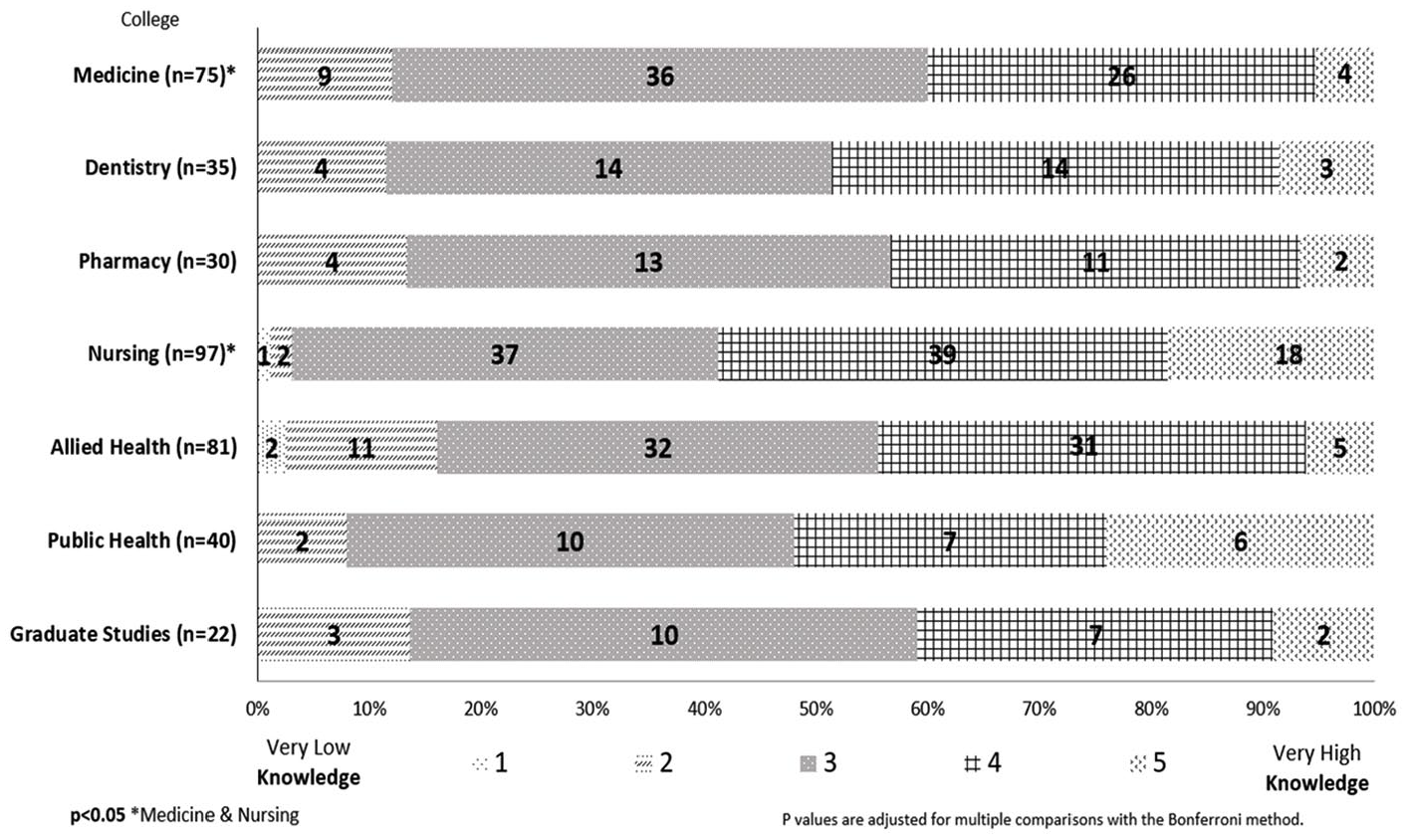
Comparison between college and general perceived knowledge of domestic and sexual violence.
Knowledge of Domestic and Sexual Violence Community Resources
A median score of 3.0 (IQR = 1) on a 5-point scale indicates students felt they had a fair level of knowledge on domestic and sexual violence community resources. Figure 3 illustrates pairwise comparisons indicating nursing students (Mdn = 3.0, IQR = 2) have significantly higher levels of perceived community resource knowledge (p < .01) compared with medical students (Mdn = 2.0, IQR = 1), allied health students (Mdn = 2.0, IQR = 1), and graduate studies students (Mdn = 2.5, IQR = 1). Scores for knowledge of community resources did not differ significantly based on respondents’ race, international status, age, or years in current program. However, females (Mdn = 3.0, IQR = 2) had statistically significant (p = .01) higher scores than males (Mdn = 2.0, IQR = 1). Students who had 5 to 10 hr of training (Mdn = 4.0, IQR = 1) reported statistically (p = .02) higher scores of perceived knowledge of community resource compared with students who reported no training (Mdn = 3, IQR = 1).

Comparison between college and perceived knowledge of domestic and sexual violence resources.
Knowledge of Domestic and Sexual Violence Reporting Requirements
A median score of 3.0 (IQR = 2) revealed students had a fair amount of knowledge on domestic and sexual violence reporting requirements. Figure 4 illustrates comparisons among colleges, which reveal nursing students (Mdn = 4.0, IQR = 2) had significantly higher levels (p < .01) of perceived knowledge on reporting when compared with students in medicine (Mdn = 3.0, IQR = 2), pharmacy (Mdn = 3.0, IQR = 2), and allied health (Mdn = 3.0, IQR = 1). In addition, public health students had significantly higher levels (p < .01) of perceived knowledge on reporting (Mdn = 4.0, IQR = 1) when compared with allied health students (Mdn = 3.0, IQR = 1). There were no statistically significant differences among knowledge of reporting scores with age, gender, race, international status, or years in current program. Students with 3 to 5 hr of reported training (Mdn = 4.0, IQR = 1) had statistically higher scores (p < .01) in knowledge of reporting compared with students who reported no hours of training (Mdn = 3.0, IQR = 2).

Comparison between college and perceived knowledge of domestic and sexual violence reporting requirements.
Health Care Professionals’ Role in Addressing Domestic and Sexual Violence
The majority of respondents (88.7%, n = 337) indicated they felt individuals in their profession have a role in addressing domestic and sexual violence in practice. Those who did not feel they had a role (3.4%, n = 13) were more likely to be between the ages of 19 and 24 years (38.5%, n = 5), females (84.6%, n = 11), White Caucasian (76.9%, n = 10), domestic (84.6%, n = 11), and enrolled in an allied health program (53.8%, n = 7).
Learning Preferences for a Domestic and Sexual Violence Education Program
The majority (64.7%, n = 246) of students indicate they would be interested in learning more about domestic and sexual violence in health care, but some (23.2%, n = 88) respondents reported they were “unsure” if they wanted to learn more. A smaller proportion (12.1%, n = 46) indicated they did not want to learn about domestic and sexual violence. Those who indicated they did want to learn were more likely to be between the ages of 19 and 24 years (58.7%, n = 27), White Caucasian (93.5%, n = 43), domestic (100%, n = 46), in a nursing program (26.1%, n = 12), enrolled for less than 1 year (54.3%, n = 25), and having 1 to 3 hr of previous learning on domestic and sexual violence in their current program (50%, n = 23). Respondents were asked to indicate their learning preferences for receiving information with the most common preferences being an in-person lunch seminar series (40.3%, n = 153) and an integration of domestic and sexual violence information and training into existing coursework (38.9%, n = 148).
Discussion
This study is unique as it is the first study we are aware of that assesses the learning needs and preferences on domestic and sexual violence among health profession students representing various disciplines at the same institution. Health profession students are a unique group of individuals who are actively building their clinical skills and attitudes, which shape their future clinical manner and practices (Feldman & Chawla, 2015; Gonsalves & Zaidi, 2016). This study reveals health profession students’ comfort, attitudes, and perceived knowledge on domestic and sexual violence widely vary at the same institution. Among disciplines, nursing students have consistently high scores in comfort, attitude, general perceived knowledge, and awareness of resources. It is unknown what factors, such as preprofessional coursework, and experiences outside of the classroom may have influenced the higher scores among this sample. A factor that may have contributed to the higher scores among nursing students is direct patient care experience. Nursing students often start clinical rotations assisting with direct patient care in the first semester of professional schooling, whereas other programs, such as medicine and pharmacy, introduce clinical rotations in later semesters (Manka & Taylor, 2009). Traditionally, nurses spend more time with individual patients in multiple intervals, which may allow for more opportunities to better understand patients’ social dynamics and psychosocial history (Guruge, 2012). Prerequisite classes and outside knowledge of the subject may also have contributed to the higher scores among nursing students. A previous study found that among a sample of nursing students, those who had received intimate partner violence training prior to nursing school had significantly higher perceived preparation and perceived knowledge of the subject when compared with those who did not receive prior training (Connor et al., 2013). Earlier exposure to the issue through clinical rotations and/or outside experiences given that the majority of students had less than 1 year in their current program may explain why nursing students in our sample had higher scores than students in other programs. Perceived knowledge was one of the highest median scores for nursing students among the four scales, but perceived knowledge did not equate to equally high comfort scores in our study. Students may feel they have adequate knowledge of the subject, but actual demonstration of skills and comfort with the topic may still be difficult. There is a lack of literature that compares nursing students’ comfort, perceived knowledge, and attitudes to other health profession students besides a Canadian study that found medical and nursing students had similar and higher comfort levels and attitudes when compared with rehabilitation students (Gerber & Tan, 2009). Our study reveals that among health profession students of various disciplines at a Midwestern academic medical center, there are differences with varying significance in attitudes, comfort, perceived knowledge, and learning preferences in the realm of domestic and sexual violence.
Comfort levels in discussing domestic and sexual violence with patients varied among students of different disciplines, but the only statistically significant differences were among pharmacy and public health students. Pharmacy students were the least comfortable of any discipline, whereas public health students were the most comfortable. The core curriculum of public health students is focused on understanding and addressing social determinants of health, such as violence, and therefore these students may have more familiarity with violence as a social determinant of health. However, it is not known to what extent familiarity with an issue impacts comfort levels in addressing the issue. Pharmacy program accreditation standards address preparing students for public health roles, but less data exist on students’ familiarity with the topic and barriers that limit pharmacy students’ comfort discussing domestic and sexual violence (Cerulli et al., 2015). Furthermore, there was a significant difference between domestic and international student comfort scores with international students reporting greater comfort. More research needs to be done to better understand factors that may contribute to comfort levels among domestic and international students. Although not statistically significant, comfort levels increased as training hours increased indicating that students with more training may be more comfortable discussing the issue with patients. This is consistent with practicing health care professionals, who report greater preparedness in discussing domestic and sexual violence with patients if they had received previous training (Papadakaki et al., 2013; Short et al., 2006).
Perceived knowledge on domestic and sexual violence varied among the sample. Male students had lower general perceived domestic and sexual violence knowledge compared with female students. This is consistent with previous findings which revealed that female health care workers tend to have better knowledge about domestic violence when compared with their male peers (Alazmy et al., 2011). Also, older students reported having more general knowledge when compared with their younger peers. Prior research indicates domestic violence is most prevalent among women in their mid-20s to early 30s (Rivara et al., 2009). It is likely that older students may have more exposure to situations involving domestic and sexual violence in their personal or professional lives, thus creating greater awareness of the issue. When the data were stratified by race, African American students had the highest median score in perceived general knowledge of domestic violence compared with students of other races, whereas those not identifying with any race had the lowest. Research shows that African Americans are at greater risk for experiencing domestic violence when compared with other racial groups. The most recent CDC report indicates 43.7% of non-Hispanic Black women reported experiencing domestic violence at some point compared with 34.6% of non-Hispanic White women (Black, 2011). Hence, it is likely that African American respondents in this study may have a higher awareness of domestic violence and report greater perceived knowledge of the subject considering the higher risk of experiencing domestic violence.
Students’ overall self-reported knowledge of community resources that provide services for domestic and sexual violence survivors is low. This is consistent with previous literature which reports practicing health providers’ unfamiliarity with community resources and referral programs and what to do if a patient discloses information regarding violence (Miller et al., 2015; Minsky-Kelly et al., 2005). In our sample, nursing students’ knowledge of community resources median score was significantly higher than the scores of medicine, allied health, and graduate studies students. Causes of the score differences are not well established in the literature. As previously mentioned, nursing students’ earlier clinical experiences may influence their perceived knowledge. Another contributing factor may be nursing students’ exposure to violence education as a social determinant of health in their health professions program. Health education curricula is heavily regulated with national accrediting bodies, whose mandates often coincide with organizations who provide national health recommendations, such as the National Academy of Medicine, CDC, and Association of American Medical Colleges. Within the past 15 to 20 years, these national organizations have urged health profession programs to integrate public health competencies, including identification of community resources, into their courses, but little information or support to implement changes exist in many health profession programs, including medicine (Morley et al., 2017). However, nursing has traditionally integrated public and community health into curricula and clinical training for more than 100 years, as recommended by founder of modern nursing, Florence Nightingale (Daniels et al., 2010). Long-standing integration of public and preventive health into nursing curricula may account for scoring differences among nursing students.
Domestic violence mandatory reporting laws for health care professionals have historically been controversial, understudied, varied among states, and unable to prove significant negative or positive consequences for survivors (Sachs, 2007). Health care professionals are not always aware of or competent in the mandatory reporting laws; previous studies showed among physicians in California 14 to 39%, and among home health nurses nationwide more than 65%, were not aware of the domestic violence mandatory reporting laws (Davidov et al., 2012; Rodriguez et al., 1999). In our study, knowledge of reporting requirements varied among students of different disciplines, like that of practicing health care professionals. The majority of students reported they had a fair level of knowledge of reporting requirements, which indicates some students may have difficulty distinguishing when and what to report to authorities. The lack of knowledge can lead to confusion and inconsistent reporting, which may place survivors in greater danger. Knowledge of reporting requirements and how to properly respond when a case is identified is essential for patient safety (Heron & Kellermann, 2002).
Most respondents indicated they felt their profession has a role in addressing domestic and sexual violence in practice. This is consistent with the widespread consensus among violence advocacy groups and health organizations that health professionals play a unique role in addressing domestic and sexual violence (Kalra et al., 2017). However, only 64.7% indicated they would be interested in learning more about domestic and sexual violence in health care, even though most students reported they had received less than 3 hr of training in their current program. It is not known what factors may have impacted the lower percentage of students who indicated they would be willing to learn more. Scores may have been impacted by students’ concern that additional learning may take more time and effort, which may not be feasible or desirable within the existing rigorous curriculum.
Most students reported receiving less than 3 hr of training in their current program. Students who reported more hours of training reported higher levels of comfort and perceived knowledge of the subject, resources, and reporting requirements. This is consistent with literature that indicates health professionals who are trained about domestic and sexual violence have an increase in knowledge, self-efficacy, and comfort (Bermele et al., 2018; Edwardsen et al., 2011; Hamberger et al., 2004). Students indicated they would like domestic and sexual violence education to be better integrated into existing coursework and offered during lunch seminars on campus. Including domestic and sexual violence within the core curricula of health profession students is needed and would be beneficial. Future efforts need to take student preferences for learning into consideration when creating training programs to produce the best outcomes. Exploring integrated educational modalities along with student preferences may promote earlier career interdisciplinary team experiences, which reduce health care costs, improve patient satisfaction, and decrease errors (Allen et al., 2006).
Limitations
This study was conducted at one health institution, had a relatively low response rate (10.6%), and is a nonrandom sample and therefore is neither nationally representative nor generalizable. This study should be replicated nationally to better discern needs and preferences of health profession students, including underrepresented subpopulations and students who are nearer to graduation. In addition, this study did not gather data on previous educational experiences outside of the classroom, personal experiences, or knowledge of the participants through objective measures, which needs to be further evaluated. Also time allocated to domestic and sexual violence within the curriculum was based on student self-report. Existing curricula for each discipline needs to be further examined to determine if students’ estimates of coursework are comparable with the actual time dedicated to domestic and sexual violence within each program’s curricula.
Conclusion
Health profession students representing various health disciplines at a Midwestern academic medical center were sampled to better understand their needs and preferences for domestic and sexual violence education. This study presents preliminary evidence that health profession students feel they have a role in addressing domestic and sexual violence but receive limited coursework in health professional programs, hindering their ability to increase comfort and skills in addressing the issue. Students’ preferred learning strategies include better integration of material into existing curricula and optional lunch seminars. Future research should assess the needs and preferences of a nationally representative sample and implement and evaluate interventions aimed at improving health profession students’ awareness and responses to domestic and sexual violence in clinical practice.
Footnotes
Acknowledgements
We thank all students at the University of Nebraska Medical Center who participated in this study.
Declaration of Conflicting Interests
The author(s) declared no potential conflicts of interest with respect to the research, authorship, and/or publication of this article.
Funding
The author(s) received no financial support for the research, authorship, and/or publication of this article.
