




Abstract
Now is the time to rethink reliance on legal intervention to end intimate partner violence (IPV). Arrest, incarceration, and family separation have fallen disproportionately on people who are Black or Brown, impoverished, or immigrant, lesbian, gay, bisexual, transgender and queer (LGBTQ). Restorative approaches bring together the persons harmed, persons causing harm, their family or community networks, or combinations of these stakeholders. Based on a U.S. national study, this article examines: What influences programs to adopt a restorative approach to ending IPV? How do programs safeguard their original vision for social change? What principles guide the programs in carrying out their work in safe and productive ways?
Today is a pivotal time in the United States to reconsider the extent of our reliance on legal interventions to end intimate partner violence (IPV). Early on, Susan Schechter (1982) chronicled the debates in the battered women’s movement on whether to advance broadscale social change to stop male violence or to reform the criminal legal system. Although women’s advocates perceived the police and courts as complicit in reinforcing IPV, they hoped that arrests and incarceration would save lives. Changes in law enforcement came with a cost.
Women of color, Native Americans, immigrants, and lesbian, gay, bisexual, transgender and queer (LGBTQ) groups have taken the lead in identifying the devastating impact of the criminal, legal, and child protection systems on their families and communities (INCITE! Women of Color Against Violence, 2016). While incarceration rates have fallen, turning to law enforcement is hazardous for Black and Hispanic communities given their disproportionate rates of imprisonment (Carson & Anderson, 2016). Incarceration results in children’s separation from their parents (Roberts, 2019), and detention and deportation heighten the threat of family separation for immigrant and refugee populations (Finno-Velasquez & Dettlaff, 2019).
One response is to adopt restorative approaches that support those most affected in envisioning how to create safer homes and communities. The intent is to restore all participants, including those harmed, those causing harm, and their communities. For IPV, restoration is not about returning to prior conditions. This would only exacerbate recurring patterns of violence and coercion undermining the abused partners’ capacity to make decisions and, if they are parents, to nurture their children (Stark & Hester, 2019). Instead, restorative justice is about establishing just relationships and acting collectively to redress harms (Braithwaite, 2002). Adopting restorative approaches does not mean doing without public resources and protections that survivors and their families want. South African women of little means have combined restorative approaches and law enforcement to strengthen their position in their families and kin networks (Moore, 2019). Using restorative approaches demands close attention to the wishes and safety of adult and child survivors.
By engaging key stakeholders in family and community dialogue, restorative forums are a means of learning from a full range of views and reaching agreements on how to proceed. Unlike court hearings and investigations, restorative processes are not about fact finding to determine fault and impose sanctions, which would only limit discussion and take decision-making from the family and community. Elements of “restorativeness” can be used to distinguish restorative approaches from legal procedures and to assess the extent to which programs live up to their ideals (Gal et al., 2018, p. 253). These restorativeness elements are (a) inclusive dialogue among persons harmed, persons harming, and their support networks; (b) informal, voluntary, and community-managed processes fostering the expression of emotions and communication of moral values; (c) orientation to the needs of persons harmed and persons harming; (d) encouragement of persons causing harm to take active responsibility for making things better; and (e) focusing on socially just outcomes (Gal et al., 2018). Systemic influences, however, can limit restorativeness: agency fears of liability for failures, professional concerns about losing control, funders’ requirements of hierarchical accountability, and court or agency referrals leading to semivoluntary participation (Daly, 2012).
Feminists have raised valid objections to applying restorative approaches precisely to IPV because current or former intimate partners are likely to have ongoing contact (Ptacek, 2010). Intimate partners may live together, have children in common, reside in the same neighborhood, remain in the same faith or cultural community, or have economic ties. This contact could facilitate those perpetrating the abuse to manipulate and threaten survivors and their supporters. The social networks might then pressure survivors to forgive and reconcile with the persons abusing them. At the same time, restorative forums offer the opportunity to raise concerns, increase the number of people aware of what is happening, validate that harm occurred, and expand networks ready to offer caring over the long term. Informal networks recognize that healing from IPV requires emotional, social, economic, and spiritual support. Family and community members are not held to legal definitions of domestic violence that is crime-centered and incident-based or to rules narrowing interventions (Coker, 2016).
Disillusionment with the criminal legal system and a growing awareness of the potential of restorative approaches have led to reconsideration of antiviolence strategies (Coker, in press; Stark, 2004). Some restorative programs to end IPV are long established in the United States, and their experience and stratagems can address questions of program and policy developers. Using data from a national study in the United States (Cissner et al., 2019), we respond to the following questions:
What influences programs to adopt a restorative approach to ending IPV?
How do programs safeguard their original vision for social change?
What principles guide the programs in carrying out their work in safe and productive ways?
These questions reflect research on social movement organizations initiated in response to critical events that set a vision for the organizations (Nownes, 2019). Social movements measure productivity in terms of advancing their agenda of social change (Martin, 2015). Success here is both acting according to principles and realizing the desired end.
We acknowledge that the above-mentioned research questions pose two major issues in terminology. The first is referring to the approaches as restorative. This umbrella term ill fits some programs that view the term as too aligned with the criminal justice system and prefer to use transformative justice (Goodmark, 2018). We should note that the term restorative approach here does not encompass Indigenous traditional practices, which long preceded contemporary developments. Second, some organizations reject the term program because it implies imposing a systemized process upon what should be fashioned in an egalitarian and organic manner.
We begin by juxtaposing the pathways of two programs from the national study that use different restorative formats: family group conferencing (FGC) and peacemaking circles (PMC). These restorative designs are selected for scrutiny because they are the most likely formats to display the elements of restorativeness identified above, including working with all key stakeholders, and to apply measures for safe participation. We discuss how FGC and PMC align with two long-standing strategies of the battered-women’s movement, respectively, building supports around persons harmed and changing gender norms. Then, we summarize the literature on the application of restorative approaches to IPV. After describing the case study methodology, we return to the two program examples, compare them with other FGC and PMC programs, and identify common and divergent methods for safe and productive implementation.
Two Pathways to Restorative Formats
In Hawai‘i, EPIC ‘Ohana adopted a restorative format they called ‘ohana conferencing, and in Minnesota, Washington County Community Circles (WCCC) adopted a format they referred to as community circles. Both programs incorporated as nonprofit organizations and have been continuously in operation for over two decades. EPIC worked with families referred by child welfare which in Hawai‘i, as true of other U.S. states, has a high co-occurrence of domestic violence in its caseloads (U.S. Department of Health & Human Services [USDHHS], Administration for Children and Families, Administration on Children, Youth and Families, Children’s Bureau, 2019). WCCC worked primarily with persons referred by the court system because of IPV, although community referrals were accepted. Both programs engaged with the persons harmed and persons causing harm, together or separately.
By 2018, EPIC served multiple Hawaiian islands, received long-term funding from the Hawai‘i Department of Human Services, employed 91 paid staff, and held 800 to 1,000 ‘ohana conferences annually. WCCC served several counties, periodically received limited grant funding, had trained 120 community members for its all-volunteer organization, and averaged six cases annually, for which 14 circles were held with approximately nine members in each circle. EPIC and WCCC were long-lasting programs that offered a solid basis from which to compare pathways with restorative programs seeking to end IPV. Their strategies for realizing this goal diverged. EPIC sought to create safer homes for children and adults by reconnecting families to their kin and cultural community; WCCC sought to create better communities by connecting persons who have committed IPV to circles of supporters. Their strategies reflected their origins.
EPIC was founded during the reemergence of the Native Hawaiian sovereignty movement (Goodyear-Kaʻōpua, 2018) and received early support from the children’s trust fund, endowed by Queen Lili‘uokalani, the last reigning monarch of Hawai‘i. Gravely concerned by the disproportionate placement into state care of children of Native Hawaiian and Polynesian backgrounds, EPIC founders designed ‘ohana conferencing in hopes of strengthening family ties and countering historical oppression. ‘Ohana in Native Hawaiian means family and more broadly kin and clan. ‘Ohana conferencing was influenced by the Hawaiian cultural practice ho‘oponopono of putting things right by bringing together the extended family to face back at their shared histories (Friesema, 2013). From this foundation, they face forward to establish harmony, not between a couple, but among the family members as a whole.
In advance of the ‘ohana conferences, the EPIC coordinators invited and prepared all participants (e.g., explaining process). The conferences opened (and closed) in a manner chosen by the family (e.g., a song) and identified the meeting’s purpose, the participants’ relationship to the children, the family’s strengths, worries and legal issues, and available resources. Next, all service providers left the room so that the family as a whole could develop their plan. Then, the service providers returned so all could reach agreement on the final plan (Friesema, 2013, p. 8).
The model was greatly influenced by the FGC model first legislated in Aotearoa New Zealand (Burford & Hudson, 2000) after protests by its indigenous peoples, the Maori, against Eurocentric approaches that they saw as harming their families and tribes (Rangihau, 1986). FGC offered a means by which the family, relatives, and informal networks could connect as a family group and make plans that promoted family safety, healing, and unity. The intent was to widen the circle of supports and protections around family members, based on their cultural traditions (Pennell & Anderson, 2005). FGC was in keeping with family-centered practice in child welfare: This practice deemphasized rescuing children from their parents and emphasized families as partners in decision-making and including families’ cultural perspectives into plans (Lietz & Geiger, 2017). 1
WCCC was established after a state court judge and a local women’s advocacy center, the Tubman Family Alliance, shared concerns about the ineffectiveness of court orders and the Duluth model to stop IPV. The Duluth model, developed in Minnesota, was designed to combine battering intervention groups with a community coordinated response (CCR) of a wide range of local organizations under the management of domestic violence advocates. Rapid CCR implementation and replication shrank the involved organizations to law enforcement, courts, and probation, with oversight by advocates squeezed out (Kim, 2019). The CCR architect, Ellen Pence, placed a power and control analysis of gender at the center of the battering intervention to encourage participants to rethink their rationalizations of entitlement and domination over intimate partners. Some group facilitators, however, used the model “too rigidly, too overwrought, too combative . . . feel[ing] like they need[ed] to drag men to nonviolence” (G. Barnes, personal communication, cited in Gondolf, 2010, p. 997).
Looking for an alternative to the legal system, the WCCC founders turned to PMCs to guide the development of their circles. Local residents received PMC training by First Nation’s people from Canada. WCCC’s (2013) circles were voluntary, nonhierarchical, and value-guided processes intended to foster dialogue and consensus. After explaining the process and obtaining consent, WCCC formed circles of the persons causing harm, the persons harmed if they opted to participate, and support persons of their choosing. They were joined by the circle keeper and other trained volunteers who were full members rather than facilitators or observers. The circles had limited preparation and no preset agendas and organically responded to members’ needs.
FGC and PMC are means to fulfilling two long-standing, mutually supportive strategies of the movement to end IPV. The first, exemplified by EPIC, is improving social supports around persons harmed by drawing upon cultural identities and practices. This cultural change strategy is grounded on a Black feminist standpoint of interlocking oppressions that connect marginalized outsiders as sisters, encourage caring for one’s own children and those of one’s community, and place value on family and culture (Collins, 1986). In agreement, transformative justice proponent Mimi Kim (2010) states, “Violence intervention must be guided by the knowledge of everyday people, carried out by those closest to and most impacted by violence, and situated in the very spaces and places where violence occurs” (p. 195). Kim emphasizes adopting community-based interventions that “engage circles of friends, families, and communities” (p. 196).
The second strategy, exemplified by WCCC, is shifting gender norms to cultivate egalitarian relationships. Feminists have long identified that masculine hegemony disempowers women and others identified as feminine (Chancer, 2019), and they avail of political–economic–social transformations to change norms in different countries (Fulu & Miedema, 2016). In Austria, where restorative programs for IPV are widespread, Christa Pelikan (2010) concludes that the process promoted women’s empowerment and increasingly supported positive change in men. She attributes the men’s progress to societal changes, national legislation, policing practices, and the restorative process helping the couple validate the abuse as wrong. This normative shift occurred across ethnic groups in Austria from Europeans to Asians to Turks.
Restorative Approaches to IPV
Most societies have resolved wrongdoing by relying largely on education and persuasion to restore relationships and only secondarily on punishment to control and exact retribution (Braithwaite & Zhang, 2017). Today, a debt is owed to Indigenous cultures for sharing their analysis of colonization, theory of interconnection, practices of healing, and vision of full growth (Battiste, 2000). Indigenous teachings inform restorative approaches that involve family and community members in participatory and healing processes (McCold, 2006).
Besides FGC and PMC, other dialogue-based approaches have addressed IPV, most notably victim-offender mediation that emphasizes one-on-one encounters (Ptacek, 2010). Unless participants are prepared and supporters mobilized, such encounters could lead to pressuring survivors to relinquish their quite justified anger against the persons causing harm. As a result, the persons causing harm would learn little from the encounter, with their coercive and violent behaviors reinforced. In response to safety concerns, jurisdictions in the United States, Britain, and Australia have banned restorative interventions for IPV, even though some couples express interest in face-to-face meetings (Nettleton & Strang, 2018). Research points to the benefits of restorative approaches. A distillation of 12 randomized trials of restorative methods with nondomestic violence and property offenses found that they worked best with violent offenses, repeat offending, or participation of a personally harmed individual and that persons harmed, especially women, experienced reductions in posttraumatic stress after taking part (Sherman et al., 2015). Published comparative studies of PMC and FGC with IPV are limited but generally positive.
A Canadian study of FGC for family violence compared families with a conference to similar families without a conference (Pennell & Burford, 2000). Pre–post data from child welfare files showed that conferencing reduced child maltreatment and IPV indicators. The findings on FGC families were backed by police files and follow-up interviews. Interviewees spoke of the healing from being able to express the pain that they had endured, feeling safer, having improved supports, and gaining a sense of pride as a family as they made plans for their relatives.
Two U.S. experimental studies of a PMC-related model called Circles of Peace reported reductions in recidivism. The first compared Circles of Peace with a battering intervention program (BIP) and reported a significant reduction in nondomestic violence arrests at 12 months, post random assignment for the circles versus the BIP (Mills et al., 2013). The second compared a hybrid of BIP and Circles of Peace with BIP alone and found over 24 months, the combination significantly decreased rearrests and the severity of crimes for all offenses, which included domestic violence (Mills et al., 2019).
Case Study Methodology
This study included only programs employing PMC or FGC because, as noted before, they were more likely to exemplify the restorativeness elements (Gal et al., 2018). To address the three research questions, the programs were systematically compared, using qualitative comparative analysis (QCA). The cross-case comparison specified which program conditions contributed to the outcome of adopting the PMC or FGC format (Question 1). The patterns identified by the QCA informed the deeper exploration of the safeguards that reinforced the programs’ original vision for social change (Question 2) and the principles that guided implementation of the programs in safe and productive ways (Question 3). The analysis of change strategies was limited to the previously discussed, two long-standing visions of the movement to end IPV.
QCA is a case study method for analyzing real-life situations and developing theories to make sense of their diversity (Ragin, 2008). The appeal of the method lies in its managing the complexity of groups of conditions and the multiplicity of pathways to the same outcome. Another plus is that QCA can work with sample sizes as small as three as well as with a much larger number of cases (Befani, 2016). Based on Boolean logic, QCA identifies combinations of conditions contributing to an outcome across cases. While one condition may be necessary for an outcome, QCA does not assume that a condition on its own, however essential, is sufficient to predict an outcome. A case may have a necessary condition but not have the outcome.
This study examined which conditions were necessary for adopting the restorative formats and then which conditions along with the restorative format were sufficient to prioritize the social change strategy. The QCA generated data matrices of numerically coded conditions to display the possible combinations of the conditions influencing an outcome. This study used crisp sets, that is, binaries of absent (0) and present (1), rather than fuzzy sets based on the degree of membership that would have provided more nuance on the extent to which a characteristic was present (Ragin, 2008). An advantage of crisp sets is that they create models often easier for practitioners to grasp and use (Warren et al., 2014). Nuance here was added by qualitative data that juxtaposed programs with the same or the other format. The QCA used fsQCA [fuzzy-set QCA], Version 3.0, a free-access program (Drass & Ragin, 1992).
Data Source
The study used data from a national study of restorative approaches to IPV, whose report describes the methodology, participating programs, and findings (Cissner et al., 2019). The larger study surveyed 35 programs in the United States, interviewed 10 programs by telephone, visited five of these 10 programs, and reviewed program documents. Among the 10 sites were one PMC program with only interviews and two PMCs and two FGCs with visits. The QCA used the survey data, and the qualitative data deepened the interpretation. Because of the lack of a centralized listing, the study identified programs by consulting experts and programs in the field, searching online, and disseminating flyers in various forums. Given the nonprobability sampling method, the survey cannot be considered representative of U.S. programs but did involve programs from all regions.
The flyer invited the participation of programs identifying themselves as “restorative, transformative, cultural, and/or community-based.” By encouraging the participation of a wide breadth of programs, the study could explore the types of restorative approaches to IPV in the United States. The survey gained the participation of programs using various restorative formats, with the three most common, in order of frequency, PMC, support circles for persons harmed, and FGC. Some programs applied more than one format. The study was intended to describe programs rather than evaluate their effectiveness. The institutional review boards at the Center for Court Innovation and North Carolina State University approved the study protocols.
Sample
The sample initially included 11 PMC, six FGC, and one joint PMC/FGC program. Three programs were removed, reducing the sample to 15: 10 PMCs and five FGCs. In QCA, a sample of 15 cases is “medium-size” (Befani, 2016, p. 200). The one PMC/FGC program was omitted to distinguish conditions specific to a restorative format. The other two were removed because of missing data. QCA requires complete data on all conditions included in the analysis because every case is considered as a totality whose missing values cannot be imputed, that is, estimated using other available data. The omitted programs were 3 or less years in age.
All 15 programs addressed domestic violence, and about half addressed sexual assault. The programs came from different regions of the country. They were primarily nonprofit organizations; however, the five FGC programs included two public human services and the 10 PMC programs had one public university. The organizations were past the early formative period, ranging from 3-31 years (Mdn = 14.8, M = 15.7, SD = 9.0). Among the PMCs, eight out of 10 had remained continually open since they started, and seven had current funding. The FGCs had all remained continuously open, and all had current funding. The PMCs had staff with one exception and between 0 and 300 volunteers (Mdn = 7.0); all FGCs had staff and no volunteers. Thus, the 15 programs had the resources and experience for implementing their restorative format.
Question 1: What Influences Programs to Adopt a Restorative Approach to Ending IPV?
The study focused on three areas pertaining to the adoption and retention of a restorative format: (a) Why the founders decided to develop the program; (b) How the programs referred to their approach; and (c) What systems made frequent referrals to the program. The reasons for program development indicated why programs were initiated and could serve as rationales for maintaining a restorative format. The designation of the approach reflected how the programs typed themselves from the outset and could guide program development in the long term. The main referral sources were part of the program blueprint of how participants were to enter the program and their expectations could reinforce (or reshape) the program design. For the QCA, the reasons for the program development and approach were coded 0 if not cited and 1 if cited. To identify referral sources likely to have the strongest impact, the frequency with which sources made referrals was divided into never, rarely, or sometimes (coded 0) and often or very often (coded 1).
To determine necessary precursors for format adoption, the QCA used a necessity analysis of the consistency with which a condition is observed in the cases with the outcome. 2 To judge if a condition consistently appeared among the programs with a restorative format, the QCA used the criterion 0.80 (or 80%) of the cases. Ragin (2008) recommends a consistency score of at least 0.80 and cautions against using scores falling below 0.75 because it is hard to maintain that a relationship exists between the conditions and outcome. Because a condition may appear in cases without the outcome, the QCA also looked at the extent to which the condition covered, or accounted for, the format. 3 QCA works best when limited to critical conditions that make a substantial rather than an incremental difference (Befani, 2016). Accordingly, the necessity analysis included conditions observed in 60% or more of the cases for one format.
Table 1 summarizes the scores for each condition’s consistency and coverage and bolded the conditions meeting the criterion of 0.80 consistency. What stands out is that the preconditions for PMCs and FGCs were strikingly divergent in the three areas for format adoption. In program development, the ineffectiveness of standard approaches to IPV was cited by 100% of PMC cases versus 40% of FGC cases. Hence, the condition of ineffectiveness was a necessary precursor of PMC adoption for its 10 cases. Two of the FGC cases also cited this reason for program development but did not adopt PMC. Thus, the reason of ineffectiveness was a perfectly necessary (100%, 10/10) and common (83%, 10/12) reason for adopting PMC, but it was not always a sufficient reason because 17% (2/12) were not covered. A second condition, restorative approach, occurred in all PMCs and only one FGC. For PMCs, ineffectiveness and restorative always co-occurred, and their combination accounted for adopting PMC and not FGC.
Necessity Analysis: Consistency and Coverage Scores by Restorative Format (N = 15).
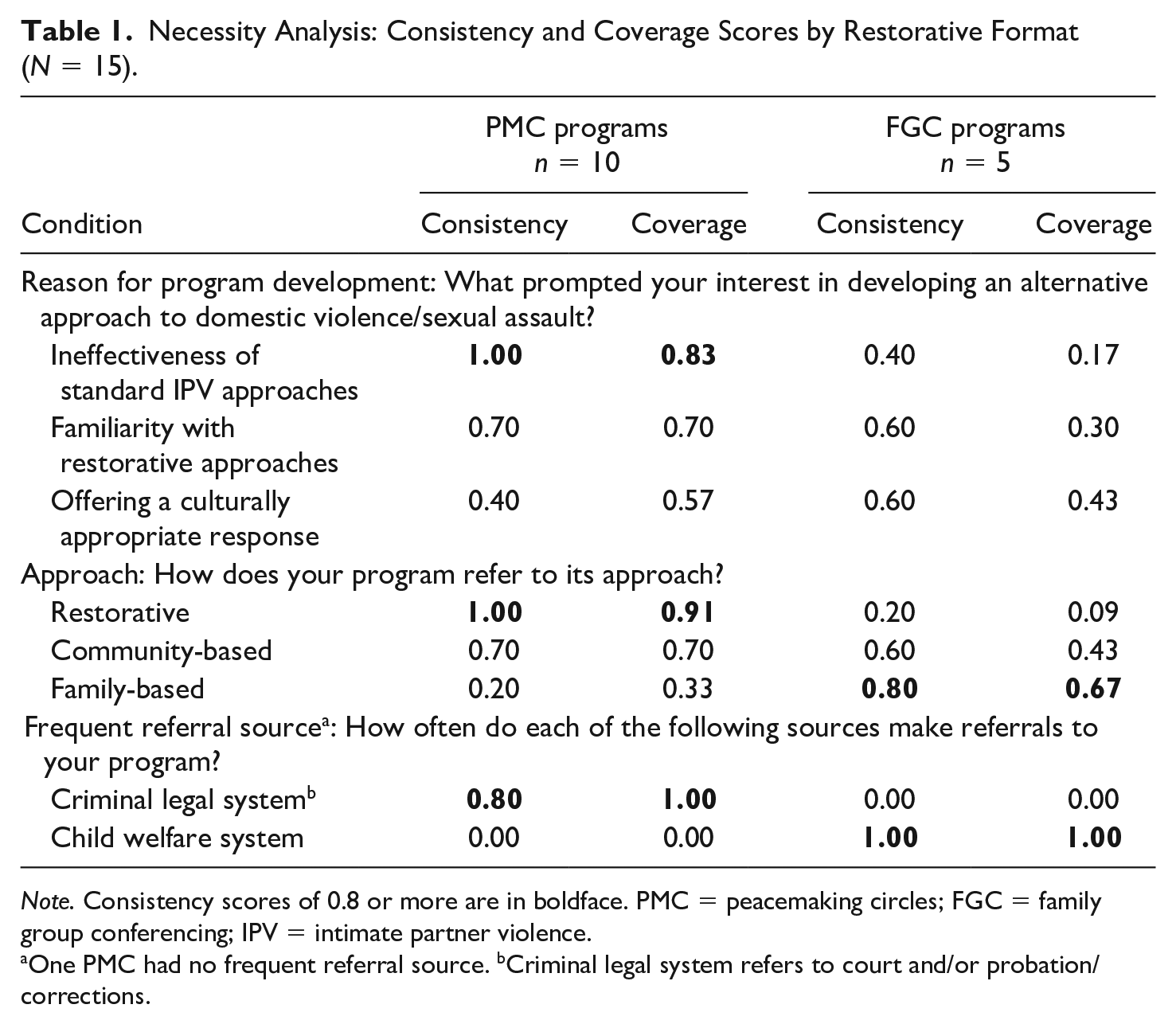
Note. Consistency scores of 0.8 or more are in boldface. PMC = peacemaking circles; FGC = family group conferencing; IPV = intimate partner violence.
One PMC had no frequent referral source. bCriminal legal system refers to court and/or probation/corrections.
Another striking finding is that the referral sources were distinct for PMCs and FGCs. The criminal legal system made frequent referrals to 80% of PMCs and 0% of FGCs. Child welfare made frequent referrals to all FGCs and no PMCs. This points to different systemic influences on PMCs and FGCs. On approach, 80% (4/5) of the FGC programs referred to themselves as family-based in contrast to 20% (2/10) of the PMCs. None of the reasons for program development for FGC rose above 60%. The data, though, supported most FGCs’ commitment to family-centered practice of engaging the families in culturally appropriate ways: Further analysis found that three FGCs paired culturally appropriate and family-based and a fourth cited family-based.
As expected, subsequent QCA analysis of pathways to each restorative format reduced the explanatory conditions to the three perfectly necessary conditions. The Boolean logic of minimization permits simplifying the pathways if they are alike except for one condition: The one exception is removed, and the two pathways combined. Boolean minimization meant that for all PMCs, the pairing of ineffective and restorative contributed to the format’s adoption, allowing for removal of criminal legal referrals as a contributory factor. For all FGCs, child welfare referrals contributed to the format’s adoption, which meant removing family-based. Using the results from the Boolean minimization, we next examine which combinations of conditions led to prioritizing the IPV social change strategies.
Question 2: How Do Programs Safeguard Their Original Vision for Social Change?
The programs’ original visions were defined as two long-standing strategies of the movement to end IPV and were operationalized using two items on the survey. The survey asked programs to rate the importance of a series of desired outcomes on a 4-point Likert-type scale. One outcome was “changing norms around domestic violence/sexual assault,” and another was “improved support network for the harmed person.” To identify the programs’ top priorities, the scale was divided into 0 for not important, somewhat important, or very important and 1 for extremely important. The salience of these change approaches was evident: extremely important was selected by 10 programs for changing social norms and 11 programs for improved social support network.
The QCA examined which packages of conditions led to prioritizing these two strategies. The conditions selected were those which remained after the minimization of conditions for the restorative format: ineffective, restorative, and child welfare referrals. In addition, the restorative formats became part of the conditions because they could contribute to achieving the change strategies. The data were sorted into a truth table, which is a spreadsheet showing the different combinations of conditions considered sufficient for reaching an outcome. 4
Table 2 displays the combinations of conditions sufficient for prioritizing the two change strategies. Under each social change strategy is the number of cases and, in parentheses, their consistency score (bolded if at least 0.80). The first table row shows that the combination of ineffective, restorative, and PMC contributed to prioritizing changing norms for a 0.9 proportion of the PMC cases (9/10 cases). 5 The pattern for prioritizing support networks was quite different than that for changing norms. As seen in the last three rows, the combination of child welfare referrals and FGC contributed to all three pathways sufficient for prioritizing support networks. Of the 10 PMC programs, six prioritized support networks; the consistency score of 0.6 means that ineffective, restorative, and PMC led relatively equally either to prioritizing or not prioritizing support networks and, thus, did not explain the determination of the social change strategy. In summary, changing norms were predicted by the combination of ineffective, restorative, and PMC, whereas support networks were predicted by the combination of child welfare referrals and FGC. Turning to the qualitative data, we examine how the combinations of conditions along with other program features influenced how the programs sustained their vision for social change.
Truth Table: Combination of Conditions Contributing to IPV Social Change Strategy (N = 15).

Note. Combinations of conditions contributing to a social change strategy are shaded. Consistency scores of 0.8 or more are in boldface. Coverage scores are in parentheses. PMC = peacemaking circles; FGC = family group conferencing.
PMCs were founded because of dissatisfaction with the effectiveness of standard approaches to ending IPV, and their words testify to hopes that a restorative approach would effect normative change in community relationships. They defined healing as “the ability to see yourself as connected to the broader community” and empowerment as “a process in which all people are given tools necessary to shape their reality and the realities of their community and their world.” They sought to shift how we think about justice in this country.” These ideals are noteworthy as most PMCs had frequent referrals from the criminal legal system. Contrary to systemic fears, this influence did not preclude prioritizing normative change.
Wider community aims were reinforced by most PMCs relying on trained volunteers, and as noted previously, they had a median of seven volunteers, with a wide range of 300, while the FGCs reported having none. Volunteers were integral to the circle processes in which they served as conveners and members. PMCs wrote with pride: “good number of active volunteers,” “having the community included in the process . . . us[ing] trained community volunteers,” “incredibly dedicated,” and prior “clients becom[ing] volunteers in future cases.” They faced challenges, though, as “many [volunteers] . . . are aging” and in “finding volunteers that represent diverse communities.”
The FGCs valued “strengths based and collaborative processes” that “position families as leaders in decision-making.” This empowerment process was crucial for “strengthening families,” “building confidence in one’s ability to have voice and choice,” and “learning and being able to resolve issues without government intervention.” They acknowledged systemic challenges: “victim blaming by some referring agency staff,” difficulties in “authentic engagement by social workers who are overworked and under tremendous stress,” and the struggles inherent in “the idea of sharing power in an agency that has all of the power.”
The FGCs sought to develop support networks around persons harmed and persons causing harm. A program observed, “We encounter domestic violence on a routine basis and are very innovative in Child Welfare for offering support and services to both the harmed and the person doing harm.” A second explained, “We make intentional efforts to ‘widen the family circle’ to ensure that the maximum number of family and natural supports are present.” A third appreciated when “a large family group (representing family/supports from both the person who was harmed and person who harmed) comes together to develop plans.”
Question 3: What Principles Guide the Programs in Carrying Out Their Work in Safe and Productive Ways?
The PMCs relied mainly on trained volunteers and the broader community to shift norms on IPV, whereas the FGCs relied mainly on the family and their cultural community to build support networks. These differences in approach led to some variation in their principles for carrying out their work safely and productively. Interviews, on-site visits, and/or document review provided more insights into the processes of three PMCs—WCCC and Men as Peacemakers both in Minnesota, and Circles of Peace in Arizona and Utah—and two FGCs—EPIC in Hawai‘i and Family Service Rochester in Minnesota. The prevalence of programs in Minnesota speaks to the state’s leadership in IPV and the programs’ development in response to the Duluth model also originating in the state. We start with overarching commonalities and then turn to divergences related to the programs’ conditions, restorative format, and social change strategy.
Guiding Principle: Tailoring the Restorative Process to Safety Concerns While Advancing the Strategy for Social Change
Commonalities
Because the programs relied primarily on system referrals, most cases had already been assessed for safety. Nevertheless, the programs conducted their own assessments. Only one fifth used a lethality assessment to determine the level of risk and danger. The programs paid close attention to the wishes of the persons harmed on whether to hold the meetings and whom to invite, involved domestic violence advocates, followed no-contact orders, and planned for the safety of participants. A vital safeguard was extending the participants beyond the intimate partners to a larger network, which mitigated against the sessions becoming two-party mediations. Another safeguard was building in public oversight. Criminal legal and child welfare systems were charged with approving agreements resulting from the restorative deliberations, authorizing public funding, and monitoring the plans’ implementation.
PMCs and changing norms
Before convening a circle, PMCs sought the consent of the persons harmed, the assessment of IPV advocates, and the authorization of the prosecutor or probation officer. Circles were held only if the persons causing harm accepted responsibility, which differs from admitting guilt in a criminal court that renders judgment and imposes sentences. By taking responsibility and committing to making amends, persons causing harm could be more open to self-reflection and receptive to noncoercive norms for intimate relationships. Testing this likelihood, WCCC held application circles that queried the persons causing harm about their actions and motivation to change. These statements were shared in a circle of volunteers and the persons harmed if they chose to attend, and then the circle collectively assessed the readiness to change. Using a different screening process, Men as Peacemakers, with the consent of the persons harmed, had a multidisciplinary steering committee weigh the risks of holding the circles, and then the coordinator in collaboration with the probation officer interviewed potential participants to assess their willingness to discuss the harms and preparedness to change.
PMCs diverged on whether they included persons harmed and persons causing harm in the same circles. WCCC brought the (ex) couple together according to the wishes of the persons harmed, thus, upholding their agency or right to make life choices. Likewise, Circles of Peace held joint circles dependent on the wishes of the persons harmed, who could take part as little or much as they wanted. In contrast, Men as Peacemakers firmly held to convening separate meetings to prevent reprisals against the persons harmed. The composition of the circle members was also intended to safeguard participants. Men as Peacemakers included advocates to represent the perspective of the persons harmed. Circles of Peace ensured that persons harmed were accompanied by “safety monitors” to lend support and communicate safety needs if they arose. WCCC encouraged participants to identify support persons to sit in the circle with them. Both WCCC and Men as Peacemakers offered separate circles to persons harmed to provide support, and they trained their volunteers not to pass communications between the circles of the persons causing harm and persons harmed without the express permission of the latter. 6
FGCs and support networks
The FGCs differed from the PMCs in their protocols for including participants. They were family-based programs, whose participants were defined in terms of their relationships to the children and which addressed intergenerational harms and the impact of IPV on the children and their families. Families served by child welfare often have complex histories of violation and deprivation and reside in communities with heightened government surveillance and hyperincarceration and deportations (Roberts, 2019), making it difficult to identify a sole perpetrator. Unlike PMCs, participants were not required to take responsibility in advance for the harm. Nevertheless, FGCs attended closely to the perspectives of the persons harmed. One program specified that harm is “injury mental, emotional, or physical as defined by the victim” and another stated that healing is “mitigating the harm as defined by the victim.” FGCs recognized that children benefited from close connections to their families and cultural communities and sought to rebuild these supportive networks around both child and adult family members. They reached out to the parents as well as the relatives on multiple sides of the family.
Given the web of interconnections among family group members, FGCs emphasized “lots of preparation work . . . prior to a meeting” and securing support persons that family members wanted from their kin or friendship networks. If a protective order was in place or safety concerns prohibited having current or former intimate partners at a conference, EPIC held split ‘ohana conferences, one for the person harmed and the other for the person causing harm. To determine how to proceed, Family Service Rochester used the Campbell (1985) lethality assessment but formed their decision mainly through a group consultation that included information obtained from the nonabusive partner, an IPV specialist, and a multidisciplinary team. If the nonabusing partner did not want a conference, it was not convened. 7
Guiding Principle: Storytelling to Produce Social Change
Commonalities
The group processes encouraged rather than compelled participation and did not have expectations of compensation, apology, or forgiveness. They emphasized dialogue, affirming connections, and consensus building. Group conveners, often called circle keepers for PMCs and coordinators or facilitators for FGCs, represented neither the referring agency nor the family, thus offering an independent perspective. The conveners checked with participants on how to structure their restorative process. In consultation with the participants, they might use rituals to open a session and welcome participants (e.g., handshake or prayer), and often met multiple times to offer ongoing support and monitoring. These steps, along with familiar supporters, helped to create a space in which participants could recount experiences and listen to others’ perspectives. Storytelling was a way to shift the narrative away from ruminating on a troubling past and blaming partners or parents (especially mothers) to envisioning a better future. 8
PMCs and restorative narratives
In the circle, members had the support to hear and share restorative narratives. Circles of Peace, Men as Peacemakers, and WCCC all passed around a talking piece (such as a feather), signaling that the recipient could choose to speak or hand on the piece. No one was to speak for another unless requested by that individual. The WCCC (2013) manual explained: “When others are holding the talking piece, it is important for participants to view the piece as an opportunity for reflection. . . . The talking piece is a symbol of the interconnectedness and shared responsibility of the participants” (p. 5).
FGCs and cultural narratives
Central to the FGC process was family private time when the family group members conferred on their own. The EPIC manual described this as “an essential step in all ‘Ohana Conferences. All service providers and EPIC staff leave the room. . . . Food and drinks are provided, and the family is allowed as much time as they need” to develop a plan (Friesema, 2013, p. 8). During this time, families recounted their shared histories and in the Hawaiian tradition of ho‘oponopono, they faced back, to face forward together.
Discussion and Conclusion
As interest heightens in applying restorative approaches to ending IPV, planners can draw upon the work of the 15 programs in this study. Although the programs did not have one exclusive social change priority, restoration meant for most PMCs changing gender norms in communities and, for all FGCs, strengthening support networks around families. The programs recognized that restoring relationships in communities and families required engaging all key stakeholders in dialogue. Therefore, it was incumbent upon them to navigate working with the persons harmed and persons causing harm in conjunction with their support networks.
The programs exemplified a range of options for inclusive participation. Program planners can take account of what factors propelled the programs toward a restorative format. PMC founders sought more effective alternatives to legal or battering interventions, turned to restorative approaches based on Indigenous practices, and accepted criminal legal referrals. FGC founders advanced family-centered practice that kept families safely together by offering a culturally appropriate, family-based program with child welfare referrals.
Contrary to fears of overwhelming systemic influences, criminal legal and child welfare referrals challenged but did not override the programs’ social change agendas. Planners need to bear in mind, though, that systemic control was lessened by other program features supporting a partnership approach through which the programs advanced their aspirations. Most programs incorporated as nonprofits, and PMCs involved volunteers, reducing the necessity of external funding. Retelling their origin stories was another means of distinguishing themselves: The programs repeatedly reminded key stakeholders that they were founded in reaction to systemic carceral or family separation policies. Their signature processes further emphasized collaborative stewardship. PMCs circulated a talking piece so that participants could co-author restorative narratives of noncoercive relationships. FGCs offered private time so that families could recount their cultural legacy and strengthen their connections.
In designing safety measures, planners need to pay attention to the dynamics of IPV, purpose of the programs, and restorative format. Some measures were applied across the board. All the programs sought to advance safety whether in the community or family. They listened closely to the concerns of persons harmed, seeking to support their agency rather than replicating coercive control. They assessed closely the capacity of persons causing harm to take part responsibly and offered supports to all the affected individuals. They widened the participants beyond the couple to create a group process rather than a mediation between parties. For PMCs, this entailed training volunteers so that they could offer their perspectives and support while remaining alert to manipulation by persons causing harm and avoiding collusion with them. For FGCs, this necessitated extensive preparations so that the family group, often with a history of tangled relationships, could iron out their differences, reconnect, and work together.
A question for PMC planners is whether to adhere to the wishes of the persons harmed on including them in the same circle as the persons causing harm. In answering this question, they will need to weigh upholding the choice of persons harmed against the potential risk of endangering their safety. Here, PMCs in the study reached different conclusions. Men as Peacemakers held separate circles, and a qualitative study found that some cases benefited from the process, with abuse reduced and supports increased (Gaarder, 2015). WCCC and Circles of Peace convened joint circles and did not report any resulting problems. In fact, two experimental studies of Circles of Peace found recidivism reductions.
FGC planners need to keep in mind that family group members are invited on the basis of their relationship to the children. They may have knowledge and resources of help to the family. The perspectives of all family group members are considered necessary for understanding the causes and impact of gendered and intergenerational violence and finding solutions supported by the whole family. The expanded circle increases the persons in the informal network who support the family, proactively influence the persons who have harmed, and intervene as needed. FGCs need to secure a full range of perspectives. This may mean holding separate conferences so that everyone can safely contribute or consulting with cultural guides on raising sensitive matters.
Limitations and Future Research
The study has three major shortcomings. First, the sample cannot be considered representative of PMCs and FGCs. The larger study from which the sample was taken used nonprobability sampling, was limited to the United States, and secured minimal participation of Indigenous groups. The recruitment flyer asked for responses from an array of programs but omitted the term family. Second, the survey questions were tilted toward community- rather than family-based programs and did not inquire about FGC outcomes such as family safety and pride. Third, the study examined the restorative processes without evaluating their outcomes. Still, the QCA offered a framework for comparing why the restorative programs were established, what they did to safeguard their social change agenda, and how they sought to carry out their work safely and productively. Juxtaposing programs with the same format or a different format made it possible to thicken the description of how the programs approached these matters.
The QCA framework distinguished restorative approaches so that programs can be evaluated on their methods and priorities rather than those of another format. The QCA procedures were transparent and, thus, replicable (Rihoux & Ragin, 2009). As a result, others can test the framework. Refinement of the framework is called for because it identified three perfectly necessary conditions, which is atypical in a complex world, and may well be a function of sample size (Ragin, 2008). More cases would likely reduce the consistency scores and increase the number of pathways leading to the outcome. The consistency scores would become smaller if the study had used fuzzy rather than crisp sets. For example, the ordinal data on referrals could have been calibrated so that frequency had four points rather than two and, thus, more variability. A caution is in order: Evaluators should not rely solely on QCA, which identifies conditions leading to outcomes but not why they have these effects. Engaging program participants in reflecting on the framework would enrich its components and enhance its validity.
Conclusion
Restorative programs addressing IPV have existed in the United States and elsewhere for decades. They are dedicated to restoring relationships to how they ought to be, not to how they were. Two restorative formats, PMC and FGC, work with both the persons harmed and those causing harm, often in face-to-face meetings. Over time, programs have honed their measures for conducting the process safely and offer guidance that takes into account IPV dynamics, the restorative format, and the programs’ social change agendas. Programs have strategically used partnership approaches that uphold change aspirations while remaining affiliated with the criminal legal or child welfare systems. At the program level, these two systems appear to be operating independently of each other. At the systems level, though, the interaction of the two has accelerated family and community separations for marginalized populations (INCITE! Women of Color Against Violence, 2016).
Growing restorative approaches in the United States requires lifting prohibitions in law and policy that prevent face-to-face meetings of those harmed and those causing harm and instituting legislation, policy, and funding that enable program initiation, implementation, and evaluation. These systemic supports need to respect the social change agendas on which the programs thrive and permit flexibility in processes. Guiding principles need to uphold the safety of all participants, the agency of persons harmed, and the strengths of communities and families in creating a safer world.
Footnotes
Declaration of Conflicting Interests
The author(s) declared no potential conflicts of interest with respect to the research, authorship, and/or publication of this article.
Funding
The author(s) disclosed receipt of the following financial support for the research, authorship, and/or publication of this article: This project was supported by a grant from the Office on Violence Against Women, the U.S. Department of Justice (Award 2016-SI-AX-0001). The opinions, findings, and conclusions or recommendations expressed in this publication are those of the authors and do not necessarily reflect the positions or policies of the U.S. Department of Justice.
