




Abstract
Police officers gave accounts of how their perceptions toward Domestic and Family Violence have changed over repeated exposure to these types of incidents as first responders. Interviews were conducted with 16 police officers in an Australian state. Officers expressed a desire to help people and reported personal growth through increased interpersonal skills and open-mindedness but many also became disillusioned. Officers highlighted futility, paperwork, and scrutiny of their actions as factors that inhibited their ability to cope. The findings imply that although officers’ competence may increase, their well-being and capacity to do their job effectively and compassionately may become impaired.
Frontline police officers play a critical role as first responders to Domestic and Family Violence (DFV) incidents. By providing compassionate, coordinated responses, police can support victims and deter future offending (Campbell et al., 2003; Special Taskforce on Domestic and Family Violence [STDFV], 2015). However, research suggests that police attitudes toward attending DFV are overwhelmingly negative, which may impact victims’ perceptions of their engagement with police and willingness to seek help (Goodman-Delahunty & Crehan, 2016; Loftus, 2009; Segrave et al., 2018). This issue raises questions about the context in which police officers’ attitudes are shaped and the effect on their capacity to be engaged and empathetic.
DFV is behavior that ranges from physical, psychological, and sexual violence, through to controlling finances, isolation, threats, and stalking. The definition can include violence against current or former partners, relatives, informal carers or care recipients, and coercive control (see Heyman et al., 2018). Coercive control is an “insidious form of domestic violence” (Myhill & Johnson, 2016, p. 5) which involves a pattern of controlling and abusive behaviors aiming to induce fear and compliance (Stark, 2012) and can be particularly difficult for police to identify (Campbell et al., 2003; Stark, 2012).
The Challenges of Policing DFV
As police tend to be a first, and ongoing, point of contact, they play a crucial role in identifying cumulative patterns of harm and collaborating with victims and offenders to address them (Stark, 2012). Effective police responses require an interdisciplinary approach where officers perform both a law enforcement and social services role (Balenovich et al., 2008). They must conduct investigations while offering support and mediating conflict with tact and compassion (Balenovich et al., 2008). Police should also focus on empowering victims to set goals, access resources, and make decisions based on their own values rather than viewing success as definitive outcomes (Kasturirangan, 2008).
Developing a positive, collaborative relationship is important when dealing with victims of DFV as their perceptions of police influence their willingness to call for help and cooperate (Johnson, 2007). Despite being a widely used term, empathy is ill defined in police literature (Jakobsen, 2021). Following the recommendations of Jakobsen (2021) who examined the role of empathy in police interviewing, it is defined here as demonstrating interest, understanding, warmth, and patience toward the persons involved in a DFV incident in verbal and nonverbal forms. Empathy can be further categorized as officers experiencing emotional empathy, demonstrating cognitive empathy through perspective-taking, and expressing empathy.
The Australian Context
DFV awareness and services reform has become a national focus in Australia (STDFV, 2015; Standing Committee on Social Issues [SCSI], 2012). For example, between 2013 and 2014, there were 66,016 occurrences reported to Queensland Police (STDFV, 2015), and there is on average one death per week across Australia that is attributed to DFV (Bryant & Bricknall, 2017). In Australia, a disproportionate number of homicides occurred in the rural and remote Aboriginal and Torres Strait Islander communities (e.g., Domestic and Family Violence Death Review Unit, 2018). A review in New South Wales (SCSI, 2012) reported concerns about police response including slow response times, officers not taking action, and officers minimizing the fear and harm caused by nonphysical forms of violence.
In Queensland, the Not Now, Not Ever report (STDFV, 2015) acknowledged that police have limited resources to cope with the high volume of DFV incidents. The Queensland report also raised concerns about police in some areas minimizing the importance of DFV and a lack of empathy in their responses. Rural and remote areas in Queensland were particularly concerning due to cultural barriers and geographical isolation. Based on these findings, the report recommended that police responses should be more timely, empathetic, and focus on victim safety and support. Findings of this nature are not unique to Queensland or New South Wales police as similar problems have been reported in police agencies internationally (Loftus, 2009; Stewart et al., 2013).
Police Attitudes
DFV incidents are one of the most frustrating and difficult calls for police to attend (Segrave et al., 2018). In an ethnographic investigation of police culture in the United Kingdom, Loftus (2009) found that officers regarded attending minor domestic disputes as burdensome and unimportant. Officers resented the counseling role required of them and felt their efforts were futile because victims would often withdraw complaints and return to a violent partner only to repeat the cycle (Balenovich et al., 2008; Loftus, 2009). These frustrations underline the conflict between empowering a victim to make informed choices and officers’ desire to administer justice where it is warranted (Sinden & Stephens, 1999). Furthermore, Myhill (2019) found that the implementation of presumptive arrest policies in the United Kingdom led to some officers becoming risk averse. Less experienced officers reported pressure to make an arrest at every DFV incident even when it was disproportionate to the situation or not in the victim’s best interests (Myhill, 2019).
Another challenge for police is role conflict from balancing victim support and the investigation (Balenovich et al., 2008; Barrett & Hamilton-Giachritsis, 2013). Balenovich et al. (2008) concluded that most participants were investigation-oriented and some were service-oriented, but few successfully integrated the two roles. Similarly, Barrett and Hamilton-Giachritsis (2013) found that officers tended to take a pragmatic approach by prioritizing the investigation over the victim’s needs. These findings resonate with Loftus (2009) as officers felt that victim support and welfare beyond the needs of an investigation should not be their responsibility. Overall, although some victims report positive experiences with police (Johnson, 2007), there is evidence that some officers are disengaged and unsympathetic (DeJong et al., 2008; Goodman-Delahunty & Crehan, 2016; Loftus, 2009).
The role an officer adopts and their attitudes toward DFV may also tie into their broader values and philosophies relating to the police occupation. For example, DeJong et al. (2008) found that officers who subscribed to the traditional policing model (in which witness cooperation and making an arrest was expected) typically expressed frustration and bitterness toward DFV. In contrast, officers who endorsed a community policing philosophy (which focuses on prevention and community collaboration) held more positive views and had more successful and empathetic engagement with victims. What remains unclear from this research is the extent to which police attitudes were preexisting and how they were shaped through exposure in the field.
Stress in Policing
Chronic and acute stress may contribute to negative attitudes and disengagement among police. The literature on stress in policing broadly identifies two key sources of stress: operational factors relating to trauma exposure and organizational factors relating to administration and management (Larsson et al., 2016). However, organizational factors tend to be perceived as more stressful (Anshel, 2000; Kop et al., 1999). Brough (2004) determined that while operational factors were associated with psychological strain, organizational factors were markedly better at predicting job satisfaction in police officers. Similarly, Chan (2001) found that New South Wales probation officers’ most frequent complaints were about resources, paperwork, managers, and pressure. Chan (2001) observed that officers’ attitudes changed with increased experience, although the changes were not uniform. Positive changes included gaining maturity and confidence, whereas negative changes included becoming more cynical, less tolerant, and less idealistic. After time in the field, most officers expressed disillusionment about the job.
Operational and organizational stressors can negatively impact officers’ performance and well-being (Kop et al., 1999; Wolter et al., 2018). One negative outcome may be burnout, which is a stress-related syndrome that is characterized by emotional exhaustion, depersonalization, and a reduced sense of accomplishment (Maslach et al., 2001). The job demands-resources (JD-R) model (Schaufeli & Bakker, 2004) conceptualizes burnout as an imbalance between positive and negative job characteristics. According to the JD-R model, chronic job demands—such as excessive workload and administrative stressors—can deplete employees’ psychological and physical resources leading to exhaustion and decline in health and performance (Kop et al., 1999; Schaufeli & Bakker, 2004; Wolter et al., 2018). However, job resources, such as a supportive team, can buffer the impact of demands (Wolter et al., 2018).
Compassion fatigue and vicarious trauma are similar phenomena that occur in helping professions through exposure to trauma victims and traumatic material (Figley, 1995). Studies have not yet explored the effects of ongoing DFV exposure on responding police officers. Although ongoing exposure to trauma and stress can be detrimental, it can also elicit positive outcomes. Posttraumatic growth can occur following adversity and may manifest as personal strength, altered priorities, relating to others, and spiritual change (Tedeschi & Calhoun, 2004). Compassion satisfaction through a sense of accomplishment and intrinsic reward from helping others can also mitigate the development of stress-related disorders (Grant et al., 2019).
Policing Coercive Control
Another issue concerning police responses to DFV is that officers tended to overlook the impacts of controlling behavior and verbal violence in the absence of physical injury or property damage (Myhill & Johnson, 2016; Stark, 2012; Stewart et al., 2013). Goodman-Delahunty and Crehan (2016) found that some officers blamed victims and belittled their concerns. In some cases, officers failed to act when it was justifiable, which the authors suggested stemmed from misperceptions about the dynamics of DFV and a flawed assumption that true victims should have physical injuries. The extent to which recent changes in police training have addressed concerns about police responses to nonphysical DFV is unclear and important given the risk of controlling behaviors escalating to homicide (Campbell et al., 2003). Potentially, knowledge of coercive control may make officers feel more job satisfaction when attending calls that they may not have previously recognized as important. It is also a reasonable assumption that officers may prefer responding to physical violence and injuries, as they are less ambiguous.
Qualitative Research
As there is a lack of data surrounding changing police perceptions toward DFV in the flux of reform, a qualitative approach was employed in this research as an exploratory tool. Qualitative approaches have been applied to understand police occupational culture (Chan, 2001; Loftus, 2009) and police perceptions of DFV (DeJong et al., 2008). Tong et al. (2007) developed the 32-item Consolidated Criteria for Reporting Qualitative Research (COREQ) checklist which allows the reader to assess the rigor and validity of the data and interpretations presented here. Within qualitative research, grounded theory is a methodology of systematically gathering and analyzing qualitative data (Corbin & Strauss, 2008). Grounded theory uses an inductive “bottom-up” approach whereby the data provide the starting point for identifying themes instead of researchers shaping them to fit existing theories (Corbin & Strauss, 2008). Constructivist grounded theory (Charmaz, 2014) is a flexible, contemporary approach. It similarly uses the constant comparative method for analyzing data but rejects the idea of researchers “discovering” latent patterns in the data and being impartial observers which were key criticisms of the original methodology and so is used here.
The Current Study
There is a relative absence of knowledge surrounding how police officers’ perceptions of DFV change with ongoing exposure and in the context of recent reform. The link between organizational and operational stressors and a reduced capacity to respond effectively and compassionately to DFV incidents over time remains unexplored. Given that there are concerns about police responses to nonphysical DFV, there is a need to examine the role this plays in their attitudes and decision-making. Consequently, three research questions were investigated:
Method
The following section reports information consistent with the COREQ guidelines on reporting qualitative research to maintain transparency (Tong et al., 2007).
Participants
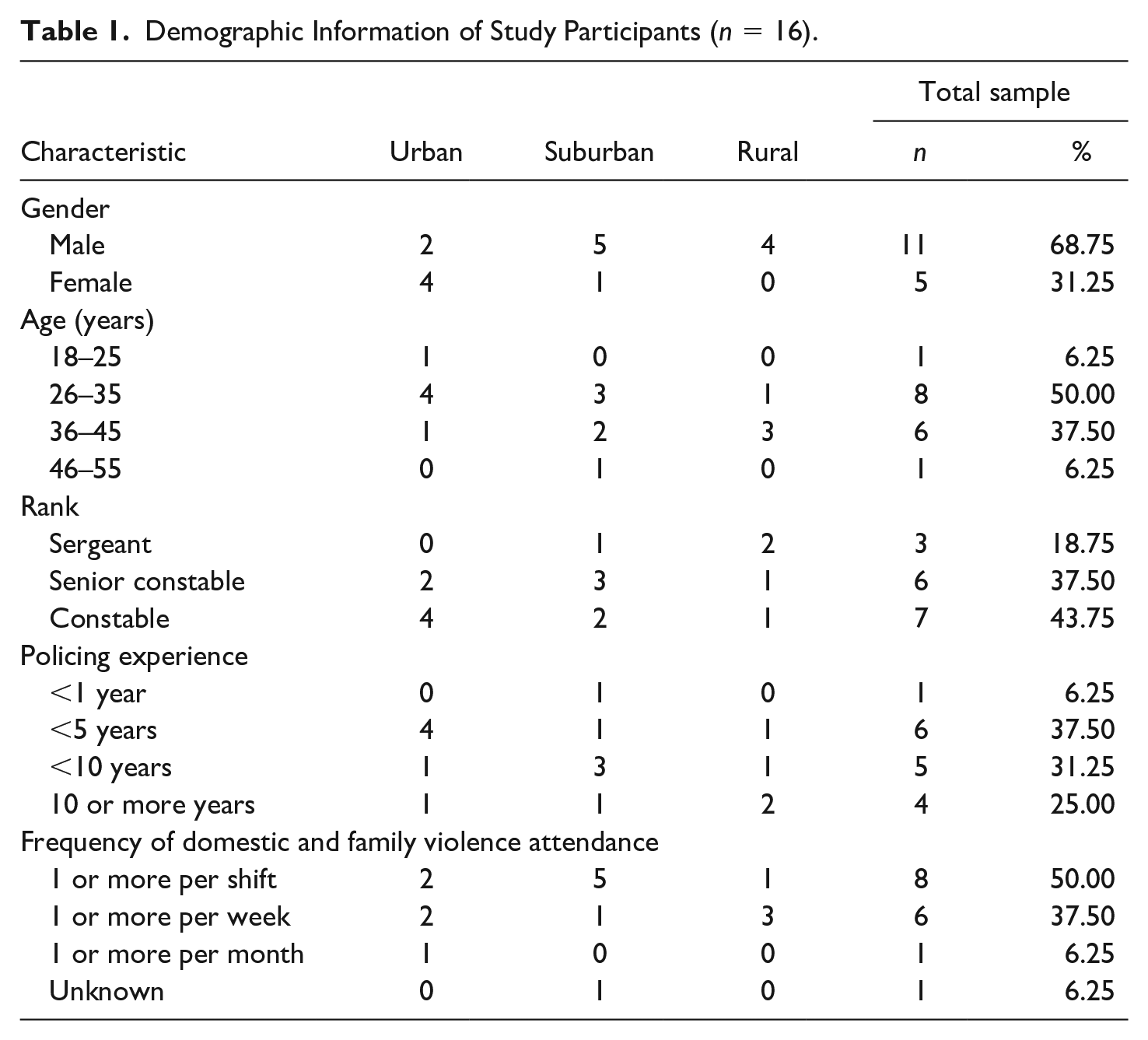
Participants were 16 police officers (69% male, n = 11) who were selected based on current or prior experience of attending DFV incidents as a first responder. The official ranks of police officers in the study included constables, senior constables, and sergeants. Participants ranged from 25–47 years of age (M = 35.74 years, SD = 6.33 years) and had varied levels of experience. The frequency of participants attending DFV incidents ranged from multiple jobs per shift to one per month (Mdn = one per shift). Table 1 contains a breakdown of participant demographics by region.
Demographic Information of Study Participants (n = 16).
Procedure
Recruitment
Recruitment was conducted through the DFV unit. They contacted senior sergeants at a number of police stations in urban, suburban, and rural areas across the state to provide a broad snapshot of Australian police. Senior sergeants then identified officers who were willing to participate in an interview.
Data collection
Ethical approval from the University’s Human Research Ethics Committee and the Police Agency Research Committee was obtained prior to conducting interviews. An interview protocol was drafted and piloted with an experienced officer to evaluate the suitability and clarity of the questions. The pilot data were not included in the analyses. Interviews were held between April and September 2019. Saturation was reached after approximately 11 interviews, which was consistent with expectations of saturation occurring within 6–12 interviews (Guest et al., 2006). Saturation is identified when there are no further issues or insights raised by subsequent participants. Of the 16 interviews, five were conducted in person and 11 were via telephone. The setting for in-person interviews was a private room at the police station during the participants’ shift. Telephone interviews were scheduled at participants’ convenience.
Only the interviewer and participant were present except for two phone interviews where participants agreed to the presence of a second interviewer for training purposes. One interview ceased after 24 min due to the officer being called out and another ceased after 36 min due to the phone connection cutting out. Nonetheless, their responses were sufficiently complete to be included in the analyses. Interviews lasted 45 min on average. Most participants (12) agreed for the interviews to be recorded, and recordings were transcribed verbatim in a de-identified form. For the four participants who preferred not to be recorded, detailed notes were taken by the interviewer both during and immediately after the interview and were included in the analyses. Each participant was given a unique identifier for the purpose of the study. There were no repeat interviews. Although the option was given, no participants requested to have their transcripts returned for comment or correction.
Research team and reflexivity
Following the COREQ guidelines, personal characteristics of the researchers and their relationship with participants should be reported (Tong et al., 2007). Most interviews (13) were conducted by the author, who is a 28-year-old female psychology graduate. Participants were made aware that the author was currently employed by the Office of the Director of Public Prosecution in administration. The interpretations presented should be viewed in light of the author potentially being sympathetic toward police due to her background in a criminal justice environment. Three interviews were conducted by a research assistant who is a female undergraduate psychology and criminology student. No relationship was established with participants prior to commencing the study. The author conducted the pilot interview under the supervision of an experienced researcher and proceeded unsupervised after receiving feedback. The research assistant observed one interview and was then supervised conducting an initial interview.
Semi-structured interviews
The interview protocol was used to guide the interviews and provide wording that was open-ended and clear. However, in accordance with constructivist grounded theory, the approach to the interviews was flexible and focused on building rapport and following interesting lines of inquiry (Charmaz, 2014). Participants were informed that the study was looking at positive and negative aspects of attending DFV incidents as well as police officers becoming desensitized and disengaged over time. Interview questions were prefaced by stating that they referred to DFV-related calls. To establish participants’ policing experience and exposure to DFV, they were asked for their age, rank, duration of service, current location, and frequency of attending DFV.
In terms of understanding participants’ attitudes toward attending DFV, they were asked about the most and least rewarding aspects and to provide examples of successful or less successful reponses. There were questions about what types of DFV incidents were easier or more challenging to explore their preferences for dealing with physical or nonphysical violence. To explore their changing attitudes, participants were asked how their feelings toward DFV had changed since becoming police officers. For example, “How do you think your ability to empathize with the aggrieved has changed over time?” Questions also focused on how well they were supported by their organization in responding to DFV and explored factors that impacted officers’ ability to cope effectively with attending DFV.
Data analysis
A constructivist grounded theory approach to analyzing qualitative data was adopted. The author was the primary coder, and the coding process was inductive as themes were not predetermined. First, transcripts and field notes were read repeatedly to gain familiarity with the content. Second, lines or small segments of data were given provisional codes that captured meanings and actions. For example, language relating to the aggrieved and respondent not taking responsibility for change was provisionally coded as “unwillingness to help themselves.” The next phase was focused coding which involved refining and organizing initial codes in terms of their significance, frequency, and relevance to the research questions. For example, the major theme of “personal growth” was formed to encompass the range of responses surrounding positive changes. At this stage of the analysis, tentative broad categories were formed and were framed in accordance with the research objectives and the natural shape of the data.
Data analysis began after the first two interviews and continued as an iterative process wherein themes were revised as new data were gathered. The content of the interviews was discussed by two researchers, and consensus was reached on the key themes during the coding scheme development. Using the finalized coding scheme, a research assistant coded a full transcript independently. Interrater reliability was calculated using the formula described by Miles and Huberman (1994). In this formula, reliability is calculated by dividing the number of agreements between the two coders by the sum of the number of agreements and disagreements. As a benchmark, researchers should aim for more than 80% (Miles & Huberman, 1994).
The agreement between the primary coder and the research assistant after two trials was 85%, which indicates an acceptable level of agreement. Member checking interviews—where results are returned to participants as a validation strategy to confirm the soundness and accuracy of the interpretations—were not conducted in this study. In the end, eight major themes and nine subthemes, belonging to four broad categories comprised the findings of the current study. The terms aggrieved (victim) and respondent (offender) are used in reporting the results to reflect the language used by participants. Quotes were edited for brevity by excluding “ums” and “ahs” and word repetition.
Results
Changing Perceptions
For most participants, aspects of personal growth and disillusionment emerged concurrently. The specific pattern of changes and the emphasis on positive or negative changes varied.
Personal growth
In total, 11 participants’ responses resonated with the theme of becoming a more competent and confident police officer. They valued how experience refined their communication skills and objectivity when attending DFV jobs.
Interpersonal skills
Growth in interpersonal skills was evident when participants became more relaxed, confident, and flexible with their approach to DFV: I was hands-on, aggressive to start off with and then just started talking to him like a normal person, and he was apologising and really emotional. You can’t just stay up at that high level. You need to be able to come back down and still talk to them like a human. Otherwise, you’re not gonna get that respect. (P5)
One participant said that when officers used their powers indiscriminately, they came across as domineering and provoked resistance. Therefore, she advocated listening and collaborating as a more effective approach. Five participants had become more successful at obtaining cooperation by taking on a social worker role and focusing on the quality of their interactions: “I want every victim to go away from their interactions with us feeling like they got everything that they deserve” (P14). A feature linking participants that supported this theme was their ability to relinquish control of the outcome (which was overwhelmingly poor) and focus on the present: “Do what you can, don’t mind the outcome because that’s where you’ll get disappointed” (P11). In contrast, three participants disagreed with this aspect of attending DFV: “We’re not social workers, we can’t solve problems” (P7).
Open-mindedness
The notion of being less judgmental, more objective in their assessment, and being fair to both parties emerged as significant changes for nine participants. Less experienced officers tended to presume guilt or jump to conclusions: “There is that change of a more balanced approach, a much less biased approach” (P8). Open-mindedness also came in the form of increased awareness of the dynamics of DFV: “My attitude has changed in that I’ve had to rethink my preconceived idea of what a domestic violence situation was” (P12). This participant was among eight who described their mind-set shifting from viewing DFV within heterosexual relationships as primarily male against female, to viewing violence as bilateral or often perpetrated by the female. Overall, their open-mindedness centered on changed beliefs about gender dynamics and the culpability of the accused party.
Disillusionment
All participants described themselves or colleagues becoming disillusioned and worn down in relation to attending DFV. Support for this theme was demonstrated by changes to empathy, desensitization to violence and distress, cynicism, and behavior.
Empathy and emotional detachment
Participants’ responses about how their empathy had changed over time were mixed but a prominent trend was that their cognitive and emotional empathy for the aggrieved and the respondent was situational but not in itself diminished. For example, it was harder to be empathetic when the aggrieved was hostile or dishonest: “I can empathise if you’re telling me a true story. But if you’re telling me lies, I don’t care” (P2). Similarly, participants felt little empathy for physically violent or non-remorseful respondents: “I have no empathy whatsoever for an actual abuser” (P12). However, eight participants also felt or became more cognitively empathetic toward respondents who were clearly in crisis or whom they felt were disadvantaged by the system: They may well deserve to be a respondent because of whatever happened once upon a time, but I’ve seen respondents have had reduced access to their children, have suffered financially, have got nowhere to live because the aggrieved has decided to utilise the system to his or her advantage. (P6)
Emotional and cognitive empathy for the aggrieved appeared to decrease or become more selective in the responses of 11 participants: “Grown adults who have full cognitive ability to walk away from the DV relationship I don’t have empathy for” (P10). Participants typically expressed empathy out of duty regardless of their personal feelings. Becoming emotionally numb was an additional change for eight participants. They spoke about running on “autopilot” with no emotion: You don’t necessarily lack any empathy or want to protect anyone, but you just become desensitised to it. Just go, oh, it’s just another job, rather than looking at the human element of it. (P9)
This emotional detachment was also seen as a positive and necessary change that increased their competence: “They need to keep emotion out of it in order to be able to deal with the emotions that the aggrieved and the respondent have” (P8). A general undertone throughout the interviews was that DFV was inherently unrewarding and it was the kind of incident where they just had to “go through the motions, tick the boxes” (P2). Desensitization to violence was particularly relevant for three participants who had relocated from rural and remote areas where severe injuries and fatalities were more commonplace.
Trust and world view
Exposure to DFV incidents altered participants’ world view and trust, leading to cynicism. After time in the field, eight participants described a pervasive mistrust toward the aggrieved, the respondent, and the public in general: “I didn’t believe that everybody lied to me when I first started off as a police officer; now I’m fairly convinced that most people do” (P6). Responses revealed a contradiction wherein participants felt they had become less biased, but they had also become less forgiving of perceived weakness or dishonesty of people that could impair their objectivity. Nine participants hinted that officers can become “jaded,” “burnt-out,” or “hard, bitter, and twisted,” whereas three openly admitted that it was something they themselves were experiencing. One participant referred to his colleagues: “The longer that they’re in, normally they become a lot more jaded or blunt” (P14). However, this participant felt he was an outlier as he had become more determined and passionate about his job. Another participant said he used to be “happy-go-lucky” but now disliked people because of having to deal with their mundane problems, and yet another expressed resentment: “With every DV that I go to, I have less and less respect for the human race. People can’t get their shit together and they expect someone else to do it for them” (P8).
Professional conduct
Five participants said they always displayed professional and courteous conduct regardless of their personal feelings. Three disclosed that there were times when they had performed their duties competently but were unduly curt or showed their frustration: You just get frustrated and then it carries on until you’ve had a chance to de-brief. And when you’re going job to job and you’ve done three DVs that shift you kind of go, look mate, just sit there, stop talking, you, shut up and go over there, let me do my job. Whereas the first job you might have sat there for a little bit longer. (P10)
These were occasions that they associated with being overwhelmed, excessively tired, or dealing with personal problems and were not characteristic of their normal behavior. Two of those participants indicated becoming less patient specifically when attending repeat calls: Once upon a time I might’ve gone there and I might’ve listened to them. But because we’ve been there multiple times and it’s the same situation every single time, our patience has worn thin with them. (P12)
This participant further suggested that serious conduct issues arise when officers are faced with difficult situations repeatedly without respite: “We are only human and if we’re dealing with certain situations continually, we might snap and we might do something silly” (P12). Seven participants referred to negative attitude and behavior changes in their colleagues when responding to DFV incidents and more generally. For example, their colleagues had become “less careful,” “more relaxed,” or “just couldn’t give a shit anymore.” They observed problematic behavior by colleagues toward the parties involved in a DFV incident: “Lack of empathy, lack of understanding . . . they’ll tell them off” (P11).
Demotivating Factors
Futility and organizational factors and several subthemes formed the prominent factors that shaped participants’ negative attitudes over time and inhibited their ability to cope with DFV. They highlighted experiences of disempowerment, stress, and dissatisfaction with the criminal justice system.
Futility
Self-help and cooperation
In total, 13 participants identified the aggrieved and the respondent’s inability or unwillingness to help themselves as one of the most frustrating aspects of policing DFV. They felt “rundown” when attending the same address for the same people and never achieving a different outcome: You’ll work your heart out and you’ll give them referrals and you’ll try and get them removed from the situation. And then you’ll get a disturbance or something like that the next week. And it’s hard, because it’s like, what are you doing yourself to remove yourself from the situation? (P5)
When both parties were resisting police, participants found it disheartening to realize that their actions would have no effect: “That’s the least rewarding, when you have to walk away because you’re powerless” (P12). These frustrations characterized the majority of the DFV calls they attended. However, all participants felt satisfied when a person was in “genuine” need of help and was willing to cooperate: If I attended a DV job and someone legitimately needs my help and I can see that, I will go and do everything that I possibly can to make sure that they get the help. And the most rewarding part is to see them take that help. (P2)
Genuine need
The majority of DFV incidents police attended were regarded as minor and petty. Participants perceived “genuine” DFV as an incident or pattern of incidents involving physical violence or serious controlling behaviors, whereas “not genuine” DFV was based on raised voices or legal technicalities. Eight participants highlighted that some aggrieved embellished the nature of an incident, fabricated entirely, or otherwise exploited the system. For example, an aggrieved inviting a respondent to live with them when it was advantageous and then later reporting a breach of a prohibition order: All of a sudden, she has enough of him so she calls the police. Guess what? He’s in breach of his bloody order. But because of the way the legislation is written, we cannot pursue the aggrieved for enabling the offence to occur. (P8)
Sometimes, participants said the aggrieved used calling the police as a threat to control the respondent: You think, well, you’re not so much a victim and fearful in this situation; you’re just using the upper hand which you have, which is, I’m gonna call triple zero [Australian Emergency Services telephone number] and you’re getting in trouble. (P6)
Organizational factors
Paperwork
In total, 11 participants commented that a major disincentive and source of frustration was the time and effort involved in processing a DFV incident. While breaches and referrals were straightforward, incidents that necessitated a new protection order application were arduous: “Whereas the application, that’s a lot more convoluted and the paperwork side of it’s a pain in the ass. There’s just so many holes, hoops to jump through” (P2). Participants felt that the time-consuming nature of the paperwork increased the pressure on first response officers: You can be off the road for three or four hours doing a domestic violence job . . . if we’re off the road for that period of time, every other crew within our area is having to respond to those other jobs that we’re not getting to. (P5)
Scrutiny
Pressure and scrutiny from increased government focus on DFV contributed to seven participants’ aversion to attending DFV calls: It’s a very time-consuming part of our role, just due to the fact that there’s so much red tape around it now . . . we just have to make sure that we do things right, which is what we should be doing anyway. (P5)
Accountability concerns were often raised, and some felt that there was an expectation to act even when there were doubts about the substance of a complaint. They expressed concerns over repercussions for themselves and respondents when there were conflicting versions of events, but felt pressure to err on the side of caution and side with the aggrieved: If this is allegedly what’s happened or not happened, how do I make sure I don’t get shafted, essentially? And that’s bad because you’re toying with people’s lives here. As bad as that is, I don’t wanna lose my job. (P2)
They resented having to justify their actions and facing criticism from above which averted their focus from the core goal: “More a mentality . . . of how do we tick all the boxes we need to tick rather than what is best for the persons involved” (P15).
Support and Coping
The themes of formal and informal supports and toughness versus vulnerability illuminated additional factors that helped or hindered participants’ ability to cope with attending DFV incidents. Formal and informal supports referred to the perceived availability, effectiveness, and use of supports, whereas toughness versus vulnerability referred more broadly to aspects of police culture.
Formal and informal support
A key issue was not having a chance to de-brief between calls. This issue was raised by five of the eight officers who attended DFV at least once per shift. There was no formal process in place to help officers cope with attending frequent DFV calls. However, participants said that many formal support options, such as human services officers and counseling services, were available but their willingness to use them varied. Informal social support such as having a close-knit relationship with family, peers, and supervisors appeared key to coping with the frustration of DFV calls. For example, one participant described the advantage of having a spouse who was also a police officer: “If there’s anything that plays on your mind or that has the potential to play on your mind, you can talk it out. Getting that understanding without being judged, I guess” (P6). While most participants noted that individuals needed to take initiative for their own well-being, six felt the advertised support was illusory because it was based on self-report: “The support network that they say is out there isn’t exactly out there” (P12). This participant explained that out of 15 years of attending fatalities, 2 years ago was the first time he was contacted to check his well-being. Others similarly felt that their organization could be more proactive: “Usually when you need help, you don’t wanna ask for it” (P10). One participant further suggested that waiting until a person had reached a breaking point or experienced a particularly traumatic incident was inadequate because it disregarded the slower, cumulative effects and that regular checks would be beneficial: “It would be nice down here or everywhere for that matter if there’s a check-in every six months . . . just to see how we’re progressing and coping over the years” (P10).
Toughness versus vulnerability
The pressure to appear mentally tough was both implied and explicit in participants’ responses, suggesting there was an issue with showing weakness in police culture: “There is no scope for the poor bastard who falls apart” (P8). They felt that it was a culture where you don’t talk about emotion: “There’s a culture change that needs to happen for people to be able to say, ‘boss, I have a problem, I didn’t handle that DV well last night. It’s bothering me’” (P8). Two participants said that as they deal with so many DFV incidents they should be used to it and it would be unusual for an officer to require support: “I think as far as traumatic events go in our job, it’s not really seen as one, even though it should be” (P12). Responses also implied that officers experiencing strong emotions were not well suited to the job: “You’ve got to be empathetic not sympathetic; otherwise, you’re not gonna be able to stay in this job” (P5). However, two participants acknowledged a gradual shift in culture through healthier coping strategies and increased mental health awareness: “The millennials that are coming through have been more self-aware of mental health issues . . . reaching out better now than they were like 20 years ago” (P9).
Awareness
Multifaceted DFV
A theme that emerged was that most participants had received extensive training and demonstrated awareness of the complexity and nonphysical aspects of DFV. In general, participants appreciated the barriers facing the aggrieved and the respondent, they described being attuned to cues of controlling behavior, and they discussed the cultural considerations specific to the community they policed. Participants explained nonphysical patterns of abuse: It may not have been violent, but it was the financial abuse, not giving her any money, she couldn’t leave the house, and it was a lot of controlling behavior. There’s a lot of different kind of components to DV. (P5)
They raised concerns about the perpetration of abuse by women toward men, often in the form of controlling a partner through access to children. They felt this was overlooked by the public and the current legislation. In rural and remote areas, they described significantly more violent DFV and major cultural barriers including stigma and the lack of support services.
Physical versus nonphysical
Among the six participants who explicitly referred to it, there were mixed preferences for dealing with physical violence compared with controlling behavior. One participant felt that physical violence involving injuries was easier to deal with than controlling behavior because there was clear evidence: “The worse the case, the easier the process . . . strangulation, choking, face is disfigured. You go there, it’s open and shut” (P13). Another participant felt aggressive respondents were easier than polite respondents who offered a credible story because it was less ambiguous. In contrast, four participants preferred nonviolent, minor incidents because of the peaceful resolution or lighter workload. One participant felt controlling behavior was more likely to change with intervention: “Whereas [physical] violence is a lot more difficult to unteach” (P11). Three participants were openly dismissive of verbal violence and expressed bias toward physical violence as being more important and “genuine.”
Discussion
The findings of the current study are encouraging as many officers reported improvements in interpersonal skills and objective decision-making over time. Also, officers generally perceived their interactions with the public to be empathetic and professional, and they were driven to protect those in genuine need. However, they felt they were bearing the burden of government and public pressure in relation to DFV. Officers’ reality was that they were often dealing with situations where their presence was unwelcome and their ability to effect change was limited. In some areas, they attended multiple DFV calls per shift without respite or a satisfying outcome because their help was rejected. Furthermore, many did not feel they were supported adequately to cope with the frequency and strain of attending DFV.
There was an expectation that officers should not be affected by routine DFV attendance. However, this is overlooking the cumulative effects of chronic stress and expecting officers to take initiative for help-seeking in a culture that is averse to recognizing and admitting “weakness” (Cotton et al., 2016). A concerning finding is that some officers across all experience levels had become worn down over time: exhibiting signs of apathy, desensitization, and cynicism, which resemble the symptoms of burnout and other stress-related conditions. This may be partly due to the ongoing combined strain of the identified demotivating factors and inadequate support structures: (a) the nature of DFV being inherently disempowering for police; (b) the pressures, flaws, and inefficient processes associated with the criminal justice system; and (c) lack of respite and having to establish their own ways of coping with varying success.
Another concern when viewing their attitudes, in light of other DFV research, is that officers may misidentify the aggressor or discourage genuine victims where physical violence is minimal, recurring, or bilateral (Stark, 2012; Stewart et al., 2013). Overall, the findings suggest that although officers’ awareness and competence in responding to DFV may increase with experience, their well-being and capacity to do their job effectively and compassionately may become impaired. As less experienced officers also reported changes of this nature, this process may occur relatively quickly for some whereas others appear to be resilient throughout their careers.
The themes of personal growth and disillusionment resonate with the findings of Chan (2001) and Loftus (2009). Most officers felt their negative attitudes or lack of emotional empathy did not impair their decision-making or capacity to express empathy. Occasionally, being less patient did come to light, and participants suggested more entrenched problematic behaviors in colleagues. Some officers appeared to be struggling with the frequency and strain of DFV, which over time may impact their well-being and capacity to do their job effectively (Anshel, 2000; Collins & Gibbs, 2003; Larsson et al., 2016). Although qualitative data limit the conclusions that can be drawn, the negative changes bear similarities to signs of stress-related disorders. The indifference, cynicism, depersonalization, shifting schemas about the world, and behavioral expressions seen in burnout and trauma-related disorders are comparable to those reported in the current research (Figley, 1995; Maslach et al., 2001). Frequent DFV attendance may be a risk factor for these disorders, although more targeted quantitative research is needed to establish a relationship.
Although the personal growth observed was consistent with posttraumatic growth (Tedeschi & Calhoun, 2004), the pattern of perceived positive and negative changes was diverse. Similar divides have been noted by DeJong et al. (2008) and Balenovich et al. (2008) and were explained as differences in policing philosophy and role perspectives. In line with Barrett and Hamilton-Giachritsis (2013) and Balenovich et al. (2008), officers tended to prioritize the investigation over the victim and seek definitive outcomes. Based on this, officers in the current study appeared to endorse slightly more traditional than community policing philosophies. While the above trends did emerge, officers’ responses were more similar than different across different regions, ranks, and frequency of exposure. It is therefore difficult to draw firm conclusions about the extent to which their attitudes, empathy, and capacity to respond effectively to DFV were influenced by demographic factors. Importantly, officers’ negative attitudes may be justified as they reflect a bleak reality where they are primarily dealing with recidivists and hostility from people they are trying to help.
The finding that the futility of police attendance negatively impacted officers’ ability to cope with DFV is highly consistent with prior research (Goodman-Delahunty & Crehan, 2016; Johnson, 2004; Loftus, 2009; Myhill & Johnson, 2016; Sinden & Stephens, 1999). Participants’ frustrations appeared to stem from a conflict between their desire to make a difference and their limited ability to do so with DFV matters as long-term change requires reciprocal effort and cooperation. Officers’ frustration at the lack of self-help by victims and offenders is consistent with findings that service providers tend to criticize victims who return to abusive relationships and view such outcomes as unsuccessful (Meyer, 2012). In the present study, many officers felt that success was synonymous with separation of the two parties and prosecution of the offender. This perception is problematic for morale as such outcomes are rare and officers expend time and effort only to reach an outcome that they perceive as failure. Shifting the focus away from success as criminal justice outcomes and toward success as victim empowerment may help officers derive more satisfaction from responding to DFV incidents.
Concerns about female victims exploiting the justice system and perpetrating DFV are consistent with the literature and have been interpreted as victim blaming (DeJong et al., 2008) and hostile sexism (Gracia et al., 2014). These interpretations may be overly simplistic as there is evidence that some females do perpetrate abuse (Drijber et al., 2013). However, the research overall supports that women are more likely to offend in the context of their own victimization (Johnson, 2007; Li et al., 2015). Officers’ assumptions that many female victims are exploiting the system may not be inaccurate in all cases but may mislead them in situations where there is coercive control with minimal evidence, or a victim is retaliating after enduring chronic abuse.
The emergence of organizational factors including paperwork and scrutiny as sources of frustration with DFV is consistent with the literature on police stress (Chan, 2001; Loftus, 2009). Heightened scrutiny of DFV matters was a major concern for officers. Responses suggest that they perceived the organizational climate as one of fear and criticism. Perceptions that they could be held accountable for offenders’ actions caused considerable distress. Some felt it diverted their focus from peoples’ needs, which aligns with findings from Myhill (2019). Streamlining processes and improving organizational climate may be strategies to reduce the stress on officers and increase their capacity to be attentive and responsive to victims’ needs when attending DFV (Anshel, 2000; Collins & Gibbs, 2003).
Perceptions of formal supports and help-seeking were mixed, but it seemed that services were available if officers could recognize a problem and were willing to seek help. Police reliance on informal support and reluctance to use services connected with work are again consistent with the literature (Chan, 2001). Officers experiencing mental health issues may delay or avoid help-seeking due to under-recognizing warning signs and fear of repercussions (Cotton et al., 2016). The finding that mental toughness was valued over displays of vulnerability aligns with research showing that there is entrenched mental health stigma (Cotton et al., 2016).
Together, these findings suggest that existing support structures are not adequately tailored to the needs of frontline officers in responding to frequent DFV incidents. Supports appeared to be reactive to critical incidents rather than proactively managing chronic, daily stressors such as attending DFV. Chronic stress may gradually erode officers’ well-being and capacity to cope (Anshel, 2000; Larsson et al., 2016). Importantly, organizational factors and support structures are modifiable and thus should be a focus for improving officers’ well-being and capacity to respond effectively to DFV (Anshel, 2000; Collins & Gibbs, 2003).
In addressing the question of preferences for policing physical violence compared with controlling behaviors, the results were mixed and data were limited. In contrast to prior research, the current study found that officers were generally well equipped and aware of the barriers, complexity, and nonphysical aspects of DFV (Goodman-Delahunty & Crehan, 2016). This finding suggests that efforts to enhance police training on DFV have been fruitful. However, some responses indicated a dismissive attitude toward verbal violence and a bias toward physical violence as more important and genuine. Officers should be cautious not to focus on isolated, severe violence as they may dismiss genuine victims and overlook the suffering associated with frequent, low-level violence (Stark, 2012).
The current study aligns with the JD-R Model (Schaufeli & Bakker, 2004) as organizational and operational job demands relating to DFV appeared to exhaust police officers’ resources and negatively impact their well-being and performance. Streamlining DFV processes to reduce the time pressure on frontline officers and providing more balanced feedback may help address this (Collins & Gibbs, 2003). As some DFV-related stressors are not modifiable, further encouraging peer support and promoting personal resources through training may be beneficial (Anshel, 2000). Increasing resources in areas where police attend frequent or severe DFV may further alleviate the burden and impacts on officers.
Limitations
A key limitation of the current study is that the findings are based on a limited sample and do not represent the views of all police officers across a policing agency nor other policing jurisdictions. Also, as four interviews were not recorded, the data gathered for those participants were less comprehensive. However, saturation was identified despite these limitations which support the validity of the themes presented. Another issue is that the findings closely mirror the process of police socialization described by Chan (2001) and Loftus (2009). It is therefore difficult to attribute changes to DFV exposure specifically rather than policing in general. Future studies could address this limitation using quantitative methods to isolate the effects of DFV exposure. Finally, officers’ self-perception of growth in interpersonal skills and open-mindedness may not validly reflect actual improvements in their competence.
Conclusion
The current study illuminated the perspectives of frontline police officers on how their attitudes and responses toward DFV changed over time. While officers became more open-minded and interpersonally capable when attending DFV, they also tended to become emotionally detached and cynical, and their empathy shifted from the victim to the offender. DFV appears inherently disempowering for officers, which, alongside organizational stressors and inadequate support structures, is likely to increase their risk of developing stress-related disorders that affect their well-being and the quality of their interactions with the public. Moving forward, interventions that simultaneously decrease organizational job demands, improve workplace climate and support systems, and promote officers’ personal resources would help cultivate a healthy and engaged workforce that is better equipped to cope with DFV.
Footnotes
Declaration of Conflicting Interests
The author(s) declared no potential conflicts of interest with respect to the research, authorship, and/or publication of this article.
Funding
The author(s) received no financial support for the research, authorship, and/or publication of this article.
