



Abstract
Using a mixed-methods design, the present study examined intimate partner surveillance among a diverse sample of intimate partner abuse (IPA) survivors (n = 246), including women of Mexican (n = 83), Korean (n = 50), Vietnamese (n = 49), and European descent (n = 64). Most survivors (57%) described surveillance in either survey or interview; inductive thematic analysis revealed seven forms of surveillance. Finally, two-step cluster analysis identified two patterns of victimization most clearly differentiated by surveillance, but ethnic group differences in rates and patterns of abuse did not emerge. Implications for both clinicians and researchers are discussed.
Intimate partner abuse (IPA) represents a significant public health threat to women in the United States. One in three U.S. women reports IPA victimization at some time in her life (Tjaden & Thoennes, 2000), resulting in numerous deleterious mental and physical health outcomes (Campbell, 2002; Mechanic et al., 2008). Despite research indicating that ethnic minority women are disproportionately victimized (e.g., Montalvo-Liendo, 2009), they remain underrepresented in IPA research (Kasturirangan et al., 2004; Mechanic & Pole, 2013). The limited research with ethnic minority women tends to focus primarily on physical and sexual violence (Frías, 2013; J. Y. Kim & Lee, 2011; Taft et al., 2008), with far less research focusing on surveillance or other nonphysical forms of abuse.
In their seminal research on coercive control, Dutton and Goodman (2005) suggest that coercive control is the central organizing feature of intimate partner violence. In this model, abusers issue a demand coupled with a credible threat, surveil survivors to ensure compliance, and then follow through with negative consequences when survivors do not comply. These negative consequences include a wide variety of abusive behaviors, including isolation, economic abuse, psychological abuse, sexual abuse, and physical abuse toward both survivors and their loved ones, all of which function together to ensure future compliance with the abuser’s demands. While research has increasingly expanded its focus to include nonphysical forms of abuse (Carney & Barner, 2012; Hamberger et al., 2017; Stylianou, 2018), very little research has been conducted on one of the central features of this model—surveillance—and the co-occurrence of surveillance with both physical and nonphysical forms of abuse. This is particularly true of research on women of color. To fill this gap in the literature, the current study used a mixed-methods design to explore patterns of surveillance, coercive control, and violence in the lives of Korean, Vietnamese, Mexican, and European heritage survivors of IPA.
The Coercive Control Framework
Domestic violence advocates have long framed IPA as an effort to control victims’ behavior (e.g., the ubiquitous Power and Control wheel; Pence & Paymer, 1993). Building on this conceptualization, Dutton and Goodman (2005) sought to operationalize the construct of coercive control and further specify when and how different forms of abuse are used. Working with an advisory panel of experts, Dutton et al. (2005) developed a conceptual model of coercive control based on an in-depth literature review, ethnographic interviews with survivors, interviews with professionals, and a review of archival data such as police reports. The resulting model suggests that abusers use a multistep process to get their way. In the first step, abusers “set the stage” by creating attachment, creating or exploiting vulnerabilities, and wearing down resistance. In the second stage, abusers issue a demand that gets coupled with an expectation of negative consequences if the victim does not comply. The abuser then uses surveillance to monitor victim compliance. If the abuser discovers that the victim has not complied, the abuser then follows through with the threatened consequences.
According to Dutton et al. (2005), the nature of the negative consequences may vary across participants and contexts, but the key is that the victim believes that the threatened consequences are credible. While research on IPA has historically had a stronger focus on physical and sexual abuse (Archer, 2000; Hardesty & Ogolsky, 2020), Dutton et al.’s (2005) conceptualization of coercive control suggests that physical abuse is only one of many possible negative outcomes used to elicit compliance. Their measure of coercive control includes a wide variety of abusive actions, including (a) physical abuse, (b) sexual abuse, (c) emotional abuse, (d) intimidation and fear, (e) isolation, (f) harm to the survivors’ reputation, (g) infidelity, (h) the dissolution of the relationship, (i) taking children away, (j) medical abuse, (k) employment abuse, (l) financial abuse, (m) legal abuse, (n) physical harm to others, (o) emotional abuse to others, and (p) self-harm by the abuser. Dutton et al.’s (2005) coercive control model thus offers a more comprehensive conceptualization of the consequences of coercive control and contextualizes when and how different forms of abuse are utilized.
Intimate Partner Surveillance
A key component of this coercive control model is abusers’ use of surveillance to track survivors’ compliance with their demands (Dutton & Goodman, 2005). Historically, this form of monitoring has been studied under the rubric of stalking which is defined as “a pattern of repeated, unwanted, attention and contact that causes fear or concern for one’s own safety or the safety of someone else (e.g., family member, close friend)” (Breiding et al., 2015, p. 14). Across two national studies, the National Violence Against Women Survey (NVAWS; Tjaden & Thoennes, 1998) and the National Intimate Partner and Sexual Violence Survey (NISVS; Black et al., 2011), the lifetime prevalence of stalking ranged from 8% (NVAWS) to 16% (NISVS) and the most common perpetrator was a current or former intimate partner (59%, NVAWS; 66%, NISVS). Within both studies, the most common form of intimate partner stalking (IPS) was surveillance behaviors, including unwanted contact (in person or via phone), being watched or followed, or having the perpetrator show up unexpectedly (Black et al., 2011; Tjaden & Thoennes, 1998).
Additional research on IPS suggests that IPS often co-occurs with other forms of physical, sexual, and psychological victimization (Black et al., 2011; Logan et al., 2007; McFarlane et al., 2002; Tjaden & Thoennes, 1998). For example, Tjaden and Thoennes (1998) found that 81% of women who were stalked by current or former partners also experienced physical IPA, and 31% had experienced sexual IPA. IPS has also been associated with increased incidence of psychological IPA (e.g., Dardis et al., 2019; Mechanic et al., 2008; Tjaden & Thoennes, 1998), and 64% of women who report lifetime IPA also report lifetime stalking (Dardis et al., 2019). These strong associations between stalking and other forms of abuse are consistent with Dutton and Goodman’s (2005) conceptualization of coercive control. When abusers note that survivors have not complied with their demands, they may enact a wide range of both physical and nonphysical punishment as a consequence (Dutton et al., 2005), leading to strong associations between surveillance and all forms of IPA.
The coercive control framework thus helps to explain the relationship between surveillance and IPA. It also provides a useful way of sorting out some of the inconsistent operationalizations that plague the stalking literature. For example, many measures of stalking include both surveillance behaviors (e.g., following, calling) as well as displays of physical violence or threats (e.g., threatened or actual physical harm, vandalism). When viewed through a coercive control lens, it becomes clear that surveillance and threats might be better measured separately—surveillance as a tool for determining compliance and intrusive behaviors as a contingent outcome for noncompliance (Hamberger et al., 2017). Similarly, many legal statutes require the victim to experience fear to qualify as a victim of stalking. When viewed through a coercive control lens, however, it is the credibility of the threat, not the surveillance measures themselves, that are theorized to cause fear (Dutton & Goodman, 2005). By conflating these two constructs, past research may have unwittingly underestimated the frequency with which abusers use surveillance behaviors (Fox et al., 2011; Owens, 2016), leading to a need for more research specifically about surveillance.
Finally, the constructs of psychological abuse, stalking, and coercive control are often not clearly differentiated in the literature. In its most general form, psychological abuse can be conceptualized as verbal or nonverbal communication that is intended to cause emotional harm (Breiding et al., 2015; Carney & Barner, 2012). Typically, this not only includes behaviors such as insulting, belittling, or humiliating the victim but can also include the use of threats and other nonphysical forms of abuse such as isolation and economic abuse (Breiding et al., 2015; Hall et al., 2012; Kelly, 2004; Tolman, 1999). However, the broadness of this definition varies across measures (Kelly, 2004; Thompson et al., 2006), and some measures of psychological abuse also include surveillance behaviors (Murphy & Hoover, 1999; Rodenburg & Fantuzzo, 1993; Sackett & Saunders, 1999; Shepard & Campbell, 1992; Tolman, 1999). This level of inconsistency and overlap among constructs can make it difficult to parse out how, when, and why abusers use different tactics of abuse or to determine the unique role of surveillance. Research that more clearly differentiates between surveillance and different forms of physical and nonphysical abuse is thus needed.
IPA Among Ethnic Minority Women
The current literature is also limited in its understanding of ethnic differences in surveillance and abuse. Comparatively, little research has focused on IPA among women of color (Kasturirangan et al., 2004; Mechanic & Pole, 2013), and the research that does exist tends to focus primarily on physical and sexual violence (Frías, 2013; J. Y. Kim & Lee, 2011; Taft et al., 2008). This is particularly true of Asian American populations. Some comparative research has found that Asian Americans report lower levels of IPA (e.g., Chang et al., 2009; Leung & Cheung, 2008), as well as less severe IPA (Cho & Kim, 2012), compared with other ethnic groups. Yet, fairly high rates of physical IPA have been found in Vietnamese American (22%) and Korean American populations (19%; Leung & Cheung, 2008). Furthermore, much of the research on Vietnamese and Korean American survivors has focused primarily on physical and sexual violence (Cho & Kwon, 2018; J. Y. Kim & Emery, 2003; J. Y. Kim & Lee, 2011; J. Y. Kim & Sung, 2000; Leung & Cheung, 2008; McKelvey & Webb, 1995; Song-Kim, 1992) with only a handful of studies incorporating measures of verbal abuse (Bui & Morash, 1999; C. Kim, 2017; Lee, 2007; Liles et al., 2012; Maru et al., 2018; Morash et al., 2007; Park et al., 2017; Tran, 1997). To our knowledge, no study to date has directly examined other forms of nonphysical abuse (e.g., isolation, economic abuse) toward Korean and Vietnamese American IPA survivors. We are also not aware of any research directly examining surveillance tactics used against Korean or Vietnamese American IPA survivors. While the NVAWS found that 4.5% of Asian/Pacific Islander women experienced stalking (relative to 8.2% of White women), this study did not disaggregate ethnic subgroups, nor did it disaggregate different forms of stalking (e.g., proximity, communication, threats), making it impossible to determine how often surveillance, in particular, has been used against Korean and Vietnamese American IPA survivors.
Similar problems exist in the literature on Latinx survivors of IPA. Comparative research on IPA in Latinx samples has yielded widely variable and conflicting prevalence estimates with some studies finding higher rates of IPA in Latinx populations and others finding lower or comparable rates (e.g., Black et al., 2011; Cuevas et al., 2010; Denham et al., 2007; Tjaden & Thoennes, 2000). However, little of this research has differentiated among ethnic subgroups, and those that have suggested that Mexican Americans may experience higher rates of IPA than other Latinx populations living in the United States (Cho et al., 2014). Much of the research that does exist with Mexican American populations focuses primarily on physical and sexual IPA (Cho et al., 2014; Duke & Cunradi, 2011; Lown & Vega, 2001; Mattson & Rodriguez, 1999; Neff et al., 1995; Sabina et al., 2012; Straus & Ramirez, 2007). The studies that do include psychological abuse tend to focus primarily on verbal insults and anger rather than other forms of nonphysical abuse (Brabeck & Guzmán, 2008; Castro et al., 2003; Coker et al., 2008; Ferguson, 2011; Firestone et al., 2003; García-Moreno et al., 2005; Grest et al., 2018; Hammett et al., 2017; Jackson et al., 2015; Ludin et al., 2017; Torres et al., 2000). To our knowledge, only three studies have directly examined stalking in Mexican American populations (Coker et al., 2008; Kyriakakis et al., 2012; Sabina et al., 2021), with 60% of those experiencing physical or sexual violence also experiencing stalking (Coker et al., 2008).
Taken together, this research suggests that there is a dearth of knowledge about the types of surveillance survivors experience and how surveillance may co-occur with other forms of physical and nonphysical abuse. This is particularly true of research with women of color. While some cross-cultural research has found higher rates of surveillance in countries characterized by lower gender empowerment, other cross-cultural research suggests that experiences and perceptions of stalking may be universal across cultures (Chan & Sheridan, 2020). Given the dearth of studies on this topic, it is currently unclear whether cross-cultural differences in surveillance exist and whether such findings would extend to ethnic populations in the United States.
Current Study
To fill this gap in the literature, the current study seeks to examine intersecting patterns of abuse among survivors of Vietnamese, Korean, Mexican, and European heritage. Of particular interest is the role of surveillance in women’s experiences of abuse, including the types of surveillance behaviors experienced, how surveillance intersects with other forms of physical and nonphysical abuse, and whether these patterns differ across ethnic groups. To achieve this goal, the current study used a convergent mixed- methods design to collect both qualitative interview data and quantitative survey data from Vietnamese-, Korean-, Mexican-, and European-heritage IPA survivors. Four primary research questions guided this study:
Research Question 1: What is the frequency of physical abuse, nonphysical abuse, and surveillance reported by survivors in standardized scales, and do these rates vary by ethnicity?
Research Question 2: What other forms of surveillance were described by survivors in their qualitative narratives?
Research Question 3: How many survivors describe at least one form of surveillance in either the qualitative interview or quantitative survey?
Research Question 4: How does surveillance intersect with other forms of physical and nonphysical abuse, and do these patterns vary by ethnicity?
Method
Procedures
A convergent mixed-methods design was used to collect both qualitative interview and quantitative survey data from IPA survivors of Mexican, Korean, Vietnamese, and European descent as part of a larger study of cultural influences on survivors of IPA (Mechanic & Ahrens, 2019). Initially, both the qualitative and quantitative data were collected during a single interview session, but time constraints made it difficult for participants to complete both forms of data collection in one sitting. The interview and survey protocols were thus split, and recruitment for each form of data collection was conducted separately. At the end of each interview and survey session, participants were then invited to participate in the other form of data collection, but completing both forms of data collection was optional.
Participants for both the qualitative interviews and the quantitative surveys were recruited with flyers, pamphlets, and in-person presentations in all four target languages. These recruitment materials were distributed to more than 1,500 community organizations, cultural centers, recreation facilities, and other community venues in two U.S. metropolitan counties. Separate materials were used to recruit adult women from each of our four target ethnicities to participate in either an interview or an online survey about relationship conflicts.
Women interested in an interview were directed to call the project phone line for more information, while participants interested in a survey were directed to a website with a link to the online survey. Both sets of participants were then screened, either on the phone or in the online survey, in English, Spanish, Korean, or Vietnamese to ensure they met the study criteria: Adult, female, from one of our target ethnicities, and were either afraid of their partner or had experienced physical or sexual abuse by a romantic partner during the past 5 years. Participants who qualified then completed informed consent procedures either over the phone or as part of the online survey.
In-person interviews were completed at a time and location of the survivor’s choosing and in the language of the survivor’s choice by a trained, bilingual and bicultural research assistant. Each interview lasted approximately 2 hr. At the end of the interview, participants were given a US$50 gift card to Walmart, a safety planning checklist, a referral booklet, and a link to the online survey to complete at their leisure. Online surveys were completed on Qualtrics. At the beginning of the survey, participants were able to select their preferred language (English, Spanish, Korean, or Vietnamese). The survey took approximately 1 hr to complete. At the end of the survey, participants received a US$20 gift code to Amazon.com, a safety planning checklist, and a referral booklet. Survey participants were also invited to call the project phone line to schedule an optional in-person interview.
Participants
These procedures resulted in a total of 246 unique participants, including 133 participants (54%) who completed only the online survey, 54 (22%) participants who completed only an interview, and 59 survivors (24%) who completed both an online survey and interview, yielding a total of 113 in-person interviews and 193 online surveys. Our three samples (survey only, interview only, and survey plus interview) were fairly comparable in terms of both basic demographic characteristics and experiences of abuse; however, survey-only participants reported significantly higher educational attainment and income and were less likely to have any children. Interview-only participants also disclosed slightly less sexual abuse (p’s < .05). Overall, participants from the combined sample of 246 participants were fairly evenly divided across our four ethnic groups: 34% of Mexican descent, 20% of Korean descent, 20% of Vietnamese descent, and 26% of European descent. Almost half of the participants were born in the United States (47%), whereas 16% were born in Mexico, 20% were born in Korea, 15% were born in Vietnam, and 2% were born elsewhere. Similarly, just over half of the participants prefer to speak English on a regular basis (53%), whereas 14% prefer to speak Spanish, 17% prefer to speak Korean, 15% prefer to speak Vietnamese, and 2% prefer to speak another language. When completing the interviews and/or surveys, 60% opted to complete them in English, 14% completed them in Spanish, 15% completed them in Korean, and 11% completed them in Vietnamese.
On average, participants were 37 years old (SD = 12.50). Overall, 55.5% of survivors had children, and, on average, participants had 2.31 children (SD = 1.47). Fourteen percent of survivors did not have a high school diploma, whereas the highest degree earned by the rest of the participants was a high school diploma (41%), a college degree (35%), or a graduate degree (9%). Nearly a third of participants (29%) did not know what their household income was; of those that did respond, 33% reported a household income of less than US$20,000, 25% reported a household income of US$20,000–US$38,000, 22% reported a household income between US$38,000 and US$62,000, and 20% reported a household income above US$62,000. Personal income was much lower with 71% of survivors reporting personal income of less than US$20,000 and only 7% reporting personal income above US$62,000.
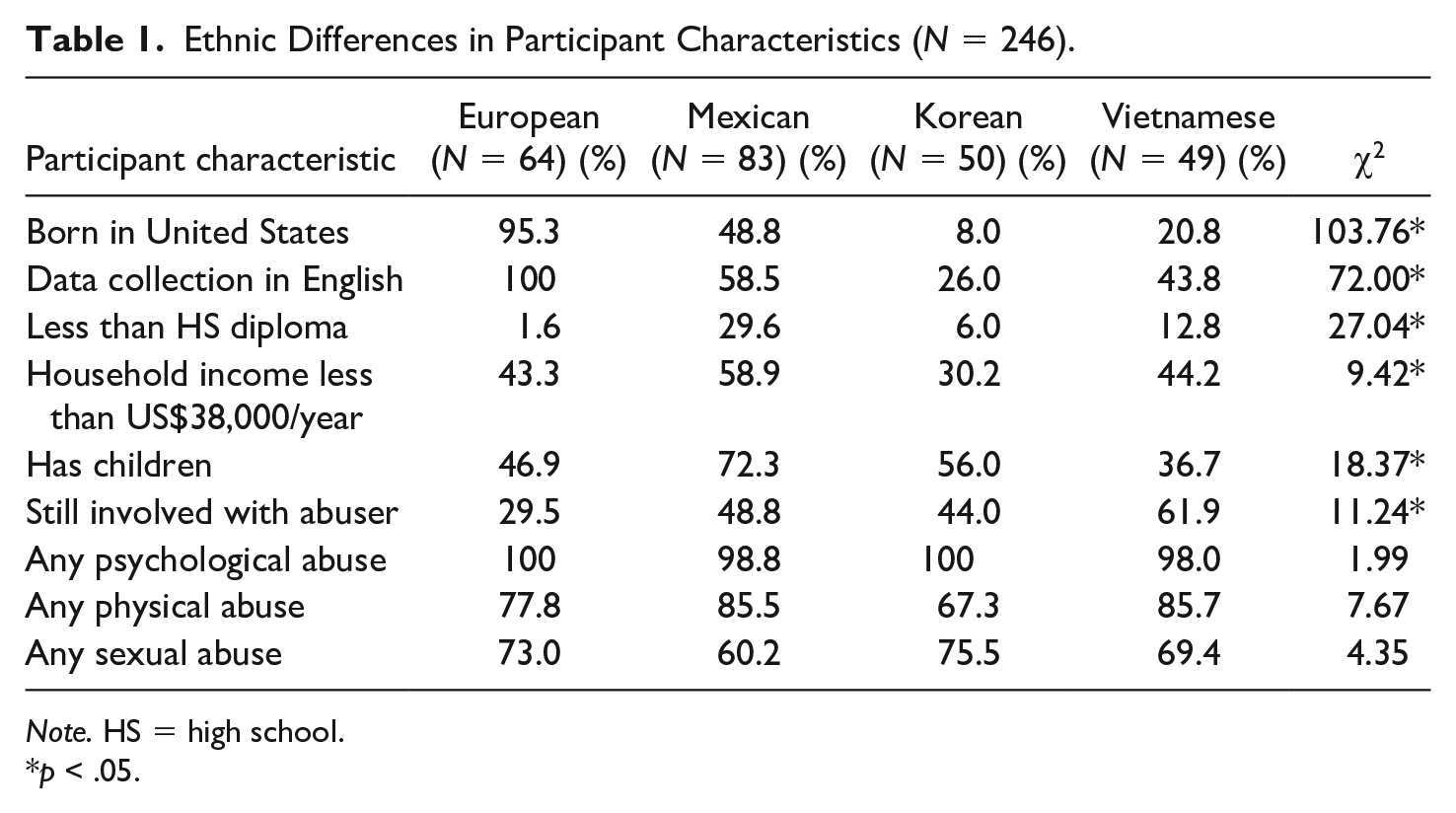
There were some ethnic group differences in demographic and study variables. As can be seen in Table 1, while there were no significant differences in having a history of psychological, physical, or sexual abuse, there were significant demographic differences across the groups.
Ethnic Differences in Participant Characteristics (N = 246).
Note. HS = high school.
p < .05.
For example, European-heritage survivors were significantly more likely to be born in the United States, whereas Vietnamese- and Korean-heritage women were significantly less likely to be born in the United States. All of the European-heritage women preferred English to be used during data collection, whereas Korean-American women (26%) were least likely to complete the study in English. Mexican-heritage women were significantly more likely to have less than a high school diploma, to have an income of less than US$38,000, and to have children relative to other groups. Finally, Vietnamese-heritage women (62%) were significantly more likely to still be involved with the abuser than European-heritage women (30%), with Mexican- (49%) and Korean-heritage women (44.0%) intermediate.
Measures
Data were collected via both online surveys and in-person interviews. Online surveys included translated measures when they existed. Other measures were translated and reviewed for cultural equivalency by bilingual experts in the field.
IPA
Experiences of past-year sexual and physical IPA were assessed quantitatively using the Revised Conflict Tactics Scale (CTS2; Straus et al., 1996). Participants were asked to report the frequency of sexual IPA (7 items) and physical IPA (12 items), with options of “1 time in the past year,” “2 times in the past year,” “3–5 times in the past year,” “6–10 times in the past year,” “11–20 times in the past year,” or “20+ times in the past year.” These items are scored according to the midpoints of the scale options, (1), (2), (4), (8), (15), and (25). A mean for each subscale was created, such that higher scores indicate increased average frequency of past-year sexual and physical IPA victimization. The reliability and validity of the CTS have been assessed (Straus et al., 1996) and replicated across a sample of 17 countries (Straus, 2017). Evidence of construct validity has been established through correlations between IPV and relationship dominance, as well as between physical IPV and injury (Straus, 2017; Straus et al., 1996). Discriminant validity has been demonstrated via a lack of correlation with social desirability (Straus, 2017). The CTS has been translated and validated in Spanish and Korean. In the present study, Cronbach’s alpha was excellent for physical IPA (α = .93) and good for sexual IPA (α = .87).
Experiences of past-year emotional abuse were assessed using the Psychological Maltreatment of Women Inventory-Short Form (Tolman, 1999). Participants were asked to report the frequency of psychological IPA (14 items) with options of ranging from 1 (never) to 5 (very frequently). For the purpose of the current study, only the Emotional/Verbal Abuse subscale was used to avoid substantial overlap between the Dominance/Isolation subscale of the PMWI and our measure of coercive control (see below). The Emotional/Abuse subscale consists of seven items such as “my partner called me names” and “my partner yelled and screamed at me.” A mean Emotional Abuse scale score was created, such that higher scores indicate increased average frequency of past-year Emotional Abuse. The PMWI has shown evidence of convergent, discriminant, criterion, and factorial validity (Tolman, 1999); for example, the PMWI is correlated strongly with other measures of psychological and emotional IPA, and to a lesser extent, physical IPA and psychological distress, and can differentiate between groups of service-seeking battered women compared with nonbattered and nondistressed samples of community-residing women (Tolman, 1999). The PMWI has been validated in Spanish. In the present study, Cronbach’s α = .93.
Perceptions of coercive control were assessed using Dutton et al.’s (2005) Coercive Control Scale, which assesses tactics abusers use to ensure survivor compliance with their demands. Participants responded to 31 Yes/No items about what survivors feared the abuser would do if they didn’t do what he wanted in the past year (e.g., “say something mean”; “embarrassing or humiliating to you”; “keep you from seeing or talking to family or friends”; “physically hurt you”; “have sex with someone else”; “hurt you financially”; “not let you take medication”; “cause you legal trouble”). Endorsed items were summed to create a total score, ranging from 0–31, with higher scores indicating greater fears of consequences for noncompliance. Evidence for scale reliability and validity are presented in Dutton et al. (2005), including evidence of factorial validity, predictive validity (through associations with PTSD, depression, and fear), and convergent validity (through associations with IPA). In the present study, Cronbach’s α = .94.
Surveillance
Surveillance was assessed both quantitatively and qualitatively. Quantitatively, three items from the Revised Stalking Behavior Checklist (SBC; Coleman, 1997) assessed the frequency of past-year surveillance. Items included, “my partner followed or spied on me,” “my partner made unwanted phone calls to me,” and “my partner showed up uninvited at my home, at school, or at other places he had no business being, to keep track of me or to bother me.” These items were specifically selected from the larger 25-item measure because they more closely capture the construct of surveillance instead of intrusion, threats, and physical violence. For consistency with measurement of other forms of IPA, the scoring in the current study was the same as that of the CTS2-SF, that is, 1 (1 time in the past year), 2 (2 times in the past year), 4 (3–5 times in the past year), 8 (6–10 times in the past year), 15 (11–20 times in the past year), and 25 (20+ times in the past year). Higher scores indicate increased average frequency of surveillance behaviors in the past year. In the present study, Cronbach’s α = .78.
Qualitatively, survivor interviews were reviewed for excerpts pertaining to surveillance. The interview protocol was developed for a larger study about cultural influences on IPA survivors’ experiences of abuse, coping, and help-seeking. For the purposes of the current study, the focus was on survivors’ experiences of monitoring and surveillance. Although the entire interview was recorded, transcribed, translated, and reviewed for relevant excerpts, the majority of survivors described their experiences of surveillance in response to a question about conflicts in their relationship. In this section of the interview, participants were handed a card listing common forms of intimate partner violence (e.g., “your partner keeping you away from family and friends,” “your partner telling you what you can and cannot do,” “your partner following you or monitoring what you do”) and were asked to describe similar experiences in their own relationship. Excerpts from survivors’ reports of monitoring and surveillance were extracted from these transcripts, yielding a total of 174 excerpts from 63 different survivors that were further analyzed using the procedures described below.
Analysis Procedures
Data analysis proceeded in three stages: (a) quantitative analysis, (b) qualitative analysis, and (c) mixed-methods analysis. Quantitatively, a series of chi-square analyses were conducted to examine sample and ethnic differences in demographic variables. Descriptive analyses were then used to examine the frequency of physical abuse, nonphysical abuse, and surveillance, and one-way analyses of variance (ANOVAs) were used to examine ethnic group differences in these measures.
Qualitatively, an inductive thematic analysis approach was used to create a codebook capturing various forms of monitoring and surveillance. Using an open-coding procedure (Boyatzis, 1998; Miles & Huberman, 1994), marginal codes were created for each excerpt and then sorted into categories reflecting different forms of surveillance. This codebook was then used by two independent raters to code every excerpt, and a consensus approach was used to resolve disagreements in ratings. In most cases, disagreements involved one coder applying a code that was overlooked by the other coder. When these omissions were included in the calculations, kappa was .83. When only outright disagreements were included, kappa increased to .94.
Data transformations were then used to integrate the qualitative and quantitative findings. This was accomplished by creating a composite variable indicating whether survivors described at least one form of surveillance during either the qualitative interview or quantitative survey. By utilizing all available information, we sought to obtain the most accurate assessment of survivors’ experiences of surveillance by capturing reports of surveillance in both the quantitative survey and qualitative interviews. This composite variable was then used in several additional statistical analyses examining how surveillance intersects with other forms of physical and nonphysical abuse, and ethnic differences in patterns of abuse.
Results
Frequency of Physical Abuse, Nonphysical Abuse, and Surveillance
Our first research question sought to examine the frequency of physical abuse, nonphysical abuse, and surveillance experiences reported by survivors in the online surveys.
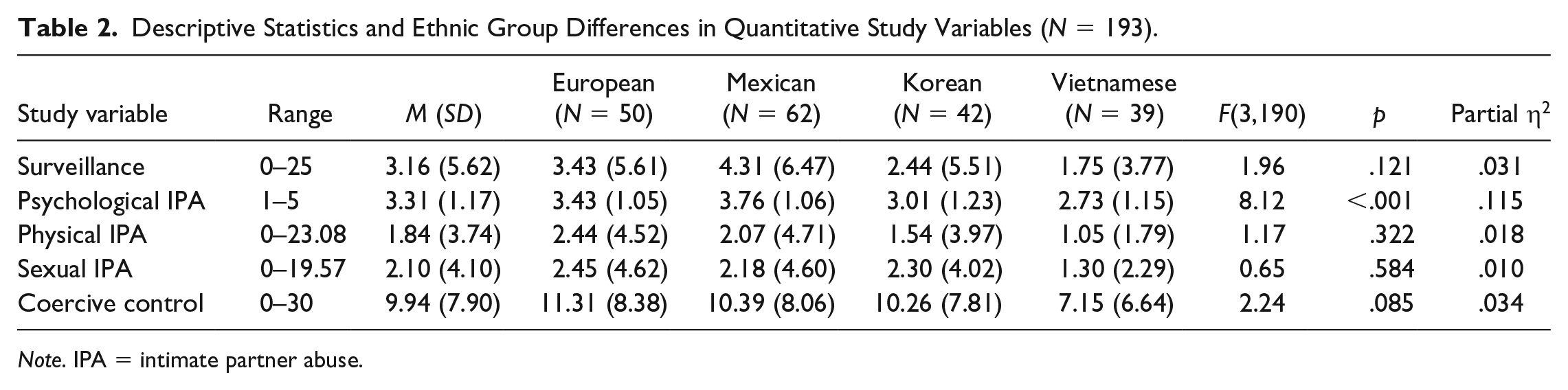
As seen in Table 2, survivors in this sample experienced moderate levels of psychological abuse (M = 3.31, SD = 1.17) and coercive control (M = 9.94, SD = 7.90), and somewhat low levels of physical abuse (M = 1.84, SD = 3.74), sexual abuse (M = 2.10, SD = 4.10), and surveillance (M = 3.16, SD = 5.62). There were no ethnic group differences in quantitative measures of physical IPA, sexual IPA, coercive control, or surveillance; however, Vietnamese-heritage women reported significantly less psychological IPA than did European- and Mexican-heritage women (see Table 2).
Descriptive Statistics and Ethnic Group Differences in Quantitative Study Variables (N = 193).
Note. IPA = intimate partner abuse.
Nature of Surveillance Experiences
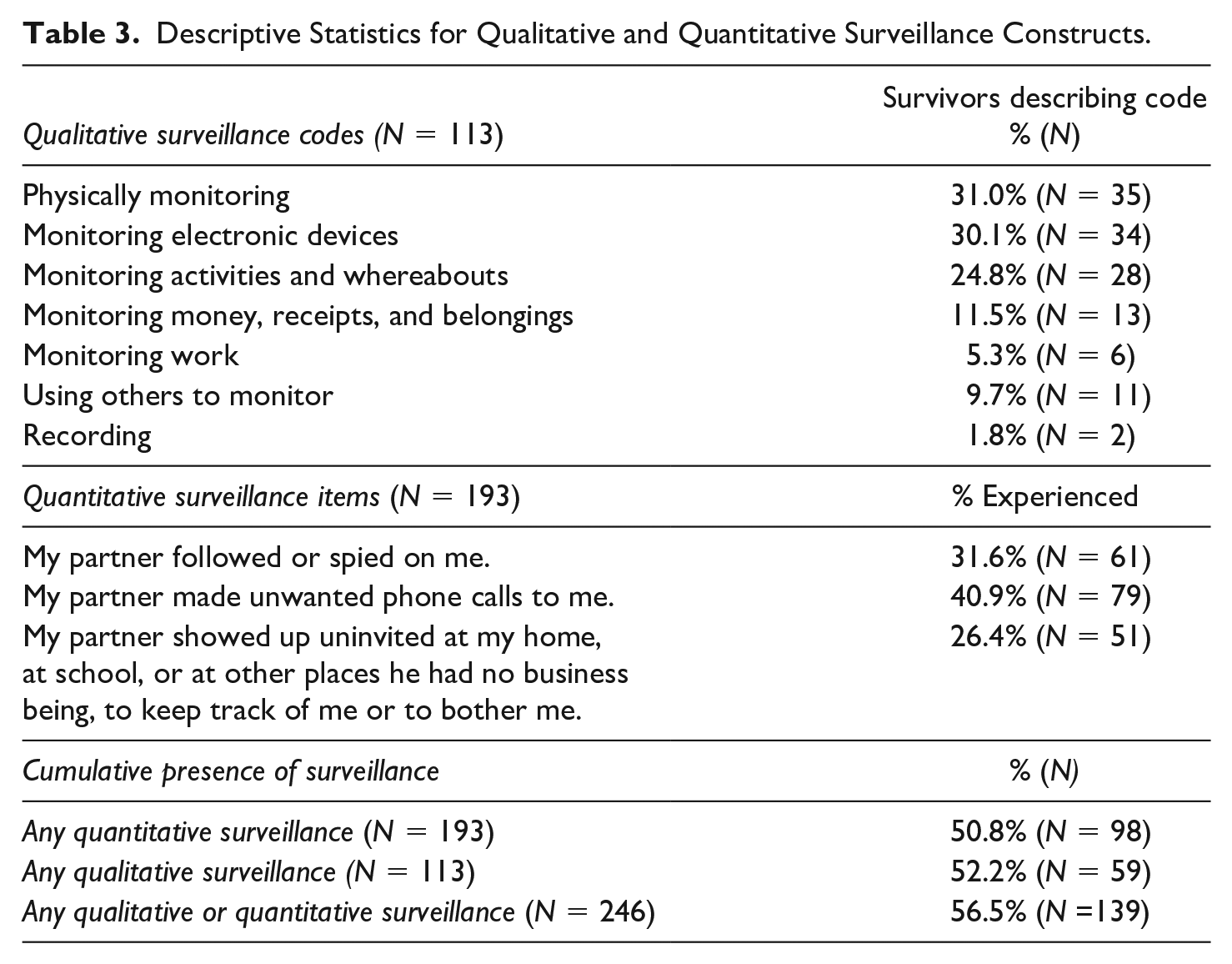
Our second research question sought to build upon these quantitative findings by exploring additional forms of surveillance described in survivors’ narratives. To do so, inductive thematic analysis was used to identify different forms of monitoring and surveillance described by participants in our qualitative interviews (n = 113). These analyses identified seven distinct forms of surveillance, including physical monitoring, electronic monitoring, monitoring activities and whereabouts, monitoring money and belongings, monitoring work, using others, and recording (see Table 3 for frequencies).
Descriptive Statistics for Qualitative and Quantitative Surveillance Constructs.
Physical monitoring
The most common form of surveillance described by survivors during the qualitative interviews was being physically followed and observed. Examples of physical monitoring included following her, watching her from afar, stopping by her house, showing up at locations she visits, and observing what she’s doing and who she’s talking to.
I had to actually get a restraining order on him as well because he would come to my house, stalk me. Tell me what times I left, what times I came home, what I was wearing. He would call my house at least 15 times a day, call my mother’s phone 15 times at, before 6:30 in the morning. He would tell me he’d come to my house, kill everybody there, kill my nephews, kill me, he doesn’t care, and if I ever see anyone again or date anyone, he would kill me and kill them. (European-heritage Survivor) Any man that would get near me, [he’d say], “What does he want, and what did he say to you?” He’d guard me everywhere, anywhere he wanted—I would go with my mom to a fair, I’d take the kids too because he’d never take them. My mom would come with me. He’d show up there very drunk [and he’d say], “And what are you doing, and why did you come?” And he’d just be there monitoring, just checking on me. He didn’t want me to be in touch with anyone, I didn’t have—I never had, I never had friends. I hardly had any [female] friends and he just wanted to have me at home like a slave. (Mexican-heritage Survivor)
Monitoring electronic devices
Monitoring electronic devices was the second most common form of surveillance. Examples of this form of surveillance include checking her call logs, reading her text messages, checking her social media accounts, reading her emails, checking her internet browsing history, checking her phone camera, and eavesdropping on phone calls. Survivors also described needing to reveal passwords, being tracked through GPS, and having phone data sent directly to his phone.
He was always checking up on me. If I made a call, then it was “show me your phone, show me the calls your made during the day, or show me who you sent [text] messages to, or give me your phone company’s list so I can see who you’re calling, to see if you are telling me the truth.” . . . Or “why did you erase a call?” Or, if I was looking at my pictures, if I deleted a picture that I didn’t like, “Why are you doing that, who did you delete?” Or things like that, he would always make up things like that in his mind. (Mexican-heritage Survivor) He has this thing where he puts his phone up to my phone, and all my pictures that I’ve taken during the day, or worked on, or anything, go straight to his phone. If I use my ATM card, it goes straight to his phone, for anything. If I use my Wells Fargo ATM card, all the information doesn’t go to my phone. It goes to his phone. . . . . We have Life 360. He knows where I am right now. Do you know what Life 360 is? It’s a family app where you can follow each other. Which in theory is good, but he’s the—he knows where I am. (European-heritage Survivor)
Monitoring activities and whereabouts
Monitoring activities and whereabouts of survivors was the third most common form of surveillance described by survivors. Examples of this form of surveillance included calling the survivor obsessively to check on her whereabouts, making the survivor call frequently to check in, making the survivor send pictures of her location, making the survivor give detailed accounts of her plans prior to leaving the house, asking numerous questions about where she was and who she was with, and becoming agitated when the survivor does not answer her phone immediately.
He just wanted to know all the details about everything, like, “Who’s calling you? What do they want? Who’s there with you at the house? Where are you? Where are you going?” Just all the time. (Mexican-heritage Survivor) I have to like answer his call no matter what. If I don’t answer things get messy. [When I went to Korea], he bought me a portable charger like this big. He was saying that I can’t make an excuse saying that I couldn’t answer the phone because the battery was dead. [When I told him I was going to sleep at my sister’s house in Seoul] he would tell me to send him a photo of younger sister’s belongings with her name on it since he needs to confirm that I’m really in that house. (Korean-heritage Survivor)
Monitoring money, receipts, and belongings
Although less common, survivors described abusers who monitored their spending of money, used receipts to track survivors, monitored shared bank account activity, looked through her belongings, or read through her personal diaries or records.
We had set envelopes, so much for groceries, so much for this bill, that bill, that bill. I would have to account for every penny, for years, every penny. We would sit down and go over it for hours and hours, because he was confident I was giving money away, or hiding money, or taking money, or having accounts someplace else, which I was not.(European-heritage Survivor) He will count the miles to know if I had only gone to the clinic and had returned [home]. Or the gas. There was always control. The same [with] the receipts of, of the stores. I had to rip everything before he came so he wouldn’t know where I was. (Mexican-heritage Survivor)
Monitoring work
Survivors also described surveillance that occurred in the context of work, such as coming to her work to check up on her, watching her at work all day, coming to work to interrogate her, and checking her time in and time out.
He’d come in, ‘cause I worked at a retail store. Yeah. He’d be like, “Oh, who’s that guy at the tech desk? Who’s that guy?” (European-heritage Survivor) He’d stop in front of where I worked, and he’d stay there all day until I’d get out of work. Or, sometimes he’d go half an hour before I got out [of work]. And you can say that’s what he was doing, there watching me. . . . If he sometimes saw a worker, or something, because sometimes they were, you can say, the windows [were] transparent and well, you can see inside, or [see] what you’re doing, and so [he said], “and I saw you talking and surely, you’re with that person.” (Mexican-heritage Survivor)
Using others to monitor her
Survivors also described the abuser using other people to monitor her behavior. This form of abuse described tactics such as repeatedly calling family members for information, having family members report to the abuser, asking children about her behavior, using the children as an excuse to follow her, contacting friends for her contact information, having neighbors monitor or spy on her, hiring a private investigator to follow her, and dating her friends to monitor her.
He just wants to know everything. He calls my daughter. He gets all kinds of information from her. (Mexican-heritage Survivor) He started reaching out to my friends that he somehow found on Facebook. And he started sending them messages, like “hey, I’m a friend of [participant] and I wanna get to talk to her again. Could you help me?” Like those type of messages. (Korean-heritage Survivor He’d place those men, cholos, on me. He’d place them on me to monitor the house, right there outside the house, right there. They’d tell me, he’d tell me that he put out an order that if they saw me talking with someone to kill them, and to kill me, to abuse me, to tear me apart. (Mexican-heritage Survivor)
Recording her
Survivors also described abusers who planted cameras or tape recorders in the home to monitor her behavior.
He used to plant tape recorders, just like this one, and a little camera he had bought that had a disk in it. He would hook it to the computer. (European-heritage Survivor) He said I’d tidy up the house because when he’d go to work, I would start working as a whore. [He said] I would let in men, I could care less, I’d have my daughters at school, well I’d go whoring around, [and] the men would come inside there. He’d come inside the house and he’d search under the beds. He spent 4 years placing cameras everywhere, in the toys, in the stereo, even in the rice things; he had cameras everywhere. (Mexican-heritage Survivor)
Mixed-Methods Analysis of Surveillance Experiences
Our third research question used a mixed-methods approach to determine how many survivors described at least one form of surveillance in either the qualitative interview or quantitative survey. In doing so, we sought to achieve integration of the qualitative and quantitative information through data transformation (Fetters et al., 2013). As can be seen in Table 3, 52.2% of the 113 interview participants and 50.8% of the 193 survey participants described at least one form of surveillance. When both sources of information are combined into a single variable, 56.5% of the total sample of 246 survivors endorsed at least one form of surveillance in either the qualitative interview or the quantitative survey.
Patterns of Intimate Partner Surveillance, Coercive Control, and IPA
Our final research question set out to examine differential patterns of surveillance, physical abuse, and nonphysical abuse in the lives of IPA survivors. Using the composite variable of surveillance described above, we ran a two-step cluster analysis on the 193 participants who completed quantitative measures of physical and nonphysical violence.
To include the transformed, dichotomous, mixed-methods surveillance variable in the cluster analysis, two-step cluster analysis was performed with log-likelihood estimation (Chiu et al., 2001). In the first step, preclustering occurs through a sequential process of constructing cluster feature trees from the standardized variables. In the second step, agglomerative hierarchical clustering is performed, with the number of clusters determined based on Schwarz’s Bayesian information criterion (BIC), with the lowest BIC preferred (Chiu et al., 2001). Following clustering, predictor importance is determined through chi-squares (categorical variables) and t tests (continuous variables); importance values are standardized to a range of 0 to 1 to permit comparison, with higher levels indicating greater predictor importance.
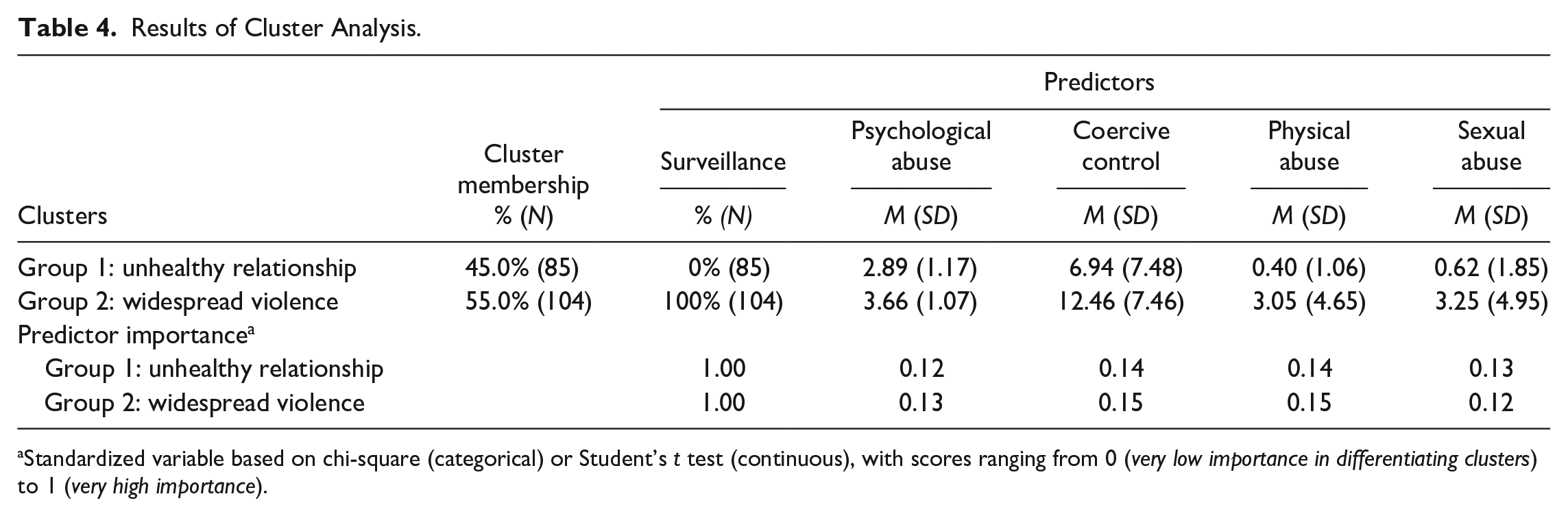
From these analyses, two patterns of abuse were identified (see Table 4).
Results of Cluster Analysis.
Standardized variable based on chi-square (categorical) or Student’s t test (continuous), with scores ranging from 0 (very low importance in differentiating clusters) to 1 (very high importance).
The first pattern, representing 45.0% of the sample, consisted of women who experienced relatively low levels of all forms of abuse and no surveillance. We are calling this pattern the Unhealthy Relationship Pattern. The second pattern, representing of 55.5% of the sample, included women who experienced higher levels of all forms of violence, which we are calling the Widespread Violence Pattern. Notably, all of the women who reported intimate partner surveillance clustered into this group. In addition, surveillance was the most important predictor in differentiating the clusters (1.00 in each cluster, on a scale from 0 to 1), with each other predictor of very low relative importance (.12–.15 on the same scale).
Consistent with our fourth hypothesis, we also examined whether there were ethnic differences in these two patterns of violence using binary logistic regression, while controlling for the significant demographic covariates shown in Table 1.
As shown in Table 5, the model fit was nonsignificant, with no significant differences in cluster membership by ethnic group (p = .979). Interpretation of a nonsignificant regression model is not indicated; however, the only demographic variable that reached significance was whether the survivor was still romantically involved with the perpetrator. Those who were not still in a relationship were more likely to be represented within the Widespread Violence cluster.
Binary Logistic Regression Predicting Cluster Membership by Ethnic Group, With Demographic Covariates.
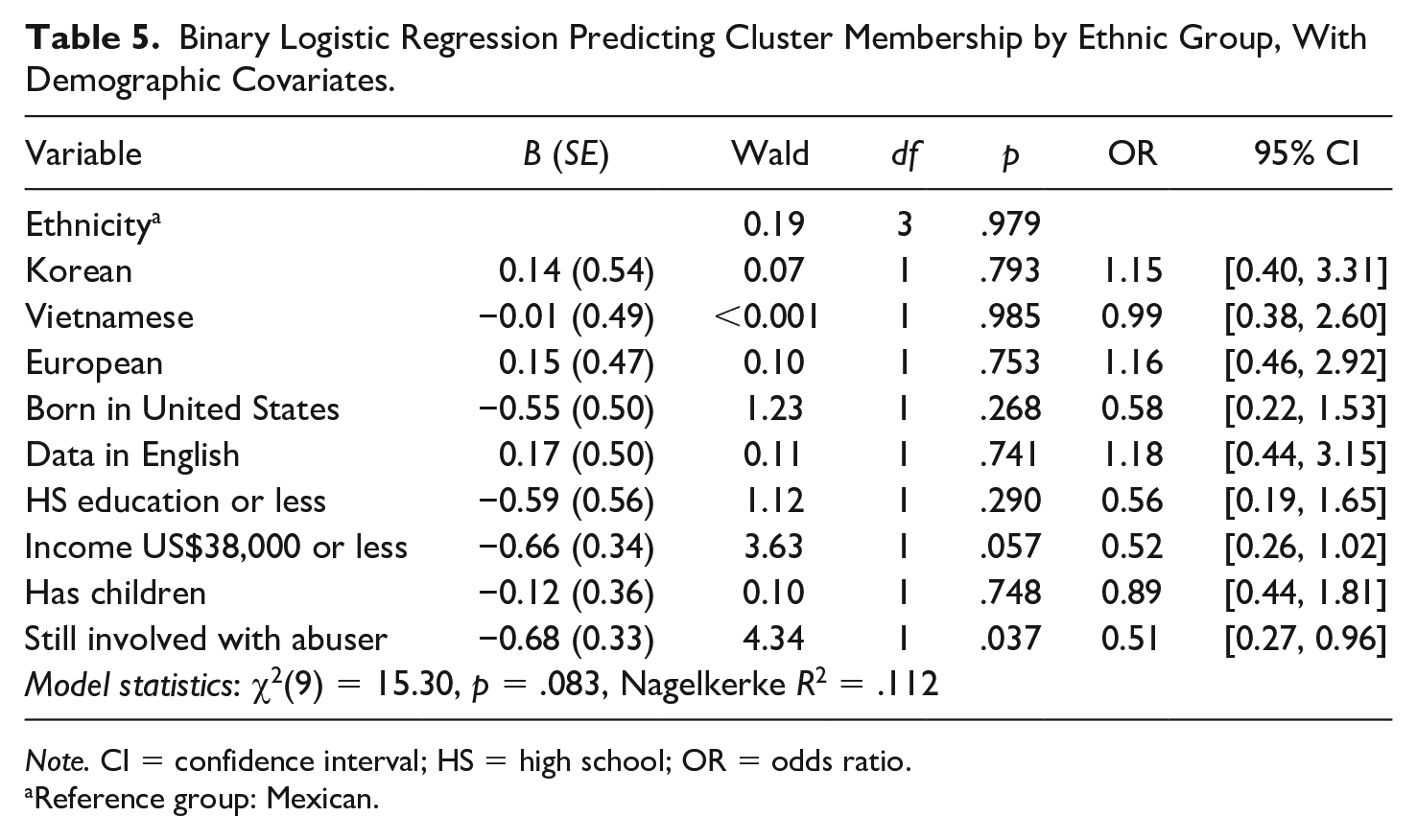
Note. CI = confidence interval; HS = high school; OR = odds ratio.
Reference group: Mexican.
Discussion
The purpose of the present study was to examine the role of surveillance in women’s experiences of abuse, including the types of surveillance behaviors that are experienced, how surveillance intersects with other forms of physical and nonphysical abuse, and whether these patterns differ across ethnic groups. Using a mixed-methods design, we first examined rates of physical abuse, nonphysical abuse, and surveillance reported on quantitative measures of abuse. Quantitatively, IPA survivors in our survey sample experienced moderate levels of psychological abuse and coercive control and somewhat low levels of physical abuse, sexual abuse, and surveillance.
Our second goal sought to expand our understanding of surveillance by examining survivors’ qualitative narratives of abuse. Qualitatively, IPA survivors in our interview sample described seven distinct forms of surveillance, including physical monitoring, electronic monitoring, monitoring of activities and whereabouts, monitoring money and belongings, monitoring work, recording, and using others. Overall, physical monitoring and electronic monitoring were the most common forms of surveillance described. That electronic monitoring behaviors, such as monitoring social media, reading the victim’s texts, and using GPS to track the victim, were reported with similar frequency as physically monitoring the survivor is significant. Given that existing measures and national studies have included limited assessment of cyberstalking behaviors (see Fox et al., 2011, for a review), future studies, including large-scale national studies, should include more comprehensive assessments of the use of technology to monitor and surveil partners.
Similarly, the qualitative analyses suggest that abusers often monitor survivors’ money and belongings as a form of surveillance. While measures of financial abuse sometimes capture this activity (Adams et al., 2020), it has not typically been captured in quantitative measures of surveillance (Thompson et al., 2006). Expanding our conceptualization of surveillance to include the full range of tactics utilized by abusers may thus be necessary. Additional research is also needed to explore surveillance “by proxy” (i.e., using family or friends to monitor or check in and report back to the perpetrator). In some cases, these individuals were unwitting accomplices in the surveillance (e.g., use of children to gather information about their mother’s whereabouts), but, in others, they seemed to be complicit (e.g., male associates delivering threats on the perpetrator’s behalf). Additional research is needed to understand what characteristics of peer groups contribute to both complicit and unwitting engagement in surveillance by proxy.
Our third goal sought to combine our quantitative and qualitative measures to obtain a more robust indicator of the frequency of surveillance tactics experienced by IPA survivors. In doing so, the majority of our sample (56.5%) indicated that they had experienced at least one form of surveillance in their relationship. This rate is higher than estimates of stalking in the NVAWS or NISVS (e.g., 8%, Tjaden & Thoennes, 1998; 17%, Black et al., 2011), which used definitions of stalking that require the presence of fear and included women who may or may not have experienced concurrent abuse. However, the present rates are comparable to rates of stalking among women in abusive relationships using methodologies that do not require victim fear (e.g., 64%, Dardis et al., 2019; 60%, Coker et al., 2008), while excluding items that may overlap with physical and psychological violence (e.g., threatened and actual violence and vandalism). These findings suggest that surveillance may be a common tactic used in abusive relationships.
According to Dutton and Goodman (2005), surveillance may play a pivotal role in abuse dynamics, serving to ensure survivor compliance with the abuser’s demands. This conceptualization of surveillance as a means for monitoring compliance is somewhat different from conceptualizations of stalking as a form of abuse in and of itself. Dutton and Goodman’s (2005) conceptualization suggests that abusers may use surveillance to determine whether or not to punish survivors for noncompliance. This is different from stalking tactics that are used as a form of punishment in and of themselves, such as leaving objects for survivors to find, leaving threatening emails, or other forms of stalking meant to elicit fear. Taken together, these findings suggest that there may be two distinct components of stalking: surveillance tactics, which are used to monitor compliance with demands, and fear tactics, which are used as a direct form of abuse. Future research on the distinction between surveillance and fear tactics is clearly needed to confirm this proposition and to determine when and how each form of stalking is used.
Finally, the current study also sought to examine the role of surveillance in different patterns of violence. Using the combined surveillance variable, results from a two-step cluster analysis suggested that two distinct patterns of violence were present in our survey data. The first pattern, which we called the Unhealthy Relationships Pattern, included relationships characterized by moderate levels of emotional abuse; low levels of coercive control, physical, and sexual abuse; and no experiences of surveillance. Conversely, our Widespread Violence Pattern included relationships characterized by moderate levels of coercive control, and high levels of emotional, physical, and sexual abuse. Within this pattern, 100% of survivors had experienced some form of surveillance, and surveillance emerged as the most important variable distinguishing these two patterns.
Consistent with research about the co-occurrence of IPS with physical and sexual victimization (Hall et al., 2012; McFarlane et al., 2002; Tjaden & Thoennes, 1998), these findings suggest that surveillance may be predictive of more severe and pervasive patterns of violence. According to Johnson (2008), the use of power and control is a key factor in differentiating widespread patterns of abuse from more sporadic and situational patterns of violence. This distinction has been upheld by multiple studies that have indicated that coercive control is almost always present in relationships that are high in physical and sexual abuse (Dutton et al., 2005; Logan & Walker, 2009; Miller, 2006; Piispa, 2002). The current study supports this distinction between sporadic and widespread violence (Johnson, 2008), but goes one step further by highlighting the predictive role of surveillance in distinguishing between different patterns of abuse. In the current study, surveillance only emerged in those relationships that were high in other forms of abuse, suggesting that surveillance may play a key role in underlying dynamics of coercive control (Dutton et al., 2005; Hamberger et al., 2017). Future research is needed, however, to further understand how, when, and why surveillance is introduced. Is surveillance an early predictor of later violence, or is surveillance only introduced after patterns of psychological abuse and coercive control are already well established? Do all abusive relationships eventually involve surveillance over time, or do only some abusers end up using surveillance to monitor survivors’ behavior? Longitudinal research is clearly needed to further examine Dutton et al.’s (2005) model of coercive control to understand if, when, and why surveillance is used in abusive relationships.
Our final research question sought to examine ethnic differences in patterns of abuse. While the current study did not reveal ethnic group differences in rates or patterns of abuse, this does not mean that culture does not affect women’s experiences of abuse. It is quite likely that cultural differences in survivors’ interpretation of and response to surveillance, coercive control, and abuse may exist. Indeed, previous research suggests that traditional gender-role and religious beliefs may make it difficult for some survivors to recognize surveillance and coercive control as part of a pattern of violence (Choi, 2015; Do et al., 2013; Han et al., 2010; Shim & Nelson-Becker, 2009; Taft et al., 2008). Similarly, stigma surrounding IPA (Bridges et al., 2018; Frías, 2013; Kim-Goh & Baello, 2008; Lewis et al., 2005), help seeking (O’Neal & Beckman, 2017; Sabina et al., 2012; Shiu-Thornton et al., 2005), and divorce (Marrs Fuchsel et al., 2012; Morash et al., 2008) may make it difficult for some survivors to know how to respond to surveillance and coercive control when it does occur. It is also possible that cultural differences may exist in the role or function of surveillance across cultures. Future research is needed to further understand how surveillance is viewed and used by abusers from different cultures. Future research should also examine within-group differences among survivors of similar ethnic backgrounds. While the current study sought to avoid ethnic gloss by focusing on Korean, Vietnamese, and Mexican survivors (rather than the larger categories of Asian American and Latinx survivors), enormous differences related to acculturation, socioeconomic status, ethnic enclaves, documentation status, and religious affiliation may differentiate survivors from the same ethnic background in important ways (Sabina et al., 2014, 2016). Future research examining such differences is therefore needed.
Despite these important findings, there were some notable limitations to the present study. While ethnic differences did not emerge in our study, our study contained fewer survivors of Korean and Vietnamese descent than Mexican- and European-heritage survivors. It is therefore not clear whether the lack of significance is a result of small cell sizes and low power to detect significant effects, reflects idiosyncrasies of our particular sample, or truly indicates a lack of ethnic differences in physical abuse, nonphysical abuse, and surveillance. Future research with a larger sample is needed before true ethnic comparisons of abuse prevalence can be made.
The current study is also limited in its design. Early in the data collection process, the decision was made to split collection of the quantitative and qualitative data into two separate sessions: an online survey for the standardized scales and an in-person interview for the open-ended, qualitative questions. While this decision helped reduce participant burden and resulted in higher quality data, only one fourth of the participants chose to re-contact us to schedule the second session. Unfortunately, IRB constraints did not allow us to reach back out to participants ourselves (because so many participants were still in the abusive relationship), leading to an oddly configured sample of 133 participants who only completed an online survey, 54 participants who only completed an interview, and 59 participants who completed both a survey and an interview. While few demographic differences were evident between these three groups of participants, it is important to note that not every participant completed an interview and a survey. That being said, all of the qualitative themes that emerged from analyses with all 113 interview participants were also present in the 59 survivors who completed both a survey and an interview, suggesting that the results from the larger qualitative sample may indeed be generalizable to the larger sample of 246 participants. Furthermore, triangulation of measures, participants, and findings is a common technique for improving the trustworthiness of qualitative research (Miles & Huberman, 1994).
It is also important to note that an abbreviated version of the SBC was used in the current study. While the items used in the current study are a good representation of the items included in the Harassing Behavior subscale of the SBC, the full SBC does include items measuring workplace harassment and other forms of electronic harassment. While our qualitative analyses still yielded previously unidentified forms of surveillance, the use of the full SBC would have resulted in slightly more overlap between the types of surveillance captured in our survey data and in our interview data.
Finally, it is important to note that while previously translated versions of the measures were used when available and our own translations were reviewed for cultural equivalency, none of the translated measures has been fully validated in Mexican, Korean, and Vietnamese populations. Future validation studies are therefore necessary to ensure that current measures accurately assess IPA and surveillance in these populations.
Despite these limitations, this study has several practical implications. First, intimate partner surveillance appears to be common among women who experience IPA and appears to take many similar forms across ethnic groups. Thus, when researchers or clinicians screen for IPA, they should also consider including intimate partner surveillance. Within these assessments, they should include an assessment of electronic forms of monitoring (e.g., monitoring social media, text messages, or using GPS to track partners), which were among the most common surveillance behaviors reported across ethnic groups. Notably, given the potentially covert nature of these behaviors, survivors may not be aware of the full extent of surveillance methods employed by perpetrators; research should thus explore perpetrators’ self-reports of surveillance across ethnic groups, including the extent and types of behaviors used as well as self-reported motives. Given that some surveillance is perpetrated through others, research is also needed to better understand what factors might contribute to other individuals’ willing inclusion in patterns of IPS. Through a better understanding of the full range of IPS behaviors and their effects, within and across ethnic groups, we stand poised to better prevent IPS and more effectively help its survivors.
Footnotes
Authors’ Note
The authors would like to thank Cassandra Gearhart and the entire CSULB research team for their tireless efforts in managing the project and collecting data. The authors would also like to thank the brave survivors who trusted us with their stories.
Declaration of Conflicting Interests
The author(s) declared no potential conflicts of interest with respect to the research, authorship, and/or publication of this article.
Funding
The author(s) disclosed receipt of the following financial support for the research, authorship, and/or publication of this article: Funding for this study was provided by the National Institute of Justice (NIJ) Grant #2013-MU-CX-0038 (PIs: Mechanic, Ahrens).
