



Abstract
Rape, sexual coercion, and sexual compliance within marriage are major components of gender-based violence globally. This article examines a range of non-consensual sexual experiences within heterosexual marriage in Aoral and Thpong districts in Kampong Speu, Cambodia. Interviews were conducted with 11 married women and thematically analyzed from a critical realist and feminist perspective. Four categories of non-consensual sex were identified and analyzed (rape/forced sex, sexual coercion, sexual compliance, and internalized pressure). These are discussed in detail, alongside the need for educational efforts that disrupt traditional gender norms that create a context conducive to women’s non-consensual sex in Cambodia.
Introduction
Non-consensual sex refers to any sexual exchange where free or unfettered sexual consent is compromised. Such a scenario can include forced sex (rape), sexual coercion (unwanted verbal or psychological pressure designed to induce sexual compliance), and voluntary sexual compliance (willingness to consent to unwanted sex despite a lack of sexual desire) (Darden et al., 2019; French & Neville, 2017; Gavey, 2019; Katz & Tirone, 2009). Here, there are two ways in which consent is compromised. One is a response to overt (assault, rape) or subtle external pressure (coercion) (Heise, 1995). The other may appear as consent on the surface, but is compromised, as it relies on sexual compliance or the internalization of various problematic or gendered sexual scripts (Raghavan et al., 2015). The latter relies on a specific “ecological framework” for coerced sex, where the larger sociocultural context, gendered power relations within heterosexuality (Farvid, 2015), or sexual scripts shape non-consensual sex (French & Neville, 2017). This approach also allows a move beyond the individual or interpersonal level to identify broader social, sexual, or cultural norms that create the landscape for unwanted sex.
As a form of gender-based violence, such non-consensual heterosex is more likely to occur between steady or intimate partners, is hard to detect, and remains underreported (Krienert & Walsh, 2018). Victims of non-consensual sex may be unaware that their experiences are coerced/induced, and if or when they do identify an encounter as such, they are unlikely to report this abuse or leave a sexually coercive relationship (Testa & Dermen, 1999). In social and cultural contexts where gender roles are more pronounced, male and female sexuality are positioned as vastly different, and there is more gender inequality, non-consensual sex is more likely to occur in marital partnerships (Impett & Peplau, 2003). This is because in such contexts, the heterosexual marital contract emphasizes the importance of the sexual needs of the husband and his sexual upkeep by the wife (with little reference to the women’s sexual desires or needs). Indeed, normative and gendered (traditional) heterosexuality, with an assumed sex-needy man and a sexually passive and responsive woman, creates the sociocultural scaffolding for such rape and sexual coercion (Gavey, 2019).
Non-consensual sex can unfold in many ways, from the internalized pressure to go along with sex (stemming from dominant and gendered sexual scripts, traditional cultural codes), to verbal pressure (ongoing arguments, continued pressure for sex, using persuasive, kind, or “sweet” words), psychological pressure (repeated requests, questions about a person’s sexuality, threats of breaking the relationship, deception, blackmail), intoxication (by taking advantage of an intoxicated person, or using intoxication as an excuse to be sexually forceful), and physical acts sought to induce arousal (caressing the body or genitals) and physical force (forced kissing, sexual touching, holding down, pushing, slapping, beating, and choking) (Livingston et al., 2004; Lyndon et al., 2007; Oswald & Russell, 2006; Struckman-Johnson et al., 2003). Verbal sexual coercion or psychological pressure can come in the form of positive inducement or threats of negative consequences (Katz et al., 2007; Lyndon et al., 2007). Positive inducement may involve kind or romantic words that are designed to provoke a sense of obligation to have sex in order to demonstrate one’s love or care (Livingston et al., 2004). Alternatively, threats of terminating a relationship, having sex with other women/sex workers, expressing dissatisfaction with the marital sex life, and accusing women of infidelity, encompass the latter tactic (Katz et al., 2007; Livingston et al., 2004). Women’s lack of access to educational and economic resources, and the desire to “be a good wife,” meet their husband’s needs, and keep their marriage intact create a context ripe for sexual coercion and an inducement for unwanted sex (Lyndon et al., 2007; Shackelford & Goetz, 2004).
The Cambodian Context
Cambodia is a society with a long legacy of war and political conflict (Nishigaya, 2010). There have been rapid but uneven capitalist changes since the turn of the 21st century, and Cambodia ranks relatively low in terms of wealth and development (Nishigaya, 2010). Rural areas are the least developed with 90% of the population living in poverty (Yaşar, 2010). The country is hierarchically male dominated, with strong patriarchal cultural traditions, as well as institutionalized gender biases in both the state structure and the economy (Eng et al., 2010; Yang et al., 2016). Women are held to very high standards of social, moral, and sexual conduct, as informed by the norms of the “ideal woman” through the poetry, proverbs, and stories of chbab srey (women’s law). Although chbab srey is less influential with some groups of women (e.g., migrant women, women politicians, feminists, and non-governmental organization [NGO] workers; see Lilja, 2016), it still largely shapes the lives of most women, particularly in rural regions. Cambodian women who practice chbab srey are referred to as srey kruap leakkh or naïve and virtuous women. Women believe that men want to marry women who embody the srey kruap leakkh personality, which is said to provide a blessing to the family.
There is a gendering of men’s and women’s roles and identities in Cambodia. Men are typically viewed as strong, brave, decisive, superior, endowed with initiative, dominant, and entitled to use violence to assert such dominance over women, if needed (Yount & Carrera, 2006). With women, there is a tension between the image of a vulnerable, submissive, timid, and docile woman, versus the hard-headed businesswoman who runs the family and the home (Hill & Ly, 2004; Ledgerwood, 1996; Lilja, 2011). The traditional “Cambodian code of conduct” expects women to be shy, quiet, patient, polite, soft, sweet, competent with family finances, but submissive to the men in their lives (Ledgerwood, 1996; Smith-Hefner, 1999; Tarr & Aggleton, 1999). Men are expected to play a dominant role as the head of the family and women are expected to respect, serve, and obey their husbands. A family’s happiness and prosperity are positioned as the main responsibility of the wife, and as affected by her moral conduct (but not the husbands; Fisher-Nguyen, 1994).
In line with the above, sex and relationship norms in Cambodia are heavily gendered, placing men and women in unequal but mutually dependent (or “complimentary”) positions (Nishigaya, 2010). A profound sexual double standard governs sexual mores, where men’s premarital and extramarital sexual behavior is acceptable, whereas women’s is not (Thapa et al., 2020). Two overlapping and mutually linked factors produce this bind—the cultural values of ideal Khmer womanhood (as discussed above) and the divergent expectations, attitudes, and behaviors related to sex and marriage (Yang et al., 2016). For women, accessing sexual knowledge and having romantic or sexual relationships before marriage are discouraged, for fear of reputation loss and supposed (sexual and feminine) purity (Hegde et al., 2012). Single unmarried women are expected to keep their virginity intact for their future husband. A popular Khmer proverb states that a fruit should not be ripe before it changes color (Kim & Kaing, 2010) and is used to warn unmarried women from engaging in premarital sex. Living with or having sexual intercourse with a man before marriage is considered a shameful act that will destroy a woman’s reputation along with that of her family, as well as compromising the type of suitor she might attract and the dowry he might be willing to pay to marry her. There are reports indicating that premarital sex is increasing in urban areas among young women, but this is not the case in rural areas (Nishigaya, 2010).
In contrast to such expectations of women, men are permitted to engage in premarital sex, view pornography, or buy sex from sex workers, prior to (and sometimes during) marriage (Thapa et al., 2020; Yang et al., 2016). Indeed, the sexual fidelity of the woman is of utmost importance while she is married, while a man’s fidelity is not always expected or guaranteed. The purpose of getting married for a man is to procure a stable sexual relationship and food/domestic upkeep, and for the woman, it is to procure financial stability and to become a mother. The sexual upkeep of a husband is seen as a wifely duty within marriage (Brickell, 2017), and to maintain marital and family harmony, women are expected to meet their husbands’ sexual needs (regardless of their own desires; Yang et al., 2016). Arguments (especially related to sex) are deemed shameful, particularly if overheard by family or neighbors (Ledgerwood, 1996; Yang et al., 2016). Refusing sex in marriage can lead to a man beating his wife, leaving the family, finding a mistress, or refusing financial upkeep of the family. It is also not uncommon for a husband to have other sexual partners, even if his wife does not refuse sex.
While the Cambodian Prevention of Domestic Violence and the Protection of Victims law from 2005 addresses direct acts of sexual assault or rape, it does not deal with sexual coercion or sexual compliance. Its implementation is also weak. Married women who experience abuse by their husband are repeatedly told to “reconcile” with their spouses by community authorities from whom they seek legal assistance (Brickell, 2016). In addition, based on the 2009 Cambodian Ministry of Women’s Affairs survey (MoWA, 2014), nearly 50% of male and female respondents agreed that men had the right to have forced sex within marriage (i.e., rape their wives). There is a paucity of research addressing non-consensual sex in marriage, particularly in rural Cambodia, with trained local researchers (Nishigaya, 2010). In this article, we seek to address this gap, using an ecological or contextual approach to examine the narratives of sex within marriage among rural women in Cambodia. We pay close attention to how (gendered) roles and power relations shape these encounters, and how traditional sexual scripts continue to create the foundations for intimate relations that involve non-consensual sex.
Method
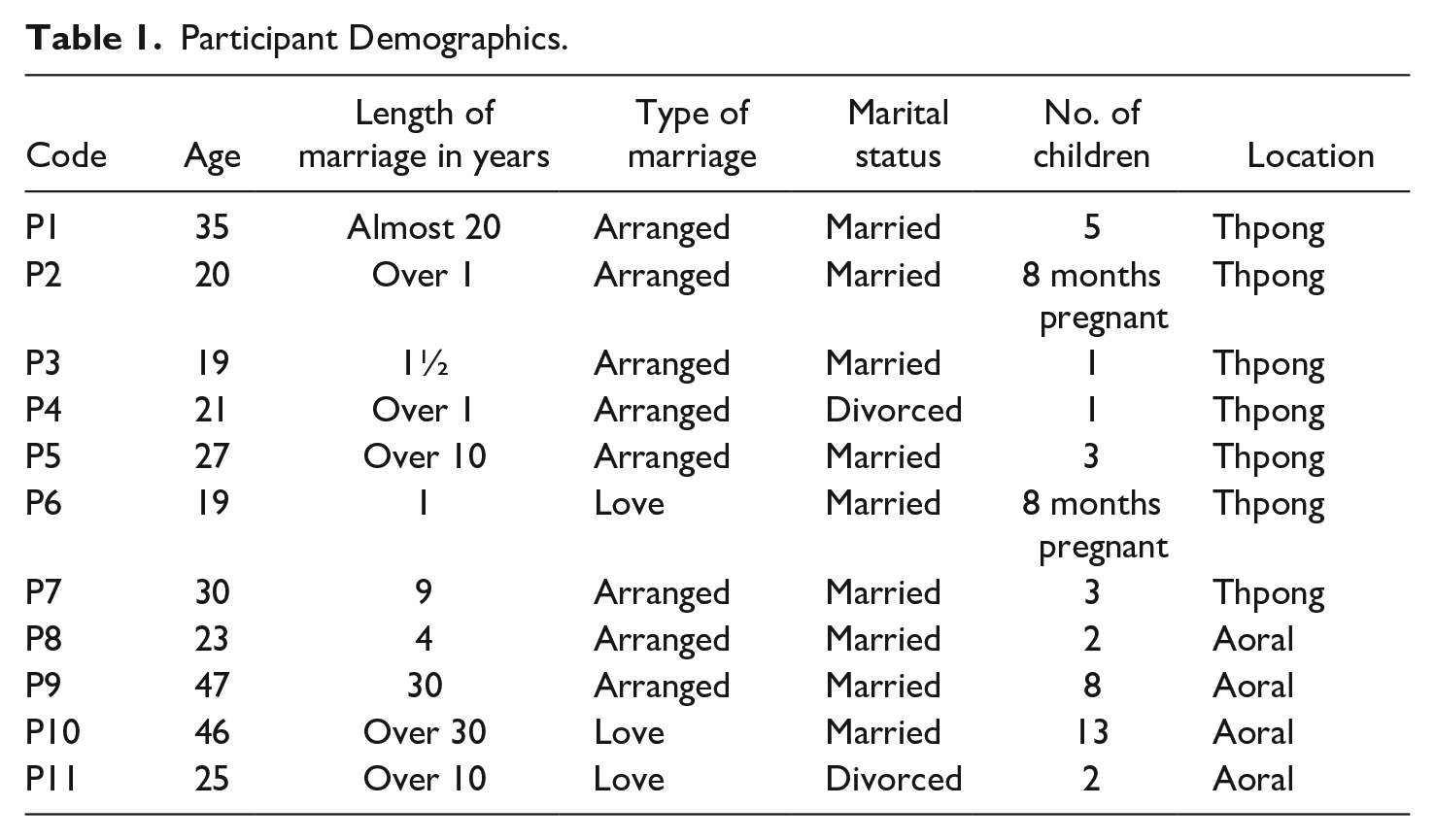
An exploratory qualitative approach was employed for this study. The study was restricted in terms of its funding parameters, with a limited amount of time reserved for fieldwork (30 days). Prior to conducting the fieldwork, ethical approval was sought and gained from Auckland University of Technology. Participants were recruited through snowballing and word-of-mouth, using village-based sexual and reproductive counselors (VSRCs) in the Aoral and Thpong districts, Kampong Speu. The VSRCs disseminated information about the research to their married women clients, who then spoke about the study to other women in their villages. We sought interviews with 10–15 women, in accordance with the project timeline, resources, and other parameters, and 11 participants matching the inclusion criteria were selected. These were married women over the age of 18 years, living in either Aoral or Thpong district, who contacted the researcher within the fieldwork time frame. While the number of participants is at the lower end of the recruitment goal, we were constrained by time and volunteers who matched the criteria. The 11 interviews, however, did provide a rich dataset for an exploratory qualitative project; the narratives were very similar in nature and included previously untold stories that are important to document. The women had been married between 1 and 30 years (with an average of 10 years). Only three women described having “love” marriages; the remainder were arranged by family. Two of the women were divorced at the time of the interview (citing years of rape and violence as the reason for seeking separation). The number of children the women had ranged from 8 months pregnant (two women) to 13 children (with an average of 3.6). Seven of the women were from Thpong and four from Aoral, and all had varying degrees of non-consensual sexual experiences (see Table 1).
Participant Demographics.
Semi-structured interviews were conducted by the second author, who is a Cambodian woman and a former senior counselor of sexual and reproductive health based in Aoral, Kampong Speu, Cambodia. The participants were asked questions about their marital life, home life, and their sexual relationship with their husbands (e.g., What is your role within the marriage/home? What is your husband’s role within the home/marriage? Is there a decision maker in the home? Did you have any sexual experience/knowledge before marriage? Who typically initiates sex? Have you ever initiated sex? How does the sexual contact unfold with your husband? Have you ever had sex when you did not desire it? Did you try to stop unwanted sex? How did that unfold?). The interviews were one-on-one and conducted in the Khmer language in the participants’ homes, or a relative/VSRC’s place of residence.
The interviews ranged between 40 and 91 min (averaging 55 min) and were digitally audio-recorded and transcribed verbatim. The data were analyzed thematically, using a data-driven or bottom-up approach (Braun & Clarke, 2006, 2012). The themes were derived both at a semantic level (looking at the content of what was explicitly said about sex and marriage) and the latent level (where the underlying norms, ideologies, or discourses that informed the semantic content were extracted via interpretive work on the part of the analysts). In using a critical realist perspective to guide the analysis (Gorski, 2013), the participants’ words were taken as representations of actual experiences and events that took place, and were also subjected to interpretive analysis by the authors, linking experiences with broader structural systems of power, oppression, and subjugation. The six general steps associated with thematic analysis were carried out, as outlined by Braun and Clarke (2006). These included becoming familiar with the data, generating initial codes, searching for themes, reviewing and refining themes, defining and naming themes, and producing the report. Both authors conducted independent analysis of the data before conferring and agreeing on the analysis provided below.
Results
The overall features of the data were striking in their uniformity. Most of the husbands were loggers or farmers, and the majority of the women were homemakers or farmed and sold food/goods in various markets. Five of the women depicted their husbands as helpful around the house, taking care of children and domestic duties, particularly if the women were sick. It was quite clear from the accounts, however, that the women’s domain was the domestic sphere (even if she worked for pay) and that the husband’s role was to earn money outside the home to support the family. Most big decisions were made jointly (e.g., buying machinery for farming), with women more likely to make smaller decisions on their own when related to food or domestic supplies. All but one woman still identified their husbands as the head of the household with the final say on the most important matters.
None of the women had any sexual knowledge or experience before getting married. Indeed, sex and sexual topics were taboo to discuss, before and also after marriage (even with husbands as well as other adults or family members). All but one articulated that their husband had engaged in sex before they were married. The consensus was that keeping pure for their future husband was important for unmarried women in Cambodia (see also Hoefinger, 2013; Tarr & Aggleton, 1999): Women like us were not allowed to have sexual relations when we were single. If a man marries a woman who has had sex with a man before marriage, he will be angry or have arguments with that wife. He can find out if she has purity or not when he has sex with her after marriage. Men need to marry a pure woman. (P4)
Some of the women were extremely nervous on their wedding night, not knowing what to expect in relation to how sex might unfold. A small number of the women who had arranged marriages successfully opted to wait until they got to know their husbands better before having sex with them (from 3 days–2 months).
All but one woman noted that their husbands were the sole sexual initiator. Husbands were referred to as having better knowledge and authority when it came to sexual matters. One woman noted that even though she had a desire for sex, she was too shy (and even ashamed) to initiate sex with her husband, even though he tried to normalize the practice: I have never been a sexual initiator because I am so shy . . . He commented after 5 years of marriage: “you have never been a sexual initiator.” I responded that no woman is a sexual initiator, only men. He replied that nowadays there are many women who are sexual initiators. I responded that it is impossible for me to do that. . . . I confess with you that sometimes I also have sexual feelings, but I do not dare to show it. I use token resistance. . . . It is my strategy as being a wife. I pretend that I never had sexual feelings or want sex in advance. (P5)
Only one woman noted that she initiated sex and that this should not be seen as a problem in marriage:
What do you think if a wife is the sexual initiator?
I think it is okay. When I have sexual feeling and want sex, I tell my husband. It should be fine for a marital life [if the man or woman is the sexual initiator]. We do not feel shy with each other.
The average amount of sex the women had within marriage was relatively high—usually daily and sometimes 2–3 times a week (with one woman saying her husband only wanted sex about once a month). The women reported not having sex when they were sick, menstruating, very tired, at various stages of pregnancy, or soon after giving birth. Two women described their husband as having a high/aggressive sexual appetite and demanding—and getting—sex everyday of their marriage (no matter what the physical or psychological state of the women, discussed below). Other men were depicted as much more tender and respectful in times where sex was seen as “reasonably” off-limits. What was very clear from the interviews, however, was that a woman’s assertion that she simply did not feel like having sex was not adequate justification. There had to be a tangible emotional or physical reason she could not have sex (as noted above). In this way, the women’s sexual desire was not only absent or arbitrary, but secondary to her wifely duty of providing sex to her husband, if or when he desired.
The men often controlled contraceptive practices, severely hindering the women’s autonomy over reproductive choices. Some men did not allow their wives to use the contraceptive pill (or any method of birth control), leading to a high number of unplanned pregnancies, for example: My husband decided to use a natural contraceptive method, but it was not able to prevent me from getting pregnant. . . . My husband does not allow me to use other kinds of contraceptives like contraceptive pills because he is afraid of destroying my health. He believes that if I use a contraceptive pill, I will not be able to get pregnant after stopping it. . . . I trusted the contraceptive pill much more than the natural method. But because of my husband’s decision, I followed him. (P2)
Other men dictated the type of birth control their wives should use, with one man deceptively luring his wife to a clinic so that she could get fitted for an intrauterine device (IUD). A few of the women had received the contraceptive injection, without telling their husbands. What was clear from the accounts was that direct and open communication about sex, sexual health, and sexual matters was uncommon, and that the men typically had the final say in contraceptive matters (with a couple of exceptions).
Non-Consensual Sex
All participants experienced some form of unwanted sex within marriage. We identified four categories or themes of non-consensual sex. Two were overtly identified as problematic by the women: forced sex (rape, sexual assault, violence used to induce sexual compliance) and sexual coercion (verbal pressure, psychological manipulation, verbal threats). The other two were more subtle, normalized, and not always identified as problematic—instances of what we call “constrained” consensual sex. These were sexual compliance (going along with sex, in the absence of sexual desire, with awareness) and internalized pressure (going along with sex to fulfill wifely duties, in the absence of sexual desire, as bounded by social and cultural gendered norms, without any critical awareness).
The women’s accounts of marital life and sex within marriage were directly intertwined with the traditional Cambodian cultural norms around gender and sexuality (as discussed above), but also offered moments of resistance and counternarratives to rule. Below, we provide exemplary quotes for each category, starting from the most subtle to the most extreme. We then outline the women’s protective and resistance strategies, as shared within the interviews.
Internalized Pressure
The participants had a strong sense of needing to fulfill their wifely duties in relation to sexual matters, driven by their own beliefs and cultural customs, which encouraged them to have sex with their husbands based on his desires. Most reported automatically going along with sex whenever a husband indicated an interest, even if he would typically respect her refusals:
Have you ever had sex with your husband when you did not want to?
Yes, I have.
Why?
Because I felt pity for him.
Did he use any strategies to make you have sex with him?
No, he has never done that. Whenever I said No, he respected my wishes . . . he does not have sex with me so often as well. He has sex with me one or two times per week . . . so I did not reject his sexual requests. If I reject his request, he will not have sex with me.
Others were compliant out of an unspoken fear of possible negative repercussions:
How does your husband express that he wants to have sex with you?
He lays near me and touches me . . . he caresses my body.
When he does that, how do you respond to him?
I do not say anything besides having sex with him . . . it is normal for being female and being male. I cannot reject him. Whenever he wants sex, he has to fulfill his sexual desire. . . . If I don’t follow him, there might be problems. . . . I never reject his request at all. Whenever he wants sex, I always follow him, so that there is not a problem occurring in our family relating to this matter.
Underlying these accounts was a gendered ideology of sexuality, where men were seen as naturally sex-needy and sex-driven, without the capacity to control their sexual urges:
To sum up (in that instance) although you rejected his sexual proposal, he did not listen or respect your idea?
Of course not. Men being men, whenever they want to have sex, no one can stop them. . . . Men cannot control their sexual desire. Whenever he wants sex, he has to get it, unlike women who can control their sexual desire.
An uncontrollable male sexuality was contrasted with a much more contained and controllable female sexuality. Alongside this diffuse internalized pressure, the women describe many scenarios of simply submitting to sex, even if they did not desire sex—what we call sexual compliance.
Sexual Compliance
When it came to sexual compliance, the women were more consciously aware of the social or relational pressure to have sex in marriage:
You did not know how to have sex, so what happened when you first had sex with your husband?
Let him do whatever he wanted, and I learned from his sexual behavior. I did not marry by love, but I respected and followed my parents’ decision. If I did not allow him to have sex with me, I would have to pay back the dowry and my family would be so embarrassed. I had to have a high level of tolerance to keep this relationship going.
Other times, sexual compliance was borne out of the fear of being misjudged as unfaithful or fearing a husband’s “rejection reaction” (see Pond & Farvid, 2017): P6: I do not want to have an argument (due to sexual matters) while living together. I could not bear to reject his (sexual) requests because I did not want him to think that I might have had someone else (an affair). I was afraid that he might have lost confidence or trust in me. He might have wondered why I suddenly reject him. He might suspect that I have had sex with another man. . . . My husband becomes easily jealous about me (and the possibility of) being with other men.
One woman successfully set limits on how much sex she would have with her husband but also felt obliged to be sexually available if he had spent time working away from home: I rarely rejected his sexual requests. If he wanted sex every day, I sometimes rejected him because it is so often. Luckily, he rarely stays at home because he has to do logging. He stays at home only two nights and stays in the forest three nights. My husband is not a difficult person when it comes to not having sex. He can understand and not have sex with me when I told him I got sick or was menstruating . . . but, when he is just back from the forest and wants to have sex with me, I cannot reject him. I think he did not have sex for many days during logging, so I have to follow him. He is getting exhausted from his work outside or logging in a forest while I am staying at home without exhaustion, so there is no reason to reject him. (P8)
Some of the women were afraid to refuse sex within marriage. One woman described how it took her many years and multiple children before she did so: I was brave enough to reject his sexual requests after I had 6 or 7 children. Before that I did not refuse him. . . . I was afraid that he might have been disappointed with me and found another girl or divorced me. If he had another girl, I would face big trouble because I would have to take care of my children alone. However, my husband has never had another girl. (P9)
Many of the women’s accounts fell somewhere between internalized pressure and sexual compliance:
Have you ever had sex with your husband, at his request, when you did not want to?
Yes, sometimes. I felt pity for my husband because he did not have sex with me for several days. Having sex with me is not like other women. In the beginning of our marital life, we had sex normally like others, but then I got a prolapsed uterus, so we had sex very few times. He cannot insert his whole penis into my vagina. . . . I wish I can fulfill his sexual desire. Due to feeling pity for him, I do not care much about my own well-being. I had sex with him even though it hurt my vagina or caused bleeding.
In the extract above, the woman tells a story of willingly enduring pain and vaginal bleeding to meet the sexual needs of her husband and almost positioning herself as lacking in some way (as a wife and woman), because of her prolapsed uterus.
Sexual Coercion
When it came to accounts of sexual coercion, the women told stories that involved verbal pressure, manipulation, and the different ways in which their husband’s drinking could be part of unwanted sex. In the extract below, repeated verbal requests are part of the coercive tactic:
Have you ever experienced having unwanted sex with your husband?
Yes, I experienced one time. I let him do whatever he wanted. I told him that I did not want to have sex with him tonight, but he repeatedly asked for it. I did not have such sexual feeling at all. I had sex due to his repeated requests. After having that sex, I felt annoyed with him and I did not get sexual orgasm. Moreover, my vagina was in pain because it was dry sex.
What is striking about the above account is the woman’s assertion that she was irritated with her husband for pressuring her into sex. This is not only because of the physical pain but also due to not reaching orgasm (unlike him). Such an articulation of a right to sexual pleasure has rarely been documented when it comes to female sexuality, particularly in rural Cambodia, and signals some possible fissures in traditional codes of sexual conduct.
Some women talked about how it was hard to refuse sex even if they had gynecological issues that led to uncomfortable or painful sex: I told my husband: “Dear, I don’t get sexual excitement, but pain and itchiness when having sex with you.” He replied he does not ask to have sex with me that often, so why should I reject him? He tries to get his sexual orgasm as fast as he can, and then he sleeps. He has sex with me once per week. . . . If I reject him often, he might get mad with me because he only asked to have sex once per week. He could accuse me of having an affair. Moreover, I feel pity for my husband, because he works outside every day in order to earn money. He just asks to have sex one per week, why should I reject him? (P7)
There are two narratives of overlapping or non-consensual sex unfolding above. One is the husband’s refusal to accept “no” to painful sex, insisting that sexual infrequentcy (sex once a week here) entitles him to sex. The other layer is the woman’s own internalization of the pressure to have sex. This is mobilized by a concern of being met with anger if she continues to reject him for sex, or that he might accuse her of infidelity. In addition, the husband is positioned as entitled to sex at least once a week because of the hard work he does to support his family; she cannot possibly reasonably refuse him the sex he is ostensibly “owed” in the marriage contract.
One woman talked about her loss of desire for having sex as she aged:
I seem not to have any sexual feeling [desire] anymore. I get sick of having sex with him. . . . Although I’m sick of having sex with him, I have no choice. I have to follow his sexual desires.
Did you tell your husband about that feeling?
Yes, I did. I told him that I have lost my sexual feeling [desire]. He replied that now I have changed and become strange. He accused me of having an affair. I replied we are old now and can stop having sex. Sometimes he still has sex with me.
In this instance, the husband refuses to accept her proposal to stop having sex, instead using verbal coercion (calling her strange, accusations of infidelity) and continuing to have sex with her. Indeed, across most interviews, being accused of extramarital sex was a strategy often used by men to procure sex. Previous research has indicated that a woman’s infidelity is extremely shameful and unforgivable (Thapa et al., 2020; Yang et al., 2016), and it seems that the women’s husbands knowingly used this as a strategy to manipulate their wives into having sex.
Alcohol consumption also underpinned narratives of sexual coercion. In Cambodia, intoxicated individuals are viewed as more likely to lose self-control or engage in “wrongdoing”, for which they do not necessarily take full responsibility (Brickell & Garrett, 2015). Some participants noted that when drunk, their husbands showed less care toward their feelings, and that coercive sex was much worse when their husbands were intoxicated:
What makes you feel satisfied or unsatisfied in your sexual relations?
I get satisfied with my husband when he listens to me. When I say I don’t want to have sex, he does not force me. However, I do not like when he gets drunk, then he doesn’t listen to me at all. I did not reject him when I saw he is drunk. I followed him and let him fulfill his sexual desire as fast as possible. . . . Having sex with him when he is drunk is more difficult because he has sex for longer and it is a bit painful. . . . I used to tell him that when he gets drunk, he should sleep and not want sex with me. I said he should only have sex with me when he is sober. He would agree. However, whenever he gets drunk, he forgets.
The women very much disliked their husbands’ alcohol-induced sexual coercion. Women believed that their husbands used alcohol as a form of manipulation to engage in inappropriate sexual behavior such as “hand sex” or “oral sex,” which is considered uncommon and unacceptable in Cambodian culture (Rammage, 2002).
A few of the women described scenarios where both sexual coercion and forced sex were present:
When he wanted to have sex with you, but you did not want to, what happened to make you have sex with him?
His behavior was like he was going to rape me. When I pushed him out, he pushed in. Although I had sex with him, he still used his hands to arouse me. If I did not allow him to have sex with me, he got really mad and created many arguments in the next morning. He said that “You are this or that. Fuck you. You only admire other husbands. I will not work or earn money if you don’t have sex with me. I work hard to earn money for you and the children. If you do not allow me to have sex with you, I will not work anymore. It is useless.”
Verbal abuse, threats, and coercive tactics, along with forced sex, were strategies that this particular husband used to procure sex. A smaller number of women provided accounts of forced sex that were much more severe.
Rape and Forced Sex
In some of the narratives, there were stark descriptions of forced sex and rape. In the extract below, the woman talked about the times she disliked sex with her husband—when he drank and rushed or forced sex: I dislike him when he gets drunk, and I do not want to be near him. When having sex, if he’s drunk, he did not start with the normal sexual behavior, but he inserted his penis immediately into my vaginal channel. He had fast sex and forced sex, so I did not get sexual satisfaction (orgasm). (P9)
This participant subtly implies that when her husband is drunk, there is no “foreplay” (or pre-intercourse activities designed to arouse her), something that is part of sex when he is sober. This fast and forced sex is described as incredibly unsatisfying, although not necessarily identified as forced sex or rape.
Another woman described the differences between sex she desires and rape by her husband:
Has he ever forced you to have sex with him, when you did not want to?
Yes, he has. I could not reject him when he really wanted to have sex with me. He was angry with me and interrupted my sleeping. He lied physically close to me, hugged me, and caressed me, so I followed him. Sometimes I did not follow him, so we were angry at each other, and there were verbal arguments. . . . There are differences between having sex when I want and when I don’t want. When I had sex when I wanted, it was fine. However, when I had sex when I did not want, he could have sex only with my physically, but I did not get sexual satisfaction in my feelings. He got an orgasm, while I did not.
What is striking in the two extracts above is that the women do not identify the instances of forced sex as rape. They position them as physically or emotionally unsatisfying, and thus as incomplete or unfair sexual exchanges (again, highlighting the lack of orgasm). One woman who had a particularly sexually demanding husband talked about how she felt throughout their marriage when he would ignore her sexual refusals:
How did you feel about his behavior?
I felt hurt, inferior, and angry with him. When he did not listen to my sexual decisions, I wanted to divorce him at that time. I felt I was worthless and not important for him at all, and he was the only important person that I had to listen to and follow. Sometimes I felt he married me only for his sexual entertainment. In the beginning of my marital life, he had sex with me every night, so I rejected his sexual requests. Then there were verbal arguments with him. . . . There were arguments between him and me because when I rejected him gently, he did not listen or follow. Sometimes we nearly had physical violence. I tried my best to hide this problem from neighbors because it was so embarrassing.
This participant was one of the few women that persisted with sexual refusals in marriage. Here, the husband is not positioned as someone who has the right to have sex with his wife whenever he desires. The woman’s narrative subtly invokes the desire for sexual reciprocity and equality in marriage and the difficulty in achieving this. Her persistence with sexual refusals is said to create verbal and physical conflict. It is hard to know if such conflict would have ensued with those women who willingly submitted to sex to avoid conflict, something that cannot be ruled out.
One woman, who was much younger than her husband, described harrowing experiences of rape within her marriage: I have 13 children, but there are 9 children living . . . he had sex with me immediately after I gave a birth. . . . After I gave birth, it was very painful because my cervix was torn widely. I still had to have painful sex with my husband. I could not do anything besides crying, staying quiet and suffering. I think he is a sex-obsessed man, because I have never stayed free of sex for a day. He has sex with me every day, even when pregnant, giving birth, or after birth. Although he has sex with me every day, he still has another girl. This problem in my family is a private one that I have never told anyone. I have had cervical problems, with it getting infected. . . . I was told that I should not have sex for the three months of treatment. However, I could not stop him having sex with me. He did not listen to me or the doctor’s suggestion. When I got very severe pain in my vagina, there was violence between him and me. I feel pain when peeing. The most painful one is when I do heavy tasks. I told him about this, but he did not believe in me at all. He accused me of having an affair, of not caring about his desire, and as having too many illnesses. He would say, if he knew I was going to be like this, he would not have married me. (P10)
In the above extract, we can see the convergence of various forms of verbal sexual coercion alongside marital rape in a context where the husband appears to be particularly ruthless. Despite such experiences of brutality, this participant still had never sought any social or legal support, positing the issues as “private” and requiring discretion. Indeed, the couple were still married at the time of the interview.
Another woman also described rape within her marriage; when she refused to have sex with her husband, violence would ensue: When he was in a good mood, he asked and requested for sex so politely with me. When he was in a bad mood, he had sex with me without asking. When I agreed with him, it was fine, but when I did not agree, he used violence, hitting and kicking me, and forcing me to have sex with him. . . . Sometimes when I seriously rejected him, he got mad not only with me but also with the children. He fought and kicked the children. He had to have sex with me by raping me. . . . One night, he had sex with me the whole night. Although his penis was not erect, he tried to do sexual behaviors on me the whole night. . . . I had no choice. I had to let it be, and I cried. It felt really difficult, because my vagina was burnt, itchy, and painful. I lived with physical, mental, and sexual problems [because of this]. (P11)
All forms of non-consensual sex took their toll on the women. The more aware of their engagement in unwanted sex, and the more forced the sex was in marriage, the more profound the negative outcomes. These ranged from physical discomfort, pain and injury (during and after sex), emotional anguish, and psychological problems. None of the women talked to anyone about the rape and sexual coercion they experienced. It was perceived as too shameful to do so. Nevertheless, they did implement some protective strategies to avoid unwanted sex.
Protective Strategies
The women’s protective strategies were typically implemented when they could no longer tolerate unwanted sex. Some women reported requesting that their husband have sex with other women, but none of the men agreed to this (except for the one husband who already had another girlfriend, which did not stop him raping his wife): It was getting difficult to have sex with him, so I requested he get another girl in order to fulfill his sexual desire. I cannot meet his needs. Men really need it (sex). If I don’t allow him to have sex with me, our relationship will be broken, or we have to divorce. (P7)
In such scenarios, the woman’s capacity to govern her sexuality, her sexual desire, or the right to sexual satisfaction were not seen as necessary (or a right) by the women (or the men). The women typically used more covert strategies such as staying at a neighbor’s house until a husband had fallen asleep, or changing sleeping arrangements in the home, for example: Sometimes I told him to sleep first because I had to stay with my children until they fell asleep. Sometimes while he was sleeping with children, I told him to sleep with them and take care of them. While we slept separately, we cannot have sex. (P1)
A vast majority of rural Cambodians live in uxorilocal residences after marriage (wooden Khmer-style houses with the wife’s extended family consisting of grandparents, parents, siblings, and their own children). Therefore, some participants used the presence of family members to avoid having coercive sex, by sleeping near other family members if they could. In such cases, the women felt safer and had greater success rejecting their husband’s sexual advances. The women reported that husbands usually did not exhibit their sexually coercive or violent tactics in front of other family members, because they did not want others to know that they pressured their wives into sex.
The women reported feeling isolated when it came to issues of rape and sexual coercion. They did not think other women were experiencing such situations and found it difficult to talk to family members about what they were going through or to get other forms of support. Even when a situation became too extreme or unbearable, a few participants turned to their family for help, but this never led to any behavior change on the part of the husband. Indeed, most of the women’s parents did not intervene. They encouraged the couple to work it out between them and for the woman to submit to sex and to live in harmony by whatever means, even if it came at a great personal cost to the women. Financial pressure meant that not losing the wife’s dowry or the husband to divorce were very important for the extended family (Yount & Carrera, 2006).
Discussion
The women’s experiences of non-consensual sex in rural Cambodia were situated within the complex social, cultural, and economic context of the region (Whittaker, 2002), which produced an unequal system of sexuality in marriage. In line with recent work, we also emphasize how important it is to consider power as it relates to gender, culture, sex, and sexuality in this context (Nishigaya, 2010). The divergent roles and expectations of husbands and wives were also a factor (see also Yang et al., 2016). Men were positioned as sex-needy and sex-driven, with an uncontrollable sexual desire that required an outlet, particularly once aroused (see also Gavey, 2019; Hollway, 1989). In contrast, women were not seen as sexually desirous and were responsible for the sexual upkeep of the husband. The expectation of being a “good” wife and maintaining family harmony created a context primed for the sexual coercion of women within marriage. The women interviewed knew very little about sex and sexuality before getting married. Most (but not all) did not know how to fully recognize their own bodily sexual desire or express their sexual needs and, sometimes, sexual limits. Even when they did so, it was not always received well or respected by their husbands. The women were not autonomous sexual agents and were not afforded full capacity to govern their bodies when it came to sexual decision making (desire, consent, family planning, and birth control).
Our analysis identified varying forms of non-consensual sex within the women’s narratives: internalized pressure, sexual compliance, sexual coercion, and rape. We theorize that internalized pressure, while not the most violent, was the most insidious form of non-consensual sex, because it involved an invisibilized form of physical and psychological colonization of the women’s body and mind. In this scenario, the women have internalized a specific version of womanhood and (gendered) sexuality, willingly submitting to their own subjugation, without necessarily knowing that they are doing so (Gill, 2009). With sexual compliance, the women displayed awareness that they were going along with unwanted sex for various reasons. And sexual coercion and rape were identified as manipulation (former) and violence (latter). Although all four of these forms of non-consensual sex stem from the same system of gendered sexuality, we argue that the core beliefs that inform internalized pressure need the most immediate education and action.
Other research has also examined internalized pressure and sexual compliance when it comes to unwanted sex (French & Neville, 2017; Glenn & Byers, 2009). Akin to our findings, the women also went along with unwanted sex due to a sense of duty or pity, not wanting to see their husbands upset and wanting to avoid negative consequences stemming from such rejection.
Sexual obedience has previously been identified as a major component of wifely duties, where participating in unwanted sex was seen as a normal fate of Cambodian women (Yang et al., 2016). Our study partly challenges this finding. Indeed, it was hopeful to see that some of the women we interviewed engaged in the following: identifying a physical desire for sex, articulating that desire to their husband, refusing sex when they did not have sexual desire (whether or not successful), identifying sex that did not involve sexual pleasure for them as lacking and unfair, identifying sex that was just based on their husband’s sexual desire as problematic, and challenging their husband’s sexually coercive and aggressive behavior directly. These counternarratives have not been documented in research with regard to rural Cambodian women’s sexuality and require further investigation. In addition, we heard a few narratives of husband and wife relationships that were more egalitarian in their partnership. Hence, it is plausible to suggest that some of the traditional gender and sexual mores associated with Cambodian culture may be very slowly shifting (Dowsett et al., 1998; Nishigaya, 2010). Such a shift may be accelerated with targeted educational efforts.
Our study also identified a sexual double standard associated with women’s and men’s acquisition of knowledge and communication about sex, which has also been reported by others (Curtin et al., 2011; Levin et al., 2012). According to Curtin and colleagues (2011), there is a strong association between traditional femininity, women’s lack of sexual knowledge, and women’s sexual passivity. These findings were supported here and draw attention to the need to dismantle traditional sex and gender roles within the Cambodian context (and at large), in favor of egalitarian approaches to sexual relating—and one that ideally involves the sexual education of women.
Similar to previous research, we also identified a link between non-consensual sex (particularly coerced and forced sex) and negative physical, sexual, and psychological health outcomes (Campbell et al., 2006; de Visser et al., 2007; Elklit & Christiansen, 2010; Jozkowski & Sanders, 2012; Katz & Tirone, 2010). The women in our study experienced “dry sex” leading to sexual pain, vaginal bruising, and vaginal bleeding. Many participants suffered negative emotional outcomes such as severe emotional distress and unhappiness. The women also reported a loss of sexual desire and satisfaction as a result of engaging in unwanted sex (Glenn & Byers, 2009; Katz & Myhr, 2008).
The women’s protective strategies included creating barriers between themselves and their husbands. Coping strategies that are commonly identified in intimate relationships include such avoidant coping strategies (Cortina & Wasti, 2005). Flight strategies include suggesting that coercive husbands have sex with another woman, managing sleeping arrangements, and requesting family intervention. Strategies reported in other research include ignorance, avoidance, seeking social support, and seeking institutional relief (Cortina & Wasti, 2005; Fitzgerald et al., 1995). The participants in the current study were more likely to employ flight strategies to cope with their coercive husbands. Shepherd-McMullen and colleagues (2015) suggested that women who live with psychological abuse in intimate partner violence are more likely to use avoidant coping strategies. They attempt to distance themselves from the problem rather than confronting it directly (Shepherd-McMullen et al., 2015; Taft et al., 2007). Extended family rarely intervened, the authorities were never involved, and no charges were pressed against the men.
Recommendations, Limitations, and Future Research
These findings indicate that non-consensual sexual coercion within marriage in rural Cambodia is strongly intertwined with the cultural and gender norms that lead to gender inequality. The overall gender and sexual systems of Cambodia need challenging through education, grassroots campaigning, and further government policies. The Ministry of Education, Youth, and Sport (MoEYS) in Cambodia has recently taken a big step toward improving sexuality education within schools and promoting concepts of gender equality to young people. This is done through integrating comprehensive sexual education in the school curriculum of Life Skills education programming, from upper primary school (Grade 4) until high school (Grade 12) (United Nations Population Fund, 2016). This curriculum is using a rights-based approach and was implemented nationwide in 2019. Issues with this approach still remain. Teachers continue to hold conservative or traditional sexual views and lack gender sensitivity training, which could mean that the program is less likely to be successful. Without comprehensive teacher training on such matters school students may not be able to fully benefit from this type of sexuality education. One recommendation is that MoEYS includes gender sensitivity curricula in the existing teacher training program and provides ongoing upskilling for teachers to curb problematic views on gender, identity, and sexuality.
In the community setting, the Royal Government of Cambodia (RGC) has adopted the national Positive Parenting Strategy (2017–2021) to prevent and reduce gender inequality and violence against children (MoWA, 2014). The main implementers of this strategy are at the sub-national level or grassroots level and led by the Community Committee for Women and Children. Currently, this strategy is rolled out in very few Cambodian provinces due to national budget and human resource constraints. Greater accountability by the RGC is needed to address this issue.
While our work provided important insights into the nature of gender-based violence in rural Cambodia, the study nevertheless has several limitations. The primary limitations stem from the small convenience sample necessitated by the time and funding parameters of the study. The study was exploratory and provided access to women whose voices and experiences have not been included in previous violence against women research. Future studies, however, should seek to recruit a larger and perhaps more diverse sample of Cambodian women to examine in greater detail how traditional gender and sexual scripts shape unequal power relations and sexual violence in Cambodia. The sexual experiences of urban women as well as young women who are still in high school should be investigated to see how they align with what has been identified here. One immediate need is research which examines men’s perspectives, to use such insights to foster education and social change when it comes to understanding sexual roles and sexual negotiation between men and women. Men’s use of alcohol as a buffer for justifying sexual abuse also needs to be addressed.
Conclusion
The findings of this article indicate that married women’s experiences of unwanted sex in rural Cambodia were situated within a larger ecological system of inequality and gendered sexuality. Internalized sexual scripts that reflected such cultural norms created a context ripe for women to experience non-consensual sex of varying degrees of severity. Any form of unwanted sexual contact a woman endures is a form of gender-based violence, which is a human rights infringement. To challenge and disrupt non-consensual sex in the Cambodian context, great work lies ahead. First and foremost, the dismantling of the gendered sexual system that expects vastly different behavior from men and women is the top priority. Progressive education around gender and sexual matters is urgently needed, with appropriately trained educators. Men require education focused on consent and respect, while women would benefit from education emphasizing the importance of sexual autonomy. Such an approach will be difficult in the traditional and patriarchal context of Cambodia, and grassroots approaches might offer the best way forward. While the RGC is making strides in the area of sexuality education, directed education focused on sexual violence prevention is needed. Such educational efforts need to directly address sexual coercion, which is a hidden yet highly damaging mode of gender-based violence that continues to affect women in Cambodia.
Footnotes
Acknowledgements
We would like to thank the participants who took part in this research.
Declaration of Conflicting Interests
The author(s) declared no potential conflicts of interest with respect to the research, authorship, and/or publication of this article.
Funding
The author(s) disclosed receipt of the following financial support for the research, authorship, and/or publication of this article: This project was supported by the New Zealand Government, through a Ministry of Foreign Affairs and Trade Scholarship.
