




Abstract
Amid growing consensus that violence against women is structurally produced, neoliberalism produces an individualist understanding of violence that blames women while simultaneously framing it as personal failings of men, obscuring the link between the structural and the personal. Using examples from federal grant funding opportunities in the United States, activism in Bangladesh, and data from qualitative research, I analyze how such individual readings of violence get produced–reproduced. I call for radical responsibility to produce equitable and just research that serves the communities that we study, not just the interests of grant funders and the neoliberal university.
Transnational and Black feminists have been saying for decades now: Interpersonal violence is structurally produced (Chowdhury, 2015; Davis, 2000; Grewal, 2013; Siddiqi, 2003). The interlocking systems of patriarchy and heteropatriarchy, capitalism, classism, colonialism, and global racism are “reconstitutive” (to use the term Crenshaw used on Twitter to explain intersectionality), structuring personal lives (often) by the use of violence or threat of violence (Collins, 1990, 1993). Yet, too often, interpersonal violence, particularly of the sexual kind, is understood as acts of “monsters” who take advantage of women that they have power over—minimizing what the #metoo movement has revealed: that sexual violence is deeply pervasive and affect individuals across race, class, gender, sexuality barriers. Indeed, a large body of scholarship views violence as (only) individual enactments and experiences of oppression, which can ostensibly be “fixed” by treating the individuals involved. In this article, I discuss the confluence of reasons for which the link between the structural and personal is continually at risk of getting obscured in favor of an individualist reading of interpersonal violence.
Let me begin with what I see as a cautionary warning from Laina Bay-Cheng (2019, p. 465) about the construction of victimhood versus agency: “Sexuality researchers often register behaviors as “agentic” only when they are readily recognizable acts of self-interest (e.g., insisting on condom use) and self-expression (e.g., initiating a desired interaction, refusing an undesired one).” This means those who are “pathetically under the control of others or shamefully out of control of themselves” are seen as victims (Bay-Cheng, 2019, p. 465). Further, Bay-Cheng argues, these constructions are racialized in that Black girls are more readily seen as victims than White girls, making them perfect recipients of civilizing state interventions that become modes of control. This warning must be heeded by those of us who research women's subjugation in intimate relationships. Most researchers of violence in intimate spaces focus on women's victimhood, drawing attention to the very many ways that women's lives are worsened when they experience violence, as they suggest legal, therapeutic, behavioral, educational, and literacy-based interventions to "empower" them individually and through the courts and the criminal justice system. That the criminal justice system is another location of violence (i.e., racist, sexist, classist, and ableist) is sidelined in favor of the idea that the criminal justice system provides safety because it makes people feel secure, even when it does little to reduce either violence or the harm that violence produces (Kaba, 2021). It is then women who participate in these interventions, for example, by seeking help from social services, medical professionals, and law enforcement, who are seen as agentic, while those who do not are constructed as victims. That there is variation in Black, Indigenous, and other women of color seeking help from formal sources means racially minoritized women fall into the trap of being constructed as victims (Satyen et al., 2019). Meanwhile, it is those who are agentic who are refashioned as resilient, which Park and colleagues critique as a “designation for risky subjects’ capacity to accommodate—not actively change—their social/political environments” (Park et al., 2020, p. 152). In other words, framing individuals as resilient justifies the neglect and oversight of the material and social conditions that predispose individuals to violence in favor of interventions that are targeted at individuals, not the conditions that produce violence. Bay-Cheng's warning must alert us to how the construction of victimhood is discursively used to justify interventions that are modes of control, most often by the masculinist arm of the State—the criminal justice system.
In this article, I call for a need to move away from an individual reading of violence that blames women and views violence as personal failings of men because that individual reading enables interventions that target individuals, not systems. For instance, the prison industrial complex that incarcerates individual men for violating women does not change the culture of violence that makes violence an everyday experience, particularly for minoritized populations. We need to dismantle systems that produce and then implicate individuals in violence. We need to abolish the prison industrial complex for a “vision of a restructured society in a world where we have everything we need: food, shelter, education, health, art, beauty, clean water, and more things that are foundational to our personal and community safety” (Kaba, 2021, p. 2).
I address the question “why do we see interpersonal violence as an individual problem?” through a discussion of the obfuscation of the link between the structural and the personal. First, I provide a brief overview of the literature that demonstrates the structural production of violence. Second, I discuss the impetus behind the focus on individuals. Third, I present how the neoliberal university becomes part of the problem. Fourth, I show how activists become complicit in producing an individual-focused narrative as they operate within the larger context of neoliberalism and NGOization in Bangladesh. Then, I turn to a discussion of how intimate and sexual violence is understood in the context of Bangladesh to show that the spectacularization of violence inspires mobilization to support a particular kind of (spectacular) victim. Finally, I conclude with a vision for taking radical responsibility toward the communities we study. The analyses provided are based on content analyses of RFPs by the NIG, an artwork by indigenous artist Tufan shared on social media by NGO-based activists in Bangladesh, and insights from qualitative interviews with Bangladeshi women who have experienced violence at various points in their lives. A comparison between the United States and Bangladesh, two countries at different stages of neoliberalism and development, allows for an explication of the tendency to view violence as an individual problem across the globe. The individual reading of violence in seemingly disparate locations is a reminder that neoliberal ideology has become hegemonic while underscoring that we operate in a global village that tends toward World Bank-esque “one-glove-fits-all” type policies and interventions (LeBlanc et al., 2019).
Structural Production of Violence
Scholar activists such as Kimberlé Crenshaw have shown how race, gender, class, and other social locations intersect to create unique experiences of oppression for minoritized groups (Crenshaw, 1991). Her work documents that violence against women is not homogeneous, and it is not class and race-neutral, highlighting that the systems of capitalism and racism engender the many forms of violence that women experience in all locations: in private, in public, and in between, primarily by men. Researchers further suggest that structural factors are critical to creating and deepening, and maintaining violence in the institutions of home, school, work, and public space (Klein, 2006; Murshid, 2020; Winter & Barchi, 2016). As Paul Farmer (1996, p. 261) writes, social forces “translate into personal disease and distress” as “embodied” individual experiences. Such formulations have since broadened our conception of violence to include the various forms of erasure that Black, Indigenous and other people of color experience, including the erasure of their cultural practices; environmental racism; medical racism; and extractive practices such as predatory lending; lack of access to health care; and new forms of segregation that keep certain neighborhoods resource-poor; and relatedly, education a location of inequity (Smith, 2015; Sohoni & Saporito, 2009; Taylor, 2019).
Meanwhile, certain forms of violence, such as partner violence, occur across class lines (Slabbert, 2017). Indeed, poverty and socioeconomics should not be seen as deterministic; it is not that the poorest of the poor are at the highest odds of experiencing partner violence (Kiss et al., 2012). However, that class oppression intersects with (hetero)sexism and other forms of discrimination to produce and maintain partner violence, such as through discriminatory housing and employment practices, prevent women from accessing help-seeking resources (Calton et al., 2016).
As legible as the structural producers of violence are, much of the intervention in this domain is at the individual level. Those who experience violence are met with individualized treatments that are often disempowering (McDermott & Garofalo, 2004). In particular, redress happens through the medicalization of violence and/or via the criminal justice system and the courts--for example, batterers programs, incarceration, therapy (Bird, 2018; Cheng et al., 2019; Morrison et al., 2021; Zarling et al., 2019). However, global racist and sexist practices of the criminal justice system make any involvement with law enforcement another risk factor for experiencing violence, particularly for minoritized groups, including dual arrest, victim blaming, disparities in sentencing laws, and death in custody of Indigenous and Black individuals, which in turn is medicalized, for example, using refrains of “timely death” due to health disparities that are (again) blamed on individuals (Cunneen, 2006; Decker et al., 2019; Miller, 2001; Razack, 2013). Such forms of state-sponsored violence are, then, at odds with their own goal of addressing the problem of violent crimes, while the criminal justice system remains the only existing system of “help” to which individuals experiencing violence can avail themselves in most countries (Hart, 1993; Hoyle & Sanders, 2000).
Meanwhile, state violence against those who are coded as criminals, or as having potential for criminality, is justified by the dehumanization of those who commit crimes, which then makes risk management, protection, and surveillance justified amid a culture of fear of violence (Adedoyin et al., 2019; Alang et al., 2017). These technologies of the security state promise safety in exchange for freedoms, in the same way that real or perceived threat of terrorism garner consent for a larger defense budget, increased policing, and draconian policies ala Stop and Frisk. Unsurprisingly, such racist, classist, and sexist policing policies and practices preclude women from calling law enforcement when they experience violence unless it is extremely severe (Coker & Macquoid, 2015). In the instances that they do call for help, it has detrimental effects on them, for example, in terms of its impact on mental health (Martinson, 2001). It becomes clear that the problem of violence, including sexual violence, cannot be curtailed through medicalization or state interventions of incarceration and surveillance (such as through sex offender registries or police patrol of communities of color), as the anthology INCITE! The Revolution will not be Funded illustrates (2020).
The Reasons for the Focus on Individuals
Despite overwhelming evidence of the structural production of violence, it is important to assess why the perception of violence remains individualized. For every articulation of the structures as the culprits that produce violence, there is a deluge of research and activism and policies and interventions that focus on individuals (Karakurt et al., 2019; Maharaj, 2017; Murshid & Bowen, 2018). There are several reasons for this.
One, the inevitable maintenance of violence in women's lives, exacerbated by social conditions such as the COVID-19 pandemic, propels researchers and activists to innovate ways in which support and treatment for women experiencing violence can be created, instead of innovating in the realm of intervention work that treats the producers of violence (Evans et al., 2020). Two, the many different ways in which women's lives are affected by violence manifest in ways that require further redress. The consequences of violence create new avenues of oppression that require amelioration (e.g., PTSD and other mental health outcomes) which means there is a need for individual-level interventions to ameliorate the harm that violence causes (Lloyd et al., 2017) that take away from redressing violence itself.
Three, neoliberalism and the rolling back of the social welfare state have ensured that state and federal funds to tackle social problems such as violence are extremely low (Peter, 2006). For example, a 2015 study shows that sexual violence receives very low public funding in the United States, indicating that in the world of social problems, violence prevention is not a high priority when compared to other public health concerns, even when the “disease burden” in terms of cost is on the higher side (Waechter & Ma, 2015). I am not suggesting that there is no intervention research being conducted, but that when we do see research on violence prevention, they are primarily individual-level interventions (Banyard et al., 2007; Grossman et al., 1997). For instance, bystander interventions are very popular, but these interventions, by “empowering” individuals to act when they see violence, makes for an odd citizens surveillance system that is bound to fail because people will only act if they think they can make a difference and if there is an opportunity to make a difference (McMahon et al., 2017). More importantly, it is assumed that people can correctly identify the many different manifestations of violence and accordingly intervene.
Four, anti-violence programs, particularly in the United States, have been eclipsed, though not completely, by academic disciplines such as Social Work that moved toward professionalization of anti-violence work, which in turn meant that anti-violence and justice work fell to those who could afford graduate school to get a Master's in Social Work (MSW): White, middle-class Americans, who remain the majority of MSW students across the United States (INCITE!, 2020). Further, Social Work's appeal as a “helping” field, ripe for saviors, ensured the depoliticization of anti-violence movements that turned into nonprofit organizations and agencies that employ social workers with graduate degrees, diminishing the grassroots model of anti-violence work that included members from minoritized communities, including communities of color and low-income communities, and importantly, women who themselves had experiences of violence (INCITE!, 2020). What we see today is a fall-out from the exclusion of these communities: a muting of discourse that centers the culpability of the State and capitalism in producing violence that individuals experience. Depoliticized, individual-level interventions are inadequate to address or ameliorate what is structurally produced in the same way that social change is a non sequitur.
Five, amid a limited-funding situation created by austerity measures, scholars and practitioners have had to pick between violence intervention and violence prevention work. In an ideal world, scholars would have the resources to do both. When there are few resources to avail, and suffering from violence is constant and ongoing, the limited resources invariably go to intervention work, as they perhaps should. There is a need for therapy and counseling, for instance. However, the American paradox is this: There is seemingly little to no money to tackle human suffering, even when US imperialism and capitalism produce much of the violence across the world that causes deep suffering. For example, the housing crisis of 2008 shoved many middle-class Americans into poverty and violence. However, it is the corporations that received “handouts,” making taxpaying citizens into “surrogate parents” of “infantile institutions” (Freddie Mac and Fannie Mae) that needed to be “saved” (Foley, 2012). Indeed, it was a way to garner consent to neoliberalism using saviorship language that many already buy into. It is then no coincidence that corporations enjoy some of the same legal rights as people (Harvey, 2005), while (racialized) human beings are stripped of their humanity. In a society structured by capitalism, the marginalization of the problems that afflict marginalized communities is inevitable, perhaps highlighting that human rights discourse—for example, discourse about the right to affordable housing (lack of which is now widely accepted as structural violence)—has failed to guarantee or produce human rights because the neoliberal, carceral state enforces such rights, for example, by court-enforced evictions for failure to pay mortgages in a housing crisis created by corporations (Hafner-Burton, 2008). But again, instead of holding corporations accountable, individuals are blamed for the problem. In the example of the housing market, homeowners are accused of not being financially savvy. In response, another host of financial products and services become available for purchase. For example, financial literacy programs, an individual-level intervention to “help” homeowners next time, are part of many financial organizations (Lusardi & Mitchell, 2007).
Suffice it to say, the focus on individual interventions that structure, govern, and monitor behaviors of individuals implicated in violence obscures the link between the structural and personal, thus maintaining the problem of violence while contributing (again) to the depoliticization of anti-violence work. That hegemonic, U.S.-based feminists “facilitate rather than counter the carceral, controlling arm of the neoliberal state” is an example of how apolitical anti-violence work has become (Bernstein, 2012, p. 235), as is the “phashi chai” (translation: we want the death penalty) campaigns against rape in Bangladesh that are organized by women's organizations. As Roger Lancaster points out, (carceral) feminists and liberals have increasingly looked to the criminal justice system for a solution to sexual violence (Lancaster, 2011), but that is exactly why such solutions fail to end violence.
But this, too, needs to be seen in context. In an op-ed, a few years ago, I demanded the criminalization of marital rape in Bangladesh—and I still do, until we have another system of justice in place, one that does not reproduce the same problems that we see today. I did it not because I want police intervention in the bedroom and through the courts, but because in a culture where the difference between sex and sexual violence remains a location of contention, harmful behaviors such as rape are often seen to be aligned with heteronormative, heterosexual, and patriarchal mores that continue to govern intimate relationships. In Bangladesh, like elsewhere, laws set the rules and norms that govern people, and without laws that see marital rape as a crime, the problem continues without redress. At the same time, however, that contextual reading falls right into the hands of the criminal justice system that would indict individuals, not rehabilitate them, and remains a problem that we need to contend with. Until we have a restorative and transformative form of justice where harm is recognized, and purveyors of violence take responsibility for their actions and make efforts to rectify their mistakes, we are stuck with the very system that is a site of sexual violence for many.
Neoliberalism is not just policy; it is an ideology—violence intervention on an individual level is in line with the individualized logic of neoliberalism, which propagates the notion of violence, particularly sexual violence, as linked to behaviors of individuals who are violated. This kind of victim blaming finds parlance in patriarchal mores that make “asking for it” normative; indeed, neoliberalism works by intertwining with cultural norms that already have public and institutional support (Murshid, 2020; Rentschler, 2015). Under such norms, women are convinced that they can prevent violence against their own bodies with the right tools and resources, becoming civilizing agents of their own bodies. When skills-based interventions target women with the promise to “fix” the problem of violence, the structural forces that keep women from reaching that goal of living a life free from violence are mystified, even invisibilized. At the same time, the neoliberal ideology of personal responsibility ensures that women are blamed for their failure to protect themselves (Murshid, 2020).
Such individualized narratives about women's experiences of violence are deeply racialized. For example, the term domestic violence gets deployed to understand partner violence among the mainstream population of the United Sates, legally and as part of public discourse, but when it comes to migrant populations, particularly Muslim women, terms like “honor killing” are deployed as a way to suggest a cultural element in the production of violence (Grewal, 2013), which works to justify a criminal justice response against racialized bodies. In a post-9/11 United States, the quest to save “Brown women from Brown men,” to use Spivak's (2003) pithy but astute analysis, fueled the War on Terror, immediately making Brown bodies precarious in all locations while producing a racist understanding of patriarchy as if it is only certain men of color from the Global South who are violent in intimate relationships. This reading of violence, implicating the entire community, renders all Muslims and their culture as the root problem of violence against women in Muslim communities. In doing so, a false binary between culture and laws is created (in the way that tradition or religion is seen in contrast to enlightenment and modernity), making Muslims appear lawless in line with the normative effects of the War on Terror in post-9/11 United States. This racialized understanding of violence and the criminal justice response, however, harms all communities. If we have learned anything from the Combahee River Collective, it is that if we dismantle the systems that produce violence in the lives of Black women, the kind of structural change that is needed to fix the problem of violence will already have taken place.
In the post-George Floyd era, however, the long-standing cries for abolition movements have made a comeback in recognizing state and structural production of violence against minoritized communities (Kaba, 2021). In 2021, we witnessed institutions being called out (and in) for producing violence. An excellent example of abolition work is the #upend movement to dismantle the child welfare system that has caused immense harm to Black, Indigenous, and other communities of color (Dettlaff et al., 2020).
Meanwhile, universities remain one of the locations in which much of the “individual” understanding of violence research gets produced, engendering individual and relational interventions to tackle violence. A review paper by Edwards et al. (2017) shows, for instance, that violence prevention programs primarily focus on education and curriculum targeting young adults, bystander prevention programs, and social and public awareness aimed at behavior change, not social change. Meanwhile, research on victims/survivors of violence focuses on financial independence, therapy, empowerment, and help-seeking from social networks, the courts, and the criminal justice system (Belknap & Grant, 2018; Fellin et al., 2019).
The Neoliberal University is Part of The Problem
The current phase of global capitalism, or neoliberalism, produces an individual-level reading of violence, which we see reflected among researchers of specific forms of violence, particularly in the domain of intimate partner violence. To understand why, I provide a brief analysis of Request for Proposals (RFPs) from the National Institute of Justice (NIJ), the federal agency that provides funding for violence research, which drives much of the violence research in the United States. Other federal agencies that fund violence research are the Department of Defense, Department of Homeland Security, and Department of Justice—all of which, by definition, are interested in strengthening law enforcement or the legal system to address violence. Others are the Department of State and USAID that fund international programs through foreign embassies. In the current period, there are three National Science Foundation grants, one looking to apply technology to legal contexts, seeking proposals on national and global security, and doctoral research in cultural anthropology.
Online Supplemental Material lists the current (as of March 2021) list of RFPs from the NIJ. This list that I provide is evidence, not just conjecture, suggesting that one reason why many scholars focus on individual responses to violence lies in how funding structures research in the United States. A close reading shows that the NIJ RFPs demonstrates a focused agenda that sees social control as the solution to the problem of violence. An exception is made for violence predominantly perpetrated by White men—school violence; that is the only type of violence for which there is explicit interest in "root causes."
A content analysis of the list of NIJ RFPs presented in online Supplemental Material reveals certain key themes that they want scholars to study. Specifically, NIJ wants researchers to develop strategies to intervene in communities of color, reduce violence through criminal justice responses, enhance policing and monitoring of those identified as criminals during and after incarceration, and generally strengthen the criminal justice system. However, the list of NIJ RFPs shows that NIJ also wants to fund research done by police to bolster their practices. Together, the RFPs indicate that the NIJ is invested in maintaining the current policing system instead of paying attention to calls for defunding the police (Figure 1).
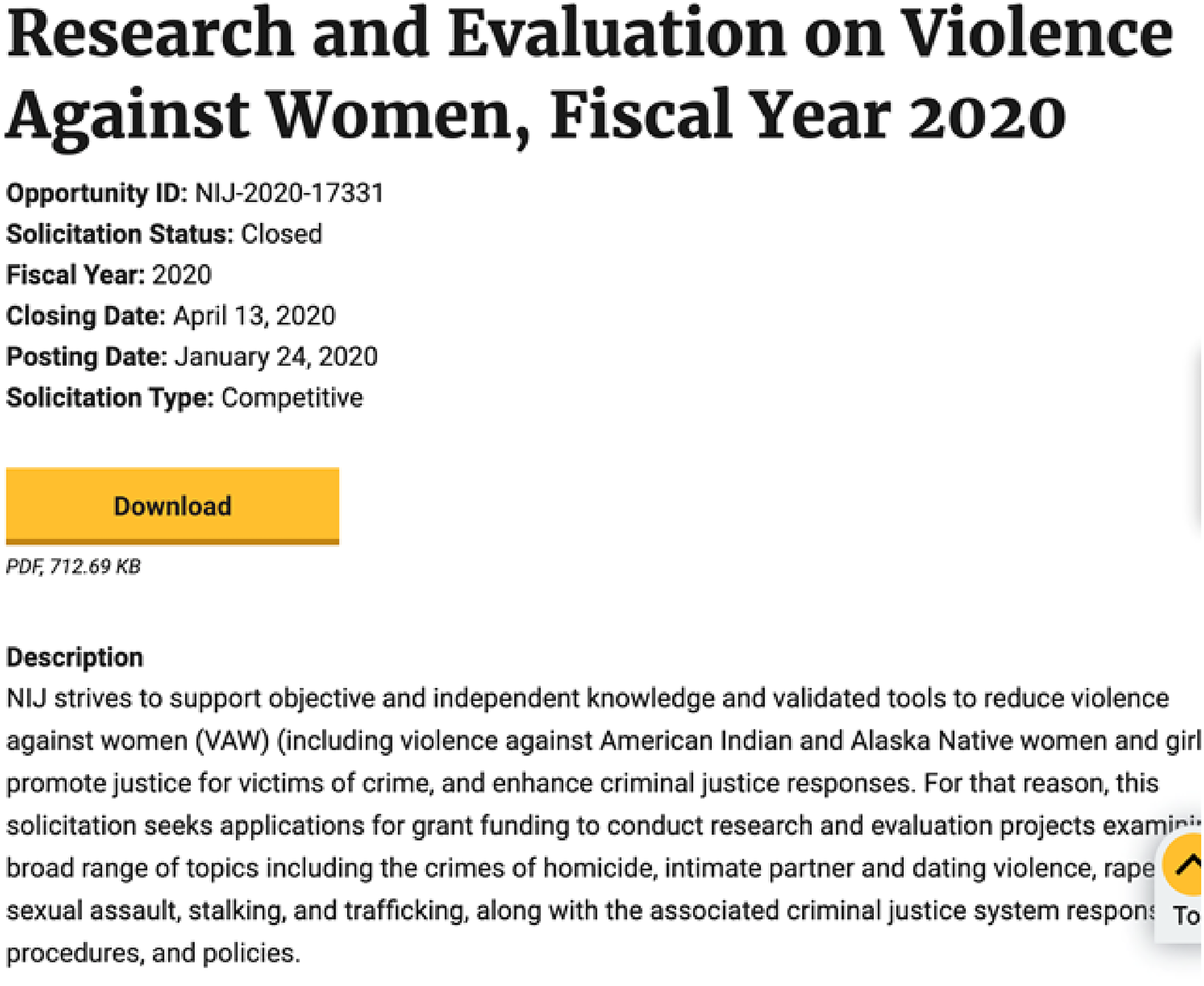
An Example of an RFP from 2020.
To delineate the difference between the general and the particular, I use an example of an RFP from 2020, randomly selected to avoid selection bias. This analysis of the particular and the general is to make NIJ's mandates for researchers clear.
The RFP titled “Research and Evaluation on Violence Against Women 2020” mandates that the research that is produced as a response to this particular call will have to “enhance criminal justice responses” to violence experienced by Native American girls and women. While the range of crimes is diverse, the options for researchers to produce mechanisms of redress are limited to the criminal justice system.
This call to address violence experienced by women and girls of color—native girls and women, in particular—is at odds with the lived experiences of women from indigenous as well as other communities of color. This RFP is what some might call “culturally incompetent,”but it is not just that; it is plain incompetent, given that both researchers and practitioners have long established that women of color, including native women, experience sexual violence in jail cells, that women frequently report that they are not believed by law enforcement when they seek help, and that racist practices of law enforcement result in the killing of Black, Brown, and Indigenous men, which further marginalizes the women in their lives, leaving them vulnerable to other forms of oppression (Gavina, 2020; Policastro & Payne, 2013; Razack, 2013; Ritchie, 2017; Willingham, 2018). Amid such structural violence, a call for “enhanced criminal justice responses” is not simply ignorant but deeply harmful.
As researchers, we must be vigilant about the practices that are harmful to the communities that we want to help. As conscientious, ethical researchers, we must understand that it is because Black, Brown, Indigenous, and other women of color experience so much violence by the carceral state in many different ways that they do not see the carceral system as an ally in the fight to end violence against women, against themselves. This means neither should we. We must be critical of NIJ and question why they continue to request and fund research that invariably embroils communities of color in the violence of the carceral state that seeks to control them. We must call out NIJ for maintaining demand for the carceral state by actively advocating for implicating communities of color in their systems and deepening the justification for state proclivity toward protection and surveillance.
We must also ask, why do university-based researchers—all of us—keep responding to these calls? By way of answer, I suggest, in the neoliberal university, tenure and promotions are increasingly tied to research funding and grant-funded research, seemingly as an indication of a researcher's market value, their research capabilities, their intelligence, and the import of their research. Ostensibly, it is exciting research that gets funded. But, as we know, what counts—or should count—is research output. Grant funding is a means to an end (research output), not an end in itself. So why is it that certain universities would not give tenure to professors with unfunded research? Because increasingly, universities must figure out how to bear the brunt of austerity measures; the coronavirus pandemic has made that all but clear. More importantly, there is the issue of university rankings and status; to remain an R1 institution, for instance, universities have to draw a certain amount of federal research funding, which incentivizes universities to reward faculty members who contribute to that goal. For those of us who do violence research, the NIJ is one of few sources of federal funds for which we can apply. This means scholars who do violence research are always at a complicated crossroad at which they, politics notwithstanding, risk extinction or freedom.
How Activists (Can) Become Complicit
Global capitalism is in the business of producing “synthesized” and unified messages, camouflaged as personal opinions, research, public interest, and so on. To show how activists (can) become complicit in this, I draw from an example from Bangladesh, where anti-violence work happens primarily in NGO-based activist circles and is part of corporate social responsibility (of corporations). I appreciate the pluralist approach to raising awareness about violence—the more players, the better. However, I pause when seemingly helpful activists inadvertently dehumanize the very women for whom they advocate, when women are depicted as individually responsible for their own experiences of violence. I highlight one case because moments such as these can be powerful in their ability to show how women's experiences of violence are socially depicted and understood.
Figure 2 shows an artwork by indigenous artist Tufan (found on his public Facebook page, Tufan's Artbin) shared by NGO-based activists in support of women who experience rape. The artwork depicts the faceless body of an indigenous woman. It is presumably meant to draw attention to the highly prevalent but neglected problem of rape of indigenous women by members of settler communities and the Bangladesh military in the Chittagong Hill Tracts (Chakma & Hill, 2013).

Artwork by Tufan in Support of Women Experiencing Rape.
Tufan's jarring representation of a rape victim/survivor in his own community simultaneously shocks and normalizes the idea of invisibility of indigenous women who experience rape. The face of the woman is completely erased, ostensibly by her rape, perhaps in shame. Her arm takes on chair-like attributes, making her seem static and immovable, like furniture. It is accompanied by text attributed to Karin Slaughter that reduces a woman to a singular instance of violation, her rape, which overshadows not only the present but her future. The message is clear: Once women experience rape, they are victims for life; anything else they do is colored through the lens of victimhood. This reading is also deterministic as it suggests that women, ruined by their experience of rape, have no hope for a better future, no room for growth; they are stagnant, forever stuck in their experience of violence. Tufan's representation is not what I critique; he represents how rape victims are viewed in a system of militarism, patriarchy, colonialism, and capitalism at a time when the Chittagong Hill Tracts have become a profitable tourist destination that benefits the State (Ahmed, 2017). What I problematize is the uncritical view that activists inadvertently take and advance when they share artwork like this without pointing out where they stand. When shared by middle-class Muslim activists in Bangladesh, this artwork illustrates that which is under scrutiny: the idea that majoritarian Bengali Muslims do not see the plight of indigenous women, just like they do not see that Tufan's depiction is a critique of them as settler colonizers. Further, it makes clear that a dehumanized view of victims and victimhood is widely accepted, which then justifies the oversight and neglect of this population. After all, if women who have been raped are beyond hope and change because of their experience of rape, there is no need to help them because they cannot be helped. It sparks the question, then, is that the same kind of rationale for which we see so few federal dollars (in the United States) to address the problem of sexual violence that Waechter and Ma (2015) draw attention to?
Tufan's artwork (Figure 2) is instructive as a reminder that not much has changed in how women's experience of violence and rape, in particular, is seen since Bangladesh's early years. Much like the birangonas (the women who were raped during Bangladesh's War of Liberation and given this title as a way to acknowledge their sacrifice) were confined to their homes as a way to manage their families’ sense of shame and stigma—forever victims who are shut away until they are “saved”--women who experience rape are reminded through messages like these, by activists no less, that they lose their humanity when they experience rape (D’Costa, 2018). They are told to see themselves as eradicated. It creates and reinforces social norms that view women as weak, easily destructible. Rape, then, keeps asserting itself as a weapon of “war”—a weapon by which women can be annihilated, as needed.
Tufan is from the indigenous community; his artwork is a representation of the world he inhabits, not a reinforcement of that world. We could perhaps assume that activists who shared Tufan's artwork were perhaps interested in bringing awareness to the harmful effects of rape. Perhaps, they thought if people—men—saw how harmful rape is, they would stop raping women. However, in doing so, they reproduced a spectacular reading of rape that is triggering for women, underscoring that rape victims make perfect victims only when they are erased—of their history, of their sexuality, of what makes them unique. The last sentence in the text box that accompanies Tufan's artwork provides one ray of hope as it suggests that women can “thrive,” but it comes with an elusive message that it has to be done in “another way,” which leaves one with the sense that it may not be achievable.
This narrative of sexual violence and rape as all-consuming and dehumanizing is spectacular, I argue, in the same way that dead Black men are made specular when they are centered in what Threadcraft (2017, p. 554) terms a necropolitical struggle. This spectacularization of rape works to obscure the everyday forms of sexual violence and “fails” victims/survivors of sexual violence in the same way that “privileging the slain Black body in politics … fails Black women” (Threadcraft, 2017, p. 554). For one, it creates the idea of a certain kind of pitiful, “pathetic” victim that Bay-Cheng (2019) has warned about, which compels women to deny their victimization as they refuse to be seen as weak and powerless, and simultaneously have their sexual histories (or lack thereof) weaponized against them to contribute to the spectacle. Indeed, women already know that they are blamed for any violence they experience because it is their responsibility to be the custodians of not just their own bodies but that of the men who might desire them (even if they themselves do not desire them). Meanwhile, when violence happens in nonmarital relationships, women are not seen as victims at all, as if the “sin” of premarital sex ostensibly negates the violence that they experience.
Public perception of the kind of women who experience violence and what happens to them once they experience violence regulates and governs how women who experience violence see themselves. The denial of victimhood by women who experience violence signals how patriarchy intertwines with the neoliberal logic of personal responsibility to produce internalized and appropriated victim blaming. Under this setting, to admit to experiencing violence (and oppression) becomes equivalent to assuming fault for said violence (Murshid, 2020). If women do not apportion blame to themselves, it becomes imperative to take action against their partners—indeed, under neoliberal logic, that is the only option that “agentic” and empowered women have—even though that may compromise their ability to act in their self-interest because that decision is mired in another set of structural factors ranging from the economic to the social and cultural. For example, research shows that women at risk of experiencing housing insecurity are more likely to endure partner violence (Thurston et al., 2013), illustrating the role of material conditions in maintaining violence in women's lives and thus constraining their ability to be “agentic.”
Further, the spectacularization of sexual violence dilutes everyday forms of sexual violence by creating a bifurcation between sex and rape that glosses over what Nicola Gavey (2018) terms “unjust sex,” or sex that is not wanted or desired but is still enacted for reasons other than sexual pleasure or desire. For example, “I just lie there while he finishes off,” a research participant from one of my research projects told me to describe her sexual relationship with a partner, a refrain that many of us who study interpersonal violence have invariably heard before. This quote acts as a reminder that heterosexual sex is a location of discontent for many women. Unpleasurable sex may not rise to the level of a crime, but there is a veneer of coercion that such sex contains, stemming from relational pressure on women to perform, even minimally, in the bedroom (Murshid & Irish, 2020). Indeed, “bad sex” is a political issue that speaks to who is deserving of pleasure and who is not, embedded in structural inequalities (Cahill, 2016). At the same time, that does not mean women are pitiful victims of crime. Unjust sex remains a discursive space between (good) sex and sexual violence, not in a continuum but scaffolded vertically, in Gavey's conceptualization. Feminists who view rape as only a product of violence and power decry the potential for the conflation of sex and rape that may happen in Gavey's reading (Karlsson, 2019). However, in a global culture of patriarchy, many young girls learn about sexual violence before they learn about sex, which means that the two are intimately connected in the embodied experiences of girls, whether or not feminists approve of it (Murshid & Irish, 2020). As scholars, it is imperative that we talk about the line between (pleasurable) sex and sexual violence, and the gray area that takes up much of that line that constitutes unjust sex. Like Cahill (2014), I do not think of heterosexual sex as coercive per se; women can and do experience sexual desire and pleasure in heterosexual partnerships, but in (too) many cases, they do not. Women's sexual pleasure in heterosexual relations is not a priority, and not only in the Global South, but that is still not a crime.
Crime is not a neutral concept. It is a word created by the criminal justice system that views violence as very specific acts which are considered crimes only when certain parameters are registered under certain circumstances. It infrequently encompasses the whole range of violence that women experience. It almost always requires that someone else witnesses it. It does not have room for forms of violence that are hidden, such as intimidation or threats of violence. Indeed, the criminal justice system cannot assess what constitutes versus what appears to be unjust when all it aims to do is prosecute; that system cannot be the adjudicator of the extent of violation and harm that people experience and the kind of justice that harmed individuals might want. Sex can be a location of social harm, even if it is not a location of physical or sexual harm for women. Let me explain.
Nonmarital sex is highly prevalent in Bangladesh, often contingent upon marital commitment. Nonmarital sex, however, gets conceptualized as rape by women when the marital commitment is broken because of puritanical ideas of women's sexuality, and what they do with their bodies undergirds the conceptualization of a “good girl” (Murshid & Irish, 2020; Quddus, 2015). Meanwhile, a culture of impunity surrounds rape trials and sexual violence in Bangladesh. Because men are infrequently implicated in the criminal justice system for committing sexual violence, the invocation of rape to register betrayal is an interesting and agentic cultural production that draws attention to women's experience of treachery. The terming of betrayal sex as rape records their protest, but without causing actual harm to the men they implicate, given that such forms of “rape” are difficult to prove and do not rise to the level of crime. This concept of betrayal as rape is an agentic moment in which women effectively manage their reputation, respectability, and sexuality, which, we know, are of great importance to women, their families, and their communities. So, when women invoke rape to talk about betrayal experienced in their sexual relationships, which is a form of social harm, they call attention to the unjust manner in which sex was procured from them instead of waiting for their male partners to protect and save them by actually marrying them. However, not all women are able to be agentic. Many young individuals are forced to marry once they are found fornicating, even though these “forced” marriages rarely last very long (Siddiqi, 2012).
Betrayal sex and the potential for forced marriage should be contrasted with another form of forced marriage: when unmarried women and girls are forced to marry their rapists for similar reasons—i.e., to manage the respectability of women and girls who are raped and that of their families. In Bangladesh, marital rape is within the rights of men, which is why marrying the rapist removes the stigma that comes with being a known practitioner of nonmarital “sex.” Indeed, respectability politics in the domain of sexuality is one of the reasons for which “justice” for some women involves getting married to their rapists (Siddiqi, 2012), while it becomes clear how sex and rape are conflated—as if the only difference between the two is marital status. Alternatively, the marriage with the rapist removes the stigma of being a rape victim, which, in the public consciousness, is to be the kind of defaced woman shown in Figure 2, with a fate “worse than death.” It reminds me of what Lila Abu-Lughod (2021) said about wars: Is raping women worse than killing men during the War? Arguably, it is not, but we know that it is often made out to be.
This example of Tufan's artwork shared on social media provides a micro picture of how sexual violence is a sociopolitical issue in Bangladesh. In the next section, I provide the context in which such socio-politics take place amid a deradicalization of women's movements as they became part of NGOs in Bangladesh.
Bangladesh: The Bigger Picture
To provide an understanding of the conditions under which activism and research on violence take place, let me introduce the contentious issue of the “Bangladesh paradox” (Hossain, 2017), which entails high growth rates amid inequality, NGO-led empowerment amid violence, and parity in girls’ education in terms of gender-based discrimination that work to maintain the systems of colonialism, capitalism, patriarchy, and global racism, that pave the way for social control over neoliberal subjects (Chowdhury, 2021). I forward that it is the empowerment rhetoric that hides violence, which then makes violence appear as aberrant, individual acts; it's the high growth rates that hide deepening inequality, it's the gender parity in primary education that hides how girls often drop out of school after they hit puberty. These paradoxes then appear to be a way to marginalize the problems that affect marginalized groups. These “positive framings” are actually moments of depoliticization. For example, empowerment, "produced" by NGOs (which are perhaps the most prominent location of feminists and gender activists in Bangladesh), has become increasingly depoliticized as they are accountable to foreign donors and their mandates. Indeed, neoliberalism-led NGOization recreated a kind of empowerment that is no longer about having agency or power, as much as it is about thinking and feeling that one has agency, self-efficacy, and self-sufficiency; not as much about changing the systems, as it is about enhancing skills and literacy, changing behaviors, and learning new trades. It is not about enhancing political participation but keeping the citizenry so engaged in neoliberal projects, turning them into consumers, that they have no time to build solidarity with others. It is not about deepening capabilities by strengthening institutions and the ability of citizens to access those institutions, which could perhaps include educational components, but about responsiblizing individuals to become their own "change agents," as if they can better their lives just by enhancing themselves. In other words, all it takes to empower women is for NGOs and corporations to create a product line for them, the consumption of which automatically empowers them and gets categorized as such.
An example of this is microfinance, which has long been categorized as empowering (Murshid, 2018). I term these moments as moments of internalizing the logic of neoliberalism—in no small part due to the depoliticized, individualized understanding of empowerment. Let me provide several examples.
One, in interviews with women participating in microfinance in Bangladesh, I learned women are burdened by the paid and unpaid labor they provide—the care work they provide at home, the health care they provide to aging parents and children, and the additional income they are expected to earn—in the absence of a well-funded welfare state which puts women in charge of addressing these social needs. But they frame the additional burden in terms of “choice.” They say, “tomake to keu jor kore Koray nai” (no one forced me to do all this)—which I read as internalization of neoliberal mantras of individual choice—which they perhaps learn from the “empowerment” projects of which they are part, and from the neoliberal social environment where these ideas are present. Two, working-class women have shared their experiences of violence at home and on the streets as they navigate public spaces to work to be financially independent. They say it occurs because they are no longer good wives and mothers because they have limited time to spare for their families and because they are out in public—what else should they expect? Meanwhile, it is the institutions, including the institution of home, which ironically is understood to be a location of safety, that remain masculine and patriarchal, producing sexual violence. Three, women have told me how hard it is to live on their meager incomes, even as they participate in financial empowerment programs, but they look inward and they blame their fates, never the economy. They tell me that their lack of education precluded them from upward mobility, but they blame themselves for it, not the conditions that prevented them from going to school, which often includes sexual harassment. Four, I see women who understand the role of intergenerational poverty in their lives, but they think that hard work, arguably another neoliberal notion, will pay off—and if it doesn’t, it is because they did not work hard enough. Five, like Karim (2011), I too see that women take on additional loans to pay back the loans that they do not have the money to pay for, which becomes a cycle of unending debt.
All of these ultimately serve the goals of (ongoing) colonialism and capitalism; oppression is a tool of the State and the capitalist elite. At the same time, it is customary to blame individuals for structurally produced and created social ills. To provide another example, an owner of one of the largest garment factories in Bangladesh and former president of Bangladesh Garment Manufacturers and Exporters Association (BGMEA), Rubana Huq (2020) had articulated that garment workers were not forced to go to work during the COVID-19 pandemic, framing their constrained choice as willing, as if the fear of losing their jobs, or fear of contracting COVID-19, were not part of that calculation. Together, these examples suggest that neoliberal mantras fashioned as empowerment rhetoric used by capitalists trickle down to the poor working-class while fostering an understanding of violence that is individualized. So, when NGO-aligned activists uncritically share the artwork by Tufan (Figure 2), it provides justification, and reinforces and legitimates the systems that have made violence prevention and treatment individual-focused, turning a piece of artwork on its head in a way that was perhaps not intended.
What Counts as Violence?
Citizens look to the State to identify what counts as violence; in other words, violence is conflated with what is codified as crime by the criminal justice system. The idea is that an act or system cannot be violent unless laws have been broken. An excellent example of this is the case of marital rape in Bangladesh, which is not criminalized, and not only is it not seen as violence, it gets conflated with sex. At the same time, we see rape being invoked by women when their sexual partners refuse to marry them. In that instance, it is betrayal that gets marked as rape, as discussed before. What appears to be a discursive application of the term rape then assumes certain ideas, such as there is no such thing as marital rape. Rape is then not seen as an instance of sexual violence but as some kind of male fantasy. What that does, in public perception, is normalize rape as nonmarital sex. However, that women feel the need to invoke rape to manage their reputations that come under attack when they are seen as willing sexual subjects is not what makes the conceptualization of rape fuzzy. It is the patriarchy that forces women to manage their reputations at all cost, so it is the patriarchy that works to ensure that violence is not unambiguously legible.
It is then natural that sexual violence seems to register as a violation of the body only when it is extremely brutal, when it occurs in public, and when it leads to death. Only when it is spectacular is it deserving of organized “necropolitical” support (Threadcraft, 2017). It is that spectacular form of violation of the body that we see protests about, organized by women's organizations and NGOs that work on women's rights, because it is the most brutally violated victims who are worthy of support.
At the root of this notion of rape in Bangladesh is perhaps Birongonas—the Bengali women who were raped during Bangladesh's War of Independence later recognized as war heroes but ostracized by their own families. The Birongona is the perfect kind of victim who fell prey to the enemy and had no fault of her own. That understanding of rape is tied to how women who experience rape are understood today: as perfect, blameless, even dead. That is the kind of victim that people rally for. It is public or otherwise spectacular instances of violence that mass movements are built around, while sexual violence in the intimate domain that occurs in the lives of the everyday citizenry is marginalized as a problem. This is particularly insidious because we know that women experience sexual violence mostly at the hands of men they know, not strangers (Rentschler, 2015). But that is the form of violence that protest movements gloss over.
What Next?
The analyses presented highlight the context in which knowledge production related to violence takes place. The solution to the problem of violence has become stagnant with interventions aimed at individual-level “empowerment” of women. As researchers interested in seeing an end to the production of interpersonal violence, we must see this kind of individual empowerment—variously defined—for what it is: lacking. Indeed, any individual-level intervention not accompanied by social change does little to change how women are treated. When scholars and practitioners, taking a cue from federal agencies, forward individual treatment programs or interventions to ameliorate violence, they inadvertently blame women who experience them. This happens because interventions aimed at fixing women are seen as fixes to the problem of violence, obscuring how partner violence is produced in the first place—by the interlocking systems of global racism, patriarchy, and neoliberalism intertwined with cultural mores. That intervention work is not accompanied by structural change is exactly what maintains violence across the lifespan. The dominant narrative of partner violence, for example, creases the binary of victim and perpetrator, where the victim is supposed to be innocent and the perpetrator guilty (Price, 2012)—a binary that gets complicated when multiple identities come into play.
Take, for example, immigrant women in abusive relationships. There is a provision under the Violence Against Women Act (VAWA) for undocumented “victims of crime” to get immigration benefits. It was created to allow undocumented individuals to get a visa but only if they testified against the “perpetrators,” the guilty. This pitting of victims and perpetrators against one another takes away decision-making power and control from the very women who experience violence, who have already experienced a loss of power and control as a result of partner violence. The continued loss of control that victims/survivors experience via state actors in response to violence makes the criminal justice system another location of violence for migrant women (Murshid & Bowen, 2018). At the same time, by treating the “perpetrator” as “guilty” from the get-go, even amid “innocent until proven guilty,” two goals are achieved: One, the State gets another opportunity to contribute to the mass incarceration of minoritized groups—for example, men of color, which, we know affects women of color as well, through furthering their experience of oppression in the criminal justice system as well as in other ways: economic, social, and cultural. Two, the State strips women of agency, making them dependent on the State (e.g., for their visa status), putting the State in a position to control them through various methods that are couched in medical and legal language. In my research with migrant women, women have told me that they found out that “contraceptive injections” were part of rape kits only when they were being administered, a time during which they were distraught and barely able to consent or even understand what was happening “because everything was happening so quickly.”
However, the State, in the name of “protection,” is absolved of being a violent force that structures the lives of women. Linda Mills terms this justice system that takes away decision-making power from women as “emotional abuse” by the State, disproportionately deployed against people of color, minoritized groups, low-income groups, and indigenous populations (Mills, 2009). Indeed, state actors such as sheriffs’ deputies, jail guards, child protective services, immigration agents, and others routinely use physical and sexual violence against women from low-income backgrounds, but there remains institutional oversight. That federal grants seeking proposals to end violence consistently insist upon partnering with law enforcement personnel and agencies is testament to that.
As scholar activists, we need to recognize the many ways in which oppression and interpersonal violence are structurally produced, be careful not to be used to do the harmful work of obscuring the link between the structural and personal, and blaming individuals for the various forms of violence they experience. We need to reimagine a world in which the systems that produce violence are dismantled, where relationships are egalitarian, where hierarchies no longer exist. We are not bound by anything other than our will to create an equal, equitable, and just society. Finally, we need to have radical responsibility, as Emmanuel Levinas had forwarded, not just compassion, for the people and communities we work with, because while compassion “motivates or prompts,” it “does not actually require action” and is therefore not enough (Shepherd, 2003, p. 447). We not only need an ethical way to conduct research in the way Institutional Review Boards intend, but we must cultivate a kind of personal and academic ethics that will ensure that we use trauma-informed, racially just, and community-engaged research, not only the (neoliberal kind of) research we need to do to get tenure and promotion or otherwise serve personal or career-related interests. As ethical researchers, we must sit, as uncomfortably as it may be, with the power dynamics that put researchers in a position of power, which we must work to mitigate and the savior-complex that drives “helping” minoritized communities and individuals, instead of unleashing them on the communities we study.
We need to advocate for a more ethical standard for research at our universities that is not just about ensuring that our research practices are not harmful but ensuring that research is not guided merely by market forces. We must demand that NIJ and other funding organizations leave the science to scientists; let us drive the direction of the research that we do in the way that we see fit (and have been trained in); and foster research creativity as well as creativity in solutions to the problem of violence, instead of prioritizing only one form of knowledge production, particularly one that converges with goals of the neoliberal carceral state apparatus.
Further, those of us who study communities of color in Global South spaces worldwide need to take a page from the playbook of anti-racist and transnational feminists to make racial capitalism and the harm that it produces central to our work on violence (Chowdhury, 2009). This means recognizing, for example, that it is racial capitalism that has made the lives of Black and Brown women in the Global South precarious and violent by employing them in low-wage factory work without making the social environment safe for them. However, neoliberalism is such that workers have few choices to pick from and sustain their families. That they (can) sustain their families become the rationale that allows the maintenance of global racial capitalism, which then continues to produce violence and harm.
Conclusion
The comparison between the United States, the global hegemon, and Bangladesh, “the periphery of periphery,” in my estimation, is helpful to underscore how global the ideas of individual responsibility and individual harm are while diverse communities continue to be minoritized in violent ways, both locally and globally. The analysis of the two sets of documents, the NIJ RFPs and the social media post by activists in Bangladesh, along with interview data, reveal that an individual-level understanding of violence gets reproduced through false dichotomies of victim–perpetrator and victim–agent that capture the public imagination, which is produced and reproduced by researchers and activists alike. What becomes clear is that the neoliberal university, along with neoliberal mantras such as personal responsibility, creates narratives that obscure the link between the structural and personal. Indeed, neoliberalism reinforces a (hetero)patriarchal, colonial, and racist understanding of Black, Indigenous, and other women of color, women from the Global South, sex, sexual violence, and rape that serve the larger purpose of hiding the systems that produce violence that the State is complicit in. After all, if that link remains obscure, efforts to delink the structural and personal would not necessitate a dismantling of these systems. That carceral feminists participate in what Mimi Kim (2020) terms “carceral creep,” justifying carceral expansion using racist, classist, and sexist tropes, remains a point of contention for anti-carceral feminists, who see the State as the purveyor of violence and are wary of the entrenchment of hegemonic ideologies in the domain of gender and sexuality that maintain the systems that produce violence.
Supplemental Material
sj-pdf-1-vaw-10.1177_10778012221083333 - Supplemental material for What We Think When We Think About (Interpersonal) Violence: Understanding Knowledge Production
Supplemental material, sj-pdf-1-vaw-10.1177_10778012221083333 for What We Think When We Think About (Interpersonal) Violence: Understanding Knowledge Production by Nadine Shaanta Murshid in Violence Against Women
Footnotes

Supplemental Material
Supplemental material for this article is available online.
Author Biography
References
Supplementary Material
Please find the following supplemental material available below.
For Open Access articles published under a Creative Commons License, all supplemental material carries the same license as the article it is associated with.
For non-Open Access articles published, all supplemental material carries a non-exclusive license, and permission requests for re-use of supplemental material or any part of supplemental material shall be sent directly to the copyright owner as specified in the copyright notice associated with the article.
