




Abstract
The current study examined how the general tolerance of women's intimate partner violence and mental violence perpetration are affected by women's ambivalent sexism and relationship causality orientation. One hundred and forty-nine of 221 Chinese female participants recruited on an online platform were included in the final data analysis. The results showed that causality orientation plays a moderating role. Specifically, as controlled orientation increased, the relationship between hostile sexism and intimate partner violence tolerance became stronger. As the autonomous orientation increased, the relationship between benevolent sexism and intimate partner violence tolerance became weaker. Hostile sexism and controlled orientation positively predict women's mental violence perpetration.
Keywords
Introduction
Intimate partner violence (IPV) is common throughout the world, violating victims’ rights and bringing instability to society. Data from the National Survey of Intimate Partner and Sexual Violence (NISVS) in the United States show that approximately one in four women and nearly one in 10 men have experienced severe IPV in their lifetime, including stalking, sexual violence, and physical violence perpetrated by an intimate partner (National Center for Injury Prevention and Control, 2018). A cross-sectional study conducted in six provinces across the three regions of China shows that 52% of participants had experienced IPV (Yuan & Hesketh, 2019). The Anti-Domestic Violence Advocacy Team in China (2015) found that psychological violence was the most common form of IPV in their survey. Some incidents related to mental violence have sparked a heated discussion about mental violence in China. For example, Li Bao, a female student at Peking University, died by suicide in October 2019 because of the mental abuse caused by her boyfriend. Chatting records between the couple had been exposed on social media and had attracted wide attention from society. There is no doubt that IPV has always been a concern in our society. In recent years, increasing attention has been given to mental violence, which is invisible and can cause great harm.
IPV Tolerance and Mental Violence Perpetration in Women
IPV against women is a major public health problem (Yu et al., 2019). Research shows that 87% of women suffering from IPV chose to tolerate IPV without seeking any help from public services (Raquel Herrero-Arias et al., 2021). Of course, tolerance of IPV does not make women responsible for being subjected to violence; in some cases, women may not seek help for fear of further violence. Specific to China, a previous study indicated that Chinese female participants had a higher level of tolerance for IPV (Kai Lin et al., 2016). Tolerance of IPV is common in China because of the influence of culture (Li, 2017). The traditional gender stereotype ties women to their husbands for financial support (Hu & Scott, 2016), and the lack of economic independence of these women in China increases the likelihood of tolerance of violence. The advocacy of “family harmony” encourages people to hide “disharmony” at home to save their “face” (i.e., caring too much about social evaluation to improve their self-esteem), and women are obliged to tolerate IPV for the unity and reputation of their family (Zhang & Zhao, 2018). Thus, women in China are more likely to tolerate IPV.
However, when problems arise in intimate relationships and women find it difficult to tolerate, they may turn to mental violence, which is intimately related to a person's inability to tolerate when circumstances make communication difficult or lack personal resources (Calleja, 2008). Due to sexual dimorphism in size and build, women are less inclined to respond to IPV physically but release their dissatisfaction through mental violence (Palmer-Hague, 2020). The European Institute of Gender Equality states a general definition of mental violence (i.e., one type of IPV): “Any act or behavior which causes psychological harm to the partner or former partner. Psychological violence can take the form of, among others, coercion, defamation, a verbal insult or harassment” (Dokkedahl et al., 2019). Studies show the prevalence and higher possibility of females perpetrating mental violence (Esquivel-Santoveña et al., 2019). However, a few studies have examined the potential influencing factors of mental violence perpetration in female participants. Identifying the factors that influence female mental violence can have a deeper understanding of IPV and reduce harm in intimate relationships.
The Relationships Between Ambivalent Sexism, Relationship Causality Orientation, and IPV
For thousands of years, China has been influenced by Confucian culture and patriarchal society containing some shackles of the pursuit of equality. In ancient China, men held more money and power, while some women depended on men in the family; thus, women were considered inferior to men. Due to social and cultural constraints, Chinese women were stereotyped to be good wives instead of pursuing equality and various rights. With the development of female equality consciousness, women who pursue greater autonomy and violate the social culture are blamed and disparaged by men (Glick et al., 2004), which creates hostile sexism. Hostile sexism (i.e., one type of ambivalent sexism) refers to the stereotype that women are inferior to men and the general suspicion that women are trying to control them (Glick & Fiske, 1996, 2012). The belief that women are weak and need to be protected also makes men more willing to take care of them, which leads to benevolent sexism. Benevolent sexism (i.e., one type of ambivalent sexism) tends to assume women as the object in need of protection or care to show men's superiority (Glick et al., 2004). The mixture of hostile and benevolent sexism contributes to ambivalent sexism (Glick & Fiske, 1996). Ambivalent sexism serves to justify and maintain patriarchy, traditional gender roles, and gender inequality (Glick & Fiske, 1997, 2001, 2012). In China, a Confucian classic called Yi Jing has influenced Chinese culture for thousands of years. This classic emphasizes traditional gender roles that women should be gentle while men should be strong, and women's activities depend on men, which roots the idea of gender inequality in culture. In the feudal society of China, the value of women is reflected mainly in giving birth for the clan, which has become the only way for women to realize their value. The feudal patriarchal system regards whether women can give birth to children for their own family as the primary ruler to measure a woman's value (Zhang, 1988). Therefore, hostile sexism and benevolent sexism have been in traditional Chinese culture for thousands of years. The sexism contained in the culture has a subtle influence on people, and sometimes it even makes sense.
Previous studies show that ambivalent sexism affects the perpetration of IPV, and men with higher benevolent sexism perpetrate less violence against women (Allen et al., 2008). In contrast, individuals with higher hostile sexism have higher levels of rape proclivity and are more likely to perpetrate physical violence (Lynch et al., 2016; Thomae & Viki, 2013). Hostile sexism was associated with a higher possibility of psychological IPV perpetration, while benevolent sexism was not related to verbal aggression (Forbes et al., 2004; Juarros-Basterretxea et al., 2019). In summary, hostile sexism could be a risk factor for violence perpetration; in contrast, benevolent sexism could be a protective factor (Mara et al., 2016). Thus, we surmise that the two types of ambivalent sexism may have different influences on IPV in women. Hostile sexism can positively predict IPV perpetration, while benevolent sexism can negatively predict it.
Although some researchers considered ambivalent sexism as a sociocultural context that affects IPV (Allen et al., 2008), there may be individual differences for both the perpetrator and the victim in intimate relationships. Causality orientation theory is used to interpret people's behaviors corresponding to different orientations, which is one of the subtheories of self-determination theory (Deci & Ryan, 1985a). Moreover, researchers have found that motivation orientation in the specific domain of close relationships is called relationship causality orientation (Øverup et al., 2017). Relationship causality orientation theory can explain individual differences in initiating and regulating behaviors through different motivations, and relationship causality orientations are relatively stable individual differences in how one orients toward the social environment (i.e., sexism and interpersonal relationships) (Deci & Ryan, 1985c). This theory includes three motives: autonomous, controlled, and impersonal orientation. Individuals with autonomous orientation are self-selected and self-determined, often related to the pursuit of internal desire and external goals, and have high internal motivation. Some researchers consider autonomous orientation to be a growth motivation in which these individuals are open to feedback from partners and desire improvement faced with challenges (Knee et al., 2002). Individuals with autonomous orientation are more likely to seek a healthy and positive way to cope with IPV. In intimate relationships, individuals with a higher autonomous orientation have a lower possibility of perpetrating IPV (Øverup et al., 2017). Individuals with a controlled orientation are more likely to be influenced by the environment and initiate or adjust their behavior according to external pressure. Some researchers consider that these individuals view feedback from the partner as threatening and less related to positive behaviors (Knee et al., 2002). In the face of conflicts in intimate relationships, they might show more tendencies to perpetrate violence and feel more threatened. Øverup et al. (2017) found that individuals with higher controlled orientation are more likely to perpetrate IPV. Previous studies have suggested that controlled orientation may be a risk factor for IPV perpetration, while autonomous orientation may be a protective factor (Deci & Ryan, 2002; Hove et al., 2010). For impersonal orientation, we did not take it into account in the present study because impersonal orientation is related to apathy and not related to perpetrating IPV (Øverup et al., 2017). In addition, women's responses to violence are shaped by their own attitudes and those of others around them (Flood & Pease, 2009). According to the different characteristics of controlled and autonomous orientation, individuals with different orientations might have different attitudes and perceive different environments. Individuals with autonomous orientation value internal desire when they respond to violence (Deci & Ryan, 1985b). Controlled orientation individuals adjust themselves according to the external environment and feel more threatened (Knee et al., 2002). Due to the different natures of orientations, individuals with a controlled orientation might more tolerate violence under more perceived pressure and be aggressive from outside. Therefore, we surmised that different types of relationship causality orientations may have a different effect on the tolerance and perpetration of IPV. More specifically, individuals with a higher level of controlled orientation might be more related to the tolerance and perpetration of IPV, while individuals with a higher level of autonomous orientation may have a lower possibility of tolerating and perpetrating IPV.
The Present Study
This study makes up for the shortcomings of previous studies and contributes to the field of violence against women. Most studies have looked at the violence perpetrated by men, but fewer have looked at women's violence. Our study examines the mental violence perpetrated by women. Although some studies have included men and women, they come to mixed conclusions without considering female and male violence characteristics. These conclusions may not be accurate and should be treated separately because female and male violence characteristics are different. Our study only investigated females to obtain more precise results combined with female characteristics. In addition, previous studies found a relationship between ambivalent sexism and IPV perpetration, but we take the special context of Chinese culture into consideration. Chinese women suffer more pressure because traditional Confucian values demand them to perform traditional gender roles (e.g., family duties, reproduction, good wife, etc.). Due to cultural differences, the conclusions of past studies are not highly applicable to Chinese women, and few studies have focused on the relationship between ambivalent sexism and female mental violence perpetration. Causality orientation theory was ideally used in intimate violence and related to IPV, as mentioned above, but limited research takes this into consideration. Thus, based on the explanation of causality orientation theory, we examine that the impact of ambivalent sexism on female IPV tolerance and mental violence may be moderated by different causality orientations (i.e., autonomous orientation and controlled orientation). We propose the following hypotheses:
Ambivalent sexism can predict female mental violence perpetration (i.e., hostile sexism can positively predict female mental violence perpetration, while benevolent sexism can negatively predict female mental violence perpetration). Relationship causality orientation (i.e., autonomous orientation and controlled orientation) plays a moderating role in the relationship between ambivalent sexism and female IPV (i.e., IPV tolerance and mental violence perpetration). Similar to hypothesis 1, the hostile and benevolent sexism subscales were treated as separate predictors when fitting the moderation models.
Method
Participants
Two hundred and twenty-one female participants were investigated on an online survey platform in China for this study by convenience sampling with three scales, aiming to test their ambivalent sexism, relationship causality orientation, and IPV (i.e., general tolerance and mental violence perpetration). In the process of data cleaning, participants who had not passed attention checks and those who had not been in a relationship or married were removed. Thus, 149 female participants were included in the final data analysis. The age of the participants ranged from 16 to 49 years (M = 23.530, SD = 6.768).
IPV
We revised Hamel et al.’s (2007) IPV questionnaire to test participants’ mental violence and IPV tolerance. The original questionnaire contains three sections (i.e., each section followed by several items), which measure IPV tolerance, mental violence, and physical violence. We kept the sections on IPV tolerance and mental violence and adapted some questionnaire vignettes for the Chinese cultural context. Each section presents at least one vignette that describes a squabble or cold violent circumstance. Participants were asked to rate the extent to which they tolerated their partner (0 = totally intolerant, 5 = completely tolerant) and perpetrated mental violence to the partner (1 = not very likely, 10 = very likely) through multiple items (i.e., if you were the protagonist of the material, how much would you tolerate being slapped by your partner?).
An example of the scenario is described as below:
“You and your partner are watching TV and discussing the mortgage payments you need to make this month, only to determine that your partner is spending most of his monthly salary on shopping. You think he should be a little thrifty and save the money to pay off the loan, rather than spend it on consumption to satisfy vanity. However, your partner insists that he should be spending money on himself, that you should be making more money instead of cutting back, that you are simply incompetent, that you are an irresponsible partner, and slams the remote control at you. When your partner blames you for what is not going well in your life and thinks you are the one who is causing both of you to lose the quality of life, it hurts your self-esteem and makes you angry at your partner for blaming and acting.”
Ambivalent Sexism
The ambivalent sexism inventory (ASI) designed by Glick and Fiske (1996) was translated and used to measure the participants’ ambivalent sexism with romantic experiences. The scale consists of two components in a total of 22 items, including hostile sexism and benevolent sexism. Hostile sexism items are like “Women seek to gain power by getting control over men,” and benevolent items are like “No matter how accomplished he is, a man is not truly complete as a person unless he has the love of a woman.” These two components were used separately in this study. Responses were given on a six-point Likert scale (0 = disagree strongly, 5 = agree strongly). For both components, a higher score indicated a higher level of benevolent or hostile sexism. The Cronbach's α values of hostile sexism, benevolent sexism, and ASI were 0.710, 0.690, and 0.804, respectively.
Relationship Causality Orientation
The causality orientation in the relationship was measured using the Relationship Causality Orientation Scale (Øverup et al., 2017), which was adapted from the General Causality Orientation Scale. The scale consists of 10 scenarios and 30 items in total. The scenario is related to a romantic relationship. Each scenario was followed by three items, corresponding to the three motivational components (i.e., autonomous, control, and impersonal). For each scenario, participants were asked to indicate how likely it is that they would respond according to three different statements on a response scale from 1 (very unlikely) to 7 (very likely). The coefficient of internal consistency was 0.732 in the current study.
An example of the scenario and statements is described below:
You went on a blind date with someone you truly came to like. When you ask about going on a second date, the person says no. It's likely that you might think:
That person isn't good enough for me anyway. I’m probably not good enough for that person. I guess we are not as compatible as I had thought.
Data Analysis
RStudio version 1.1.456 was used for data analysis. First, the mean, standard deviation, and correlation coefficient were calculated for the main variables in the present study. Second, Harman's univariate test was conducted to examine the common method bias within all measurement items. Third, all-subsets regression/all possible regressions (Package “leaps,” https://cran.r-project.org/web/packages/leaps/index.html) were used to examine the associations between ambivalent sexism and IPV (mental violence and IPV tolerance) and the moderating effects of relationship causality orientation. All-subset regression fits all possible models based on the researcher specifying the predictive variables and then outputting the best fitting model according to the particular criterion. Adjusted R square was chosen as the criterion for picking the best fitting model in the present study. The reasons why we conducted the all-subsets regression are as follows: (a) to avoid multicollinearity issues, because of high correlations between hostile/benevolent sexism and their interaction terms with relationship causality orientation (see Table 1); (b) since the present study has only nine predictive variables in the regression model, all-subsets regression allows us to achieve the best fitting result without losing much model interpretability. The raw data were standardized before modeling. Then, we fitted regression models with age, ambivalent sexism, relationship causality orientation, interaction terms as predictive variables, and IPV tolerance and mental violence as outcomes.
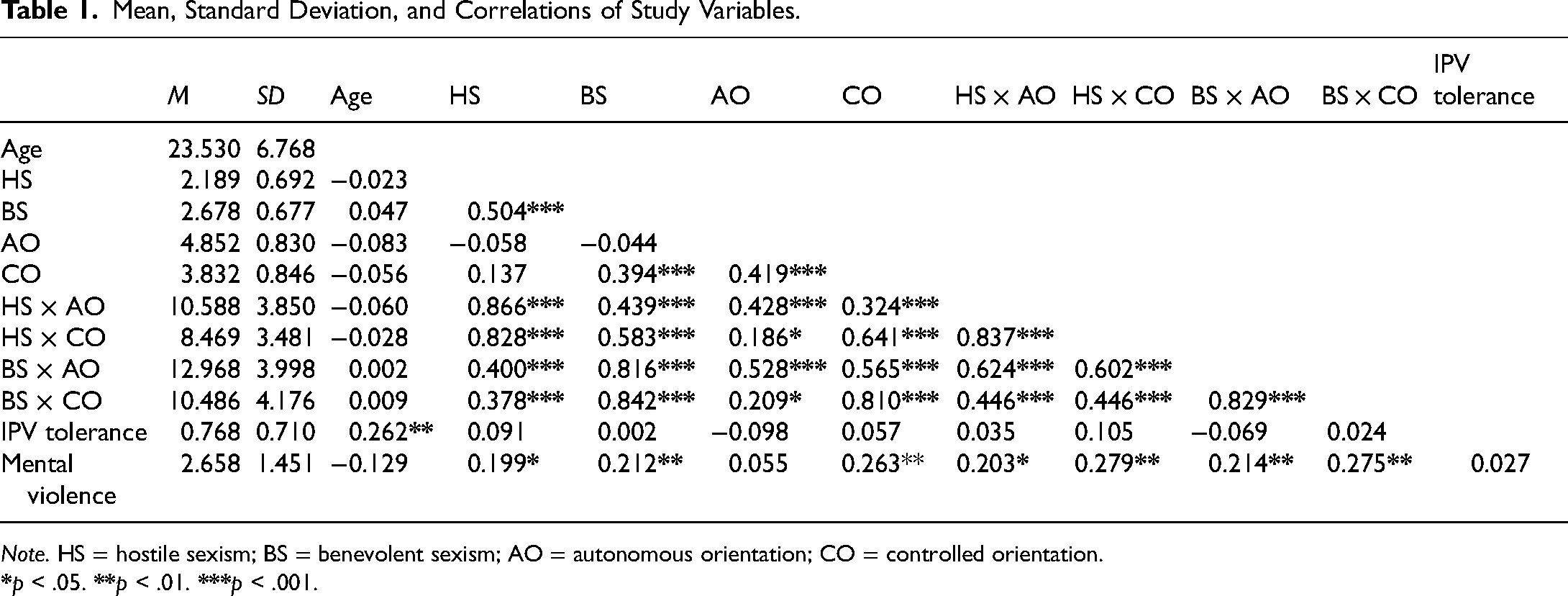
Mean, Standard Deviation, and Correlations of Study Variables.
Note. HS = hostile sexism; BS = benevolent sexism; AO = autonomous orientation; CO = controlled orientation.
Results
Common Method Bias
Common method bias may exist between the independent and dependent variables because of the common data source or raters, the common measurement environment, or items with their characteristics. Thus, it is necessary to examine whether the present study has a common method bias using Harman's univariate test (Podsakoff et al., 2012). We form a factor in nonrotating exploratory factor analysis with all measurement items using maximum likelihood estimation. The average variance explained by the factor was only 10%, indicating that no common method bias was found in the current study.
Descriptive Statistics
Table 1 presents the means, standard deviations, and correlation matrix of this study's main variables. We examined the Pearson's correlation coefficients between the IPV (i.e., mental violence and IPV tolerance) and the potential influencing factors, including age, ambivalent sexism, relationship causality orientation, and their interaction terms. The results suggested that mental violence was significantly positively associated with hostile sexism, benevolent sexism, controlled orientation, and the interaction terms of ambivalent sexism and relationship causality orientation. However, IPV tolerance was only significantly positively correlated with age. Benevolent sexism had a significant positive relationship with controlled orientation. In addition, the interaction terms of ambivalent sexism and relationship causality orientation were highly positively correlated with each other and with both hostile and benevolent sexism, suggesting that we should be cautious about the multicollinearity issue when constructing regression models. In general, our sample exhibited a low tendency of IPV tolerance and a medium level of mental violence.
Hierarchical Regression Analysis
All subset regressions/all possible regressions were performed to search for the best subsets of the predictive variables (age, ambivalent sexism, relationship causality orientation, and the interaction terms) for predicting IPV tolerance and mental violence (see Figures 1 and 2). This method helps to avoid multicollinearity issues and pick the best fitting model (according to adjusted R square). Because there were only nine predictive variables, the fitted model may not lose much model interpretability (i.e., how easy the model is for humans to understand the processes it uses to arrive at its outcomes). Before we conducted the exhaustive search procedure, the raw data were standardized. Specific to the exhaustive search, the following nine predictive variables were included: age, hostile sexism, benevolent sexism, autonomous orientation, controlled orientation, hostile sexism × autonomous orientation, hostile sexism × controlled orientation, benevolent sexism × autonomous orientation, and benevolent sexism × controlled orientation.
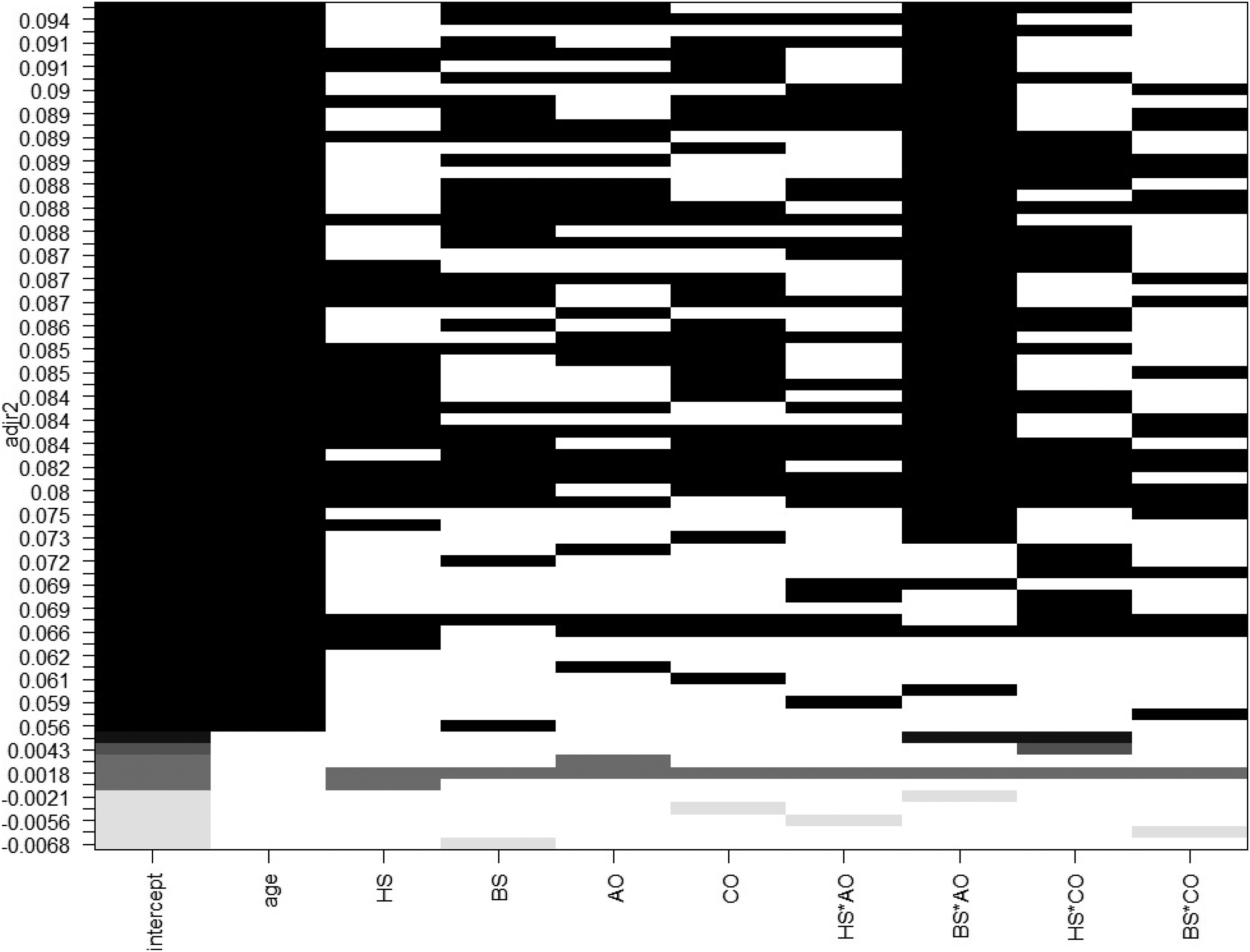
The result of an exhaustive search (all subsets regression) for the best subsets of the nine predictive variables for predicting IPV tolerance. Y axis stands for adjusted R2.

The result of an exhaustive search (all subsets regression) for the best subsets of the nine predictive variables for predicting mental violence. Y axis stands for adjusted R2.
Figure 1 presents the result of the exhaustive search for the best subsets of the nine predictive variables for predicting IPV tolerance. As shown at the top of Figure 1, if the model included age, benevolent sexism, autonomous orientation, the interaction term of benevolent sexism and autonomous orientation, and the interaction term of hostile sexism and controlled orientation, it would have the largest adjusted R square (i.e., >.094). Similarly, Figure 2 shows that age, hostile sexism, and controlled orientation should be included as predictors for the mental violence model.
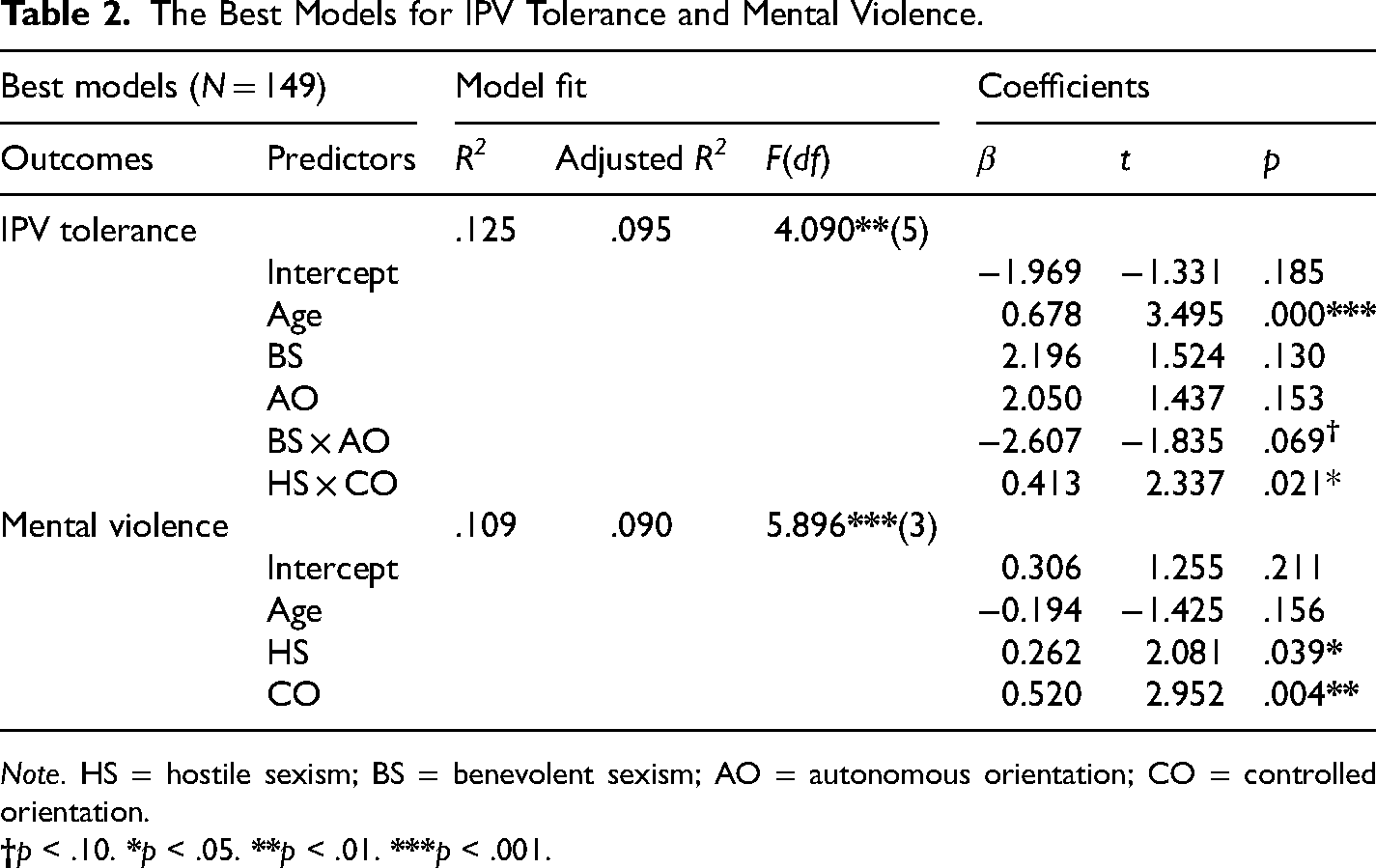
Table 2 presents the results of the all-subsets regression further. Specific to the IPV tolerance model (F = 4.090, p < .01, adjusted R2 = .095), age and the interaction term of hostile sexism and controlled orientation could significantly predict participants’ IPV tolerance (bAge = 0.678, tAge = 3.495, pAge < .001; bHS×CO = 0.413, tHS×CO = 2.337, pHS×CO < .05), suggesting an enhancing effect. Namely, as controlled orientation increases, the relationship between hostile sexism and IPV tolerance becomes stronger. The interaction term of benevolent sexism and autonomous orientation marginally significantly predicted IPV tolerance (b = −2.607, t = −1.835, p = .069), but caution should be taken when interpreting the marginally significant result. In general, the above results demonstrate the existence of the moderating effect of relationship causality orientation on the relationship between ambivalent sexism and IPV tolerance. For the mental violence model (F = 5.896, p < .001, adjusted R2 = .090), the effects of hostile sexism and controlled orientation were positively significant (bHS = 0.678, tHS = 3.495, pHS < .001; bCO = 0.413, tCO = 2.337, pCO < .05).
The Best Models for IPV Tolerance and Mental Violence.
Note. HS = hostile sexism; BS = benevolent sexism; AO = autonomous orientation; CO = controlled orientation.
Discussion
This study investigated how ambivalent sexism and relationship causality orientation impacted IPV tolerance and mental violence perpetration in a Chinese female sample. We found that hostile sexism and controlled orientation are positively associated with mental violence. In addition, the moderating effect of relationship causality orientation on ambivalent sexism and IPV tolerance has been proven.
The Predictions of Mental Violence Perpetration
The present study found that hostile sexism positively predicts mental violence perpetrated by women. Faced with conflicts in intimate relationships, women with higher levels of hostile sexism are more likely to perpetrate mental violence toward their partners. This conclusion is consistent with a previous study showing that hostile sexism could be a risk factor for violence perpetration (Mara et al., 2016). Due to women's attack characteristics, they are more likely to use indirect aggression (e.g., mental violence) (Denson et al., 2018). Although Hammond and Overall (2013) found that women with benevolent sexism have lower satisfaction facing relationship problems and hurtful behavior from partners, less satisfaction does not mean that women perpetrate violence in response to relationship difficulties. A previous study was also consistent with our conclusion, which revealed that benevolent sexism makes women have a lower possibility of challenging gender roles because they have an increased perception of risk and greater behavioral regulation (Expósito & Herrera, 2009). Therefore, compared with women with benevolent sexism, women with hostile sexism are more likely to perpetrate mental violence to express their disapproval of male dominance in their family.
In addition, we found that a controlled orientation can positively predict the mental violence perpetrated by women. People with a higher controlled orientation may experience more anger when discussing relationship problems (Knee et al., 2002). A previous study found that controlled orientation often responds to defense reactions (Øverup et al., 2017). To protect themselves from negative encounters, women with a higher controlled orientation may avoid discussing relationship problems by strategies such as changing the topic or avoiding their partner altogether (Knee et al., 2002), which can become cold violence against their partner. Furthermore, women with a controlled orientation are more likely to adopt behavioral control in their relationship with their sexual partners (Hadden et al., 2015). In Chinese culture, males traditionally dominate intimate relationships, and women with a controlled orientation probably engage in controlling behaviors (e.g., psychological manipulation: verbal aggression, cold violence) to achieve a balance of status in conflicts.
The Moderating Role of Relationship Causality Orientation
Our results suggest that relationship causality orientation moderates the relationship between ambivalent sexism and IPV tolerance. First, as controlled orientation increased, the relationship between hostile sexism and tolerance of IPV became stronger. This conclusion might be explained by the characteristic of controlled orientation, which is similar to a risk factor in the relationship. The higher the controlled orientation, the easier the individual perceives the negative evaluation from the outside world; thus, women with a higher controlled orientation are probably more likely to tolerate relationship problems due to the fear of gossip about failed relationships. For instance, some Chinese women are reluctant to end their marriages despite being in discontented intimate relationships or even experiencing domestic violence. When faced with the threat of the dissolution of the intimate relationship, women with a higher controlled orientation may feel guilty about the relationship's dissolution, fear of losing dependence, criticism, and loneliness because of external pressures. Thus, the controlled orientation may strengthen the relationship between hostile sexism and IPV tolerance.
Second, our study shows that as autonomous orientation increases, the relationship between benevolent sexism and female IPV tolerance becomes weaker. Autonomous orientation has a protective effect on this relationship. A previous study found that increased autonomy was associated with reduced violence (Tenkorang, 2018). Women with a more autonomous orientation will pursue internal desire and more value their privilege (Deci & Ryan, 1985b). In traditional Chinese culture, men pay for dates to show that they can provide material security for women. As a result, some women naturally depend on men financially and lose the desire to acquire wealth independently. However, Chinese women who seek to be independent repeatedly emphasize that they are economically independent and not dependent on men's wealth, so women with a more autonomous orientation may have more choice and follow their hearts when faced with intimate partner conflicts.
Limitations and Directions for Future Research
There are some limitations to the current study. First, this study adopts a cross-sectional design, which does not allow us to draw causal relationships. Longitudinal design or experimental methods can be used in future research to identify several causal relationships between ambivalent sexism and IPV and further explore its mechanism. Second, some researchers consider that self-determination theory (i.e., including cognitive evaluation theory, organismic integration theory, causality orientation theory, and basic needs theory) is helpful for understanding IPV (Øverup, 2017). However, this study focused only on one of the subtheories. Other subtheories under self-determination theory can also be explored. Third, our study tests mental violence perpetration by reading materials that might not be very close to personal experience. Ratings of the likelihood of mental violence perpetration may not fully reflect the actual tendency of the subjects because they may be insensitive to the situation depicted in the material or may deliberately hide their tendency. Future research could use couples’ daily diaries to compare aggression with self-reported aggression to reveal the dynamics of interpersonal conflict and motivation more fully. Finally, this study focuses on measuring explicit aggressiveness. Implicit experiments can be designed to test implicit aggressiveness toward intimate partners in the future. Despite these limitations, we fill remaining gaps in previous studies and innovate in the field of female violence. The current study uses Chinese women as participants to draw more detailed conclusions combining female characteristics and takes into account the sexism existing in traditional Chinese culture. This study explores mental violence and uses causality orientation theory to investigate the individual differences of perpetrators, which may help establish a positive intimate relationship and promote relationship equality.
Conclusion
The relationship causality orientation moderates the relationship between ambivalent sexism and women's IPV tolerance. Specifically, as controlled orientation increased, the relationship between hostile sexism and IPV tolerance was enhanced. As the autonomous orientation increased, the relationship between benevolent sexism and IPV tolerance became weaker.
The level of hostile sexism and controlled orientation can positively predict the mental violence perpetrated by women.
Footnotes
Author's Note
Chunhui Yang is also affiliated at Department of Psychology, Faculty of Social Sciences, University of Macau, Macau, China.
Declaration of Conflicting Interests
The author(s) declared no potential conflicts of interest with respect to the research, authorship, and/or publication of this article.
Funding
The author(s) disclosed receipt of the following financial support for the research, authorship, and/or publication of this article: This work was supported by the Research Center for Applied Psychology of Sichuan Province and Research Center for Sociology and Sex Education of Sichuan Province (grant number: CSXL-202A02, SXJYB2012).
