



Abstract
Obstetric violence has started to attract attention as a form of violence against women. This study aimed to determine and analyze the psychometric properties of a Turkish version of the Obstetric Violence Questionnaire (OVQ). Four hundred sixty-eight women from 19 to 59 years of age (M = 35.28, SD = 7.22) participated. The confirmatory factor analysis confirmed a multifactorial structure of two factors. The Cronbach's α internal consistency coefficients were .72, .70, and .73 obtained for the total scale, abuse and violence, and non-consented care subscale, respectively. The OVQ consisted of 11 items, proving to be a reliable and brief measure.
The World Health Organization (WHO) has recommendations for respectful childbirth care, promoting humanization of care and empowering women to experience of childbirth positively, fulfilling their expectations and beliefs (WHO, 2018). In 2014, the WHO gave a place to the high number of women who experienced disrespectful and offensive treatment during the care received for childbirth in its Declaration on Prevention and Eradication of Disrespect and Abuse during Childbirth Care in Health Centers (WHO, 2015).
The concept of obstetric violence (OV) was first described in Latin American countries in the 2000s (D’Gregorio, 2010). An extensive variation in the prevalence of OV was reported, ranging between 15% and 91% depending on the context (Martínez-Galiano et al., 2021). Factors that make it difficult to determine the prevalence of the OV phenomenon include the small number of studies, the variety of methods and measures used, and the lack of a standard definition of obstetric severity (Scandurra et al., 2022). Although the lack of consensus on how to define and measure violence against women during childbirth care in health centers as recognized by the United Nations Population Fund (UNFPA; Šimonović, 2019), OV is generally used to designate the concept of disrespect and abuse during childbirth, institutional, or structural violence in childbirth care (Bowser & Hill, 2010; Garcia, 2020; Misago et al., 2001). In more detail, OV is used to indicate the existence of unnecessary and harmful practices regarding a woman's health, including relevant actions, conduct, or omissions that dehumanize pregnant women and violate their rights within the healthcare system (Martínez-Galiano et al., 2021). OV might be shown via physical or verbal abuse during delivery, non-consented obstetric procedures, the violation of privacy, and non-recommended clinical practices (Ravaldi et al., 2018; Sando et al., 2017). OV is far beyond this. According to Šimonović (2019) and Diaz-Tello (2016), OV is defined as a form of gender-based violence, inscribed within a broader discourse of structural inequality, discrimination, patriarchy, and lack of access to equality and women's human rights.
A variety of descriptions of OV are based on cultural and linguistic differences, norm behaviors (Freedman & Kruk, 2014), and differences in research methods used in reporting (Vogel et al., 2016). Considering different definitions and measurements of the OV phenomenon, there are several measurement tools developed to measure OV. Castro and Frías (2020) assessed the prevalence and factors associated with experiences of OV by using the 2016 National Survey on Household Relationship Dynamics in a sample of Mexican women. The Mexican version of the scale consists of 13 items with Yes/No answers which indicate two factors; the first one is abuse and violence and the second one is non-consented care Castro and Frías (2020). Scandurra et al. (2022) used the former one to assess the types and incidence of OV with a few additional items in their study consisting of Italian women. Another Italian questionnaire was developed by Ravaldi et al. (2018) to assess abuse and disrespect during childbirth. Limmer et al. (2021) developed a German measurement tool to assess disrespect and abuse of women during childbirth via items comprising indicators of mistreatment during childbirth and discrimination during maternity care. Martínez-Galiano et al. (2021) developed a Spanish questionnaire to assess the types of verbal, physical, and psycho-affective of the OV. In Northwest Ethiopia, Mihret (2019) developed another questionnaire to assess OV that could be used in the Amharic (local) language. Both scale development and adaptation studies and other research studies show that OV is a worldwide issue (Baranowska et al., 2019; Castro & Savage, 2019; Jardim & Modena, 2018; Mena-Tudela et al., 2020; Vedam et al., 2019).
Measuring OV is also very important in terms of determining the relationship between OV and mental health difficulties. For example, having experienced OV increased the reporting of the experience of postpartum depression (PPD; Silveira et al., 2019). In another study, although no valid measurement tool is used for OV, women who experienced OV were found to have an increased risk of developing PPD than women without these experiences (Souza et al., 2017). Similarly, experiencing verbal and psycho-affective OV were among the risk factors for PPD (Martinez-Vázquez et al., 2022). Moreover, birth-related PTSD has been negatively associated with respectful clinical practices and the adoption of a person-centered approach (Hernández-Martínez et al., 2020).
Although review studies on OV have started to be carried out recently in Turkey (e.g., Kaya & Şahin, 2021; Kilci et al., 2020; Odabaş & Taşpınar, 2021), there is not yet a valid and reliable measurement tool developed or adapted to measure OV. Based on the view of Freedman et al. (2014), OV needs to be examined in local contexts, due to differences in inter-countries, inter-cultures, and also maternity care settings. Thus, adapting and validating a Turkish questionnaire on OV is crucial.
This study was carried out to determine the psychometric properties of the Obstetric Violence Questionnaire (OVQ) in a Turkish sample. Specifically, the aims of this study are; in women who had birth experience (a) to determine the factor structure of the questionnaire and (b) to investigate the validity and reliability properties of the questionnaire.
Method
Study Design
A retrospective cross-sectional study was undertaken with Turkish women who had at least one birth experience in their lifespan.
Participants
Purposive sampling was used to target mothers who are 18 years of age and older, had given birth in the Turkey healthcare system to a live infant, do not have any diagnosed mental illness, and whose native language is Turkish.
Procedure
Women were asked to complete the survey using an online survey platform (surveey.com). This study was approved by the Ethical Committee of Ankara University (date: 25.04.2022, No.: 10/123). All the participants were given information about the study and online informed consent was obtained.
Measures
Sociodemographic and Clinical Information Form
This form was created by the author and comprised questions relating to sociodemographic details (e.g., age, educational level, income level, etc.) and birth-related factors (e.g., gestation week, type of delivery, Kristeller maneuver, episiotomy, continuous fetal monitoring, etc.) of the participants.
Depression Anxiety Stress Scale-21
Developed by Lovibond and Lovibond (52), DASS-42 is a 4-point Likert-type scale ranging from 0 to 3. The short form (DASS-21) was developed by Henry and Crawford (2005) and adapted into Turkish by Sarıçam (2018) and consists of 21 items, 7 items for each subscale; depression, anxiety, and stress subscale. The internal consistency coefficients for each subscale were .82, .90, and .93, respectively, and .88 for the total scale. In the Turkish version, internal consistency coefficients for depression, anxiety, and stress sub-dimensions were found to be .87, .85, and .81, respectively (Sarıçam, 2018).
Perinatal Posttraumatic Stress Disorder Scale-II
The scale was developed by DeMier et al. (1996) to investigate the relationship between high-risk birth stress and the development of posttraumatic stress disorder symptoms in mothers, and was rearranged by Callahan et al. (2006) as the Perinatal Posttraumatic Stress Disorder Scale-II (PPQ-II). The scale consists of 14 items and 3 subscales and is scored as 5-point Likert type (0 = never; 4 = often, more than a month). The Turkish version of the scale consists of 13 items and 2 sub-dimensions. The internal consistency coefficient of the original and Turkish version of the total scale was found to be α = .90 (Callahan et al., 2006; Kömürcü Akik & Durak Batigun, 2020). Findings show that the scale is valid and reliable.
Obstetric Violence Questionnaire
The OVQ is a scale developed by Castro and Frías (2020) to understand the severity that may be associated with birth experience. The Turkish adaptation of the OVQ was made within the scope of this study. After permission from the corresponding author, the scale was translated into Turkish using the translation-back translation procedure (Behling & Law, 2000). After this process, a team of six colleagues, including psychologists, nurses, and obstetricians, studied to discuss whether each item was clear and understandable, and the items were finalized. As a result of the validity and reliability analyses carried out within the scope of this study and explained in the following section, the final form consisting of 11 items and 2 subscales was formed. These are (a) abuse and violence (1, 2, 3, 4, 5, 6, 7) and (b) non-consented care (8, 9, 10, 11) subscales. It is requested that the items on the scale be answered by considering the last birth experience. Each factor is calculated as the sum of the answers given to each item. High scores on both factors indicate high levels of OV severity.
Statistical Analyses
First, a confirmatory factor analysis (CFA) was employed in order to test the psychometric properties of the OVQ. To test the factor structure of the OVQ, CFA was conducted with robust maximum likelihood estimation (which is more appropriate for ordinal data; Li, 2016) and covariance matrices. In the analysis, the following criteria were used for acceptable model fit: Chi-square (χ2)/degrees of freedom (df) lower than 3, Comparative Fit Index (CFI), and Goodness of Fit Index (GFI) greater than or equal to .90 and Root Mean Square Error of Approximation (RMSEA) of .08 or less (Byrne, 2016; Hu & Bentler, 1999; Kelloway, 1998; Kline, 2011). In order to compare the nested models, a chi-square difference test was used (Steiger et al., 1985; Tabachnick & Fidell, 2001). Second, in order to assess reliability, internal consistency reliability coefficients of the OVQ total score and its subscales were calculated. Finally, a correlation analysis was conducted to investigate relationships between OVQ scores and other measures of psychological symptoms. All statistical analyses were conducted using SPSS 22 and AMOS 22 statistical packaged software, using a .05 significance level.
Results
Participants’ Characteristics
First, participants’ sociodemographic characteristics, and birth-related factors were assessed. According to the assessment, the data of individuals who did not report the week of gestation (n = 1), whose gestational week was greater than 42 weeks (n = 4), who did not specify the baby's birthdate (n = 1), and who did not give birth in Turkey (n = 3) were not included in the sample. The final sample consisted of a total of 468 women between the ages of 19–59 (M = 35.28, SD = 7.22). Participants’ characteristics are reported in Table 1.
Descriptive Characteristics of Study Sample.

Note. M = mean, SD = standard deviation.
Types and Prevalence of Obstetric Violence
Two hundred and four women (43.6%) experienced symptoms from at least one of the OV in their last birth. Of them, 199 (42.5) had experienced at least one type of abuse and violence, and 20 (4.3%) had experienced at least one type of non-consented care (Table 2).
Types and Prevalence of Obstetric Violence.

Refers to the items that provide additional information, not included in OVQ. These items also were not included in the calculated percentages for abuse and violence, non-consented care, and OV.
Percentage calculated on the total of participants who gave birth vaginally.
Percentage calculated on the total number of participants who gave birth by C-section.
Factor Structure of the OVQ
According to the CFA results made by assigning 14 items in the scale to the factors suggested in the original study, the items that had statistically significant factor loadings (p > .05) were excluded from the analysis and the analysis was repeated. As a result of the CFA, the items in each factor and the item loadings are presented in Table 3.
Factor Loadings of the OVQ.
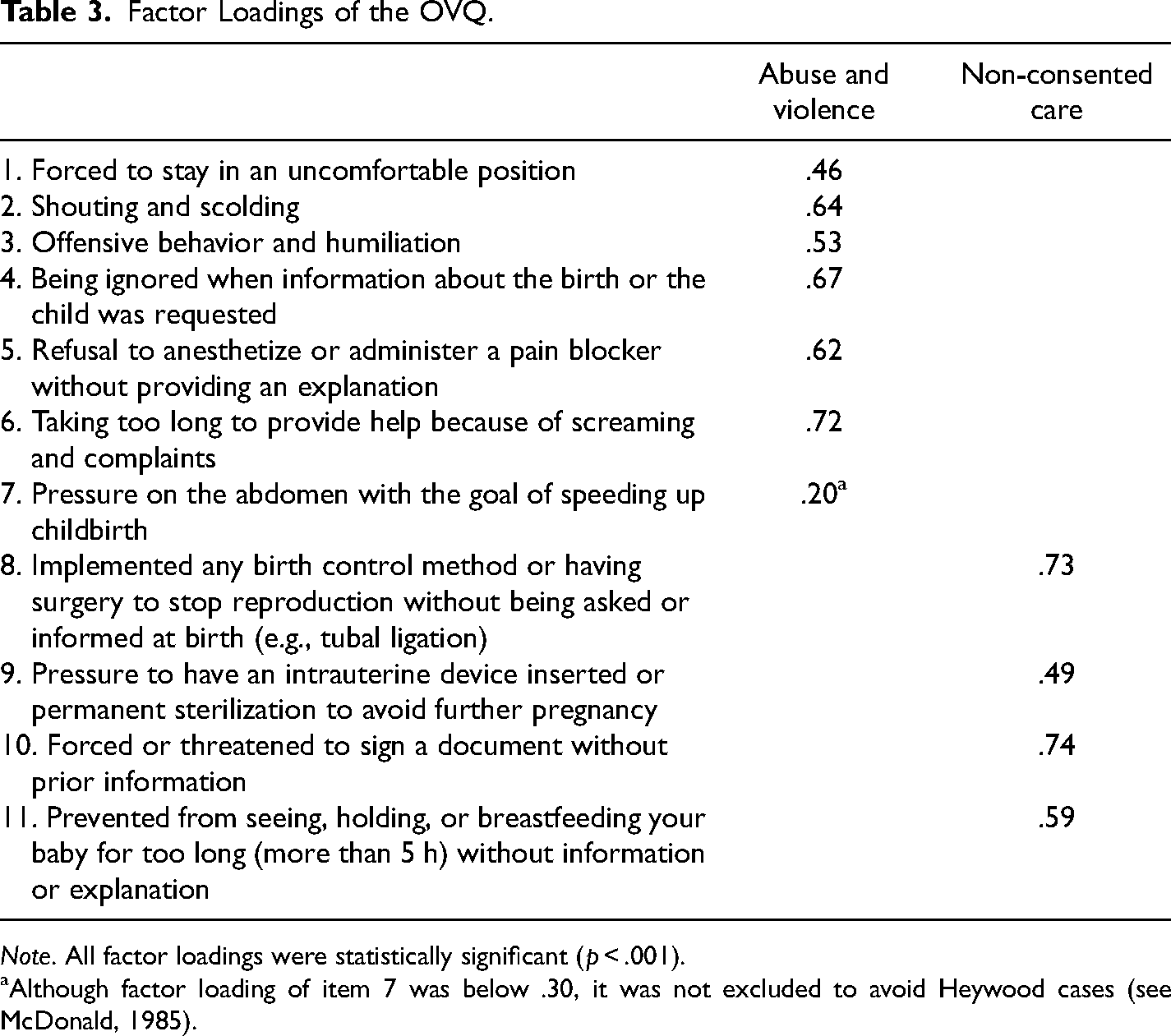
Note. All factor loadings were statistically significant (p < .001).
aAlthough factor loading of item 7 was below .30, it was not excluded to avoid Heywood cases (see McDonald, 1985).
As can be seen in Table 3, item loads in the first factor, abuse and violence, vary between .46 and .72, except for one item with a loading value of .20. The item loads in the second factor, the sub-dimension of care without consent, ranged from .49 to .74.
According to the results of CFA, road diagram and goodness-of-fit criteria were taken into consideration in the evaluation of CFA. CFA was performed with the 15-item version of the scale, and it was seen that the fit indices were not within acceptable limits (χ2 = 673.89, SD = 89, χ2/SD = 7.57, p < .001, CFI = .65, GFI = .84, AGFI = .78, IFI = .66, RMSEA = .12). Four items that did not load the relevant factor statistically significantly (e.g., episiotomy, continuous electronic fetal monitoring despite the absence of a risky pregnancy, information on why cesarean is necessary, and authorization for cesarean section) were not included in the analysis (p > .001). The CFA results performed again after removing the four items in question showed that the scale had acceptable fit indices (χ2 = 112.17, SD = 43, χ2/SD = 2.61, p < .001, CFI = .94, GFI = .96, AGFI = .94, IFI = .94, RMSEA = .06).
Reliability of the OVQ
In order to demonstrate the reliability of the OVQ, the Cronbach alpha reliability coefficients were found as .72 for the total score of OVQ; as .70 for the “Abuse and violence” subscale and as .73 for the “Non-consented care” subscale.
Validity of the OVQ
The correlation coefficients between the OVQ total score and its subscales, and PPQ-II and depression, anxiety, and stress scores are presented in Table 4.
Correlations Between OVQ and Study Variables.
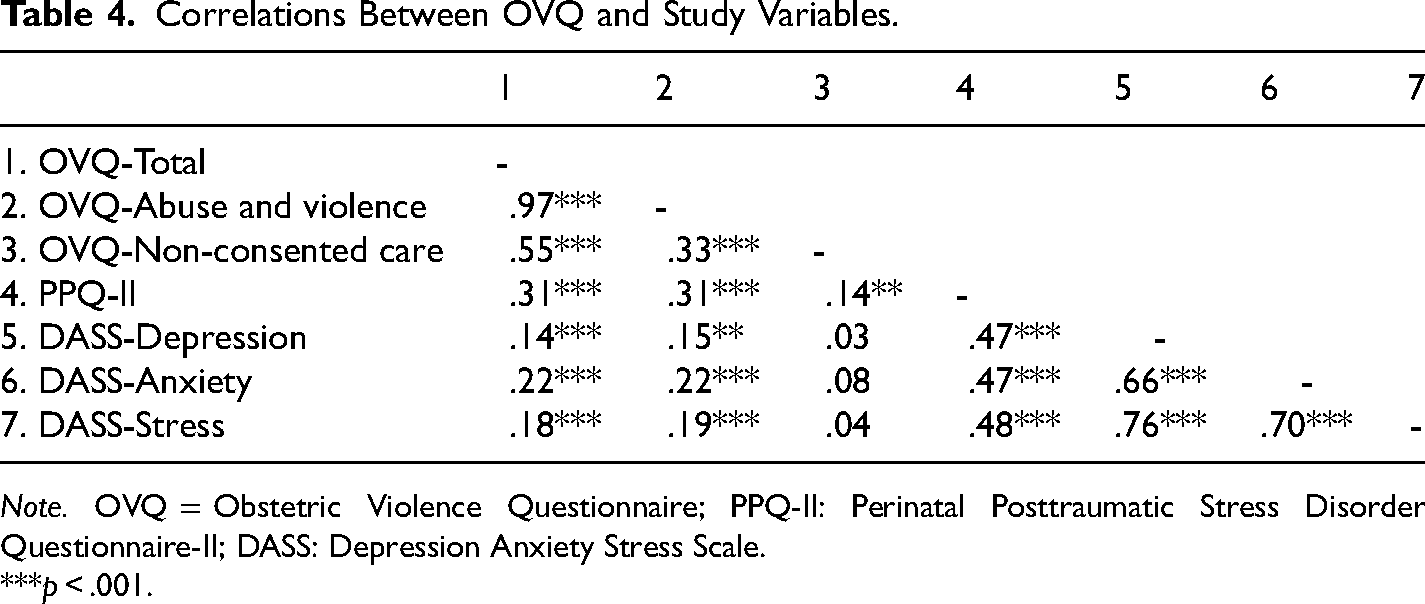
Note. OVQ = Obstetric Violence Questionnaire; PPQ-II: Perinatal Posttraumatic Stress Disorder Questionnaire-II; DASS: Depression Anxiety Stress Scale.
***p < .001.
As can be seen in Table 3, the relationships between the total score of OVQ and its subscales and other scales are generally in the expected direction and are statistically significant.
Discussion
The purpose of the present study was to investigate the psychometric properties of the original version of the OVQ with additional items among Turkish women. Our findings demonstrated that the original two-factor structure of the OVQ (i.e., “abuse and violence” and “non-consented care”/13 items; Castro & Frias, 2020) did not fit the data very well in our sample. Two items on the original scale (information on why cesarean is necessary, and authorization for the cesarean section) were excluded from the questionnaire. However, the item regarding which was thought to be associated with abandonment of care but was not included in the scale because it was not loaded on any factor in the original study (Castro & Frias, 2020), was loaded on the non-consented care subscale in our study (“Were you prevented from seeing, holding, or breastfeeding your baby for more than 5 h for no reason or without being told of a reason for the delay?”). In addition, of three items added by us based on the relevant study by Scandurra et al. (2022), two items (episiotomy, continuous electronic fetal monitoring despite no high-risk pregnancy) were removed from the Turkish version of OVQ, but an item regarding Kristeller maneuver was not removed. This result may be explained by the possible differences in women's health practices in both countries. For example, applications in which the reason for the cesarean section is not explained or permission is not obtained are not carried out in Turkey, or if any, they did not take place in our sample. Thus, the removal of items related to cesarean sections could be evaluated as plausible. In addition, interventions such as episiotomy and continuous fetal monitoring may be perceived by women as interventions to facilitate delivery. A similar result was obtained in another study for a similar intervention, amniotomy (Gökçe İsbir et al., 2022).
Consequently, when four items were omitted, the confirmatory factor analyses of the two-factor OVQ did yield sufficient results. The CFA showed an acceptable model fit for the 11 items OVQ. This version of OVQ had promising psychometric properties to measure various concepts of OV.
The results of the reliability analyses confirm the internal consistency of the two-factor OVQ among our sample. Internal consistencies of the OVQ (Cronbach's α = .72 for total score, .70 for abuse and violence, and .73 for non-consented care) indicated an acceptable level of reliability, and they are considered sufficient in terms of obtaining information about OV.
Convergent validity of the OVQ subscales was explored with the PPQ-II and DASS. The correlation coefficients between all variables were statistically significant and positive, except for the relationship between the non-consented care subscale and the subscales of DASS. Thus, future research should be undertaken to investigate the relationship between the concepts of non-consented care and mental health comprehensively. In line with our findings, one study showed a strong association between OV and PPD (Souza et al., 2017). In addition, in recent years, an increasing number of studies showed that negative birth experiences could have serious effects on postpartum PTSD (Dekel et al., 2017; Martinez-Vázquez et al., 2021). Similarly, in another study by Scandurra et al. (2022), it is found that the abuse and violence subscale of OV had a higher correlation with DASS-21 (r = .44, p < .001) and IES-R (r = .55, p < .001); showed that non-consented care had a lower correlation with DASS-21 (r = .12, p < .05) and IES-R (r = .16, p < .01). In addition, the two-factor OVQ has sufficient psychometric properties for validity using both subscales separately and the total score of the scale alone. Both options are beneficial and accurate to interpret the findings. Further, the subscales of the two-factor OVQ were also found to be intercorrelated in a positive direction. This finding is in line with another study on OV (Scandurra et al., 2022). Taken together, the correlations between these scores reveal that the OVQ has sufficient validity.
Limitations and Strengths
The current study presented a valid and reliable measurement for the quantitative evaluation of OV in Turkey, addressing two domains (obstetric abuse and violence and non-consented care). The study demonstrated that childbearing women's experiences of OV is a relevant phenomenon in Turkish maternity care. The current study suggested the OVQ has the potential to be useful to measure OV. However, it had several limitations to acknowledge. First, the sample was composed of highly educated women. Using a specific population to validation of the instrument could hinder the instrument from being used with the general population. Thus, when using OVQ in a different population will call for revalidation at least re-reliability by checking internal consistency coefficient. Therefore, the results may not be generalized to other populations. Future research should seek to validate the Turkish version of the OVQ and confirm the factor structure of its in low-educated populations. Second, the study was conducted based on cross-sectional and correlational design, limiting the ability to draw any causal conclusions. Third, the limits of self-report measurements must also be considered. The OVQ has very private items regarding birth experiences.
Consequently, besides limitations, this study has some strengths. To our knowledge, OVQ is one of the initial measurements to provide a chance to examine OV in Turkey. Considering the prevalence of OV (43.6%), it is crucial to work on determining OV in terms of women's postpartum health. These findings highlight an inevitable need to increase awareness of professionals to help with identification of OV. Additionally, due to the possible association between OV and postpartum mental health problems, by providing respectful, dignified, consented, and supportive obstetrics care to women during childbirth, maternity care providers play a significant role in preventing postpartum mental health difficulties. The current study is one of the limited studies that assessed associations between OV and symptoms of perinatal posttraumatic stress disorder (P-PTSD). Convergent validation against a measure of P-PTSD is a solid contribution to the testing of the validity and utility of the OVQ. This finding was in line with the results of another study, which is showing the relationship between disrespect and abuse and postpartum PTSD (Limmer et al., 2021). In addition, there was no effect of time elapsed from childbirth on women's OV scores. To sum up, the results indicated that the Turkish version of the two-factor structure of the OVQ appears to be a valid and reliable measure of OV. Moreover, the two-factor OVQ offers a brief and user-friendly measurement tool. The adaptation of OVQ is intended to lead to further research on OV itself, and especially with regard to postpartum mental health. The present study also offers possibilities to conduct cross-cultural research regarding OV and associated factors.
Footnotes
Acknowledgment
I would like to thank Elife Nur Özsoy, Meryem Demir, and Şeyma Nur Kula for admitting this research project idea as their bachelor thesis, for assistance with ethics committee application form, and for helping data collection to finalize this study.
Declaration of Conflicting Interests
The authors declared no potential conflicts of interest with respect to the research, authorship, and/or publication of this article.
Funding
The authors received no financial support for the research, authorship, and/or publication of this article.
