



Abstract
This research evaluates whether third-party presence is associated with rape and sexual assault (RSA) victims help-seeking and reporting to police, addressing a gap in the literature about how the presence of a third-party is associated with victim behavior. This research uses secondary data from the National Crime Victimization Survey (NCVS). Findings indicate that third-party presence has no statistically significant association with help-seeking and marginal significance with police reporting. This research focuses on third-party presence as a precursor to understanding victim help-seeking behaviors and reports to police. This research raises questions about the expected role of third parties in RSA victimizations.
Despite ample research about sexual victimization, third-party presence 1 and victim behavior post-victimization, little is known about the association between the presence of a third-party during a rape and sexual assault (RSA) and victims’ subsequent behaviors. 2 Extant third-party literature focuses on understanding the effectiveness of third-party intervention training by measuring the impact third parties have on one another (Bickman & Rosenbaum, 1977), the impact third-party intervention training has on the acceptance of rape myths (Coker et al., 2011), a third-party's intent to help (Banyard, 2011; Banyard & Moynihan, 2011), and factors related to the likelihood of a third-party intervening (Bennett et al., 2017; Fischer et al., 2011; Palmer et al., 2018).
Most RSA scholarship focuses on victim, offender, and incident characteristics and how they are related to victim help-seeking and police reports (Addington & Rennison, 2008; Bachman, 1998; Felson et al., 1999; Kaukinen, 2004; Rennison, 2002; Ullman & Filipas, 2001; Zaykowski, 2015), or perceptions of the assault such as believability, fear of retaliation, being blamed, shame, and fear of the treatment by the criminal justice system itself (Bachman, 1993; 1998; Campbell, 1998; Chen & Ullman, 2010; Pinciotti & Seligowski, 2021; Wolitzky-Taylor et al., 2011).
Despite extant research examining RSA victims and their behaviors, a gap exists: namely, the literature lacks a foundational knowledge of how third-party presence during an RSA victimization is associated with post-victimization behavior. The purpose of this research is to begin understanding how third-party presence is associated with RSA victim help-seeking and reports to police.
Understanding the association between third-party presence and victim help-seeking and reports to police adds to the current knowledge by uncovering more about the basic tenants of third-party intervention and behavior. Research regarding third-party intervention needs to establish a baseline of behavior, which means focusing on victim behavior in real cases of RSA, where a third-party was present. This baseline of behavior is the key to our understanding of victim behavior and the potential of third-party intervention strategies to be beneficial to the victim.
This research also raises additional questions, including: Could third parties offer greater benefits beyond potentially stopping RSA? Is there a secondary role expected from third parties, including guiding victims to police and helpful resources? This research acts as an initial step in answering these questions. The questions: How is the presence of a third-party during victimization associated with RSA victim help-seeking and how is the presence of a third-party associated with reports to police, guide this research.
To address this topic, the paper is structured as follows. First, a review of the literature outlines current understanding of the RSA victimization, help-seeking, police reporting, and research about third-party intervention. Next, there is a description of methods, data, case selection, measures, and analytic techniques. Finally, we present and discuss the findings.
Literature Review
Third-Party Presence
This research uses “third-party presence” to assert that victims report there was someone other than themselves and the offender(s) present during their victimization. Examining how victim behavior is associated with the presence of a third-party is important because third parties are present in 30% of RSA victimizations 3 and victims may make decisions based on it. Additionally, this research focuses on presence because most third parties who are present during victimizations do not engage nor act (see e.g., “bystander effect” (Latané & Darley, 1970). Understanding whether victim behavior is associated with third-party presence is a critical first step in understanding more about the potential role third parties could play in victimization contexts.
Descriptives of Rape and Sexual Assault Victim, Offender, and Incident Characteristics, NCVS Q3 2008-Q4 2020.
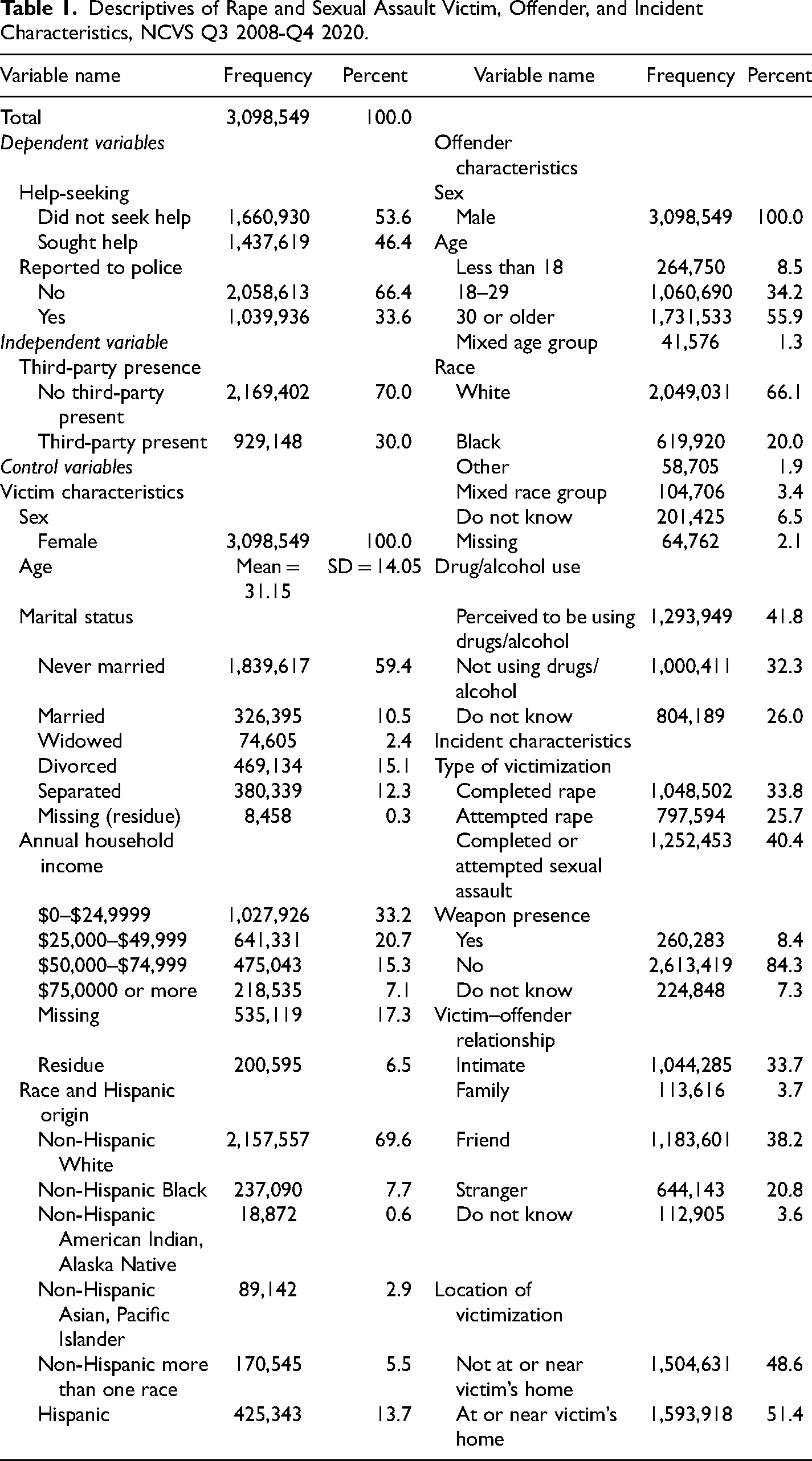
Although not the focus of this research, there exists a robust amount of research about third-party intervention. The majority of research related to third parties examines the effectiveness of intervention training (Coker et al., 2011), assesses the likelihood a third-party will intervene based on vignette scenarios (Bennett et al., 2017), and compare contextual variables and personal characteristics with a person's intent to act (Banyard, 2011; Bennett et al., 2017; Franklin & Garza, 2021; McMahon et al., 2020) These studies miss a critical part of this research: focusing on the victim's actions and examining outcomes based on real data. To understand this research, there are a few critical areas of research to understand.
Sexual Violence
Given this research focuses on victims of RSA, it is important to know that sexual victimization is a major societal concern. Research demonstrates that at least 1 in 6 American women and 1 in 33 American men has been the victim of an attempted or completed rape in their lifetime (Rape, Abuse, & Incest National Network [RAINN], n.d.; Tjaden & Thoennes, 2006). These numbers are best-estimates based on reported information gathered through formal police data (e.g., National Incident-Based Reporting System [NIBRS]) and victimization surveys (e.g., National Crime Victimization Survey [NCVS]; National Victimization Against Women Survey [NVAWS]). Each of these data sources, while valuable, underestimate the degree of RSA they measure (DeKeseredy & Rennison, 2019).
Extant research on sexual victimization demonstrates that RSA victims are most often girls and women, assaulted by boys and men, and do not report to the police (Addington & Rennison, 2008; Ahrens & Campbell, 2002; Mulder et al., 2021; Sampson & Lauritsen, 1994). There are several reasons why victims may choose to report their victimization including personal choice, prior experience with police, acceptance of rape myths, and feelings about how officers and the criminal justice system treat victims (Fisher et al., 2003).
While some research has included third-party presence as a correlate, most has neglected to make third-party presence the focal point of understanding the relationship between presence and victim behavior (see e.g., Addington & Rennison, 2008). The majority of prior research relies on using vignettes and asking respondents to report how they may respond based on the hypothetical scenario presented to them. Current research needs to understand how third-party presence is associated with post-victimization behaviors in actual instances of RSA. This information is an important first step in understanding the role third parties may have on victims’ help-seeking and reports to police.
Informal Help-Seeking
Research indicates that victims are more likely to engage in informal help-seeking than formal help-seeking with police (Ahrens & Campbell, 2002; Ahrens et al., 2007; Campbell et al., 1999; Kaukinen, 2002, 2004; McCart et al., 2010). Specifically, RSA victims prefer to seek help from family and friends (Ahrens & Campbell, 2002; Ahrens et al., 2007; Kaukinen, 2002; Kaukinen & DeMaris, 2009; Mennicke et al., 2021). For victims who only engage in informal help-seeking, they report experiencing less stereotypical assaults (man against woman, stranger, with a weapon, injured), fewer PTSD symptoms (see Addington & Rennison, 2008; Bachman & Paternoster, 1993), and fewer negative social reactions (Ahrens et al., 2007; Starzynski et al., 2005).
Victim and incident characteristics such as age, gender, victim/offender relationship, race, victim income, injury, and weapon presence also play a role in help-seeking behaviors (Campbell & Martin, 2002; Kelley et al., 2021; Zaykowski, 2011, 2014, 2015). Kaukinen (2004) found that White women and victims of intimate partner violence (IPV) are more likely to engage in seeking help from family, friends, and other social services (p. 984). Prior research in this area demonstrates how victim help-seeking are specific behavioral strategies and that victim, offender, and incident characteristics play a role in these decisions (Campbell et al., 2001; Starzynski et al., 2005, 2007).
Other research suggests that the victim–offender relationship and victim race play a role in whether a third-party would suggest to the victim that they seek help (Franklin & Garza, 2021). Despite the utility in understanding that referrals for help are likely to increase when the offender is a stranger and that victim culpability is related to race when the victim is Black, this research uses vignettes and a sample limited to college students (Franklin & Garza, 2021). Although prior research is helpful for understanding some of the factors that are associated with victim decisions to seek help, they do not include third-party presence as a key variable. It is beneficial to the current literature to understand victim help-seeking and reports to police.
Reporting to Police
Victimization research has widely investigated reports to police post-RSA victimization. Research finds that sexual violence often goes unreported, with estimates that 18% of completed rapes and 24% of attempted rapes reported to the police (Rennison, 2002; Tjaden & Thoennes, 2006). Sexual violence has low police reporting rates regardless of the time period (year(s) that the victimization occurred) or data source used (NIBRS, NCVS, NVAWS all show low rates of reporting to police). Formally reporting RSA victimization is typically associated with certain factors, including weapon presence, injury, multiple offenders, co-occurring crimes, and the victim's relationship to the offender—reflecting the role of rape myths in post-victimization decision making (Addington & Rennison, 2008; Baumer et al., 2003; Du Mont et al., 2003; Fisher et al., 2003; Gartner & Macmillan, 1995).
RSA victimizations are chronically underreported to the police for a variety of reasons. Most research finds that the acceptance of rape myths, by victims, third parties, and officers, including feelings of shame and blame by victims, contributes to the underreporting of these crimes (Kruttschnitt & Carbone-López, 2009). Additionally, victims fear the second rape, which refers to the feelings of revictimization victims experience navigating the criminal justice processes (Campbell et al., 2001; Gamble & Madigan, 1991).
Some research has examined the experiences of victims who consulted with others and received advise on reporting to police (Bickman & Rosenbaum, 1977; Paul et al., 2014). Paul et al. (2014) found that victims who were encouraged to report to the police were more likely to do so, compared with victims who were discouraged or did not consult with anyone. However, this research also found support for other mitigating factors, including those related to common rape myths and health concerns, served as predictors for reports to police (Paul et al., 2014).
Research conducted by Henry et al. (2021) suggests that people who receive an RSA disclosure are likely to recommend reporting to the police if they view procedural justice positively. This research supports other studies that find that rape myth acceptance plays a role in responding to victimizations and often decreases the likelihood of suggesting victims report to the police (Henry et al., 2021).
Based on prior research, the presence of a third-party during a victimization may provide victims with feelings of legitimacy regarding their victimization because someone else was there (Campbell & Johnson, 1997). However, most research neglects to consider the actual cases (not hypothetical vignettes) of RSA and how victim behavior was associated with third-party presence. A person being present does not necessarily mean a victim will feel more confident in reporting to the police. Factors related to the characteristics of the third-party (i.e., race, gender, relationship to the victim or offender) may affect victim decisions (Felson et al., 1999). Given this, it is critical to examine how third-party presence is associated with police reporting, by providing a foundation of information to build on.
Method
Data
To address the research questions NCVS data are used. These data are gathered on an ongoing basis from a large, nationally representative sample of housing units and noninstitutionalized people ages 12 and older in the United States. Each year, roughly 150,000 housing units are drawn into sample via a stratified, multi-stage cluster approach. In each household, all members aged 12 or older participate in interviews both in person and over the phone every 6 months. Households participate for three and a half years. Respondents are asked about victimizations using a 6-month reference period (Rand & Rennison, 2005; Rennison & Powers, 2020).
NCVS Data Advantages
An advantage of the NCVS is it is a large, representative sample of persons aged 12 and older living in housing units in the United States that is characterized by high response rates. Additionally, it gathers in-depth victimization information including victim characteristics (i.e., age, race, marital status, income, and sex), offender characteristics (i.e., perceived age, race, sex, and victim–offender relationship), and incident characteristics (i.e., time, location, weapon use, injury, reports to police, and help-seeking behaviors). This allows researchers to control for relevant correlates. Another advantage of the NCVS is that it includes victimizations reported and unreported to police. Since RSA is chronically underreported to the police, the NCVS including victimizations both reported and unreported is beneficial because it captures more information about RSA victimizations.
NCVS Data Limitations
The NCVS data also have limitations, including that it fails to ask about sexual violence behaviorally specific ways meaning current NCVS measurement leads to an underestimate of incidents (Fisher, 2009). NCVS data gathers little information about third parties, but includes whether a third-party was present, if there was a report to police, and victim perceptions of how actions (if taken) by the third-party “helped” or “harmed” the victim. 4 The NCVS does not gather any other characteristics about the third-party.
NCVS data excludes the experiences of those living outside of housing units including people experiencing homelessness, those in shelters (domestic violence), prisons, and in military barracks. Like all samples, the NCVS has sampling error.
Finally, a perennial issue with measuring victimization is how to deal with series victimizations which are ongoing in nature, in contrast to discrete violent events. This research uses the Lauritsen et al. (2012) protocol which enumerates series victimizations based on the victim's estimate of the number of times the victimizations occurred during the 6-month reference period, with a maximum of ten victimizations.
Case Selection
This research includes all cases of threatened, attempted, and completed RSA perpetrated against girls and women from 2008 to 2020. 2008 is the starting year given key questions related to the help-seek variable were added then. 2020 is the most current year of data available. This research includes victims who identify as female. 5 This research focuses on RSA victimizations. Rape includes verbal threats of and forced sexual intercourse including psychological coercion and physical force. Forced sexual intercourse includes vaginal, anal, or oral penetration by the offender(s) using body parts or foreign objects. Sexual assault includes a broad variety of victimizations including verbal threats of, attacks, or attempted attacks of unwanted sexual contact which may or may not involve force (e.g., grabbing or fondling). In the NCVS, rape can occur between two people of the same or different sex, but this research includes male perpetrators because they make up the vast majority of RSA offenders. 6
Following this case selection procedure, the final sample includes 3,098,549 weighted cases (survey weighting is done to account for the complex sampling of the NCVS) and 838 unweighted cases (survey weighting in Stata to ensure regression results are not all significant because of the large n of weighted cases) of RSA victimizations (see Hosmer & Lemeshow, 2000; Levy & Lemeshow, 1999).
Measures
Dependent Variables
Two dependent variables are examined: help-seeking and reports to police. The help-seeking variable was constructed using three NCVS items: (a) “Sought professional help for feelings experienced as a victim,” (b) “Help from victim agencies,” and (c) “Got medical attention from friend/family/neighbor.” If the victim responded “yes” to at any of these items, they were coded “1.” Others were coded “0.”
The police reporting variable indicates whether the violence was reported (coded as 1) or was not reported (coded as 0). If the victim was unsure if the victimization was reported, it was coded as 0.
Independent Variable
The independent variable is the presence of a third-party during the RSA which is defined as someone who is present for the victimization who is not the victim or the offender(s). Victimizations with a third-party present were coded as a “1.” When victims stated no third party was present, they were coded “0.” If a victim did not know if a third-party was present during the victimization, it was coded “0” because we assume that if the victim did not know if there was a third-party present, they most likely acted in a way that is congruent with no third-party presence.
Control Variables
The analyses include a number of control variables, including victim characteristics (age, race/Hispanic origin, marital status, and annual household income), offender characteristics (age, race/ethnicity, and perceived drug/alcohol use), and incident characteristics (victim–offender relationship, weapon presence, location of victimization and nature of RSA). See Appendix for additional information.
Analytic Strategy
The analyses include descriptive statistics of the sample and binary logistic regressions using the appropriate statistical weights from the files. Binary logistic regression is appropriate given the dependent variables are dichotomous (Hosmer & Lemeshow, 2000). The regressions use Taylor series linearization to account for the complex sample design of the NCVS and allows for accurate significance testing of the coefficients (Levy & Lemeshow, 1999). One limitation in adjusting for the complex sampling is the inability to estimate traditional goodness-of-fit diagnostics for these models, therefore they are not presented (Hosmer & Lemeshow, 2000).
Findings
Descriptive Analysis
Most RSA victimizations were sexual assaults (40%), followed by completed rapes (33.8%), and attempted rapes (26%). Less than half (46%) of RSA victims engaged in help-seeking after the victimization, and about one-third (33.6%) of victimizations were reported to the police. Almost one-third of RSA included a third-party (30%). The average age of RSA victims is 31 years (14.05 SD). Victims are predominantly non-Hispanic White (70%), have never been married (59%), and have an annual household income of less than $24,999 (33%). Most offenders are 30 years or older (56%), White (66%), and known to the victim. Just over one-third (34%) of the offenders are intimate partners, and 38% are friends. About half (51%) of RSA occurs at or near the victim's home, and most did not involve an armed offender (84%). See Table 1 for more information.
RQ1: Third-Party Presence and Help-Seeking
The first research question examines if third-party presence is associated with RSA victim help-seeking. Table 2 shows that third-party presence is not statistically associated with victim help-seeking (p = .16). While third-party presence is not associated with help-seeking, several correlates are.
Third-Party Presence and RSA Victim Help-Seeking, NCVS Q3 2008-Q4 2020.

Note. Unweighted n = 838; weighted n = 3,098,549.
*p < .0.5. **p < .10.
Seeking help is significantly related to a victim's annual household income, with the odds increasing nearly 3.5 times for those in an income range of $25,000 to $49,999 (compared to victims with an annual household income of $75,000+; p = .03). Additionally, the odds of help-seeking increase more than 5 times when the offender is a family member (p = .01) but decrease 57% when the offender is a stranger (compared to a friend; p = .01).
The odds of a victim seeking help also decreases 68% when the offender is 18 to 29 years old (p = .01) and 74% when the offender is over 30 years old (p = .01). Victims’ odds of help-seeking decrease significantly (66%) when the victim experiences an attempted rape (p ≤ .01), or sexual assault (68% decrease; p ≤ .001), compared to victims who experienced a completed rape.
RQ2: Third-Party Presence and Police Reporting
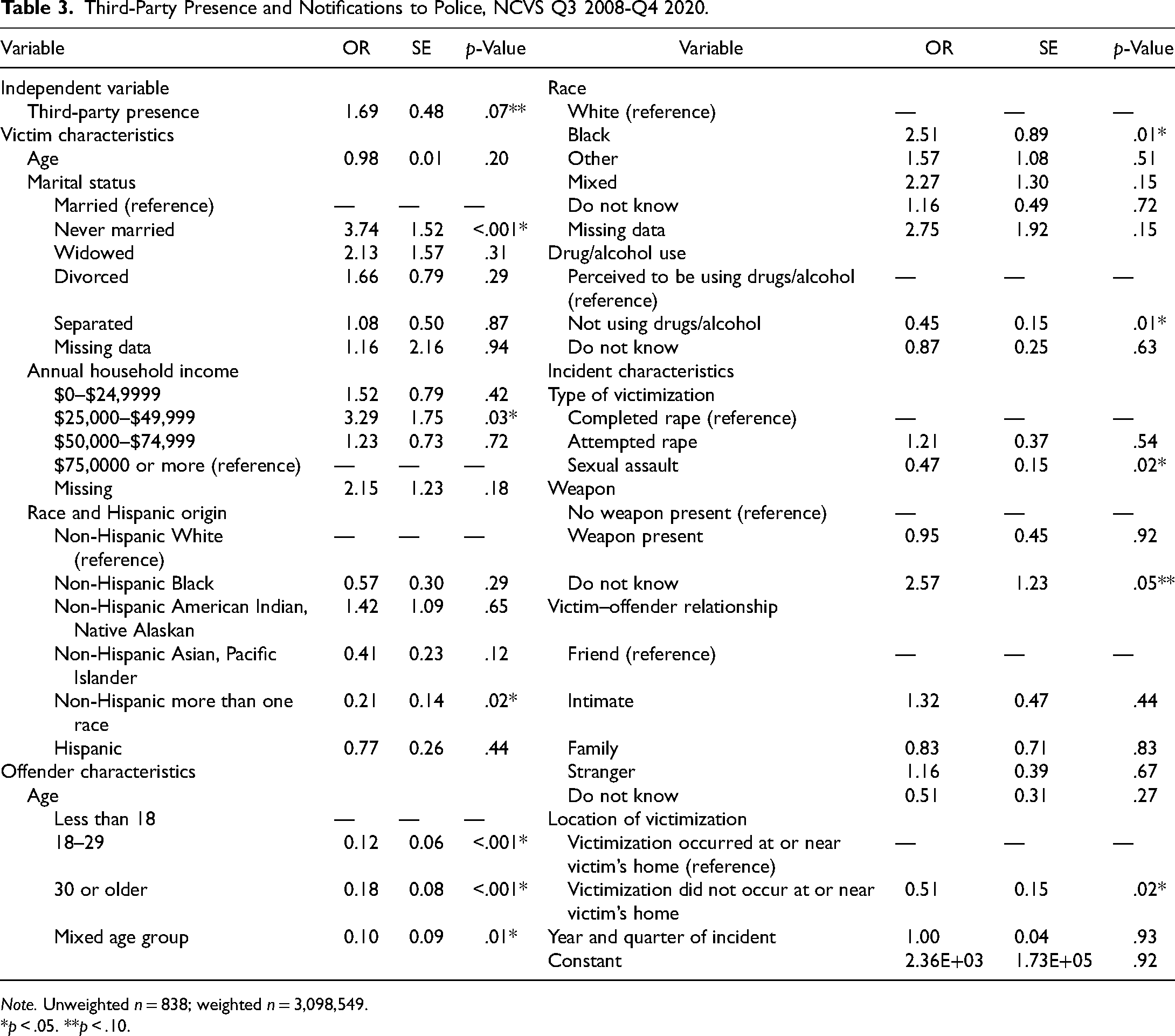
Research question two examines how third-party presence is associated with RSA police reporting. Table 3 demonstrates that third-party presence is marginally related to police reporting (p = .07). There are several other variables that are associated with reports to police.
Third-Party Presence and Notifications to Police, NCVS Q3 2008-Q4 2020.
Note. Unweighted n = 838; weighted n = 3,098,549.
*p < .05. **p < .10.
The odds of reporting to police increase about 4 times when the victim has never been married (compared to victims who are married; p ≤ .001). The odds of reporting to police increase over 3 times when the victim's annual household income is $25,000 to $49,9999 (compared to victims with an annual household income of $75,000+; p = .03).
The odds of police reporting decreases 79% when the victim is non-Hispanic and more than one race (compared to White; p = .02). Reports to police increase 2.5 times when the offender is Black (compared to White; p = .01).
The odds of reporting to police decrease 53% when the victim experienced a sexual assault compared to a completed rape (p = .02), and 49% when the victimization occurred away from the victim's home (p = .02). The odds of reporting to police decrease across the board based on the offender's age: 88% when the offender is 18 to 29 years old (p ≤ .001), 82% when the offender is 30 years or older (p ≤ .001), and 90% when the offender group was of mixed ages (p = .01). When the offender is perceived as not using drugs or alcohol, the odds of reporting to police decreases 55% (compared to offenders who are perceived to be using drugs or alcohol; p = .01).
Discussion
This research examined the association between third-party presence during an RSA victimization and victim help-seeking and reports to police post-victimization. Findings show that third-party presence is unrelated to RSA victim help-seeking but has a marginal association (p < .10) to police reporting, controlling for relevant correlates. These findings are intriguing, given social and theoretical assumptions that third-party presence offers beneficial outcomes. These findings are difficult to place within the current literature because there is little research examining these relationships.
Given prior police reporting research, it is reasonable that the likelihood of police reporting would increase with third-party presence. Although the current research cannot answer why this is, prior research suggests that people are more comfortable reporting to the police when a third party was present as they can support them, act as a witness, and help add to feelings of legitimacy related to the victimization (Baumer et al., 2003; Du Mont et al., 2003). It is also possible that the third-party encouraged the victim to make a report to police or reported to the police themselves.
This analysis finds no significant relationship between third-party presence and victim help-seeking. Based on prior research showing that victims reach out to friends, family, and victim services most often (Kaukinen, 2002, 2004), we expected that victims would be more likely to seek out these options when a third-party was present. Additionally, based on what we know about third-party intervention training, we would expect that a third-party would encourage and support a victim in help-seeking behaviors (Coker et al., 2011; Paul et al., 2014).
However, our research does not support these assumptions. Research that includes more information about the characteristics of the third-party may provide greater understanding. Having more demographic information about the third-party would help confirm how individual and contextual factors may affect third-party and post-victimization behavior. Knowing about feelings of shame that surround RSA victimizations, it is entirely possible that victims just do not feel comfortable seeking help, feelings that witnesses to their victimization may exacerbate.
Critically, the current results may be useful for informing the purpose and practice of third-party intervention training models. It is important to understand why the current research found no statistically significant relationship between third-party presence and help-seeking, and marginal statistical significance to police reporting, given the assumptions made about third parties and intervention. There are several factors that may explain these findings.
First, the third-party may not have known what was happening, so they did not have the opportunity to intervene or engage meaningfully with the victim. An example may be a sexual assault on a crowded bus. This would essentially nullify their assumed actionable role as a third-party, who has the ability to engage in any sort of recourse with the victim.
A number of factors could explain the finding related to police reports and third-party presence. First, it is possible that the third-party was a police officer or some other official, which would make the police knowing automatic. Second, since we do not know when police received a report of the victimization (instantly or weeks later), it is possible that victims thought about it, sought help, or engaged in other behaviors that led to their decision to report to police. Additionally, it is possible that the third-party notified the police, or a household member did.
Finally, it is possible that a victim having a third-party present sees that as enough help-seeking. Victims may not want to reach out to anyone else because they already have someone who witnessed and interacted with them after the incident. Or they may not want to relive the experience with anyone else. These findings and questions warrant further investigation.
Overall, it is surprising to find that third-party presence is statistically insignificant when it comes to victim help seeking behaviors. It certainly calls into question assumptions about the purpose and role third parties are expected to play in the victimization context. Future evaluations should include thinking about such questions as: What role do we want third parties to have? Should that role lead to increased odds of victims seeking help? If yes, then intervention training programs may need to revisit how they can train third parties to not just prevent or stop RSA, but how to support a victim after victimization occurs.
Limitations
Although the information gleaned from this research is valuable in understanding more about the association between third-party presence and victims’ post-victimization behaviors, there are a few limitations worth discussing.
First, this research focuses on female victims who were assaulted by male perpetrators. Although this is the most common scenario, being able to include male victims and female offenders could influence these results, since these types of assaults are non-stereotypical, and may influence help-seeking and police reporting behaviors differently.
Second, despite the advantages of using NCVS data, it does not include information about the gender identity of respondents. Respondents’ genders are determined based on the surveyor's perception. There may be differences in post-victimization behaviors for victims who identify as transgender compared to those who are cisgender.
Finally, as mentioned in the NCVS data limitations section, the information about third parties is limited. This includes not knowing if the third-party has participated in any sort of intervention training. Intervention training may influence how a third-party responds to a victim, which in turn may change their association with post-victimization behaviors.
Conclusion
The current study examined third-party presence during RSA and its association with help-seeking and reporting to police. Findings demonstrate that third-party presence did not have a statistically significant relationship with victim help-seeking. Third-party presence was, however, marginally significant for reports to police. These findings are intriguing, given the demonstrated emphasis communities are putting on the role of third parties in RSA prevention. The current research acts as a critical first step in understanding the actual role third-party presence plays in the RSA victimization context. It also suggests that future research may consider utilizing qualitative methods to understand the characteristics and nuances of victim behavior and third-party presence/intervention.
Footnotes
Declaration of Conflicting Interests
The author(s) declared no potential conflicts of interest with respect to the research, authorship, and/or publication of this article.
Funding
The author(s) received no financial support for the research, authorship, and/or publication of this article.

Notes
Author Biographies
Appendix