




Abstract
This evaluation examines the impacts of Exhale to Inhale's trauma-informed yoga (TIY) on stress, somatic complaints, and self-efficacy among female survivors of intimate partner violence (IPV) and affiliated staff in community-based domestic violence agencies. A two-phase study design was employed, the first of which collected data from in-person group classes and the second from remotely taught classes due to COVID-19 safety restrictions. Collected over 3 years, 526 female survivors (n = 361) and staff (n = 165) from 66 domestic violence agencies completed surveys revealing improved stress, somatic complaints, and self-efficacy following a single TIY session. TIY serves as a capacity-building intervention that is suitable and adaptable for survivors of IPV and the staff at domestic violence agencies.
Survivors of intimate partner violence (IPV) have an increased risk of elevated stress (Yim & Kofman, 2019), somatic complaints (Iloson et al., 2021), and poor self-efficacy (Zlotnick et al., 2006). Reports indicate that survivors hope to receive emotional support and safety, learn coping skills to better deal with stress and challenging emotions like anger, strengthen self-esteem, and improve self-care practices from domestic violence agencies (Tutty, 2006). At the same time, access to mental health resources may be difficult for this group, already so challenged by factors such as economic scarcity (Goodman et al., 2009) and displacement that domestic violence perpetuates (Bowstead, 2017).
Thus, while this group faces an urgent need for stress reduction, interventions must be both accessible and portable. Capacity-building interventions, which teach stress management and emotion regulation skills, can provide relief from posttraumatic stress symptoms and improve emotional functioning among trauma-exposed individuals (Ford, 2017). Teaching self-care and coping techniques has been found to aid in survivors’ recovery (Khedari, 2020), as well as protect staff who work at domestic violence agencies from burnout and compassion fatigue (Decker et al., 2019; Salloum et al., 2015). Interventions such as mindfulness and yoga have been adapted to various settings and provide useful self-care skills (Duraiswamy et al., 2007; Polusny et al., 2015).
Professionals who support survivors at domestic violence shelters and agencies face similar challenges to their clients (e.g., Slattery & Goodman, 2009) and are at risk for compassion fatigue and burnout related to workplace conditions (Baird & Jenkins, 2003). Workers at agencies who serve victims of IPV overwhelmingly report feeling like their jobs are meaningful and have positive impacts on their clients (Brown et al., 2020). Simultaneously, staff often report having high caseloads and challenging work situations, which may lead to frustration, stress, and compassion fatigue resulting in high rates of workplace turnover (Frieze et al., 2020). In order to support domestic violence agencies’ staff who are susceptible to work-based stress, wellness efforts and self-care practices are widely recommended (Cayir et al., 2021). Such support systems that benefit staff have the secondary benefit of improving client outcomes (Sullivan & Virden, 2017).
The need for cost-effective, capacity-building, trauma-informed programming for IPV survivors and affiliated staff is immense. One service that is offered at some domestic violence shelters is trauma-informed yoga (TIY). Yoga, the practice of physical postures, breathing exercises, and mindfulness, may serve as a useful adjunctive tool in treating the effects of interpersonal trauma in shelters and agencies serving survivors. TIY, in particular, focuses on psychological safety while building skills to tolerate and modulate physiological and affective states that have become dysregulated by trauma exposure (Rhodes et al., 2016) and to strengthen interoceptive awareness (Emerson, 2015). Data on the mechanisms of mindfulness meditation demonstrate lesser amygdala activation (Hölzel et al., 2010) and greater gray matter concentration within the hippocampus (Hölzel, Carmody, et al., 2011). Findings, therefore, suggest that the mindfulness factor of TIY may strengthen practitioners’ fear-extinguishing capacity (Hölzel, Lazar, et al., 2011). The focus of attention on the sensory experience of physical sensations promotes heightened body awareness that aids in identifying triggers of emotional responses (West et al., 2017).
TIY has been implemented in various contexts (e.g., Rousseau & Cook-Cottone, 2018; Spinazzola et al., 2011; Vosters, 2020) for diverse populations of trauma-exposed individuals (Braun et al., 2021; Razza et al., 2019; Smoyer, 2016). Few studies focused on TIY, however, are implemented in community-based IPV agencies. Of those studies, the findings appear promising (Nguyen-Feng, Morrissette, et al., 2019). A feasibility study by Clark et al. (2014) evaluated the administration of TIY at the end of group therapy sessions for female survivors (n = 17) of IPV at a community domestic violence agency. The program was deemed feasible, according to recruitment, retention, and participants’ reports of safety.
Studies conducted outside of community-based settings demonstrate that yoga has positive effects on self-regulation (Tibbitts et al., 2021), depression (Pilkington et al., 2005), anxiety (Smith et al., 2007), acute stress reactions (Telles et al., 2010), and posttraumatic stress symptoms (Staples et al., 2013), including dissociation (Price et al., 2017), even among treatment-resistant patients (Van der Kolk et al., 2014). Although promising, research on TIY could benefit from larger sample sizes and measuring the impact within community-based environments (Macy et al., 2018; Nguyen-Feng, Clark, & Butler, 2019).
Given anecdotal evidence that suggests that TIY is growing in popularity, there is an increased need for psychological evaluations of TIY programs in community-based settings that serve survivors. The present study introduces results from a multi-year evaluation of a TIY program, conducted in person and remotely. The evaluation aims to measure impacts of TIY classes on stress, self-efficacy, and somatic complaints among survivors of IPV and the associated workforce in community-based shelters and agencies. The paper examines the feasibility of conducting in-person and remote TIY classes and ongoing program evaluation in community-based organizations.
Method
Overview
The largest New York City-based organization to provide TIY, free of cost, to survivors in domestic violence shelters and agencies is Exhale to Inhale (ETI, https://www.exhaletoinhale.org). Key elements of ETI's trauma-informed yoga method include choice making, body awareness, and cultivating safety within oneself in a relatively safe environment (Exhale to Inhale Trauma Informed Training, Sixteen Hour Training). Choice making is encouraged through use of invitational language and demonstrated variations for each pose. Body awareness is promoted by inviting participants to notice sensations in different parts of their body or their breath. Cultivation of psychological safety is encouraged in the environment, for example, by organizing the room in such a way that participants can always see the door and clock; and safety is promoted within oneself by encouraging participants through physical practice to notice their own strength and resilience.
Each TIY class is facilitated by a teacher 1 who has completed a TIY yoga training program with ETI and is a certified yoga instructor. Classes are offered weekly at each partner site and are approximately one hour 2 in duration. Self-efficacy, strengthening interoceptive awareness and tolerance for internal body sensations, and stress reduction are emphasized in classes. Teachers are trained that no specific pose is required; instead, they offer different variations of poses. Students are invited to try various forms of the pose and are encouraged, through nondirective, invitational language, to choose how they want to practice. Moving slowly between poses, students have the opportunity to observe sensations and have time for relaxation. Coordinated breath and movement practices are commonly offered to students. Certain poses are contraindicated, including physically challenging poses, like headstands, to avoid injury and a competitive environment, and poses that may elicit sexual connotations, such as lying on one's back with feet together and knees splayed out to either side.
Program evaluation does not require Institutional Review Board (IRB) approval given that the project aimed to assess quality assurance through systematic, data-guided activities implemented to improve practices and reveal effects of current ETI's TIY yoga program delivery. The New School's IRB approval affirmed this understanding at the outset of the project. After findings appeared to be of larger interest, we consulted with The New School's IRB who determined that the use of the present data was exempt from IRB approval as they were archival program evaluation data with no identifiers.
Program Participation
All female-identified adult individuals, including staff and clients, at partner sites were eligible to attend TIY classes. Participation was voluntary and may have been encouraged by case managers, therapists, or staff supervisors for individuals who reported elevated stress, sleep difficulty, body soreness, or mood disturbances. Depending on partner site demographics, classes were taught in English or Spanish.
Participants were clients who sought services or staff who work at ETI's New York City-based partner sites, which include domestic violence shelters, transitional homes, social and support service agencies, and day treatment programs that support survivors of domestic violence. All participants were English- or Spanish-speaking female-identified adults who are 18 years or older. ETI and the research team made the determination to not collect participant demographic information for confidentiality concerns and to limit participant burden.
Although partner sites do not have publicly accessible demographic data on their clients, sites serve a racially, culturally, and ethnically diverse population of survivors, many of whom have limited social and economic resources. The demographics of the neighborhood where the domestic violence agency is located may not be illustrative of an agency's client population considering that clients may, for safety purposes, seek services far from their prior place of residence. Maintaining clients’ confidentiality was prioritized due to safety risks if location or identity were revealed to outside personnel. As such, participant social history was not collected by ETI and the research team. The present evaluation was designed to avoid burdening participants with lengthy, potentially emotionally triggering surveys that could disrupt the TIY practice. The classes that are represented in this study were taught separately based on client or staff membership.
Phase 1: In-Person Evaluation
Method
Evaluation design
To evaluate the impact of ETI's TIY programming on participants’ subjective stress and body sensations, and agency voluntary surveys were administered before and after each class. Participants could complete surveys at the start and end of multiple classes, but analyses only incorporated participants’ first or sole class survey.
Program setting
Classes were conducted in person at New York, United States-based partner sites in multipurpose rooms, which include yoga mats and chairs for staff and client participants.
Survey instrument
The survey instrument was developed by Exhale to Inhale's program evaluation consultant, staff, and board members. The goal in developing the survey was to create a simple assessment of stress, self-efficacy, and somatic complaints that could be administered before and after each yoga class without interfering with class time. The three-item survey (How stressed do I feel? How does my body feel? How able do I feel to handle daily challenges?) used a seven-point Likert scale with smiling to frowning faces ranging from 1 (smiling face) to 7 (frowning face). Surveys were administered in English or Spanish. In order to include participants with limited reading capabilities, surveys were read aloud by the yoga teacher or site staff member to the group.
Procedure
In-person data were collected from January 2018 to March 2020 as part of ETI's quality assessment. Surveys were distributed by either an ETI volunteer leading the class or a partner site staff member. Participants completed the paper survey immediately before and directly after each yoga class they attended. Survey completion was not required to participate in TIY classes; as such, the number of completed surveys cannot be equated with TIY class dosage. Surveys were completed anonymously. Completed surveys were returned to ETI's program evaluation consultant who kept surveys in safe storage until results were compiled, at which point paper surveys were securely discarded.
Data Analysis Plan
Data were examined and screened for outliers. There was no data reduction because data are single-item scales, and all distributions were visually inspected and found to be within range.
IBM SPSS Statistics Version 24 was used for all statistical analyses. To not compare data from before to after class among participants who varied in TIY dosage and frequency of survey completion, solely data from participants’ first, or only completed survey were used for analyses. A repeated-measure ANOVA with time one and two (i.e., preclass and postclass) as within-subject factors and participant type (i.e., client and staff) as a between-subject factor. This strategy allowed for examination of group and time interaction (Warner, 2012). Data fulfill the assumptions for a repeated-measure ANOVA, such that the dependent outcomes variables are independent, normally distributed, and assume sphericity.
Results and Discussion One
Three hundred thirty-three participants completed self-report surveys before and after TIY classes between winter of 2018 and winter of 2020. Of the participants, 64.6% were clients, and 35.4% were staff from 20 domestic violence shelters and social service agencies that support survivors of IPV. Participants completed between one (n = 178) and 15 (n = 1) pre- and postclass surveys with an average of 2.46 (SD = 2.45) surveys completed over the course of data collection. Ninety percent of participants completed five or fewer surveys.
Thirteen participants did not have data on stress from the preclass survey, and 38 participants had missing data from postclass surveys. On average, participants’ reported stress before class was 4.41 (SD = 1.71, n = 320) and 2.42 (SD = 1.33, n = 295) after class, yielding a complete data set with a sample size of 284.
A repeated-measure ANOVA performed to compare the effect of time on stress revealed a significant effect of time on stress, F(1, 282) = 398.56, p < .001, such that stress decreased from before to after class; see Figure 1 for change in stress. A significant between-subject effect was found across self-reported stress, F(1, 282) = 6.39, p = .012, such that before class, staff reported more stress than clients. No significant interaction was found between participant type and time on stress, F(1, 282) = .008, p = .930.

Phase 1 stress change across participant type. Note. On the Likert scale, 1 represents the least stress and 7 the most stress.
Twelve surveys from before and 36 from after class did not include body sensation data. On average, participants’ reported body sensations before class were 4.28 (SD = 1.46, n = 321) and 2.18 (SD = 1.18, n = 297) after class. A repeated-measure ANOVA was performed with 286 surveys to compare the effect of time on somatic complaints. The effect of time on body sensation, F(1, 284) = 438.12, p < .001, was statistically significant; see Figure 2 for change in body sensations. No significant between-subject effect, F(1, 284) = 2.83, p = .094, or significant interaction between participant type and change, F(1, 284) = .01, p = .921, was revealed with regards to body sensations.

Phase 1 somatic change across participant type. Note. On the Likert scale, 1 represents the least somatic complaints and 7 the most somatic complaints.
Participants’ average self-efficacy prior to TIY was 3.58 (SD = 1.44, n = 320) and 2.14 (SD = 1.18, n = 292) after TIY on the Likert scale, in which lower numbers indicate greater self-efficacy. Regarding missing data, 13 surveys did not include responses to the self-efficacy question before class and 41 surveys lacked data from after class. A repeated-measure ANOVA of 281 surveys revealed a statistically significant effect of time on self-efficacy, F(1, 279) = 273.83, p < .001; see Figure 3 for change. Findings did not reveal a statistically significant between-subject effect on self-efficacy between staff and client participants, F(1, 279) = .96, p = .328, nor a significant interaction between participant type and time on self-efficacy, F(1, 279) = .02, p = .900.

Phase 1 self-efficacy change across participant Type. Note. On the Likert scale, 1 represents the least self-efficacy and 7 the most self-efficacy.
Brief Summary and Discussion of Phase 1
Data suggest that both staff and client participants experience significant reductions in stress and somatic complaints as well as improvements in self-efficacy immediately following TIY. While both staff and clients report significant improvements in stress following yoga, staff report higher stress compared to participants before and after TIY class. Prior to classes, staff and clients report comparable levels of somatic complaints and self-efficacy and report notable improvement in both constructs after yoga.
Phase 2: Remote Evaluation
Method
Evaluation Design
To measure the impact of digitally delivered TIY programming, voluntary surveys were electronically administered after class. Participants could complete the survey after more than one class, though only the first survey was used for analyses. Unlike in phase 1 of the study, phase 2 did not include pre- and postclass data collection. The decision to collect virtual program evaluation data after class, rather than before and after, was based on findings that virtual response rates are often lower compared to in-person data collection (Groves, 2011). The program evaluation consultant and ETI staff, therefore, decided to condense the survey into a single data collection period.
Program Setting
Due to the COVID-19 pandemic safety protocols, ETI adapted and provided TIY classes online. The program evaluation survey was modified, firstly, to extend upon prior findings, and, secondly, to examine the efficacy of the video delivery format, which has implications for program dissemination. Prerecorded classes were distributed using the video sharing platform, Vimeo. Electronic links for TIY classes were shared with partner sites five times per week.
Survey Instrument
The survey instrument was developed by ETI's program evaluation consultant, staff, and board members. As with the in-person survey, the remote survey aimed to assess client and staff stress, self-efficacy, and bodily sensations and was offered in English and Spanish. The remote, postclass survey, however, added several emotional states to include: stress, happiness, anxiety, calmness, excitement, somatic complaints, and physical energy level. Participants were presented with the following questions: How did you feel before class? and How did you feel after class? Participants were instructed to select yes or no to all concepts that applied. Given that the survey was conducted after class only and did not interfere with class time, questions were added to better understand how participants experienced TIY in relation to the assessed domains.
Furthermore, staff compassion fatigue and burnout were assessed using two items from the compassion satisfaction subscale (I get satisfaction from being able to help people and I’m happy that I chose to do this work) and two items of the burnout subscale (I feel worn out because of my work and I feel overwhelmed because my caseload seems endless) from Stamm's Professional Quality of Life Scale (2009; ProQOL). To maintain the program evaluation's brevity, only two items were selected from each subscale to minimize participant burden. As a commonly used measure of the positive and negative effects of working with individuals who have survived highly stressful events (Stamm, 2010), items from the ProQOL's satisfaction and burnout subscales were selected. Items from the compassion satisfaction subscale yielded acceptable internal reliability (ɑ = .79) and items from the burnout subscale demonstrated good internal reliability (ɑ = .84). Items are measured on a five-point Likert scale from 1 (Never) to 5 (Very Often).
In addition to providing participants a space to provide qualitative feedback on ETI's TIY classes, the program evaluation included two exploratory questions developed by the ETI program evaluation consultant and staff to assess participant engagement in TIY. A multiple choice question asked participants: Did you do any practices from class in your daily life? Please check all that apply. The other multiple choice questions asked: What part of the class was most challenging for you?
Procedure
Unlike the in-person survey, the remote instrument was administered after class only using a secure online survey tool, Momentive. Following each TIY class on Vimeo, a link to the voluntary survey was displayed on participants’ screens and participants received the link via email. Surveys were administered between June 2020 and December 2021.
Data Analysis Plan
There was no data reduction because data are single-item scales. As the data are composed of all single-item questions, no missing data were interpolated. All data were normally distributed.
Statistical analyses were conducted with IBM SPSS Statistics Version 24 and data visualization with R.4.2.2. Only data from participants’ first or unique survey were used for analyses. A McNemar Chi-square test was conducted to analyze the proportion of participants who endorsed assessed emotional states before and after class. Data meet the assumptions for a McNemar's test, such that the outcome variables are categorical, dichotomous, and mutually exclusive and the categorical independent time variable has two related groups.
Results and Discussion Two
One-hundred-ninety-three staff (n = 47) and client (n = 146) participants from 66 domestic violence shelters and agencies completed the postclass survey. Participants completed between one (n = 176) and 20 (n = 1) postclass surveys with an average of 1.48 (SD = 2.15) surveys completed over the course of data collection.
A McNemar's test determined that there were statistically significant differences in the proportion of client participants before to after class who felt stressed, p < .001; happy, p < .001; anxious, p < .001; calm, p < .001; achey, p < .001; and energized, p < .001, with participants showing a decrease in negative states (stressed, anxious, and achey) and an increase in positive states (happy, calm, energized). Similarly, there were statistically significant differences in the proportion of staff participants from before to after class who reported feeling stressed, p < .001; happy, p < .001; anxious, p < .001; calm, p < .001; achey, p < .001; and energized, p < .001. For mean change of participants who endorsed feeling stressed, anxious, achy, energized, calm, and happy before and after class, see Figure 4.
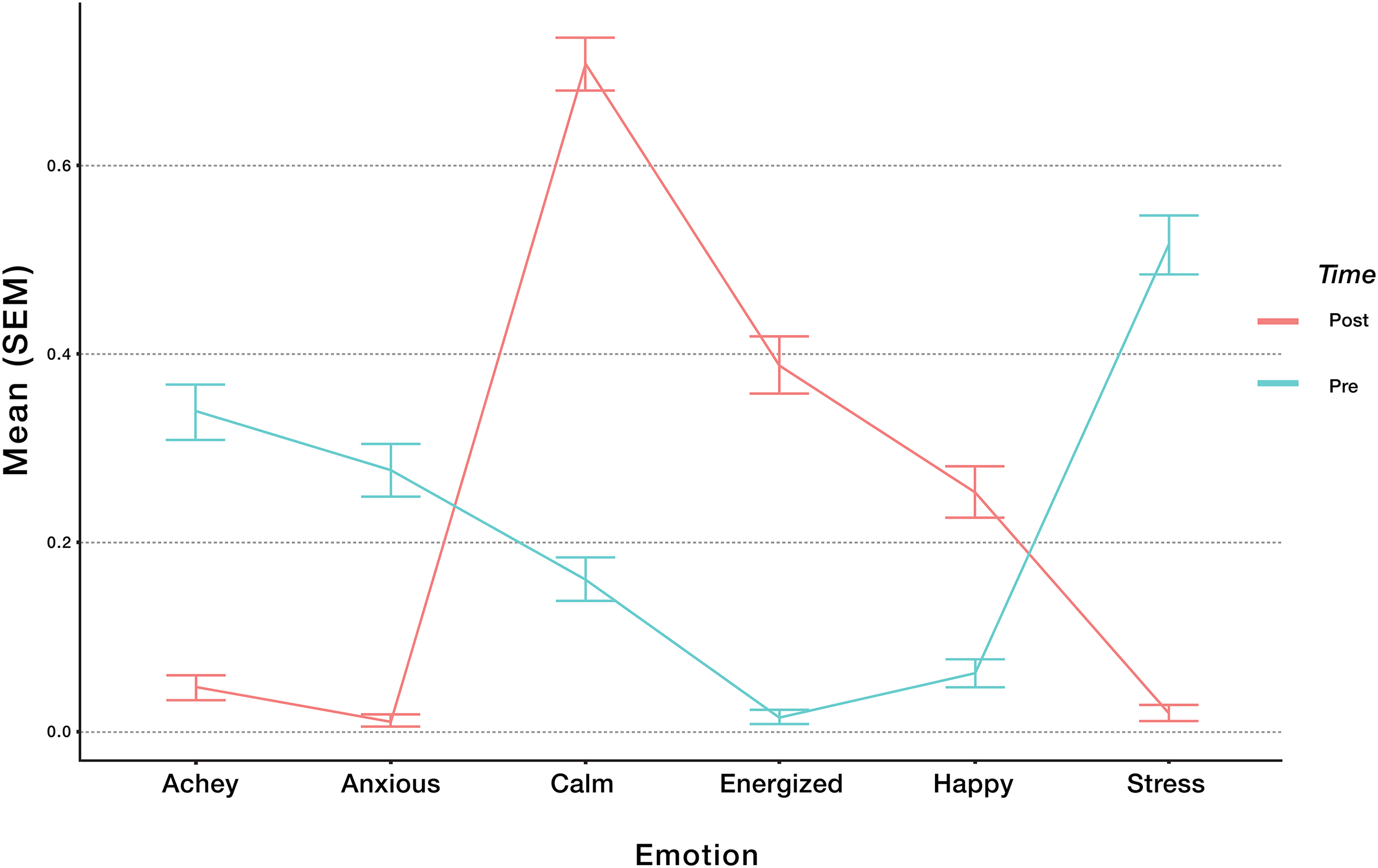
Phase 2 before to after TIY class change in emotions states.
Breath awareness (n = 93) and stretching (n = 93) were the most commonly endorsed yoga-based practices that participants reported doing outside of TIY classes. For endorsed rates of other practices, see Table 1. Within yoga classes, 22% of respondents endorsed choosing the more challenging yoga posture option (n = 42), and 20% reported choosing the more gentle option (n = 38). For reported options that participants chose in class, see Table 2.
Daily Life Practices.
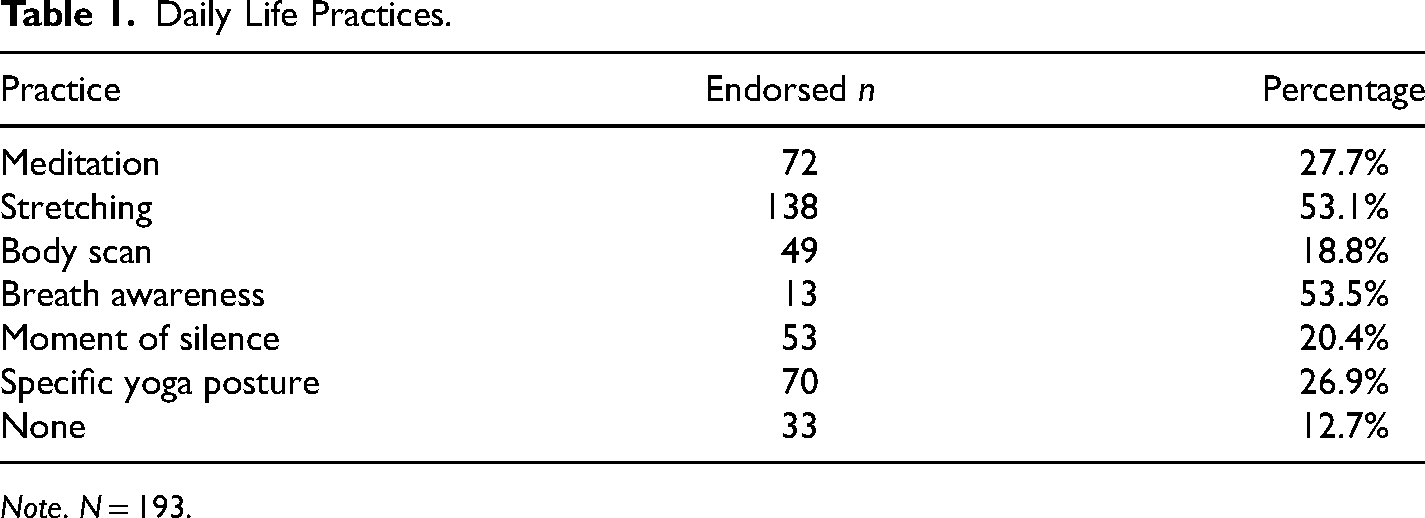
Note. N = 193.
Yoga Pose Options.
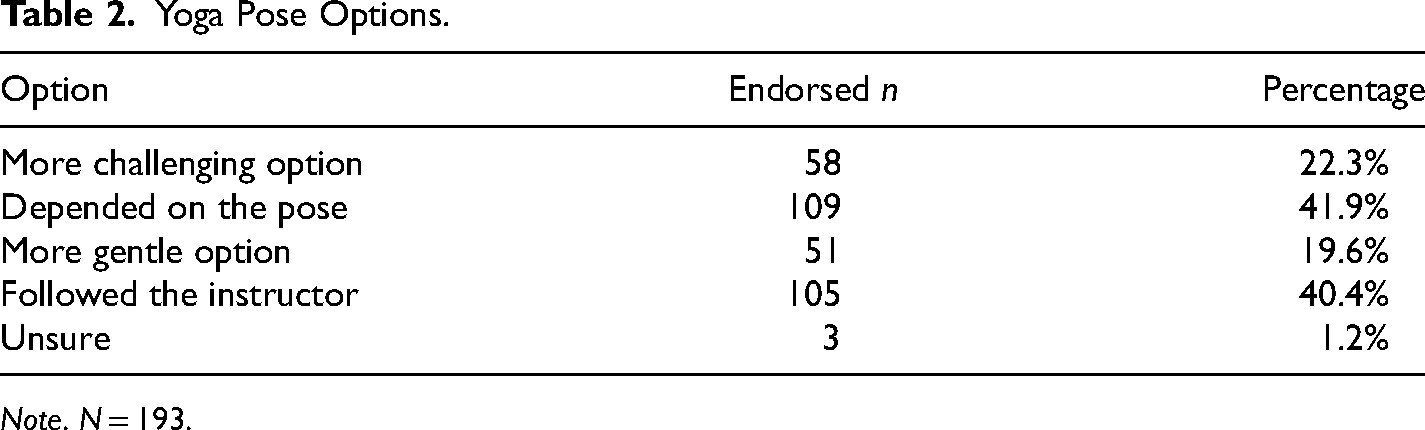
Note. N = 193.
Among staff who reported on burnout, the majority (87%) report feeling satisfied with work often or very often, whereas the remaining participants reported being satisfied at work sometimes. Similarly, most staff (73%) report feeling happy with work on their first or only program evaluation survey often or very often. Half of staff reported sometimes feeling overwhelmed (54.3%) and 43.5% endorsed sometimes feeling worn out by work. Among staff, 41% reported being worn out, and 24% endorsed feeling overwhelmed often or very often.
Brief Summary and Discussion of Phase 2
Participants report that virtual TIY helped to increase calmness, happiness, and energy. Virtual classes also benefited participants’ somatic complaints and feelings of stress and anxiety. In addition to during-class practices, participants endorsed using some of the practices taught in class in their day-to-day lives. Data indicate that TIY classes can build participants’ capacity to self-soothe, relax, and improve physical discomfort in class and outside of guided TIY classes.
Data suggest that staff, although reporting less stress than clients before yoga, do experience elevated stress, compassion fatigue, and burnout. Staff would benefit from continued workplace support and self-care practices, such as TIY, which staff chose to participate in even when they felt burnt out.
General Discussion
The present program evaluation, which makes up the largest known sample of TIY participants, aimed to assess impacts of TIY classes on stress, agency, and body sensations among clients and staff of domestic violence shelters and social service agencies. Furthermore, the present evaluation examines feasibility and utility of incorporating quality assessments for TIY programming. Data of 526 unique participants were collected in person and remotely for over 3 years among both IPV clients and staff.
Data reveal that in-person and remotely taught TIY is an efficacious program for agencies that serve IPV survivors. Participants report significant reductions in stress, somatic complaints, and improved self-efficacy from before to after a single TIY class. Furthermore, data suggest that staff and client participants learn body-based coping skills (e.g., stretching and meditation) that can be used outside of yoga classes to help participants alleviate aches and pains, reduce stress, increase relaxation, and feel more energized. The strengthened coping skills and self-efficacy from TIY classes may support survivors’ mental health (Benight et al., 2004) and physical safety by promoting the individual's likelihood to remain separated from an abuser (Ozer & Bandura, 1990). These enhanced internal resources may better enable survivors to continue to seek help and adaptively react to environmental stressors.
For staff, TIY provides a supportive work-based resource that promotes relaxation, self-efficacy, and physical wellness. ETI's TIY may protect against staff burnout and compassion fatigue by creating a supportive work environment that teaches helpful coping strategies (Brown & O’Brien, 1998). Agency staff was able to continue with this self-care program even when many interventions and work were canceled or became remote for COVID-19 safety reasons. Staff continued to attend TIY classes and, consistent with in-person programming, reported perceived benefits of the remote classes.
Limitations
The program evaluation did not collect data using a validated instrument, as such data on the impacts of TIY are limited. Furthermore, collecting data continuously elucidated challenges of capturing evaluation data for a voluntary program. For example, client participants who live in domestic violence shelters may have inconsistent weekly schedules that include longer commute times if their shelter is far from their previous dwelling. Clients who are shelter residents may also only be in residence for 6 months or less. Considering the nature of the evaluation, the evaluation was unable to measure the dose effect of TIY classes longitudinally.
Another limitation is the evaluation relied solely on self-report data, and during the in-person phase, data were collected by the yoga teachers or partner site staff, which may be impacted by reporting bias. Questions may have been answered based on how participants believed they should feel rather than based on actual present experience (Razavi, 2001). Reporting bias is particularly salient for the postyoga survey because participants may have had preconceived notions of how they believed yoga was meant to impact them or want to please their yoga teacher; however, the latter concern is somewhat mitigated by the remote delivery of the survey and class.
Furthermore, when ETI's TIY classes and program evaluation transitioned to a virtual platform for COVID-19 safety measures, the evaluation protocol and survey instruments changed, as such data from phase 1 and phase 2 cannot be compared.
Future Directions
Data offer preliminary evidence for the differences between in-person TIY classes, which have the potential benefits of being in community with other participants, compared to virtual, prerecorded TIY classes that were likely attended alone at one's place of residence. Further research ought to examine the plausible psychosocial benefits of practicing TIY in community (Beckes & Coan, 2011), with an in-person instructor and the impacts of practicing TIY through a virtual platform, individually. Further data collection may also examine interpersonal influences of clients and staff practicing TIY together through in-person or virtual instruction.
Future studies are also needed to better understand TIY as a capacity-building intervention for survivors and affiliated staff. Longitudinal data collection will elucidate what yoga-based practices are most accessible or useful in survivor and staffs’ daily life. Studies may also examine the qualities of movement (e.g., soothing/restful and heating/intensive) participants choose to practice when outside of class and how these body-based decisions relate to participants’ psychological well-being. Such studies should corroborate self-report questionnaires with measures that are less vulnerable to reporting bias.
Conclusion
ETI's TIY is a survivor-centered, capacity-building program that addresses mental and physical health. Accessible and adaptable to various contexts and populations, TIY can be taught remotely or in person at residential or nonresidential IPV agencies. Data reveal that TIY may help equip female survivors and affiliated staff with body-based coping skills and strengthened self-efficacy. Such benefits may empower survivors to remain separated from abusers or seek help in alternative ways and manage trauma-related symptoms, including somatic complaints, chronic stress, and emotional difficulties. These results support the use of TIY in residential and nonresidential agencies that serve survivors of IPV and their staff.
Footnotes
Declaration of Conflicting Interests
The authors declared no potential conflicts of interest with respect to the research, authorship, and/or publication of this article.
Funding
The authors received no financial support for the research, authorship, and/or publication of this article.
