




Abstract
News media have an important role in shaping public knowledge about intimate partner violence (IPV) and intimate partner femicide (IPF). This article (a) argues for intersectional feminist work to operationalize the social ecological model for media research and advocacy surrounding IPF reporting and (b) outlines an example of such a coding framework for analyzing IPF media coverage. This framework provides a tangible illustration of what balanced reporting on IPF could look like and highlights the need to decrease news reliance on individual- and relationship-level explanations and increase community- and societal-level explanations from an intersectional feminist, violence prevention standpoint.
Keywords
Introduction
Recent decades have seen a strong body of scholarship focusing on media portrayals of gender-based violence, including research on news coverage of intimate partner femicide (IPF), domestic violence, intimate partner violence (IPV), and sexual violence (e.g., Berns, 2004; Bullock & Cubert, 2002; Carlyle et al., 2014; Fairbairn et al., 2023; Naeemzadah, 2023; Taylor, 2009). These works offer numerous feminist critiques of various forms of news coverage, including identifying problematic patterns of representing the femicide as an isolated event devoid of social context, regularly employing victim-blaming framing, and over-reliance on police as news sources.
Continued research around various aspects of media representation of IPF is important (see Fairbairn et al., 2023 where we identify specific areas where further attention is needed); however, the knowledge base in this area is sufficiently clear that media portrayals of IPF require attention to reduce harm and increase capacity to operate as a form of prevention. Given this, what comes next for feminist researchers and advocates in this vein? In studying news coverage and synthesizing work done in this area to date, we consider here the questions of (a) what specifically might feminist researchers and advocates be hoping to see in terms of changes in news coverage of IPF, and (b) what existing theoretical tools are most useful in this pursuit?
To explore these questions, we first outline the state of research on news media representation of IPF and discuss how this work is understood from intersectional feminist perspectives. In using the term “news media,” we refer to both digital/online and print news. We then consider broader public health approaches to public education and violence prevention, focusing on the social ecological model—what it is and how it can be understood in relation to feminist media critique and feminist approaches to gender-based violence prevention. After explaining the importance of bridging these frameworks, we lay out how a feminist social ecological framework can be operationalized as a coding scheme to examine the representation of femicide in news coverage of IPF and consider the benefits of such an approach to coding news coverage. Drawing from our ongoing research project Representing intimate femicide in Canada, we describe how, in our current research, we have embedded an intersectional feminist social ecological model into our coding for data analysis. While highlighting key tensions and challenges in attempting to operationalize the social ecological model, we argue that the social ecological framework, widely used in gender-based violence prevention work, can be operationalized to study news media representation and to theorize an understanding of where to set the goalposts for news representation of IPF, that is, what “good” news media coverage of IPF looks like from an intersectional feminist, violence prevention standpoint. This is particularly important for primary prevention work where the targets are underlying attitudes, norms, and behaviors and the aim is to create knowledge, attitude and behavior change to end violence against women and girls (Crooks et al., 2019). By illustrating the complex and multi-factorial causes of IPF, the social ecological model provides a tangible illustration of what balanced news coverage of IPF could look like. In operationalizing this framework, our contributions here are to (a) provide a potential framework and introduce specific variables to approach analyzing news coverage of IPF across time periods and across jurisdictions, and (b) highlight a need to move away from reliance on individual- and relationship-level understandings of IPF and to highlight community- and societal-level factors as areas where journalists may look to increase representation to provide more balanced coverage.
Feminist Media Work on Intimate Partner Femicide
Initial News Media Representation of Intimate Partner Violence
Feminist work to construct IPV as a social problem has been underway for decades and has had an important relationship with news media throughout this period. News media have played an important role in depicting and defining the activities and priorities of feminist research and activism from the 1960s through to the early 2000s (Bronstein, 2008; Cancian & Ross, 1981; Tierney, 1982). Here, the women's movement struggled to gain legitimacy in news coverage, as gendered hierarchies in media representation trivialized their issues and degraded the legitimacy of the movement (Ashley & Olson, 1998; Costain et al., 1997), demonstrating that gendered hierarchies play out in capitalist and patriarchal media environments (Mendes, 2011). While not an initial focus of feminist activism and media coverage, IPV (more widely referred to as wife abuse or domestic violence at the time) became a significant issue of feminist advocacy in the mid-1970s and this, in turn, led to changes in media coverage where “the wife-beating problem” became a focus of mainstream media (Tierney, 1982). Thus, IPV was transformed from private shame to a matter of some public concern within a decade (Loseke, 1989; Tierney, 1982).
The construction of IPV as a social problem, although occurring seemingly quickly, did not happen organically. Rather, feminist work building a conversation in legal arenas, social services, and scholarship identified a problem with a name and provided media with a framework to talk about IPV (Tierney, 1982). While broadly successful at naming IPV as a social problem, the battered women's movement faced numerous media-relationship hurdles. These included news media under-representing domestic violence, press failure to identify and access adequate news sources, and the movement's concerns with exploitative media coverage (Barasko & Schaffner, 2006; Tierney, 1982). Despite facilitating increased resources, mass media attention also meant that the battered women's movement no longer controlled the framing and messaging surrounding IPV (Tierney, 1982). Furthermore, because empirical research on IPV was not yet available, the women's movement was not able to use data to support its claims (Tierney, 1982). Thus, women's movement victories were, “perhaps inevitably,” co-opted by prevailing media tendencies of sensationalization and trivialization (Los & Chamard, 1997, p. 295). Media coverage, therefore, presented significant challenges as well as opportunities for feminist anti-violence work, and became an important area of feminist engagement and critique moving forward.
Feminist Critiques of News Representation
Following the successes of battered women's activism in garnering news attention, media representation of IPV and sexual violence became a particularly fruitful ground for feminist analysis and critique in the late 20th and early 21st centuries. Within the broader media landscape, news reporting plays a significant role in public education surrounding IPV (Naeemzadah, 2023). Unlike much popular culture and fiction that generally prioritize entertainment over education, news media have, traditionally, an explicitly informational role, and journalists are generally thought to strive for objectivity as a core pillar of their work (though see, e.g., Carter et al., 1998 for problematizing notions of objectivity and neutrality in news reporting). Thus, mainstream news has historically been viewed as both a powerful vessel for transmitting information and a tangible arena to study public discourse about social problems such as IPV, which perhaps explains why it has garnered consistent feminist analyses in previous decades.
In general, feminist critique of media coverage of IPF builds on empirical knowledge to highlight patterns of myths and misrepresentations. As we outline in other works summarizing this scholarship (Fairbairn et al., 2023), this scholarship consistently finds that mainstream news media portrays IPF as an isolated event through episodic, individualized coverage and perpetuates several negative myths and stereotypes that potentially impede social and political progress to address this violence (Berns, 2004; Bouzerdan & Whitten-Woodring, 2018; Hernández, 2018).
Episodic coverage is of course not unique to VAW but is a pattern well established in news coverage in general (Carlyle et al., 2017; Ericson et al., 1991). Episodic coverage generally relies on individual explanations for news events, whereas thematic coverage relies on social explanations (Carlyle et al., 2008). For IPF news coverage, the episodic coverage focusing on individual circumstances and attributes are fertile discursive ground for sensationalized details and further harmful representation including victim-blaming, suggesting that victims are responsible for their deaths and/or that the perpetrator's actions were somehow justifiable. These representation patterns have been observed in earlier studies of IPF news coverage (e.g., Berns, 2004; Bullock & Cubert, 2002; Voumvakis & Ericson, 1984) as well as more recent analyses (e.g., Bagai & Faimau, 2021; Montiel Valle & Martin, 2021; Pröll & Magin, 2022).
The sources journalists use to construct news stories are central to representation. Feminist critiques of IPF coverage repeatedly note that news media over-rely on police and other criminal justice officials as sources of information and frequently fail to gather information from gender-based violence experts or advocates (Carlyle, 2008; Fairbairn & Dawson, 2013; Garcia-Del Moral, 2018; Hernández, 2018; Taylor, 2009). Because police typically only provide details about specific incidents (Chagnon, 2018), this contributes to news media's failure to connect these deaths to other instances of femicide and gender-based violence and may prevent the inclusion of important public health and social services information (Carlyle, 2017; Gillespie et al., 2013).
We see, then, there is a strong body of research problematizing news coverage of IPF that has coalesced around themes of over-reliance on individual, episodic explanations, and limited use of news sources with gender-based violence expertise, leading to myths and misrepresentations that adhere to and reinforce this episodic coverage. While these patterns are observed generally across IPF coverage, representation (or lack thereof) can be particularly harmful when coverage involves individuals from racialized groups and other historically and intentionally marginalized communities. For example, in Canada and the United States, racialized and/or Indigenous victims are found to be represented as less newsworthy, more blameworthy, or less likely to receive humanizing coverage (Gilchrist, 2010; Jiwani, 2009; Slakoff & Fradella, 2019).
Media Interventions
In its current form, then, news media coverage of IPF overwhelmingly renders community-forces and social structures largely invisible, resulting in coverage that supports a status quo understanding of femicide as somehow inevitable and primarily as the result of individually driven circumstances (Fairbairn et al., 2023). This allows the state to maintain limited involvement in addressing the conditions that contribute to IPF, overlooks the important role of community leaders and organizations in preventing violence, and maintains insidious myth-saturated patterns of shaping attitudes and beliefs about IPF. Recognizing this need for change, some researchers and advocates have explored changes in sourcing practices (Simons & Morgan, 2018), interviewed journalists about how their newsroom experiences shape their reporting on femicide (Hernández, 2023), engaged in collaborative training of working journalists (Easteal et al., 2021; Ryan et al., 2006), and considered creative methods for preparing journalism students to report on gender-based violence (Fairbairn and Bernbaum, 2026). Various handbooks for journalists have been produced focusing on reporting gender-based violence broadly, including the Journalism Initiative on Gender-Based Violence from the Centre for Women's Global Leadership at Rutgers University (Dharmaraj, 2021).
In building on these efforts to bridge analysis and intervention, it is helpful to map out the specifics of what gender-based violence researchers and advocates might be looking for in news coverage (what does good news coverage of IPF look like?), and how might this be advanced in the current news landscape (where should change efforts be focused?). While researchers, advocates, and survivors (whom are themselves intersecting groups) will have various standpoints here, we argue that a starting point for the goalposts is to work towards news media coverage that facilitates public understanding that (a) when women are killed by a current or former intimate partner this is part of the social problem of IPF, which (b) is a public health issue that occurs due to a multi-faceted and multi-level set of risk factors and (c) preventing these deaths is possible but requires addressing multiple risk levels beyond individual factors, as well as recognizing that (d) some groups of women and girls are at disproportional risk of IPF because of systemic discrimination and structural barriers. To this end, we explore using a public health approach to further ongoing intersectional feminist work to critique and intervene in news coverage of IPF.
Public Health Approaches to Understanding Violence
Framing Intimate Partner Violence as a Public Health Issue
Violence generally and gender-based violence specifically are now recognized as public health issues by the World Health Organization (WHO; Dahlberg & Krug, 2006; Jewkes et al., 2015). This contrasts with approaches to violence as solely a criminal justice issue. Carlyle (2017, p. 162) explains that Violence as a public health issue is unique in both its relative youth – it was first recognized as a priority area in the Surgeon General's Healthy People report in 1979 – and its duality as a criminal justice issue. Accordingly, support for public health-oriented approaches to violence prevention is evolving alongside public understandings of violence as a health issue.
As support for public health approaches to violence prevention evolves, one goal is increased public health literacy on IPV. Health literacy refers to the extent to which individuals can obtain, process, understand and critique health information (Bernardino, 2019). In the context of IPV, health literacy might involve information about physical safety and healthy relationships, various forms of IPV (e.g., coercive control; financial abuse), the warning signs and high-risk circumstances of lethal violence within intimate relationships, and where to seek further information and support. At present, news coverage is a missed opportunity to increase public health literacy in these areas. By failing to discuss important factors beyond individual, episodic elements, this incomplete and unbalanced coverage reduces people's capacity to assess their own lives and relationships, as well as their ability to inform and support family, acquaintances, and colleagues, and to advocate within and shape community settings and social systems more broadly.
Media Advocacy and the COVID-19 Shift
Struggles to frame violence as a public health issue are not unique to IPV and occur elsewhere in violence prevention work, such as gun violence research and advocacy. Here, researchers find that news media coverage of gun violence in the United States still holds individuals primarily responsible for the issue of gun violence, demonstrating that “the public health approach is not resonating with the public” (McKeever et al., 2022, p. 151) on this issue. This, the authors argue, requires further work to frame gun violence as a public health issue, and for media advocacy to frame gun violence as a public health issue. Here, media advocacy often involves re-framing a problem as a public health issue, changing the focus from individual behavior change to promoting policy and/or economic solutions and using the power of people, groups and institutions to respond to social problems. (McKeever et al., 2022, p. 140)
The value of public health knowledge has been increasingly recognized in recent years, with the COVID-19 global pandemic that began in 2020 creating an urgent need for media advocacy to share timely, evidence-based information pertaining to the public health crisis. In many ways, the pandemic presents a concentrated and time-bound case study containing relevant lessons for IPF news coverage. When the proliferation of COVID-19 news stories began in early 2020, the public was inundated with scientific (and nonscientific) messaging to an unprecedented extent, leading to widespread confusion about the behaviors needed to reduce personal risk and control the outbreak at the population level. The WHO declared this phenomenon to be an infodemic, “an overabundance of information—good or bad—that makes it difficult for people to make decisions for their health.” (Mahajan et al., 2021, p. 105). Many public health experts consequently went to great lengths to advocate for the inclusion and dissemination of public health expertise across news stories and social media platforms (Albrecht et al., 2022). IPF news coverage, in contrast to the intensely concentrated media production surrounding COVID-19 that occurred over just a few years, spans decades, with myths and stereotypes about IPF being deeply entrenched long before the emergence of social media. While much less concentrated than COVID-19 news coverage, IPF is unfortunately a recurring phenomenon and therefore repeatedly in the news. Over time, this coverage has operated as a long-term leak rather than a short-term deluge of (mis)information, creating impacts that are nonetheless corrosive to societal knowledge and beliefs surrounding IPF.
These corrosive impacts are entrenched and difficult to dislodge. To date, much media work on IPF has attempted to reduce harm and focus on identifying “what not to do”: e.g., relying less on police as news sources, avoiding sensational and victim-blaming language, and avoiding framing the IPF as a “crime of passion” and/or something that occurred “out of the blue.” This has been important and necessary work to highlight myths and misrepresentations that not only are harmful to victims and their loved ones, but that hinder violence prevention efforts. But a public health approach to media-facilitated violence prevention goes further; it acknowledges that we can not only reduce harmful representation through reducing focus on individual attributes and circumstances, but can, additionally, work to actively increase public health literacy and shift attitudes and beliefs surrounding IPF specifically and gender-based violence more broadly. In this regard, media advocacy around IPF can and should put forward a framework for understanding IPF as a public health issue, with the goal of increasing the news media's role in preventing IPF.
The Social Ecological Framework as a Roadmap for Reporting IPF
Multi-faceted and multi-level risk factors
A public health framework offers a pathway to news coverage that facilitates public understanding that (a) IPF occurs due to a multi-faceted and multi-level set of risk factors and (b) preventing IPF requires addressing multiple factors across multiple levels. Specifically, a social ecological model, a key framework used in public health approaches to gender-based violence (Goodmark, 2018), recognizes that gender-based violence is a multi-faceted phenomenon that arises out of the interplay of factors at the individual, relationship, community, and societal levels. The social ecological model is widely used in public health approaches to violence prevention and has been adopted in much gender-based violence research and education, including by the WHO to explain GBV as a global public health problem (Kelly, 2011). For our purposes here, a public health approach broadly encourages shifting focus to how people, groups, and institutions can respond to social problems, whereas a social ecological model provides a framework for outlining the specifics of what this might look like in the context of IPF.
According to the social ecological framework, gender-based violence cannot be explained by a single factor or multiple factors at a single level, and prevention needs to occur at all levels in order to provide effective responses (Alaggia et al., 2012). However, historically much prevention work is based on individual- and relationship-level risk factors, with less attention to community- and societal-levels (Jewkes, 2015), a trend that replicates in news media coverage of IPF. For example, reporting frequently focuses on perpetrator's mental health, emotional state, and/or substance use; victim's behavior prior to the homicide; and/or discussion of relationship history, without additional context of community and societal forces (e.g., institutional barriers and/or availability of IPV services; relevant data on GBV and IPF more broadly and/or risk factors that were missed or ignored). For balanced reporting, journalists need to pursue explanations at multiple levels. Note that we are not calling to eliminate individual- and relationship-level explanations and reporting patterns. Instead, a social ecological approach to reporting IPF shifts away from an “either/or” debate of individual versus societal understandings of violence, to acknowledge a journalist's reality that reporting on some aspects of individual circumstances remains a core practice and expectation for covering homicide, and that many loved ones of victims will want their individual stories shared.
Intersectional Feminist Work, Social Ecological Model, and Media
In academic and advocacy work, arguing for single-factor theories to explain violence is a barrier to knowledge production, and, in the context of IPV, theory “must be able to account for both why individual men become violent and why women as a class are so often their target” (Heise 1998, p. 263). As Heise (1998) explains, in studying the origins of violence against women: The task of theory building has been severely hampered by the narrowness of traditional academic disciplines and by the tendency of both academics and activists to advance single-factor theories rather than explanations that reflect the full complexity and messiness of real life. (p. 262) This reluctance, however, must be seen in the context of a discourse on violence that has traditionally been very slow to acknowledge the significance of gender inequalities and power differentials in the etiology of violence directed toward women. For years, academic social science failed to acknowledge even the presence of the problem, much less to incorporate issues of power, gender, and rights into its reigning analysis. As a result, feminist researchers and activists have been understandably reluctant to endorse any theory that is not grounded in a thorough understanding of the way that male privilege operates to perpetuate gender-based abuse. (p. 263)
Heise (1998, p. 285) argues that Acknowledging the influence of situational or personal history factors in the etiology of abuse in no way exculpates the perpetrator of the violence; we have never applied this type of logic to other crimes. Nor does it lessen the significance of macrolevel factors, such as notions of masculinity and male hegemony, in defining why women, especially intimate partners, are so consistently the targets. What a nested ecological approach to violence does, however, is to help activists and researchers grapple with the complexity of real life.
Across disciplines, feminist theorists have recommended the use of feminist intersectionality as a means of not only obtaining a more comprehensive understanding of the multiplicative effects of social inequalities experienced by vulnerable and marginalized groups, but also of conducting research and developing interventions that address health disparities (Kelly, 2011, E44). In recent decades, feminist theory has evolved to encompass broader intersecting systems of oppression such as race and class (Crenshaw, 1991; Potter, 2006). This is primarily due to the work of racialized women and other historically marginalized groups, and perhaps most visible in the contributions of Black feminist theory and critical race theory (see Hill Collins, 2000; Crenshaw, 1991; Potter, 2006).
In attempting to articulate and track what “good” news coverage of IPF looks like, it is important to encourage inclusion of community and societal level explanations that are not focused exclusively on gender. This is to recognize that gender is “a necessary but not definitive condition” for IPF and that it is imperative to attend to “structural and representational processes that shape and are shaped by the historical material realities of specific groups of women” (García-Del Moral, 2018, p. 930). For example, as García-Del Moral (2018) explains The murders of Indigenous women in Canada constitute racialized gendered violence rooted in the ongoing material and discursive effects of colonial power relations. They require a conceptualization of femicide that does not rely on patriarchy to explain violence against women and on gender as a single axis of analysis. (p. 929)
The Latin American Model Protocol for the investigation of gender-related killings of women (femicide/feminicide) (2014) outlines a feminist social ecological model and advocates for its use in the investigation of gender-related killings of women. The Protocol explains that An intersectional analysis allows for considering the different ways that discriminations (related to race, gender, sexuality, rural origin, etc.) interact with other varied and complex factors of exclusion, without subordinating or qualifying one in favor of the other. Rather each category can be taken as a tool that allows for bringing to light the differential impacts of violence against women. The intersectionality of factors that are present within the same woman must be understood as related to a global structure of domination. (p. 43: 120)
Social media is a powerful tool for violence prevention, particularly in terms of its capacity to boost messaging that challenges individual-level framing and encourage conversation about community and societal factors (Fairbairn, 2020). It is also an important arena for tracking changes in societal attitudes. However, in relation to IPF, news media outlets retain a position of authority among much of the public for laying out “what happened,” and the information and sources that are selected to explain the events are frequently all that the public will know about IPF. If approaching IPF cases with the notion that balanced coverage requires “both sides” i.e., victim and perpetrator, the community- and societal-level factors will lose out every time. Instead, we propose that representation of IPF at all levels of the social ecological framework can and should be a template for a meeting ground of journalism, intersectional feminism, and public health representation of IPF.
Adapting a Social Ecological Framework for Intersectional Feminist Frame Analysis of Intimate Partner Femicide
To recap, we have argued that there has been a great deal of feminist work conducting framing analyses (among other approaches) of news coverage of IPF specifically and GBV more broadly. Amidst growing recognition of the importance of this work on a global scale, we are interested in a roadmap forward of (a) What balanced news coverage might look like for journalists reporting on IPF; and (b) A news coverage data collection tool that could be used to describe current representations; compare various contexts (e.g., countries); and/or potentially measure changes in news reporting moving forward. In developing a coding approach, we asked: Building on research that has critiqued news representation of IPF, how can intersectional feminist work take up the social ecological framework to engage in media research and media advocacy around news coverage of IPF? The coding process we discuss here is part of a larger codebook developed for our research project Representing intimate femicide in Canada. For this research, we have collected all Canadian news coverage available through Factiva for the 652 cases of IPF that the Canadian Femicide Observatory for Justice & Accountability (CFOJA) documented for the years 2010 to 2022, representing approximately 24,000 articles. While findings from the larger project will be detailed in separate publications, we focus here on the coding process and draw select examples from coverage of cases coded to date using a social ecological framework (∼2000 articles).
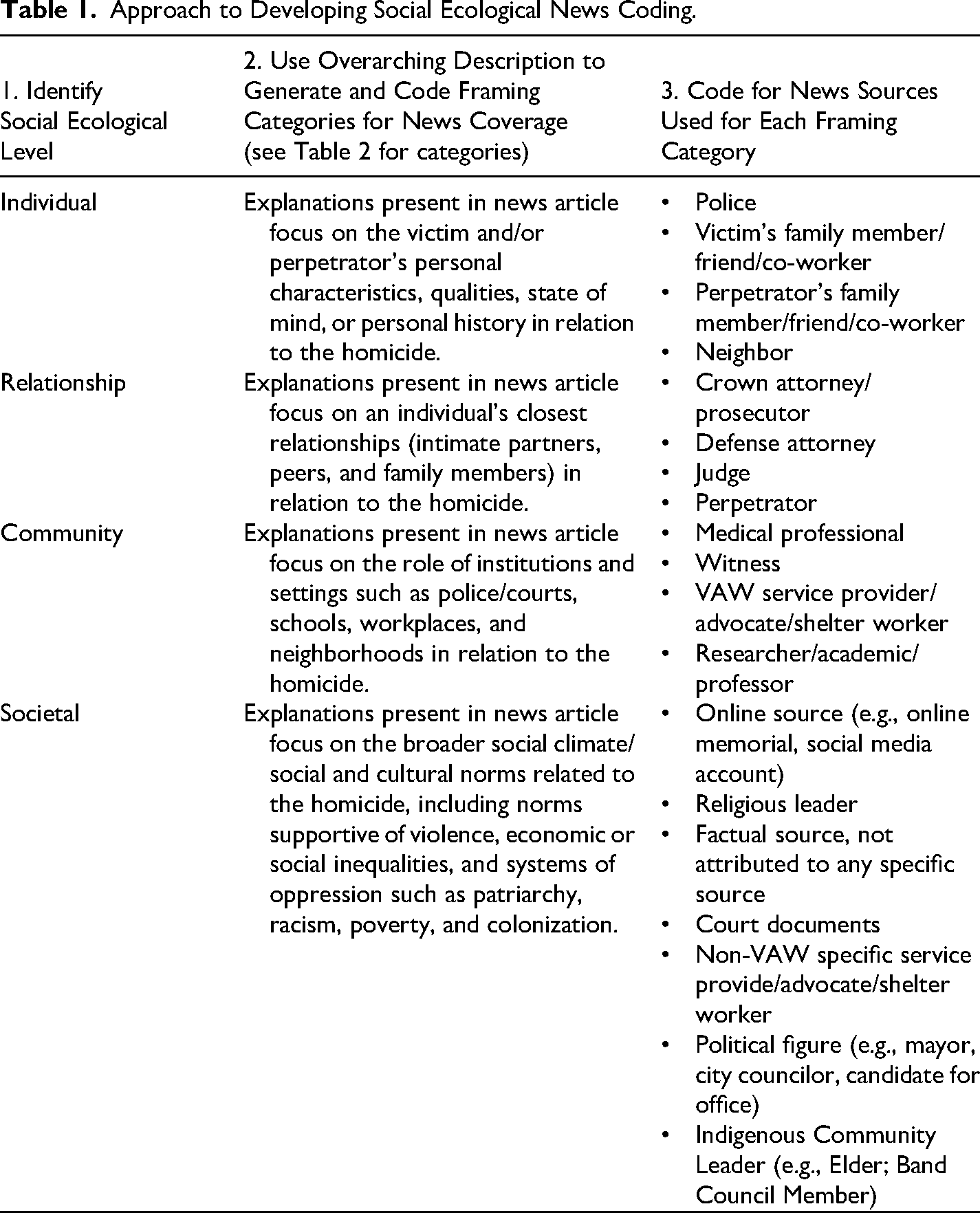
Table 1 describes how we approached coding driven by a social ecological model, and Table 2 lays out how we operationalized specific variables. Our scan of research literature demonstrated that there is no singular social ecological framework or model used, but that what is consistent is the use of multiple levels beginning at the individual level and ending at a macro/societal level, and multiple factors at each level. Drawing from Heise (1998) as well as other work that describes the social ecological model (e.g., Alaggia et al., 2012, Carlyle et al., 2021, Kelly, 2011), we began with an approach that identified and named four levels to our social ecological framework: individual, relationship, community, and societal. Within each of these levels, we then described the level in terms of what types of explanations of IPF would be included (specific coding categories by level are presented in Table 2). Finally, we generated a list of news sources to be coded for each framing category, to enable analysis of the relationship between news sources included in coverage and the types of explanations present. While news sources are not inherently linked to any specific social ecological level, some sources may lend themselves more to individual-level explanations (e.g., neighbors, Crown prosecutors, defense attorneys, police), whereas others may be more likely to provide community- and/or societal-level explanations (e.g., VAW advocates and service providers; researchers). Thus, identifying patterns of not only who are used as news sources but also what types of explanations they are providing can provide a helpful journalist roadmap as to where to increase (or decrease) sourcing practices to provide balanced coverage.
Approach to Developing Social Ecological News Coding.
Coding According to the Social Ecological Framework.
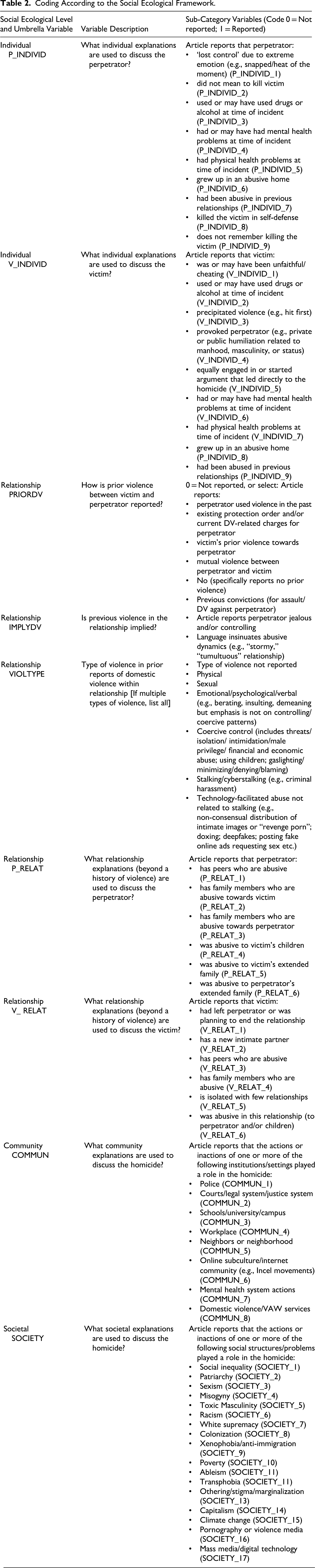
Table 2 describes the umbrella variable names that we used to code for each type of explanation observed in coverage; for example, P_INDIVID is the umbrella variable for all categories of individual explanations used to discuss the perpetrator in relation to the IPF. For the individual and relationship levels, many of these categories were developed from earlier work (see Fairbairn & Dawson, 2013 for further explanation). Thus, we were aware that these explanations are occasionally or frequently found in news coverage but needed to work through which belong at the individual level and which at the relationship level, based on our understanding of the overarching description presented in Table 1.
For community- and societal-level explanations, we generated codes from various community institutions and settings that are often discussed in relation to gender-based violence prevention broadly (e.g., police/courts, schools, workplaces, neighborhoods), and then added additional categories based on our initial sample of test coded articles (e.g., mental health system actions; domestic violence/VAW services). For every level, we included an “Other” category of explanation for where it was determined that the article included an explanation at a specific level that did not fit into one of the pre-existing categories. Over time, these will help us to identify additional factors to be added to the codebook for analysis.
Table 3 provides select examples of news content at each level from our coding to date. While this paper is focused on the need for and development of a social ecological coding process and not the results, it is worth noting that much IPF coverage in the incident reporting stages (not trial coverage) contains limited information at any level of the social ecological model, making that which is included even more potent in terms of public awareness and understanding of IPF. While these example quotations each come from different articles, it is of course possible to have a variety of explanations at a variety of levels within an individual article, and future project work will consider what levels are included together.
Examples of News Explanations by Level and Variable.
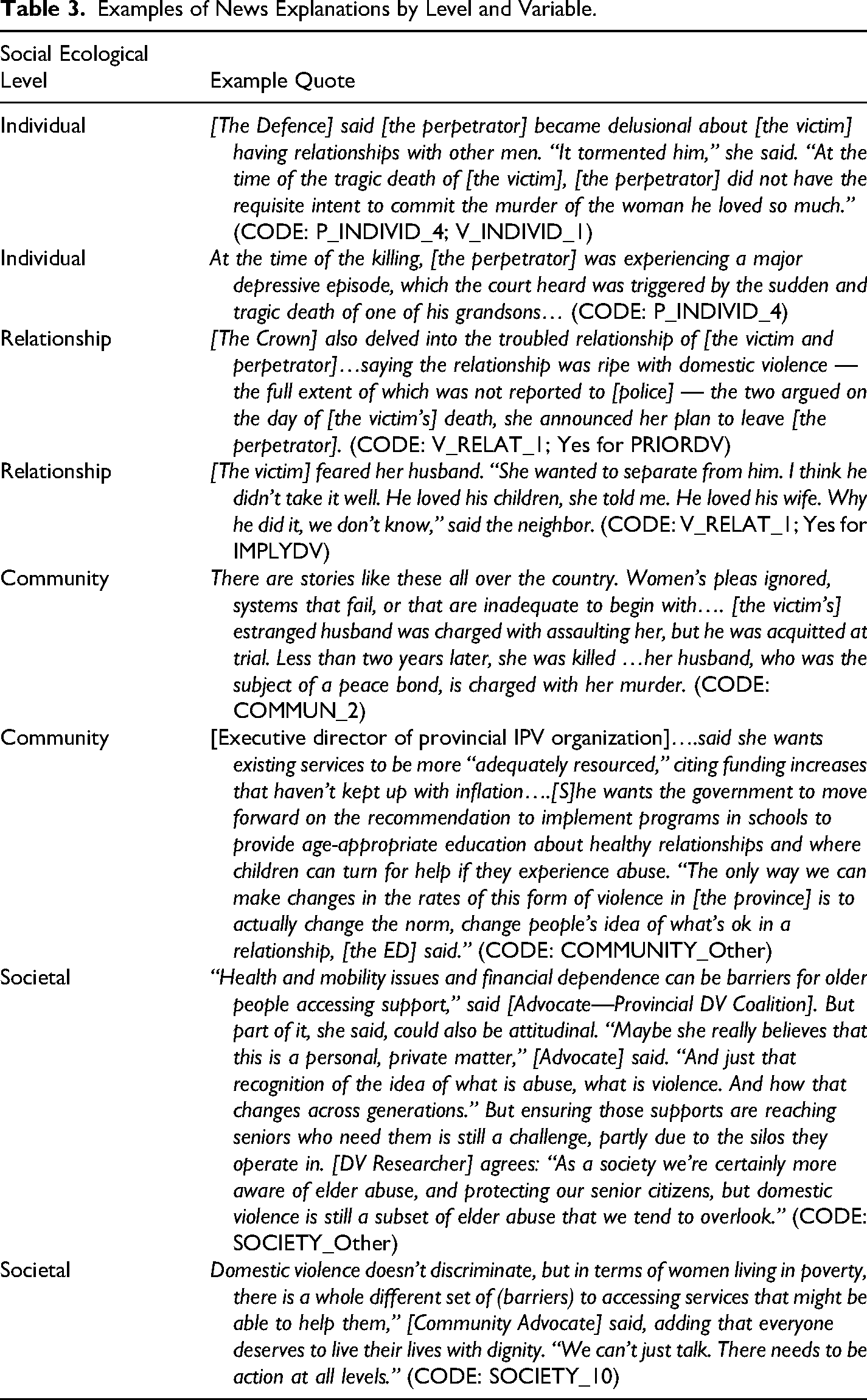
In determining how to code explanations at each level, we returned frequently to the variable descriptions and sub-category variables as laid out in Table 2. One area that required some discussion was differentiating community- and societal-level explanations, as certain community-level explanations (e.g., “systems that fail”) could arguably be societal level. Here, we understood community-level explanations as more concrete institutions or systems (e.g., criminal legal system, social supports systems) and societal-level explanations as higher-level systems of oppression, norms, and/or social problems (e.g., misogyny, racism, poverty). While recognizing there may be some slippage between community explanations and societal explanations depending on exact wording, the broader point at this stage is to advance community and societal explanations in news coverage of IPF (rather than one or the other). Thus, even coding community and societal explanations collectively as a larger category would provide ability to track the presence and/or changes in these important levels of understanding.
Objectives and Training
We conclude with two points of discussion about this coding process. The first pertains to our understanding of what this media analysis framework does and does not do. This adapted model is intended to analyze representations of IPF: to take the information that has been selected by journalists to be part of the news story on a particular case of IPF and categorize it according to a social ecological framework. Thus, the framework does not look to analyze whether an explanation is objectively true and/or to evaluate what the journalist might have intended by including specific information. Instead, we approach this with the understanding that, “in a situation where many different perspectives, information, and explanations are potentially relevant to the case, what choices did the reporter make about what information and context to include?” This was something that all members of the research team discussed and of which we reminded ourselves frequently. For example, if we look at the variable V_INDIVID_1 as an example (“article reports that the victim was or may have been unfaithful/cheating”), we do not know if this actually occurred, nor do we know the reporter's reasoning for including this information or whose narrative a reader would believe within a story (e.g., “but are they really saying she was cheating, or just that her husband was accusing her of cheating? I think the reader would likely understand that she probably didn’t actually cheat?”). It can be tempting to want to code for the anticipated interpretation of the information, rather than the information itself, and/or to get further into qualitative analysis than we are focused on at this stage in our analysis. That will come later. Here, we are focused on quantitative coding for the presence/absence of various explanations, and what we are coding for is the choice that is made to include this information in the story. In this example of news representation of actual, potential, or perceived victim infidelity, this information is situated as relevant to “what happened/why she died” in a way that, in the absence of other context or information, provides a skewed understanding of the dynamics of IPF and may lead to victim-blaming. In contrast to the scenario where only the frame of V_INDIVID_1 is included, it might be balanced with additional context, such as quoting a VAW advocate or researcher who might link patriarchal male partner jealousy, possessiveness, and/or coercive control to this case. Here, the presence of multiple sources at multiple levels constructs a more nuanced picture, even if the reporter deems the information regarding the perceived or actual infidelity necessary to include.
A second observation about this process is that the training and coding consultation process takes a significant time investment, at least at the outset. As depicted in Tables 1 and 2, laying out how we interpreted each level of the social ecological framework and how that would be operationalized in terms of coding news content was central to our coding process. Beyond this, we needed to get all members of the research team on the same page. For the three research assistants (RAs) involved in coding according to this framework, we held one full day training session and a second half-day session where the RAs and two project leads (first and second authors) each coded 10 news articles that were purposefully selected as including a variety of explanations (in contrast to many other news articles that include only very basic details about the homicide and thus provide little material for training, particularly around the community- and societal-level variables). Following this training, we held weekly check in meetings for several months into the coding process where we talked through any questions or ambiguity about how to code. After this time, we transitioned to posting questions and discussion about coding decisions in a group communications platform and where we documented our decisions. In addition, the lead RA (third author) regularly checked over articles coded by the second and third RAs and noted any discrepancies in coding, then re-checked. To note, these processes pertain specifically to training and efforts to compile valid and reliable data. As we prepare the coded data for analysis and publication, all articles coded at any level of the social ecological framework will be reviewed by the project lead and additional measures to evaluate and respond to reliability in data collection will be employed.
Conclusion and Future Directions
Analyzing news coverage according to a social ecological model enables researchers, advocates, and policy makers to approach news media as a tool of primary prevention, and to engage journalists in a framework for balancing news reporting. In an environment where journalism's professional aims of objectivity frequently play out around portraying “both sides” of victims and perpetrators at an individual level, the social ecological model enables intersectional feminist anti-violence stakeholders (which can include journalists) to reframe what balanced news coverage looks like and thus enhance prevention efforts. Here, the idea is to shift from a binary understanding of “bad” or “good” coverage to consider if and how news coverage can more consistently incorporate a variety of levels of the social ecological model when reporting IPF. Balancing news framing, at a minimum, involves decreasing reliance on individual-level explanations and consistently seeking to include community- and societal-level explanations. News sources are a pivotal component of this, because these community- and societal-level explanations will frequently (though not always) come from advocates, IPV service providers, community leaders, and/or researchers.
To borrow from public health terminology, this approach is, in effect, a harm reduction approach to news media: While many in intersectional feminist research and/or public health approaches to violence prevention would likely aspire to see news coverage that rarely or never relies on individual explanations for IPF, this approach is not at present realistic in the context of most journalists’ training and professional norms. In an enterprise of tight deadlines and the need to construct a narrative of a terrible and complex event in a short timeframe, understanding community-and societal-level framing as one way to approach balanced reporting can provide journalists with examples of areas to consider pursuing or potential sources that are likely to speak to the community and societal contexts of IPF. While critique is at the core of much academic analysis, efforts to engage journalists, we argue, will benefit from an orientation that points towards where we wish to go, rather than primarily focusing on what are the issues with current news media representation.
Intersectional feminist work and public health approaches share a commitment to highlighting the prevalent and systemic epidemic of violence, and in developing anti-violence efforts that address the multi-faceted nature and systemic roots of gendered and racialized social problems such as IPV. In this paper we have described the evolution of the relationship between news media and feminist anti-violence work, considered the importance of drawing from a public health approach to mobilize violence prevention education through news media, and presented a data collection approach to analyze the presence of social ecological explanations within news coverage of IPF. In addition to mapping out the theoretical and practical justifications for using the social ecological model to analyze news media representations of IPF, this paper provides an example coding schema for researchers who are interested in pursuing this work, and a framework to facilitate cross-national comparisons of IPF news media representation.
The value of public health knowledge has been increasingly recognized in recent years, and efforts in a variety of jurisdictions to declare IPF an epidemic, we hope, will increase journalist receptiveness to including community- and societal-level explanations in the context of reporting on IPF cases. Thus, as we consider questions of where to go next in intersectional feminist media research and advocacy, we look to build on the decades of research, analysis, and critique to normalize a social ecological understanding of IPF into news accounts to not only report on “what happened” but to direct public attention to the question of “how do we keep this from happening again?”
Footnotes
Acknowledgments
The authors would like to thank Michelle Zecharia and Eileen Oh for their research assistance work on the project.

Ethical Considerations
Ethics approval was not required for this project.
Funding
The authors disclosed receipt of the following financial support for the research, authorship, and/or publication of this article: The research for this paper was funded by the Social Sciences and Humanities Research Council of Canada [grant number 435-2020-0076].
Declaration of Conflicting Interests
The authors declared no potential conflicts of interest with respect to the research, authorship, and/or publication of this article.
Data Availability
Data sharing not applicable to this article as no datasets were generated or analyzed during the current study.