




Abstract
Recent reviews of sexual violence prevention (SVP) initiatives on college and university campuses in Canada and other countries foreground the lack of student-centered SVP programs meeting the needs of international students. This study addresses the gap by exploring international students’ preferences for content, delivery modes, and facilitators of SVP programs on campus. The study uses an exploratory sequential mixed-method approach consisting of personal interviews with international students (n = 64) to inform the design of a survey administered among both international and domestic students (n = 341) in three universities in Ontario, Canada. The findings inform recommendations for an international student-centered SVP approach that would enhance the impact of SVP education among both international and domestic students.
Keywords
Introduction
Sexual violence involves unwanted touching, assault, harassment, online bullying, and stalking that violates the sexual integrity of a person (UN Women, 2025). Such violence occurs in all spheres of social life, including higher education, where women, racialized, 2SLGBTQ+, international, and students with disabilities face a greater risk of victimization (Miodus et al., 2023). In Canada, a survey from 2020 showed that 1 in 10 women students were sexually assaulted in the 12 months prior to the study (Government of Canada, 2020). Ninety percent of sexual violence incidents in Canadian higher education settings, however, are not reported to campus authorities or to the police (Jones & Ashcroft, 2025). The issue prompted federal and provincial legislature mandating post-secondary educational institutions to have sexual violence policies that outline processes for reporting incidents, provide victim-centered services, and deliver sexual violence prevention (SVP) education to students, faculty, and staff (Legislative Assembly of Ontario, Bill 132, 2016).
Recent reviews of campus-based SVP programs stemming from these policies show their positive impact yet barriers that prevent them from reaching their full potential (Chen et al., 2024; Graham et al., 2021; McQueen et al., 2024). For example, in 2024, Canada hosted 1.6 million international students from over 150 countries who speak dozens of languages and embody tremendous cultural, racial, sexual, and religious diversity (Government of Canada, 2024). The number of international learners remained high in 2025, although a new federal policy reduced the intake of new international students by about 40% (Government of Canada, 2025). Yet, widely implemented SVP programs such as bystander intervention training, alcohol and risk reduction workshops, men's hubs, self-defense training, and consent education on campuses fail to involve in meaningful ways international students who do not see their culture, faith, needs, or knowledges reflected in these programs (Bonistall Postel, 2020; Ghani, 2024; Kennedy et al., 2024; Linder et al., 2020). These SVP initiatives further consist of sporadic and short-in-duration activities that international students find insensitive to their needs (Hubach et al., 2019; Lee, Bouchard & Wong, 2023). International student needs, researchers suggest further, are related to their unique circumstances, such as temporary visa/residency status, lack of awareness of existing campus resources, limited access to off-campus services, loss of social networks, and coping with a new culture and language that increase the risk of sexual violence victimization among international students (Legusov et al., 2022; McGregor et al., 2022; Tarzia et al., 2025).
This study explores international student-centered SVP programming that could better meet international student needs and interests and thereby increase these learners’ engagement in SVP initiatives on campus. Student-centered education has been recognized globally as a potent pedagogical practice that reverses relations of power by inviting learners to participate in the selection of topics and issues to be discussed and studied and engages students with these topics in ways that respond to their learning needs, cultural backgrounds, and lived experiences (Ping et al., 2024; Wright, 2011). To this end, the study is guided by the following questions: What kinds of SVP program-related educational content, format, and facilitation do international students prefer? To what degree are these preferences specific to international students (versus domestic students), and how could these preferences anchor the design of international student-centered SVP educational programming on campus?
Literature Review
Low Student Participation in Sexual Violence Prevention on Campus
Campus-based SVP consists of services, policies, and educational and training activities aimed at curbing rates of sexual violence incidents among post-secondary students. For example, higher education institutions in Canada and other countries such as Australia, Nigeria, Spain, South Africa, Vietnam, and the United States have implemented sexual violence awareness campaigns, sexual consent education, bystander intervention training, risk reduction and self-defense courses, community safety workshops, and other programs intended to enhance students’ safety and knowledge about sexuality, intimacy, and positive relations (Akiyode-Afolabi et al., 2022; Bonar et al., 2022; Machisa et al., 2023; Tavcer & Dobkins, 2023; Wong et al., 2023; Yount et al., 2022). However, researchers have found that limited student participation and low levels of student engagement in SVP activities can be attributed to content that students find irrelevant (McQueen et al., 2024), to student perceptions about how important or prevalent sexual violence is in one's society and on campus (Exner & Cummings, 2011), and to multiple, competing, and overwhelming demands for student attention (Mabachi et al., 2020). The focus of campus-based prevention education on women as victims and men as perpetrators of sexual violence also results in resistance among men students and student athletes (Harry & Garry, 2022). Exclusionary foci on cis-heterosexual intimate relations in consent and bystander education further alienates queer and transgender students who feel especially marginalized by these interventions (Hoxmeier et al., 2022). Campus-based SVP education advancing narrow ideas of sexual consent also fails to address cultural, religious, social, and linguistic differences, resulting in limited student participation in these initiatives as well (Hubach et al., 2019; Thiessen et al., 2021).
A recent qualitative study of SVP training among international students further highlights barriers to participation (Ghani, 2024). For instance, international students are aware of the importance of SVP education on campus but do not participate because in their communities, “religious and cultural practices prohibit premarital sexual activities and view public discussions of sex as taboo (Ghani, 2024, p. ii).” International students from Asian countries flag gaps in “consent education” teaching students to practice giving and receiving active agreement to participate in specific sexual activities (Todorova et al., 2022, p. 45). Critics point out that “consent training” on campuses does not recognize that gestures associated with lack of consent for sexual intimacy in Western cultures communicate modesty rather than rejection and are meant to increase erotic feelings in foreplay in some Asian cultures (Hong et al., 2026; Kennedy et al., 2024; Levand, 2019). Likewise, women students and faculty object to campus programs that train women in self-defense instead of teaching men non-violent behaviors and positive masculinities (Brown, 2019; Hollander, 2010).
Power Relations in Campus-Based Sexual Violence Prevention Education
Low international student participation in prevention education is further related to the dearth of student-driven and student-centered SVP programs on campuses. University administrators, external experts, and campus staff determine the content, format, delivery, scope, timing, and intensity of bystander programs, sexual consent education workshops, courses on gender inequality, and sexual/gender-based violence student awareness campaigns (Bloom et al., 2022). Whether these prevention interventions will be 20 minutes, 3 hours, or 3-month-long, facilitated by peers, faculty, or community members, and delivered in-person or via an online video, decisions about these approaches tend to be made by campus staff, contracted external experts, and/or university administrators without consulting students’ interests, needs, and experiences (Jouriles et al., 2018). Curriculum-based prevention approaches embedded in university courses designed by faculty members in psychology, women and gender studies, sociology, history, and other disciplines also enact top-down teaching agendas that tend to focus on individual behaviors related to the social identities and cultural environments of victims and perpetrators (Cavanaugh, 2019; Harris & Linder, 2017; Hong, 2017; Linder et al., 2020). These stakeholders deliver what they think is important for students to learn rather than asking students what they want to explore and discuss regarding sexuality, intimacy, and violence (Lac & Mansfield, 2018).
Higher education institutions thus enact SVP curricula based on “logic models” that “… typically include a series of if–then statements: for ex. if these resources are available on campus, then students will benefit from these resources in a desired way and then the institution will benefit as well (Hawkins et al., 2009, pp. 31–2).” In this model, SVP on campus is determined by cost-benefit analysis, as well as power-based, top-down decision making performed by university administrators and staff. Not surprisingly, research finds that post-secondary students are mostly critical of these interventions and seek SVP education whose “tone … match[es] the serious subject matter” (Philyaw-Kotov et al., 2021, p. 1879).
Student-Centered Sexual Violence Prevention Campus-Based Programming
A recent study highlights the capacity of a student-driven, theater-based, intersectional prevention program that shows to effectively engage peers, to reduce student acceptance of rape myths, and to simultaneously shift student beliefs about racism and sexism (Fleckman et al., 2023). The intervention, enacted in a university in Southeastern United States, consists of students performing their own real-life experiences of racism, sexism, Islamophobia, and sexual violence to large student audiences on campus. In so doing, the approach entrusts choices related to prevention education in the hands of students who communicated directly, and on their own (artistic and expressive) terms, with other students with whom they share experiences, i.e., dealing with stressful academic work, being away from home for the first time, and figuring out how to navigate intersecting gendered, sexed, racialized, and hegemonic social realities. Two faculty members in the theater department of the university serve as allies providing the student performers with tools and expert training to enable their performances (Fleckman et al., 2023). Similarly, a student-led national movement with branches on university campuses in New Zealand is driven by students’ need for institutionally unfiltered conversations about the causes of sexual violence (Winn, 2018). Student members and supporters of the movement dress in black clothes on Thursdays to keep student awareness of the issue high and to allow for direct student dialoging about sexual violence at tables set up throughout the campus (Winn, 2018). The practice has involved thousands of students in frequent conversations about violence and positive relationships countering it.
These SVP approaches better attract both domestic and international students because their content responds to students’ lived experiences (Bloom et al., 2022). Such deeper understanding of the student population targeted for education and training is one of the most important principles for designing effective and impactful educational curricula: a principle often ignored by university administrators, campus staff, researchers, and experts determining prevention programming on our campuses (Patton & Prince, 2018; Zhu et al., 2021). Not surprisingly, general SVP approaches persist despite their inability to address the needs, experiences, and multiple intersecting identities of specific student groups and individuals, such as international students (O’Rourke, 2021).
Student-centered educational approaches used by post-secondary educators to teach subjects such as engineering and new language acquisition show that international students respond to student-based pedagogies involving mixing of key concepts from Western and non-Western cultures, as well as problem-solving activities associated with active engagement and greater participation (Bremner et al., 2022; Pham & Pham, 2021). International students are especially committed to their professional training and post-degree work placement as pathways for immigration, but SVP practitioners have not considered how that international student prerogative could be incorporated and addressed in bystander training, sexual consent workshops, or safety audits on campus (Saunders, 2023). Likewise, student-centered teaching supports international students’ tendency to co-operate and work in teams outside the classroom by translating educational content and new ideas to each other thus learning in togetherness (Bate, 2024). That tendency, related to shared experiences of coping with a new environment and foreign language, has not been recognized in SVP education either, as most prevention initiatives engage international students as individuals in need of awareness and guidance rather than agentic people with prior knowledge and objectives who could co-create SVP curricula and choose delivery formats and facilitators (Todorova et al., 2022).
Our study is inspired by the need for more student-driven SVP education programming that involves international students as co-creators by exploring international student preferences for SVP curriculum content, timing, facilitation, and delivery modes.
Methods and Demographic Sample
The study used an exploratory sequential mixed-method approach consisting of two consecutive phases where qualitative data was gathered to explore topics and identify patterns that were used to build a survey instrument (Creswell, 2003; Mihas, 2019). The approach is well suited for educational research exploring latent and under-researched variables such as student perceptions of educational content and teaching modes (Borji-Navan et al., 2025; Kumar et al., 2019).
Phase One: In-Depth Interviews
Trained graduate students conducted semi-structured interviews with international students (n = 64) across three campuses, using closed and open-ended questions such as “Have you participated in SVP education on campus? What do you like about it? Why? Are there aspects you found in need of improvement? Why? Are there topics or issues not addressed in these programs that you would like to see covered? Why are these topics important to you?”
NVivo analysis of the interview transcripts generated counts of the 100 most frequently used words across the interview narratives. Words are concepts; therefore, the frequency counts illustrated the importance of these concepts in the mind of the international students interviewed for the project (Winchester-Seeton et al., 2016, pp. 103–4). The research team next mapped the location of these concepts across the transcripts to generate insights into the context of their usage and meanings ascribed by the speakers. For example, the top three most frequently used words by international students in the interviews (shown here with number of times appearing in the transcripts) represented so-called “little words” (articles, pronouns, prepositions, and paralinguistic utterances) such as “like” (8916), “mmhmm” (2465) and “yeah” (2804) (James & Chung, 2014, p. 25). Psychologists pay special attention to such “little words” because they signify emotions, in this case doubt and hesitation that underline international student narratives about sexual violence and its prevention (James & Chung, 2014). Indeed, the frequent usage of the preposition “like” may be interpreted as speakers’ making sense of a phenomenon for which they lack a clear definition by relating and comparing that phenomenon to other occurrences.
The frequency counts further revealed that international students attach importance to concepts such as “meaning” (588), “difference” (487), “causes” (451), “women” (436), “culture” (353), “men” (330), “silence” (310), “rape” (301), “girls” (300), “home” (274), “country” (252), “education” (213), “course” (200), “harassment” (126), “reasons” (113), and “policies” (113). Coding of the interview passages where these concepts appeared allowed the researchers to identify common themes used to formulate the rubrics of the quantitative survey tool to be used in the next phase of the research. For example, the frequency counts and thematic coding showed that post-secondary international students tend to refer to post-secondary education in general, and teaching and learning related to SVP in particular, as a “course” and “academic courses.” That prompted a survey rubric using similar wording. On a broader analytical scale, linking coded passages with most frequently used words such as men, women, rape, reasons/causes, culture, meaning, policies, and silence revealed that “power,” and the related concept of “unequal power,” is a recurrent, and thereby overarching theme across the interview transcripts. A woman graduate international student from Egypt, for instance, referred to the state government and cultural and educational institutions in that country using their power to silence women seeking equality by not collecting data on the prevalence of social and gender-based violence against women and by punishing women who do not follow strict dress codes. In other coded passages, both man- and woman-identifying international students from India spoke about the issue of gang-raping girls and women in that country as the result of cultural values, traditions, and gender power inequalities. International learners from China, India, Iran, Nigeria, and the Philippines further gestured to unequal geopolitical power relations by describing how their origin in a country considered “undeveloped” and “violent” is used in Western societies and Canadian universities to justify racially biased treatment of international students as people who know little or nothing about sexual violence or positive intimate relations. Interviewees from Ghana, Jamaica, and Nigeria also mentioned the role of Western European colonialism in Africa and the rest of the Global South as a legacy and factor for sexual violence, the outlawing of queerness, and gender inequalities in postcolonial countries.
The thematic analysis of the interviews further showed that international students are interested in learning about “sexual consent” and “consent culture” in Canada and across cultural and religious communities. That was especially the case among men international students who shared an interest in dating outside their cultural enclave. International students further articulated interest in SVP training that focuses on mental health, housing, and student safety services on campus. These and other international student preferences, illustrated by the interviews, informed the formulation of a survey question asking respondents to rank these topics by perceived importance.
Phase Two: A Survey Tool
The six-question survey administered between June 2022 and January 2023 allowed the researchers to test the degree to which preferred content, intensity, timing, and facilitation of prevention education, identified by international students in the personal interviews were considered as important by other international students, as well as domestic students responding to the survey. Survey ranking questions force study participants to prioritize choices thus revealing not just SVP educational topics that would satisfy an individual student but a deeper commitment and interest in the topic among both international and domestic students (Rea & Parker, 2014). Researchers refer to such deeper commitment as true preferences that in educational research translate into better focused, effective, and efficient curricula designs (Hill et al., 2022). Additionally, comparative surveys involving both international and domestic students have allowed researchers to identify needs, circumstances, and experiences that are specific to international students. Such specificity is essential to the design of services and improved access to resources that support international learners and meet their needs (Mullen & Li, 2025).
Opening the survey to both international and domestic students also helped address the issue of institutional power over international students (Brunner, 2023). International students hesitate to participate in institutional surveys due to fear of being recognized and bearing consequences for being critical of the university, their academic program, professors, or the host country. To deal with this power dynamic, recruitment of participants in the survey did not single out international students thereby decreasing their fear of institutional reprisal. Furthermore, Survey Monkey was specifically chosen as the survey platform as it is not affiliated with or controlled by the state or higher education institutions in Canada or globally. A socio-demographic rubric asking participants to self-identify in terms of race, ethnicity/nationality, sexuality, gender, and student status of domestic or international allowed the researchers to distinguish between the two student populations while also tabulating survey results in relation to specific sub-group characteristics. An open-ended prompt at the end of the survey invited respondents to share additional thoughts about the survey topics in their own words.
Participant Demographics
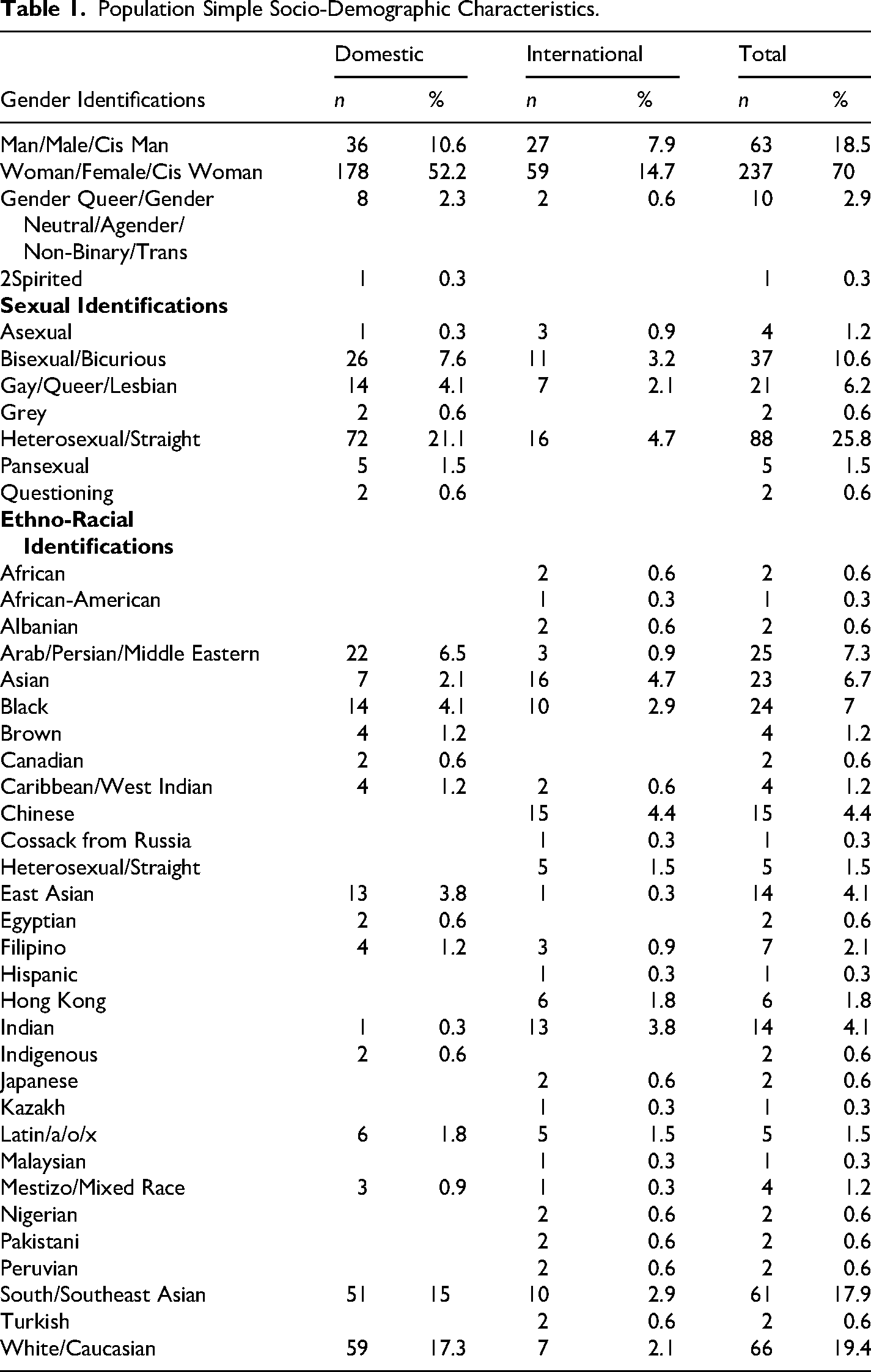
Participants were self-identifying female/woman/ciswoman (70%), male/man/cisman (18.5%), non-binary/agender/trans (2.9%), and 2Spirited (0.3%) students over the age of 18 who were enrolled in full-time or part-time degree programs in an accredited higher education institution. Participants further identified as heterosexual (25.8%), bisexual (10.6%), gay/queer/lesbian (6.2%), pansexual (1.5%), asexual (1.2%), greysexual (0.6%), and questioning (0.6%). Survey participants represented over 30 different ethno-racial self-identifications across both domestic and international student statuses (see Table 1).
Population Simple Socio-Demographic Characteristics.
Recruitment
Initially, participants were recruited by e-mail requesting survey dissemination through international student offices. Although the Research Ethics Board of the host institution had approved the study, staff members in two international student offices would not forward the survey link to their student listserv due to their inability to supervise the research. Upon further consideration, the researchers decided not to involve any of the international student offices on the campuses under study. Instead, trained student research assistants were especially effective in reaching out to faculty members (professors and lecturers) invested in SVP who would dedicate 15 minutes to the study in the in-person and online graduate and undergraduate courses they taught. Study participants were further recruited by contacting the student unions in the academic institutions under study and asking their leaders to disseminate the call for participants among their members. Survey participation was voluntary.
Limitations
Despite heterogeneity across self-identified ethno-racial categories, Table 1 shows the degree to which our survey findings capture SVP-related preferences of mostly heterosexual-identifying respondents. Importantly, however, only half of domestic respondents self-reported their sexuality, and even fewer international students volunteered such identifications (38%). It is, therefore, difficult to fully ascertain correlations across queer and non-queer respondents and prevention education needs and desires among both domestic and international students. Future studies are, therefore, warranted to explore the ways in which student sexuality might impact students’ SVP education-related preferences and to help shape prevention initiatives that speak across all student groups.
Our results also demonstrate a sampling bias in that 70% of respondents identify as female/woman/ciswoman. Research shows, however, that women are more likely to be engaged in topics of sexual and gender-based violence and its prevention, considering women are overwhelmingly impacted by such violence (Government of Canada, 2020). This bias did not hinder the study of the differences and similarities between international and domestic students, but it impacted our analysis of how differently gendered international and domestic students respond to the survey questions.
As this is an exploratory study, further and more extensive research involving larger population data sets is needed to support interpretations signifying generalizable international and domestic student preferences for SVP educational content.
Study Findings
In total, 401 respondents accessed the online survey. More specifically, 118 self-identifying international students accessed the survey and answered some of the socio-demographic questions. Of those, only 98 international learners completed the survey in its entirety. These 20 unfinished surveys, as well as only 38% of international students disclosing their sexuality (see Table 1), suggest that despite measures to detach the survey from institutional oversight, not all international students are comfortable to participate in research and conversations related to sex, sexuality, gender, and violence: a reality noted by other researchers in the field (Brunner, 2023; Ghani, 2024).
The data analysis is based on 341 completed surveys by 98 international and 243 domestic students. The survey findings derive from both descriptive trends and bivariate analyses based on “student status” (i.e., domestic or international) and desired components of an SVP educational model (content, facilitation, format, etc.) captured through survey responses. The responses denoted differences between international students, as well as differences and similarities between international and domestic students.
Question 1—If Your University/College Offers a Course on Positive Intimate Relations, Sexuality, Dating, Consent, Violence, and Other Related Topics, What Course Format Do You Prefer?
This survey question sought to understand the desired mode of SVP training delivery across domestic and international student groups. Responses included: (a) an academic course that will count toward my degree requirements and fulfillment; (b) participation in 3–6 mandatory 30–45-min sessions held throughout one semester; or (c) one longer session (1–2 h) during orientation week for incoming students. Results demonstrate that the highest number of international student respondents desired 3–6 session-long SVP trainings over a semester (37.76%) or delivered in a single longer session (35.71%) during student orientation week in the beginning of the fall term. Importantly, a lower number of international students (26.53%) desired SVP training in the form of an academic course that will be listed in their academic transcript and counted toward their degree.
Question 2—Should This Course/Training be Required for All Students to Take (Including International Students), or Should it be Offered as an Elective?
This survey question gauged the degree to which students interpreted the necessity and importance of campus-based violence prevention education. Responses ranged from: (a) yes, this course should be mandatory for all incoming students to take; (b) no, this course should be offered as an elective course so only interested students will enroll in it; or (c) the course should be strongly recommended for all students but not required. An overwhelming majority of international students felt such educational programming should be mandatory for all students (52.04%) or strongly recommended to all students (40.82%). Yet, a man-identifying survey respondent stipulated their support for such SVP training in the open comments section, suggesting that “… having such a course is really good but people won’t take it if they don’t learn anything new. The content should be chosen carefully and be political and gender identity free,” wrote the student.
Question 3—Do You Think the Course/Training Should be Attended by Students of All Genders or Should it Have Separate Sessions for Distinct Groups?
Considering the differential ways in which sexual violence impacts diverse gender identities (Harris & Linder, 2017), this question probes student perspectives on whether campus-based SVP education should hold separate sessions to cater to diverse gender identities or hold open sessions with all students across all genders. Results showed that international students desire SVP education open to all students regardless of gender or student status, i.e., international or domestic (58.16%). Despite a disproportionately higher number of woman-identifying survey respondents, the desire for open sessions inviting all students regardless of gender was supported across all gender identifications, except for two international student respondents who identified as a “trans man” and “agender.”
In the section for open comments, an international student respondent wrote that “separate sections for different genders/ethnicities feels discriminatory.” A woman international student clarified that her support for all-inclusive SVP training is with the condition that students be given a choice and that woman/female-identifying international students should be offered separate and safe spaces for SVP-related discussions. Another woman wrote that open SVP-related courses would provide an opportunity for men and women to learn from each other and that an open and inclusive course would provide “…. a chance to understand firsthand the struggle of another group.” Yet a man international student wrote: “Make [the training] safe and equal for everyone. DONT SAY ‘ALL MAN/WOMAN/MUSLIMS blah-blah-blah.’ This phrase is inherently offensive.”
Question 4—Would You Prefer if the Course/Training Were Delivered or Taught by: (a) A Peer/ Community Member, or (b) A Professor/Researcher Who is an Expert in the Area?
This survey statement probed the desired facilitation or from whom international students would most like to learn. The question revealed that international learners were almost evenly divided as slight majority (53.06%) preferred to learn about sexuality, intimacy, and sexual violence from professors or other professional experts, while the rest of the respondents (46.94%) preferred SVP education facilitated by peers or community members. This question of facilitation therefore deserves further inquiry and exploration.
Question 5—Please Rank Your Interest in Learning About the Topics Below Based on the Following Scale: (1) = Very Important (2) = Important (3) = Not Sure (4) = Less Important (5) = Not Important
Through this ranking question, the survey inquired into topics of greatest interest/relevance to domestic and international students. Topics to be ranked included: (a) dating, intimate, and marriage relationships in different cultures and countries; (b) practicing safe sex and maintaining good sexual health; (c) the role of local and global power inequalities and racial, economic, gender, and sexual hierarchies in how individuals encounter each other and form social and intimate relationships; (d) navigating resources and supports in and out of university/college campuses for mental, emotional, and sexual health; and (e) consent, healthy boundaries, and sexual/intimate encounters based on consensual agreements and non-violence.
The distribution of international student topical preferences for SVP education shows 28.75% of survey respondents want SVP training to focus on sexual consent and healthy boundaries. A similar number of international students (23.47%) want to learn about and discuss practicing safe sex and maintaining sexual health. Ranking third in terms of preference is the topic on global power inequalities and how these shape individual and intimate relations in societies the world over: 18.37% of international survey respondents seek SVP education that allows students to explore this topic. Slightly lower is international student preference for SVP training addressing dating, intimate and marriage relations (15.31%), and navigating resources on campus (14.29%).
Question 6—Do You Think the Course/Training Should Have Sections Dedicated to Distinct Cultural and Religious Groups in Canada?
This question sought to gauge whether students believed and desired that prevention initiatives should provide distinct sessions for distinct cultural and linguistic groups in Canada. Survey findings show that most international students (58.16%) believe that prevention education/sessions should respond to cultural and linguistic groups; yet 41.84% further think such culturally specific SVP courses or sessions should be open to all students regardless of sexual, gender, or international/domestic status identifications. A woman respondent commented that some students “may be afraid to voice out” their concerns or share ideas in large, all-inclusive SVP-related courses open to all students. “Respect others’ cultures and thoughts… having special sections for specific groups to make inner community education and communication is also necessary,” another woman international respondent wrote. Other respondents disagree: “Courses should be taught together to all racial groups,” a woman international student wrote, “because people in different groups can learn general knowledge about other groups.”
Relating International and Domestic Student Responses
Comparing international and domestic student responses to the survey questions yielded data that illustrates differences yet important overlaps. In terms of SVP education delivery format, the distribution of student preferences is strikingly similar between international and domestic students. Thus, majorities of both domestic (52.04%) and international (52.67%) learners think SVP education on campus should be offered as a required course that counts toward one's academic degree. Respectively, significantly lower numbers, 11.52% of international and 7.14% of domestic students, think such an SVP-focused course should be elective.
Regarding student topical preferences, international and domestic students in the study are aligned in that most international and domestic student respondents rank the topic concerned with sexual consent and healthy boundaries as their first interest. However, while 28.57% of international learners want SVP education focused on sexual consent, domestic students in the survey (39.51%) attach greater importance to this topic. Likewise, the percentage of international students (23.47%) who want to learn about safe sex and sexual health is significantly higher than the number of domestic students (13.99%) who are interested in this topic. Statistically significant differences also mark international and domestic preferences for the format of SVP education on campus: most domestic students in the survey (45.27%) prefer SVP training delivered in the form of an academic course; in contrast, the lowest number of international survey respondents would support the institutionalization of such a course (26.53%).
Most international (58.16%) and domestic students (64.61%) in the survey support open gender and culturally inclusive SVP education and training on campus; however, more international students (41.84%) favor SVP education on campus that is open and inclusive while offering space for culturally specific group discussions that support distinct ethnic and religious communities of students. A lower percentage of domestic students (35.39%) favor SVP education revolving around culture, religion, and other social differences. Yet, similar numbers of international (53.06%) and domestic students (50.21%) prefer that SVP education on their campus is delivered by experts, such as professors, lecturers, and researchers. Importantly, as many international (46.94%) and domestic (49.79%) students want to learn about sexual violence from peers and community members, such as other students, community elders, activists, and survivors of sexual violence.
Discussion
Choosing Sexual Violence Prevention Education Content, Format, Facilitators, and Timing
Our survey findings validate other studies that highlight the importance of involving students in designing new and evaluating existing SVP programs on campus (Bloom et al., 2022). Probing international student preferences for topics, timing, duration, and facilitation of SVP campus-based education highlights gaps in widely implemented initiatives yet also serves as a road sign to guide the design of effective SVP initiatives that reach out to and involve international learners in meaningful ways. For example, recent reviews of SVP approaches show that most interventions consist of short-in-duration, one-time activities related to sexual violence or sexual consent, delivered during campus orientation week, and targeting incoming students only (Addis & Snowdon, 2023). International students appreciate these activities and like their short duration; yet in our study, more international students disclose that they would prefer several related sessions over one semester to explore the issue in more depth. A comment left by one international student responding to the survey suggests that international learners associate the duration of teaching and learning activities with the importance of the subject being studied: “A 45 min consent workshop for incoming students is not serious…” the student wrote. Indeed, universities keep telling international (and domestic) students that sexual violence is a profoundly significant issue, but the short and sporadic educational interventions related to the issue do not bespeak either the significance and impact of sexual violence on individuals and societies, or the university's commitment to prevention.
Although packaging SVP education as a fully developed academic course would signal to students the importance of the issue, such a course may not attract those international students who, like the respondents in our survey, believe such a course should be elective (7.14%) or strongly recommended (40.82%), but not mandatory and thus imposed. The reason is that international learners pay higher tuition fees for each academic course they take and, therefore, prioritize academic courses that directly support their professional training (Fink, 2024). Paying tuition for an SVP-related course listed on their transcript would not add the same value as a course in accounting, engineering, business administration, or computer science that illustrates to potential employers their robust post-secondary training. An SVP course, therefore, could be mandatory for all students, but it should be tuition free to attract both international and domestic students, as well as delivered in multiple related sessions over the course of an academic term or year.
International students, especially self-identified women, transgender, and queer international learners in our survey seek meaningful, well-designed, and culturally relevant prevention education integrated into their academic programs. The need for such culturally relevant SVP initiatives has been highlighted by other researchers focused on international students (Ghani, 2024). Add-on short SVP initiatives discussing widely generalized topics such as “a community of consent” and “safe and inclusive spaces” (Queens University, 2022), or a 2.5-h long, one-shot “Bring in the Bystander” online workshop (University of Victoria, 2021) demand international student time, effort, and attention, and can also involve cultural taboos, emotional discomfort, and even danger for international students who are attending online, from home, but may be subjected to domestic and intimate partner violence (Chaliawala et al., 2025; Das Gupta & Sidhu, 2023). The rewards from such SVP training for international learners are rarely, if ever, specified in campus calls for student participants. Most international students return to their home countries after completing their academic programs (Government of Canada, 2024). It is unclear, however, how SVP training in Canada benefits their personal life or the wellbeing of their communities in India, Nigeria, China, Iran, or the Philippines where the largest numbers of international learners pursuing post-secondary degrees in Canada originate (Government of Canada, 2024).
University administrators and campus staff in Canadian higher education institutions further entrust SVP education to students who lack proper training and expertise in the field (McGill University, n.d.; McMaster University, n.d.; University of Guelph, n.d.). Indeed, peer-to-peer SVP education is impactful because it engages students as equals and in the contexts of youth cultures (Warthe et al., 2013). However, our study shows that a substantial number of international students (53.06%) prefer that SVP education is facilitated by faculty members, such as professors, researchers, and lecturers. One reason may be that international students tend to trust the expertise of their professors more than that of their peers. History books foreground higher education as a practice that rests upon the belief that those who deliver such education are professors (who are different from teachers) because they are professional researchers and highly trained educators tasked by academic institutions and societies with producing knowledge and imparting special skills to individuals pursuing academic and professional degrees (Neem, 2021). By extension, a substantial number of international students in our study (50.21%) also believe that, like the rest of their academic training, SVP on their campus should be entrusted to such experts.
Comparing International and Domestic Students: Notes on Definition
Comparing student populations is a potent way to force into light differences in the educational experiences between disadvantaged and privileged student groups, to enable delivery of finely tuned and culturally relevant curricula, and to provide important information to guide the design and implementation of institutional policies and academic programs in higher education (Grossmann et al., 2025; Summers et al., 2023). However, the significant overlap in our survey results between domestic and international students calls for attention to how these student populations are defined and identified in the context of immigrant societies, such as Canada. The literature on international students emphasizes their unique circumstances and specific needs but fails to address cultural, linguistic, religious, and other similarities between international learners (who hold temporary student permits), and immigrant, diasporic, and refugee populations in Canada who, due to their permanent residency or citizenship status in the country, are identified in the literature as domestic students (Wu et al., 2025). In fact, most newcomers and immigrants in Canada originate in China, India, Iran, Nigeria, and the Philippines, from where most international students attending Canadian universities also come (Statista, 2025; Statistics Canada, 2022, p. 13). Overlapping socio-demographic, ethno-racial, and linguistic characteristics between international students and immigrant populations in multicultural and highly diverse societies such as Canada could thus explain shared experiences and needs between these groups, despite their different legal or citizenship statuses in the country. Additionally, Canadian immigration policies are driven by economic needs (Thanthong-Knight, 2023); hence, international students are seen as talent, and a desired pool of potential immigrants trained in Canada (Government of Canada, 2021). As a result, an undergraduate student who held a student permit/visa status a few years ago considered “international,” may be counted as a “domestic” graduate student today because they now hold a Canadian permanent resident status.
Comparisons in the literature conclude that international students face “unique challenges” such as social and cultural isolation (Calder et al., 2016, p. 92; Ecochard & Fotheringham, 2017, p. 100), limited access to services (Lee & Guirguis, 2021; Perry et al., 2020), coping with cultural and language differences in the new country and university (Cho et al., 2021; La Montagne et al., 2023; Nikolaev et al., 2021), and lack of support systems available to most domestic learners, thereby increasing their vulnerability to sexual and other forms of violence (Arkoudis & Baik, 2014; Scholl et al., 2021). Due to such unique circumstances, international students are also presumed to need unique SVP interventions designed especially for this campus population (Fethi et al., 2023; Hutcheson & Parsons, 2022; Liu et al., 2021). For example, guiding tools provided to post-secondary administrators, and frontline workers on Canadian campuses is organized around “Frequently Asked Questions,” by international students such as “What is sexual violence?” “Where do I find services?” and “Will reporting sexual violence impact my visa status?” as well as advice for “targeted” prevention efforts and health and safety services that are important to international students (Fethi et al., 2023, p. 16; Hutcheson & Parsons, 2022; Liu et al., 2021). The researchers proposing these questions and services, however, do not specify how they identified and ranked international student needs. Moreover, similar questions about the availability of services and safety concerns are prominent among new immigrants arriving in Canada (Surrey Local Immigration Partnership, 2025).
Analyzing international student needs further, stakeholders suggest that “…when it comes to sexual education, international students have distinct needs that programs designed for their domestic peers don’t typically address (Reid & Dunlap, 2017, par. 3).” Our findings highlight specific international SVP education preferences and needs; yet our study foregrounds international and domestic students shared interest in SVP content formats, delivery, and facilitation. The information marks important student groups’ distinctions and shared aspects upon which effective and potent international student-centered prevention education could be conceived and delivered.
Toward International Student-Centered Sexual Violence Prevention: Recommendations for Practice
International students consider important and want to discuss SVP-related topics, such as consent and healthy boundaries, sexual health, the role of relations of power embedded in racial, colonial, political, and patriarchal formations that are root causes of sexual violence across societies and regions of the world, and dating and intimate relations across racial, cultural and other boundaries and communities. Importantly, domestic students are equally interested in these conversations; hence, international student-centered SVP education will benefit all students on campus. Another benefit of international student-centered SVP initiatives that simultaneously attracts domestic students is increased opportunities for creating spaces where international students socialize with domestic learners, feel seen, and participate in SVP programming where their experiences are valued and addressed in meaningful ways. Such prevention approaches would support the inclusion and embracing of international post-secondary students who struggle with acculturation and feel lonely, but who seek new friends and are very curious about their new social and cultural surroundings (Zheng et al., 2023). Bringing international and domestic students together in meaningful prevention education programs could further promote inter-cultural conversations about sexual violence and gender inequality. We have ample evidence that religion, patriarchy, colonialism, racism, economic and material factors, and policies and governing are structural causes for sexual violence across societies, countries, and regions of the world. These root causes thereby link student groups, as well as communities, despite our cultural, linguistic, and other differences.
Such a focus on global structural reasons for sexual violence would further support an internationalized SVP educational approach. That approach, however, should be supported by faith-based, cultural, and gender/sexuality-specific prevention activities that align with what international students in our survey also desire. Furthermore, such SVP initiatives ought to be entrusted to student interest groups that are often organized around ethnic, faith, and other identifications, such as the Indian, Filipino, Muslim, Queer South Asian, Chinese, Francophone African, African International, and other student support groups and associations led and run by students that already exist at the University of Toronto, Carleton University, University of Ottawa, University of British Colombia, and other Canadian institutions of higher education. These international student groups are funded by the post-secondary educational institutions hosting them; hence, funds should be provided by the college or university toward SVP education, defined and organized by the students in the group in consultation with their peers in the broader community rather than by university staff whose role should be limited to providing support and institutional resources.
To better engage international students, post-secondary institutions should consider inviting interested professors who specialize in areas related to sexual violence, power, gender, political economy, sociology, critical race theories, decolonization, and pedagogy and curriculum studies to participate in collaborations to design and deliver an accredited, interdisciplinary, elective or strongly recommended SVP course. Such a course could be attached to the international student office or the SVP centers mandated in all Canadian universities. Professors who wish to teach such a course could be specialists in a variety of disciplines; however, teaching such an SVP-related course targeting international students or the general student population should be properly acknowledged in their workload assignment letters and institutional files.
Conclusions
Mapping and understanding international student SVP-related educational preferences is paramount in designing prevention education that actively involves international learners and speaks to their needs and experiences. This exploratory study, therefore, contributes to the necessary and on-going work of designing effective SVP strategies on college and university campuses able to engage international students in meaningful ways. Student-centered SVP education requires deep knowledge of the learners targeted for such education; hence, further research in other social and institutional contexts is required to support a robust international student profiling upon which effective SVP designs depend. We also need to test, implement, and evaluate international student-centered SVP initiatives to build a repertoire of effective and proven practices. We believe this study is a step toward such practices. We believe in the tremendous capacity of such student-based prevention approaches to attract more international (and domestic) students as participants and leaders in SVP education on higher education campuses in Canada and beyond.
Footnotes

Funding
The authors disclosed receipt of the following financial support for the research, authorship, and/or publication of this article: This research is supported by a grant from the Social Sciences and Humanities Research Council of Canada.
Declaration of Conflicting Interests
The authors declared no potential conflicts of interest with respect to the research, authorship, and/or publication of this article.